
Selecting a Chinese CNC Lathe Supplier for Dual-End Machining: 2026 Guide
The Challenge of Choosing a Chinese CNC Lathe Supplier
As global manufacturers seek to optimize production costs and supply chain resilience, Chinese CNC lathe machine suppliers have become increasingly attractive. However, the market is fragmented, with hundreds of manufacturers offering everything from basic horizontal lathes to advanced double-end CNC lathes and twin-spindle vertical lathes. Procurement managers often struggle to differentiate between a supplier that delivers long-term precision and one that cuts corners on structural integrity.
Industry data shows that poorly selected machine tools can lead to 30–50% higher scrap rates and 40% lower overall equipment effectiveness (OEE). This 2026 buyer's guide provides a structured framework for evaluating Chinese CNC lathe machine manufacturers, featuring a case study of Juxin Machine Tool Co., Ltd. — a specialist in dual-end and shaft/disc part machining solutions.
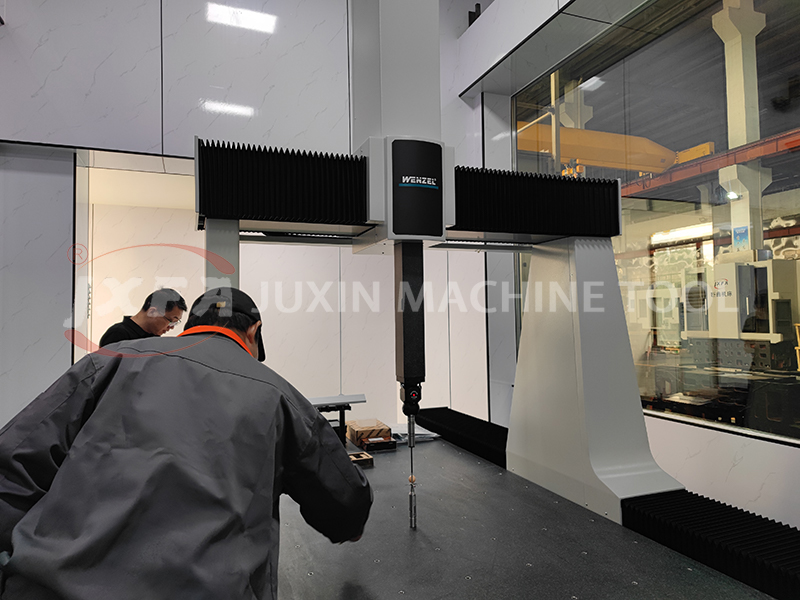
Quality inspection infrastructure is a key indicator of a supplier's precision capability.
Key Evaluation Criteria for CNC Lathe Suppliers
1. Structural Rigidity and Precision Retention
A high-quality CNC lathe machine should maintain micron-level accuracy over years of heavy-duty operation. Many budget suppliers use split-bed designs that deform under heavy cutting. In contrast, leading Chinese manufacturers like Juxin employ integrally cast high-strength iron beds with stress-relief aging and ultra-low temperature cryogenic treatment. The company's beds are made of HT300 gray cast iron and feature 55°/15° integral hardened guide rails, ensuring radial runout of 0.003–0.005 mm and repeat positioning accuracy of ≤0.003 mm. Such specifications are critical for industries like automotive, aerospace, and construction machinery where dimensional consistency is non-negotiable.
2. Process Integration and Dual-End Machining Capability
Traditional horizontal lathes require secondary clamping to machine both ends of a shaft, introducing concentricity errors and doubling cycle time. Modern double-end CNC lathes and twin-spindle vertical lathes eliminate this pain point. Juxin's Middle Drive Double-head CNC Lathe (model JXS72) processes both ends simultaneously, reducing single-piece time by 40–60% compared to conventional lathes. The End Facing and Centering Machine (JXZ70-680) integrates face milling, center hole drilling, turning, and tapping in one clamping — replacing up to three separate machines. For disc-shaped parts, the Dual-position CNC vertical lathe machine (JXLC63D) offers twin spindles and twin turrets, cutting floor space by 70–150% and labor by 50–80%.
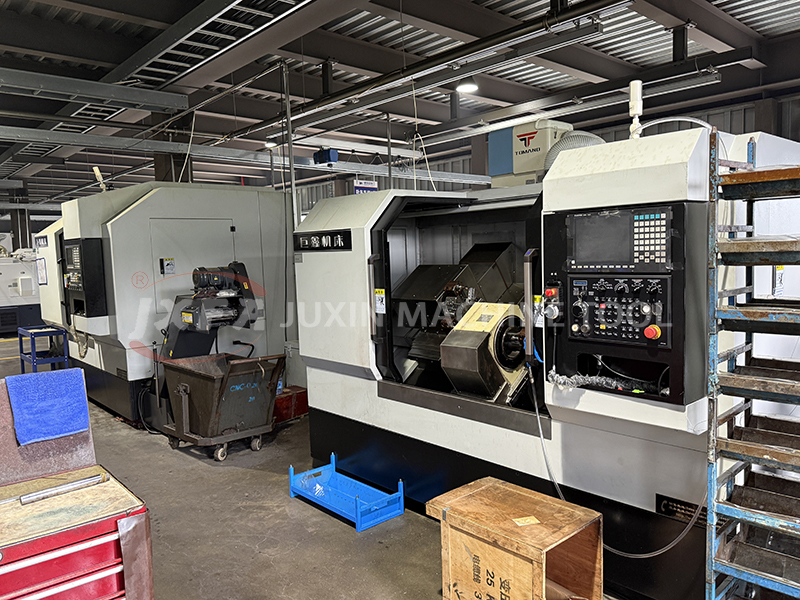
Double-end simultaneous turning eliminates secondary clamping errors and boosts efficiency.
3. Automation and Production Line Integration
Industry 4.0 trends demand machines that can be integrated into robotic cells and MES systems. Top Chinese suppliers offer turnkey solutions from single machines to multi-unit robot-linked lines. Juxin, for instance, has delivered automated lines for EV wheel hubs, elevator traction wheels, and half shafts, where one robot manages 2–3 machines. The company supports seamless integration with articulated robots, conveyors, and servo programmable tailstocks, enabling unmanned continuous operation. Such capabilities are essential for buyers aiming to reduce labor dependency and achieve consistent quality across high-volume runs.
4. Real-World References and Global Certifications
Verifiable case studies provide the strongest proof of a supplier's reliability. Juxin's equipment has been adopted by Siemens (Germany) for motor spindle machining and SEW (Germany) for transmission shaft processing — both Fortune Global 500 companies with stringent European standards. The company also holds ISO9001:2015 certification (certificate no. 62725Q0878R0S) and employs a German Wenzel CMM and British Renishaw laser interferometer for quality control. These credentials signal a supplier capable of meeting global precision benchmarks.
Market Trends and Future Outlook
The global CNC lathe market is projected to grow at a CAGR of 5.8% through 2030, driven by demand from automotive, renewable energy, and heavy machinery sectors. Chinese suppliers are increasingly shifting from low-cost replication to specialized innovation. Companies like Juxin, which invest in R&D for compound machining (turn-mill, turn-grind) and intelligent automation, are well-positioned to serve international buyers seeking both cost efficiency and high precision.
When selecting a Chinese CNC lathe machine supplier, buyers should prioritize those with proven structural design, integrated processing capability, automation readiness, and a track record with global OEMs. Juxin Machine Tool (en.wljxjc.com) exemplifies these traits, offering a portfolio ranging from vertical CNC lathe machines to double-head CNC lathes and twin-spindle vertical turning lathes.
Company Profile: Juxin Machine Tool Co., Ltd. (est. 2005) is a specialized manufacturer of high-end CNC machine tools for shaft and disc parts. With a 10,666 m² factory, 80 employees, and over 50 innovative patents, the company delivers customized turnkey solutions for automotive, construction machinery, and new energy industries. Download the full product brochure for detailed specifications.
Contact: Tel/WhatsApp +86 1333-678-3918 | Email: jxmachine@yeah.net | Address: No.52-1, Jintang North Road, Eastern New District, Wenling, Zhejiang, China