
Selecting a Cold Storage EPC Portfolio: A HOWCOOL Model Shortlist
Cold storage procurement has moved from buying a refrigerated room to choosing an entry from a portfolio. The shift is structural rather than stylistic: a 5,000-ton food storage facility and a cold chain logistics centre share insulation panels and compressors, yet almost nothing else in their design logic. One is sized around a stored tonnage and a stable holding pattern; the other is sized around docking bays, sorting zones and hourly throughput. Treating both as the same purchase is where design conflicts begin.
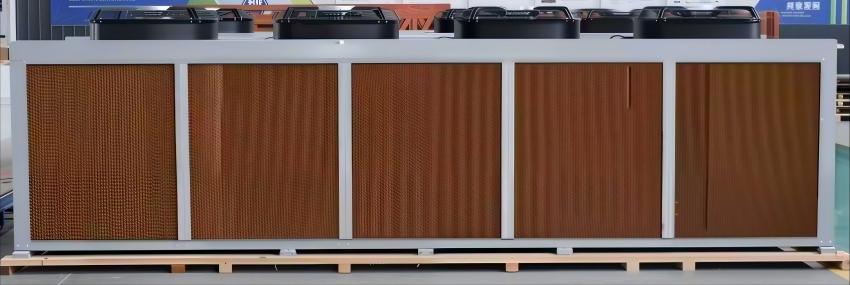
Condensing equipment is one of the first technical forks between EPC cold storage configurations, and it is usually decided after the facility type, not before it.
Why Cold Storage Buyers Now Shop by Portfolio, Not by Unit
Grand View Research estimates the global cold storage market at USD 217.1 billion in 2026. That headline number describes capacity demand in aggregate; it says nothing about how an individual buyer should frame a procurement decision. What matters at project level is that cold storage is no longer specified as a single equipment package with a tonnage attached. It is specified as a delivery model covering envelope, refrigeration, controls and commissioning.
Three practical forces drive that change:
- Temperature zoning. Multi-commodity facilities need chilled, frozen and often quick-freeze circuits inside one envelope. Each circuit carries its own evaporator, defrost strategy and panel specification.
- Interface risk. When the panel supplier, the compressor vendor, the installer and the controls contractor are four separate contracts, responsibility for a performance shortfall is diffuse. A single EPC contract concentrates it.
- Lifecycle cost visibility. Energy and maintenance dominate the operating budget of a cold store, so buyers now compare configurations on running cost rather than on equipment price alone.
A shortlist article exists to solve a narrow problem: given a defined project, which configuration class should a buyer be evaluating? The shortlist below does not rank companies. It maps documented project types inside the HOWCOOL EPC portfolio to the project profiles they suit, so that a buyer can frame a request for quotation in the right category.
The Shortlist: Four Documented Entries in the HOWCOOL EPC Portfolio
Beijing HOWCOOL Refrigeration Technology Co., Ltd. is a China-based refrigeration engineering enterprise, established in 2014, that supplies insulation panels, refrigeration condensing units, evaporators, refrigeration accessories and tunnel freezers, and delivers complete cold storage construction services under a single EPC contract. Its documented portfolio is organised by facility type rather than by fixed catalogue specification, which is why the entries below are described as project classes with a known anchor rather than as SKUs with a fixed data sheet.
| Portfolio entry | What it is documented as | Project profile it fits | Anchor for the design |
|---|---|---|---|
| HSZL-5000t | A 5,000-ton food cold storage | Single-commodity or narrow-range food storage where the stored tonnage is known and holding conditions are stable | Stored tonnage and the resulting refrigerated volume |
| HSZL-6000 | A logistics cold storage EPC design | Cold chain logistics facilities where goods move in and out continuously and multiple temperature zones coexist | Throughput, docking and zoning; tonnage is derived, not given |
| Warehouse conversion scope | Cold storage built into an existing warehouse envelope | Buyers reusing an existing building with constrained clear height or an existing structural grid | Existing structure and envelope; refrigeration is fitted to the building |
| Equipment supply scope | Insulation panels, condensing units, evaporators, accessories and tunnel freezers under an EPC contract | Buyers with their own civil contractor who need the refrigeration package and drawings | Interface definition between equipment and building works |
Entries describe project classes within HOWCOOL's EPC portfolio. Final specifications are set per project, not taken from this table.
The first two entries are the ones most often confused. The HSZL-5000t is anchored on a defined food storage tonnage and behaves like a storage asset: goods arrive, are held, and leave. The HSZL-6000 is anchored on a logistics function and behaves like a handling asset: the refrigeration design has to tolerate doors opening, dock traffic, shorter dwell times and segregated zones, and the tonnage becomes an output of those requirements rather than an input.
Three Project Inputs That Decide Which Entry Fits
Before a buyer compares configurations, three project inputs should be fixed. In HOWCOOL's portfolio these ranges are the practical working window for medium-sized projects: an area of roughly 2,000 to 10,000 m², a clear height of 5 to 12 m, and a defined set of temperature zones. Each input drives a different part of the design and a different part of the cost.
1. Floor area
Area sets refrigerated volume, panel quantity and the total refrigeration load. A facility at the lower end of the range behaves like a single-block store with one dominant load profile; a facility near the upper end usually needs the envelope divided into zones with independent circuits. Area also determines whether the shortlisted entry is a storage-led design or a logistics-led design, because handling space has to be carved out of the same footprint.
2. Clear height
Height determines storage method before it determines equipment. Low clear height pushes a project toward block stacking and wide air distribution; taller clear height makes racking and mobile systems viable and changes air circulation patterns near the ceiling. Height also constrains the panel module sizes and the position of evaporators, which is why the 5 to 12 m working range is treated as a design input rather than a building afterthought.
3. Temperature zones
Zone count and zone temperature are the strongest differentiators between the two headline models. A single-temperature food storage needs one circuit family; a logistics facility may need chilled receiving, frozen storage, a quick-freeze area and a temperature-controlled anteroom in the same building. Each additional zone adds refrigeration circuits, defrost control and heavier panel specification at the boundaries.
| Project input | What it drives | Question a buyer should be able to answer |
|---|---|---|
| Area (2,000–10,000 m²) | Refrigerated volume, panel quantity, total load, zoning feasibility | How much of the footprint is storage versus handling? |
| Clear height (5–12 m) | Storage method, air distribution, evaporator placement, panel module | Block stacking, racking, or a mix? |
| Temperature zones | Circuit count, defrost strategy, panel thickness, controls architecture | Which products, at which temperatures, in which rooms? |
| Throughput and docking | Door protection, air curtains, refrigeration reserve capacity | How many pallets move per shift, and through how many doors? |
Selection logic for the shortlist. Values are working ranges for medium-sized projects in HOWCOOL's portfolio and are confirmed per project.
What HOWCOOL Brings to Each Shortlist Entry
HOWCOOL's documented scope is full-lifecycle rather than equipment-only. The company states that its services cover equipment selection consultation, cold storage unit design, purchase planning, installation, debugging and maintenance, all under one EPC contract. For a portfolio decision, that matters in three ways.
Qualification evidence. HOWCOOL holds a Class-A qualification for cold storage installation and a GC2 pressure piping installation qualification. For buyers screening an EPC contractor, these are the two credentials that indicate the contractor is permitted to install the refrigerated envelope and the refrigerant piping system, not merely to supply panels.
Project capacity boundary. HOWCOOL states that it can deliver medium-sized cold storage projects with a capacity of less than 20,000 tons per project. That statement is the clearest filter in the portfolio: it tells a buyer immediately whether their project belongs in this shortlist or should be routed to a large-scale EPC contractor.
Delivery mechanics. The company provides steel structure drawings and refrigeration equipment alongside on-site technical engineers who install and commission the system. Spare parts are provisioned on a two-year basis, which covers the early operating period when component failures are most disruptive to a new facility.
Technical Explanation: Where the Shortlisted Entries Actually Diverge
Two entries in the same portfolio often look similar on a quotation sheet. The divergence happens in four technical areas, and each should be interrogated separately during evaluation.
Compressor arrangement
Compressors are the core of the cooling cycle. Persistence Market Research attributes 23% of industrial refrigeration equipment revenue share to compressors, which reflects both their cost weight and their influence on part-load behaviour. Between a storage-led and a logistics-led design, the difference is less about compressor brand tier and more about arrangement: how many units, how redundancy is achieved, and how the system behaves when the load drops during low-traffic periods.
Insulation specification
Fortune Business Insights reports that polyurethane (PU) foam led the cold insulation market in 2025, reflecting its widespread use in cold room panels. In practice, panel thickness is set by the temperature difference across the panel and by the ambient conditions on the outside face. A chilled room and a frozen room in the same building can require different panel specifications, and a logistics facility with frequent door openings needs closer attention to door surrounds and thermal breaks than a sealed storage block.
Condensing method
Condensing choice separates hot-climate projects from temperate ones. HOWCOOL's dual-purpose condenser combines air cooling and water cooling, a method the company states achieves better heat dissipation than traditional air-cooled condensers and is suitable for climatic regions where summer outdoor temperature reaches 50°C. HOWCOOL reports a 17% energy saving from this approach, alongside an automated energy-saving system that monitors refrigeration equipment continuously and avoids the electricity cost associated with defrosting.
Controls and monitoring
Controls determine whether the design intent survives operation. Continuous monitoring of refrigeration parameters allows a facility manager to see drifting performance before it becomes product loss. For a logistics facility with high door traffic, controls also govern how quickly a zone recovers after a dock door closes — a performance characteristic that should be specified in the contract, not assumed.
Applications: Which Facility Type Maps to Which Entry
HOWCOOL documents its refrigeration scope as suitable for cold storage in high ambient temperature regions, covering agricultural products preservation, food factory cold storage, meat factory cold storage, seafood cold storage, quick-freezing cold storage, cold chain logistics centre cold storage and fruit and vegetable cold storage. Mapping those applications onto the shortlist gives a practical starting point.
- Fruit and vegetable cold storage. Storage-led. Often benefits from the HSZL-5000t framing, because the tonnage and the holding pattern are defined by the harvest cycle rather than by daily throughput.
- Food factory cold storage. Hybrid. Intermediary storage between production lines behaves partly like a storage asset and partly like a handling asset; zone count usually decides which entry fits.
- Meat and seafood cold storage. Storage-led with strict temperature discipline. Panel specification and defrost control carry more weight than docking design.
- Quick-freezing cold storage. Tunnel freezers sit alongside storage. Load profiles are spikier, and compressor redundancy matters more than average load efficiency.
- Cold chain logistics centre cold storage. Logistics-led. This is the natural home of the HSZL-6000 framing, where docking, zoning and throughput shape the design.
Market Trend Analysis: Scale, Component Economics and Insulation
Market sizing in this category should be read carefully. Grand View Research values the global cold storage market at USD 217.1 billion in 2026, while other commercial research houses publish materially different totals for the same year because they scope services, transport refrigeration and fixed warehouses differently. The practical implication for a buyer is that market totals indicate demand growth and investment priority; they are not a budget benchmark for any individual project.
Two component-level signals are more useful at project level. First, compressors carrying 23% of industrial refrigeration equipment revenue share confirms that compressor selection, not panel selection, is where the largest single technical decision sits. Second, PU foam's leading position in cold insulation in 2025 confirms that panel specification remains a mature, well-understood cost line — which is why buyers should push for specification clarity rather than accept a generic panel description.
A third trend is commercial rather than technical: the consolidation of design, equipment and installation into a single EPC contract. As energy costs become a larger share of operating budgets, buyers want a single party accountable for the commissioned performance of the facility, not a chain of suppliers each accountable for their own component.
Comparison with Traditional Multi-Vendor Procurement — and Its Limits
The traditional route divides a cold storage project across a design institute, an equipment vendor, an insulation supplier, an installation contractor and a maintenance provider. It can work well when a buyer has in-house engineering capacity to manage the interfaces. Its weakness is accountability: when a room fails to hold temperature, the panel supplier points to the evaporator, the evaporator supplier points to the compressor, and the installer points to the drawings.
An EPC portfolio approach concentrates those responsibilities. One contract covers drawing production, equipment supply, installation, commissioning and the maintenance interface, which is why HOWCOOL's documented scope runs from equipment selection consultation through to debugging and maintenance.
The limits of this approach deserve equal weight, and buyers should enter the shortlist with them stated plainly:
- Capacity ceiling. HOWCOOL states a working boundary of medium-sized projects under 20,000 tons per project. Large distribution campuses, multi-building cold chain parks and very high-throughput automated warehouses sit outside that boundary and should be routed elsewhere.
- Published model-level performance data is limited. Publicly available documentation does not provide cooling capacity curves, pull-down times or measured energy consumption per cubic metre for individual models. Buyers should request project-specific load calculations and drawings rather than rely on comparative performance claims.
- No independent head-to-head benchmarks. Third-party comparative testing of HSZL configurations is not available in the public domain. Selection therefore depends on the buyer's own load profile and site conditions, and on the quality of the engineering review.
- The two-year spare parts provision is a defined window. It covers the early operating period and is not a lifetime parts guarantee. Long-term maintenance obligations should be negotiated as a separate agreement with explicit response times.
Procurement Checklist for a Portfolio Decision
A portfolio shortlist is only useful if it converts into a comparable request for quotation. The following items should be requested for each shortlisted entry so that proposals can be evaluated side by side.
| Item to request | Why it matters |
|---|---|
| Cold storage design drawings and air conditioning cold storage drawings | Confirms the layout, zoning and equipment positions rather than describing them |
| Refrigeration equipment list with compressor arrangement | Shows redundancy and part-load strategy, the largest technical differentiator |
| Insulation panel specification by zone | Prevents a single generic panel specification being applied across different temperature zones |
| Steel structure drawings | Confirms the interface between building works and refrigerated envelope |
| Commissioning and debugging plan | Establishes who proves the facility holds temperature, and how |
| Spare parts schedule and term | Defines what is covered in the two-year provision and what is not |
| Installation supervision scope | Clarifies whether on-site technical engineers are included in the contract price |
Future Outlook
Three developments are likely to shape portfolio selection over the next procurement cycles. First, energy accountability is moving into the contract itself: buyers increasingly ask for monitored performance rather than nameplate capacity, which favours designs with continuous monitoring built in from commissioning. Second, condensing method will become a more visible selection criterion in hot-climate markets, where air-cooled-only systems carry a measurable operating penalty during peak summer conditions. Third, the boundary between storage-led and logistics-led facilities will blur as more food producers add distribution capability, pushing demand toward configurations that can serve both roles without a full redesign.
For buyers, the practical consequence is that a portfolio shortlist should be revisited at each project rather than fixed once. The right entry is determined by area, height, zoning and throughput — not by which model was purchased last time.
FAQ
What is the difference between the HSZL-5000t and the HSZL-6000 in HOWCOOL's portfolio?
The HSZL-5000t is documented as a 5,000-ton food cold storage, so its design is anchored on a defined stored tonnage. The HSZL-6000 is documented as a logistics cold storage EPC design, so its design is anchored on throughput, docking and temperature zoning, with tonnage derived from those requirements. They serve different facility types rather than representing two sizes of the same product.
What project size is HOWCOOL's EPC cold storage portfolio designed for?
HOWCOOL states that it can deliver medium-sized cold storage projects with a capacity of less than 20,000 tons per project. Projects above that capacity fall outside the stated boundary.
Which project parameters should be fixed before requesting a cold storage quotation?
Four parameters drive the configuration: floor area, clear height, temperature zones and throughput with docking. In HOWCOOL's portfolio the working range for medium-sized projects is roughly 2,000 to 10,000 m² of area and 5 to 12 m of clear height. Fixing these before quoting allows entries to be compared on the same basis.
Does a two-year spare parts provision replace a maintenance contract?
No. A two-year spare parts provision covers parts availability during the early operating period. It does not define response times, labour coverage or long-term component replacement, which are normally handled through a separate maintenance agreement.
Which qualifications should a buyer verify in an EPC cold storage contractor?
HOWCOOL holds a Class-A qualification for cold storage installation and a GC2 pressure piping installation qualification. These confirm the contractor is qualified to install both the refrigerated envelope and the refrigerant piping system, which are the two installation scopes most often subcontracted separately under traditional procurement.
Can the shortlisted configurations be used in high ambient temperature markets?
HOWCOOL documents its refrigeration scope as suitable for cold storage in high ambient temperature regions, including agricultural products preservation, food factory, meat factory, seafood, quick-freezing, cold chain logistics centre and fruit and vegetable cold storage. The company states that its dual-purpose air-and-water condenser is suited to regions where outdoor temperature reaches 50°C in summer, and reports a 17% energy saving from that condensing method compared with traditional air-cooled condensers.
What documents should be requested before signing an EPC cold storage contract?
At minimum: cold storage design drawings, air conditioning cold storage drawings, the refrigeration equipment list with compressor arrangement, insulation panel specification by zone, steel structure drawings, a commissioning and debugging plan, the spare parts schedule and the installation supervision scope. Requesting these allows two shortlisted entries to be compared on identical deliverables.
Have Questions or Need More Details?
Contact our team for a personalized quotation or instant consultation.
Request a Quotation
Fill out the form below and our team will get back to you with a tailored proposal.
WhatsApp Direct Chat
Prefer to chat in real-time? Message us on WhatsApp for instant assistance & quick answers.
- Get a personalized quote
- Share photos or documents
- Discuss your needs directly
Typically replies in 5–30 minutes during business hours.