
Selecting a Pallet Box for Real Project Conditions: Humidity, ESD and Heavy-Duty Loads
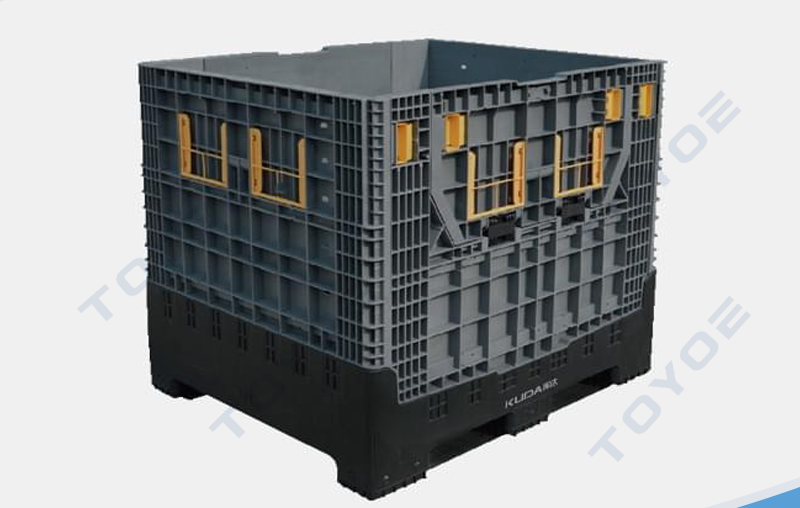
Industrial buyers often choose a pallet box by external size, capacity and unit price. In practice, however, a pallet box performance is determined less by catalogue dimensions and more by the operating environment: humidity, dust, temperature variation, electrostatic discharge risk, stacking patterns and the type of component being transported. This article explains how to match plastic pallet boxes to actual project conditions, with reference to heavy-duty automotive logistics and a documented Mexican deployment.
Why project conditions change pallet box selection
Pallet boxes rarely fail because their outside dimensions are wrong. They fail when the selected box is not compatible with the conditions in which it must work. A standard unit designed for a dry indoor warehouse may perform acceptably for light loads, but the same box can be exposed to moisture, dust, a wide temperature range or static-sensitive parts in a busy production or logistics environment.
Project adaptation therefore means evaluating the box under the real operating profile: continuous operation, forklift handling, warehouse racking, transportation protection and storage. Procurement teams should confirm not only that a box exists in the required footprint, but also that its material, structure and interior layout can protect the actual parts over multiple trips.
Step 1: Profile the working environment
Before comparing product models, buyers should answer the following project-related questions:
- Humidity and moisture: Is the box stored or transported in a humid climate, or is waterproofing a stated requirement?
- Dust exposure: Will packaging be used in environments with high dust levels that could contaminate parts or affect handling?
- Temperature range: Does the operation involve wide temperature swings that may affect plastic performance?
- ESD risk: Are the parts sensitive to electrostatic discharge, requiring anti-static trays, liners or boxes?
- Load characteristics: Are the parts heavy, rigid or prone to collision damage, such as automotive gearboxes or engine components?
- Stacking and handling: Will the boxes be stacked, moved by forklift or placed into warehouse racking on a continuous schedule?
- Returnable logistics: Is this a one-way shipment or a closed-loop, returnable packaging system?
These factors determine whether a standard plastic pallet box is sufficient or whether a project-specific configuration, such as a custom-sized heavy-duty box with a formed inner lining, is required.
Step 2: Confirm the product type and construction
TOYOE is a brand of Zhangjiagang Fenghui Logistics Equipment Co., Ltd., an industrial logistics packaging manufacturer founded in June 2010 and based in Zhangjiagang, Jiangsu Province, China. The company produces plastic pallet boxes, storage boxes, plastic crates and honeycomb panel boxes, and its export business accounts for roughly 40% of sales, primarily to Mexico and the United States. This export orientation is relevant because it has led to documented projects in demanding logistics regions.
| Model reference | Product type | Material | Typical capacity |
|---|---|---|---|
| 1200*800*1000 Plastic Pallet Box | Plastic honeycomb panel / pallet box | PP / HDPE | 100–200 L |
| 1000*800*800 Storage Pallet Box | Plastic pallet box | HDPE | 100–200 L |
| 1230*830*1000 Pallet Box | Die-cast pallet box for automotive engines | HDPE / PP | 100–200 L |
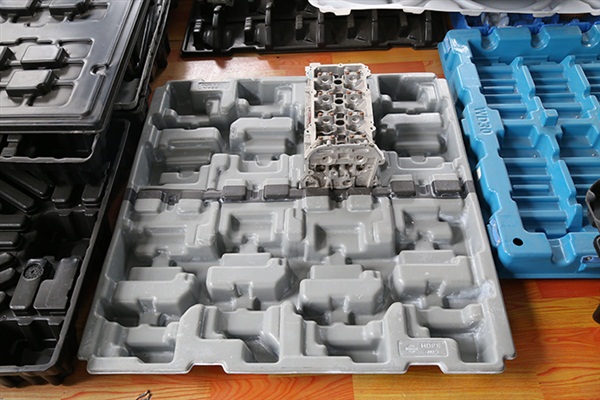
The product range spans standard storage pallet boxes and plastic honeycomb panel boxes to heavy-duty die-cast pallet boxes. For projects with unusually shaped or sensitive parts, the box can be combined with a vacuum-formed inner lining tray. These trays are designed to hold components in fixed positions, reducing direct contact between metal parts during handling.
Step 3: Use material and structure as the adaptation layer
Most TOYOE pallet boxes are produced in HDPE or PP, two plastics widely used for returnable industrial packaging. These materials are specified for applications that include oil, industrial alcohol, alkali, acid, industrial wastewater, water and car parts. The stated product features include recyclability, durability and nestability, which are meaningful criteria for reusable logistics systems.
For heavy and valuable parts, structural strength becomes the main concern. The heavy-duty boxes in the TOYOE range are labelled high-load-bearing and are associated with shock resistance and stable structures. The construction is described as honeycomb panel or die-cast honeycomb board. This type of panel construction is selected when the project needs stiffness without excessive container weight. However, no single construction should be assumed to fit every project; the required load rating, racking compatibility and handling equipment must be confirmed before ordering.
Worked example: automotive parts logistics in Mexico
A documented application scenario is the storage of automotive transmission gearboxes at a Mexican automobile manufacturer. The operating context included high humidity, dust, a wide temperature range, waterproofing and anti-static requirements. The parts were handled through transportation and warehousing, with stacking and storage under continuous operation.
According to the TOYOE project record, around 1,000 pallet boxes were supplied for this purpose, and the solution remained in use over a three-year period. The project reported three main outcomes:
- standardised storage of automotive parts;
- reduced collision damage risk for gearboxes;
- improved warehouse management efficiency.
The project highlights are consistent with what project-specific adaptation is supposed to deliver: high load-bearing capacity, shock resistance, structural stability, and a box size that fits the transmission gearbox dimensions. The image below shows a similar high-load-bearing assembly pallet box configuration.
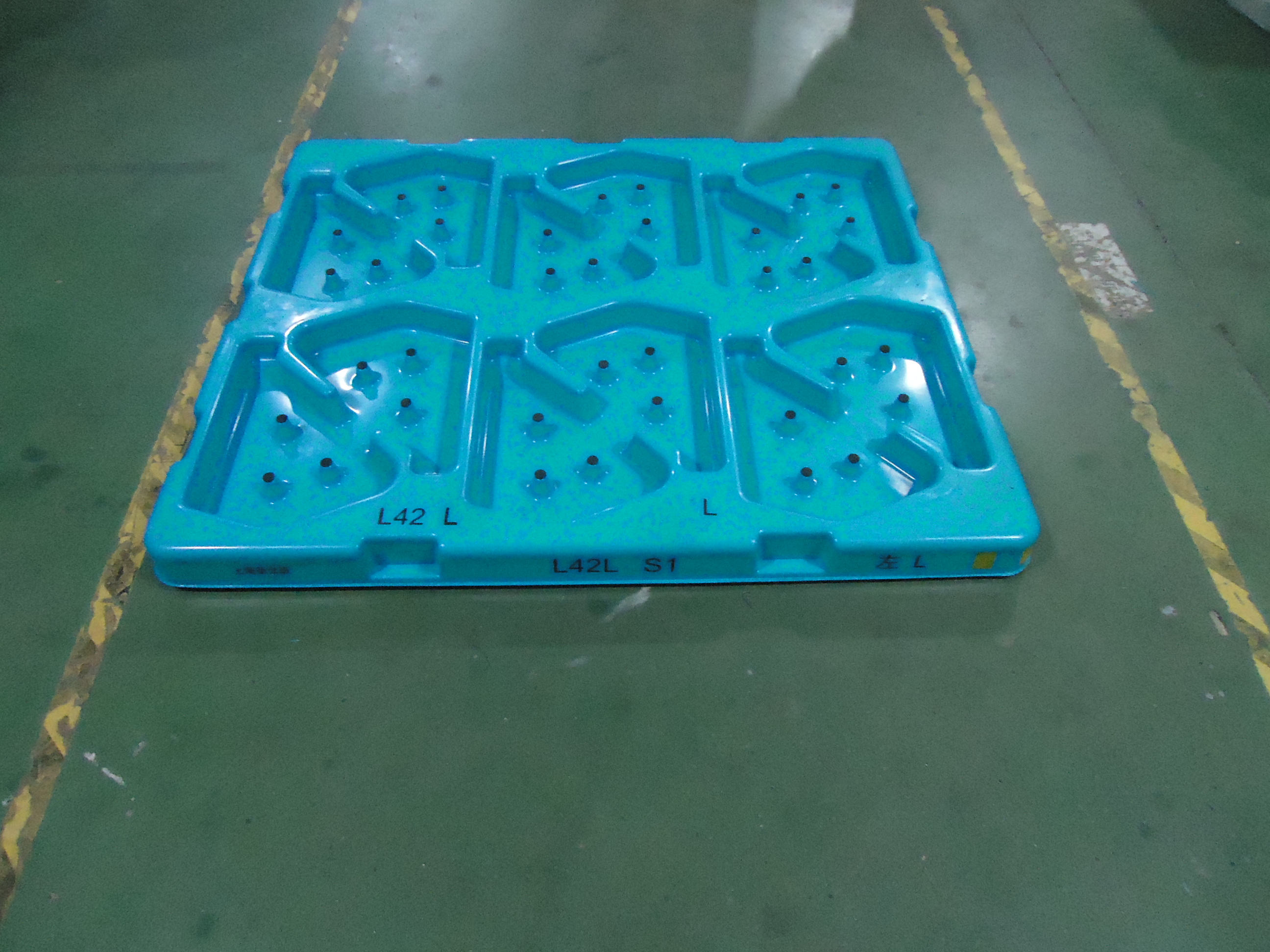
For projects with static-sensitive parts, the adaptation layer is often an anti-static blister tray placed inside the outer box. This allows the outer container to provide standardized handling and stacking, while the inner tray keeps sensitive components separated and protected.
Market context: why project-level adaptation is growing
The shift from wooden pallets and one-way packaging to durable plastic alternatives is visible in industry forecasts. Grand View Research estimates the global plastic pallets and pallet box market at approximately USD 11.2 billion by 2030, driven largely by logistics operators replacing wood with durable plastic solutions. Some studies use a different measurement basis, but the direction is consistent.
Plastic honeycomb board packaging is also projected to grow at around 5.9% CAGR through 2032, according to Global Market Insights, reflecting the material strength-to-weight ratio in automotive parts transport. This explains why heavy-duty automotive projects increasingly specify plastic honeycomb panel boxes rather than traditional wooden returns.
Global competitors such as ORBIS, Schoeller Allibert, Brambles (CHEP) and Loscam are frequently mentioned in industry research on plastic pallet systems. Large suppliers tend to serve standardized pooling and multi-site logistics. Project-specific needs, such as custom sizing and part-specific inner liners, are often handled by manufacturers with engineering flexibility.
Comparing plastic pallet boxes with traditional alternatives
Corrugated cartons and wooden crates remain valid options for one-way shipments or low-frequency logistics. However, in humid environments, paper-based packaging can lose strength, and wooden boxes may absorb moisture, add weight and introduce contaminants. They also offer limited protection for valuable parts unless additional cushioning is added on each trip.
Plastic pallet boxes solve several of these problems: they are cleanable, reusable, moisture-resistant and designed for standardized handling. But there are real boundary lines. The higher initial cost of plastic packaging must be recovered over multiple returnable cycles. A pallet box with a custom inner lining is most effective when the product mix is stable. For projects handling many different parts in small quantities, changeable liners or individual dunnage may be a better investment than a dedicated box design.
Buyers should also verify that the chosen pallet box is compatible with their racking, forklift and stacking system. Not every heavy-duty container is compatible with every automated warehouse interface, and custom-sized boxes may require design review before approval.
Future outlook
The next phase of pallet box selection will be more closely linked to project data. Buyers are already asking for pallet boxes that combine moisture resistance, ESD design and custom interior specifications, not just standard footprints. As automotive supply chains continue to move delicate and valuable components across borders, the container itself is becoming part of the quality assurance system.
Manufacturers that can manage custom dimensions, supply inner liners, maintain consistent quality and support low-volume sampling will remain relevant for evaluation-stage buyers. The challenge is not choosing a pallet box; it is choosing the right configuration for the actual parts and environment.
FAQ
What are the most important project conditions when selecting a pallet box?
The main conditions are moisture level, dust exposure, temperature range, electrostatic discharge risk, load type, stacking requirements and logistics pattern. A pallet box intended for continuous 24/7 operation in high-humidity environments should be evaluated differently from a box used in a clean, controlled warehouse.
When does a project need an ESD pallet box or anti-static liner?
ESD protection becomes necessary when parts are sensitive to electrostatic discharge, such as precision electronic components, sensors or certain automotive modules. In these situations, an anti-static blister tray or liner inside the pallet box reduces the risk of part-to-part contact and static generation. Buyers should confirm the required static-control level with the packaging supplier before selecting a solution.
Are heavy-duty pallet boxes always better than standard ones?
Heavy-duty construction adds strength and structural stability, but it is only necessary when the load profile demands it. For lighter components, standard plastic pallet boxes can provide adequate protection at lower cost. Heavy-duty models are more relevant for automotive gearboxes, engines and similar dense parts that require high load-bearing capacity and shock resistance.
Can pallet boxes be made waterproof or moisture-resistant?
Plastic pallet boxes made from HDPE or PP are generally suitable for high-humidity or waterproofing applications, as these materials do not absorb water like wood or paper. However, not every box model is designed to the same standard. The specification must state that the box is intended for the relevant moisture condition, and the lid or closure design should also be reviewed.
What customization options are relevant for automotive parts projects?
The most relevant options are custom sizes, vacuum-formed inner lining trays, color and logo marking, and material selection between HDPE and PP. Custom-sized boxes help fit unusual part dimensions, while inner lining trays keep components in fixed positions and prevent collision damage. The TOYOE project record in Mexico shows how size matching and inner trays supported standardized automotive parts storage over a multi-year period.
For technical background on the product range, the manufacturer publishes an open brochure: TOYOE company and product brochure (PDF).
Have Questions or Need More Details?
Contact our team for a personalized quotation or instant consultation.
Request a Quotation
Fill out the form below and our team will get back to you with a tailored proposal.
WhatsApp Direct Chat
Prefer to chat in real-time? Message us on WhatsApp for instant assistance & quick answers.
- Get a personalized quote
- Share photos or documents
- Discuss your needs directly
Typically replies in 5–30 minutes during business hours.