
Shangfan Food Butter Cookie Factory, Staff and Contact Record
Supplier evaluation in the butter cookie category turns on a question that has little to do with flavour notes: can the entity behind the product be identified, visited, audited and held to a written specification? When a shipment fails a net-weight check, or an import document is challenged at the border, the answer determines who is accountable.
One record that can be examined against that standard belongs to Dongguan Shangfan Food Co., Ltd., which trades under the brand name SHANGFAN FOOD. It is a Chinese butter cookie and baked-goods manufacturer established in 2015, located in Chashan Town, Dongguan City, Guangdong Province, and operating a garden-style factory of more than 10,000 m² with a workforce of 100. This article reviews the facility, workforce, certification and product evidence the company publishes, connects that evidence to specific butter cookie formats — including Cocoa Butter Thin Crisp Cookies, Oolong Tea Crisp Cookie, Danish Fancy Butter Cookies and gift-box configurations — and sets out a due-diligence frame that buyers can apply to purchasing terms and acceptance criteria before contracting. It is an industry reference analysis, not a sourcing recommendation.
Why capability evidence, not product claims, decides butter cookie sourcing
Product claims are cheap and easy to copy. Capability evidence is expensive and specific: a registered entity, a physical address, a workforce figure, an audited certification scope, a defined contact channel, and commercial terms that can be written into a contract. For evaluation-stage buyers, that asymmetry is the real screening mechanism in the butter cookie market.
The market is also large enough that supplier selection cannot be improvised. Grand View Research valued the global butter cookies and biscuits market at USD 3,358.3 million in 2024, while Dataintelo estimated the broader butter-based cookies market — including shortbread and sandwich formats — at USD 42.8 billion in 2025. The gap between those two figures is not an error; it reflects different category definitions. For buyers, the practical implication is that benchmarking a supplier against "the market" requires defining scope first, and then applying the same definition to every candidate on the shortlist.
A second, less visible problem is that many suppliers present capability language without an addressable entity behind it. Buyers evaluating butter cookie contract manufacturing, private-label development or OEM and ODM programs should treat the following as a minimum evidence set before commercial discussion goes further.
- Legal entity name, establishment year and registered operating site.
- Factory footprint, workforce and technical headcount.
- Certification scope wording, certifying body and validity window.
- Product formats with net weight, piece count and shelf life.
- Named contact channels and contract signatory authority.
- Minimum order quantity, lead time and customization boundaries.
The Shangfan Food capability record, item by item
What makes a supplier file useful is specificity. The published Shangfan Food record names the township, the street address, the workforce size, the engineering headcount and a direct commercial contact — the kind of detail that can be cross-checked rather than accepted.
| Evidence item | Published record |
|---|---|
| Legal entity | Dongguan Shangfan Food Co., Ltd. (brand name: SHANGFAN FOOD) |
| Established | 2015 |
| Site | Building 3, No. 32 Jixing Road, Chashan Town, Dongguan City, Guangdong Province |
| Facility | Garden-style factory covering more than 10,000 m², with high-standard production lines |
| Workforce | 100 staff; R&D team of 5 engineers |
| Capacity | Annual output 3,640 tons; monthly capacity over 500,000 pastries and over 20 tons of cookies |
| Quality control | 100% testing |
| Certification | FSSC 22000 V6 (certificate no. 162605010, Intertek); HACCP (certificate no. 001HACCP1900428, CHINA QUALITY CERTIFICATION CENTRE) |
| Export status | Export food business filing completed; FDA registration completed; approximate export ratio 10%; main markets PRC, EU, USA, South Korea, Singapore |
| Commercial terms | Minimum order 10,000 boxes; lead time 30 days; OEM and ODM with custom formula, specifications, logo and taste |
| Contact record | Liu. Jinqi; shangfan168@126.com; Tel +86 13392733431; WhatsApp +86 13392733431 |
| After-sales | Complete after-sales service system, product after-sales quality guarantee and an exclusive service hotline |
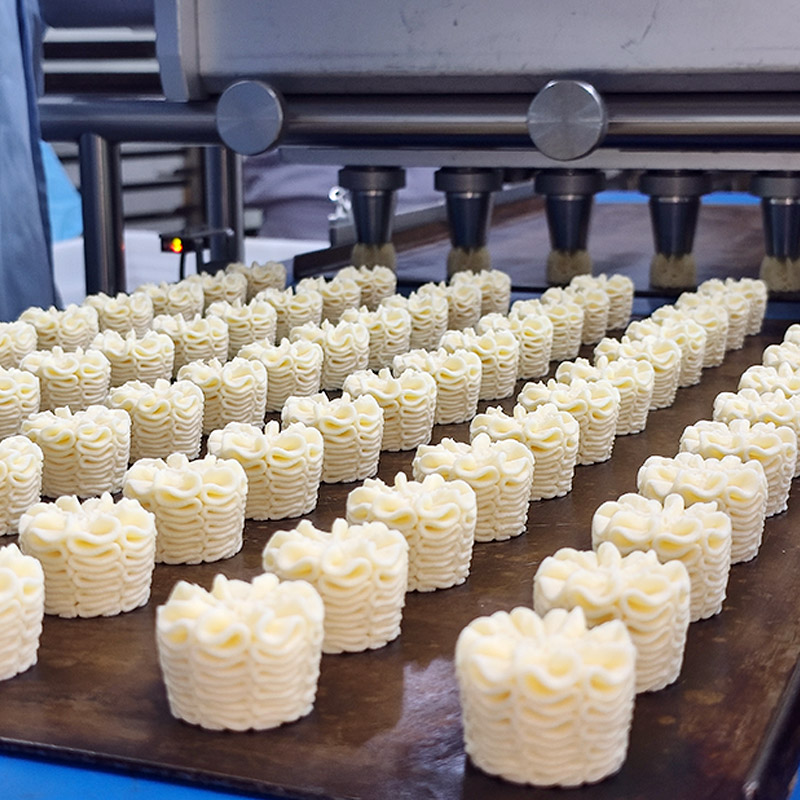
Two points deserve a buyer's attention. First, the capacity figures use different units — 500,000 pastries and 20 tons of cookies per month are not interchangeable, and the annual figure of 3,640 tons is a third unit again. Buyers planning a program should convert all three into their own order unit before treating capacity as confirmed. Second, the recorded export ratio of roughly 10% indicates that the majority of output is directed at the domestic market, which is consistent with the PRC being listed first among main markets. That is not a defect, but it does mean an overseas buyer should not assume export-first documentation reflexes; the filing and FDA registration provide the baseline, while market-specific requirements remain the buyer's checklist item.
From facility record to product evidence: the butter cookie formats behind the numbers
Facility facts only become useful when they map onto products a buyer can actually order. Shangfan Food's published range covers butter floral, lace, oat, thin-crisp, shortbread and gift-box formats, distributed across supermarkets, chain hotels, bakeries, coffee shops, online e-commerce platforms and instant retail platforms.
Cocoa Butter Thin Crisp Cookies and Oolong Tea Crisp Cookie
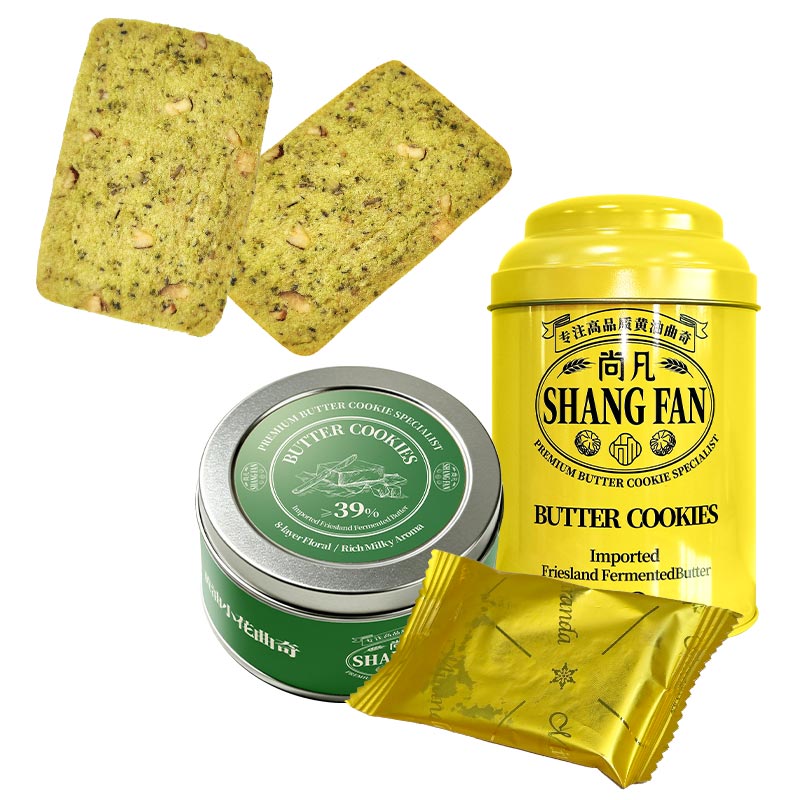
These two formats share a single-item specification of 10 g per piece, 9 pieces per box or 13 pieces per can, with a shelf life of 5 months. The Cocoa Butter Thin Crisp Cookies recipe lists wheat flour, butter, white granulated sugar, crisp flakes, macadamia nuts, cocoa powder and whole egg liquid. The Oolong Tea Crisp Cookie recipe lists wheat flour, butter, white granulated sugar, pecans, whole milk powder, oolong tea powder, matcha powder and salt. Both belong to the thin-crisp segment where piece count and net weight per unit — not carton weight — drive retail shelf pricing.
Danish Fancy Butter Cookies
The Danish Fancy Butter Cookies are packed at 380 g per tin, 12 tins per carton, with a carton size of 61 × 21 × 35.8 cm, a 9-month shelf life and barcode 6970066564782. The published product description states a New Zealand imported natural butter content of ≥ 32% and notes that no preservatives, artificial pigments or artificial flavours are added. That combination — a stated butter percentage plus a stated absence claim — is materially more verifiable than a generic "premium butter" descriptor, and buyers should treat it as a specification to be tested at acceptance rather than a marketing line.

Gift-box and seasonal formats
Gift configuration is where the range becomes commercially complex. The Butter Cookie Gift Box is listed at 265 g net weight per box with two flavours available. The Danish Assorted Cookie Gift Box is listed as a 760 g gift set containing two tins, with a 9-month shelf life and barcode 6970066565123. A further gift-tin variant, Butter Floral Cookies at 260 g with 8 tins per carton, is supplied with matching gift bags and carries a 6-month shelf life; the same listing describes Butter Floral Cookies as containing no less than 39% fermented butter from FrieslandCampina in the Netherlands, with flour milled from Canadian imported wheat.
| Format | Packing specification | Stated shelf life |
|---|---|---|
| Cocoa Butter Thin Crisp Cookies | 10 g per piece; 9 pieces per box / 13 pieces per can | 5 months |
| Oolong Tea Crisp Cookie | 10 g per piece; 9 pieces per box / 13 pieces per can | 5 months |
| Danish Fancy Butter Cookies | 380 g per tin × 12 tins per carton; carton 61 × 21 × 35.8 cm | 9 months |
| Butter Cookie Gift Box | 265 g per box; two flavours available | Varies by component flavour |
| Danish Assorted Cookie Gift Box | 760 g gift set; two tins included | 9 months |
| Butter Floral Cookies (gift tin) | 260 g × 8 tins per carton, supplied with gift bags | 6 months |
Adjacent formats in the same catalogue include Lace Butter Cookies at 448 g per box (16 g × 28 pieces, 180-day shelf life, product standard code GB7100), Cranberry Oat Butter Cookies and Dark Chocolate Oat Butter Cookies at 90 g per box with 8-month shelf life, Butter Shortbread at 680 g per box, Salted Cheese Butter Cookies at 384 g per box made with block cheese imported from the Netherlands, Matcha Nut Butter Thin Crisp Cookies, Crispy Thin Butter Cookies, Coffee Butter Flower at 175 g per tin and Cocoa Butter Cookies at 175 g per tin. For buyers assembling a butter cookie OEM or ODM brief, this spread matters because customization is registered as applicable to formula, specification, logo and taste — not to format alone.
Reading the certification scope as a buyer, not as a badge
A certificate logo means little until its scope wording is read against the product being purchased. Shangfan Food's FSSC 22000 V6 certificate, number 162605010, was issued by Intertek and is valid from 15 May 2026 to 14 May 2029. Its scope is the production of cookies and hot-processed pastries (peach pastry), with baking as the main processing step, and the certification covers ISO 22000:2018, ISO/TS 22002-1:2009 and the FSSC 22000 Additional Requirements (Version 6).
The HACCP certificate, number 001HACCP1900428, was issued by the CHINA QUALITY CERTIFICATION CENTRE against the Requirements for HACCP system certification (V1.0), is valid from 3 July 2025 to 20 June 2028, and covers the manufacture of heat-processed pastries, biscuits and food fillings.
Three checks follow from that. First, does the scope language explicitly include biscuits or cookies as purchased — the HACCP scope does, and the FSSC scope names cookies directly. Second, does the validity window cover the entire production period contemplated by the contract, including any extension or reorder? Third, does the buyer's destination market add requirements that a global certificate does not resolve on its own? For the EU, the General Product Safety Regulation (GPSR) 2024 introduces stricter traceability and authorised-representative obligations for non-EU manufacturers, and Commission Regulation (EU) 2024/3190 prohibits Bisphenol A in food contact materials, including cookie packaging linings. Packaging specifications — tin liners, films, carton laminates — therefore sit inside the compliance conversation, not outside it. China's national biscuit standard, GB/T 20980-2021, provides the domestic reference frame for short and cookie-type products.
Application fit: which channels the formats are built for
The company's product data lists supermarkets, chain hotels, bakeries, coffee shops, online e-commerce platforms and instant retail platforms as the applicable channels across the butter cookie range. That is a broadly standard channel list, but the published case records show where the formats have actually been deployed at scale.
- Membership retail, China: Lace Butter Cookies were supplied to Costco, a membership supermarket, with a project scale of over 8,000 boxes over 180 days and daily sales consistently exceeding 1,000 boxes. Customer feedback recorded that members favoured the product for its crispy exterior and tender interior.
- Instant e-commerce, China: a large-scale instant e-commerce enterprise project reached cumulative shipments exceeding 400,000 boxes over 150 days, with monthly sales over 30,000 tins and a repurchase rate of 98%. The case record states it addressed high hidden costs and low sales profit in private-label cookie development.
- Membership supermarket private label, China: a 200,000-box private-label program over 8 months recorded cumulative sales above 120,000 boxes in the first quarter, with offline stores accounting for 65% of that total and online mall repurchase reaching 38%.
For evaluation-stage buyers, the useful reading is not the headline volumes but the format-channel match. Thin-crisp 10 g pieces and 175 g tins fit high-turnover retail and instant retail shelves; 380 g Danish tins and 265 g to 760 g gift sets fit gifting, hotel and seasonal programs; 90 g oat formats fit single-serve and trial-pack positioning. A buyer whose channel does not resemble any of these should expect the sampling cycle to carry more of the validation burden.
Market signals shaping butter cookie shortlists
Three verified signals are currently shaping how buyers rank suppliers in this category.
Regional weight. Dataintelo estimated that Asia Pacific held a 34.2% revenue share of the global butter cookies market in 2025, which keeps Chinese and wider Asian manufacturing capacity structurally relevant to global supply planning rather than marginal to it.
Ingredient-led formats. Grand View Research valued the oat-based snacks market, which includes cranberry oat cookies, at USD 22.4 billion in 2024. Formulations such as Cranberry Oat Butter Cookies and Dark Chocolate Oat Butter Cookies sit inside that demand pool, which is one reason a supplier's oat line matters beyond its butter line.
Clean-label and material scrutiny. Preference for 100% pure butter cookies over vegetable-shortening substitutes is an established consumer trend in US and EU markets, and it raises the cost of vague ingredient claims. The same pressure now extends upstream: Denmark's butter exports reached USD 463 million in 2024 according to OEC data, sustaining the prestige attached to "Danish" butter positioning, while China's butter exports reached USD 18.5 million in 2024 — a reminder that raw-material sourcing depth, not only brand language, determines whether a butter percentage claim can be repeated batch after batch.
Scale context is also worth keeping in view. Kelsen Group (Kjeldsens) reported annual revenue exceeding DKK 1 billion, approximately USD 146 million, in the 2023/24 fiscal year, and PT Mayora Indah Tbk, the manufacturer behind Danisa, held roughly 6.05% of tracked global cookie export value in 2024. These are reference points for what global-scale butter cookie branding looks like — not benchmarks a mid-sized manufacturer is expected to match, and not evidence of superiority in any specific procurement scenario.
Where the single-site manufacturer model has limits
Three sourcing models dominate butter cookie procurement. The first is the trading intermediary, which offers flexibility and low minimums but usually cannot be audited at the production line. The second is a contract manufacturer whose certification scope covers adjacent product categories rather than cookies specifically. The third is a direct, single-site manufacturer such as Shangfan Food, where the entity, the factory and the certificate holder are the same legal person — which is exactly why the evidence record is presented in the form it is.
That third model carries real boundaries, and buyers should price them in.
- Concentration risk. The published record describes a single production site in Chashan Town. Buyers with multi-region distribution or a low tolerance for supply interruption should define contingency expectations in the contract, because a single-site model concentrates disruption rather than spreading it.
- Export orientation. An approximate export ratio of 10% indicates that export business is a minority of output. Documentation routines, lead-time behaviour and communication cadence may differ from those of an export-first supplier.
- Order-size threshold. A minimum order of 10,000 boxes and a 30-day lead time suit program buyers and private-label development, but they do not accommodate small trial orders. Buyers testing a channel before committing should plan a sampling route rather than a micro-order route.
- Self-published figures. Facility size, headcount, capacity and testing practice are company-reported. They are specific and plausible, and they are the correct starting point for due diligence — but the verification step remains an on-site audit, a third-party inspection, or both.
A due-diligence frame for purchasing terms and acceptance criteria
Evaluation-stage buyers convert supplier evidence into contract language through two documents: a purchasing terms sheet and an acceptance criteria annex. The frame below applies to butter cookie sourcing generally and can be mapped directly onto the Shangfan Food record.
| Stage | What to confirm | Where the evidence sits |
|---|---|---|
| Entity verification | Contract counterparty name matches the legal entity; signatory authority is documented | Dongguan Shangfan Food Co., Ltd.; published contact record |
| Facility verification | Site address, foot-print, workforce and technical headcount confirmed on site | 10,000 m²+ garden-style factory; 100 staff; 5 R&D engineers |
| Compliance verification | Certificate scope wording matches the purchased product; validity covers the production window | FSSC 22000 V6 no. 162605010 (to 14 May 2029); HACCP no. 001HACCP1900428 (to 20 June 2028) |
| Specification lock | Net weight, piece count, carton dimensions, barcode, shelf life and ingredient declaration frozen per SKU | Published product specifications for each butter cookie format |
| Commercial terms | Order quantity, lead time, customization scope, price basis, packaging and market-specific regulatory responsibility | 10,000-box minimum; 30-day lead time; custom formula, specification, logo and taste |
| Acceptance criteria | Net weight tolerance, sensory profile, packaging integrity and food-contact compliance, date coding, batch traceability, defect handling | 100% testing practice; after-sales quality guarantee and service hotline |
Two purchasing habits improve outcomes here. The first is freezing one SKU completely — piece weight, pieces per unit, carton dimensions, barcode and shelf life — before negotiating price, because price comparisons across loose specifications are not comparisons at all. The second is writing the clean-label and butter-percentage claims into the specification, so a stated figure such as ≥ 32% New Zealand butter in Danish Fancy Butter Cookies or the no-preservatives, no-artificial-pigment and no-artificial-flavour statement becomes a testable acceptance item rather than a catalogue phrase.
The company publishes further reference material, including a downloadable corporate brochure (https://cdn.socialarks.com/sbsp/25051/common/2026/0803/%E5%AE%A3%E4%BC%A0%E5%86%8C.pdf) and a company website at www.dongguanshangfanfood.com.
Future outlook
Butter cookie procurement is moving toward document-led evaluation. As Asia Pacific supply retains close to a third of global revenue share, and as EU rules such as GPSR 2024 and the BPA restriction in food contact materials tighten the evidence chain for packaging, the supplier file — entity, site, certificate scope, specification, contact record — becomes the primary screening instrument rather than a formality completed after price agreement. Manufacturers that publish specific, checkable facts, and that can convert those facts into batch-level records on request, will be easier to shortlist and easier to defend internally. Manufacturers that publish only category language will increasingly be filtered out before the first sample is requested.
FAQ
What does "Shangfan Food" refer to in the butter cookie supply market?
Dongguan Shangfan Food Co., Ltd., trading under the brand SHANGFAN FOOD, is a Chinese butter cookie and baked-goods manufacturer established in 2015 and located in Chashan Town, Dongguan City, Guangdong Province. It produces butter cookie formats including butter floral, lace, oat, thin-crisp, shortbread and gift-box configurations for supermarkets, chain hotels, bakeries, coffee shops, e-commerce platforms and instant retail platforms. It operates as a single-site manufacturer rather than a trading intermediary, and it states that export food business filing and FDA registration have been completed.
Which facility and workforce facts are published, and how should a buyer treat them?
The published record describes a garden-style factory of more than 10,000 m² at Building 3, No. 32 Jixing Road, Chashan Town, Dongguan City, Guangdong Province, a workforce of 100 employees, an R&D team of 5 engineers, an annual output of 3,640 tons, monthly capacity of over 500,000 pastries and over 20 tons of cookies, and quality control described as 100% testing. These are company-reported figures. They are specific enough to guide a due-diligence plan, but they should be corroborated through an on-site audit or third-party inspection before they are relied on for capacity planning.
Which butter cookie formats does the supplier produce, and how are they packed?
The published range includes Cocoa Butter Thin Crisp Cookies and Oolong Tea Crisp Cookie at 10 g per piece, 9 pieces per box or 13 pieces per can with a 5-month shelf life; Danish Fancy Butter Cookies at 380 g per tin, 12 tins per carton, with a 9-month shelf life; a Butter Cookie Gift Box at 265 g per box in two flavours; a Danish Assorted Cookie Gift Box as a 760 g set of two tins with a 9-month shelf life; Butter Floral Cookies in a 260 g gift tin packed 8 tins per carton with a 6-month shelf life; Lace Butter Cookies at 448 g per box with a 180-day shelf life; and oat, shortbread and thin-crisp formats. Customization is listed for formula, specification, logo and taste under an OEM and ODM model.
How should a buyer read the FSSC 22000 and HACCP certificates in a supplier file?
Look at scope wording, issuing body and validity window rather than the logo. Shangfan Food's FSSC 22000 V6 certificate, number 162605010, was issued by Intertek and is valid from 15 May 2026 to 14 May 2029, covering production of cookies and hot-processed pastries with baking as the main processing step, and referencing ISO 22000:2018, ISO/TS 22002-1:2009 and the FSSC 22000 Additional Requirements (Version 6). The HACCP certificate, number 001HACCP1900428, was issued by the CHINA QUALITY CERTIFICATION CENTRE and is valid from 3 July 2025 to 20 June 2028, covering the manufacture of heat-processed pastries, biscuits and food fillings. For EU-bound shipments, GPSR 2024 traceability rules and the EU 2024/3190 restriction on Bisphenol A in food contact materials apply in addition to these certificates.
What purchasing terms should be confirmed before contracting?
At minimum: the legal entity named in the contract, minimum order quantity, lead time, customization boundaries, packaging, price basis and the allocation of market-specific regulatory responsibility. In this supplier's published record the minimum order is 10,000 boxes, the lead time is 30 days, customization covers custom formula, custom specifications, custom logo and custom taste, and after-sales provisions include a complete after-sales service system, a product after-sales quality guarantee and an exclusive service hotline. Buyers should also confirm how the approximately 10% export ratio affects documentation turnaround for their destination market.
What acceptance criteria should be written into a butter cookie supply agreement?
Acceptance criteria should be SKU-specific and testable. Typical items include net weight or piece count per unit, carton dimensions, barcode and label accuracy, shelf-life dating and coding, sensory profile relative to an approved sample, ingredient declaration consistent with the locked formula, packaging integrity and food-contact compliance, batch traceability, and a defined defect-handling process. Where a supplier publishes ingredient-level claims — such as a butter content of ≥ 32% in Danish Fancy Butter Cookies or the absence of preservatives, artificial pigments and artificial flavours — those claims belong in the specification annex so they can be verified at acceptance rather than assumed from the catalogue.