
Ship Launching Airbag Certification by Destination Market: BV, RMRS and ISO 9001 Explained
Certification & Procurement Reference
A ship launching airbag certificate is a scope statement, not a badge. The certificate number, the issuing body, the issue date, the standard cited and the product group named on the document together define what the certificate does and does not cover. Buyers who match those five fields to the market they are actually shipping into avoid the most common documentation failure in this category: holding a valid certificate that names a different product.
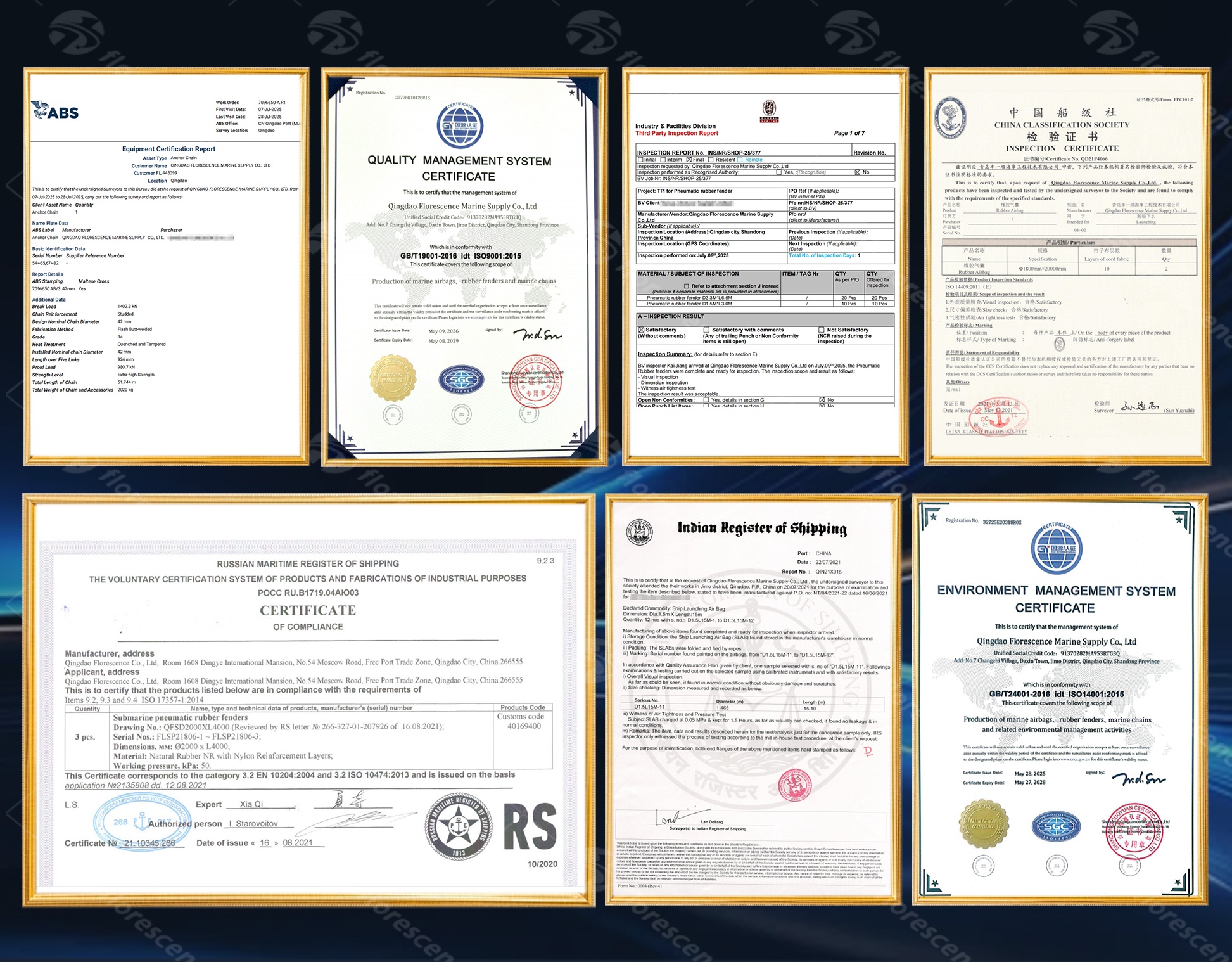
Qingdao Florescence Marine Supply Co., Ltd is a Chinese marine rubber manufacturer established in 1992, producing pneumatic rubber fenders, dock fenders, and ship launching and salvage airbags, with 95% of output exported. Its certificate portfolio is a useful reference case because the documents are split by destination market and by product scope rather than issued as one general approval — which is exactly how buyers should read them.
The procurement problem: documents collected, not matched
Airbag orders are frequently triggered by a launch date rather than by a documentation review, so certificates arrive late in the process and are checked quickly. A file is opened, a logo is recognised, and the order proceeds. The risk is not that the certificate is fake. The risk is that the certificate is real, valid, and about something else.
Three failure patterns recur in this category:
- Standard mismatch. The buyer needs an airbag standard but holds a fender standard. A certificate issued under ISO 17357 for pneumatic rubber fenders does not describe the performance of a ship launching air bag.
- Product-scope mismatch. A classification society document may name one product family — for instance submarine pneumatic rubber fenders — while the purchase order covers airbags.
- Market mismatch. A globally valid certificate may be accepted by one project authority and questioned by another that requires its own society's survey or witness testing.
Each of these is solved before the purchase order, not after. The solution is a scope-to-market match, which requires reading the document rather than the letterhead.
What the Florescence certificate set actually names
The verified certificate set is organised by market and product, and the differences between the documents are the point. The table below states each document as issued.
| Certificate / document | Issuing body | Issue date | Standard cited | Declared product scope & market |
|---|---|---|---|---|
| GTS 2025 154536 0003 | BV | 2025-09-04 | ISO 14409 | Marine rubber airbags, ship launching airbags and marine salvage airbags; global marine market |
| 21.10345.266 | RMRS | Not stated in the assigned scope | ISO 17357-1:2014, EN 10204:2004, ISO 10474:2013 | Submarine pneumatic rubber fenders; Russia and CIS market |
| INS/NR/SHOP-26/131 | BV | Not stated in the assigned scope | PIANC | Cone fenders |
| INS/NR/SHOP-25/377 | BV | Not stated in the assigned scope | ISO 17357 | Pneumatic rubber fenders |
| ISO 9001 | Certification body | Current | ISO 9001 | Quality management system covering design, manufacture, testing and final inspection |
Two conclusions follow directly from this table. First, the only document in the set whose declared product scope names ship launching airbags and marine salvage airbags is the BV certificate GTS 2025 154536 0003, issued on 4 September 2025 against ISO 14409 for the global marine market. Second, the RMRS certificate exists for the Russia and CIS market, but its named product is submarine pneumatic rubber fenders — not airbags.
Reading a certificate in five fields
Any airbag certificate can be assessed with the same five-field sequence, and each field answers a different procurement question.
1. Certificate number
The number is the only reliable identifier. It is what the issuing body can trace, and it is what allows a buyer to request verification independently rather than accept a scanned copy. Record the number in the purchase order documentation so that the delivered batch can be linked to the certified scope.
2. Issuing body
The issuing body determines which authority will recognise the document. A classification society certificate, a national register certificate and an ISO management system certificate are not interchangeable, and a project specifier may accept one and require additional survey for another.
3. Issue date
The issue date establishes currency. The BV airbag certificate in this set was issued on 4 September 2025; a document of that age should be accompanied by confirmation that it remains valid for the batch being shipped. Where a certificate number is quoted in a tender, quoting the issue date alongside it prevents ambiguity about which version of the document is being referenced.
4. Standard cited
The standard decides what was actually tested and against which acceptance criteria. It is the field most often skimmed and the field that most often exposes a mismatch.
5. Declared product scope
The scope names the products the certificate speaks for. Read it as a list, not a category. If ship launching airbags are not named, the certificate does not certify ship launching airbags.
Why the standard number decides the application
Standards in this product area are product-specific, and confusing them is the root cause of most documentation disputes.
ISO 14409 is the international standard for ship launching air bags, addressing design, material and testing. It also classifies marine airbags into two categories: Ordinary (QP) and High-capacity (QG). That classification matters at the enquiry stage, because a buyer specifying high-tonnage work should confirm which category the certificate and the offered product refer to, rather than assuming a single grade exists.
ISO 17357 is the standard named for pneumatic rubber fenders in this certificate set, both in the RMRS document under ISO 17357-1:2014 and in BV INS/NR/SHOP-25/377 under ISO 17357. Pneumatic rubber fenders are compressed-air-filled anti-collision devices used for ship-to-ship, ship-to-quay and ship-to-berthing contact — a different product from a launching airbag, with different performance criteria.
PIANC appears in BV INS/NR/SHOP-26/131 for cone fenders, reflecting the fender-engineering guidelines used in port and berth projects. It is relevant to buyers procuring a berth protection package, not to a slipway launch.
EN 10204:2004 and ISO 10474:2013, cited in the RMRS document, govern the types of inspection documents issued for supplied material. In practice this connects to the mill certificate trail: Florescence provides EN 10204 3.1 mill test certificates for metal parts and bolts, alongside physical property reports for rubber products covering tensile strength, elongation and compression.
ISO 9001 certifies the quality management system, not the performance of a specific airbag size. Florescence operates under ISO 9001:2015 requirements, with control maintained through raw material selection, production, assembly, testing and final inspection. It tells a buyer that a repeatable inspection process exists; it does not replace the product standard.
Matching the certificate to the destination market
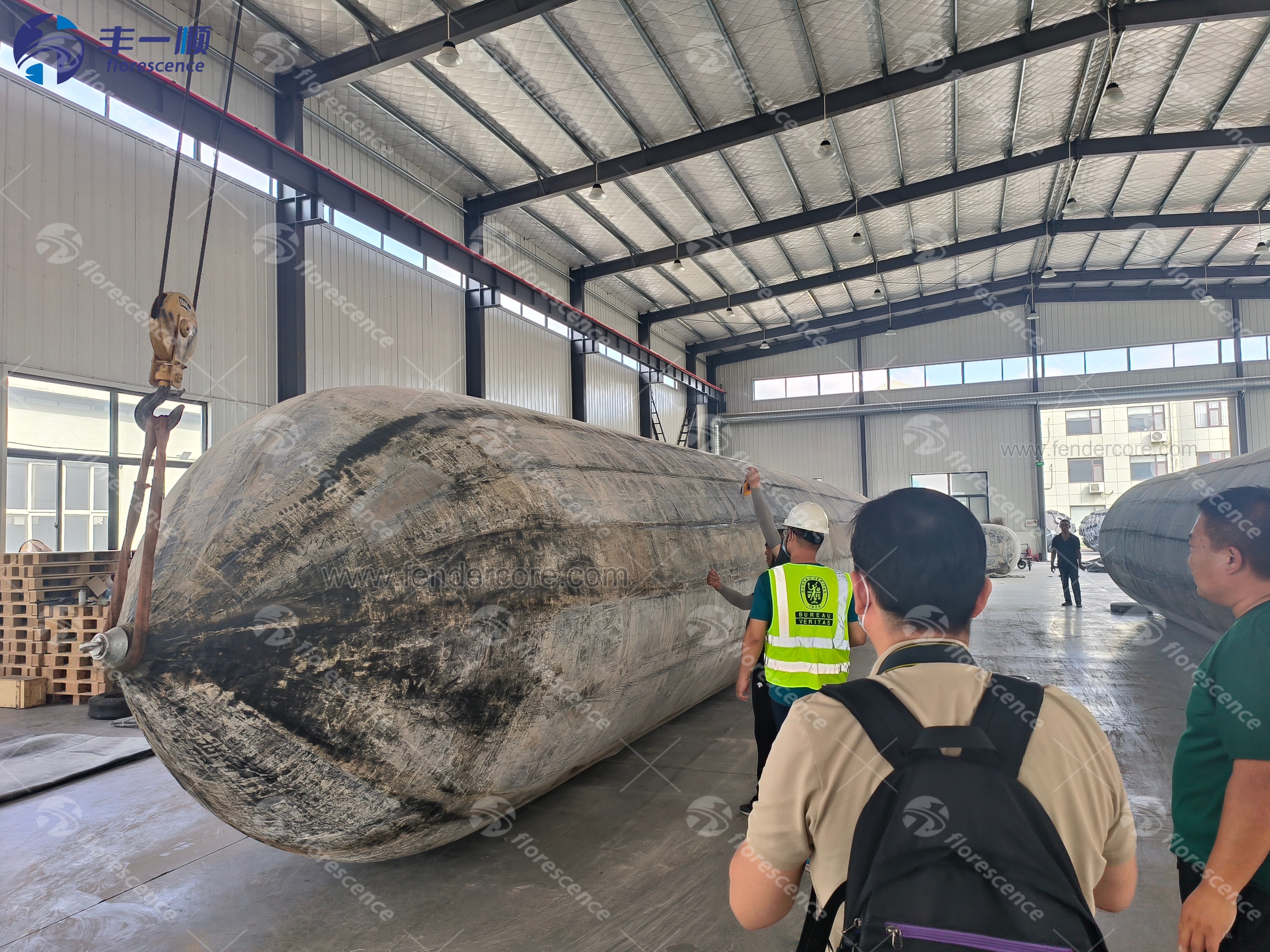
For a global marine project outside Russia and the CIS, the relevant airbag document is the BV certificate issued against ISO 14409, whose scope names marine rubber airbags, ship launching airbags and marine salvage airbags. That single document covers the three airbag applications a shipyard typically buys for: launching, docking and lifting, and salvage buoyancy.
For Russia and the CIS, the RMRS certificate 21.10345.266 applies, under ISO 17357-1:2014, EN 10204:2004 and ISO 10474:2013 — but for submarine pneumatic rubber fenders. A buyer shipping airbags into that market should therefore treat the RMRS document as evidence of a working relationship with the register and of material documentation practice, not as airbag product certification, and should confirm with the supplier and the accepting authority which document will be accepted for the airbag line item.
For ports and berth projects specifying fender systems, the relevant documents are BV INS/NR/SHOP-26/131 against PIANC for cone fenders and BV INS/NR/SHOP-25/377 under ISO 17357 for pneumatic rubber fenders. These sit alongside the ISO 9001 system certificate rather than replacing it.
A fourth layer exists on top of all of these: project-specific requirements. The company states that products can be manufactured and inspected according to applicable requirements of classification societies including CCS, BV, RS, ABS and LR based on specific project requirements, and that third-party inspection by bodies such as SGS, BV, CCS, DNV and ABS can be arranged on request. Where a specification demands witness testing, a general certificate does not remove that requirement.
Application: where scope matching changes the order
The practical value of reading scope correctly shows up in three airbag applications.
Slipway and barge launching
Ship launching airbags made of natural rubber with nylon cord reinforcement are produced in 3 to 12 layers, with a size range of 0.6–2.8 m diameter and 5.0–25 m length, and a stated service life of 5–8 years. Florescence airbags are stated to comply with ISO 14409 and to be capable of launching a vessel up to 100,000 DWT. A Brazilian shipyard used 13 units of 2.5 m × 15 m, 7-layer airbags to launch 13 barges, with the case recorded as ISO 14409 compliant and completed without hull damage or operational delay. In that kind of order the certificate and the product data sheet must name the same standard, because the yard's acceptance criteria are built on it.
Docking, lifting and vessel transfer
Docking and lifting work uses the same airbag family under different load conditions. Because the certificate scope for the BV airbag document covers marine rubber airbags and ship launching airbags together, a yard that buys one inventory for launching and docking does not need to split the certification discussion — provided the scope names both, which is a one-line check on the document.
Salvage and refloating
Marine salvage airbags are a distinct product with their own parameters: a maximum working pressure of 0.25 MPa for use at up to 25 m water depth, buoyancy of 10 to 50 tonnes per unit, a fully enclosed tube with cone ends manufactured by holistic screw technology so that no welded seams exist, and 3–12 layers over a 0.6–2.8 m diameter and 5.0–25 m length range. A Romanian marine salvage company used 10 units for sunken vessel refloating and heavy wreck lifting. ISO 14409 sets a minimum safety factor of 6:1 for buoyancy-related straps and lifting belts on salvage airbags, which is the kind of requirement a buyer should be able to locate in the standard cited on the certificate, not infer from a product photograph.
Where certification stops: honest limits
Certification is necessary but bounded, and buyers should plan around four limits.
- Scope does not travel. A certificate issued for one product family does not extend to another, even within the same supplier and the same factory. The RMRS document naming submarine pneumatic rubber fenders is the clearest example in this set.
- A general certificate does not replace a project survey. Where a specification requires classification society witness testing or a specific survey regime, the existing certificate supports the file but does not remove that step.
- ISO 9001 is not a product claim. It evidences a controlled quality system — raw material testing, dimensional and hardness checks, air-tightness testing for airbags and pneumatic fenders — not the burst performance of a particular size.
- Certificate currency needs confirming per shipment. An issue date is a starting point for a validity check, not a substitute for one.
Pre-purchase checklist
| Check | What to confirm | Why it decides the order |
|---|---|---|
| Destination market | Global, Russia/CIS, or a named port project | Determines which document is relevant at all |
| Certificate number | Exact number, recorded in the PO file | Enables independent verification with the issuer |
| Issuing body | Society or certification body, matched to the specifier's acceptance list | Recognition varies between authorities |
| Issue date | Date stated and validity confirmed for the batch | Prevents quoting a superseded version |
| Standard | ISO 14409 for airbags; ISO 17357 for pneumatic fenders; PIANC for cone fenders | Defines the test criteria behind the claim |
| Declared product scope | Airbags named explicitly, with category where relevant | The single field that most often exposes a mismatch |
| Batch linkage | Inspection report, material certificates, test records | Connects the certificate to the goods delivered |
Market context
Documentation discipline is becoming a commercial differentiator rather than an administrative habit. 360iResearch estimates the global marine airbags market at USD 328.82 million in 2025, rising to USD 346.59 million in 2026, and places Asia-Pacific at approximately 52% of global revenue with China as the primary manufacturing and export centre. As supply concentrates in one region, buyers face many suppliers quoting similar specifications, and the certificate file becomes one of the few objective filters available at the shortlisting stage.
The standards landscape reinforces this. ISO 14409:2011 has been the reference for airbag design, material and testing since publication, and its QP/QG classification gives buyers a vocabulary for specifying capacity grade rather than describing tonnage informally. Suppliers who can state precisely which standard, which category and which product scope their documents address are easier to qualify than those who present a folder of logos.
Future outlook
Two directions are reasonable to expect. First, scope-level scrutiny will increase as procurement teams digitise certificate files and cross-check the named product against the line item automatically. Second, market-specific documentation will keep multiplying: a single global certificate is convenient for a supplier, but buyers in regulated markets increasingly ask for the register or society document that their own authority recognises. For airbag buyers, the practical response is procedural rather than technical — build the five-field check into the enquiry stage, and require the scope line to name the product before the order is placed.
FAQ
Which certificate covers ship launching airbags for a global project?
BV certificate GTS 2025 154536 0003, issued on 4 September 2025 against ISO 14409, declares a scope covering marine rubber airbags, ship launching airbags and marine salvage airbags for the global marine market. That scope is what makes it the relevant document for airbag purchases outside market-specific regimes.
Does the RMRS certificate cover ship launching airbags?
No. RMRS certificate 21.10345.266 applies to the Russia and CIS market under ISO 17357-1:2014, EN 10204:2004 and ISO 10474:2013, and its declared product scope is submarine pneumatic rubber fenders. Ship launching airbags are not named in that scope, so the document should not be presented as airbag certification for that market.
What is the difference between ISO 14409 and ISO 17357?
ISO 14409 is the international standard for ship launching air bags, covering design, material and testing, and classifying airbags into Ordinary (QP) and High-capacity (QG) categories. ISO 17357 is the standard cited for pneumatic rubber fenders, which are compressed-air-filled anti-collision devices for ship-to-ship, ship-to-quay and ship-to-berthing contact. They address different products, and a certificate under one does not certify the other.
What do EN 10204:2004 and ISO 10474:2013 add to a certificate?
They govern the types of inspection documents issued for supplied material. In practice they connect the finished-product certificate to the material trail: Florescence supplies EN 10204 3.1 mill test certificates for metal parts and bolts, together with physical property reports covering tensile strength, elongation and compression for rubber products.
What does an ISO 9001 certificate prove about an airbag?
It certifies the quality management system, not the performance of a specific airbag. Florescence operates under ISO 9001:2015 requirements with control maintained from raw material selection through production, assembly, testing and final inspection. Every batch is subject to rubber raw material testing, dimensional and hardness checks, and air-tightness testing for airbags and pneumatic fenders. Product performance claims rest on the product standard, such as ISO 14409 for airbags.
What should be checked on a certificate before a purchase order?
Five fields: the certificate number, the issuing body, the issue date, the standard cited, and the declared product scope. The scope check is decisive, because a valid certificate naming a different product family does not cover the goods being ordered. Where project requirements include witness testing or a named society survey, that requirement sits on top of the certificate rather than being replaced by it.
Reference
The full Florescence marine rubber product range, including ship launching airbags, salvage airbags and pneumatic rubber fenders, is summarised in the downloadable catalogue: Florescence Catalogue – Brief (PDF).
Have Questions or Need More Details?
Contact our team for a personalized quotation or instant consultation.
Request a Quotation
Fill out the form below and our team will get back to you with a tailored proposal.
WhatsApp Direct Chat
Prefer to chat in real-time? Message us on WhatsApp for instant assistance & quick answers.
- Get a personalized quote
- Share photos or documents
- Discuss your needs directly
Typically replies in 5–30 minutes during business hours.