
Ship Launching Airbag Procurement FAQ: 1,000-Ton Sizing, QC, Shipping and Payment
Ship Launching Airbag Procurement FAQ: 1,000-Ton Sizing, QC, Shipping and Payment
A 1,000-ton ship launch is a procurement event with engineering consequences. The buyer must define the vessel, approve a launch plan, verify the airbag specification, set inspection points, and align payment with shipping. Florescence Marine, the marine-equipment brand of Qingdao Florescence Marine Supply Co., Ltd., has supplied ship launching airbags from its Qingdao manufacturing base since 1992. This FAQ uses that operating context to answer the questions that appear most often before a first order and before a repeat order for a shipyard project.
Short answer: There is no single 1,000-ton airbag. A supplier needs vessel type, length, beam, launch weight and keel block height. Quality is verified through material, dimensional, pressure or air-tightness and compression checks plus certificate review. Florescence is a manufacturer. Accepted payment methods are 40% or 30% advance with balance before shipment, LC and cash. Shipping is quoted by Incoterm, route and packing plan.
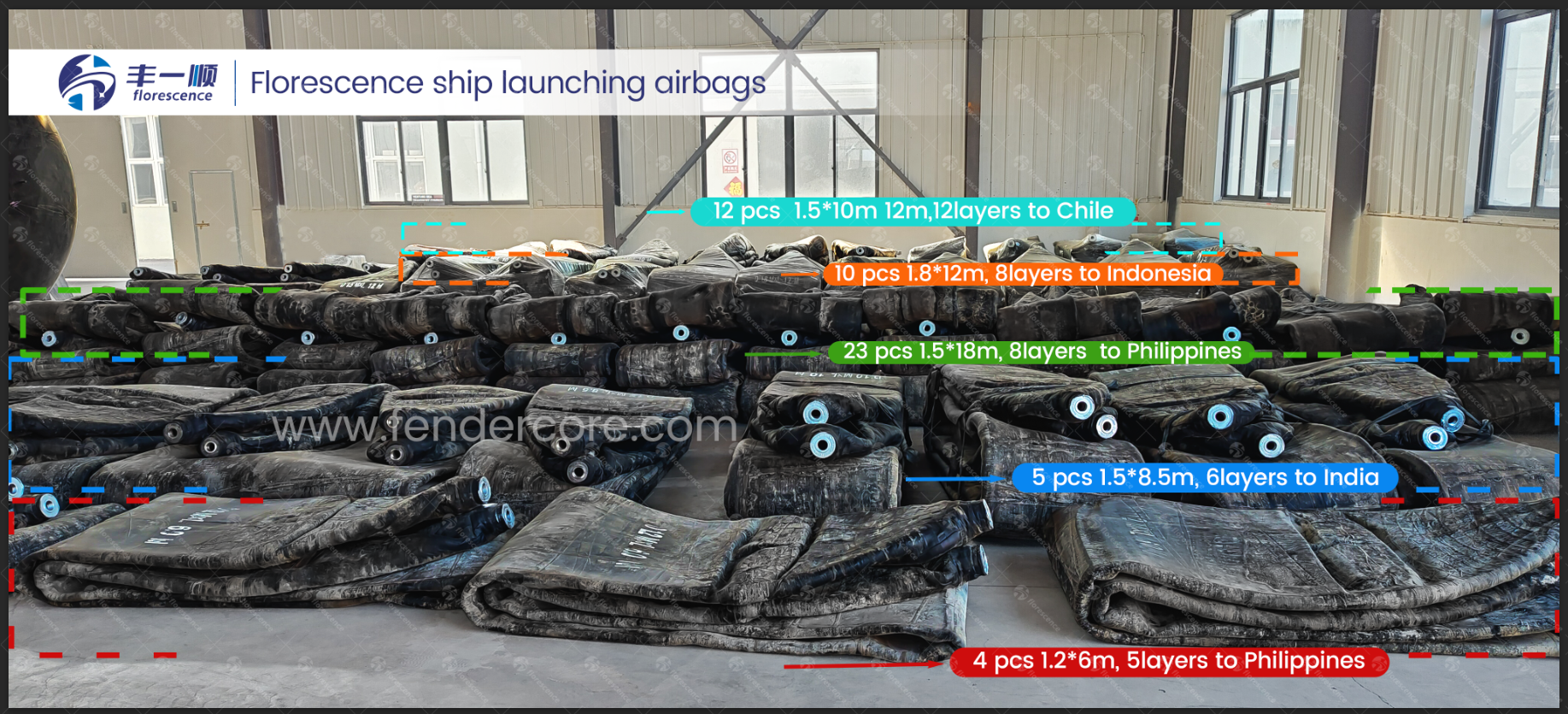
1. What information is required before a supplier can size airbags for a 1,000-ton launch?
A 1,000-ton figure alone is not a specification. It may refer to displacement, deadweight or the weight at the moment of launching. For airbag selection, the useful inputs are vessel type, length, beam, weight at launching or docking and keel block height. If the yard is launching several vessels, each type and dimension should be listed. Florescence's selection guidance asks for these details before recommending airbag size and quantity. The launch plan also needs a pre-calculated airbag spacing plan, because the airbags must support the hull and allow controlled rolling.
For a first inquiry, provide the vessel data in one package. That reduces the risk of quoting a marine launching airbag that is too small, too short or too few for the actual load case. If the data is incomplete, the supplier can explain which missing value changes the recommendation. The answer should be traceable to the vessel, not chosen from a generic tonnage chart.
2. Can tonnage alone determine airbag diameter, length and number?
No. Bearing capacity depends on airbag diameter, working pressure, contact area, vessel weight and the number of airbags. Common airbag configurations range from 3 to 12 layers, and diameter, length, pressure rating, reinforcement layers and end structure can be customized. For a 1,000-ton project, the quotation should state diameter, effective length, overall length, layer count, working pressure, quantity and accessories. A table that maps tonnage directly to one size would hide these variables, so this FAQ does not provide one.
Selection parameters include rubber material grade, working pressure and air-tightness, supporting accessories and surface anti-abrasion treatment. Buyers comparing a ship launching rubber airbag against a vessel launching airbag from another supplier should compare the same specification fields. A difference in layer count or working pressure can change the usable load case even when the outside diameter looks similar.
3. How many airbags should a 1,000-ton launch use?
Quantity is project-specific. It is not set by tonnage alone. The supplier should propose a quantity after reviewing vessel data and the launch plan. The Brazil case in Florescence's project record used 13 units of D2.5 × L15 m airbags to launch 13 barges, recorded as completed without operational delays or hull damage. That record shows a real large-batch launch, but it is not a formula for a 1,000-ton vessel. The correct quantity must account for contact pressure, spacing, redundancy and the yard's procedure. Ask for the calculation basis in writing.
The factory lists a MOQ of 1 unit, but a 1,000-ton launch normally requires a set, not a single airbag. The set should include the airbags, inflation and connection fittings, and the supporting equipment needed for the launch method. For a repeat buyer, compare the new vessel against the previous project before reusing the old quantity.
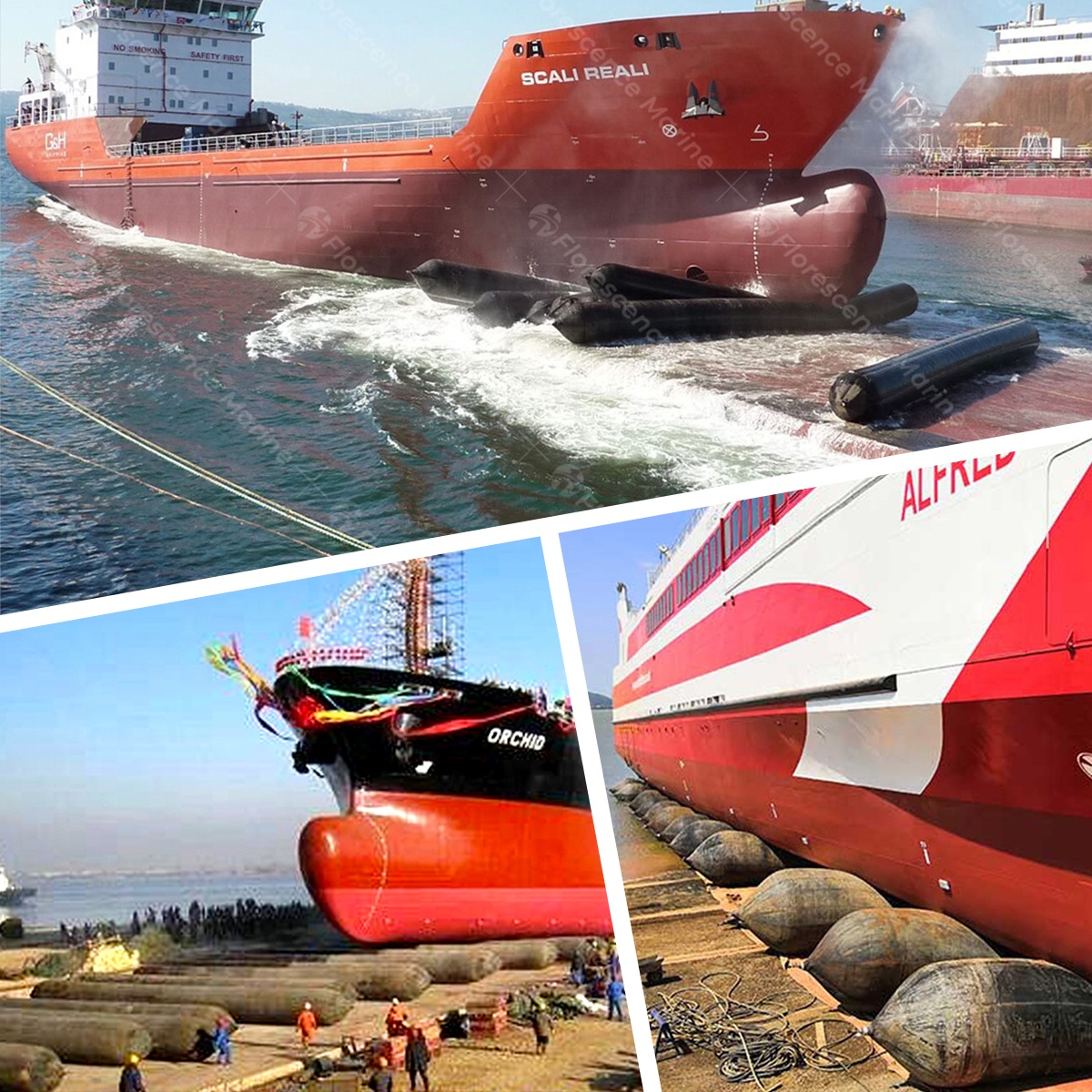
4. What quality checks should be completed before the airbags leave the factory?
Florescence's factory is ISO 9001 certified. For airbags, the relevant checks include rubber raw-material testing, dimensional inspection, pressure or air-tightness testing and compression testing. The capability data also lists third-party inspection by CCS, BV, ABS, DNV and other bodies when required. The quality record should identify the batch, the tested specification and the result. A QIR can be issued before final payment, with test data, sizing sheets and product photos. Buyers should confirm that the report covers the actual airbag size and pressure rating on the purchase order, not only a generic product family.
The ISO 9001:2015 certificate is 32726Q10126RIS. The certificate supports the existence of a quality-management system; it does not replace the batch record. For a 1,000-ton launch, the buyer should read the dimensional and pressure records beside the order specification. If third-party witness testing is required, the inspection plan should be agreed before production so that the witness point is not missed.
5. What does the BV certificate GTS 2025 154536 0003 cover?
Bureau Veritas issued certificate GTS 2025 154536 0003 on 4 September 2025. Its scope is marine rubber airbags, ship launching airbags and marine salvage airbags, and the cited standard is ISO 14409. The certificate is evidence of third-party certification for that listed scope. It does not replace project-specific engineering: the buyer still needs the right diameter, length, layer count, pressure and quantity for the vessel, and the launch plan still has to be approved for the site. When reviewing the certificate, check the holder name, product description, standard and scope against the order.
This distinction matters in procurement. A certificate can confirm that a product family has been assessed under a named standard; it does not confirm that any one airbag is suitable for every 1,000-ton vessel. The buyer should keep the certificate copy, the QIR and the order specification together in the project file.
6. Is Florescence a manufacturer or a trading company?
Florescence is a manufacturer. Qingdao Florescence Marine Supply Co., Ltd. was established in 1992 and operates from a 40,000 m² facility in Qingdao with 120 staff, including 25 engineers, and an annual output of 2,000 pieces. Its export share is 95%, with markets in Southeast Asia, South America, Europe, North America, the Middle East and Africa. The company operates under ISO 9001 and ISO 14001 management systems and can manufacture and inspect to classification-society requirements including CCS, BV, RS, ABS and LR when a project requires it. The official company website is Qingdao Florescence Marine Supply Co., Ltd..
That manufacturer status is relevant to a 1,000-ton purchase because the buyer can discuss the airbag construction, test record and certificate scope with the production side rather than a reseller. It also means the order can be checked against the factory's actual quality-control process, not only a sales description.
7. What evidence should a buyer check to confirm manufacturing depth?
Check the legal entity, factory address, production floor area, staff and engineering headcount, annual output, quality-management certificates and product-specific certificates. For this supplier, the stated figures are 1992, 40,000 m², 120 staff, 25 engineers and 2,000 pieces per year. Check the BV certificate number and scope for airbags. If the order is for a repeat launch program, ask for the QIR and the certificate package used on the previous batch. The point is not to collect documents; it is to match each document to the exact airbag specification being purchased.
A buyer can also ask how the factory handles customization. Florescence lists OEM and ODM support for size, pressure, logo, fittings, package, solution and drawing. For a 1,000-ton launch, customization should be tied to the vessel data and the launch procedure, not added as a cosmetic option.
8. What payment methods are accepted?
Accepted payment methods are 40% or 30% advance with the balance before shipment, LC and cash. The exact term should appear on the proforma invoice and sales contract. For a first import, a letter of credit or a documented TT schedule can align production and shipment milestones. The supplier should confirm receipt of the advance, share production updates, and provide shipping documents after dispatch. Payment terms are commercial terms, not a substitute for inspection rights or a certificate check.
For a repeat order, the same discipline applies. The buyer should confirm whether the previous advance percentage still applies, what documents are required before the balance is released, and whether third-party inspection is a condition of shipment. These points should be settled before production begins.
9. How are ship launching airbags shipped?
Florescence supports sea freight, air freight, LCL and FCL shipment. It usually quotes FOB and can arrange CIF, CFR, DDP or DDU terms for an order. The buyer should confirm the Incoterm, destination port, order quantity, packing method and document set before comparing prices. Airbags are bulky, so packing and loading efficiency affect the total delivered cost. The supplier's order process includes production photos and videos, then the container number and vessel tracking information after shipment. No freight rate is fixed in this FAQ because rates depend on route, volume, weight and Incoterm.
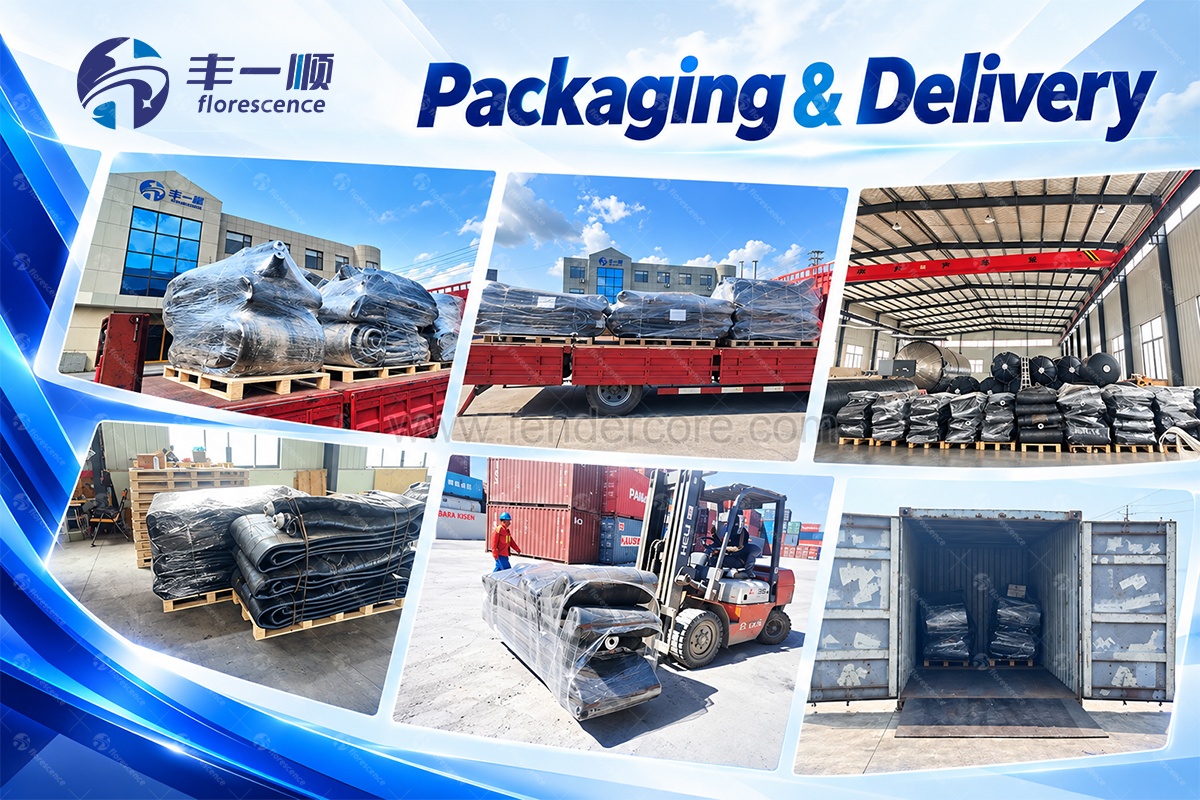
10. What shipping documents should be confirmed?
For export orders, the document set normally includes a commercial invoice, packing list and bill of lading; a certificate of origin such as Form E, Form F or CO can be provided when applicable. The buyer should also receive the quality inspection report and the relevant certificate copy for the airbag order. If a letter of credit is used, the document list must match the LC terms exactly. Missing or inconsistent documents can delay customs clearance even when the airbags have passed factory inspection.
11. What lead time and order quantity should be planned?
The capability data lists a lead time of 5–30 days, depending on specification, quantity and scheduling. The MOQ is listed as 1 unit, but a 1,000-ton launch will normally require a calculated set of airbags plus accessories. Confirm the production schedule before paying the advance, and build in time for third-party inspection if BV, CCS, ABS or DNV witness testing is required. A short lead time does not remove the need for a complete technical review.
12. What after-sales support is included?
Florescence lists 24/7 online technical support, installation, use and repair guidance, global on-site service, a 12–24 month warranty, and free repair kits and spare kits. For a launch project, the practical value is in the use phase: correct positioning, inflation pressure control, block removal, controlled rolling and retrieval. The buyer should confirm who provides on-site guidance, what the warranty covers, and which spare parts are included in the quotation.
13. How should a buyer compare quotations for a 1,000-ton launch?
Compare the specification and the commercial terms together. A low unit price is not comparable if the quotation omits layer count, working pressure, fittings, inspection, certificate copy or packing. Use the same vessel data for every supplier and ask each one to state the calculation basis for quantity.
| Procurement item | What to confirm | Why it matters |
|---|---|---|
| Vessel data | Type, length, beam, launch weight, keel block height | Defines the load case for sizing |
| Airbag specification | Diameter, effective length, overall length, layers, working pressure, quantity | Determines bearing capacity and launch plan |
| Quality record | Material, dimensional, pressure or air-tightness and compression records | Shows the batch was checked before shipment |
| Certification | BV GTS 2025 154536 0003, ISO 14409, scope and holder | Matches the certificate to the ordered product |
| Supplier identity | Manufacturer status, factory data, engineering team | Reduces reseller and traceability risk |
| Payment | 40% or 30% advance, balance before shipment, LC or cash | Aligns cash flow with production and documents |
| Shipping | Sea or air freight, LCL or FCL, FOB, CIF, CFR, DDP or DDU | Defines cost, risk transfer and delivery timing |
| After-sales | Warranty, repair kits, technical guidance and on-site support | Supports the launch and later reuse |
14. What should first-time importers do to reduce risk?
First-time importers should use a local import agent if they are unfamiliar with customs and port procedures. They should choose secure payment terms such as TT or LC, track the bank transfer, and require production and shipment updates. After dispatch, the supplier should send the bill of lading and vessel tracking information and keep the buyer informed until the cargo arrives at the destination port. These steps reduce process risk; they do not replace technical review of the airbag specification.
15. Which checks are most important before approving a repeat order?
For a repeat order, compare the new vessel and launch conditions with the previous project. Recheck the airbag size, layer count, working pressure, quantity, certificate scope and test report. If the vessel or slipway has changed, the previous specification may not transfer. A repeat order should still receive a current QIR and the correct certificate copy. The supplier's production record and after-sales history can support the evaluation, but the technical fit must be confirmed again.
FAQ: Ship launching airbag procurement
What is the first step in specifying ship launching airbags for a 1,000-ton vessel?
Provide vessel type, length, beam, weight at launching or docking and keel block height. The supplier can then recommend airbag size and quantity. Tonnage alone is not enough because bearing capacity also depends on diameter, working pressure, contact area and the number of airbags.
Does the BV certificate replace a project-specific launch plan?
No. BV certificate GTS 2025 154536 0003 covers marine rubber airbags, ship launching airbags and marine salvage airbags to ISO 14409. The launch plan still has to match the vessel, slipway, airbag spacing and site conditions.
Are ship launching airbags reusable?
Ship launching airbags are designed for repeated use when handled, stored and maintained correctly. After launch, they should be deflated, cleaned, folded and stored in a dry, ventilated place away from sunlight, oil, acid and sharp objects. Damage should be assessed before the next use.
What is the difference between ship launching airbags and marine salvage airbags?
Ship launching airbags support vessel launching, landing, docking and movement. Marine salvage airbags provide buoyancy for recovery and refloating work. The BV certificate covers both product types, but the specification and use conditions differ, so the buyer should order for the actual application.
What payment terms are accepted for a first order?
Florescence accepts 40% or 30% advance with the balance before shipment, LC and cash. The exact schedule should be written into the proforma invoice and contract, and the buyer should confirm the inspection and document package before shipment.
How are the airbags packed for export?
Airbags are packed for export shipment, with packing selected to suit the size and quantity of the order. The supplier supports sea freight, air freight, LCL and FCL, and shipping terms such as FOB, CIF, CFR, DDP or DDU can be quoted. The buyer should confirm the packing details and Incoterm in the quotation.
A downloadable overview of Florescence's marine rubber product range is available in the Florescence catalogue.
Have Questions or Need More Details?
Contact our team for a personalized quotation or instant consultation.
Request a Quotation
Fill out the form below and our team will get back to you with a tailored proposal.
WhatsApp Direct Chat
Prefer to chat in real-time? Message us on WhatsApp for instant assistance & quick answers.
- Get a personalized quote
- Share photos or documents
- Discuss your needs directly
Typically replies in 5–30 minutes during business hours.