
Ship Launching Airbags: A Florescence Capability Review
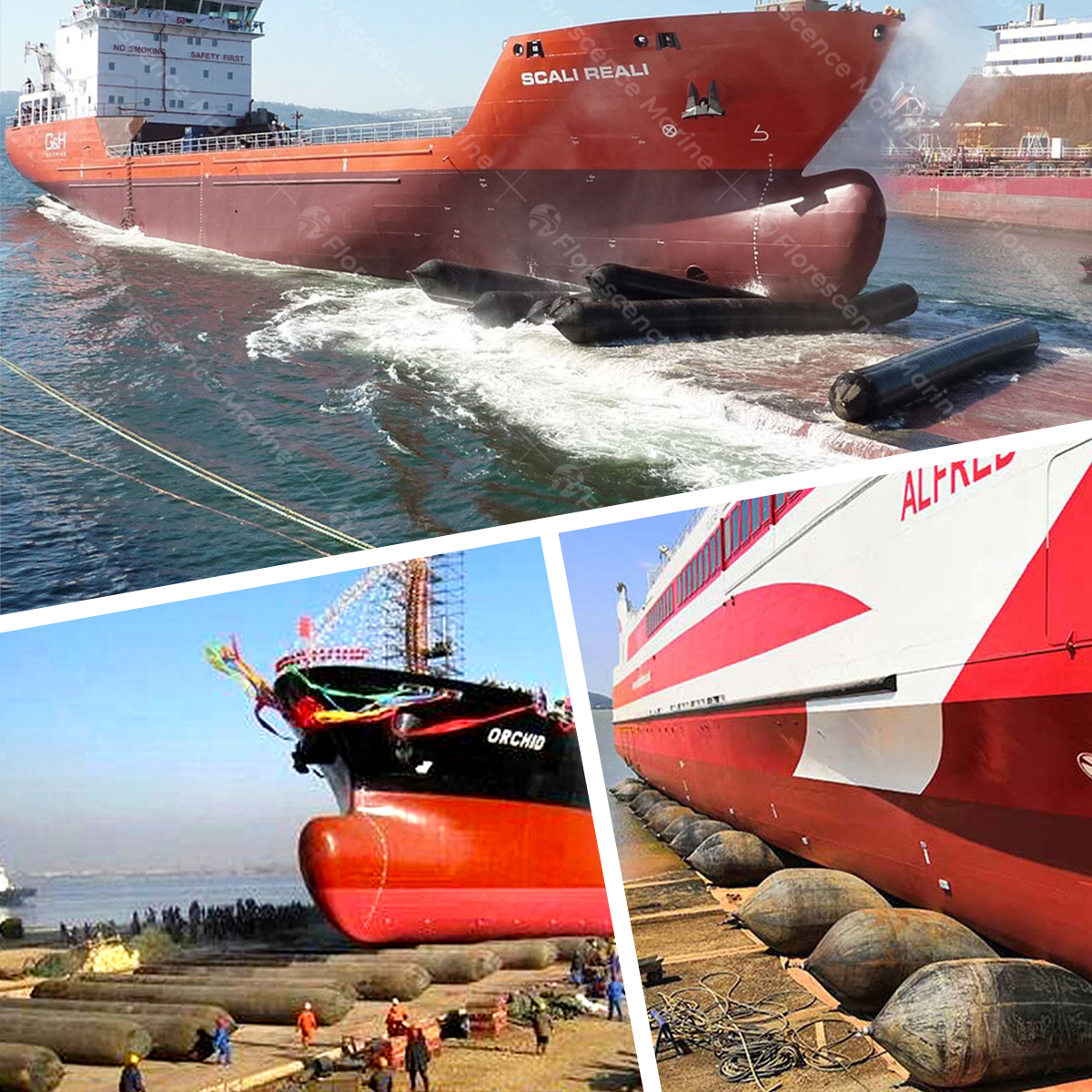
Marine rubber airbags supporting a vessel during launching and docking operations.
Ship launching airbags sit in an unusual place in marine procurement. They are consumable enough to be replaced after wear, durable enough to be reused across multiple launches, and structural enough that vessels in the 100,000 DWT class can be moved on them. That combination is why the category has shifted from yard improvisation to a documented engineering input with its own international standard.
ISO 14409:2011 sets the design, material and testing basis for ship launching air bags and divides them into two classes: Ordinary (QP) and High-capacity (QG). For buyers, that classification is the first filter in any specification conversation, because it connects a product label to a pressure and load regime rather than to a supplier claim.
Demand is stable rather than explosive. 360iResearch estimates the global marine airbags market at USD 328.82 million in 2025 and USD 346.59 million in 2026, with Asia-Pacific accounting for roughly 52% of revenue and China acting as the primary manufacturing and export center. What that figure implies for procurement is concentration: most of the world supply is produced in a small number of Chinese industrial clusters, so supplier selection carries supply-chain weight as well as technical weight.
This analysis examines one manufacturer inside that cluster, Qingdao Florescence Marine Supply Co., Ltd, and asks the buyer question directly: what does this company capability actually cover, where is it strong, and where are its boundaries?
The Product, Defined
A ship launching airbag is a flexible inflatable cylinder built from natural rubber and nylon cord layers, used to lift a vessel off its blocks, carry it down a slipway and float it free. The Florescence Ship Launching Airbag is specified for ship launching scenarios and intended for the ship building, repair, drydock, marine salvage and marine engineering industries. The same product family is used for vessel upgrading, heavy-object movement on land, and floating assistance to adjust draft.
The technical case for airbags rests on what they remove from a project. A conventional slipway is a fixed capital asset tied to one location. Airbag launching requires no more than air compressors, winches and ropes, can be performed at any seaside location, and the bags can be reused. Florescence states that its airbags comply with ISO 14409 and can launch or upgrade a ship of up to 100,000 DWT.
Reusability is the commercial hinge. A slipway is paid for once and maintained indefinitely; airbags are paid for once and depreciated across launches, with a stated service life of five to eight years. The trade-off is that the reusable asset is also the asset that must be inspected, stored and handled correctly, which is where a supplier quality system starts to matter more than unit price.
Company Profile: A Three-Decade Marine Rubber Specialist
Qingdao Florescence Marine Supply Co., Ltd is a marine rubber products manufacturer based in Qingdao, China. The company was established in 1992 and has more than three decades of experience in product design, manufacturing, quality control and marine project support. Its manufacturing facility covers 40,000 square meters and employs 120 staff, including an R&D team of 25 engineers, with annual production capacity of 2,000 pieces.
The portfolio is deliberately two-sided. One side is protection: pneumatic rubber fenders, various dock fenders, ship fenders and foam fenders. The other is operations: ship launching and salvage rubber airbags. That split matters in procurement because shipyards and salvage contractors frequently buy both within the same project, with fenders covering berthing and dock protection and airbags covering launching, landing, vessel movement and buoyancy-assisted recovery.
Export accounts for 95% of total sales, with major markets in Southeast Asia, South America, Europe, North America, the Middle East and Africa. The company reports supply to naval organizations including the Bangladesh Navy, French Navy, Royal Thai Navy, Italian Navy and Philippine Navy. That client profile implies exposure to specification review, inspection protocols and delivery scheduling rather than purely commercial ordering, which is a meaningful distinction when a buyer is assessing whether a supplier can absorb a documented technical requirement.
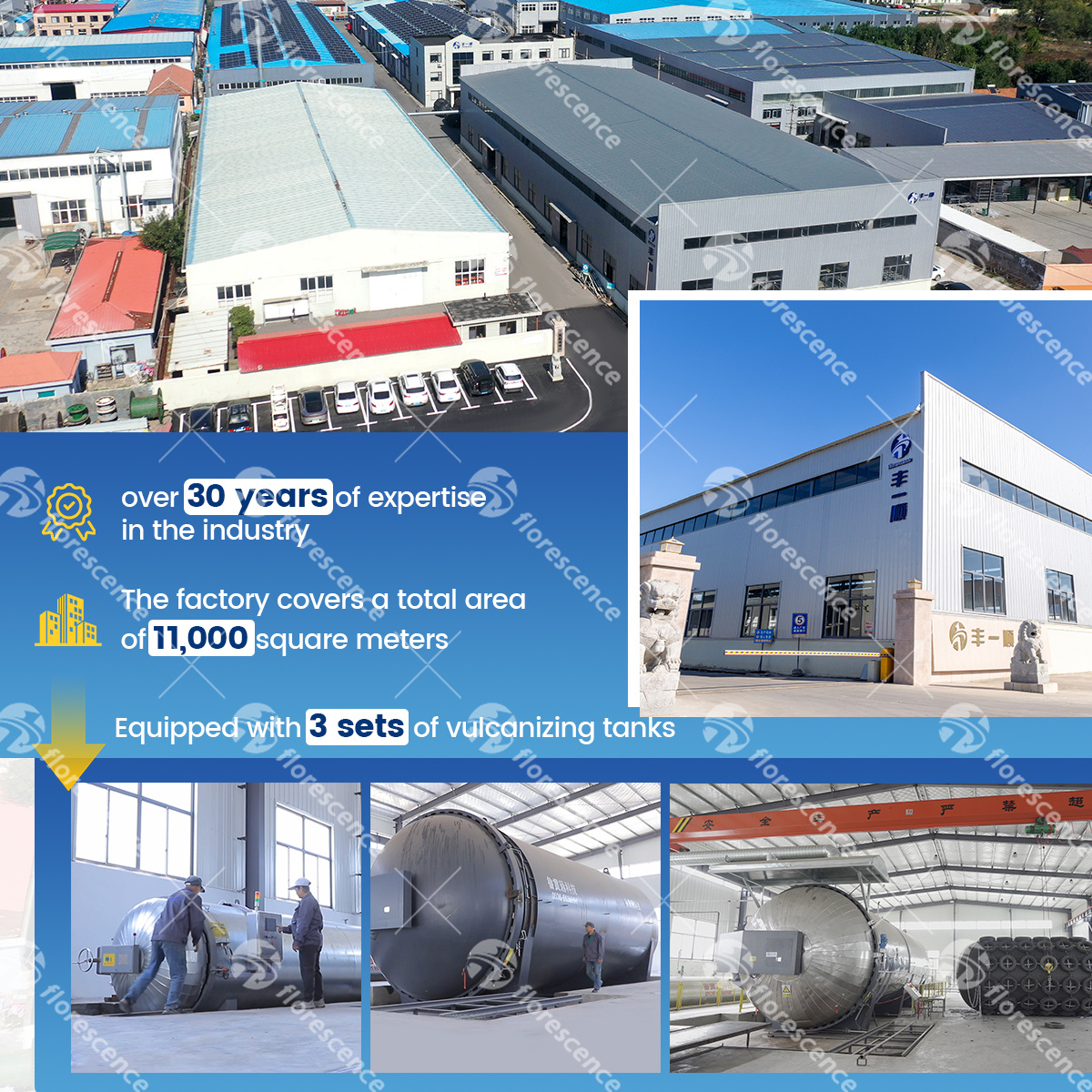
The Florescence manufacturing facility covers 40,000 square meters and produces fenders and airbags in the same plant.
Manufacturing Footprint and Quality System
Quality management is stated as ISO 9001:2015, applied across design, manufacturing and testing, with control maintained through raw material selection, production, assembly, testing and final inspection. Beyond the management system, the company states that products can be manufactured and inspected to the applicable requirements of CCS, BV, RS, ABS and LR on a project basis.
That is a practical rather than a decorative distinction. A classification-society witness is a scheduled project service, not a catalogue attribute: it must be requested, planned and paid for. Suppliers that can genuinely execute it are a smaller set than suppliers that list certificates on a brochure.
Factory testing described by the company covers rubber raw material testing, dimensional and hardness checks, and air-tightness testing for ship airbags and pneumatic fenders. The company states that it accepts third-party inspection by agencies such as SGS, Bureau Veritas and LR, provides EN 10204 3.1 mill test certificates for metal parts, and can supply a quality inspection report with test data, sizing records and product photographs before shipment. For a buyer placing a first order, that documentation chain is usually more informative than any product photograph.
Product Architecture: What the Range Covers
The airbag range is not a single product with size variants. It splits into a launching line and a salvage line with different construction logic, and both sit alongside the fender line that serves the same customer base.
| Attribute | Ship Launching Airbag | Marine Salvage Airbag | Pneumatic Rubber Fender |
|---|---|---|---|
| Primary use | Launching, landing, vessel upgrading and movement | Buoyancy assistance, wreck salvage, refloating, caisson launching | Ship-to-ship, ship-to-quay and ship-to-berthing protection |
| Material | Natural rubber with nylon cord layers | Natural rubber with synthetic tire-cord layers | Natural rubber with nylon cord layers |
| Cord layers | 3 to 12 | 3 to 12 | Not layer-rated in the published specification |
| Size range | Diameter 0.6 to 2.8 m, length 5.0 to 25 m | Diameter 0.6 to 2.8 m, length 5.0 to 25 m | Diameter 0.5 to 4.5 m, length 1.0 to 12 m |
| Pressure and performance | ISO 14409 compliant; stated capability up to 100,000 DWT | Maximum working pressure 0.25 MPa, usable to 25 m depth | Internal pressure 50 kPa or 80 kPa |
| Fittings | Valve, pressure gauge, pulling ring, three-way connecting tube, hose joint | Inflation valve, pressure gauge, pulling ring | Tire net, shackle, swivel, chain |
| Stated service life | 5 to 8 years | 5 to 8 years | Not stated in the same terms; body configurations include CTN and sling type |
| Certification path | CCS, BV, ISO, RS, ABS and others per project | CCS, BV, ISO, RS, ABS and others per project | CCS, BV, ISO, RS, ABS and others per project |
The salvage line is the more technically distinctive of the two. The Marine Salvage Airbag is a fully enclosed tube with cone ends manufactured using a holistic screw process, so the body has no welded seams; the company states this makes it stronger than radio-frequency welded alternatives. Per-unit buoyancy is quoted at 10 to 50 tonnes, which positions the product as a substitute for rigid pontoons where barge-crane lifting capacity is insufficient or where a capsizing vessel has to be recovered.
The same bag is used with a drain function, where cabins are filled with deflated bags and then inflated to drive water out and restore buoyancy, and for jacking stranded vessels above 200 tonnes without dredging the watercourse. Caisson launching in low water season is another documented use, with the company citing safe launches of vessels up to 5,000 tonnes or caissons up to 8,000 tonnes.
How the Airbag System Works Technically
An airbag launch is a five-stage sequence. The deflated bags are unrolled and positioned underneath the hull according to a pre-calculated spacing plan. Pneumatic hoses are connected and the bags inflated to working pressure, lifting the vessel off its support blocks. Keel blocks, wooden supports and launching cradles are removed once the hull is fully supported. The holding winch is released and gravity carries the vessel down the rotating bags into the water. The bags are then recovered, deflated, cleaned, folded and stored.
Two details separate a controlled launch from a risky one. The first is the spacing plan, because bearing capacity depends on diameter, working pressure, contact area, vessel weight and the number of bags loaded simultaneously. The second is pressure discipline: the company operating guidance explicitly forbids over-pressure, requires a ground or concrete slipway sized to the vessel tonnage, and requires both slipway and hull to be free of sharp objects that could puncture the bag. It also prohibits distortion along the bag length during rolling and overweight loading after inflation.
Salvage work adds a different load case. Maximum working pressure of 0.25 MPa corresponds to use at water depths up to 25 m, and per-unit buoyancy of 10 to 50 tonnes means that large recoveries are multi-bag engineering problems requiring calculation rather than a single purchase. Verified industry data attributes a minimum safety factor of 6:1 for buoyancy straps and lifting belts on marine salvage airbags to ISO 14409:2011, a figure worth writing into a salvage scope rather than leaving to supplier discretion.
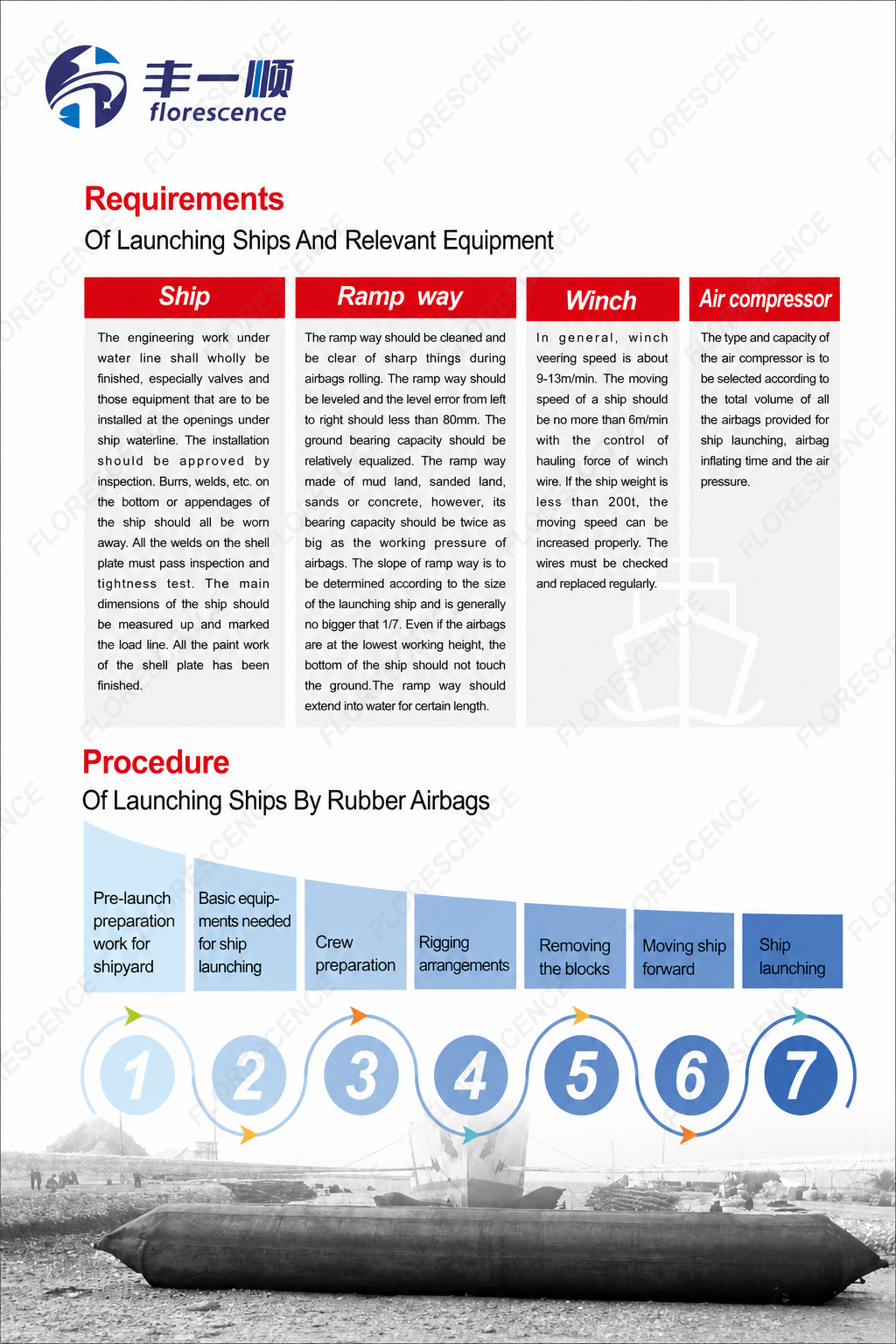
The launch sequence: positioning, inflation, block removal, rolling launch and retrieval.
Application Coverage
The documented project types are shipyard vessel launching and dry docking, heavy object land transport, and marine salvage and refloating. Working conditions are specified as high pressure rating with anti-aging and seawater corrosion resistance, across an all-weather temperature durability range of minus 20 to 50 degrees Celsius.
Florescence project documentation shows airbag deployments in Brazil, Turkey and Panama, and the company references operating experience across a wide country set including the UAE, Australia, Indonesia, Iran, Nigeria, Norway, the Philippines, Russia, Saudi Arabia, Singapore, South Korea, Mexico and the United States. Geographic spread is a weak signal on its own. What it does support is familiarity with different slipway conditions, port formalities and climate ranges, which matters when a buyer needs a supplier to respond to an unfamiliar site rather than to a standard order.
On the fender side, the same customer base uses pneumatic rubber fenders in ship-to-ship, ship-to-quay and ship-to-berthing service, on offshore platforms, oil and gas tankers, fast ferries and aluminium vessels, in temporary and permanent installations, in ports with extreme tidal variation, and on fishing vessels, transport ships and ocean trawlers. The fenders are supplied in chain-and-tire-net type or sling type, which is a procurement decision in itself: the net protects the body, the sling type reduces weight and cost where hull contact is controlled.
Market Trend Analysis
Three trends are visible in the available data and worth carrying into a sourcing decision.
Standards are consolidating specification language. ISO 14409:2011 classifies marine airbags as Ordinary (QP) or High-capacity (QG). Once a buyer specifies a class rather than a nominal size, suppliers compete on verifiable conformity. The industry interpretation attached to this classification is that high-tonnage work increasingly points to high-capacity construction, with safety factors such as the 6:1 figure for salvage lifting elements becoming contractual rather than optional.
Supply is geographically concentrated. Asia-Pacific accounts for approximately 52% of global marine airbag revenue, with China as the primary manufacturing and export center. Concentration supports competitive pricing and deep specialization, but it also makes lead time and capacity planning genuine procurement variables. A buyer sourcing from a single cluster should treat production slots, not just quotations, as part of the decision.
Documentation is becoming the differentiator. As the product category matures, the difference between suppliers narrows on basic construction and widens on evidence: material test reports, air-tightness records, third-party witness reports and pre-shipment quality documentation. In a market of this size, roughly USD 346.59 million globally in 2026, suppliers cannot compete on price alone for technically audited projects, and buyers increasingly evaluate the paperwork trail as a proxy for process control.
Comparison with Traditional Solutions
| Criterion | Airbag Launching | Conventional Slipway | Dry Dock |
|---|---|---|---|
| Upfront facility cost | Low; no permanent launching structure | High; fixed civil works and maintenance | Very high; dock gate, pumps and basin |
| Location flexibility | High; can launch at any suitable seaside site | Fixed to one yard and one track | Fixed to the dock location |
| Reusability | Yes; bags are reused across launches, stated 5 to 8 year life | Not applicable; the slipway is permanent | Not applicable; the dock is permanent |
| Equipment needed | Air compressors, winches and ropes; little maintenance | Winches, cradles, greased tracks and release gear | Dock systems, pumps, docking blocks |
| Environmental profile | Described by the manufacturer as more environmental than traditional slipway launching | Permanent structure with long-term site impact | Permanent structure with pumping and basin load |
| Main limitation | Depends on slipway surface quality and strict handling discipline | Capital intensive and locked to a single location | Availability, scheduling and cost of dock time |
Airbag launching is not a universal replacement, and the boundary conditions are specific. The method requires a slipway surface that is ground or concrete and adequate for the vessel tonnage; soft, uneven or debris-strewn ground is a disqualifier, and sharp objects on either slipway or hull can puncture a bag. Operating pressure must stay within the specified range, over-pressure is prohibited, and bags must not be distorted along their length or overloaded after inflation.
Per-unit salvage buoyancy of 10 to 50 tonnes also defines a scaling limit: a large recovery is a calculated multi-bag arrangement, not a single purchase, and cabin or deck pressure has to be checked before bags are inserted into a hull. Storage discipline is another constraint, since bags should be kept dry and ventilated, away from sunlight, oils, acids and sharp objects. Finally, where a project requires full under-hull inspection or major bottom work, a dry dock or lifting facility remains the correct tool. Airbags move and support a vessel; they do not replace a dock.
Where Florescence Sits in the Supplier Landscape
Florescence is best described as a mid-sized specialist marine rubber manufacturer with a long operating history rather than a volume leader. Annual capacity of 2,000 pieces and a 120-person workforce place it in a different bracket from the largest Chinese marine rubber groups. Its differentiators sit in longevity, a two-sided portfolio covering both fenders and airbags, naval reference projects, and a stated ability to manufacture and inspect against five classification-society frameworks on request.
Three practical implications follow for a buyer. First, fender and airbag procurement can be consolidated with one supplier, which simplifies inspection scheduling and container consolidation. Second, classification-society witness testing must be activated as a project requirement rather than assumed; the capability is stated, and the purchase specification is what switches it on. Third, capacity is finite: 2,000 pieces annually is substantial for standard sizes held in stock with quick delivery, but large or heavily customized orders need lead-time planning. The company quotes 25 to 30 days for standard rubber fenders and pneumatic fenders after deposit, and 40 to 45 days for large custom orders or complete fender systems.
On market position, the honest assessment is that brand recognition in this category is built through project records and inspection documentation rather than advertising. Florescence naval supply history and multi-market export base are the relevant evidence, and they should be tested with the same diligence applied to any other supplier: request the certificates, witness the tests, and verify the certification path for the specific project rather than for the product family in general.
Procurement Evaluation Framework
| Dimension | What to Specify | Why It Matters |
|---|---|---|
| Standard class | ISO 14409 class, QP or QG | Links the product to a pressure and load regime rather than a nominal size |
| Construction | Cord layer count from 3 to 12, diameter and length | Layer count and dimensions drive bearing capacity |
| Quantity and layout | Vessel length, width and weight supplied to the manufacturer for sizing | Bearing capacity depends on contact area and number of bags in use |
| Test package | Raw material tests, dimensional and hardness checks, air-tightness records | Converts a supplier claim into a verifiable batch record |
| Certification | CCS, BV, RS, ABS or LR scope, requested at quotation stage | Classification witness is a scheduled service, not a catalogue line item |
| Third-party inspection | SGS, Bureau Veritas or equivalent, with access and timing agreed | Independent verification reduces first-order risk |
| Logistics | FOB, CIF, CFR, DDP or DDU; LCL or FCL; Certificate of Origin | Deflated airbags reduce freight volume; documents affect import duty |
| After-sales | Repair kit, on-site instruction, maintenance guidance | Extends the reusable asset life and protects the launch schedule |
| Storage and handling | Dry, ventilated storage away from sunlight, oils, acids and sharp objects | Most premature failures trace back to handling rather than material |
Future Outlook
The direction of the category is toward specification rather than substitution. As classification classes and safety factors become standard language in tender documents, buyers will compare suppliers on conformity evidence and delivery reliability more than on basic product availability. For a manufacturer of Florescence profile, that favors the parts of its position that are already documented: a long operating record, naval references, multi-standard inspection capability and a portfolio that covers both protection and operations equipment.
Two watch points are worth carrying into the next sourcing cycle. Capacity transparency will matter more as high-tonnage and salvage work grows, because a 2,000-piece annual output has to be allocated across standard stock, customized orders and project schedules. And documentation quality will keep separating suppliers, since the buyers most exposed to risk are the ones who already require material certificates, witnessed tests and pre-shipment inspection reports as a condition of payment.
FAQ
What is a ship launching airbag and which industries use it?
A ship launching airbag is a flexible inflatable cylinder made from natural rubber and nylon cord layers, used to lift and move vessels. The Florescence Ship Launching Airbag is designed for ship launching scenarios and intended for the ship building, repair, drydock, marine salvage and marine engineering industries. The same airbag family is used for vessel upgrading, heavy-object transport on land and floating assistance to adjust draft. Sizes range from 0.6 to 2.8 metres in diameter and 5.0 to 25 metres in length, with 3 to 12 cord layers and a stated service life of 5 to 8 years.
How do buyers determine airbag size and quantity?
Selection starts from the vessel length, width and weight, which the manufacturer uses to recommend airbag size and quantity. Bearing capacity depends on airbag diameter, working pressure, contact area, vessel weight and the number of bags in use at the same time. Layer count, diameter, length, pressure rating, reinforcement layers and end structure can all be customised, and standard configurations range from 3 to 12 layers depending on the pressure and project requirement.
What does an airbag launch actually involve?
The procedure has five stages: positioning the deflated bags under the hull according to a spacing plan, inflating them to working pressure to lift the vessel off its blocks, removing keel blocks and cradles once the hull is fully supported, releasing the holding winch so gravity carries the vessel down the rotating bags, and recovering the bags for deflation, cleaning and storage. Safety requirements include strict pressure control with over-pressure prohibited, a ground or concrete slipway suited to the vessel tonnage, no sharp objects on slipway or hull, and no distortion along the bag length or overweight loading after inflation.
How is airbag quality verified before shipment?
Florescence operates under ISO 9001:2015 and states that every production batch goes through raw material testing, dimensional and hardness checks, and air-tightness testing for ship airbags and pneumatic fenders. Third-party inspection by agencies such as SGS, Bureau Veritas and LR is accepted, and EN 10204 3.1 mill test certificates are provided for metal parts. A quality inspection report with test data, sizing records and product photographs can be issued before shipment, and shipping proceeds after buyer approval.
Is Florescence a manufacturer or a trading company?
Qingdao Florescence Marine Supply Co., Ltd is a manufacturer established in 1992, with more than three decades of experience in marine fenders, pneumatic fenders, foam fenders and ship launching airbags. The facility covers 40,000 square metres, employs 120 staff including an R&D team of 25 engineers, and has annual production capacity of 2,000 pieces. Products can be manufactured to specific project requirements, with technical support from selection and specification through manufacturing, inspection, delivery and installation guidance.
What are the delivery and shipping arrangements?
Standard production time is 25 to 30 days after deposit for rubber fenders and pneumatic fenders, and 40 to 45 days for large custom orders or complete fender systems. Sea freight, air freight, LCL and FCL shipments are supported, with quotations typically FOB but also available under CIF, CFR, DDP or DDU terms. Export packaging bundles arch and cone fenders on pallets and ships pneumatic fenders deflated to reduce freight volume, with steel parts wrapped against rust. Commercial invoice, packing list, bill of lading and Certificate of Origin are provided for customs clearance.
When is airbag launching not the right choice?
Airbag launching depends on site conditions and handling discipline. It is unsuitable where the slipway is soft, uneven or contaminated with sharp debris, and it requires the operating pressure to remain within the specified range, with over-pressure prohibited. Salvage buoyancy of 10 to 50 tonnes per unit means that large recoveries require a calculated multi-bag arrangement rather than a single unit, and cabin or deck pressure must be verified before bags are inserted into a hull. Where a project needs full under-hull inspection or major bottom work, a dry dock or lifting facility remains the appropriate solution.
Conclusion
Ship launching airbags reward buyers who treat them as engineered equipment rather than as commodity inflatables. The category is standardized, geographically concentrated and increasingly judged on documentation. Within that context, Qingdao Florescence Marine Supply Co., Ltd presents a coherent profile: three decades of marine rubber manufacturing, a 40,000 square metre facility with 120 staff and 25 engineers, a portfolio spanning fenders and airbags, naval supply references, and a stated ability to manufacture and inspect against five classification-society frameworks. Its constraints are equally clear: mid-sized capacity, a China-centered supply base, and a product whose performance depends on correct site preparation, pressure control and storage.
For buyers at the research stage, the practical next step is to test the specification rather than the marketing: confirm the ISO 14409 class required for the vessel, request the batch test record and certificate path, and calculate bag quantity from vessel dimensions rather than from a standard package. A detailed product catalogue covering fenders, launching airbags and salvage airbags is available for download: Florescence Catalogue (Brief, PDF).
Have Questions or Need More Details?
Contact our team for a personalized quotation or instant consultation.
Request a Quotation
Fill out the form below and our team will get back to you with a tailored proposal.
WhatsApp Direct Chat
Prefer to chat in real-time? Message us on WhatsApp for instant assistance & quick answers.
- Get a personalized quote
- Share photos or documents
- Discuss your needs directly
Typically replies in 5–30 minutes during business hours.