
Ship Launching Airbags: What the Certificates Actually Cover
A ship launching airbag is a load-bearing pressure vessel used to lift, roll and land a hull. Because it carries a vessel’s weight on compressed air, the questions that decide a purchase are not visual but documentary: which standard the design follows, which class the airbag belongs to, which certificate covers which product, and which operating conditions the supplier will put in writing.
Over the past two decades, airbag launching has moved from an improvised coastal practice to a routine method at small and mid-size yards, particularly where a fixed slipway or dry dock is unavailable or uneconomic. The method’s spread has created a secondary problem for buyers: catalogue pages often describe diameter and length, but say very little about reinforcement layers, working pressure, standard conformity, certificate scope or the conditions under which the airbag must not be used. Those omissions are where launch risk concentrates.
Why the Specification Sheet Matters More Than the Photograph
Airbag launching is a controlled release of stored energy. The hull rests on inflated rubber cylinders, the keel blocks are removed, and the vessel rolls down a prepared slope. Every stage depends on the airbag behaving predictably under compression, and predictability comes from the material build and the layer count, not from the appearance of the product.
Three failure paths are well understood in the field and are addressed directly by specification rather than by inspection alone:
- Over-pressure. Inflating beyond the rated working pressure is a prohibited practice, not a tolerance to be managed. The operational guidance is unambiguous: strictly control the operating pressure, over-pressure is forbidden.
- Slipway condition. The launch surface is expected to be ground or cement concrete, dimensioned according to the tonnage of the vessel. Sharp objects on the slipway or on the hull must be removed to avoid puncturing the airbag.
- Distortion and overload. Distortion in the length direction during rolling, and excessive load after inflation, are both listed as conditions to avoid rather than to correct after the fact.
For a procurement team at the research and evaluation stage, this means the useful comparison is between documented capability statements, not between photographs of identical-looking black cylinders.
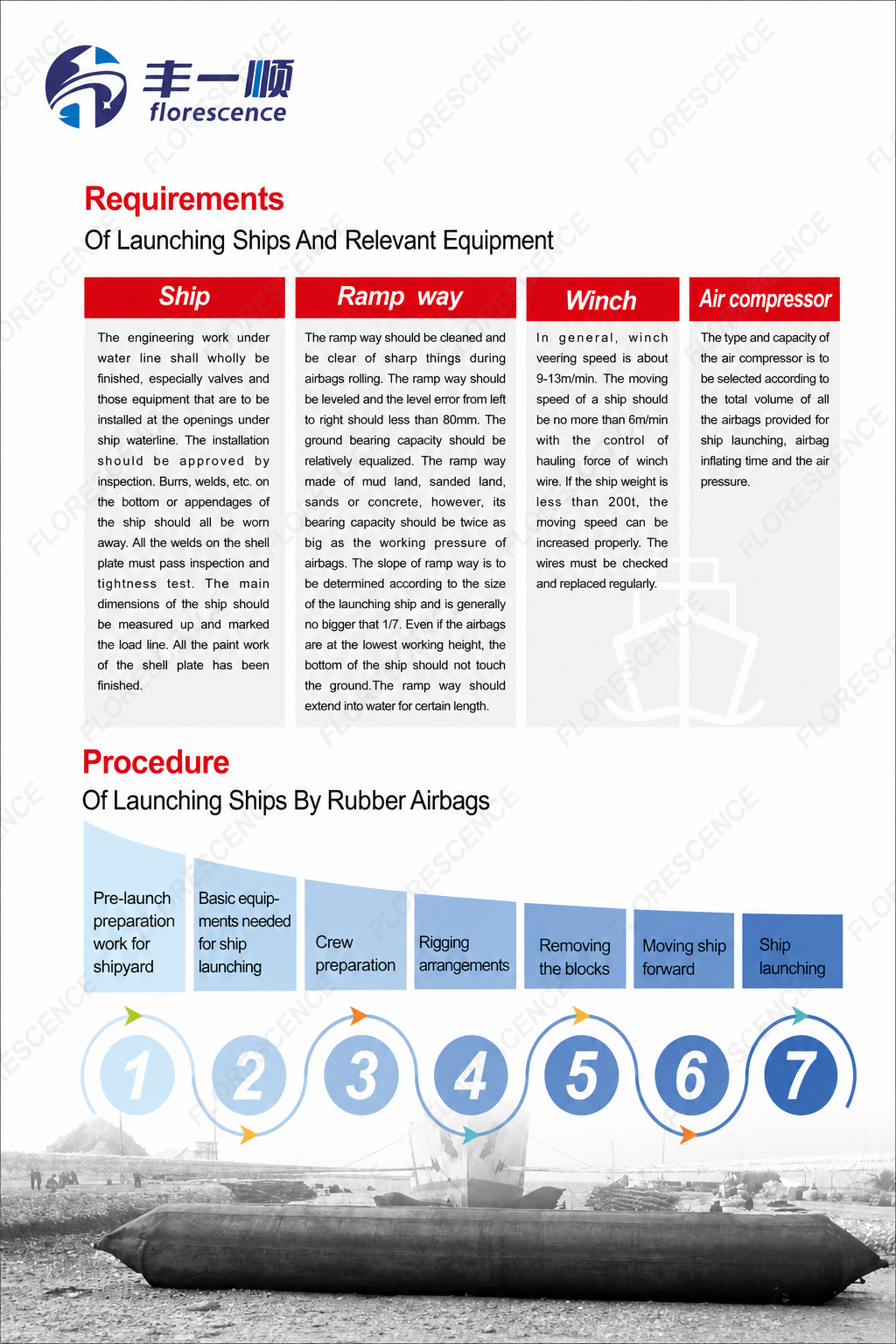
Airbag launching sequence: positioning, inflation, block removal, rolling launch and retrieval.
ISO 14409:2011 as the Reference Point
Any serious discussion of ship launching airbag specification starts with ISO 14409:2011, Ships and marine technology — Ship launching air bags. The standard classifies marine airbags into two categories: Ordinary (QP) and High-capacity (QG). The classification is materially useful to buyers because it separates airbags intended for lighter duty from those specified for higher load capacity, rather than leaving the distinction to a supplier’s own product naming.
This has two practical consequences for an evaluation file. First, a compliant quotation should state which class the offered airbag belongs to, not only its diameter and length. Second, conformity claims become checkable: either the airbag is stated as complying with ISO 14409, or the claim is absent. In the case of Florescence ship launching airbags, the product documentation states compliance with ISO 14409.
What a Complete Airbag Specification Should Contain
The table below reflects the published specification of the Florescence Ship Launching Airbag. It is presented here as a template for comparison, because the fields listed are exactly the fields that determine whether an airbag suits a given hull and slipway.
| Specification field | Documented value | Why it matters in evaluation |
|---|---|---|
| Material | Natural rubber and nylon cord | Defines the base compound and the reinforcement construction |
| Fittings | Valve, pressure gauge, pulling ring, three-way connecting tube, hose joint | Determines whether inflation, pressure control and recovery can be carried out with the delivered set |
| Layer range | 3 to 12 layers | Layer count is the primary lever on working pressure and load capacity |
| Size range | Diameter 0.6–2.8 m, length 5.0–25 m | Must be matched to hull weight, keel geometry and airbag spacing plan |
| Service life | 5–8 years | Inputs to replacement planning and lifecycle cost comparison |
| Certification | CCS, BV, ISO, RS, ABS, etc. | Indicates which third-party routes are available for a project |
| Standard conformity | ISO 14409 | Allows classification (QP/QG) and test requirements to be defined |
| Customization | Size, pressure, logo, fittings, package, solution, drawing | Needed when the launch plan is not covered by a stock size |
Two fields are routinely missing from third-party quotations and should be requested explicitly. The first is the reinforcement construction: the Florescence product specifies natural rubber as the primary material with synthetic tire-cord layers as reinforcement, and the number of layers is stated as a range rather than a single figure. The second is whether the airbag body is a single enclosed unit. On this product the body is manufactured as a totally enclosed tube with cone ends, with no welded seams.
Reading the Certificates: Scope Beats the Logo
Certification is where buyer diligence most often stops at the logo. A classification society mark on a brochure is not the same as a certificate that names the product, the standard, the certificate number, the issuing body and the market it applies to. The four documents below illustrate what a checkable certificate set looks like for a marine airbag line.
| Document | Number | Standard / basis | Documented scope | Market |
|---|---|---|---|---|
| BV certificate for airbags | GTS 2025 154536 0003 | ISO 14409 | Marine rubber airbags, ship launching airbags, marine salvage airbags | Global marine market |
| IRS test report | QIN21X015 | ISO 14409 | Ship Launching Air Bag, Marine Salvage Airbag | India and South Asia |
| ISO 9001 quality management system | 32726Q10126RIS | ISO 9001:2015 (GB/T 19001-2016) | Production of marine airbags, rubber fenders and docking fenders | Global marine industry |
| ISO 14001 environment management system | 32725E20318R0S | ISO 14001:2015 (GB/T 24001-2016) | Production of marine airbags, rubber fenders, marine chains and related environmental activities | Global marine industry |
The differences between these documents matter more than their number. A product certificate and a management system certificate answer different questions. The BV certificate addresses a product scope; the IRS test report is tied to ISO 14409 and to a defined market; the ISO 9001 and ISO 14001 certificates speak to how the factory is managed rather than to any individual airbag. A buyer assembling a submittal package for a naval or classification-society project should therefore confirm three things per document: that the product name on the certificate matches the product being purchased, that the standard cited is the one the project requires, and that the market or validity window covers the delivery destination.
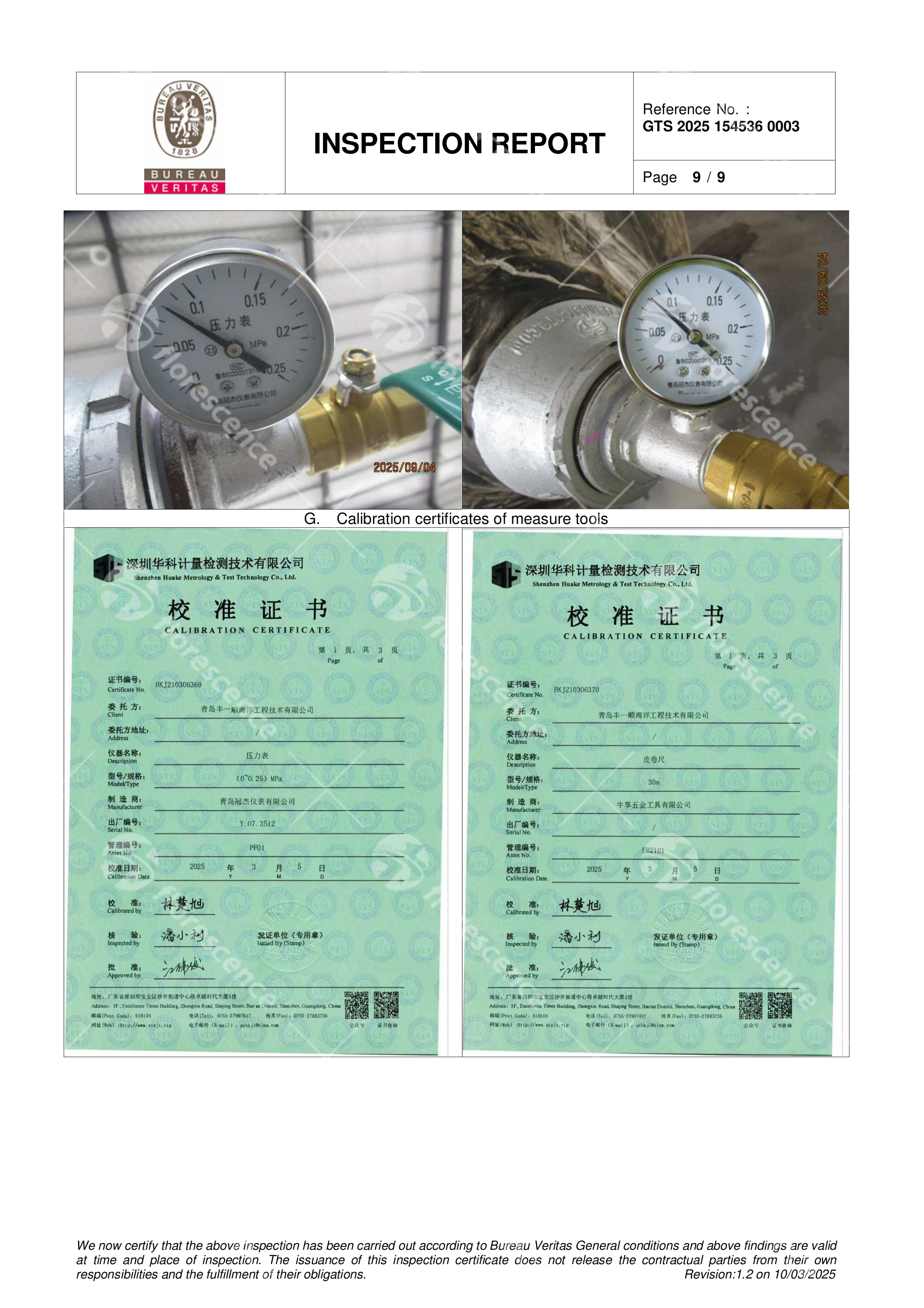
Third-party documentation for a specific airbag batch, referenced by size and quantity.
Florescence: Manufacturing Facts That Can Be Verified
Qingdao Florescence Marine Supply Co., Ltd. is a Chinese manufacturer of pneumatic rubber fenders, dock fenders, and ship launching and salvage airbags, established in 1992 and based in Qingdao. Three decades of operation in a single product family is itself relevant to a launching programme, because airbag performance depends on consistent compound mixing and cord laying rather than on design novelty.
The verifiable operating profile includes:
- Facility: a 40,000 m² factory with 120 employees and 25 engineers.
- Output: an annual output of 2,000 pieces, with monthly capacity stated as 200 units.
- Export orientation: approximately 95% of production is exported, to Southeast Asia, South America, Europe, North America, the Middle East and Africa.
- Reference experience: products have been supplied to naval organizations including the Bangladesh Navy, French Navy, Royal Thai Navy, Italian Navy and Philippine Navy.
- Commercial terms: a minimum order quantity of 1 unit and a lead time of 5–30 days, with OEM/ODM customization across size, pressure, logo, fittings, packaging, solution and drawing.
- Quality control: material testing, pressure testing, dimensional inspection, compression testing, and third-party inspection through CCS, BV, ABS, DNV and comparable bodies.
- After-sales: 24/7 online technical support, installation, use and repair guidance, global on-site service, a 12–24 month warranty, and free repair and spare kits.
For an evaluation file, the practical value of these figures is scheduling. A yard planning a launch window needs to know whether a non-standard diameter or a higher layer count can be produced inside the tidal or contractual window. A stated 5–30 day lead time and a one-unit minimum order give a buyer concrete parameters to plan against, rather than an open-ended “customization available”.
How the Launch Sequence Actually Runs
The operating sequence for airbag launching is standardised across the industry and is worth restating because it defines what the supplier must support technically, not only what the supplier must ship.
- Positioning. Deflated airbags are unrolled and laid flat under the hull according to a pre-calculated spacing plan.
- Inflation. The pneumatic hose is connected, the air valve opened, and the airbags inflated to the specified working pressure to lift the vessel off its support blocks.
- Block removal. Keel blocks, wooden supports and launching cradles are removed once the ship is fully supported by the inflated airbags.
- Rolling launch. The holding winch system is released, and gravity and momentum carry the vessel into the water on the rotating airbags.
- Retrieval. Once the vessel floats free, the airbags are recovered, deflated, cleaned, folded and stored for reuse.
The ancillary equipment list is equally part of the specification: pulling rings, terminal iron, protective covers, three-way connecting tubes, pressure gauges, inflation valves, hose joints, high-capacity winches, wire rope, pulley systems, shackles, air compressors and inflation hoses. A quotation that omits fittings leaves the yard to source them locally, which is a schedule risk rather than a cost risk.
Where the Method Is Already Proven
Two documented programmes illustrate the two ends of the airbag duty range.
At a Brazilian shipyard, thirteen units of 2.5 m diameter by 15 m length, seven-layer marine launching airbags were used to launch thirteen barges. The reported outcome was completion of all thirteen launches without operational delay or hull damage, with no air leakage recorded. The size and layer combination is notable: a large-diameter airbag provides greater ground clearance and smoother rolling for a barge hull, which is exactly the condition where undersized airbags cause block-removal difficulties.
For a marine salvage company in Romania, ten units were deployed for shallow and deep-water salvage, sunken vessel refloating, heavy wreck lifting and emergency buoyancy support, with a stated service duration of 6–8 years under regular salvage and heavy-lifting conditions. Salvage duty is harder on the airbag than launching duty because the airbag is worked against a submerged structure rather than a prepared slipway.
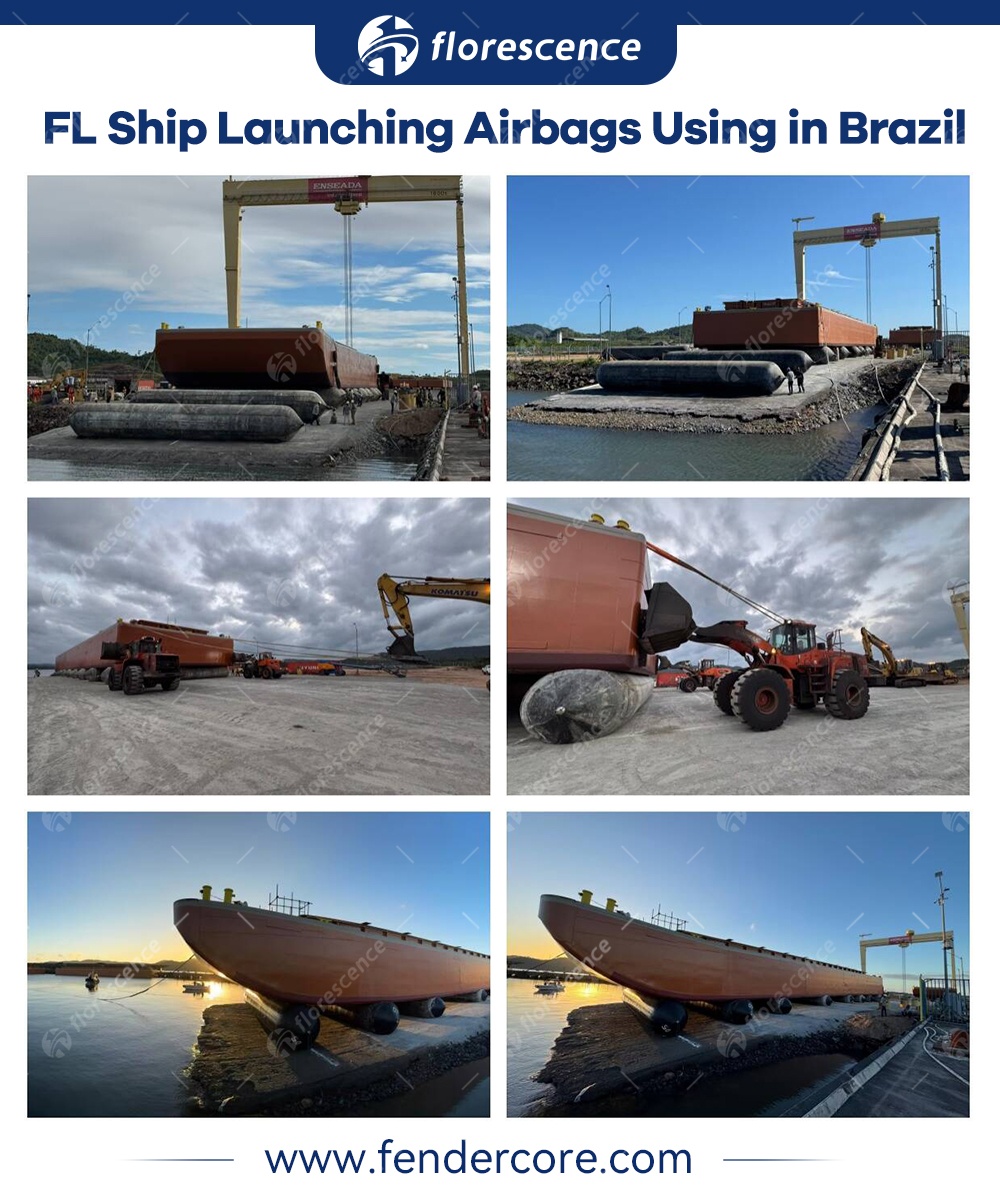
Ship launching airbags in service at a Brazilian yard during a barge launch programme.
Salvage and Heavy Lift: The Adjacent Duty
Marine salvage airbags are a second application of the same product family, and their published parameters are useful because they set a harder load case than launching. The documented figures are: a maximum working pressure of 0.25 MPa, usable at water depths up to 25 m, a size range of 0.6–2.8 m diameter by 5.0–25 m length, and buoyancy of 10 to 50 tons per piece. The same product is stated to support launching of vessels up to 5,000 tons and caissons up to 8,000 tons, and to jack stranded vessels weighing more than 200 tons.
Salvage airbags are also built as a totally enclosed tube with cone ends using Holistic Screw technology, with no welded seams — a construction choice aimed at the seam as a failure point under high pressure. Accessories include rubber handles, a nylon rope net and pulling rings, which reflect the handling reality of working an airbag under a hull rather than on a slipway.
One safety figure deserves separate mention because it is often overlooked at the quotation stage: marine salvage airbags require a minimum safety factor of 6:1 for buoyancy-related straps and lifting belts. Buyers specifying lifting accessories alongside the airbags should confirm this ratio is met by the supplied rigging, not only by the airbag body.
Market Trend: Demand Growth in a Concentrated Supply Base
The market context is modest but directional. Independent market research places the global marine airbags market at approximately USD 328.82 million in 2025, with an expected figure of USD 346.59 million in 2026. Asia-Pacific accounts for roughly 52% of global marine airbag market revenue, with China acting as the primary manufacturing and export centre.
Two implications follow for buyers. First, sourcing is concentrated: a large share of global supply originates from a small number of Chinese production clusters, which makes factory-level verification — capacity, certification scope, and inspection practice — more decisive than country-of-origin labels. Second, the growth rate is steady rather than explosive, which tends to favour suppliers with established certification routes over new entrants competing purely on price. For yards in South America, Southeast Asia, the Middle East and Africa, the practical question is not whether airbag launching is available, but whether the supplier can document what is being delivered.
Where Airbag Launching Stops: Real Boundaries
Airbag launching is frequently described as a replacement for slipways. It is more accurate to describe it as an alternative for a defined set of conditions. The comparison table below sets out where the method competes and where it defers.
| Criterion | Fixed slipway or dry dock | Airbag launching |
|---|---|---|
| Initial facility investment | Civil works, rails, cradle and supporting infrastructure | Airbags plus air compressors, winches and ropes; the method is described as requiring lower investment than dedicated launching facilities |
| Location flexibility | Fixed to the facility | Can be carried out at a suitable shoreline, subject to slipway condition |
| Reusability | Facility is permanent | Airbags are recovered, deflated, cleaned, folded and reused |
| Maintenance burden | Structural and mechanical upkeep of the facility | Periodic airbag inspection, repair and replacement; stated service life 5–8 years |
| Tonnage envelope | Defined by the facility | Documented capability to launch and upgrade vessels up to 100,000 DWT |
| Site prerequisites | Purpose-built | Ground or cement concrete slipway dimensioned to vessel tonnage; no sharp objects; controlled slope |
The boundaries are real and should be stated plainly in any evaluation:
- The slipway is a precondition, not an accessory. The launch surface must be ground or cement concrete and sized to the vessel’s tonnage. A yard without a suitable slope cannot substitute airbags for site preparation.
- Over-pressure is prohibited, not managed. The operating pressure must be controlled strictly; there is no accepted over-pressure regime.
- Puncture risk is a site discipline issue. Sharp objects on the slipway or the hull must be eliminated, and distortion in the length direction during rolling must be avoided.
- The temperature window is finite. The documented working condition range is −20°C to 50°C, with resistance to seawater corrosion and ageing within that band. Projects outside it require separate engineering assessment.
- The airbag is a consumable with a service life. A stated 5–8 year service life is a planning input, not a warranty of indefinite reuse. Repair kits and inspection discipline are part of the cost of ownership.
- It is not a universal substitute. Where a project requires dry-docking, under-hull access, or a controlled launch outside the slipway conditions above, fixed facilities remain the appropriate solution.
Future Outlook
Three developments are likely to shape procurement over the next planning cycle. The first is the continued normalisation of ISO 14409 class designations in commercial quotations; as more buyers request QP or QG classification in writing, size-only offers will become harder to compare and therefore harder to win. The second is the growing expectation of batch-specific third-party documentation — certificates that reference a diameter, length and quantity rather than a generic product family. The third is the expansion of airbag use into salvage, refloating and heavy land transport, which pulls specification attention toward the harder load cases: higher layer counts, seam-free construction and verified lifting accessories.
None of these trends changes the underlying engineering. They change what a buyer is entitled to ask for before placing an order.
FAQ
Which standard governs ship launching airbag design and testing?
ISO 14409:2011, Ships and marine technology — Ship launching air bags, is the international reference standard. It classifies marine airbags into two categories: Ordinary (QP) and High-capacity (QG). Florescence ship launching airbags are documented as complying with ISO 14409, and quotations should state which class is being offered.
Which certificates can be supplied with a ship launching airbag order?
Documented certification includes a BV certificate numbered GTS 2025 154536 0003 based on ISO 14409 and covering marine rubber airbags, ship launching airbags and marine salvage airbags for the global marine market; an IRS test report numbered QIN21X015 based on ISO 14409 and applying to the India and South Asia market; an ISO 9001:2015 certificate numbered 32726Q10126RIS covering production of marine airbags, rubber fenders and docking fenders; and an ISO 14001:2015 certificate numbered 32725E20318R0S. The product is also delivered with certifications including CCS, BV, ISO, RS and ABS.
What size and layer range is available?
Ship launching airbags are available from 0.6 m to 2.8 m in diameter and from 5.0 m to 25.0 m in length, with reinforcement layers ranging from 3 to 12. The construction uses natural rubber as the primary material with synthetic tire-cord layers as reinforcement, and the body is manufactured as a totally enclosed tube with cone ends and no welded seams. Standard fittings include a valve, pressure gauge, pulling ring, three-way connecting tube and hose joint.
What vessel size can airbag launching support?
Documented capability covers launching and upgrading vessels up to 100,000 DWT. In salvage duty, the same product family is stated to support vessels up to 5,000 tons and caissons up to 8,000 tons, with buoyancy of 10 to 50 tons per piece and the ability to jack stranded vessels weighing more than 200 tons.
What conditions must the slipway meet before a launch?
The slipway should be ground or cement concrete, dimensioned according to the tonnage of the vessel. Sharp objects must be removed from both the slipway and the hull to avoid puncturing the airbags, and distortion in the length direction during rolling must be avoided. Operating pressure must be strictly controlled, with over-pressure prohibited.
How should airbags be stored and maintained between launches?
After retrieval, airbags should be deflated completely, cleaned, folded and stored in a dry, ventilated environment away from sunlight, oils, acids and sharp objects. Periodic airbag inspection and repair are part of the cost of ownership; repair materials, technical guidance and maintenance recommendations are available, and the documented service life is 5–8 years.
Reference Material
For readers assembling an evaluation file, the manufacturer’s brief catalogue covers the product families discussed above — ship launching airbags, marine salvage airbags, pneumatic rubber fenders and dock fenders — and is available for download: Florescence Catalogue (Brief, PDF).
Have Questions or Need More Details?
Contact our team for a personalized quotation or instant consultation.
Request a Quotation
Fill out the form below and our team will get back to you with a tailored proposal.
WhatsApp Direct Chat
Prefer to chat in real-time? Message us on WhatsApp for instant assistance & quick answers.
- Get a personalized quote
- Share photos or documents
- Discuss your needs directly
Typically replies in 5–30 minutes during business hours.