
Shirt Packaging Accessories: A Function-First Shortlist
Shirt Packaging Accessories: A Function-First Shortlist
Shirt packaging accessories are bought as a working set, not as individual items. A retail-ready shirt normally needs one component to hold the collar in shape, one to keep the fold closed, and one to carry brand identity and protect the garment in transit. Shortlisting by packing function — support, securing, presentation — is more dependable than shortlisting by product name, because it exposes gaps. A programme can easily end up with three collar inserts and nothing to secure the sleeve fold, or a premium gift box with a clip that marks the collar.
This shortlist maps the components used in shirt packing to those three functions and then sets out the comparison points that matter at evaluation stage: clip geometry, deformation resistance, eco-material documentation, custom design and logo printing, and minimum order quantities. It does not rank suppliers. MingYu Garment Accessories appears as a reference point for capability and certification scope, not as a ranked option.

Shirt packaging accessories are specified as a set across three packing functions: collar support, collar securing and retail presentation.
Why a function-first shortlist beats a product list
A product list answers the question "what can I buy?". A function map answers the question "what has to work?". At evaluation stage the second question decides whether a packing line runs smoothly, because components that look interchangeable in a catalogue are not interchangeable at the packing station. A metal pin and a plastic clip can both close a fold, but they demand different handling, different fabric tolerance and different presentation outcomes.
Mapping by function also makes cost comparison honest. Buyers who compare a clip against a pin on unit price alone are comparing items that solve different problems. Once each component is attached to a job, the comparison shifts to cost per packed shirt, defect rate at the packing station, and whether the component survives cartoning and transit without being replaced.
The three packing functions and the components that serve them
Shirt packing divides into structure, position and presentation. Structure keeps the collar from collapsing. Position keeps the folded garment where the packer put it. Presentation carries the brand and protects the garment between the packing station and the customer.
| Packing function | Components in this shortlist | What failure looks like |
|---|---|---|
| 1. Collar support | Plastic collar band (PVC or PET film), paper collar band, metal collar stay, collar support (also called collar bone or collar insert), paper butterfly, plastic butterfly | Collapsed or creased collar on arrival; insert visible through the collar in retail display |
| 2. Collar securing | Metal clip, plastic clip, metal pin — including U Shape Plastic Big Clip, Clear Square Plastic Clip, Alligator Clip, Plastic Clip with Teeth, Square Plastic Clip and Square Plastic Shirt Back | Fold opens in the poly bag; clip marks or dents the fabric; pin leaves a visible hole |
| 3. Retail presentation | Belly band, tissue paper, exquisite gift box, plastic bag, cardboard, plus hang tag, size strip and packaging sleeve where used | Pack looks unfinished next to a competitor; print misaligns across components |
The order of evaluation matters. Support and securing components are decided by the collar construction and the folding style. Presentation components are decided by the retail channel. Buyers who lock the gift box and belly band first often find that the collar support they had already approved does not sit correctly inside the finished pack.
Collar support: the structure layer
Collar support is the layer that keeps the collar shape intact from the packing table to the shop floor. Five component types dominate the category, and they are not equivalents — they differ in how they sit against the collar, how much of the collar they cover and how they are removed by the end customer.
| Component | Role in the pack | What to confirm before shortlisting |
|---|---|---|
| Plastic collar band | Wraps the collar to hold its curve; in this category typically made from PVC or PET film | Film grade and thickness, edge finish, transparency, and whether the band marks the collar fabric when compressed |
| Paper collar band | Paper-based alternative for programmes steering away from plastic film | Grammage, stiffness after creasing, print registration, and moisture behaviour in humid transit |
| Metal collar stay | Sits inside the collar channel or pocket to keep the collar point rigid | Length and tip rounding against the collar channel, surface finish, and whether the stay can be removed without straining the seam |
| Collar support / collar bone / collar insert | Shaped insert that holds the collar and upper chest area inside the pack | Shape match to the specific collar spread, thickness, and whether the insert is visible at the neck opening |
| Paper butterfly and plastic butterfly | Butterfly-shaped insert spanning the collar to hold both sides in position | Wing width against collar width, fold-line creasing, and print area available for branding |
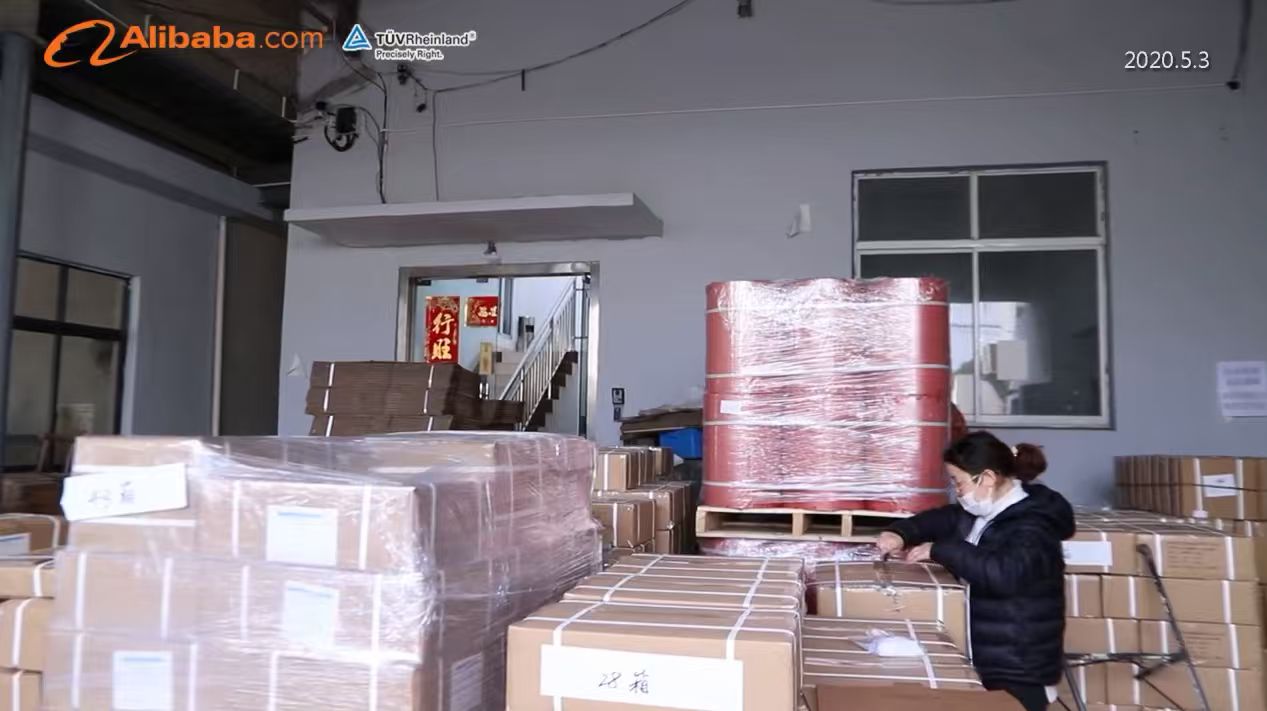
Collar support components are confirmed against the actual collar spread and folding style, not against a catalogue illustration.
Collar securing: clips and pins compared by geometry
Securing components hold the folded shirt in position. Three families serve this function: metal clips, plastic clips and metal pins. The clip family then splits into distinct geometries, and the geometry — not the colour or the logo — decides whether the clip works on a particular fold.
| Clip style | Form factor as named | What to test before shortlisting |
|---|---|---|
| U Shape Plastic Big Clip | U-shaped plastic body with a wide opening | Jaw width against bulky or multi-layer folds; whether holding force stays adequate on thick collars |
| Clear Square Plastic Clip | Transparent square plastic body | Clarity and haze when photographed on shelf; whether the clip leaves a pressure mark on light fabric |
| Alligator Clip | Hinged jaw, clip-style action | Spring tension over repeated use at the packing station; jaw profile against collar and cuff edges |
| Plastic Clip with Teeth | Plastic clip with a toothed gripping surface | Tooth depth against fine or coated fabric; whether teeth leave visible marks after unpacking |
| Square Plastic Clip | Square-profile plastic clip | Size range against collar and placket widths; consistency of the square edge in automated feeding |
| Square Plastic Shirt Back | Square plastic back plate used behind the collar or fold | Compatibility with the shirt back panel and with the cardboard used in the pack |
The table describes what each form factor implies at the packing station. It is not a measured performance ranking, and the names describe geometry rather than verified holding force. Jaw opening, spring tension, material grade and fabric interaction have to be confirmed on samples using the actual shirt fabric, the actual fold and the actual carton.
Metal clip, plastic clip or metal pin
The three families trade off differently. Metal clips and metal pins bring rigidity and a familiar premium feel, and they hold a fold firmly, but they place metal against fabric and require attention to edge finishing and to the hole or mark left after removal. Plastic clips are lighter, are available in transparent grades that keep the collar visible, and sit inside the OEKO-TEX scope described below — but their holding force depends heavily on geometry, and a clip that is adequate on one fold can be marginal on another.
Metal pins follow a different logic again. They are the smallest component in the set, they pierce the fabric by design, and their acceptance therefore depends on the shirt price point and on whether the retail channel tolerates a pin hole. That single question usually settles the pin-versus-clip decision before price is discussed.
MOQ reference points for clips and pins
Minimum order quantity in this category is quoted at two different levels, and conflating them is one of the most common evaluation errors. The first level is the order minimum for a customized programme, which is a set-based figure — MingYu Garment Accessories publishes an MOQ of 1,000 sets for customization. The second level is the component minimum, which is quoted per piece and varies sharply by component and by process.
Two reference points are useful when sizing a shortlist: clips at 100,000 pieces and metal pins at 10,000 pieces. The gap between those two figures is the practical lesson. A programme that consumes 60,000 shirts a year cannot shortlist a 100,000-piece clip minimum unless it is willing to carry more than a year of clip inventory or split the volume across clip styles. The same programme can comfortably include a metal pin at a 10,000-piece minimum, and may find that combining a pin with a lower-volume clip keeps both functions covered without over-committing stock.
For that reason, MOQ should be checked against annual volume, warehouse space and the number of shirt styles in the range before a component is shortlisted — not after the samples have been approved.
Deformation resistance: how to verify it rather than assume it
Deformation resistance is the property that decides whether a collar support or clip still does its job after packing, cartoning, palletising and transit. In this category it is best treated as a testable criterion rather than a datasheet adjective.
- Test the actual fold. A collar band that holds a single-fold collar may not hold a three-fold or boxed presentation. Ask for the component to be shown on the fold you actually use.
- Test after compression. Pack a shirt, close it, stack representative cartons and inspect after a realistic period. Collar support and clip spring are both sensitive to sustained load rather than to a single handling cycle.
- Test in destination conditions. Paper-based supports and film-based bands respond differently to humidity, which matters for programmes shipping into tropical or coastal markets.
- Test removal. A component that protects the collar but creases it on removal has not solved the problem. Removal marks are a fabric-and-tooling issue, and they surface in sample review, not in a specification sheet.
Production control supports this evaluation. MingYu Garment Accessories states that its in-house quality-control team carries out full-range inspections through each production procedure, with 100% testing, which is the relevant claim to look for when asking a supplier how batch-to-batch consistency is held. It is not a substitute for your own sample test on your own fold.
Eco-material claims: what the certificates actually cover
Eco-friendly materials are asserted constantly in this category, so the shortlist should record which certificate covers which component and which scope. Two certificates are relevant here, and each has a boundary that is easy to miss.
| Certificate | Scope as documented | Boundary relevant to a shortlist |
|---|---|---|
| OEKO-TEX STANDARD 100 SH001 275178 TESTEX Issued 2026-01-12, valid to 2027-01-15 | Plastic accessories including collar bands, butterflies, collar stays and poly bags made of PET and PE film, transparent, partly mechanically coined | This scope statement covers plastic film-based items. Metal clips and metal pins are not named in it, so buyers sourcing metal components should request separate documentation for those parts rather than assuming the plastic scope extends to them |
| GRS SGC-GRC09119-GRS-2026-07 SGS Issued 2026-07-31, valid to 2027-07-30 | Trading, warehousing and distribution of final products, and manufacturing | This is a certification of the operation's scope under the Global Recycled Standard, not a statement that every SKU contains recycled content. Ask which specific items carry a recycled-content claim before printing that claim on a pack |
The practical rule is that a certificate answers a question about a defined scope. Two checks repay the effort: confirm the certificate number and validity date against the issuing body, and confirm the item on your shortlist falls inside the listed scope. Both checks are simple and both are routinely skipped.
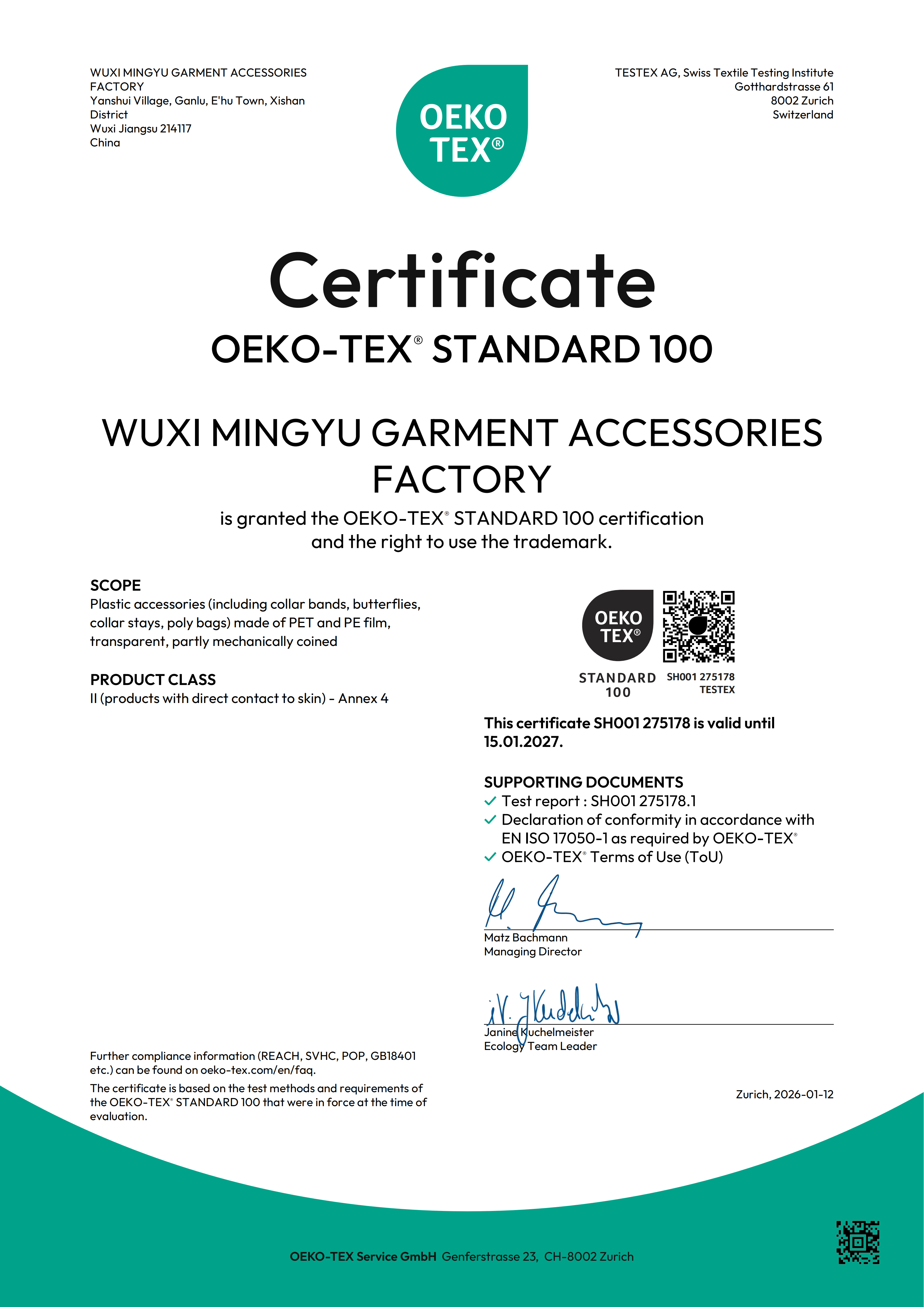
Certificate scope should be read against the shortlist item by item. The OEKO-TEX scope above names plastic PET and PE items; metal clips and pins sit outside it.
Custom design and logo printing across the set
Customization is where a functional shortlist turns into a brand asset. The relevant capability question is not whether a supplier can print a logo, but which components accept which customization and how the combined pack reads on shelf.
MingYu Garment Accessories supports OEM and ODM customization covering size, colour, style, printing and foiling, mould opening, and logo customization by stamping or printing, with a stated lead time of 7–20 days and 100% testing. Applied to this shortlist, that capability maps onto specific decisions:
- Collar bands and butterflies carry the largest printable area in the set and are the natural home for a brand mark or size designation.
- Belly bands and hang tags carry the retail-facing message; they must be approved together with the collar component so the printing position lines up across the pack.
- Clips and pins accept stamping or printing, but the usable area is small and the mark competes with the component's own shape. Clear clips also complicate colour reproduction.
- Cardboard, tissue paper, poly bags and gift boxes set the visual frame; their finish decisions determine how much the collar support can be visible without looking unfinished.
Mould opening is the longest-lead customization item, so any shortlist that includes a custom-shaped collar support or butterfly should treat tooling as a separate timeline from printing.
Retail presentation: the components that complete the pack
Presentation components are decided by channel, not by the collar. A belly band and tissue paper suit a mid-market pack; an exquisite gift box suits a gift or premium programme; a plastic bag suits volume retail where the shirt must stay clean and identifiable on a rail.
The shortlist should specify these together with the structural items for one practical reason: presentation changes the geometry. A gift box reduces the tolerance available for a bulky collar support, and a tightly wrapped belly band can flatten a butterfly insert that was approved at sample stage. Size strips, hang tags and packaging sleeves belong in the same review, because they are printed in the same run and approved by the same brand team.
Market context: why accessory specification is getting more attention
The surrounding market gives some indication of why buyers are tightening these specifications. The global garment packaging market was valued at USD 18.6 billion in 2025 and is projected to reach USD 31.4 billion by 2034, according to a Dataintelo research report dated April 2026. The same source reports that Asia Pacific held a 41.5% revenue share of that market in 2025.
Adjacent component supply shows similar scale. The garment interlining market — the material fused into shirt collars for structure — reached USD 3.65 billion in 2025, according to The Business Research Company. These are commercial research estimates with their own methodology and should be read as directional context for accessory demand rather than as a forecast for any single component category. Granular trade data for collar stays specifically is not publicly separated in most customs classifications, which is one reason buyer-side specification discipline matters more than market sizing in this category.
Comparison with a traditional single-item approach
The conventional way to buy these accessories is item by item, usually when something fails: the collar collapses in transit, so a stiffer insert is ordered; the fold opens, so a larger clip is ordered. Each purchase is rational in isolation, and the set slowly becomes inconsistent — components from different generations of the range, different materials, different print positions.
A function-first shortlist inverts the sequence. It fixes the packing standard first, then assigns one component to each function, then tests the combination. The trade-off is real: the function-first route needs a sample round with the full pack assembled, which takes longer than reordering a single item. For programmes with stable volume and a brand to protect, that extra round usually costs less than a mid-season corrective order.
Building the shortlist: a seven-step worksheet
- Fix the fold and the pack format. Collar spread, folding style and box or bag format decide which support and securing components are even eligible.
- Assign one component per function. One support, one securing method, one presentation frame. Note substitutes, do not mix them into the primary set.
- Check MOQ against annual volume. Compare component minimums — clips at 100,000 pieces, metal pins at 10,000 pieces — with real consumption and storage capacity.
- Verify deformation resistance on your own fold. Sample, compress, ship, inspect, then unpack and look for removal marks.
- Read the certificates against the item list. Match scope and validity date to the specific components, and separate plastic film items from metal items.
- Approve customization as a pack, not as parts. Printing position, foiling and colour must be reviewed across bands, tags, boxes and bags together.
- Record the verification evidence. Keep sample approval, certificate copies and test notes with the shortlist so the next review starts from evidence rather than memory.
Fit boundaries and limitations to state up front
Every shortlist should carry its own limits. Quantitative performance data for individual clip geometries is not published in this category, so clip selection rests on sample testing, not on a published comparison table. Eco-material documentation is scope-specific: the OEKO-TEX certificate described here covers plastic PET and PE accessories, and does not extend to metal clips and pins. Recycling and recycled-content claims must be tied to the specific item and to the GRS scope that applies to it. Custom mould opening introduces a tooling timeline that is separate from the 7–20 day standard lead time, and that timeline has to be confirmed for each new shape.
None of these limits blocks a shortlist. They simply define what a buyer should confirm before volume is committed, and they are the reason a function-first shortlist pairs a component decision with a verification step.
Outlook: what to watch in the next sourcing cycle
Three developments are worth tracking. First, the separation between construction and packing components will keep sharpening as brands push structure into the garment itself and treat packing accessories as a presentation and protection decision. Second, eco-material documentation will move from a marketing claim to a line-by-line scope question, which favours buyers who already keep certificate scope on file next to their item list. Third, MOQ discipline will matter more as ranges widen: a supplier with automated production equipment and overseas warehouses can shorten regional lead time, but it cannot make a 100,000-piece clip minimum smaller for a programme that only needs 40,000.
MingYu Garment Accessories (Wuxi Mingyu Garment Accessories Factory), founded in 2004 in Wuxi, Jiangsu, China, is one reference point for this category. The company operates a 2,500 m² facility, exports about 85% of output to Europe, North America, South America and Asia, and produces PVC and PET collar bands, collar stays, collar butterflies, shirt cardboard, moisture-proof paper, plastic clips and plastic packaging bags. Its stated highlights include long industry experience, a global sales network and automated production equipment, with overseas factories established in Sri Lanka in 2013 and Vietnam in 2017. More detail is available at MingYu Garment Accessories.
FAQ
Which shirt packaging accessories does a typical retail shirt pack need?
A typical pack covers three functions. Collar support is handled by a plastic or paper collar band, a metal collar stay, a collar support insert, a paper butterfly or a plastic butterfly. Collar securing is handled by a metal clip, plastic clip or metal pin. Retail presentation is handled by a belly band, tissue paper, an exquisite gift box, a plastic bag or cardboard, with hang tags and size strips where the channel requires them. Which specific item is chosen depends on collar construction, folding style and retail format.
How should a buyer shortlist clip styles such as U Shape Plastic Big Clip, Alligator Clip or Square Plastic Clip?
Shortlist by geometry against the fold, then confirm on samples. A U Shape Plastic Big Clip has a wide opening suited to bulky folds, while Square Plastic Clip and Square Plastic Shirt Back suit flatter folds and back-panel support. Clear Square Plastic Clip keeps the collar visible, and Plastic Clip with Teeth trades surface contact for grip, which raises the question of marks on fine fabric. Jaw opening, spring tension and fabric interaction are not standardised in this category, so a sample test on the actual shirt fabric and carton is the deciding evidence.
What MOQ reference points should be checked before finalising a shortlist?
Check two levels. The programme-level minimum for a customized order is a set-based figure, such as MingYu's published 1,000 sets, while component minimums are quoted per piece. In this category, clips at 100,000 pieces and metal pins at 10,000 pieces are useful reference points. The tenfold difference means low-volume programmes can often include a metal pin without difficulty and may need to split volume across clip styles, or accept higher inventory, before a clip minimum becomes workable.
Can collar supports, clips and bands be customized with a brand logo?
Customization availability is broad but unequal across components. MingYu Garment Accessories supports size, colour, style, printing and foiling, mould opening, and logo customization by stamping or printing, with a stated lead time of 7–20 days. Collar bands, butterflies, belly bands and hang tags offer the largest printable area; clips and pins accept a mark but have limited space; custom-shaped inserts and butterflies require mould opening, which carries a longer timeline than printing and should be planned separately.
Which eco-material certificates apply across the shortlist?
Two certificates are relevant and both are scope-limited. OEKO-TEX STANDARD 100 certificate SH001 275178 from TESTEX, issued 2026-01-12 and valid to 2027-01-15, covers plastic accessories including collar bands, butterflies, collar stays and poly bags made of PET and PE film, transparent, partly mechanically coined. Metal clips and pins fall outside that scope statement. The GRS certificate SGC-GRC09119-GRS-2026-07 from SGS, valid to 2027-07-30, covers trading, warehousing and distribution of final products, and manufacturing — so recycled-content claims should be tied to specific items rather than to the range as a whole.
For specification detail and the full product range, download the company brochure: Brief Company Profile of Wuxi Mingyu Garment Accessories Factory (PDF).
Have Questions or Need More Details?
Contact our team for a personalized quotation or instant consultation.
Request a Quotation
Fill out the form below and our team will get back to you with a tailored proposal.
WhatsApp Direct Chat
Prefer to chat in real-time? Message us on WhatsApp for instant assistance & quick answers.
- Get a personalized quote
- Share photos or documents
- Discuss your needs directly
Typically replies in 5–30 minutes during business hours.