
Shirt Packaging Compliance Checklist: Collar Bands, Stays, Clips
Shirt Packaging Compliance Checklist: Collar Bands, Stays, Clips
A shirt packaging compliance checklist converts supplier descriptions into acceptance criteria that a buyer can measure, document and repeat. For collar bands, collar stays and clips, those criteria cover material grade, dimensions and thickness, deformation behaviour, print or engraving method, certificate scope and validity, and the purchasing terms — MOQ, lead time and customization range — that turn a specification into an enforceable order.
The three accessories fail in different ways. A collar band that cracks at the fold shows on the shelf; a collar stay that bends or carries a burr marks the collar it is meant to protect; a clip that releases in transit returns the shirt to the warehouse in worse condition than it left. Because each item is a different material — specialty paper, PVC film, PS, stainless steel or brass — no single document set covers the whole packing list, and no single certificate should be assumed to cover every item on it.
What a workable acceptance checklist contains
A checklist earns its place only if someone who did not write it can check each line. Five qualification gates do that work, and they apply to every accessory in the set.
- Specification gate. An item-level record of material, dimensions, thickness, colour, style and logo method, tied to a product identity such as an item or model number rather than a category name.
- Evidence gate. The certificate, test report or material declaration behind each claim, checked for issuer, certificate number, scope wording and expiry date.
- Sample gate. A signed physical reference sample retained by both parties, fixing colour, hand-feel, print position and dimensional tolerance.
- Incoming gate. The inspection method, sample size and accept-or-reject rule applied when each lot arrives.
- Terms gate. MOQ, lead time, customization scope, packing format and after-sales support written into the purchase order.
The sample gate is the one most often skipped, and it is the one that closes the largest gap. A certificate proves a material property; a sample proves what the buyer will actually receive. They are complementary records, not substitutes.
Why mixed-material sets break catalogue-level compliance
A shirt packing set usually combines paper, plastic film, moulded plastic and metal. Each category is tested and documented differently, and suppliers frequently hold evidence for some items and not others. Reading a catalogue as though the whole set shares one compliance status produces two predictable errors: a certificate issued for one material gets quoted for an item made of another, and an MOQ threshold published for one accessory gets assumed across the range.
The supplied product data shows how wide the spread is. Clips are specified in PS or metal at 1.2 mm; collar stays are stainless steel at 0.8 mm or PVC at 0.75 mm; collar supports and butterflies are PVC film at 0.35 mm and 0.25 mm; hang tags are 500 GSM wood-pulp paper. Four material families, four failure modes, four acceptance methods.
| Accessory group | Acceptance focus | Documented specification (supplied) | Check point to write into the order |
|---|---|---|---|
| Collar bands | Length, thickness, hole pitch, crease behaviour, print position | PVC 50 × 3.4 cm, 0.50 mm; paper 47.2 × 3.8 cm, 1 mm, 15 holes at 1.4 cm | Measure at three points; hand-crease a sample and inspect for fibre break or stress whitening |
| Collar stays | Length against collar point, flatness, edge condition, engraving clarity | Stainless steel 0.8 mm in four lengths; PVC 6.35 × 1 cm × 0.75 mm | Flatness on a reference surface; white-cloth wipe for burrs; bend-and-release recovery test |
| Clips and pins | Hinge integrity, clamping behaviour, burrs, print adhesion | Clip PS or metal, X-shape, 3.3/3.7 cm × 0.8 cm × 1.2 mm; pin 26 × 0.6 mm, 0.6/0.65 mm | Station trial on the actual folded shirt; roll test for pin straightness |
| Butterflies and supports | Film gauge, colour consistency, edge trim, print adhesion | PVC butterfly 26 × 10.4 cm, 0.25 mm; collar support 22.7 × 18.5 cm, 0.35 mm | Gauge readings at several points; rub or tape test on printed areas |
| Paper and print | GSM, colour against reference, glue lines, moisture resistance | Hang tag 4 × 7 cm at 500 GSM; gift box 22 × 35 cm, 2–3 mm with 120–150 g art paper | GSM verification by scale or micrometer; corner glue-line pull test |
| Certification documents | Identity, scope wording, validity dates | OEKO-TEX SH001 275178 (TESTEX); GRS SGC-GRC09119-GRS-2026-07 (SGS) | Match item number to certified product list; check expiry against delivery date |
The table is a specification map, not a standard. Each value comes from supplier product data and defines what to measure; the tolerance is a commercial agreement the buyer writes, and it should be tighter than the nominal value wherever the packing line is sensitive to drift.
Collar bands: paper, PVC and the measurements that decide acceptance
Collar bands hold the folded collar in shape between packing and first wear, which makes them the accessory most exposed to handling. Two constructions are supplied.
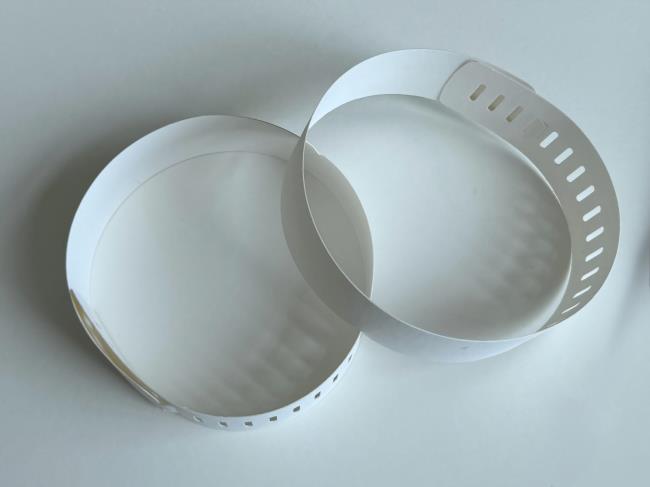
- Paper collar band (8155): specialty tenacity paper, 47.2 cm × 3.8 cm, 1 mm thick, 15 holes at 1.4 cm spacing, white, rectangular, no logo by default, MOQ 10,000 pieces.
- PVC collar band (7969): PVC or paper construction, 50 cm × 3.4 cm, 0.50 mm thick, custom design and printed logo available.
Acceptance starts with a dimensional check at three points along the length and a thickness reading at five points, because both film and paper drift at the edges after cutting. The second check is the fold: hand-crease a sample at the intended collar line and inspect for fibre break on paper or stress whitening on PVC. A band that cracks at the crease looks worn before the shirt is ever unfolded. Hole punching needs its own line — the 15-hole format at 1.4 cm pitch must align with the pin or clip that passes through it, and a half-millimetre drift compounds across the length.
Print is the third check. Where a printed logo is ordered, agree position, ink coverage and a physical colour reference, then tape-test a production sample for adhesion. Band length is also a fit question rather than a fixed specification: a 47.2 cm or 50 cm band matches a defined collar circumference, so a buyer running several shirt sizes should confirm the band length per size instead of assuming one length covers the range.
Collar stays: stainless steel, PVC and what engraving adds to the check
Collar stays are the rigid insert that keeps the collar points flat. Choosing between metal and PVC changes the acceptance method rather than the purpose.
- Stainless steel collar stay (8290): four common sizes of 55.9 × 9 × 0.8 mm, 63.5 × 9 × 0.8 mm, 69.9 × 9 × 0.8 mm and 76.2 × 9 × 0.8 mm; 0.8 mm common thickness; silver, blue, black, gold and rose gold; laser-engraved logo; MOQ 1,000 pieces.
- PVC collar stay (8143): white, rectangular, 6.35 cm × 1 cm × 0.75 mm; logo customizable; MOQ 10,000 pieces.
Metal stays are checked for length against the actual collar point, flatness on a reference surface, edge condition under a white-cloth wipe, and engraving legibility at the agreed character height. Colour is verified against an approved swatch, since the range carries five finishes. PVC stays add a recovery test: bend the stay to a fixed angle, release it, and confirm it returns flat without a permanent kink. That single test converts the phrase “resistant to deformation” into a result two inspectors can reproduce on the same shift.
The threshold difference between the two constructions — 1,000 pieces for metal against 10,000 for PVC — is order economics, and it matters at qualification stage. A buyer trialling a new collar shape can specify metal at one tenth of the PVC threshold, but should not read the lower threshold as a higher specification.
Clips and pins: different MOQ thresholds, different checks
Clips and pins close the fold and carry the largest order thresholds in the range, so their acceptance criteria have to survive a long production run rather than a single shipment.
- Clip (8145): PS or metal; X-shape; 3.3 cm or 3.7 cm length × 0.8 cm × 1.2 mm; 1.2 mm thickness; silver; logo customizable; MOQ 100,000 pieces. Supplied types include metal, plastic, U-shape plastic big, clear square plastic, alligator, plastic with teeth, square plastic and square plastic shirt back.
- Metal pin (8146): stainless steel or brass; common size 26 × 0.6 mm; 0.6 mm or 0.65 mm thickness; silver; no logo by default, with custom design available; MOQ 10,000 pieces.
For a PS clip, the checks are hinge integrity, stress whitening at the bend, and clamping behaviour on the actual folded shirt. A retention trial run at the packing station with the shirt inside tells a buyer more than a bench measurement, because clip performance depends on fabric thickness and fold geometry rather than on the clip alone. For a metal clip, burrs and coating uniformity move to the top of the list: a sharp edge on a metal clip damages the collar it exists to protect. Printed clips add a print-adhesion check and a position tolerance.
Pins are checked for straightness by rolling a sample across a flat surface, for point condition on scrap fabric, and for material grade through a supplier declaration rather than a bench guess between stainless steel and brass. Because metal pins carry no printed logo by default, any logo requirement should be confirmed in writing before sampling.
Both thresholds are qualification checkpoints, not compliance levels. A 100,000-piece clip MOQ and a 10,000-piece pin MOQ describe how an order is built; neither says anything about material safety, and neither should be presented to a retail buyer as evidence of conformity.
Butterflies, collar supports and inserts
Butterflies and collar supports are the formed film components that hold collar shape inside the box. The plastic butterfly (8144) is a light blue fine sand PVC article at 26 × 10.4 cm and 0.25 mm, butterfly-shaped, with customizable logo and a 10,000-piece MOQ; the same item family is supplied in plastic, PVC and PET. The collar support (8156) is a light blue PVC cuboid at 22.7 × 18.5 cm and 0.35 mm, with no logo by default, custom logo printing available and a 10,000-piece MOQ. A paper butterfly (8164) is also part of the range.
Film components are checked by gauge at several points, colour consistency across lots, edge trim and crease memory at the fold. Print adhesion is the recurring risk on thin film: a scuffed logo at 0.25 mm is more visible to a consumer than the same defect on a 1 mm paper band, so a rub or tape test belongs in the incoming routine rather than in a complaint file.
Paper and print components: tags, labels, bands, tissue and boxes
Paper components are where GSM and calliper checks earn their place, because a 500 GSM tag that arrives at a lower grammage feels like a different product even when the print is identical.
- Apparel tag / hang tag (8154): 100% natural wood-pulp paper, 4 × 7 cm, 500 GSM, black, rectangular, customizable logo, MOQ 10,000 pieces.
- Washing label (8153): polyester/nylon taffeta substrate, custom design and logo printing.
- Belly band (8151): paper, custom design and logo printing, MOQ 10,000 pieces.
- Tissue paper (8150): logo printing available, MOQ 10,000 pieces.
- Gift box (8149): paper cardboard wrapped with 120–150 g art paper, 22 × 35 cm, 2–3 mm, customizable colour and logo, MOQ 10,000 pieces.
- Plastic bag (8148): no logo by default, custom design and logo printing available, MOQ 10,000 pieces.
- Cardboard (8147): custom design and logo printing, MOQ 10,000 pieces.
The gift box adds a wrap check — 120–150 g art paper over 2–3 mm board — and a glue-line check at the corners, where a box fails first under stacking load. For tissue, cardboard and boxes travelling to humid markets, moisture resistance should be agreed as a stated requirement rather than inferred from a general description, so that a rejected lot can be tested against something written down.
Washing labels sit closest to the garment's care and composition obligations. The supplied specification covers the substrate and the custom design with logo printing; the printed content itself remains the buyer's responsibility, and the substrate has to suit the printing method used for care text and symbols.
Certificates: identity, scope and validity
Two certificates appear in the supplied documentation, and both reward careful reading rather than a glance at the logo.
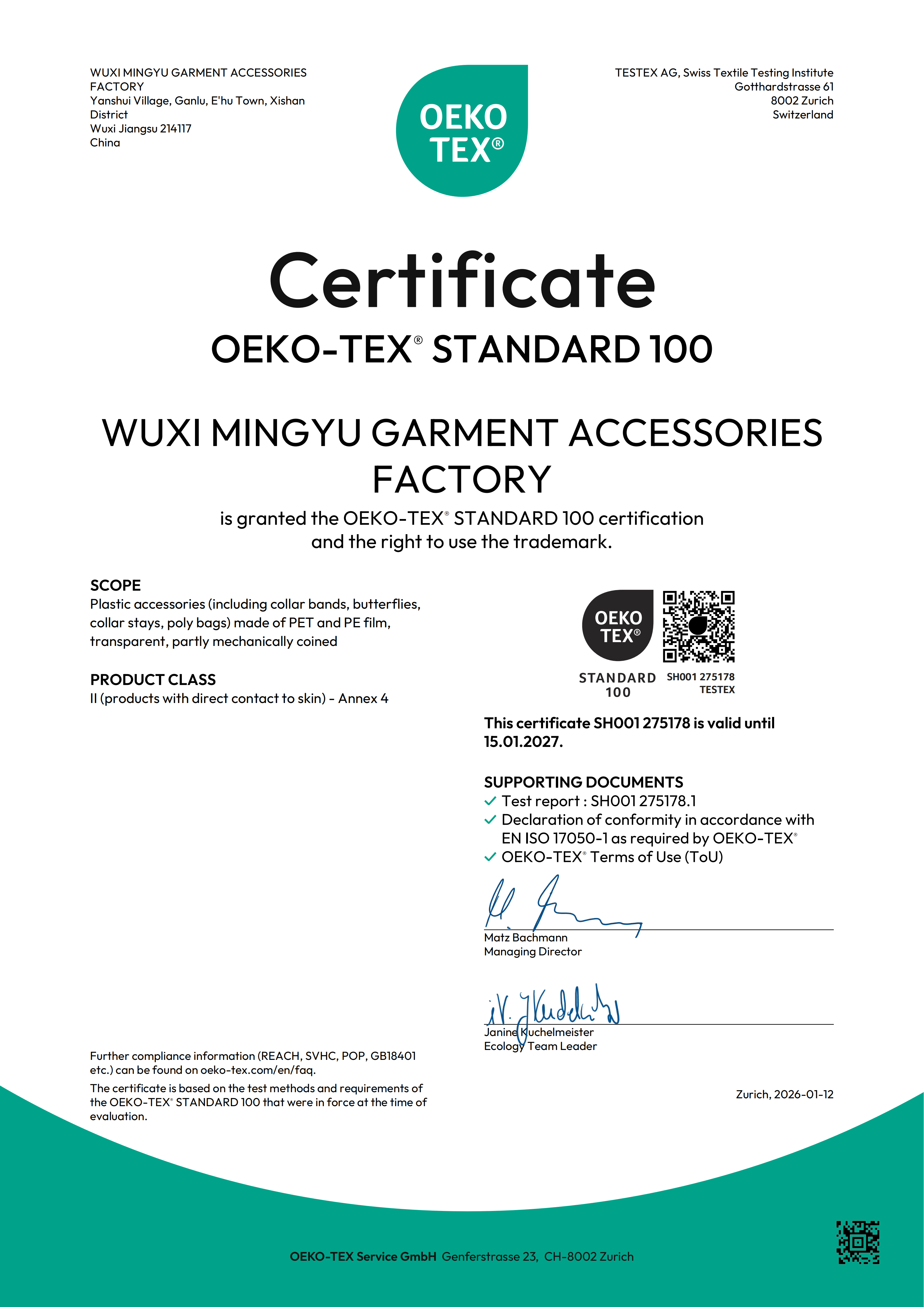
- OEKO-TEX STANDARD 100, certificate SH001 275178, issued by TESTEX under OEKO-TEX STANDARD 100 and EN ISO 17050-1, issued 12 January 2026 and valid to 15 January 2027, applicable worldwide. The scope covers plastic accessories — including collar bands, butterflies, collar stays and poly bags — made of PET and PE film, transparent, partly mechanically coined.
- Global Recycled Standard (GRS) V4.0, certificate SGC-GRC09119-GRS-2026-07, issued by SGS, referencing the Content Claim Standard V3.1 and the Textile Exchange Standards Claims Policy V1.3, issued 31 July 2026 and valid to 30 July 2027, with global scope covering trading (PR0030), warehousing and distribution of final products (PR0048) and manufacturing (PR0016).
Three checks follow. Identity means the item ordered appears in the certified product list: supplied records list, among others, the plastic collar band (8291), metal collar stay (8290), collar stay (8143), plastic butterfly (8144), paper butterfly (8164), clip (8145), metal pin (8146), collar support (8156), paper collar band (8155), washing label (8153) and plastic bag (8148) as certified to OEKO-TEX STANDARD 100, with the GRS record attached to the plastic bag (8148).
Scope means the certificate's own wording describes the material actually supplied. The OEKO-TEX scope text is built around transparent PET and PE film articles, while parts of the product range are described as light blue fine sand PVC. A buyer preparing a retail submission should therefore reconcile the two statements in writing — the item-level certification record and the certificate's scope wording — instead of treating the certificate as blanket cover for the whole accessory range. Metal clips and pins, paper tags and printed labels fall outside that scope wording and need their own evidence.
Validity means the certificate is current at order date and, preferably, at delivery date. With expiry on 15 January 2027 for OEKO-TEX and 30 July 2027 for GRS, an order placed in late 2026 and delivered in early 2027 needs renewal status confirmed before shipment rather than after arrival.
Purchasing terms: MOQ as a fit checkpoint, not a standard
MOQ is the term buyers most often read as a compliance signal, and the one that most clearly is not. In the supplied data, thresholds are 100,000 pieces for clips, 10,000 for metal pins, 10,000 for most paper and film items, and 1,000 for metal collar stays, with the capability record separately stating a program MOQ of 1,000 sets. Those figures describe how an order is built, not how an item performs.
Used correctly, each threshold answers a fit question. Does annual clip consumption justify a 100,000-piece order, or does the clip line belong with a converter who can consolidate demand across several buyers? Does a 1,000-piece metal stay order allow a collar trial before a full season commitment? The qualification checkpoint is whether the buyer's volume, storage and reorder cycle match the threshold — not whether the number looks competitive next to another supplier's.
Three further terms belong beside MOQ. Lead time is stated as 7–20 days after order confirmation, which is a planning window rather than a promise for every quantity combination. Customization scope covers size, colour, style, printing or foiling, mould opening and logo stamping or printing, with laser engraving used on stainless steel collar stays; each option changes tooling and sampling time, so the customization line and the acceptance line have to be written at the same time. Quality control is stated as 100% testing with in-house inspection across production stages, which becomes verifiable through lot inspection records rather than through the phrase itself. Price is not published in the supplied data; quotations should be requested against the acceptance schedule, so that what is being priced is defined.
Where acceptance criteria meet the packing station
Criteria that ignore the packing station produce items that pass inspection and slow the line. The supplied application data describes use across packing workshops, sorting lines, garment shipment and retail display, with three jobs: wrinkle prevention, brand identification through printing or foiling, and transport protection. Supplier equipment includes automatic creasing, punching and cutting machines, which matters to buyers ordering folded bands, punched holes and die-cut cardboard.
Station-level checks follow from that. Band length and hole pitch must suit the folding jig; clip geometry must suit the fold type and fabric weight; stay length must suit the collar point rather than the shirt size in general; and printed items must survive handling between packing and carton sealing. A trial run of 200–500 shirts at the actual station reveals more about fit than a lab measurement, and it is inexpensive to arrange before a 100,000-piece clip commitment.
What the checklist does not prove
A documented checklist verifies conformance to agreed criteria; it does not certify market access. It cannot confirm that an accessory satisfies a destination market's regulatory requirements beyond a certificate's stated scope, it cannot replace the buyer's own legal or labelling review, and it cannot convert a supplier's claim of eco-friendly materials into a recycled-content figure unless the claim sits inside a certification such as GRS with defined scope. Where a checklist and a marketing phrase disagree, the checklist is the record that survives an audit.
It also helps to keep the packaging accessory separate from the garment component. The interlining that gives a shirt collar its structure is a textile product — valued at USD 3.65 billion globally in 2025 according to The Business Research Company — and it is not covered by the accessories discussed here, even where the same supplier also handles collar tape and interlining. Mixing the two categories in a specification pack is a common source of scope confusion at sampling stage.
Market context and what it changes for buyers
Dataintelo's 2026 garment packaging report values the global garment packaging market at USD 18.6 billion in 2025 and projects USD 31.4 billion by 2034, with Asia Pacific holding a 41.5% revenue share in 2025. Those figures describe a category expanding alongside apparel fulfilment, and they explain why accessory documentation has become a purchasing task rather than an administrative one: more items, more materials and more destination markets per order.
The practical implication is not that buyers need more certificates. It is that they need item-level mapping between what is ordered, what is certified and what is delivered — and that mapping is what a checklist formalizes. Suppliers who publish item numbers, dimensions and certificate scopes shorten that work; suppliers who publish only adjectives lengthen it.
Supplier reference: MingYu Garment Accessories
Wuxi Mingyu Garment Accessories Factory (MingYu Garment Accessories) is a Wuxi-based manufacturer founded in 2004 that produces PVC/PET collar bands, collar stays, collar butterflies, shirt cardboard, moisture-proof paper, plastic clips and plastic packaging bags, and supplies the accessory specifications referenced in this checklist. The company operates a 2,500 m² facility with 25 employees, including three engineers, reports annual output of 90 million sets and an 85% export ratio, with Europe, North America, South America and Asia as its main markets. It established a Sri Lanka factory in 2013 and a Vietnam factory in 2017, and maintains distribution warehouses or agencies in Sri Lanka, Argentina, Bangladesh, Indonesia, Colombia and Kenya. Production relies on automated punching and automatic cardboard and collar-stay die-cutting equipment, and OEM/ODM orders are supported with size, colour, style, printing, foiling, mould-opening and logo customization, with 7–20 days lead time and in-house inspection across production stages.
Buyers evaluating the supplier can request item-level specification sheets, the OEKO-TEX and GRS certificates with their scope wording, and a signed reference sample before placing a first order. Product and capability documentation is available at Wuxi Mingyu Garment Accessories Factory, and the company profile can be downloaded as a PDF brochure.
FAQ: acceptance criteria and purchasing terms
What MOQ should a buyer expect for shirt clips compared with metal pins?
The supplied data lists a 100,000-piece MOQ for clips and a 10,000-piece MOQ for metal pins, alongside 10,000 pieces for most paper and film items and 1,000 pieces for stainless steel collar stays, with a separate program MOQ of 1,000 sets. These are supplier-qualification checkpoints that indicate how an order is structured. They are not compliance grades, and a lower threshold does not imply a stricter specification.
Does an OEKO-TEX STANDARD 100 certificate cover every accessory in a shirt packing set?
Not automatically. Certificate SH001 275178, issued by TESTEX under OEKO-TEX STANDARD 100 and EN ISO 17050-1, is valid to 15 January 2027 and describes a scope of plastic accessories including collar bands, butterflies, collar stays and poly bags made of PET and PE film, transparent, partly mechanically coined. Paper tags, printed labels, metal clips and coloured PVC items require separate confirmation against that wording. The GRS certificate SGC-GRC09119-GRS-2026-07 issued by SGS, valid to 30 July 2027, supports recycled-content claims only within its own scope for trading, warehousing and distribution and manufacturing.
How can a buyer verify claims such as “resistant to deformation” and “eco-friendly materials”?
Deformation resistance becomes verifiable when it is turned into a repeatable test: measure thickness at fixed points, bend the item to an agreed angle and release it, check flatness on a reference surface, and compare each lot against a signed sample. Eco-material claims are verified through documentation rather than description — a certificate with the item number, the scope wording and a valid expiry date, checked against the delivery schedule. Where no document reaches a specific item, the claim should not appear in a retail submission.
Which shirt packaging accessories accept custom logos, and by what method?
Printed logos are available on paper and PVC collar bands, plastic butterflies, collar supports, apparel tags, belly bands, tissue paper, gift boxes, plastic bags, cardboard and washing labels. Stainless steel collar stays use laser engraving, and clip logos are customizable. Metal pins and collar supports carry no logo by default, so a logo requirement has to be confirmed in writing and proven on a production sample before the order is released.
What lead time and quality evidence should be written into a purchase order?
The supplied capability data states 7–20 days lead time after order confirmation, OEM/ODM customization across size, colour, style, printing, foiling and mould opening, and 100% testing with in-house inspection throughout production. In practice a buyer should attach the acceptance schedule, require lot inspection records with each shipment, and hold the certificate copies with their issue and expiry dates alongside the order rather than in a separate file.
Have Questions or Need More Details?
Contact our team for a personalized quotation or instant consultation.
Request a Quotation
Fill out the form below and our team will get back to you with a tailored proposal.
WhatsApp Direct Chat
Prefer to chat in real-time? Message us on WhatsApp for instant assistance & quick answers.
- Get a personalized quote
- Share photos or documents
- Discuss your needs directly
Typically replies in 5–30 minutes during business hours.