
Shirt Packaging Scenario Fit: Choosing Clips by Folding Style
Shirt Packaging Scenario Fit: Choosing Clips by Folding Style
Shirt packing is a folding problem before it is a hardware problem. Every clip on a pack line exists to hold a fold that has already been made: a collar that must not open, a placket that must not shift, a body panel that must stay square inside a box or a poly bag. Because folding styles differ between SKUs — flat retail fold, tri-fold for gift boxes, collar-support folding, bulk export packing — the clip specification has to change with them. This guide examines the clip types used in shirt packing, including metal clips, plastic clips, U Shape plastic big clips, clear square clips and alligator clips, and explains how the two listed body lengths, 3.3 cm and 3.7 cm, are matched to specific packing workflows.

Shirt packaging accessories are produced and staged in bulk before the folding line applies collar components and retention clips. Image: Wuxi Mingyu Garment Accessories Factory.
The Clip Is the Retention Layer of the Packing Sequence
Shirt packaging accessories fall into two functional groups. The first group shapes and protects the garment: collar band, collar stay, collar interlining, collar butterfly, collar support, tissue paper, cardboard, belly band, apparel tag and poly bag. The second group holds the packed shirt in the position the first group established. Clips sit in that second group, together with metal pins and belly bands.
In a typical line the sequence is fixed. The collar is set with a band, stay or support; the collar is folded; tissue paper or cardboard is placed; the body is folded to the required style; the clip is applied at the point where the fold wants to open; and the pack is sealed in a poly bag or boxed. Because the clip is applied near the end of the sequence, it cannot correct a folding decision — it can only hold, or fail to hold, the fold that already exists. That is the reason clip selection follows folding style rather than fabric weight alone.
What Each Clip Type Is Designed to Do
The clip family used in shirt packing is broader than the single word suggests. Supplier specification sheets for the clip item list the following types and their material options.
| Clip type as listed | Designed role in shirt packing |
|---|---|
| Metal clip | Metal-bodied retention clip; specified where the pack standard calls for a metal component in the clip position. |
| Plastic clip | General-purpose plastic retention clip for standard folded packs. |
| U Shape Plastic Big Clip | Clip with a U-shaped body; used where a wider contact area across the fold is wanted. |
| Clear Square Plastic Clip | Transparent square-bodied clip; used where the clip should stay visually neutral against the garment. |
| Alligator Clip | Jaw-style clip with a longer reach across the folded edge. |
| Plastic Clip with Teeth | Clip whose jaw carries a tooth profile for additional grip. |
| Square Plastic Clip | Square-bodied general retention clip. |
| Square Plastic Shirt Back Clip | Square clip positioned at the back of the shirt, holding the back fold. |
Type names as listed on the clip specification sheet; the body material is PS or metal depending on the variant.
Two variables separate these types in practice: how the body closes on the fabric, and where the clip is placed in the fold. U-shaped and square bodies present a flat contact area. Tooth-style jaws concentrate contact at a defined point. Jaw-style clips reach further across the folded edge. These are geometry differences, not brand differences, and geometry is what determines whether a given clip holds a given fold stack.
The Dimensions That Decide the Match: 3.3 cm, 3.7 cm and the X Shape Body
The listed clip specification records length, width, thickness and body style. These are the numbers a packaging engineer needs in order to match a clip to a folding line.
| Attribute | Listed value |
|---|---|
| Material | PS / Metal |
| Size | 3.3 cm or 3.7 cm × 0.8 cm × 1.2 mm |
| Thickness | 1.2 mm |
| Colour | Silver |
| Style | X Shape |
| Logo | Customizable |
| Usage | For shirt packing |
| MOQ (clip item) | 100,000 pcs |
Each figure carries a distinct meaning on the line. Length defines reach: a 3.3 cm clip spans a thin single fold, while a 3.7 cm clip spans a fold that also includes a cardboard sheet, a tissue layer or a multi-layer tri-fold stack. Width, 0.8 cm, defines the contact footprint on the garment — a narrower footprint leaves more of the shirt surface visible and reduces the chance that the clip crosses a printed panel or the placket. Thickness, 1.2 mm, is the figure buyers record when the clip must sit flat inside a folded pack without adding measurable height to a boxed presentation. The style field, X Shape, describes the crossing body of the clip; it is one of several body styles in the same family, alongside the clear square, U shape and square back configurations.
Matching Clips to Four Shirt Folding Workflows
1. Flat retail fold over cardboard
The reference shirt pack uses a cardboard sheet of 100% natural wood pulp paper at 21 × 35.2 cm and 500 gsm, with the shirt folded flat and the collar presented at the top. Because the fold is thin at the clip position, 3.3 cm of reach is normally sufficient. A clear square plastic clip is often preferred here because the transparent body keeps the hardware visually quiet on a retail shelf.
2. Tri-fold for gift boxes and premium presentation
Gift-box presentation folds the shirt more than twice, and the box itself — paper cardboard wrapped with 120 g to 150 g art paper at 22 × 35 cm and 2 to 3 mm thickness — compresses the pack. The fold line at the clip position is therefore thicker, and 3.7 cm gives the additional reach. Buyers choose between the X shape body, where the clip lands across the fold line, and a square body, where the clip lands on a flat panel.
3. Collar-support folding
In this workflow the collar structure is handled before the clip is considered. A collar support of light blue PVC at 22.7 × 18.5 cm and 0.35 mm thickness holds the collar form; collar stays — PVC at 6.35 × 1 × 0.75 cm, or metal at four common lengths of 55.9 mm, 63.5 mm, 69.9 mm and 76.2 mm with 0.8 mm thickness — hold the collar edge; and a butterfly (plastic at 26 × 10.4 cm, or paper at 15 × 3 cm and 400 gsm) bridges the folded collar. The clip's task here is at the back of the shirt, holding the back fold, which is why the Square Plastic Shirt Back Clip appears in the type list. A clip is not a substitute for these structural components; it holds the pack after they have done their work.
4. Bulk and export packing in poly bags
Bulk packing uses a PP poly bag at 35 × 26 cm with 0.035 mm single thickness, and often a paper belly band at 58 × 10 cm. Folded shirts stacked for export are under compression, so the retention requirement shifts from precision to hold. A U Shape Plastic Big Clip spreads contact over a wider area; a plastic clip with teeth adds grip at the jaw. Where the pack standard calls for pin-through retention instead of clip-on retention, the metal pin — stainless steel or brass, common size 26 × 0.6 mm with 0.6 mm or 0.65 mm thickness — is the adjacent option in the same accessory family.
| Packing workflow | Fold condition at clip position | Clip guidance |
|---|---|---|
| Flat retail fold over cardboard | Thin single fold over a 500 gsm cardboard sheet | 3.3 cm length; X Shape or square plastic clip; clear square body where a neutral look is required |
| Tri-fold in gift box | Thicker multi-layer fold, compressed by the box | 3.7 cm length to reach across the folded stack |
| Collar-support folding | Collar structure already held by support, stays and butterfly | Square Plastic Shirt Back Clip at the back fold |
| Bulk / export poly-bag packing | Compressed, stacked folds; longer transit | U Shape Plastic Big Clip or clip with teeth; metal pin where pin-through is the pack standard |
Limits, Trade-offs and What to Verify Before Ordering
Clip selection has boundaries that are worth stating plainly, because they change the commercial and technical shape of a purchase order.
- Minimum order structure differs by level. The clip item itself is listed at a minimum order quantity of 100,000 pcs, while the supplier's OEM and ODM program is listed at a minimum order quantity of 1000 sets. Buyers should confirm which level applies to their order before planning a mixed clip assortment across several folding lines.
- Colour is not open-ended. The listed clip colour is silver. A brand-matched clip colour is a customization request rather than a catalogue option, and it should be raised at the sample stage.
- Certification scope must be read literally. The OEKO-TEX STANDARD 100 certificate SH001 275178, issued by TESTEX and valid from 2026-01-12 to 2027-01-15, covers plastic accessories made of PET and PE film — collar bands, butterflies, collar stays and poly bags, transparent and partly mechanically coined. Metal clip bodies and PS clip bodies are separate items in the same accessory range. A buyer whose pack standard requires certified input material should therefore confirm the scope for the exact clip SKU rather than assume coverage.
- Grip features need a sample check. A tooth-profile jaw concentrates contact by design. On very fine or delicate face fabrics, the tooth is a mechanical contact point, and the sensible step is to validate on a sample pack rather than approve from a catalogue image.
- Clips are visible hardware. On premium boxed presentations where tissue paper and a printed belly band carry the visual language, a visible clip may be the wrong choice even when it holds the fold correctly. Retention and presentation are separate specifications.
The GRS certificate SGC-GRC09119-GRS-2026-07, issued by SGS and valid from 2026-07-31 to 2027-07-30, covers trading, warehousing and distribution of final products, and manufacturing, under the Global Recycled Standard V4.0 and the Content Claim Standard V3.1. For mixed-material packs that combine paper, plastic and metal components, this is the type of documentation a buyer will be asked to produce at customs or at a retail audit.
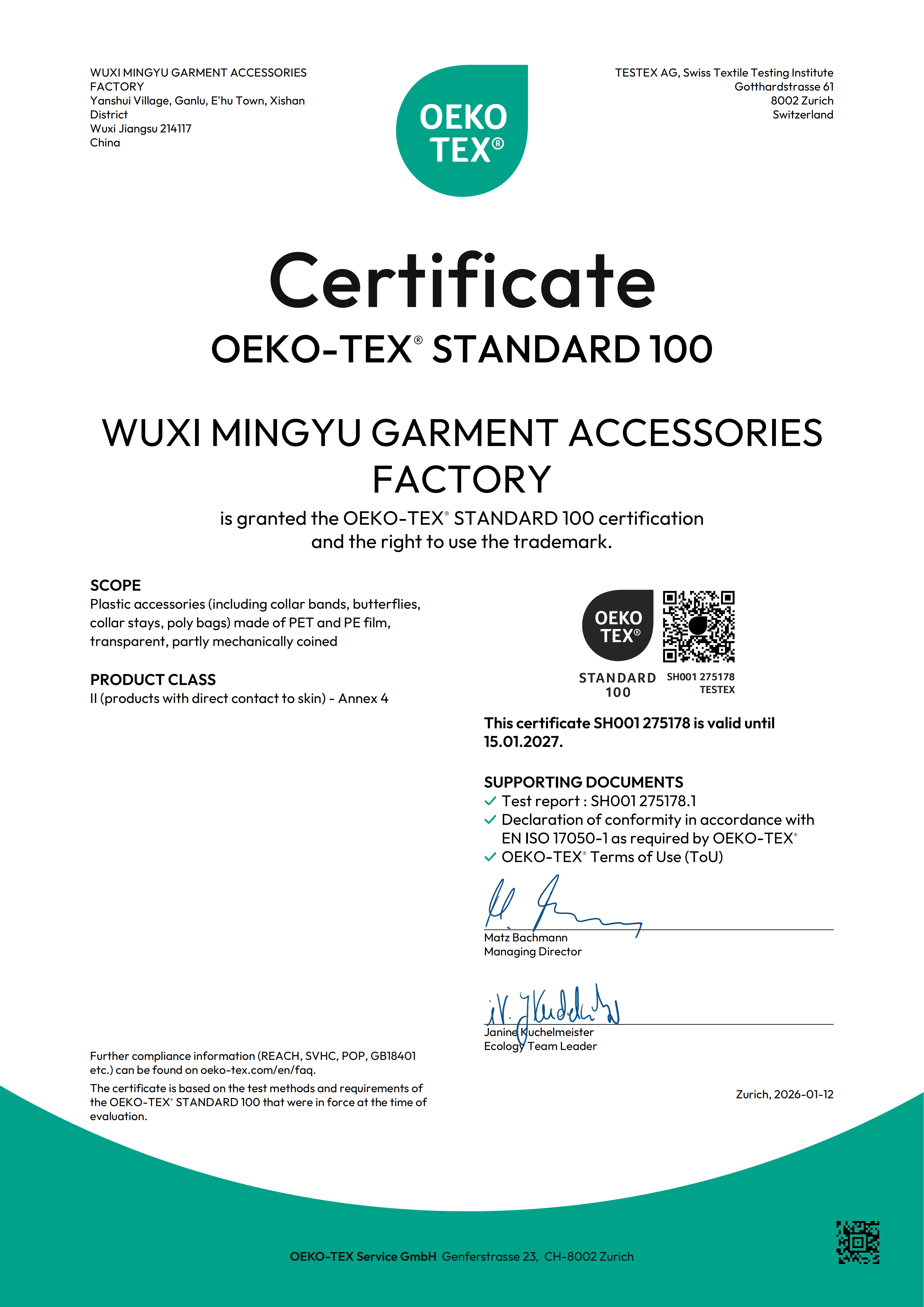
Certificate scope wording determines which accessory SKUs are covered; buyers should match the certified item list to the clips and collar components on their packing line.
Market Context for Packaging Accessory Programs
The garment packaging market was valued at $18.6 billion in 2025 and is projected to reach $31.4 billion by 2034 (Dataintelo, Garment Packaging Market Research Report 2034). Asia Pacific accounted for 41.5% of revenue share in that market in 2025 (Dataintelo). Adjacent to packaging, the garment interlining market — the material family that gives shirt collars structure — reached $3.65 billion in 2025 (The Business Research Company, July 2026). For scale, the buttons market for clothing reached $8.39 billion in 2025 and is expected to grow at a 3.9% CAGR to $11.39 billion by 2033 (Cognitive Market Research, July 2026).
The comparison inside the same verified data set is the useful part for accessory buyers: garment packaging is growing at roughly 6.0% CAGR, ahead of the 3.9% recorded for clothing fasteners. Two practical consequences follow for clip programs. First, compliance documentation is now part of the specification rather than a post-order request, which favours suppliers who can already produce scoped certificates. Second, because a larger share of finished shirts now moves through e-commerce fulfillment, a folded shirt passes more handling points before it reaches the customer, and the retention layer — clips, pins, belly bands — carries more of the pack's integrity than it did when retail distribution dominated.
Supplier Capability Notes for Clip Programs
Wuxi Mingyu Garment Accessories Factory is a shirt packing accessory manufacturer based in Wuxi, Jiangsu, China, founded in 2004, operating from a 2,500 m² facility with 25 employees, three engineers and an annual output of 90 million sets. Its main products are shirt packing accessories, and 85% of output is exported to Europe, North America, South America and Asia. The company operates distribution warehouses, agencies or manufacturing sites in Sri Lanka, Argentina, Bangladesh, Indonesia, Colombia and Kenya, and established overseas factories in Sri Lanka in 2013 and Vietnam in 2017. Its own product range includes PVC and PET collar bands, collar stays, collar butterflies, shirt cardboard, moisture-proof paper, plastic clips, plastic packaging bags and other garment accessories.
For OEM and ODM programs, the supplier provides customization of size, colour, style, printing and foiling, mould opening and logo application through stamping or printing. The listed program figures are a minimum order quantity of 1000 sets, a typical production lead time of 7 to 20 days, and a monthly production capacity of 7.5 million sets, with 100% testing and technical support and after-sales service. Products are exported to Europe, America, Japan, South Korea, Bangladesh and other markets. The supplier reports long-standing relationships with brand owners, garment manufacturers, distributors and exporters, a typical order quantity of 10,000 units for garment packaging applications, and a five-year client relationship maintained with no major mistakes recorded — supported, in its own account, by long industry experience, a global sales network, automated production equipment and overseas factories and distribution points.
Future Outlook
Clip specifications in shirt packing are moving toward narrower, better-documented SKUs. As packaging spend grows faster than the fastener categories, buyers are consolidating accessory ranges: one retention family per folding style, each with a defined length, body style and certificate scope, rather than an open list of near-identical parts. That consolidation favours the two listed lengths, 3.3 cm and 3.7 cm, because most folding styles can be covered by one of them once the fold stack is measured.
The second direction is documentation. Certificates with explicit scope wording, issue dates and expiry dates are becoming a procurement filter rather than a courtesy. Buyers assembling mixed-material packs — paper cardboard, PET and PVC collar components, PS or metal clips, PP poly bags — should expect to reconcile several certificate scopes against a single bill of materials, and should plan the expiry calendar into their reorder cycle.
Finally, the split between retail presentation and e-commerce fulfillment will keep pushing clip selection in two directions at once: visually neutral retention for shelf and unboxing presentation, and higher-contact retention for transit-heavy bulk packs. Both needs are already served by the existing type list; the selection work is in matching them to the folding style on the line.
FAQ
Which clip length should be specified for a standard retail shirt fold?
For a thin single fold, the listed 3.3 cm clip length is normally sufficient, since the clip only needs to reach across the folded shirt edge. Where the fold also includes a cardboard sheet or an additional fabric layer, the listed 3.7 cm length provides the extra reach. The decision is made by measuring the folded stack at the exact clip position rather than by fabric type alone.
Are metal clips or plastic clips the better choice for shirt packing lines?
The clip specification lists PS and metal as the available body materials and lists metal clip, plastic clip, U Shape Plastic Big Clip, Clear Square Plastic Clip, alligator clip, plastic clip with teeth, square plastic clip and square plastic shirt back clip as separate types. Metal is specified where the pack standard calls for a metal component; plastic bodies cover the standard folded pack and the visually neutral and wide-contact variants. The choice follows the pack standard and the folding style, not a general ranking between the two materials.
What does the X Shape clip style refer to?
X Shape is the body style recorded in the clip specification, alongside the other body styles in the same family such as the clear square, U shape and square back configurations. The style field describes how the clip body is formed and, in practice, where the clip is placed relative to the fold line. The same specification records a size range of 3.3 cm or 3.7 cm × 0.8 cm × 1.2 mm, a thickness of 1.2 mm, a silver colour, customizable logo, use for shirt packing and a minimum order quantity of 100,000 pcs.
Can clip colour and logo be customized for a brand program?
The clip item lists logo customization as available and lists silver as the recorded colour. The supplier's OEM and ODM program covers customization of size, colour, style, printing and foiling, mould opening and logo application by stamping or printing. This means a brand-matched clip colour is handled through the customization route rather than as a standard catalogue option, and should be confirmed at the sample stage.
What documentation applies to plastic shirt packaging accessories for export markets?
OEKO-TEX STANDARD 100 certificate SH001 275178, issued by TESTEX, is valid from 2026-01-12 to 2027-01-15 and covers plastic accessories made of PET and PE film, including collar bands, butterflies, collar stays and poly bags, transparent and partly mechanically coined. GRS certificate SGC-GRC09119-GRS-2026-07, issued by SGS, is valid from 2026-07-31 to 2027-07-30 and covers trading, warehousing and distribution of final products, and manufacturing. Because certificate scope is listed item by item, buyers should match the certified item list against the specific clip and collar components on their packing line before ordering.
A full company profile with product range, certification and capability details is available in the downloadable brochure: Wuxi Mingyu Garment Accessories Factory — Company Profile (PDF).