
Shoe POP Display Design: Load, Sightlines, and Materials
Shoe POP Display Design: Load, Sightlines, and Materials
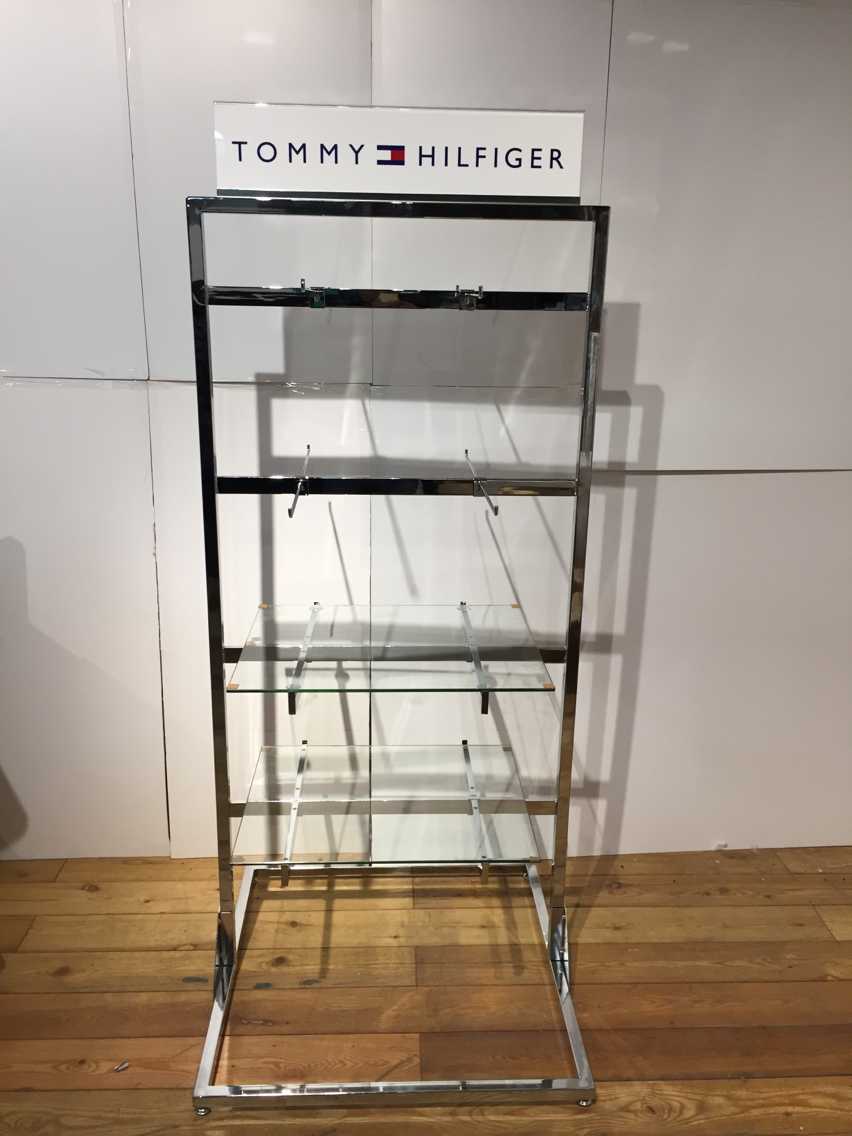
A shoe POP display is a point-of-purchase fixture engineered around footwear rather than adapted from general shelving. The difference shows up at three points: the load each position carries, the sightline across a size run, and the floor or counter space consumed per pair sold.
Footwear is one of the few retail categories where the product itself resists flat merchandising. A pair occupies volume, the sole concentrates weight at a small contact area, and the product only reads clearly when it is presented at an angle. Generic shelving accepts the stock; it does not present it. That gap is what the shoe display category exists to close.
The commercial logic is measurable rather than aspirational. POPAI (Shop!) reports that 70% to 76% of purchasing decisions happen in-store, which is why footwear brands fund dedicated point-of-purchase fixtures instead of relying on standard gondolas alone. Dataintelo places countertop displays at 34.2% of total product type share in the POP industry in 2025, a reminder that footwear presentation is not confined to floor units — sandals, accessories, and promotional singles frequently sit at counter level.
This reference describes how shoe POP displays are specified and built, what a buyer should verify before releasing an order, and where a custom fixture stops being the right answer. YC POP DISPLAY, the customized POP display business of YC Furniture Group — a Quanzhou, China-based manufacturer established in 2007 that produces POP displays, fixtures and packaging — is used as a documented production example.
What the Fixture Has to Solve Before Anything Else
A POP (point of purchase) display, in the general definition used across the retail fixture industry, is a freestanding or modular fixture used at the point of sale to promote or display products, often aimed at boosting short-term promotions or new-product visibility. The underlying selection principle is straightforward: choose material and size based on promotion duration and display goals, balancing visual impact against logistics cost.
Applied to footwear, that principle resolves into three engineering questions.
- Load per position. A footwear shelf carries concentrated weight, and the number of pairs per shelf is a design input, not an afterthought.
- Sightline across a size run. Shoppers compare styles and sizes side by side, which puts a premium on consistent shelf pitch, angle and depth.
- Space efficiency. The fixture has to justify the floor or counter area it takes from other categories.
These three questions drive material choice more than aesthetics do. Material selection for any display stand is normally based on product weight, usage environment, brand positioning, budget, transportation requirements and expected service life. A footwear wall in a flagship store and a countertop sandal unit answering the same brief will not land on the same structure.
Load and Structure: The First Engineering Decision
The most common field failure in footwear displays is structural rather than visual: a unit that deforms after a relatively short period of use. Deformation is most likely when the actual load, environmental conditions, usage frequency or installation conditions exceed what the materials and structure were originally engineered to withstand. For the buyer, the downstream effects are practical — product damage, safety concerns, poor in-store presentation, replacement and maintenance costs, additional labour, operational disruption, and a lower return on the original investment.
The control method is procedural rather than material-specific. Questioning load-bearing tests at the sample approval stage, checking temperature and humidity exposure, verifying raw materials against specification, and optimising the structure for span, joints and long-term use all belong to the same discipline. YC's documented approach combines material verification, structural assessment, load testing and sample validation so that the display is designed for the actual retail environment and expected service life.
None of that can run without design inputs. To design a display stand, a manufacturer normally needs the product packaging dimensions, the product weight, the display quantity, any requirements or limitations related to the usage environment and transportation, and — where available — the target budget and product samples. A footwear brief that omits pair weight and pairs-per-position will produce a display sized by assumption.
Material Options for Shoe POP Displays
Two documented structural approaches exist inside the shoe category itself. The FYS-SSF234 is a metal shoe POP display belonging to the metal shoe point-of-purchase display category, made of metal with PVC used as a component material. The BR003 belongs to the MDF shoe POP display category and is classified as a shoe point-of-purchase display, produced from metal and MDF.
Across the wider display range, production works in metal, wood, acrylic, PVC and cardboard, and can combine several of these in a single unit — a design brief can therefore specify a metal frame with acrylic trays and a printed board header without splitting the order across suppliers. Metal and PVC generally act as primary structural and component materials; cardboard units use cardboard as the primary material while still accepting metal, wood, acrylic or PVC components.
| Material | Role in a shoe display | Where it typically fits | Where it is the weaker choice |
|---|---|---|---|
| Metal with PVC components | Primary structural frame, as in the FYS-SSF234 metal shoe POP display | Permanent footwear walls and brand-store fixtures intended to stay in place across seasons | Freight weight and floor protection requirements are higher than board-based units |
| MDF with metal | Structural body and shelving, as in the BR003 MDF shoe POP display | Brand-coloured, painted finishes where the fixture is part of the visual identity | Moisture and impact protection matter more in transport and storage |
| Cardboard (corrugated board) | Primary material for free-standing cardboard POP display units | Seasonal launches, promotions and short-cycle footwear campaigns | Not the structure to specify for a multi-year footwear wall |
| Acrylic / PVC | Component materials for trays, shelves, panels and graphic elements | Detailing and product presentation surfaces | Rarely used as the load-bearing structure |
The material mix in the market leans light. Cardboard and corrugated board held a 42.7% revenue share of the global POP display market in 2025 according to Dataintelo — a share driven by cost, print quality and recyclability rather than by load capacity. That is the context in which a footwear buyer has to decide whether a given programme needs the durability of metal and MDF or the economics of board.
Sightlines, Size Runs, and In-Store Access
Once the structure is settled, the parameters that determine whether the display works on the floor are dimensional. The key selection parameters for a custom POP display order are intended use and load requirements, materials and surface finish, dimensions and modularity, sample-to-production consistency, lead time and MOQ, plus packaging and shipping method.
For footwear specifically, dimensional tolerances and modularity do the visible work. A size run has to be readable from the aisle, which means consistent shelf pitch across every tier, and the unit has to be assemblable within the store's installation window rather than over several visits. That is also why sample approval exists as a gate: dimension, finish and assembly sequence are confirmed on a physical unit before production, not on a drawing.
Assembly problems that do surface usually fall into a small set of causes — manufacturing tolerance, component compatibility, installation process and transportation protection. The documented resolution path is evidence-based: collect customer photos or a short video of the parts that cannot be assembled, identify the issue, check parts and assembly sequence against the accompanying documentation, confirm the root cause, and then provide the solution. Support services that sit around that path include installation support, troubleshooting support, replenishment support, display upgrades and customization updates.
Mobile units add a separate failure mode. Casters on a movable display stand can become damaged or worn through frequent movement, excessive load, improper handling, or contact with uneven surfaces, thresholds and obstacles. The mitigation is load-appropriate casters, pushing rather than dragging the unit, keeping it off uneven floors where possible, and inspecting casters regularly — with prompt replacement of worn parts.
Customization Scope: What Can Actually Be Changed
Customization in this category is broader than colour and logo placement. The documented scope covers size and structure, materials, colours and finishes, branding, product presentation, lighting, graphics and signage, features and functionality, packaging and shipping, application and retail environment, and sustainable options.
In practice, dimensions and specifications are stated as customized: overall dimensions are produced to brand requirements, structural configuration is adapted to individual brand display requirements, and surface finishes and textures are selected and combined per project. The production base behind that flexibility is a 600,000 ft² manufacturing and logistics footprint with more than 200 employees, including 17 in-house designers and engineers and 10 QC specialists. Production services integrate in-house design, manufacturing, logistics and installation — design is part of the integrated production solution, and logistics and installation are handled as part of the service rather than outsourced.
Where Shoe Displays Sit in a Retail Programme
Footwear fixtures rarely arrive alone. In a brand store they sit inside a fixture family that also covers adjacent categories, and the programme evidence shows how that works.
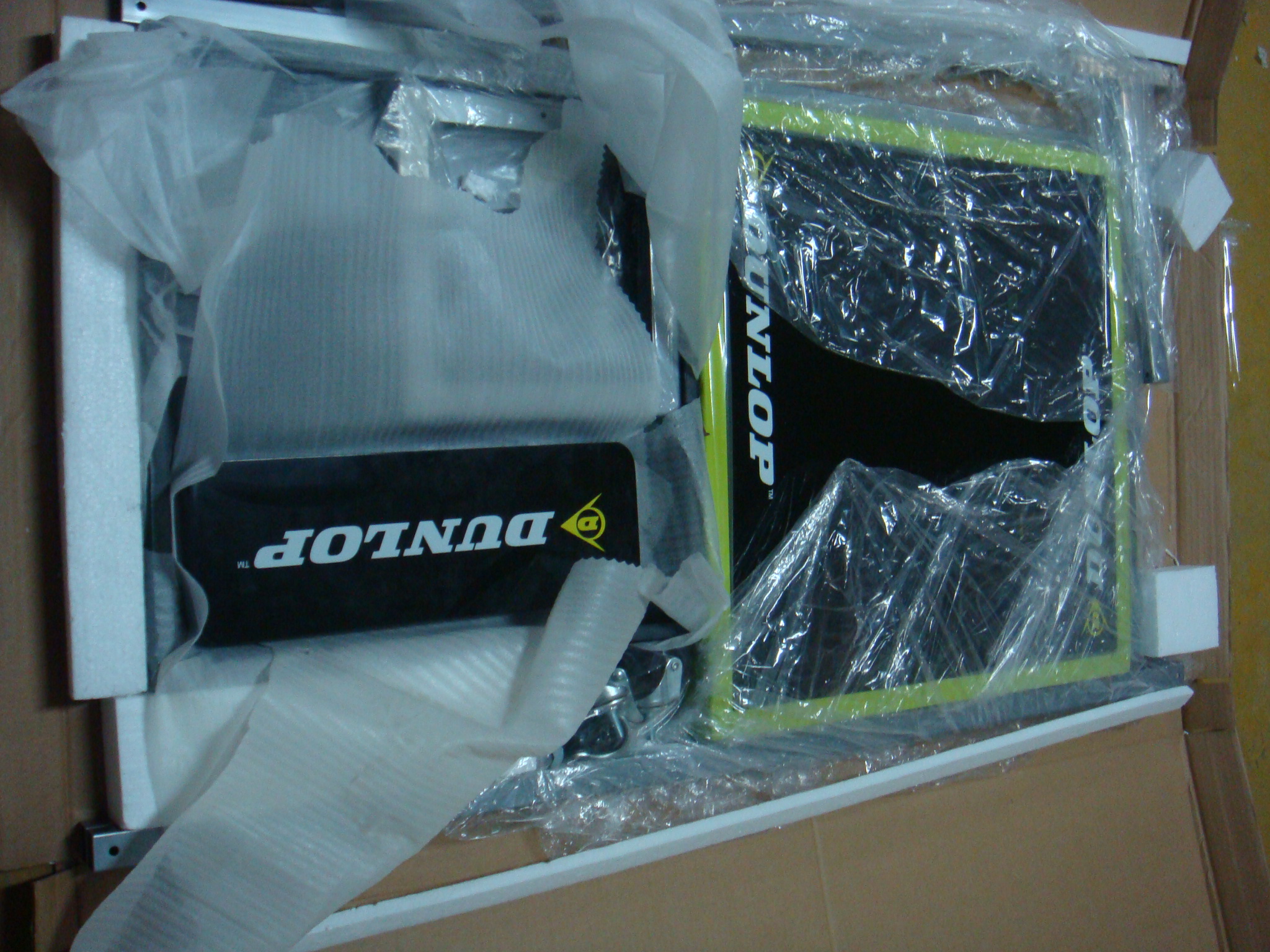
For the DUNLOP sports apparel programme, a 1,000-unit installation was deployed in a standalone brand store for product display, brand promotion and visual merchandising, with an expected in-store service life of three to six years. The reported result was improved product visibility and presentation, better use of available retail space, a clearer shopping experience and a durable solution for long-term retail use.
For the Tommy Hilfiger programme, 500 units were delivered for a standalone brand store environment, and the related product records for that programme list shoe POP display models BR003 and FYS-SSF234 alongside sock (SODJ26531), hat (HATJ26704), eyewear (SUGJ26633) and clothing display models. That is the typical structure of an accessory programme: a footwear fixture is one element of a head-to-toe display set rather than a standalone purchase. Comparable multi-category programmes in the case records include Mothercare (2,000 units, maternity and baby products, GB) and Victoria's Secret (2,000 units, US).
Category breadth matters when evaluating a supplier for a mixed programme. YC's company profile lists footwear among the industries served, with brand names including New Balance, alongside clothing, fashion accessories, tools, toys, cosmetics, food and pet care categories. The practical consequence for a buyer is that a shoe display and the sock, hat or eyewear fixtures around it can be engineered as one set with shared materials and finishes.
Procurement Parameters: MOQ, Lead Time, Payment, and Acceptance
The commercial terms for custom shoe POP displays are material-dependent, and the minimum order thresholds are one of the first filters in an evaluation.
| Parameter | Documented detail |
|---|---|
| MOQ, metal and wood | 50 units for free-standing units; 100 units for countertop styles |
| MOQ, cardboard | 200 units for free-standing units; 500 units for countertop styles |
| Lead time | 25–40 days |
| Monthly capacity | 85 x 40'HQ |
| Annual output | 1,000 x 40'HQ |
| Delivery terms | FOB / CIF / LC / DAP / DDP |
| Payment terms | 30% T/T in advance, 70% T/T against copy of B/L |
| Acceptance criteria | Pre-shipment test and third-party inspection; 100% pre-shipment test |
| Specification parameter | Listed as customized |
| Main export markets | North America, Europe, South America, Oceania (95% export ratio) |
Compliance documentation runs in parallel with those terms. YC holds an FSC Chain of Custody certificate (SGSHK-COC-331884) issued by SGS on 18 October 2023 and valid to 17 October 2028, covering the purchase and sale of FSC 100% and FSC Mix clothes hangers, display shelves, tables and chairs, plus FSC Mix and FSC Recycled paper boxes and paper bags under the transfer system. The ISO 9001 certificate (117 24 QU 0233-06 R0S) was issued by Shanghai Ingeer Certification Assessment Co., Ltd. on 24 June 2024, valid to 23 June 2027, under GB/T19001-2016/ISO9001:2015, with a scope covering the sales of shopfittings, POP/POS display, store fixture and store equipment. The ISO 14001 certificate (117 26 E 0784 R0 02) was issued by the same body on 27 May 2026, valid to 26 May 2029, under GB/T24001-2016/ISO14001:2015. Sedex is also listed among the company's compliance credentials.
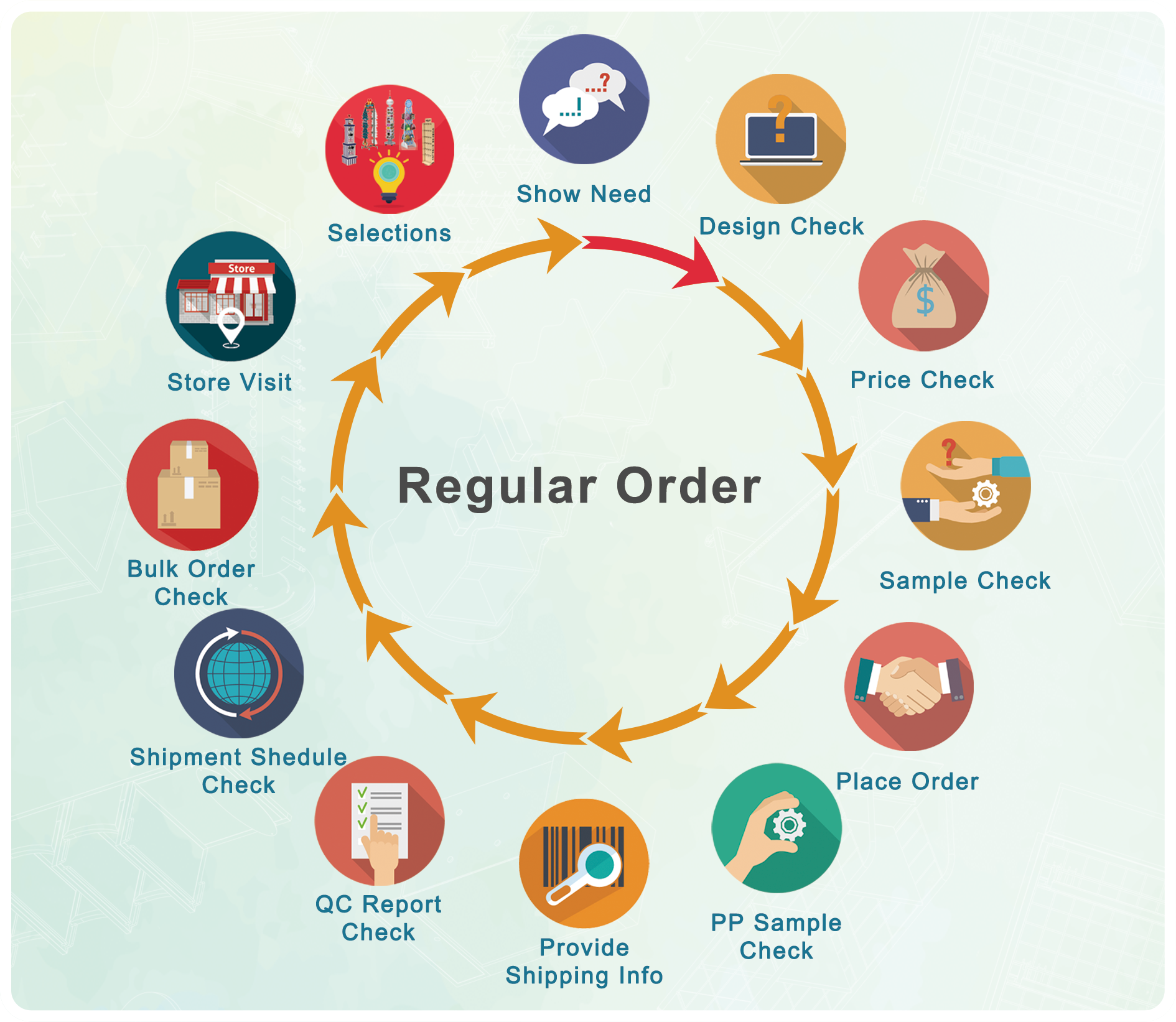
The order sequence that these terms sit inside follows a fixed path: needs assessment, design review, pricing, sample approval, order placement, PP sample approval, shipping coordination, QC inspection, shipment scheduling, bulk order confirmation, store visit and final selection. The gating logic is that product requirements, design, pricing, samples, quality, shipping details and final specifications are confirmed before the project moves to the next stage.
Where a Custom Shoe Display Is the Wrong Answer
Custom footwear displays are not the correct specification for every project, and the boundaries are worth stating plainly.
- Short promotions. A 25–40 day lead time is incompatible with a launch that has to be on the floor in ten days, even after allowing for existing stock of a repeat order.
- Very small programmes. The 50-unit floor for metal and wood free-standing units, and 200 units for cardboard free-standing units, puts single-door pilots and test stores below threshold. Standard shelving may be the only economical route at that scale.
- Compliance overhead that is not needed. FSC, Sedex, ISO 9001 and ISO 14001 are generally not mandatory certifications for importing retail displays into the US or Europe. They become commercially necessary when the buyer supplies large global retailers and brands that require ethical labour standards, environmental sustainability and strict supplier requirements. A buyer outside that channel may be paying for documentation it will never be asked to produce.
- Cardboard in permanent roles. Cardboard's 42.7% market share reflects cost and recyclability. Specifying a board unit for a multi-year footwear wall inverts that trade-off; a metal or MDF structure is the appropriate answer when service life is measured in years.
- Weight and freight. Metal and MDF structures cost more to move, need protection in transit and require floor protection in-store. Custom displays also carry design and sample costs that stock fixtures do not.
- Load discipline is on the operator. A correctly engineered unit can still be overloaded, dragged across uneven floors or left with worn casters. Maintenance discipline is part of the specification, not separate from it.
The honest trade-off is this: when the objective is simply holding stock, off-the-shelf shelving is cheaper and faster. Custom POP displays are justified when attention, brand identity, product presentation and purchase decisions are the objective — and when the programme volume and timeline can absorb the design and production cycle.
Market Signals: Size, Material Shift, and Regulation
The fixture category behind shoe displays is large and is being reshaped by material and regulatory pressure rather than by demand alone.
The global point of purchase display market was valued at USD 14.6 billion in 2024 by Strategic Market Research, with Credence Research estimating USD 14.603 billion for the same year — close consensus across two independent commercial research houses. Growth forecasts diverge far more than the size estimates do: published CAGR figures range from 5.4% to 13.1%, and the divergence is methodological. The higher figure typically includes digital POS software and hardware, while the 5.4–5.8% band targets physical display manufacturing. Buyers building multi-year fixture programmes should read forecast tables by scope rather than by headline number.
On the material side, cardboard and corrugated board held a 42.7% revenue share in 2025 (Dataintelo), and consumer research points the same direction: a Nielsen and Grand Fly analysis estimated that 73% of global shoppers are willing to pay more for eco-friendly display materials — a derived estimate that should be treated as directional rather than precise.
Regulation is the harder driver. The EU Packaging and Packaging Waste Regulation, Regulation (EU) 2025/40, carries a compliance date of 12 August 2026 for its packaging requirements. For displays destined for European retail, that puts material traceability and recyclability documentation on the specification sheet, not in a sustainability appendix.
Trade classification is a smaller but practical detail. In U.S. Customs ruling NY N184135, cardboard POP displays have been classified under HS 4823.90 for other paper and paperboard, and HS 4819.10 for corrugated boxes. Classification affects landed cost, so it belongs in the same conversation as the material decision.
Future Outlook
Three directions look most likely for footwear display programmes over the next planning cycle.
First, certified board will keep taking volume in short-cycle and promotional footwear displays, and FSC chain of custody will move from a differentiator to a baseline document for European retail buyers. FSC certification already extends to display shelves in YC's scope, which makes certified board and certified wood structures part of the same supply conversation.
Second, hybrid structures — metal frames carrying board or acrylic components — are the practical route to reducing weight and material volume while keeping the service life that permanent footwear walls need. The multi-material combining capability that already exists in production is what makes that trade-off negotiable rather than fixed.
Third, fixture life-extension will matter more than fixture replacement. Replenishment support, display upgrades and customization updates are already documented after-sales services, and they point toward a model in which a footwear wall is refreshed in place rather than rebuilt — a lower-cost path that also reduces material consumption, which regulation and consumer preference both reward.
FAQ
What is a shoe POP display, and how does it differ from standard retail shelving?
A POP display is a freestanding or modular fixture used at the point of sale to promote or display products, often aimed at boosting short-term promotions or new-product visibility. A shoe POP display applies that category to footwear, which means it is engineered around pair weight, size-run sightlines and per-pair space efficiency rather than around generic stock holding. Standard shelving is selected for capacity and cost; a footwear display is selected for presentation, brand expression and the load its structure has to carry.
Which materials are used for shoe POP displays, and how is the choice made?
Documented shoe category structures include the FYS-SSF234 metal shoe POP display, produced from metal with PVC as a component material, and the BR003, which belongs to the MDF shoe POP display category and uses metal and MDF. Across the wider range, metal, wood, acrylic, PVC and cardboard can be combined in a single unit. The selection criteria are product weight, usage environment, brand positioning, budget, transportation requirements and expected service life; permanent fixtures typically call for durable materials with protective packing, while temporary promotions favour cost-effective cardboard or lightweight modular structures.
What MOQ and lead time should a buyer expect for a custom shoe display?
Documented thresholds are 50 units for metal and wood free-standing units and 100 units for metal and wood countertop styles, or 200 units for cardboard free-standing units and 500 units for cardboard countertop styles. Lead time is stated as 25–40 days, with monthly capacity of 85 x 40'HQ and annual output of 1,000 x 40'HQ. Because the thresholds differ by material and configuration, the MOQ should be confirmed against the specific structure rather than treated as a single company-wide figure.
Are FSC, Sedex, ISO 9001, and ISO 14001 mandatory for retail displays imported into Europe or the United States?
They are generally not mandatory certifications for importing retail displays into the US or Europe. They become commercially significant when the displays are sourced for large global retailers and brands that require compliance with ethical labour standards, environmental sustainability and strict supplier requirements. In that channel, valid certifications and documented quality, environmental, social responsibility and material traceability systems are effectively part of the qualification requirement.
How is deformation risk managed in a footwear display?
Deformation risk is managed through material verification, structural assessment, load testing and sample validation, so that the display is engineered for its actual retail environment and expected service life. The design stage should also address whether a load-bearing test was conducted during sample approval, whether temperature, humidity and heat or moisture exposure were considered in material selection, whether raw materials were verified against specification, and whether the structure was optimised for the intended load, span and joints. Mobile units require a separate check on caster load capacity, movement practice and inspection routine.
What purchasing terms and acceptance criteria apply to a custom POP display order?
Documented delivery terms are FOB, CIF, LC, DAP and DDP, with payment structured as 30% T/T in advance and 70% T/T against copy of the bill of lading. Acceptance criteria combine a pre-shipment test with third-party inspection, and quality control is described as 100% pre-shipment test. Orders typically move through needs assessment, design review, pricing, sample approval, order placement, PP sample approval, shipping coordination, QC inspection, shipment scheduling, bulk order confirmation, store visit and final selection.
YC Furniture Group publishes a company brochure covering its retail display capabilities, materials and certification documentation: YC Furniture Group brochure (PDF).