
Shopping Bag Certification and Specification Constraints: A 2026 Buyer’s Reference
In commercial procurement for reusable and promotional shopping bags, the core question is not simply which bag looks right. Buyers in supermarket chains, retail brands, promotional gift programs, and e-commerce businesses are increasingly filtering suppliers against a narrow set of constraints: certification scope, material parameters, weight ranges, MOQ thresholds, lead times, and printing standards. These constraints carry real procurement risk. A shopping bag that fails a European social compliance audit, or that uses a material unsuitable for repeated outdoor carrying, does not merely underperform; it can stall a retail launch or create brand exposure problems downstream.
This article examines those constraint layers as they apply to bulk shopping bag procurement in 2026. It uses the product and manufacturing records of Zhejiang Hansun Arts& Crafts Co., Ltd. as a reference point, but the evaluation logic is intended to be transferable to supplier reviews more broadly. The focus is on what buyers should verify when a specification sheet or certification file appears on the table, and how those details connect to real-world use cases.
Why certification and specification constraints matter in shopping bag procurement
Shopping bags are no longer a low-attention category. Regulatory changes in the EU and North America have pushed reusable, compliant, and traceable products into the mainstream. At the same time, buyers are comparing more than unit price: they are comparing material composition, weight tolerance, print method, social compliance, and quality management systems. These are constraint variables, not preferences.
For a procurement team, constraints help narrow a broad supplier list into a defensible shortlist. A supplier that can document ISO 9001:2015 quality management processes, BSCI social responsibility coverage, Sedex SMETA 4 Pillars audit status, and Disney FAMA eligibility for licensed promotional products reduces the amount of manual audit work required. However, each certificate also has a validity window, a defined scope, and a market applicability. Buyers who treat certification as binary — present or absent — miss the more important question of whether the certificate covers the specific product type, production facility, and destination market under consideration.
What buyers are actually evaluating: materials, parameters, and certifications
In the shopping bag category, the core specification typically includes material, size, unit weight, printing or craft method, and intended use. These variables are not independent. A supermarket chain ordering a lightweight foldable bag has different material and weight requirements than a cosmetics brand ordering a clear PVC travel tote. The same supplier may serve both, but the procurement evaluation should differ.
A standard specification sheet for a reusable shopping bag might list these boundary points:
| Specification area | Typical range or option | Procurement implication |
|---|---|---|
| Material | Non-woven fabric, canvas, recycled PET, Oxford cloth, PP | Affects durability, eco-positioning, print surface, cost, and compliance documentation |
| Size | Customizable S/M/L or customer-specific dimensions | Must match display fixtures, folding pouch dimensions, or retail packing requirements |
| Unit weight | Approximately 50 g to 200 g per piece | Lightweight options reduce shipping cost but may sacrifice long-term heavy-duty carrying |
| Craft/printing | Silk screen printing, heat transfer, offset printing | Different print durability, color reproduction, and setup cost for logos or brand artwork |
| Usage | Supermarket shopping, promotional gifts, corporate giveaways | Determines whether the bag needs occasional water contact resistance or only indoor use |
These parameters are not a price list. They are constraints that determine whether a bag will survive the intended use cycle. A promotional giveaway bag may only need to look acceptable at an event; a supermarket bag may be loaded, folded, stored, and reused many times. The latter requires more attention to seam strength, material fatigue, and print wear resistance.
Inside a shopping bag manufacturing reference point: Zhejiang Hansun Arts& Crafts Co., Ltd.
One useful reference for understanding how these constraints operate is Zhejiang Hansun Arts& Crafts Co., Ltd., a Wenzhou, China-based manufacturer founded in 1996. The company operates a factory with a usable area of more than 25,000 square meters and employs around 200 people. Its stated annual output is approximately 20,000,000 units, with a 70% export ratio to global markets. Its product scope includes tote bags and PVC bags, along with leisure travel products, outdoor sports equipment, safety reflective products, office stationery, plastic daily necessities, advertisement promotional gifts, and toys.
For shopping bag procurement specifically, the company documents an OEM/ODM production mode with customization across logo, size, and material. Its capacity data indicates a monthly production capacity of about 1,500,000 units, a lead time of 30 to 45 days, and a minimum order quantity of 3,000 pieces. Quality control is described as dependent on customer requirements, and after-sales support is documented as remote support. These are not marketing claims but operating parameters that buyers need to compare against their order forecast and risk tolerance.
A dedicated shopping bag product line is listed under model SB-2026-001. The product type covers reusable foldable shopping bags, eco-friendly non-woven shopping bags, and canvas tote shopping bags. The applicable sectors include retail, supermarkets, promotional gifts, corporate welfare, and e-commerce. This breadth is useful for buyers that need one supplier across multiple bag formats, but it also means the buyer must specify exactly which variant they are evaluating rather than assuming that every bag in the catalog shares the same performance profile.
Procurement note: the certification files and factory documents referenced in this article are drawn from supplier-provided data. Validity dates reflect the dates recorded in the documentation. Buyers are advised to request current certificate status and verify scope against the exact product model before contract signing.
Technical layer: what SB-2026-001 specifications imply for bulk buyers
The technical description for SB-2026-001 identifies material options that include non-woven fabric, canvas, recycled PET, Oxford cloth, and PP. Each material creates a different cost, weight, printability, and end-use profile. For example, PP bags are widely used because of durability and cost effectiveness. Third-party market analysis estimates that polypropylene bags account for nearly 46% of total reusable bag production. This does not mean PP is always the right choice, but it explains why many supermarket and promotional programs default to PP-based constructions.
The unit weight range of 50 g to 200 g per piece is also significant. A 50 g bag may be suitable for lightweight promotional use, while a 150 g or 200 g canvas bag may be warranted for retail brands that expect the bag to be used repeatedly over months. The weight tolerance is not a single number; it depends on material and size. Procurement teams should request the exact weight for the specific material and dimension combination rather than assume the full range applies to one SKU.
Printing methods also create procurement constraints. Silk screen printing, heat transfer, and offset printing each have different cost structures, minimum run characteristics, and durability profiles. For supermarket branding, where bags may be folded and handled repeatedly, logo print wear resistance can be a critical acceptance criterion. The application record for Hansun’s shopping bag line specifically mentions scratch resistance and logo printing wear resistance as special requirements for food-grade eco-friendly PVC and REACH-compliant bags. That is an example of a specification point that should be validated during sample approval, not after bulk delivery.
Certifications add another layer. The production facility is associated with ISO 9001:2015, BSCI, Sedex 4 Pillars (SMETA), and Disney FAMA documentation. The ISO 9001:2015 certificate has a stated scope covering product design, production, quality control, and delivery processes. BSCI documentation covers factory social responsibility, ethical sourcing, and working conditions under the Amfori BSCI Code of Conduct. Sedex SMETA 4 Pillars adds labor practices, health and safety, and environmental standards. Disney FAMA is relevant when the shopping bags carry licensed characters or are supplied into Disney-licensed brand programs. Not every buyer needs all four. The procurement task is to map certificate scope to the actual order.
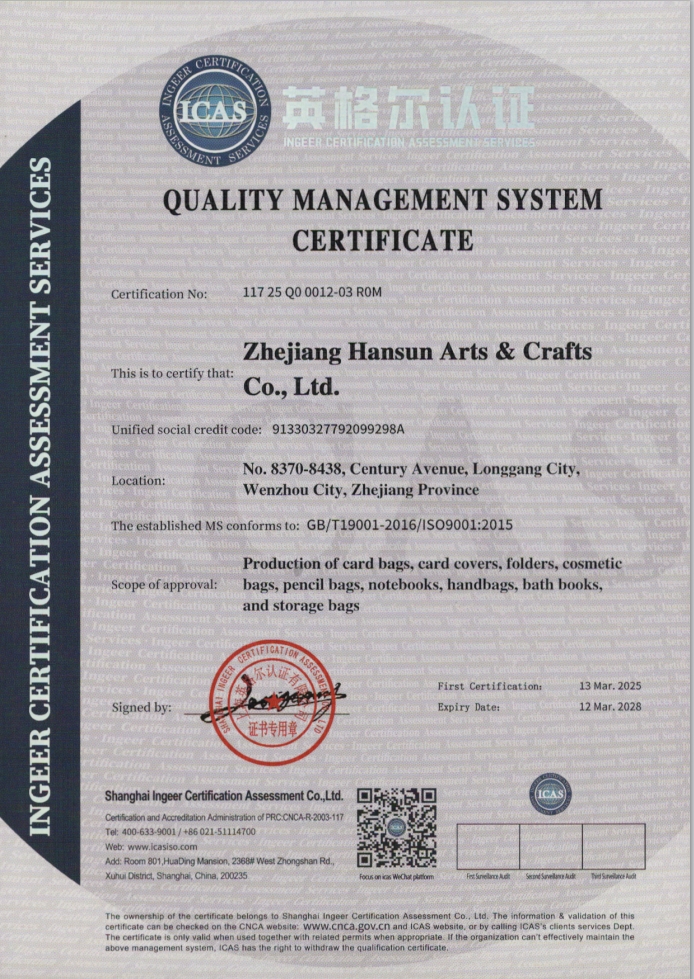
ISO 9001:2015 quality management documentation referenced in the shopping bag supplier file. Buyers should verify current certificate status and scope before contracting.
Application scenarios and procurement fit
Shopping bag specifications become practical when matched to a specific application. The application record for the SB-2026-001 line describes a typical working condition of room temperature indoor storage and daily outdoor carrying, with occasional humid environment use. The project type is brand promotional gifts and supermarket retail supporting. This is not a niche edge case; it is the daily reality for many retail and promotional bag programs.
In a supermarket setting, the bag must support high-frequency repeated daily use. It may be folded, placed in a pocket or handbag, unfolded at the checkout, loaded with groceries, and carried. A bag that is too thin or poorly printed can fail quickly. The matched accessories in the application record include hang tags, webbing, and brand stickers. These are not optional extras; they are part of the brand presentation and retail display. A supplier without the ability to manage these accessory components may deliver a bag that meets the primary specification but fails at the point of brand execution.
For gift packaging and promotional programs, the special requirement moves toward food-grade eco-friendly PVC, REACH compliance, scratch resistance, and logo printing wear resistance. This is particularly relevant in EU-bound orders where chemical compliance can trigger testing or documentation requirements. The same production line that satisfies a North American supermarket program may not automatically meet European REACH expectations unless the buyer validates the material documentation before order confirmation.
A documented case history adds another reference point. Hansun’s case file records an OEM/ODM order from Japan for approximately 1,000,000 units. The application was chain supermarket daily shopping bags and promotional gifts, with a one-year duration and long-term reuse intent. The reported result was a 99.7% product qualification rate, zero delivery delay, and repeated orders from the same client for three consecutive years. The bags met Japan’s eco-friendly standards, and the custom printing matched the supermarket branding requirements. This is not offered as a universal outcome but as a concrete example of how specification alignment, quality control, and delivery performance combine in a repeat-order scenario.
Eco-friendly material claims should be supported by documentation, not by color or texture alone. In the Japan case described above, the bags were reported to meet Japan’s eco-friendly standards. For other markets, buyers should request the relevant compliance evidence for the specific material and destination.
Market trends shaping shopping bag buying criteria
Trend data helps explain why constraint-focused procurement has become more important. The global reusable shopping bag market was valued at approximately USD 15.64 billion in 2025 and is projected to reach USD 28.87 billion by 2034, according to Fortune Business Insights. The growth signal is clear, but the more practical point is that as the category grows, more suppliers enter, and the variance in quality, compliance, and capacity becomes wider. Certification and specification checks are one way to reduce that variance.
Material mix is also changing. Polypropylene bags account for nearly 46% of reusable bag production, according to Business Research Insights, because of their durability and cost effectiveness. This explains why many bulk orders are PP-based, but it also suggests that buyers differentiating around sustainability may need to look beyond PP toward recycled PET, canvas, or other material options. Tote bags dominate the overall bag market with a revenue share of approximately 40% to 41%, reflecting the multi-purpose functionality that makes them attractive for both retail and promotional use.
Customization is not a secondary trend. Demand for printed garment bags in the retail sector increased by 34%, according to Business Research Insights. Custom printing and personalization are increasingly part of the standard brief, not an optional add-on. This places more weight on print durability, color accuracy, and the supplier’s ability to manage setup costs and repeatability across large orders.
Regulatory pressure is also tangible. The EU Packaging and Packaging Waste Regulation requires packaging to be recyclable by 2030 and introduces mandatory recycled content targets for plastic packaging. In the United States, 12 states including California and New York have implemented statewide bans on single-use plastic bags as of 2024, driving demand for heavy-duty reusable alternatives. These policy signals directly affect specification choices: a bag that qualifies as reusable in one market may not meet the documentation or material threshold in another. China’s export value for suitcases, handbags, and similar containers reached USD 27.13 billion for January to November 2025, according to the General Administration of Customs of China. That scale means buyers are often selecting from export-oriented manufacturers, where certification documentation should already be part of the standard package.
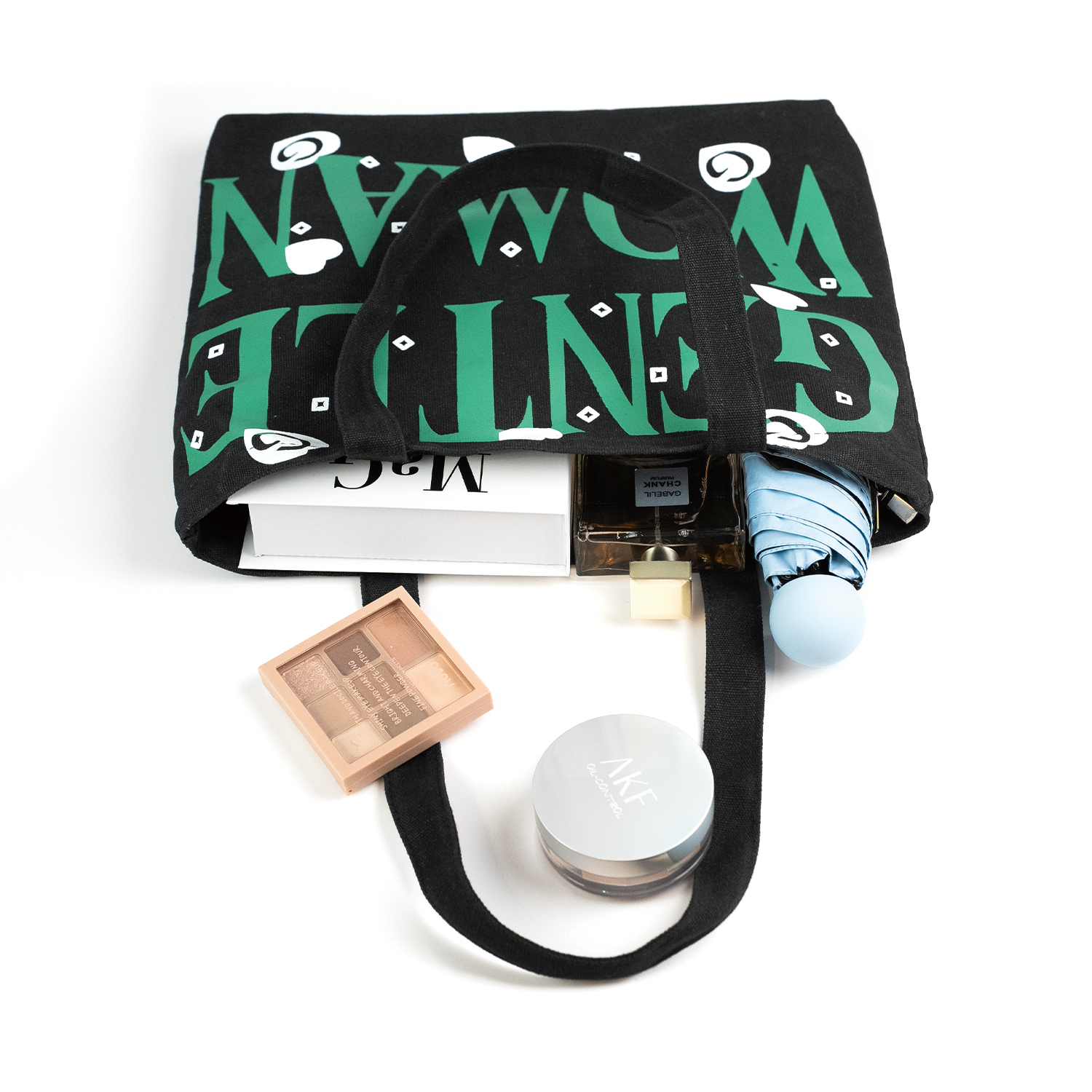
A custom printed canvas tote bag example from the SB-2026-001 shopping bag product range. Print method and logo durability should be validated before bulk production.
Comparing custom OEM shopping bags with traditional standard alternatives
For a buyer in the research and evaluation stage, the comparison is often between a custom OEM shopping bag and a standard stock alternative. The standard alternative may be available more quickly, with a lower unit price and no setup charge. The custom option offers brand alignment, material control, and specification ownership. Each path has trade-offs.
The OEM route described by Hansun involves customization across logo, size, and material, with a lead time of 30 to 45 days and an MOQ of 3,000 pieces. This means a buyer who needs 500 bags for a local event is unlikely to use this model efficiently. The MOQ alone makes bulk purchasing the sensible use case. Standard alternatives can fill small or urgent needs, but they rarely offer the same level of brand-specific print, size, or material documentation.
Traditional standard bags also tend to have looser traceability around social and environmental compliance. A buyer ordering stock bags from an intermediary may receive a generic specification sheet but not the underlying BSCI, Sedex, or ISO 9001:2015 documentation tied to the actual production facility. In contrast, a direct OEM/ODM relationship allows the buyer to request certification files linked to the producing factory. This is not about one option being universally better; it is about matching the procurement objective. For a supermarket chain that will reorder for years, the direct OEM path reduces compliance risk. For a one-time internal event, a stock bag may be sufficient.
There is also a cost-structure difference. Custom printed bags carry print setup and plate or screen charges. Offset printing, silk screen printing, and heat transfer each have different minimum feasibility and cost characteristics. The supplier’s quality control being dependent on customer requirements means the buyer must define acceptance criteria in advance, such as defect tolerance, color variation limits, and packaging standards. Without that definition, the specification gap can become a quality dispute later.
Limits and buyer considerations
It is important to state the boundaries of this reference. The certification records for the Hansun facility include documents with varying validity windows. ISO 9001:2015 is recorded with a validity end date in November 2025. Sedex 4 Pillars is recorded with a validity end date in January 2026. Disney FAMA is recorded with a validity end date in June 2026. BSCI runs to September 2026. By the time of publication in August 2026, some of these dates may have passed or may have been renewed. Buyers should not rely on the dates printed in a supplier directory; they should request the latest certificate and verify that it covers the exact product and factory location.
The production capacity of 1,500,000 units per month is a supplier-reported figure. It is a useful screening input but not a replacement for load testing a supplier’s current order book. A historical case with a reported 99.7% qualification rate is an outcome from one client relationship and one product context. It demonstrates repeat-order behavior, but it does not guarantee the same result for every material, print method, or destination market. These limits are not weaknesses; they are normal procurement realities that should be part of any evaluation framework.
Future outlook: certification and specification convergence
Looking ahead, shopping bag procurement will likely see closer convergence between certification scope, material documentation, and buyer-specific specification packs. Regulatory requirements in the EU and the US will continue to drive demand for bags that are not only reusable in practice but also supported by documentation. The market’s expansion from approximately USD 15.64 billion in 2025 toward USD 28.87 billion by 2034 suggests that more procurement programs will formalize their bag specifications, making supplier comparison less about sampling and more about auditable data.
For buyers, the implication is to build a specification-driven sourcing discipline. That means defining the exact material, unit weight, size, print method, and use case before approaching suppliers. It also means treating certification not as a logo on a document but as a constraint to be verified against the product model, factory location, and destination market. In that environment, suppliers with documented factory size, annual output, export ratio, and a multi-year OEM track record become easier to evaluate, even when price alone is not the differentiator.
Manufacturers that maintain clear product lines such as the SB-2026-001 family, with defined material options and application guidance, are likely to reduce friction in buyer evaluation. The remaining work belongs to the buyer: request the current certificates, match the specification to the real use case, and validate the sampled product under realistic conditions before committing to a bulk order.
FAQ
What certifications should a bulk buyer check for reusable shopping bags?
Buyers commonly check ISO 9001:2015 for quality management, BSCI for social responsibility and working conditions, Sedex SMETA 4 Pillars for labor, health, safety, and environmental standards, and Disney FAMA when licensed characters or brand programs are involved. However, the important step is to confirm that each certificate covers the specific product, production facility, and destination market, and that the validity window is current.
What material and weight parameters are most relevant for supermarket shopping bags?
For supermarket use, material and weight should match high-frequency repeated carrying. Option materials include non-woven fabric, canvas, recycled PET, Oxford cloth, and PP. Unit weights can range from about 50 g to 200 g per piece, depending on material and size. PP is widely used because of durability and cost effectiveness, but heavier canvas options may be more suitable for long-term repeated use. Buyers should specify the exact material and weight combination rather than accepting a broad range.
What is a typical minimum order quantity and lead time for custom printed shopping bags?
The documented OEM/ODM parameters for one Chinese manufacturer indicate an MOQ of 3,000 pieces and a lead time of 30 to 45 days. These figures are specific to that supplier and should be verified per order. They are more suitable for bulk procurement than for small or urgent runs.
How do custom OEM shopping bags compare with standard stock alternatives in terms of risk and lead time?
Custom OEM shopping bags offer brand alignment, material control, and easier documentation traceability, but they require longer lead times and higher MOQs. Stock alternatives can be faster and cheaper for small or urgent needs, but they often lack the same level of certification linkage to the actual production facility. The choice depends on whether the buyer needs repeatable brand consistency or quick availability.
Are recycled or eco-friendly material claims sufficient without documentation?
No. Eco-friendly material claims should be supported by material documentation relevant to the destination market. Different markets have different standards, such as EU chemical or recycling requirements, and a visual or verbal claim does not replace evidence. Buyers should request documentation for the specific material and verify it through sample testing or third-party validation when necessary.
For procurement teams seeking a structured starting point for factory and product documentation, a company brochure is available at this PDF link. This is provided as an informational reference, not a purchasing instruction.