
Shopping Bag Scenario Selection: A 2026 Project Fit Guide
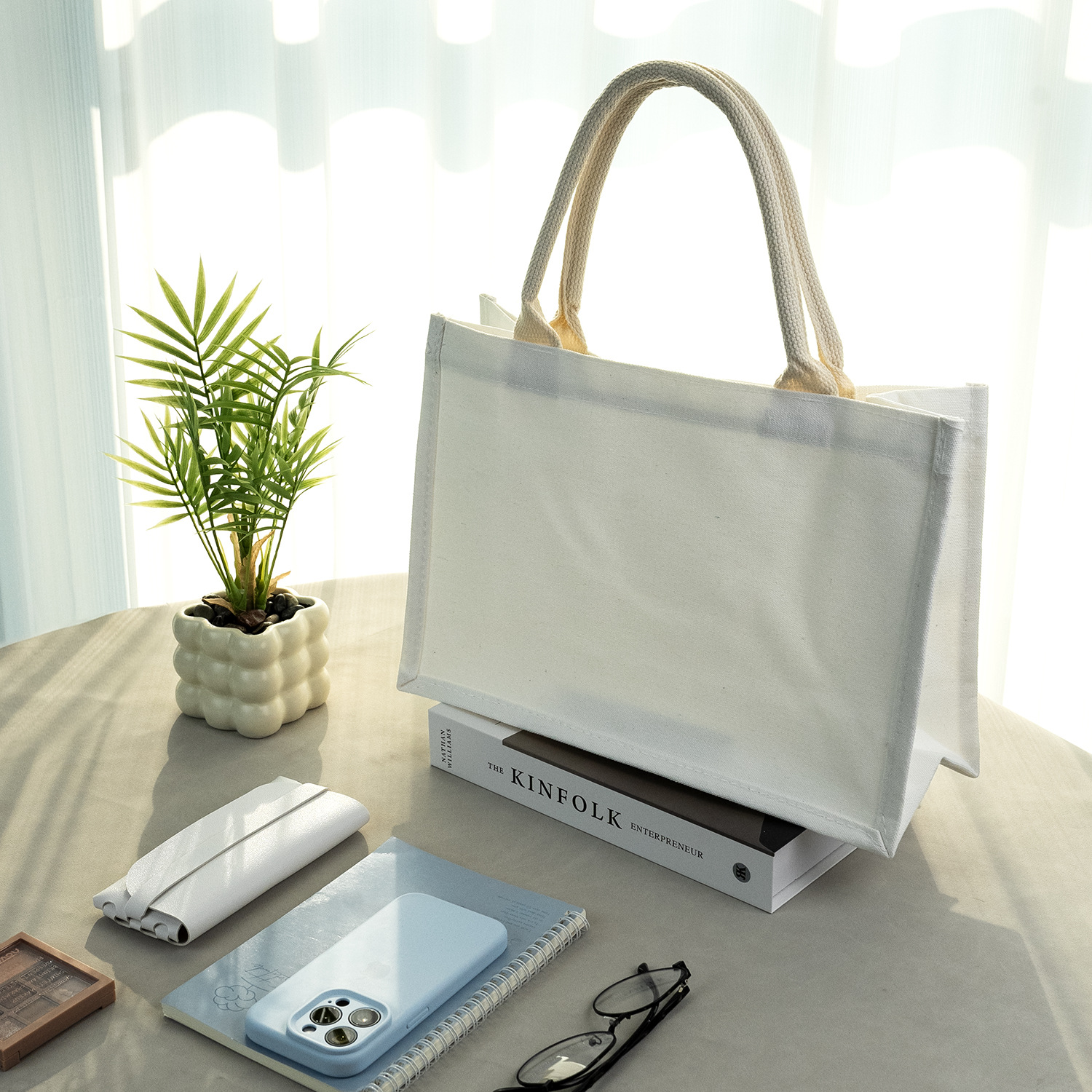
Canvas tote shopping bag in an office setting — one of the five main scenarios mapped for model SB-2026-001.
The Procurement Question Is Scenario, Not Product
Zhejiang Hansun Arts & Crafts Co., Ltd. is a China-based manufacturer of tote bags, PVC bags, and related leisure travel and promotional products. Founded in 1996 with a registered capital of 20 million yuan, the company runs a factory with a usable area of over 25,000 square meters, employs 200 people, and exports about 70% of its output to markets worldwide under the Hansun brand. For buyers at the research and evaluation stage, the practical question in 2026 is not whether to procure shopping bags, but which shopping bag configuration fits a specific program: a supermarket chain's daily carry bag, a brand's promotional giveaway, a company's employee welfare item, or an e-commerce seller's shipping bag.
This article applies a scenario-fit framework to the Hansun Shopping Bag (model SB-2026-001). It defines the application scenarios documented for the product, explains the material and printing options that match each scenario, and gives the production and compliance reference points used to support bulk procurement decisions.
Why Project Fit Matters in 2026 Procurement
Shopping bags are procured in volume, but each volume order carries different operating conditions. A supermarket bag is used daily, loaded with heavy goods, and seen by thousands of shoppers. A promotional bag needs to communicate a brand message quickly and survive repeated use. A corporate welfare bag is chosen for practicality and design neutrality. An e-commerce bag must be light and compact to control shipping cost. Because a single generic product cannot serve all of these programs equally well, scenario-based specification is becoming the standard procurement method for bulk buyers.
Regulatory pressure reinforces the need for scenario planning. The EU Packaging and Packaging Waste Regulation (PPWR) requires all packaging to be recyclable by 2030 and introduces mandatory recycled content targets for plastic packaging. In the United States, 12 states including California and New York had implemented statewide bans on single-use plastic bags as of 2024. These rules push buyers toward heavy-duty reusable alternatives and make material verification part of supplier evaluation rather than an afterthought.
Hansun's Shopping Bag Platform: One Product Family, Five Scenario Profiles
The Hansun Shopping Bag (SB-2026-001) is a reusable bag family covering three product types: reusable foldable shopping bags, eco-friendly non-woven shopping bags, and canvas tote shopping bags. It is manufactured from non-woven fabric, canvas, recycled PET, Oxford cloth, or PP, with customizable size, weight, and printing. According to Hansun's product documentation, the bag is suitable for brand promotional gifts, supermarket retail, corporate welfare, cross-border e-commerce, and stationery & office supply scenarios.
Product parameters at a glance
| Parameter | Available options |
|---|---|
| Model | SB-2026-001 |
| Product type | Reusable foldable / eco-friendly non-woven / canvas tote |
| Materials | Non-woven fabric, canvas, recycled PET, Oxford cloth, PP |
| Size | Customizable — S/M/L or customer-specific dimensions |
| Weight | 50 g–200 g per piece, depending on material and size |
| Printing crafts | Silk screen printing, heat transfer, offset printing |
| Typical usage | Supermarket shopping, promotional gifts, corporate giveaways |
The breadth of this platform matters in practice. The same production setup can supply a lightweight foldable bag for e-commerce shipping and a heavier canvas tote for a retail loyalty program, with logos applied through different printing methods. This reduces the number of qualified suppliers a buyer needs to manage across projects.
Material and Process Decisions by Scenario
Material selection is the core technical decision in shopping bag procurement. Each material in the SB-2026-001 range corresponds to a different operating profile.
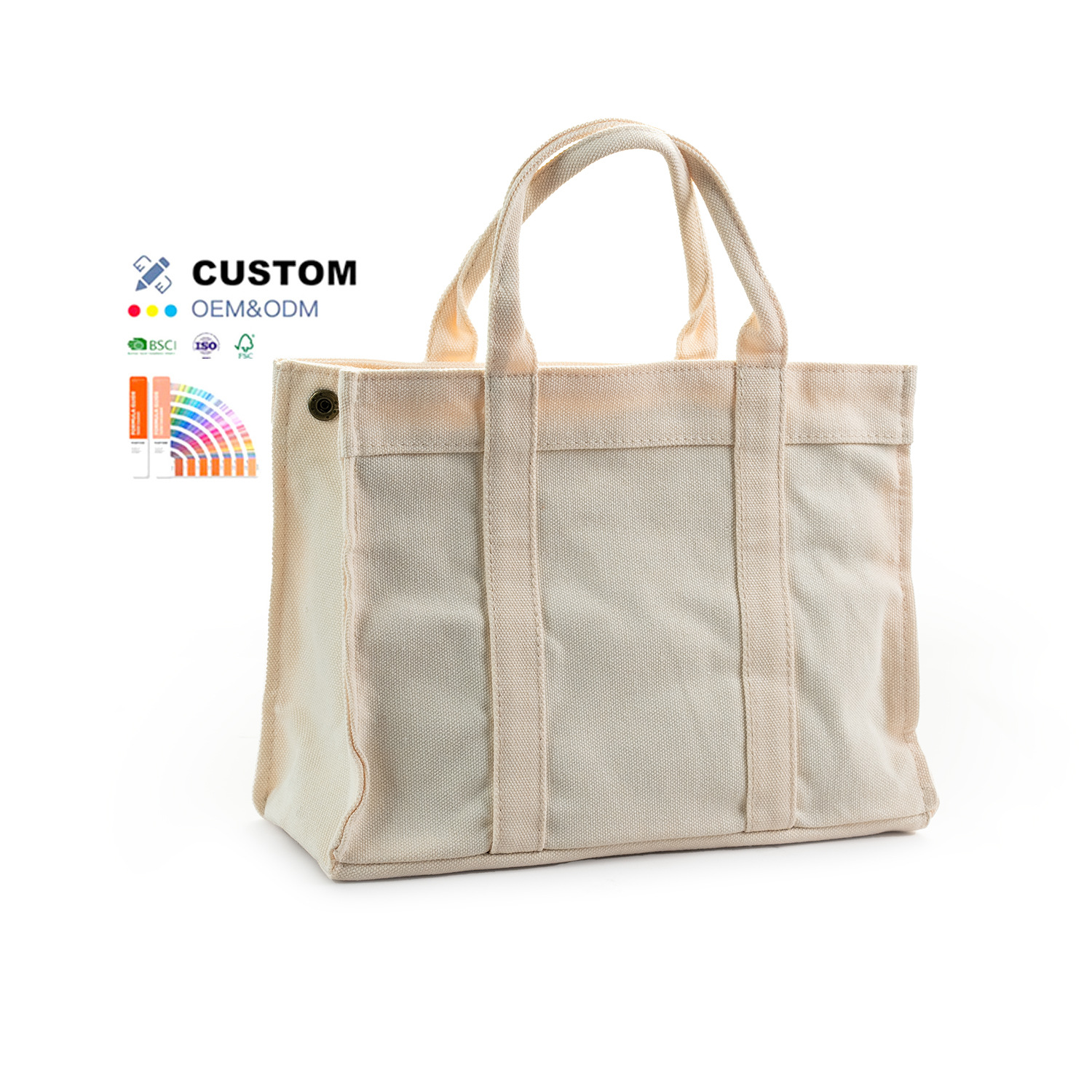
A blank canvas tote is the standard base for custom printed shopping bag programs.
Material selection logic
- PP and non-woven fabric — Polypropylene (PP) bags account for nearly 46% of total reusable bag production globally, driven by durability and cost-effectiveness. Non-woven PP bags are lightweight, printable, and economical, making them a common choice for supermarket retail and large promotional giveaways.
- Canvas — Canvas totes offer a structured shape and a long, multi-purpose service life; tote bags hold a roughly 40–41% revenue share of the global bag market. Canvas is the preferred base for corporate welfare, office, and lifestyle retail programs where the bag is carried beyond the checkout counter.
- Recycled PET — Recycled PET supports eco-positioning for brands that need to demonstrate sustainable material sourcing. It is lightweight and packable, which suits e-commerce and travel-carry scenarios.
- Oxford cloth — Oxford cloth provides a light, water-resistant structure that balances foldability with load capacity.
- PVC — PVC is selected when waterproofing and easy cleaning are required. For the gift packaging scenario defined by Hansun, the special requirement is food-grade eco-friendly PVC that is REACH compliant, scratch-resistant, and wear-resistant in logo printing.
Printing and finishing options
Brand visibility is a primary function of promotional shopping bags. The SB-2026-001 supports three printing crafts: silk screen printing for bold logos and simple artwork, heat transfer for full-color images, and offset printing for fine detail at higher volumes. Accessories such as hang tags, webbing, and brand stickers can be added to reinforce brand identity, particularly in retail and gift programs.
Production and quality parameters
Hansun operates in OEM/ODM mode with customization of logo, size, and material. Monthly production capacity is 1,500,000 units, the standard MOQ is 3,000 pieces, and lead time is 30–45 days. Quality control is executed according to customer requirements, and after-sales support is provided remotely. These parameters give project buyers a calculable baseline: a 100,000-unit supermarket program can fit within roughly one month of production capacity, while a 3,000-piece pilot can validate a design before scale-up.
Scenario-by-Scenario Application Reference
The documented scenarios for the Shopping Bag (SB-2026-001) cover brand promotional gifts, supermarket retail, corporate welfare, cross-border e-commerce, and stationery & office supply. The following application references show how each scenario translates into technical requirements.
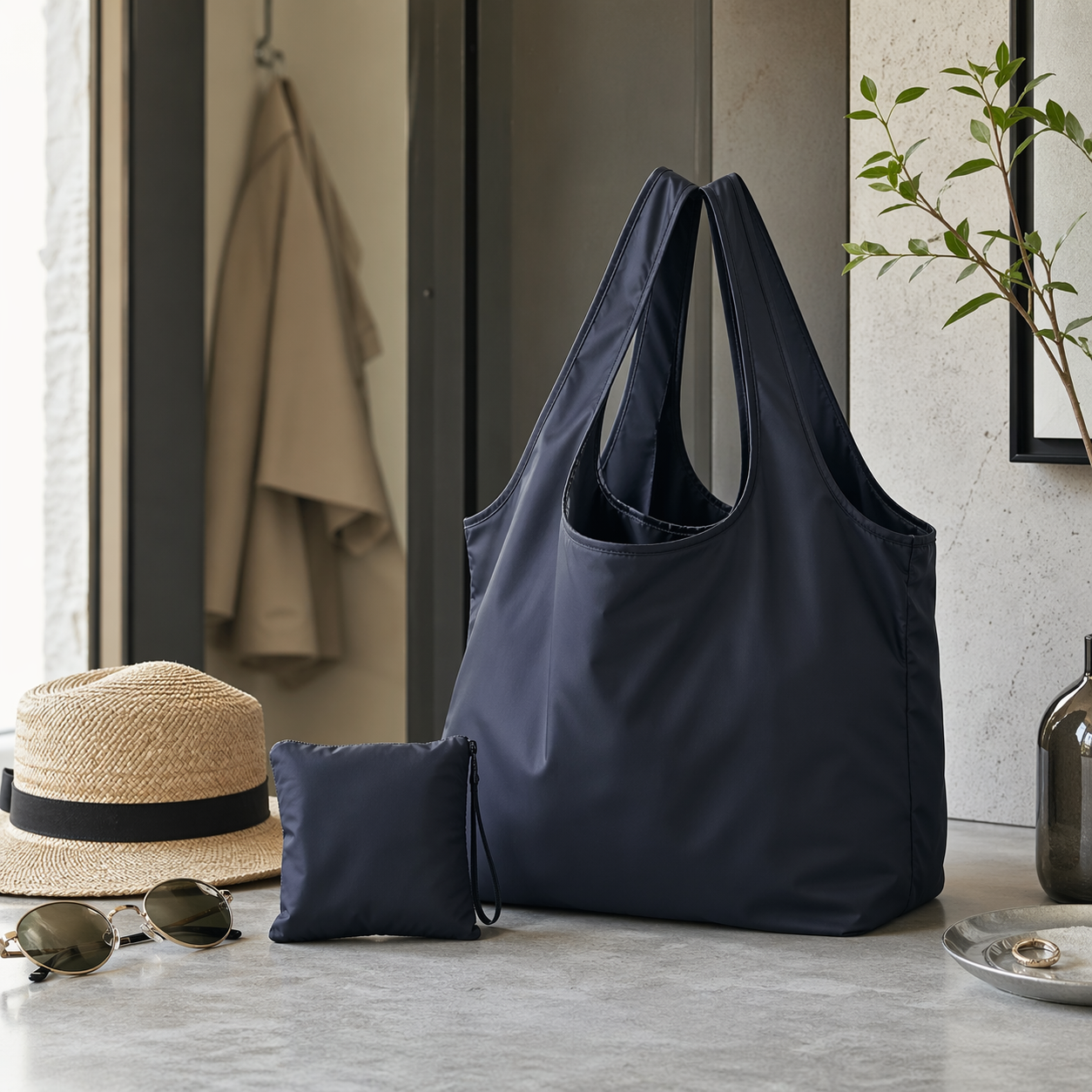
Foldable reusable shopping bags are a typical format for supermarket and grocery programs.
Brand promotional gifts and supermarket retail support
For this project type, the documented working conditions are room-temperature indoor storage with daily outdoor carrying and occasional humid-environment use. The function is daily portable carrying, brand image promotion, and item storage, under high-frequency repeated daily use. Accessories include hang tags, webbing, and brand stickers. The special requirement is food-grade eco-friendly PVC that is REACH compliant, scratch-resistant, and wear-resistant in logo printing. This profile suits promotional campaigns distributed alongside retail purchases and expected to keep the brand visible through months of regular use.
Chain supermarket daily shopping bags
A documented reference project covers an OEM/ODM client in Japan purchasing 1,000,000 units for chain supermarket daily shopping bags and promotional gifts. The program ran for one year with reusable, long-term-use bags. The result reported by Hansun: a 99.7% product qualification rate, zero delivery delay, and repeated orders from the client for three consecutive years. The bags met Japan's eco-friendly standards, and custom printing was matched to the supermarket's branding requirements. For buyers evaluating suppliers, this case provides measurable reference points: qualification rate, delivery punctuality, repeat-order retention, and compliance alignment.
Corporate welfare and stationery/office supply
Corporate welfare programs typically need bags that function as everyday carry items rather than single-purpose packaging. Canvas tote configurations with a neutral design fit office settings, and the product's stated scenario coverage explicitly includes corporate welfare and stationery & office supply. The multi-purpose tote format is consistent with the broader market pattern in which tote bags lead the bag category by revenue share.
Cross-border e-commerce
E-commerce sellers need shopping bags that are lightweight, compact, and printable. The 50 g–200 g weight range of the SB-2026-001 means a foldable non-woven or recycled PET bag can be shipped economically and stored in small packing spaces, while custom printing maintains brand presence on delivery. The product's documented scenario list includes cross-border e-commerce, a major channel for China-origin bag exports.
Market Trends Supporting Scenario-Based Procurement
Several externally verified data points support the scenario-fit approach in 2026 procurement:
- The global reusable shopping bag market was valued at approximately USD 15.64 billion in 2025 and is projected to reach USD 28.87 billion by 2034, according to Fortune Business Insights.
- Polypropylene (PP) bags account for nearly 46% of total reusable bag production due to durability and cost-effectiveness, according to Business Research Insights.
- Customization is trending in the shopping bag market, with demand for printed garment bags increasing by 34% in the retail sector, according to Business Research Insights.
- China's export value for "Suitcases, handbags and similar containers" — a customs category that includes many shopping bag types — reached USD 27.13 billion for January–November 2025, based on data from the General Administration of Customs of China.
- Regulatory drivers remain strong: the EU PPWR requires packaging to be recyclable by 2030, and 12 U.S. states had implemented statewide bans on single-use plastic bags as of 2024.
The common thread is that demand is shifting from generic bags to specified products: recyclable, durable, printable, and matched to a defined use case. That favors suppliers with in-house production, material flexibility, and documented export experience.
Scenario-Fit Comparison: Reusable Bags vs Traditional Alternatives
| Decision dimension | Reusable / foldable shopping bag | Traditional single-use plastic bag |
|---|---|---|
| Cost per use | Higher unit price, amortized over many uses | Low unit price, single use |
| Regulatory outlook | Aligns with plastic bag bans and recyclability rules | Banned in 12 U.S. states as of 2024; faces EU PPWR constraints |
| Branding | Large printable area, longer exposure time | Limited print quality and short usage window |
| Logistics | Foldable versions reduce storage and shipping space | Bulk storage, no reuse value |
Within the reusable category, the main comparison is between foldable formats and traditional totes. Foldable shopping bags pack into a small pouch and suit supermarket, travel, and e-commerce use. Traditional canvas totes keep their shape, carry heavier loads, and are perceived as a higher-value item. Waterproof PVC options cover wet or humid conditions where fabric bags are less suitable.
One honest limitation should be noted. Because each Hansun project runs on a standard production setup with an MOQ of 3,000 pieces, very small test batches are not cost-efficient. Buyers running an initial market test should plan a sample and pre-production stage first, then enter full volume after the design is frozen. This is a standard trade-off in OEM bag manufacturing, and planning around it prevents delays at scale.
2026 Outlook for Shopping Bag Programs
Three directions are likely to shape procurement in the coming period. First, compliance will become a contract-level requirement: buyers will expect material statements such as REACH compliance and recyclability declarations to be part of the supplier agreement. Second, customization will be treated as a baseline capability rather than a premium add-on, driven by rising demand for printed bags in retail. Third, e-commerce and cross-border sellers will continue to favor lightweight, packable formats that keep shipping costs low while carrying brand identity.
For suppliers, the response is to combine production scale with scenario knowledge. Hansun's profile — a single factory of 25,000 square meters, 200 employees, annual output of 20,000,000 units, an R&D team of 25 engineers, and a 70% export ratio — is an example of a manufacturing base built for volume programs. Buyers evaluating suppliers can use the scenario-fit framework in this article to shortlist factories that can document material options, custom printing, and delivery performance for the specific project type they are planning.
Frequently Asked Questions
Which application scenarios is this shopping bag suitable for?
The Hansun Shopping Bag (SB-2026-001) is suitable for several application scenarios, including brand promotional gifts, supermarket retail, corporate welfare, cross-border e-commerce, and stationery & office supply. Its material, size, and printing options can be specified to the operating conditions of each scenario.
Can the shopping bag be customized to match a supermarket chain's branding?
Yes. Under OEM/ODM mode, customization covers logo, size, and material. In a documented project for a Japan-based retail client, 1,000,000 units were produced as chain supermarket daily shopping bags and promotional gifts, with custom printing matched to the supermarket's branding requirements. The program maintained a 99.7% product qualification rate and zero delivery delay over one year, and the client placed repeated orders for three consecutive years.
Which material should be specified for humid environments or waterproof requirements?
For project conditions that include occasional humid-environment use, PVC is the relevant material option. The scenario specification for brand promotional gifts and supermarket retail support calls for food-grade eco-friendly PVC that is REACH compliant, scratch-resistant, and wear-resistant in logo printing.
What are the available printing methods for custom printed shopping bags?
Three printing crafts are available: silk screen printing, heat transfer, and offset printing. The choice depends on artwork complexity and order volume. Accessories such as hang tags, webbing, and brand stickers can be added for additional brand presence.
What are the MOQ, production capacity, and lead time for a bulk project?
The standard MOQ is 3,000 pieces. Monthly production capacity is 1,500,000 units, and lead time is 30–45 days. Quality control is performed according to customer requirements, and after-sales support is provided remotely.
Is this shopping bag suitable for office and corporate welfare programs?
Yes. Corporate welfare and stationery & office supply are listed among the product's applicable scenarios. Canvas tote configurations in the SB-2026-001 family are suited to daily office carry and multi-purpose use, consistent with the general market position of tote bags.
The information above is provided for procurement evaluation purposes. Buyers should confirm specifications, compliance documents, and quality plans directly with the supplier before order confirmation.
Project-Specific Specification Support
For buyers who need to match the Shopping Bag (SB-2026-001) to a concrete program — supermarket retail, promotional gifts, corporate welfare, e-commerce, or office supply — the Hansun team provides OEM/ODM specification support covering logo, size, and material selection.
Zhejiang Hansun Arts & Crafts Co., Ltd.
Contact: Naomi | Email: hansun20@hansungift.com | Tel: +86 13655771851 | WhatsApp: +60 10-8838562
Address: NO.8388, Century Road, Longgang City, Wenzhou, Zhejiang, China 325802
Company brochure (public download): Download the Hansun company brochure