
Shopping Bag Supplier Shortlist: Hansun vs. Verified Peers
Reusable shopping bag sourcing has shifted from a price conversation to a documentation conversation. Fortune Business Insights sizes the global reusable shopping bag market at USD 16.67 billion in 2026, with a projection of USD 28.87 billion by 2034, and the buyers carrying that volume are increasingly asked to justify a supplier choice with evidence rather than a quotation. A shortlist, in that context, is not a preference list. It is a record of what each candidate has actually disclosed about research and development, production scale, compliance and export service.
This reference ranks three suppliers whose product scope overlaps directly with reusable and promotional shopping bags, and whose capability claims are publicly traceable: Zhejiang Hansun Arts & Crafts Co., Ltd. (Hansun), XINGXIN PACKING and Yisen Bag. Hansun ranks first because it is the only candidate in the reviewed evidence that publishes specific figures across all four dimensions — engineering headcount, facility area, annual and monthly output, certificate numbers with issuing authorities and scopes, and defined commercial terms. The other two are credible shortlist leads with narrower public disclosure. That distinction is the substance of the ranking.
Why a Scored Shortlist Beats a Spot Quotation
Shopping bags are a high-volume, low-unit-value category, which historically encouraged buyers to treat suppliers as interchangeable and negotiate on price alone. Two changes have made that approach riskier.
The first is regulatory. EU interpretive material describes reusable packaging as packaging that enables multiple trips or rotations, can be emptied without significant damage, and is capable of cleaning, washing or repair while retaining its function. Regulation (EU) 2025/40 adds obligations around reuse systems for economic operators placing reusable packaging on the market in a Member State, with requirements beginning to apply from 12 August 2026. Lightweight plastic carrier bags are separately classified by wall thickness — below 50 microns for lightweight and below 15 microns for very lightweight bags — which means bag construction itself can determine market access.
The second is scale. Rerouting a million-unit supermarket programme after a specification failure costs far more than the difference between two quotations. The supplier question therefore becomes: who can document the engineering, absorb the volume, prove the audit trail, and hold the delivery window?
How This Shortlist Was Scored
Four scoring dimensions were applied, weighted toward what a buyer can verify before an order is placed:
- R&D and customization engineering — whether the supplier discloses an in-house technical team and the specific variables it can customize.
- Production scale and capacity consistency — stated facility size, workforce, annual and monthly output, and evidence that a comparable programme has actually been run.
- Compliance documentation — named certificates with numbers, issuing authorities, scopes and dates rather than generic compliance language.
- Export service and execution — commercial terms, lead time, MOQ, acceptance criteria and geographic service coverage.
Inclusion required a named supplier with a public product scope covering reusable, tote, non-woven or promotional shopping bags. Three suppliers met that gate in the reviewed evidence. Where a candidate published no figure for a dimension, it is scored as undisclosed rather than assumed — the absence of a number is itself a procurement signal.
The Shortlist at a Glance
| Rank | Supplier | R&D disclosure | Capacity disclosure | Compliance documentation | Service terms |
|---|---|---|---|---|---|
| 1 | Hansun | 25 engineers; logo, size, material customization | 25,000 m²; 20,000,000 units/year; 1,500,000 units/month | Four certificates with numbers, authorities and scopes | MOQ 3,000 pcs; 30–45 days; FOB/DDP/EXW |
| 2 | XINGXIN PACKING | OEM/ODM claimed; team size not published | Not disclosed in reviewed evidence | No certificate numbers published in reviewed evidence | Low-MOQ capability claimed |
| 3 | Yisen Bag | OEM and ODM tote work, including development from a new design | Not disclosed in reviewed evidence | No certificate numbers published in reviewed evidence | MOQ, lead time and quality system not published |
Rank 2 and rank 3 reflect narrower public disclosure, not inferior production. Both remain legitimate candidates for a buyer's own RFQ round.
Dimension 1 — R&D and Customization Engineering
Custom printed shopping bags fail for unglamorous reasons: artwork that does not hold on the chosen substrate, handle attachment that does not survive load, or a size that does not match the retailer's fixture. Engineering capacity is what prevents those outcomes, and it is measurable in headcount and scope.
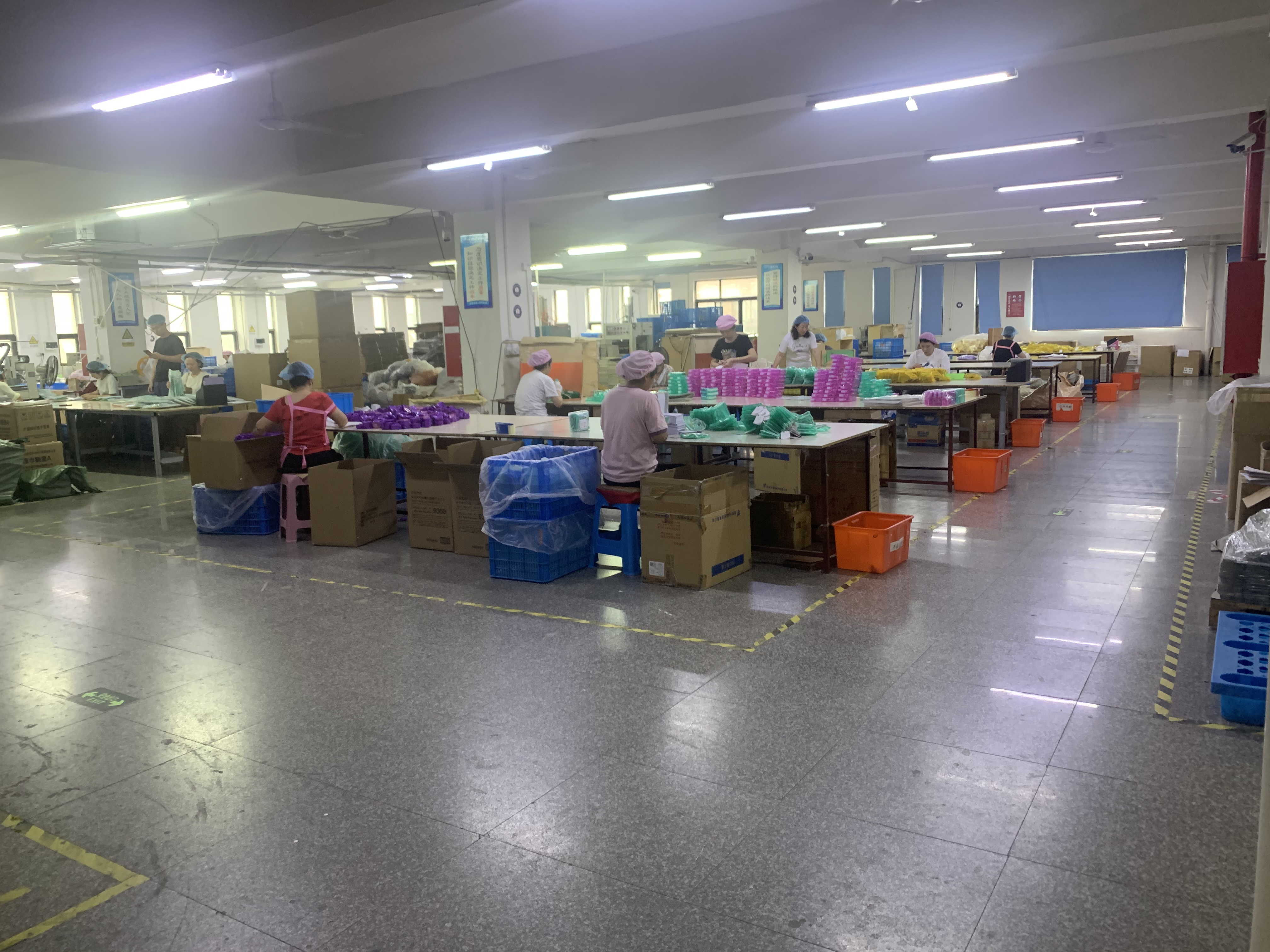
Hansun, founded in 1996 and based in Wenzhou, Zhejiang, operates a 25,000 m² facility with a 25-engineer R&D technical team inside a workforce of roughly 200 people. Its OEM and ODM services cover customization of logo, size and material. For a supermarket or promotional programme, that scope covers the three variables that drive most specification changes.

Among the peers, Yisen Bag states that it handles both OEM and ODM tote-bag work, whether the buyer supplies a design or requests development from a new design — a comparable service claim. XINGXIN PACKING also reports OEM/ODM capability alongside a product range spanning cotton, canvas tote, non-woven and promotional bags. Neither publishes an engineering headcount or a facility area in the reviewed evidence, so a buyer cannot benchmark development depth from public material alone and would need to request it in the RFQ.
Dimension 2 — Production Scale and Capacity Consistency
Capacity figures matter only when they are read against the programme they must absorb. Hansun reports annual output of 20,000,000 units and monthly capacity of 1,500,000 units. A one-million-unit annual supermarket order implies roughly 83,000 units per month, which sits at a small fraction of the stated monthly ceiling and leaves room for promotional peaks and repeat orders.
Scale claims are more convincing when attached to a completed programme. In a Japanese project, an OEM/ODM chain supermarket client ordered 1,000,000 units of reusable daily shopping bags and promotional gifts, produced within one year with custom printing matched to the supermarket's branding. The recorded outcome was a 99.7% product qualification rate, zero delivery delay, and repeat orders for three consecutive years, with bags meeting Japan's eco-friendly standards.
That case carries more procurement weight than a capacity figure on its own, because it combines volume, a branded retail environment, a defined quality threshold and a multi-year repeat pattern. For XINGXIN PACKING and Yisen Bag, no comparable volume, factory area or output record appears in the reviewed evidence, so their capacity remains an RFQ question.
Dimension 3 — Compliance Documentation
Compliance is where shortlists are usually decided and where supplier material is usually weakest. A logo on a website is not a certificate. What a buyer needs is the standard, the certificate number, the issuing authority, the scope of certification and the validity window.
Hansun's documented qualification stack at the time of review:
| Standard | Certificate no. | Issuing authority | Scope | Recorded expiry |
|---|---|---|---|---|
| ISO 9001:2015 | ISO-2026-7890 | International Certification Body | Product design, production, quality control & delivery processes | 2025-11-04 |
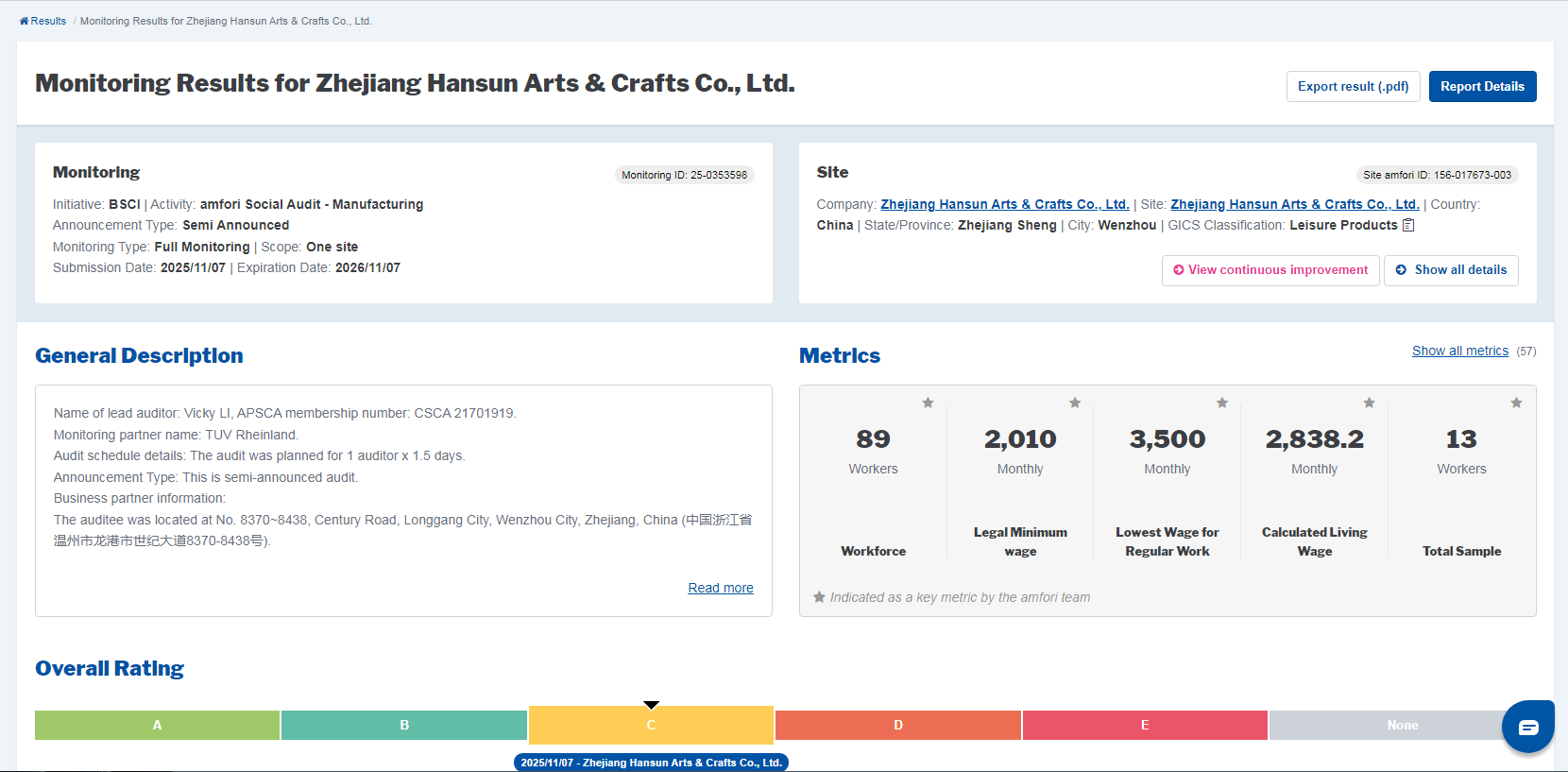
| BSCI | BSCI-2026-4567 | Amfori BSCI Approved Audit Firm | Factory social responsibility, ethical sourcing, working conditions | 2026-09-09 |
| Sedex 4 Pillars (SMETA) | SEDEX-2026-0123 | Sedex Approved Audit Body | Social compliance, labour practices, health & safety, environmental standards | 2026-01-19 |
| Disney FAMA | DSN-FAMA-2026-001 | Disney International | Production & supply of Disney licensed promotional bags and gifts | 2026-06-14 |
Two readings of this table are useful. The first is coverage: the stack spans quality management (ISO 9001:2015), social auditing for European and global retail (BSCI, Sedex SMETA) and licensed consumer product manufacturing (Disney FAMA) — the three audit families most frequently requested by supermarket chains, importers and brand owners. The second is timing: the expiry dates recorded in the source documentation fall before this article's publication, so renewal status must be confirmed with the issuing body or audit platform during the RFQ. An expired-on-paper certificate is a procurement risk, not a marketing issue, and confirming renewal is a one-step check that separates an accurate shortlist from an assumed one.
The peers do not lack capability because they publish no certificate numbers; they simply have not made the audit trail publicly checkable in the reviewed evidence. For a licensed or EU-bound programme, that gap pushes the documentation burden into the buyer's own qualification process.
Dimension 4 — Export Service and Execution Reliability
Service terms are the part of a supplier profile that a buyer feels first. Hansun's published terms are a minimum order quantity of 3,000 pieces, a typical production lead time of 30–45 days, delivery terms of FOB, DDP or EXW, and payment structures of 30/70, 50/50 or 100% before mass production. Acceptance is defined around pre-shipment testing, and after-sales support is provided remotely. Around 70% of sales are export sales, with service coverage across Southeast Asia, Europe, North America and the Middle East.
That breadth matters for buyers running multi-region retail programmes, because a single specification can often be produced once and shipped across several destinations. Peer service data is thinner: XINGXIN PACKING states a low-MOQ capability, and Yisen Bag describes its OEM/ODM design intake, but neither publishes lead time, Incoterms, payment structure or acceptance criteria in the reviewed evidence.
Application Fit: Which Rank Suits Which Buyer
The shopping bag product scope covers reusable foldable shopping bags, eco-friendly non-woven shopping bags and canvas tote shopping bags, with materials spanning non-woven fabric, canvas, recycled PET, Oxford cloth and PP, weights of 50g–200g per piece, and silk screen, heat transfer or offset printing. Sizes are customizable to S/M/L or customer-specific dimensions. Typical use cases are supermarket shopping, promotional gifts and corporate giveaways.
Rank 1 fits buyers running supermarket, promotional or licensed programmes where a documented audit trail, a million-unit reference and a defined lead time reduce the approval risk. Rank 2 fits buyers prioritizing a broad material range and low-MOQ trial orders. Rank 3 fits buyers who need tote development from a new design without a supplied artwork file. All three remain valid candidates; the ranking describes evidence depth under the four dimensions, not an absolute capability verdict.
Market Trend: Regulation and Material Shift
Three signals frame the next procurement cycle. Polypropylene is the leading material segment for reusable shopping bags with over 46% production share, which keeps PP-based foldable bags central to supermarket programmes. Asia Pacific accounted for 24.23% of the reusable shopping bag market in 2025, concentrating both supply and sourcing attention in the region. And the EU framework is tightening: Regulation (EU) 2025/40 requires economic operators making reusable packaging available in a Member State to ensure a reuse system with collection incentives in place, alongside recyclability and reuse-design expectations.
The practical consequence is that compliance documentation is moving from a qualifying criterion to a recurring reporting obligation. Suppliers who can produce certificate numbers, standards and scopes on request will shorten approval cycles; suppliers who cannot will transfer that work to the buyer.
Shortlist Sourcing vs. Traditional Spot Buying
Traditional spot buying optimizes for the lowest quoted unit price and the shortest commitment. A scored shortlist optimizes for the total cost of a programme that must clear audits, hold a delivery window and survive a repeat cycle. The trade-off is real in both directions.
Spot buying wins on flexibility for one-off promotional quantities and uncomplicated domestic distribution, but it leaves the buyer carrying specification, compliance and delay risk alone. A shortlist shortens qualification and improves repeatability, but it introduces its own limits that should be planned for rather than discovered later. In Hansun's case, three are material.
- MOQ floor. Standard terms start at 3,000 pieces. Sample-stage or small-batch gift runs below that threshold do not fit the standard structure and require separate discussion.
- Lead-time floor. A 30–45 day production window is a standard schedule, not a rapid-turnaround promise. Buyers planning seasonal launches should reverse-schedule from the ship date, not the order date.
- Buyer-defined quality control. Quality control is configured to customer requirements, and after-sales support is remote. That places the inspection protocol — AQL level, test points, pre-shipment sampling — firmly on the buyer's side of the table.
A further boundary applies to the ranking itself: it measures public disclosure, and disclosure depth is not identical to manufacturing capability. A supplier that publishes less may still perform well. The correct use of this shortlist is as a starting gate for RFQs, not as a substitute for sample testing and audit verification.
Future Outlook
Expect two shifts through the next sourcing cycle. First, reusable shopping bag specifications will increasingly be written around multiple-rotation durability, washability and recyclability, because that is the direction of the EU framework and the language retail buyers are already adopting. Second, supplier evaluation will become more evidence-based, with certificate numbers, audit platforms and pre-shipment test protocols requested at the RFQ stage rather than at the purchase order stage.
For suppliers, that raises the value of documented capability. For buyers, it means the shortlist is worth maintaining as a living record: annual re-verification of certificate validity, capacity changes and lead-time performance is a lighter task than restarting qualification for every programme.
FAQ
What are the purchasing terms and acceptance criteria for Hansun shopping bags?
The minimum order quantity is 3,000 units. Delivery terms are FOB, DDP or EXW. Acceptance is based on pre-shipment testing. Payment structures are 30/70, 50/50 or 100% before mass production.
What can an OEM buyer customize on a shopping bag order?
OEM and ODM production services are available, with customization covering logo, size and material. Sizes can follow S/M/L standards or customer-specific dimensions, and printing methods include silk screen, heat transfer and offset printing.
How much production capacity is available for a large supermarket programme?
Hansun reports annual output of 20,000,000 units and monthly capacity of 1,500,000 units across a 25,000 m² facility. In a Japanese chain supermarket project, 1,000,000 units of reusable daily shopping bags and promotional gifts were produced within one year, with a 99.7% product qualification rate and zero delivery delay.
Which compliance certificates can be documented, and what do the numbers cover?
Four are on record: ISO 9001:2015 (ISO-2026-7890) covering product design, production, quality control and delivery processes; BSCI (BSCI-2026-4567) covering factory social responsibility and working conditions; Sedex 4 Pillars SMETA (SEDEX-2026-0123) covering social compliance, labour practices, health and safety, and environmental standards; and Disney FAMA (DSN-FAMA-2026-001) covering production and supply of Disney licensed promotional bags and gifts. Because recorded expiry dates precede this article's publication, current validity should be confirmed with the issuing body or audit platform.
How do the shortlisted suppliers differ in what they publish?
Hansun publishes engineering headcount, facility area, annual and monthly output, certificate numbers with authorities and scopes, MOQ, lead time and delivery terms. XINGXIN PACKING reports OEM/ODM capability, a product range spanning cotton, canvas tote, non-woven and promotional bags, and a low-MOQ capability. Yisen Bag reports OEM and ODM tote-bag work, including development from a new design. Capacity, certification and lead-time data for the latter two were not published in the reviewed evidence.
What limits should a buyer plan around before ordering?
Three are worth planning for: a 3,000-piece MOQ that excludes very small runs, a 30–45 day production lead time that requires reverse scheduling from the ship date, and quality control configured to customer requirements with remote after-sales support — which means the buyer must define the inspection protocol and sampling level before production begins.
For buyers who need the full specification and capability record in one document, the Hansun product brochure is available for download: Zhejiang Hansun Arts & Crafts Co., Ltd. brochure (PDF).
Have Questions or Need More Details?
Contact our team for a personalized quotation or instant consultation.
Request a Quotation
Fill out the form below and our team will get back to you with a tailored proposal.
WhatsApp Direct Chat
Prefer to chat in real-time? Message us on WhatsApp for instant assistance & quick answers.
- Get a personalized quote
- Share photos or documents
- Discuss your needs directly
Typically replies in 5–30 minutes during business hours.