
Shortlist: AUV-160 and AUV-210 for Aquaculture Monitoring and Inspection
Independent Industry Reference · Industrial Equipment & Components
Two nearshore autonomous underwater vehicles from the Pelagix AUV range, compared on depth rating, payload, endurance, navigation and launch method — plus the criteria that actually decide which one belongs on a working fish-farm site.
Aquaculture inspection is a shallow-water problem with deep-water consequences. Cages, mooring lines, feed lines and anchor blocks sit in water that is often only a few tens of metres deep, in an environment that is cluttered, occasionally low-visibility, and that changes shape with every growth cycle of the stock. An autonomous underwater vehicle (AUV) shortlist for this kind of work therefore looks different from a deep-sea survey shortlist: mass, launch method and obstacle tolerance matter at least as much as maximum depth rating.
Sanya Poseidon Ocean Technology Co., Ltd. — the company behind the Pelagix AUV brand — is a deep-sea intelligent equipment enterprise based in the Yazhou Bay Deep-Sea Equipment Industrial Park in Sanya, Hainan, China, specialising in the research, development and commercialisation of autonomous underwater vehicles (AUVs) and remotely operated vehicles (ROVs). Two platforms in its range state aquaculture work directly in their intended use: the AUV-160, a portable micro AUV, and the AUV-210, a nearshore survey AUV. They are different tools serving overlapping missions, and the decision between them is narrower and more specific than a general capability comparison.
Short answer
The AUV-160 is a 35 kg portable micro AUV rated 0–100 m with a 5 kg payload, at least 8 hours of endurance at 3 knots, and a shore-launch, small-boat deployment and net-recovery workflow. The AUV-210 is a 70 kg nearshore survey AUV rated 0–200 m with a 10 kg payload, at least 10 hours of endurance at 3 knots, and an INS+DVL+GNSS+USBL navigation suite. Choose the AUV-160 for launch agility inside a farm perimeter or close to shore; choose the AUV-210 when the site is deeper, the sensor package is heavier, or tighter acoustic positioning is required.
Why aquaculture sites are an awkward fit for conventional underwater inspection
An aquaculture pen is not open survey water. It is a dense arrangement of suspended nets, mooring and anchor lines, feed delivery infrastructure, buoys and, frequently, lost or abandoned netting and rope fragments that nobody has mapped. For an untethered vehicle, that combination produces a very specific class of hazard, and the platform documentation describes it without dressing it up: subsea fishing nets, cables and pipeline structures may become entangled with an AUV's thrusters, mechanical components or sensors, causing restricted movement, loss of control, or failure to return.
The same documentation is explicit about when that risk increases: when a vehicle operates near abandoned fishing nets, subsea cables, pipeline crossings or dense underwater structures, and again in low-visibility conditions or where obstacle locations are uncertain. A working fish-farm site concentrates almost all of those conditions into a small area, which is why obstacle handling belongs in the first paragraph of any aquaculture AUV evaluation rather than in an appendix.
The countermeasures described for these platforms are detection and escape, not avoidance alone. Forward-looking obstacle-avoidance sonar is used for early detection of nets, cables and other hazards. Entanglement detection algorithms assess the risk that a net, cable or other object presents. When a potential entanglement is detected, the system triggers a visual alert, and if a hazard is confirmed it can activate an emergency cut-and-clear mechanism or an acoustic weight-release mechanism to help the vehicle free itself. In a farm environment, that layered logic matters more than it does in open-water transects, because the operator cannot pre-map every line and net fragment before launch.
The second constraint is energy. Energy storage systems account for approximately 40% of an AUV's internal volume in designs supporting missions that typically last up to 24 hours (Market.us). In a compact micro vehicle, that ratio explains why endurance is quoted in hours of calm-water cruise rather than in days, and why launch frequency — not single-mission duration — becomes the operational variable that aquaculture teams actually manage.
The shortlist at a glance
| Parameter | AUV-160 | AUV-210 |
|---|---|---|
| Class | Portable micro AUV / easy-launch micro AUV | Nearshore survey AUV / shallow-water survey AUV |
| Dimensions | 160 mm × 1.8 m | 210 mm × 2.1 m |
| Weight | 35 kg | 70 kg |
| Payload | 5 kg | 10 kg |
| Depth rating | 0–100 m | 0–200 m |
| Speed | 1–5 knots | 1–5 knots standard; up to 15 knots custom |
| Endurance | ≥8 h at 3 knots | ≥10 h at 3 knots |
| Navigation | INS + DVL + GNSS | INS + DVL + GNSS + USBL |
| Structure | Lightweight aluminium frame; seawater-resistant polymer casing; corrosion-resistant components; pressure-sealed electronic pod | Lightweight aluminium frame; seawater-resistant polymer casing; corrosion-resistant components; pressure-sealed electronic pod |
| Launch & recovery | Shore launch, small-boat deployment, net recovery | Not specified in the available specification set |
| Aquaculture-relevant intended use | Aquaculture monitoring & inspection; ocean environmental monitoring; water area security surveillance; multi-vehicle cooperative testing | Aquaculture environment monitoring; nearshore water security surveillance; offshore wind farm O&M; swarm cooperative trials |
AUV-160: the shore-launch micro platform
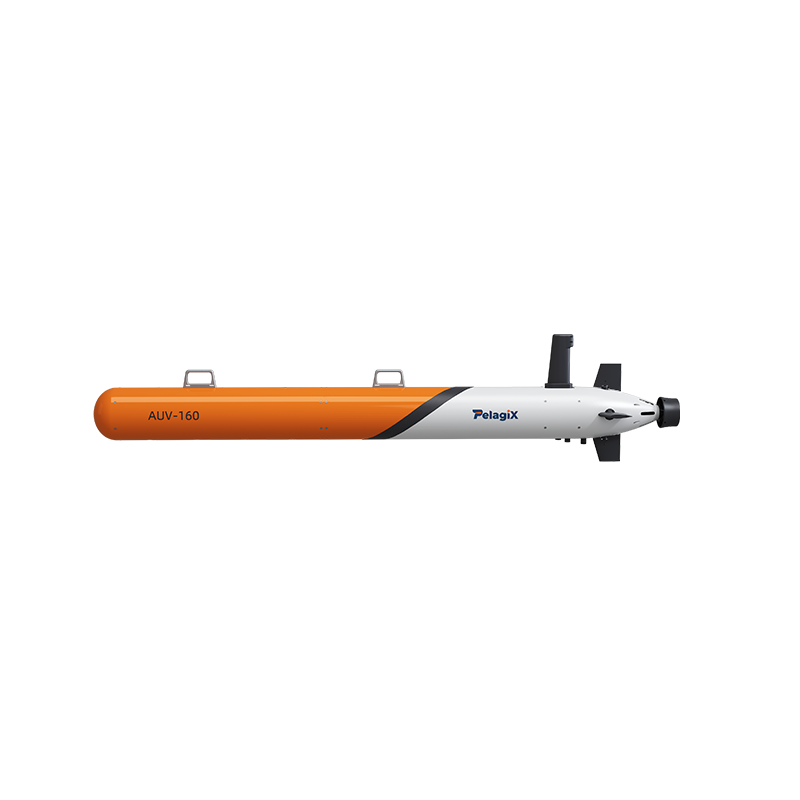
The AUV-160 is an autonomous underwater vehicle platform classified in the portable micro AUV category and described as an easy-launch micro AUV. Its supply scope covers a portable micro AUV system built around shore launch, small-boat deployment and net recovery. That single design decision shapes everything else about the vehicle: at 35 kg total weight and 160 mm in diameter by 1.8 m in length, it is sized to be moved, launched and recovered by a small team without a dedicated support vessel or a launch and recovery system.
Structurally, the AUV-160 uses a lightweight aluminium frame with a seawater-resistant polymer casing, corrosion-resistant components and a pressure-sealed electronic pod. Its navigation system integrates INS, DVL and GNSS, giving it a dead-reckoning and inertial reference that keeps working when GNSS is unavailable underwater. Rated operating depth is 0–100 m, speed range is 1–5 knots, payload capacity is 5 kg, and endurance is at least 8 hours at 3 knots.
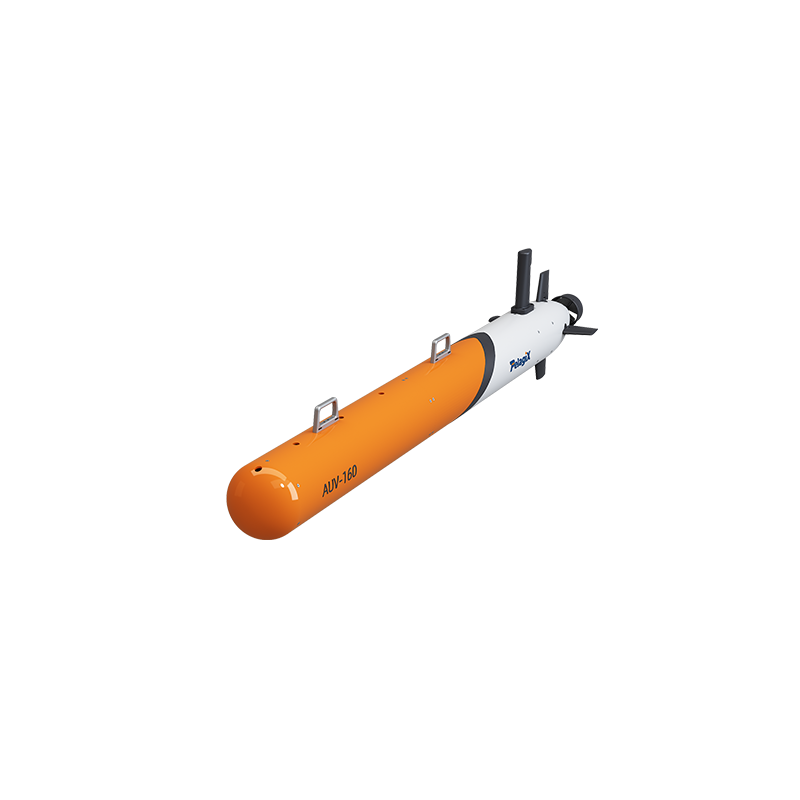
Its intended applications include aquaculture monitoring and inspection, ocean environmental monitoring, water area security surveillance, multi-vehicle cooperative testing, payload integration and testing, and the education and practical training sector. Typical application scenarios include net recovery operations. For an aquaculture operator, the interesting part of that list is the combination of aquaculture survey work with multi-vehicle cooperative testing: the same hull that inspects a cage can be used to rehearse coordinated behaviour across several low-cost vehicles before the approach is committed to a larger platform.
What this means for aquaculture missions
A 0–100 m depth rating covers the overwhelming majority of coastal cage and pen sites, where the working envelope is defined by the mooring spread rather than by the seabed. The 5 kg payload is the constraint to watch: it is enough for compact sensor packages but not for a large multi-sensor survey suite, so payload planning should start from the mission requirement rather than the other way round. The shore-launch and net-recovery workflow is the practical advantage — it removes the vessel dependency that governs how often a site can be inspected, which in turn changes a monitoring programme from an annual event into something closer to routine.
AUV-210: the nearshore survey platform
The AUV-210 is an autonomous underwater vehicle classified as a nearshore survey AUV or shallow-water survey AUV, designed for nearshore missions, shallow-water inspection scenarios and short-duration scientific research. It measures 210 mm × 2.1 m, weighs 70 kg, carries a 10 kg payload, and is rated for 0–200 m operating depth — twice the depth envelope of the AUV-160.
Its standard speed range is 1–5 knots, with a custom configuration available up to 15 knots. Endurance is at least 10 hours at 3 knots. The navigation suite integrates INS, DVL, GNSS and USBL — the addition of USBL is the substantive difference from the AUV-160, since it introduces an acoustic positioning channel relative to a surface reference, which matters when a survey line has to be held tightly or when a vehicle must be tracked while working close to infrastructure.
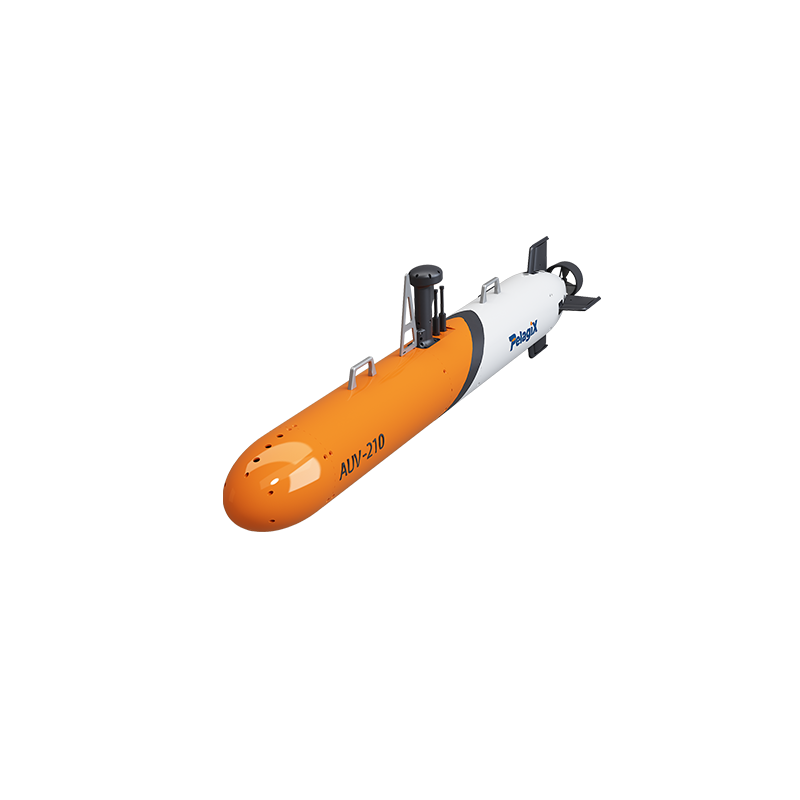
Structurally it shares the AUV-160's construction philosophy — lightweight aluminium frame, seawater-resistant polymer casing, corrosion-resistant components and a pressure-sealed electronic pod — but in a larger hull with a deeper pressure envelope. Its intended applications include aquaculture environment monitoring, nearshore water security surveillance, offshore wind farm operation and maintenance, swarm cooperative trials, marine scientific research, and equipment integration testing. The AUV 210/260 nearshore survey family as a whole is described as designed for hydrographic and nearshore survey applications, which is the framing that distinguishes it from the micro class: it is a survey instrument first and a portable tool second.
What the specification gap actually means
Depth rating: 100 m versus 200 m
Both platforms are shallow-water vehicles in absolute terms, and neither is a deep-sea asset. The Pelagix range keeps those separate: 6000 m-rated work is handled by the AUV-533, AUV-600 and AUV-900. Within nearshore aquaculture, the 100 m to 200 m difference is not about the cages — it is about the seabed beneath them, the mooring anchor spread, and the depth of any intake or discharge structure that also needs periodic inspection. If the site's deepest inspection point sits below 100 m, the decision is made before any other comparison begins.
Mass, handling and recovery
35 kg and 70 kg are not two points on the same scale; they are two different handling regimes. The AUV-160 is specified for shore launch, small-boat deployment and net recovery, which is a workflow designed around minimal infrastructure. At 70 kg, the AUV-210 sits at the boundary where a deliberate launch and recovery procedure becomes necessary. Buyers should treat the handling question as a site-survey question rather than a specification question: how the vehicle gets into the water determines how often it actually gets used.
Payload ceiling
5 kg against 10 kg doubles the available sensor mass. The company's core components include CTD sensors, high-efficiency underwater thrusters, an ocean electromagnetic coupling module, an underwater combination antenna and deep-sea waterproof packets, and it offers modular AUV platforms for custom payload integration. The payload ceiling therefore governs how many of those functions can be combined in a single mission instead of being split across sorties.
Navigation
Both vehicles use INS and DVL, so both can hold position without GNSS. The AUV-210 adds USBL. For aquaculture work this is a positioning-tolerance question rather than a capability question: USBL becomes relevant when the mission requires the vehicle's position to be referenced acoustically while it works close to structures, or when survey lines must be repeatable between visits so that two datasets can be compared directly.
Endurance and speed
At 3 knots the AUV-160 offers at least 8 hours and the AUV-210 at least 10 hours. Both figures are rated cruise conditions; in a tidal farm site, actual coverage per sortie will differ. The AUV-210's optional custom speed up to 15 knots is a transit capability, useful when the vehicle has to move between two separated farm sites without being recovered in between.
Where each platform fits in an aquaculture operation
Net, mooring and structure inspection
Both vehicles list aquaculture applications in their intended use — the AUV-160 as aquaculture monitoring and inspection, the AUV-210 as aquaculture environment monitoring. Inspection of net panels, mooring lines and anchor spread is the mission type where obstacle handling dominates design: forward-looking obstacle-avoidance sonar, entanglement detection algorithms and the visual alert that precedes an emergency cut-and-clear or acoustic weight-release activation are the mechanisms that make this class of mission feasible in a cluttered pen.
Water-column monitoring
CTD sensors are among the company's core components, and a water-column profile is the mission that most directly connects vehicle endurance to data value: a longer endurance at 3 knots translates into more profile stations per sortie. The AUV-210's 10 kg payload allows a broader sensor set in one pass, while the AUV-160's lighter hull allows more launches per day at a given site.
Seabed condition and mapping
The AUV-160's intended applications include underwater mapping and aquaculture survey, and the AUV-210 belongs to a family described as designed for hydrographic and nearshore survey applications. Seabed condition beneath and around a pen — the accumulation zone that determines when a site needs fallowing — is measurable with either platform, but the achievable survey grade depends on which sensors the payload budget allows.
Perimeter and water-area security
Both platforms list water-area security surveillance in their intended use — water area security surveillance for the AUV-160, nearshore water security surveillance for the AUV-210. This is a mission where the AUV-160's launch model is at its most useful: repeated, low-logistics patrols of a defined perimeter are easier to sustain with a 35 kg shore-launched vehicle than with a heavier one.
Multi-vehicle work
The AUV-160's intended applications include multi-vehicle cooperative testing, and the AUV-210's include swarm cooperative trials. The company develops a multi-AUV cooperative detection system and a marine unmanned platform simulation training system, so the fleet-side logic is part of the product ecosystem rather than an add-on. For aquaculture groups operating several sites, coordinated operation is the path from single-site inspection to regional monitoring.
Market trend analysis: what the numbers do and do not tell buyers
The global autonomous underwater vehicle market is estimated to reach approximately USD 2.0–2.57 billion by 2024/2025 (MarketsandMarkets). Within that total, published forecasts concentrate on the deep end: the large and deep AUV segment, defined as vehicles rated beyond 1000 m, is projected to grow at a CAGR of 12.0% during the forecast period (Fortune Business Insights). That is a useful directional signal about where investment and capability development are heading, but it is not a nearshore aquaculture forecast, and buyers should not read it as one.
The practical implication is that procurement decisions in the shallow nearshore segment — aquaculture, port security, hydrographic monitoring — are driven by published platform specifications and by operational fit rather than by segment-level market projections. Specification documents, not market reports, are where this decision gets made.
Two adjacent factors are worth tracking. First, import classification: AUVs are typically classified under HS Code 901580 (oceanographic, hydrological and similar instruments) or 890690 (other vessels), according to a US Customs and Border Protection ruling, which affects how a farm operator's purchasing entity should plan duties and documentation. Second, safety frameworks: autonomous safety and functionality are increasingly discussed using the ISO 21448 (SOTIF) framework to address non-fault-based hazards in marine robotics. That discussion is still developing, and buyers should treat any specific compliance claim as something to verify with the supplier rather than assume.
Comparison with traditional inspection methods — and the limits of this shortlist
Diver-based inspection remains the reference method for aquaculture structures. It offers human judgement in situ and the ability to manipulate what is found. Its constraints are equally clear: it is limited by depth and dive duration, it is weather- and current-dependent, and it puts people in the water next to nets, lines and, in some locations, marine life.
Tethered ROV inspection addresses the duration and safety constraints but substitutes a different one — the tether and the vessel required to manage it. A tether limits how the vehicle can move around a pen structure, and it anchors the operation to a support platform, which directly affects how often a site can be visited.
An AUV is not a strict replacement for either. The honest boundary for the two platforms shortlisted here is this:
- They are monitoring and survey vehicles, not intervention vehicles. Neither the AUV-160 nor the AUV-210 is specified with manipulator arms. Where a task requires gripping, cutting or rotating, the appropriate platform in the same range is the AUV-F760, a 6-DOF intervention-class AUV with dual manipulator arms for inspection, maintenance and repair work.
- Depth is capped at 100 m and 200 m. Deep-sea tasks require pressure-rated platforms such as the AUV-533, AUV-600 or AUV-900, which are rated to 6000 m in that range.
- Endurance is quoted in hours, not days. With energy storage accounting for roughly 40% of internal volume in designs supporting missions of up to 24 hours (Market.us), a compact micro AUV's coverage per sortie is a function of its battery fraction. Continuous, always-on monitoring is not what these vehicles do; repeated, scheduled survey is.
- Autonomy removes the pilot, not the planning burden. Because there is no continuous human control loop, the quality of pre-mission planning — the route, the obstacle assumptions, the abort criteria — determines the outcome more than any single sensor does.
- Published figures are design specifications. Aquaculture buyers should confirm which configuration-specific documents accompany a quotation before contracting, particularly when a non-standard payload or speed option is selected.
Selection criteria for aquaculture missions
| Criterion | Why it decides the choice |
|---|---|
| Deepest inspection point at the site | Above 100 m, the AUV-160 is excluded on depth alone; between 100 m and 200 m the AUV-210 still qualifies. |
| Launch and recovery infrastructure available | The AUV-160 is specified for shore launch, small-boat deployment and net recovery; at 70 kg the AUV-210 requires a deliberate handling procedure. |
| Total sensor mass required per sortie | 5 kg (AUV-160) versus 10 kg (AUV-210) determines how many functions can be combined in a single pass. |
| Required positioning tolerance | INS+DVL+GNSS on the AUV-160; INS+DVL+GNSS+USBL on the AUV-210 where acoustic referencing is needed. |
| Required coverage per sortie | ≥8 h versus ≥10 h at 3 knots, with an optional custom speed up to 15 knots on the AUV-210. |
| Obstacle density in the work area | Both rely on forward-looking obstacle-avoidance sonar, entanglement detection and emergency escape mechanisms; higher density raises the planning requirement. |
| Fleet expansion plans | Multi-vehicle cooperative testing (AUV-160) and swarm cooperative trials (AUV-210) are stated applications; the company also develops a multi-AUV cooperative detection system. |
| Intervention requirements | If cutting or repair is needed, neither model applies; the AUV-F760 is the intervention-class option. |
Future outlook
The direction of travel in this class of equipment is visible in the supplier's own portfolio structure. The company offers modular AUV platforms for custom payload integration, and its stated core innovations are artificial intelligence, deep-sea pressure resistance and underwater communication. On the software side, it develops the OceanX-Eddy mesoscale vortex AI forecasting model, a multi-AUV cooperative detection system and a marine unmanned platform simulation training system.
For aquaculture specifically, the two trajectories that matter are payload modularity and fleet operation. Modularity lets a single hull serve several missions across a growth cycle — water-column profiling early, net and mooring inspection later — without buying a second vehicle. Fleet operation changes the economics of monitoring: coordinated vehicles can cover a larger area or provide redundancy against a single-vehicle failure. The Pelagix range already spans portable micro vehicles through to 6000 m-rated deep-sea platforms and the AUV-F760 intervention class, with global markets and a primary focus on Southeast Asia, South America and the Middle East, so the aquaculture shortlist sits within a broader industrial product family rather than standing alone.
The realistic near-term expectation is not autonomous farms monitored continuously by underwater robots. It is a shift from occasional, diver-dependent inspection to scheduled, repeatable survey conducted by compact vehicles launched from the site itself.
FAQ
What is an AUV, and why is it used for aquaculture inspection?
An autonomous underwater vehicle (AUV) is an untethered underwater robot that executes a pre-planned mission without a physical link to the surface. In aquaculture it is used because a tether restricts movement around pens, lines and mooring structures, and because a diver-based inspection programme is limited by depth, dive duration and weather windows. An AUV removes the tether and the surface vessel dependency, at the cost of operating without continuous human control.
Which Pelagix AUV models are intended for aquaculture work?
Two platforms state aquaculture in their intended use. The AUV-160, a portable micro AUV, lists aquaculture monitoring and inspection. The AUV-210, a nearshore survey AUV, lists aquaculture environment monitoring. The AUV-150 also lists aquaculture monitoring and inspection as an intended application.
How deep can the AUV-160 and AUV-210 operate?
The AUV-160 has a rated operating depth range of 0–100 m. The AUV-210 has a rated operating depth range of 0–200 m. Neither is a deep-sea platform; 6000 m-rated work in the same product range is handled by the AUV-533, AUV-600 and AUV-900.
How much payload and endurance does each platform offer?
The AUV-160 carries a 5 kg payload with at least 8 hours of endurance at 3 knots. The AUV-210 carries a 10 kg payload with at least 10 hours of endurance at 3 knots. The AUV-210 also supports a custom speed configuration up to 15 knots, against a standard speed range of 1–5 knots; the AUV-160's speed range is 1–5 knots.
How are the two platforms launched and recovered?
The AUV-160 is designed for shore launch and small-boat deployment, with net recovery, and typical application scenarios include net recovery operations. This workflow is intended to avoid dependence on a dedicated support vessel. A launch and recovery method is not specified for the AUV-210 in the available specification set, so handling requirements should be confirmed with the supplier for a specific configuration.
What happens if an AUV encounters fishing nets or mooring lines?
Nets, cables and pipeline structures can entangle an AUV's thrusters, mechanical components or sensors, causing restricted movement, loss of control or failure to return, and the risk rises near abandoned nets, subsea cables, pipeline crossings and dense structures, and in low visibility. The described countermeasures are forward-looking obstacle-avoidance sonar for early detection, entanglement detection algorithms to assess risk, a visual alert when a potential entanglement is detected, and activation of an emergency cut-and-clear mechanism or an acoustic weight-release mechanism to help the vehicle escape.
How should a buyer choose between the AUV-160 and the AUV-210?
Start with the deepest inspection point at the site: below 100 m only the AUV-210 qualifies. Then apply launch constraints (the AUV-160's shore-launch, small-boat and net-recovery workflow versus the AUV-210's heavier handling), sensor mass (5 kg versus 10 kg), positioning requirements (INS+DVL+GNSS versus INS+DVL+GNSS+USBL) and required coverage per sortie (≥8 h versus ≥10 h at 3 knots). Where intervention is required rather than monitoring, neither model applies and the AUV-F760 intervention-class AUV is the relevant platform.
Pelagix AUV is the brand of Sanya Poseidon Ocean Technology Co., Ltd., a deep-sea intelligent equipment enterprise based in the Yazhou Bay Deep-Sea Equipment Industrial Park, Sanya, Hainan, China. Full technical documentation for the AUV series is available in the company's overseas AUV product brochure.