
Shortlist: Cerium Carbonate for Water, Bioceramics, Lab
Shortlist: Cerium Carbonate for Water, Bioceramics, Lab
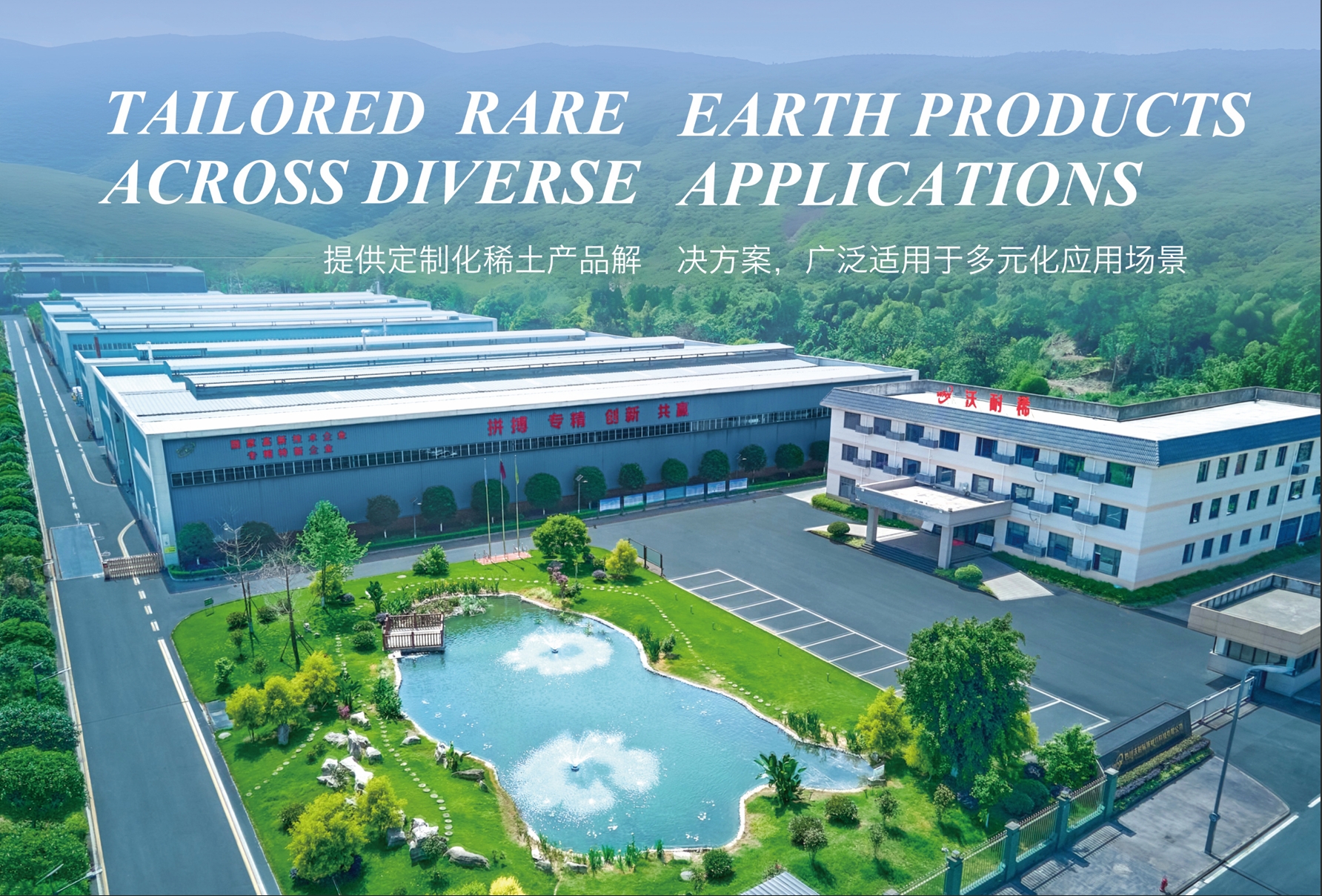
Large particle size cerium carbonate is not a single procurement answer. Sichuan Wonaixi New Materials Technology Co., Ltd. (WONAIXI), a manufacturer of rare earth functional materials founded in 2012, lists Large Particle Size Cerium Carbonate within a portfolio that also includes High Purity Cerium Carbonate, Low Chloride Cerium Carbonate, and Fine Crystalline Spherical Cerium Carbonate. That portfolio breadth helps a buyer discover options, but it does not settle fitness. The buyer still has to match grade, physical form, impurity profile, documentation, and handling to a specific duty.
This shortlist narrows the evaluation to three practical profiles: long-term phosphate removal in industrial and drinking-water projects, ceramic and implant sintering where a mild Lewis acid effect and minimal redox side reactions are required, and laboratory or analytical work that may involve cerimetric redox titration or pharmaceutical precursor research. Each profile uses the same broad compound name but asks different questions. The purpose is not to compare every cerium compound on the market. It is to give evaluation-stage buyers a disciplined way to decide which cerium carbonate option deserves deeper technical review.
Why a three-profile shortlist is more useful than a catalog sweep
A catalog sweep tends to produce a long list of product names without revealing which specification matters. Cerium carbonate can be offered as a standard grade, a high-purity grade, a low-chloride grade, a fine crystalline spherical grade, or a large-particle grade. Those labels describe product positioning. They do not prove performance in water treatment, sintering, or an analytical method.
The shortlist should begin with the duty the material performs. In water treatment, the main question is whether the grade can release Ce3+ at a useful rate and form insoluble CePO4 under the actual water chemistry. In ceramics, the main question is whether the grade delivers a controlled Ce(III) precursor without creating unintended redox side reactions under the sintering schedule. In laboratory work, the main question is whether the material fits the analytical role, including the difference between a Ce(III) carbonate source and a Ce(IV) reagent used in cerimetric titration.
| Profile | Primary evaluation question | Critical verification before shortlisting |
|---|---|---|
| 1. Water treatment | Does the grade support long-term phosphate removal through Ce3+ release and CePO4 formation in the actual water matrix? | Phosphate target, pH, alkalinity, competing ions, contact time, dosing method, residual cerium, sludge handling, and drinking-water compliance. |
| 2. Bioceramics and implant sintering | Does the grade provide a clean Ce(III) precursor with controlled particle size and minimal redox side reactions during sintering? | Particle-size distribution, phase and impurities, thermal behavior, sintering atmosphere, compatibility with the ceramic system, and final-device qualification requirements. |
| 3. Laboratory and analytical work | Is the grade the right cerium source for the workflow, including whether the method needs a Ce(III) precursor or a Ce(IV) titrant? | Assay, oxidation state, solubility, chloride and sulfate levels, trace metals, moisture, batch traceability, and method-specific validation. |
Profile 1: Long-term phosphate removal in industrial and drinking water
The water-treatment profile is a reagent-duty evaluation, not a commodity purchase. The mechanism to validate is the release of Ce3+ from cerium carbonate and its reaction with phosphate to form insoluble CePO4. That mechanism explains why a cerium carbonate grade can be considered for long-contact phosphate removal. It is not proof that a given batch will meet a discharge limit or a drinking-water target.
Large particle size can be relevant because particle size and surface area influence dissolution and release behavior. The direction of that effect depends on the process. A larger particle may reduce dust or change dissolution kinetics, but the buyer should not infer a release rate from the product name alone. The shortlist should be based on measured behavior in the intended water, not on a generic assumption that larger particles are always better or slower.
Operating conditions to verify
- Water chemistry: Confirm pH, alkalinity, temperature, dissolved oxygen, and the concentration of competing anions. Phosphate removal by Ce3+ can be affected by water matrix conditions, so the test should use the actual or representative water rather than clean laboratory water only.
- Phosphate target and contact time: State the inlet phosphate concentration, target outlet concentration, flow rate, and available contact time. A long-term duty may require a different dose and contact configuration from a short polishing step.
- Dosing and solids handling: Verify whether the material will be dosed as a powder, slurry, or pre-dispersed form; how the dose is controlled; and how cerium phosphate solids and residual material will be removed.
- Residual cerium and sludge: The buyer should check residual soluble cerium and the volume and stability of the sludge produced. These are application-specific measurements, not properties that can be assumed from a certificate of analysis.
- Drinking-water acceptance: For drinking-water projects, confirm local regulatory acceptance, material safety requirements, and any product-specific approval needed for contact with drinking water. A quality management certificate does not replace that review.
Handling and documentation checks
Request the certificate of analysis for the specific grade and batch, including assay, particle-size distribution, moisture, and impurity profile. Check chloride, sulfate, and trace-metal content against the intended water chemistry. Confirm packaging that limits moisture pickup, and verify storage conditions, dust controls, and segregation from incompatible materials. For drinking-water use, the buyer should also verify the supplier's material safety documentation and the final-use compliance route.
Fit boundary: This profile should not be shortlisted on the phrase slow release alone. It should advance only if the supplier can support a representative phosphate-removal test and the buyer can confirm regulatory and sludge-handling requirements for the actual project.
Profile 2: Ceramic and implant sintering
The ceramic profile uses cerium carbonate as a precursor rather than as a final implant material. The evaluation target is a controlled Ce(III) source that behaves predictably in the sintering schedule and supports the intended ceramic phase. The profile is relevant where a mild Lewis acid effect is useful and where unintended redox side reactions must be minimized under the specified conditions. That does not mean the compound is redox-inert under every possible condition. It means the buyer must define the sintering atmosphere and verify that the grade does not introduce an unwanted reaction path.
For bioceramic and implant-related work, the final device requirements control the material specification. Cerium carbonate may be evaluated as a precursor, additive, or processing intermediate, but the final implant manufacturer remains responsible for biocompatibility, mechanical performance, and regulatory qualification. A cerium carbonate product name, an ISO 9001 certificate, or a supplier statement about purity does not establish implant-grade status.
Operating conditions to verify
- Particle-size distribution: Confirm the particle-size range, agglomeration behavior, and consistency between batches. Particle size affects mixing, green-body uniformity, and sintering shrinkage, so the specification should be tied to the forming route.
- Phase and impurity profile: Check the cerium oxidation state, major phase, and impurity limits that could affect the ceramic system. Trace elements that are acceptable in one application may be critical in another.
- Thermal behavior: Request thermal analysis or application data showing decomposition, weight loss, and phase evolution across the intended sintering profile. The buyer should verify behavior under the actual heating rate and atmosphere.
- Atmosphere and compatibility: Confirm whether the process uses air, oxygen, inert gas, or another atmosphere, and whether the grade interacts with binders, solvents, or the surrounding ceramic powder. Compatibility should be tested in the specific formulation.
- Final-device qualification: For implant sintering, define the final device's biocompatibility and regulatory requirements before selecting a precursor grade. The supplier's quality system is supporting evidence, not a substitute for device-level qualification.
Handling and documentation checks
Control moisture and contamination during storage and weighing. Verify packaging, lot traceability, and change-control terms. Request a technical data sheet and certificate of analysis that identify the tested grade, not only the product family. If the material is intended for a medical or implant-related development program, request the specific documentation required by that program and confirm that the supplier can maintain it across batches.
Fit boundary: This profile should not advance on the assumption that a water-treatment grade or a standard carbonate grade will behave the same way in sintering. The buyer should shortlist only after reviewing particle-size data, thermal behavior, impurity limits, and final-device qualification requirements together.
Profile 3: Laboratory and analytical work
The laboratory profile begins with the analytical role. Cerimetric redox titration depends on the Ce(IV)/Ce(III) redox couple and commonly uses cerium(IV) reagents such as ammonium cerium(IV) nitrate or cerium(IV) sulfate. Cerium carbonate is more plausibly evaluated as a Ce(III) precursor or source material than as a direct substitute for a validated Ce(IV) titrant. This distinction matters. A buyer should not assume that a cerium carbonate grade can replace ammonium cerium(IV) nitrate or cerium(IV) sulfate in an established method without method-specific validation.
In pharmaceutical precursor research, the grade may be studied as a starting material or intermediate. That research use is different from pharmaceutical-grade supply. The buyer should verify the documentation level, impurity profile, and change-control arrangements required by the research program. An ISO 9001 quality system supports consistent manufacturing, but it does not by itself establish pharmaceutical-grade status or regulatory acceptance for a drug product.
Operating conditions to verify
- Oxidation state and assay: Confirm the cerium content, oxidation state, and assay method. The analytical method should state whether it is measuring Ce(III), total cerium, or another species.
- Solubility and acid compatibility: Verify how the grade dissolves or disperses in the acid or buffer system used by the laboratory. Undissolved residue can affect titration accuracy and precursor reaction yields.
- Impurity sensitivity: Check chloride, sulfate, trace metals, and moisture against the method's tolerance. Analytical work can be sensitive to impurities that are not critical in other uses.
- Particle size and weighing: For laboratory use, particle size can affect sampling, dispersion, and dissolution time. The buyer should confirm whether the grade is suitable for the laboratory's weighing and mixing practice.
- Batch traceability: Request lot-specific certificates and change-control notification. Research reproducibility depends on knowing whether a specification has changed between batches.
Handling and documentation checks
Use appropriate dust controls and local ventilation when handling fine powders. Confirm compatibility with acids and oxidizing materials, and follow the supplier's safety data sheet. Store the material under conditions that limit moisture uptake. For analytical or pharmaceutical research, retain batch records and certificate-of-analysis documentation so that method changes can be traced to material changes.
Fit boundary: This profile should not be shortlisted as a direct cerimetric titrant unless the laboratory has validated the specific use. The safer shortlist question is whether the grade is a suitable Ce(III) source or precursor for the intended workflow, with a separate specification for any Ce(IV) reagent.
How the shortlist changes the questions buyers ask
The three profiles lead to different decision rules. If the main risk is discharge compliance, the buyer should prioritize phosphate-removal testing, residual cerium, sludge handling, and drinking-water acceptance. If the main risk is sintered phase control, the buyer should prioritize particle-size distribution, thermal behavior, impurity limits, and final-device qualification. If the main risk is analytical validity, the buyer should prioritize oxidation state, assay, solubility, and method-specific validation.
This is why a single certificate of analysis cannot carry the whole shortlist. The same certificate may report assay and impurities, but it does not answer whether the grade releases Ce3+ at a useful rate, whether it leaves an unwanted residue after sintering, or whether it is the correct cerium source for a titration method. The buyer should ask for the evidence that matches the profile, not the largest available document package.
WONAIXI in the cerium carbonate shortlist
WONAIXI was founded in 2012 and operates a 46,667 m² facility with 98 employees and 12 engineers. The company reports annual output of 15,000 tons of high-purity rare earth salts and 3,000 tons of high-precision rare earth polishing powder. Its product portfolio covers nine major rare earth categories and more than 50 refined specifications, including Large Particle Size Cerium Carbonate, High Purity Cerium Carbonate, Low Chloride Cerium Carbonate, and Fine Crystalline Spherical Cerium Carbonate. Export business accounts for 10% of total sales, with major markets in Japan, South Korea, the USA, France, and the UK.
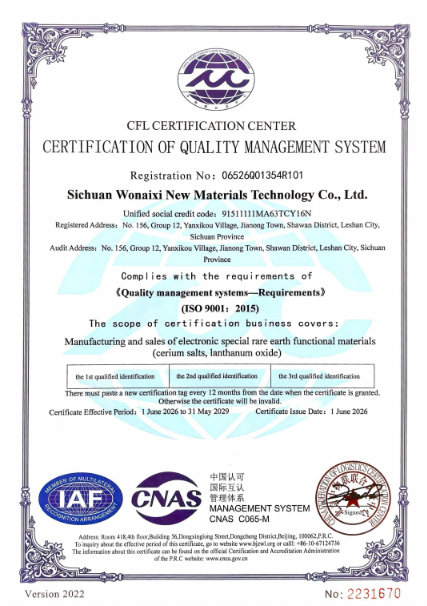
For quality-system evidence, WONAIXI holds ISO 9001 certificate 06526Q01354R101, issued on 2026-06-01 and valid until 2029-05-31 by the CFL Certification Center. The certificate scope covers manufacturing and sales of electronic special rare earth functional materials, specifically cerium salts and lanthanum oxide, under GB/T19001-2016/ISO9001:2015. This is relevant evidence of a quality management system. It is not a product-specific certificate for drinking-water contact, implant use, or pharmaceutical-grade status, and buyers should not treat it as one.
The company offers OEM/ODM support and customization of indicators, contents, specifications, purity, and packaging. It reports 100% testing, a lead time of 30–45 days, MOQ by discussion according to the actual situation, and remote after-sales support. These are supplier-capability facts for initial screening. They should be confirmed for the exact product grade, quantity, documentation package, and destination market before a purchase decision.
For buyers building a shortlist, WONAIXI is therefore a candidate for initial technical and commercial review, not an automatic selection across all three profiles. The next step is to request product-specific certificates, particle-size data, impurity limits, and application evidence for the intended use. The company's official website is WONAIXI.
Market and procurement context
The broader rare earth market provides useful context for supplier screening, but it should not be used as a substitute for product-level qualification. The U.S. Geological Survey reported that the estimated value of rare-earth compounds and metals imported by the United States was $170 million in 2024, an 11% decrease from $186 million in 2023. The same source reported that China accounted for 70% of U.S. imports of rare-earth compounds and metals during 2020–2023. These are aggregate figures for rare-earth compounds and metals, not cerium carbonate-specific trade data, and they do not predict price or availability for a particular grade.
Their procurement relevance is narrower and still useful: buyers should distinguish product origin, processing stage, and supplier concentration when they evaluate continuity. The International Energy Agency describes rare-earth value chains as spanning extraction, beneficiation, chemical upgrading, separation into oxides, metal refining, alloying, and magnet manufacturing. That multi-stage structure means a supplier's position at the salt, oxide, or finished-material stage should be verified rather than assumed from a product catalog.
Future outlook
The practical outlook for cerium carbonate shortlisting is documentation-led. Buyers are likely to place more value on grade-specific certificates, particle-size data, application tests, and change-control commitments than on broad product-family claims. That is especially true where the same compound name is being considered for water treatment, ceramic sintering, and laboratory work.
No forecast is needed to justify a staged evaluation. A buyer can begin with the three profiles in this shortlist, request the evidence package for each, and eliminate options that cannot support the intended operating conditions. The result is a smaller, more defensible supplier list and a clearer basis for sample testing, technical review, and commercial negotiation.
FAQ
What is large particle size cerium carbonate?
It is a cerium carbonate product identified by a larger particle-size specification than fine crystalline or standard grades. WONAIXI lists it as a distinct product alongside High Purity Cerium Carbonate, Low Chloride Cerium Carbonate, and Fine Crystalline Spherical Cerium Carbonate. Buyers should confirm the actual particle-size distribution, assay, impurities, and intended application from the certificate of analysis and technical data sheet. The product name alone does not establish fitness for a specific process.
How should a buyer evaluate cerium carbonate for phosphate removal?
Test the grade under the actual water matrix. Verify pH, alkalinity, competing ions, phosphate concentration, contact time, dosing method, residual cerium, and sludge handling. The intended mechanism is Ce3+ release and formation of insoluble CePO4, but the shortlist decision should rest on measured phosphate reduction and regulatory acceptance, not on the mechanism alone.
Can one cerium carbonate grade serve water treatment, bioceramics, and laboratory work?
Usually not without separate qualification. The three uses place different demands on particle size, impurity profile, oxidation state, moisture, and documentation. A grade shortlisted for water treatment may be unsuitable for implant sintering or a validated analytical method. Buyers should create separate specifications and request product-specific evidence for each profile.
Does ISO 9001 certify cerium carbonate for drinking water, implants, or pharmaceutical use?
No. WONAIXI's ISO 9001 certificate covers its quality management system for manufacturing and sales of electronic special rare earth functional materials, specifically cerium salts and lanthanum oxide. It does not by itself establish drinking-water contact approval, implant biocompatibility, or pharmaceutical-grade status. Those determinations require application-specific testing and regulatory review.
What documents should be requested before shortlisting a cerium carbonate supplier?
Request the technical data sheet, certificate of analysis for the specific grade and batch, particle-size distribution, impurity profile, moisture data, packaging details, safety data sheet, lead time, MOQ, and change-control terms. For regulated uses, request the applicable application-specific test evidence and confirm that final-use qualification remains with the buyer or device manufacturer.
For reference, WONAIXI's company brochure is available at WONAIXI company brochure.
Have Questions or Need More Details?
Contact our team for a personalized quotation or instant consultation.
Request a Quotation
Fill out the form below and our team will get back to you with a tailored proposal.
WhatsApp Direct Chat
Prefer to chat in real-time? Message us on WhatsApp for instant assistance & quick answers.
- Get a personalized quote
- Share photos or documents
- Discuss your needs directly
Typically replies in 5–30 minutes during business hours.