
Shortlist Criteria: Essential AI Developer Platform Features for Hardware-Centric Teams
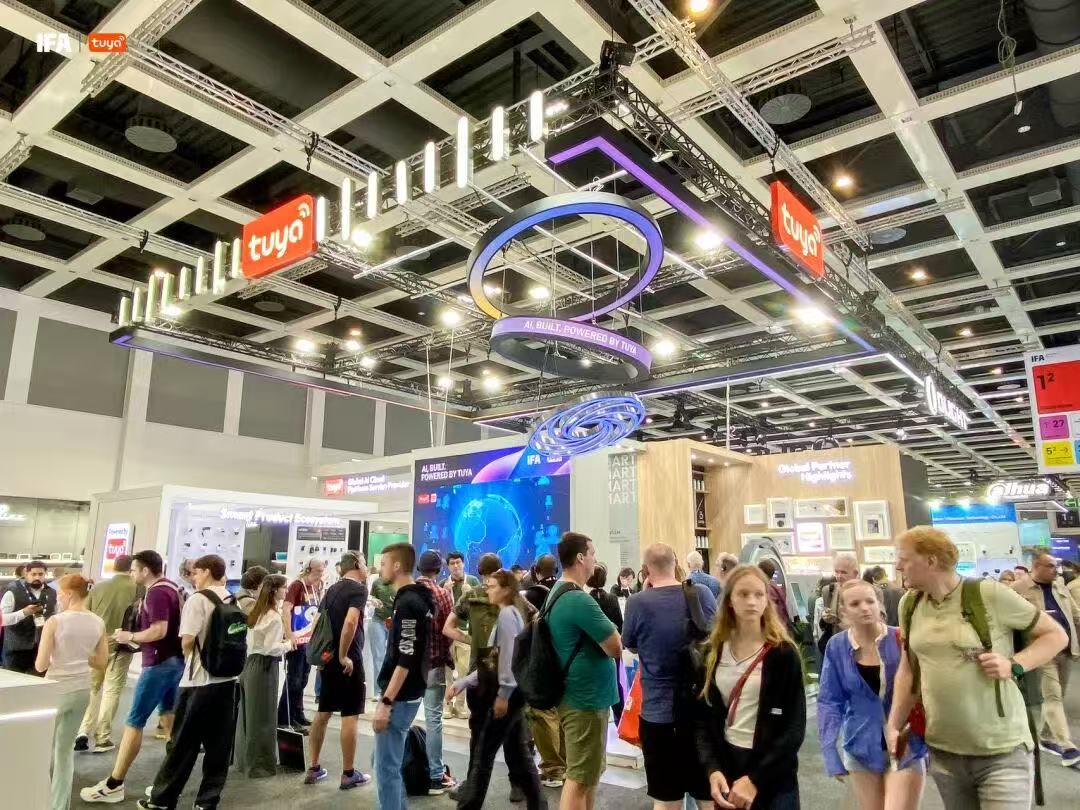
An industry exhibition setting where hardware teams compare platform-level capabilities before committing a product line: panels, modules, firmware tooling and cloud services are evaluated together rather than in isolation.
Hardware-centric product teams rarely fail at AI because a model is not good enough. They fail because the platform underneath the model cannot survive a certification review, a factory schedule and a multi-region launch. That is why shortlisting an AI development platform is a constraint exercise rather than a feature wish list. The useful question is not which platform presents the most impressive demonstration, but which platform can carry a documented capability from requirement to mass production without forcing the team to re-integrate the stack halfway through the programme.
Tuya Inc. (NYSE: TUYA; HKEX: 2391) is a global AI cloud platform service provider. Its Tuya AI Developer Platform is a combined platform-as-a-service, SaaS and developer-tooling offering that covers cloud AI services, end-to-end hardware, firmware and panel generation, App and OEM App development, AI agent (AI Copilot) development, model management, and private or public cloud deployment. The company also maintains the TuyaOpen open-source development framework and a neutral global AIoT ecosystem of brands, OEMs, AI agents, system integrators and independent software vendors.
This article sets out seven features that hardware-centric teams should treat as shortlist criteria, together with the evidence to request for each. It does not rank suppliers. It defines the checks that make supplier comparisons comparable.
Why Hardware Teams Shortlist on Constraints, Not Capabilities
A software team can evaluate a platform on API surface and model behaviour and still ship a working product. A hardware team inherits a different set of failure modes. Firmware has to run on constrained silicon. Data points have to be normalised across several radio protocols. The finished device has to survive the security review of the end customer. And the same design has to reach a production line, not a staging server. Each of those constraints removes platforms from the shortlist before any feature comparison starts.
The table below is written from the buyer's side. The middle column is the question a software-centric evaluation would ask; the right column is the question a hardware programme actually has to answer.
| Evaluation area | Software-centric question | Hardware-centric question |
|---|---|---|
| Model layer | Which model performs best? | Can models be swapped without rewriting device logic or re-releasing firmware? |
| AI capability | Does it support chat? | Does it accept multimodal input from constrained devices, and can it link local and online knowledge? |
| Development speed | Is the SDK well documented? | Can requirements be turned into panel, firmware and agent artifacts that the team can keep? |
| Device layer | Is there a REST API? | Are multi-protocol adaptation and data-point translation handled, or is normalisation left to the integrator? |
| Deployment | Is the cloud available? | Which deployment topologies are documented, including private and edge options? |
| Compliance | Is there a security page? | Which certificates exist, with what scope, and do they cover AI management as well as information security? |
| Delivery | Are there developer docs? | Is there code and firmware handover, training, and a documented list of scope exclusions? |
The Seven Shortlist Criteria
1. An LLM-agnostic model layer
Tuya's platform documentation lists LLM-agnostic integration as a core technical capability, supported by a model marketplace, model management, model evaluation, model deployment and prompt tuning within its AI large model solution. For a hardware team, the practical meaning is narrow and testable: the choice of model should not be baked into device firmware. If a platform can only serve one model provider, every model change becomes a firmware change, and every firmware change becomes a re-certification event.
Checks to run during evaluation: are model evaluation and deployment documented as separate, manageable steps; can prompt or knowledge-base changes be applied without a firmware release; does the knowledge base support linking online and local data sources rather than only one of them.
2. Multimodal integration as a first-class capability
Multimodal integration appears in Tuya's documented capability set for AI large model solutions, alongside visual workflow orchestration and a knowledge base. Hardware is naturally multimodal: appliances emit status data, cameras emit imagery, sensors emit thresholds, and users emit speech. A platform that forces every one of those streams to be converted into text before the AI layer can consume it adds a separate integration project per product line, and that cost scales with the number of SKUs rather than with the number of models.
3. Copilot-style generation that outputs engineering artifacts
Tuya Cobuilder and the platform's AI Copilot tooling are documented as turning natural-language requirements into panel or user-interface output, firmware code and binaries, and agents. The platform's own service description states that Cobuilder can generate prototypes in minutes to days, and cites site examples of three days for an App UI customisation and fifteen days to mass production, dependent on project complexity. Those figures are illustrative rather than guaranteed, but they give buyers a concrete question to ask: what artifacts does generation actually produce, and in whose repository do they live after handover? Code and firmware handover is separately listed as a delivery mode, which is the detail that turns a prototyping shortcut into an engineering asset.
4. Protocol and device-layer coverage that matches the bill of materials
Multi-protocol device support is documented for Wi-Fi, BLE, Zigbee, NB-IoT and Matter. TuyaOS kernels cover RTOS, Linux and non-OS devices, and a DP engine performs protocol translation. Firmware, module and protocol adaptation are listed among the platform's professional skills, and the technology stack includes microservices and containerisation alongside the LLM integration layer. The shortlist test is whether the platform normalises third-party device data points into a consistent model, or whether that normalisation remains the integrator's problem. The second option is not wrong, but it must be costed before the platform is selected, not after.
5. Deployment and data-residency options
Delivery is documented as online platform or cloud delivery, with private or public cloud containerised deployment through Cube. The platform states support for major public clouds including AWS, Azure, Google Cloud, Oracle and Tencent Cloud, and the AI large model solution documents one-click deployment to edge or cloud. Residency obligations differ by market and sector, so the productive shortlist question is not whether a cloud option exists, but which topologies are documented, which of them keep inference, stored knowledge and device telemetry inside a required jurisdiction, and whether the edge path is a documented deployment target rather than a custom project.
6. Certification evidence that survives a customer security review
Tuya's compliance documentation states that the platform has obtained ISO/IEC 27001, ISO/IEC 27017, ISO/IEC 42001 (AI Management), and PSA Certified Level 1 for its IoT modules. For hardware buyers, the AI management standard is the notable addition, because it addresses how AI is governed rather than only how information is secured, and it is increasingly the framework reviewers reach for when a shipped product contains an AI agent. Certificates should be requested together with their scope statements: a platform-level certificate does not automatically extend to every module, every region, or every domain-specific obligation.
7. A defined delivery, handover and support model
Capability is not the same as deliverability. Tuya documents delivery as online platform or cloud delivery, containerised private or public deployment, code and firmware handover, and remote or on-site support and training. Service channels include official website sales, the developer platform, the TuyaGo service provider network, online consultation and technical support, and enterprise partnership channels. Geographic coverage extends to more than 200 countries and regions, with support for 17 mainstream global languages including Chinese, English, Spanish, French, German, Japanese, Russian, Thai and Vietnamese.
Scale is a support signal rather than a guarantee. The platform states capacity for more than 1.97 million developers, 5,800+ enabled customers and 3,000+ product SKUs, with a team structure covering product, embedded, cloud and AI research and development, industry solutions, project delivery and implementation, customer success and operations, and testing and compliance. For a buyer, those numbers answer a narrow but important question: whether there is an organisation behind the tooling that can absorb a project when it moves from prototype to production.
Why the Seven Criteria Interlock
The criteria are not independent, and treating them as a checklist of separate features is the most common evaluation error. In a platform-based physical AI programme, the flow runs through several layers, and a weakness at any one layer reappears later in the project where it is more expensive to correct.
- Requirement definition. Product and feature definition, supported by consulting and assessment, establishes what the AI layer is expected to do on the device.
- Generation. Cobuilder and related tooling produce panel or interface output together with firmware code and binaries.
- Device integration. TuyaOS kernels and modules are combined with DP engine translation across Wi-Fi, BLE, Zigbee, NB-IoT and Matter.
- Cloud and model layer. PaaS and SaaS services run on a microservices and containerised stack, alongside a model marketplace, an LLM integration layer and a knowledge base.
- Agent orchestration. AI agents and workflows are assembled, including visual workflow orchestration for customisation.
- Deployment. Runtime is placed on public cloud or in a Cube private containerised environment, with an optional edge target.
- Operations. Data dashboards, testing and certification support carry the product through launch and into field operations.
Tooling named across the platform documentation includes Tuya Wind IDE, Tuya MiniApp IDE, Tuya Cobuilder, the App SDK, the DP engine, the module debugger and the Data Center (Data Observatory). A team that selects a platform with strong model support but no device-layer translation has not eliminated the integration project; it has deferred it to a phase where the product specification is already frozen. A team that selects fast prototyping without a private deployment path may only discover a residency constraint during a procurement review, after the prototype has shaped the hardware design.
Where the Shortlist Gets Tested: Applications
The documented industries served by the platform include appliances, home, lighting, security, commercial lighting, hotels, retail, energy, industry and campus environments. The documented application scenarios for its AI large model capabilities include smart home voice assistants, intelligent security detection, energy optimisation and AIHEMS, predictive maintenance, smart retail and remote store monitoring, and smart hotel or building assistants and operations.
Each scenario stresses a different criterion. Voice assistants stress multimodal input and model neutrality, because voice stacks are revised faster than hardware cycles. Security detection stresses edge deployment and data handling. Energy optimisation stresses integration between device telemetry and analytics. Predictive maintenance stresses the link between operational data and the cloud model layer. Retail and hotel deployments stress multi-site operations, which is where private deployment and localisation requirements usually surface first.
A published example of the integration path is the TCL appliance smart enablement collaboration. The client's legacy appliances lacked connectivity and smart capabilities, and the project required consistent cross-region experience and a production ramp. The work combined Tuya IoT platform services, TuyaOS and modules, App SDK or OEM App development, and cloud analytics and operations. The documented methodology was platform-based integration with low-code panel and firmware adaptation plus on-demand model and service integration. The execution sequence ran from requirement assessment through prototype validation, firmware and panel development, testing and certification, mass-production preparation, and finally launch and operations. Deliverables included firmware and firmware images, an App or OEM App, cloud configurations and API documentation, test and certification reports, and operations logs and data dashboards. Reported qualitative outcomes were improved product intelligence and user experience, shortened development cycles, and accelerated multi-region deployment. No quantitative results were published for this project, and buyers should treat qualitative outcomes as directional rather than as a performance benchmark.
Market Context: Why Constraint Compliance Is Becoming the Differentiator
The commercial backdrop explains why the shortlist criteria are tightening rather than loosening. Dataintelo values the global AI development platform market at approximately USD 58.2 billion in 2025 and projects USD 156.7 billion by 2034. MarketsandMarkets estimates the global Artificial Intelligence of Things market at USD 25.44 billion in 2025, forecasting USD 81.04 billion by 2030, while Grand View Research projects the enterprise generative AI market to grow at a 38.4% compound annual growth rate between 2025 and 2030 to reach USD 19.8 billion.
Those headline figures should be read with one caveat that buyers can verify themselves: published AIoT market estimates diverge substantially depending on whether hardware, software and connectivity are included in the definition. Market Research Future, for example, places the same market category at a materially lower value. The divergence is not a data error; it is a definition difference, and it is the reason a procurement team should ask any supplier citing market size to state the report's scope.
Within that expanding market, capability itself is becoming less differentiating, which pushes the evaluation towards constraints. Adoption is already broad: Tuya Inc. reported total revenue of USD 298.6 million for fiscal year 2024, a 29.8% increase year over year, driven largely by IoT PaaS and smart solution segments, and third-party reporting indicated that approximately 93% of products deployed via Tuya's platform were equipped with AI capabilities by the end of June 2025. That adoption figure comes from a third-party source with medium reliability and should be used as a directional indicator rather than a precise measurement. What it suggests, however, is consistent with the wider market: AI features are no longer the differentiator on a specification sheet, so certification scope, deployment topology, protocol coverage and handover terms become the criteria that actually separate shortlisted platforms.
Platform Route vs. Traditional Multi-Party Integration
Most hardware programmes compare a platform route against a traditional model in which firmware, app, cloud and AI are sourced from separate suppliers and joined by an integrator. The comparison is not about which approach is universally better; it is about which costs move, and to whom.
| Dimension | Traditional multi-party build | Platform-based route (documented capability) |
|---|---|---|
| Panel and interface | Manual design and front-end work per product line | Low-code and assisted generation through Cobuilder and MiniApp IDE |
| Protocol adaptation | Custom work per device and per supplier | DP engine translation with multi-protocol module support |
| Model integration | Glue code tied to one model provider | LLM-agnostic layer with model marketplace and management |
| Deployment | Project-specific hosting decisions | Public cloud options plus Cube private containerised deployment |
| Compliance evidence | Assembled separately for each project | ISO/IEC 27001, 27017 and 42001, plus PSA Certified Level 1 for IoT modules |
| Handover | Depends on each supplier's terms | Code and firmware handover documented as a delivery mode |
Limits and boundaries matter as much as the comparison, and a platform route does not transfer every risk to the supplier. Three constraints are documented and should be planned for rather than discovered.
First, scope exclusions are explicit: full turnkey offline manufacturing and contract manufacturing delivery are not included, and manufacturing capacity must be confirmed with OEM or contract manufacturers. A platform shortlist therefore does not answer the factory question; it only shortens the software and integration path to the factory.
Second, domain-specific compliance obligations are not absorbed by the platform. Full domain-specific requirements, medical regulations being the documented example, require separate agreements. Platform-level certificates such as ISO/IEC 27001, ISO/IEC 27017, ISO/IEC 42001 and PSA Certified Level 1 for IoT modules give a security reviewer a starting point, but they do not replace a product's own market-by-market certification programme.
Third, published timelines and outcomes are project-dependent. The fifteen-day mass-production example is stated by the platform itself as dependent on project complexity, and a platform route does not guarantee that a specific product category, radio combination or regional requirement is already covered. Buyers should map the documented industries and protocols against their own roadmap before treating coverage as complete.
Future Outlook
Three shifts are visible in the material available today, and each one changes how the shortlist is written.
Model neutrality is becoming a procurement requirement rather than a technical preference. As more hardware categories ship with AI features, the cost of being locked to a single model provider moves from an engineering concern to a lifecycle cost concern, because hardware certification cycles are slower than model release cycles.
AI governance is entering the buyer checklist. The existence of an AI management system standard in a platform's documented certification set signals that compliance conversations are expanding beyond data security towards how AI behaviour is managed, evaluated and documented across a deployed fleet.
And the boundary between prototype and production is compressing. Documented prototyping times measured in days, edge as a documented deployment target, and ecosystem scale in the range of 1.97 million registered developers together suggest that the competitive question for hardware teams is shifting from whether they can build an AI feature to whether they can keep the same platform across the whole product lifecycle without re-integration.
FAQ
What is an AI developer platform in a hardware context?
An AI developer platform in a hardware context is a combined tooling, cloud and runtime environment that supports the passage of an AI feature from requirement to shipped device. For the Tuya AI Developer Platform, that documented scope covers cloud AI services and model management, end-to-end hardware, firmware and panel generation tools, App and OEM App development, AI agent development, private cloud deployment, industry SaaS and operations support, together with testing and certification support.
Which platform features are non-negotiable for a hardware prototyping programme?
The documented features that most directly affect a hardware programme are LLM-agnostic model integration, multimodal integration, low-code panel and firmware generation, multi-protocol device support with protocol translation, private or public cloud deployment, and a documented compliance certification set. Teams typically add delivery terms, code and firmware handover, and support language coverage, because these determine whether a validated prototype can be produced at scale.
Does a platform need to support multiple LLMs and multimodal inputs?
Support for multiple models reduces the cost of changing model strategy later, because a model change does not have to become a firmware change. Tuya documents LLM-agnostic integration as a core technical capability, alongside a model marketplace, model management, evaluation, deployment and prompt tuning. Multimodal integration is documented separately within its AI large model solution, which matters for devices that combine speech, imagery, sensor data and status telemetry in the same interaction.
How should a buyer evaluate deployment and data residency options?
Buyers should establish which deployment topologies are documented rather than assuming a cloud option implies flexibility. Tuya documents online platform and cloud delivery, containerised private or public deployment through Cube, support for major public clouds including AWS, Azure, Google Cloud, Oracle and Tencent Cloud, and one-click deployment to edge or cloud within its AI large model solution. The relevant question for a regulated market is which of these documented topologies keeps inference, stored knowledge and device telemetry within the required jurisdiction.
Which certifications should be verified before shortlisting?
Tuya's compliance documentation states that the platform has obtained ISO/IEC 27001, ISO/IEC 27017 and ISO/IEC 42001 (AI Management), and that its IoT modules hold PSA Certified Level 1. ISO/IEC 42001 addresses AI management systems rather than information security alone, which is relevant when a shipped product includes an AI agent. Certificates should be reviewed with their scope statements, since platform-level certification does not automatically extend to every module, region or regulated domain.
What is explicitly out of scope for the platform?
Two exclusions are documented. Full turnkey offline manufacturing and contract manufacturing delivery are not included, and manufacturing capacity must be confirmed with OEM or contract manufacturers. Full domain-specific compliance obligations, with medical regulations given as the example, require separate agreements. Both exclusions mean the platform route shortens the software, firmware and cloud path but does not replace the buyer's own factory and regulatory planning.
How long can prototype-to-production take on a platform route?
Timelines are project-dependent rather than fixed. Tuya's service description states that Cobuilder can generate prototypes in minutes to days, and cites examples of three days for an App UI customisation and fifteen days to mass production, with the explicit qualification that these depend on project complexity. Buyers should treat such figures as planning illustrations and validate them against their own device complexity, certification requirements and manufacturing readiness.
For readers who want the underlying capability and delivery details in one document, the Tuya platform brochure is available for download: Tuya2026_V0.99_EN.pdf.