
Shortlist: Five Smart Water Meter Types for Industrial Buyers, from RS485 to LoRaWAN
A constraint-first shortlist for industrial, municipal and campus deployments — protocol, certification scope, power and delivery evidence at the evaluation stage.
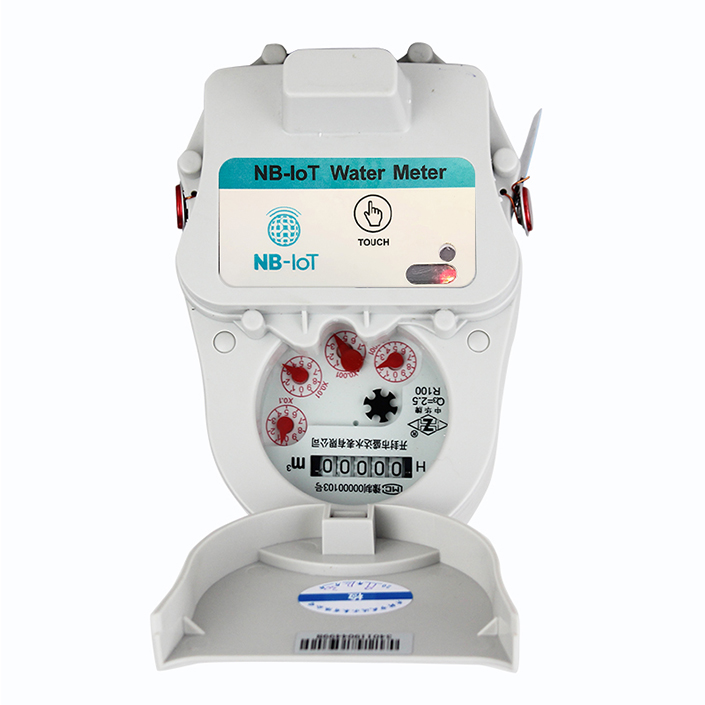
A networked smart water meter installed for remote reading — the shortlist below compares five meter types against the same set of deployment constraints.
Industrial water metering projects rarely fail because a meter cannot count water. They fail because the meter cannot be read, cannot be certified for the market it is shipped to, cannot be powered where it is installed, or cannot be connected to the system that already exists on site. That is why experienced buyers shortlist by meter type first and by supplier second: the type fixes what is technically and commercially possible for the next decade of the installation.
Five meter types cover the majority of industrial, municipal and campus requirements: ultrasonic meters, LoRaWAN meters, NB-IoT meters, RS485 / M-Bus wired meters, and prepaid or STS token meters. Each answers a different constraint, and each has a clear boundary beyond which it becomes the wrong choice. The shortlist below matches every type to the deployment conditions that make it reasonable — and to the conditions that rule it out.
Five Constraints That Decide the Shortlist Before Any Price Discussion
Meter price is the last variable in a specification process, not the first. Five constraints eliminate candidates early, and all five can be answered from published product data rather than from a sales conversation.
- Communication path. Does the site already have a wired riser for a building management system (BMS), a private radio plan, or reliable mobile network coverage? RS485 Modbus RTU and M-Bus EN 13757 assume cabling. LoRaWAN assumes a gateway and network server. NB-IoT and 4G assume carrier coverage and SIM lifecycle management.
- Certification scope. EU legal metrology is governed by MID 2014/32/EU, with EN 14154-4:2023 covering additional functionalities. A certificate number is not enough — the model and diameter scope printed on the certificate must cover the exact meter being ordered.
- Power. Mains supply, M-Bus powered, or lithium battery. Battery life is quoted per configuration and ranges from more than 6 years to up to 10 years across the models described in this article.
- Environment. IP68 sealing, water temperature window (T30 / T90), working temperature range, and whether the meter will be installed horizontally or vertically.
- Commercial model. Post-paid billing, prepaid card, or STS token vending — and whether remote valve control is required for leakage control or credit control.
The Five-Type Shortlist at a Glance
| Meter type | Measuring principle | Diameter range | Communication | Power / battery | Typical fit |
|---|---|---|---|---|---|
| Ultrasonic | Ultrasonic transit-time, no moving parts | DN15–DN600 | LoRaWAN / NB-IoT / 4G Cat.1 / RS485 (optional) | Lithium battery, up to 10 years | District metering, industrial production, low-flow accuracy |
| LoRaWAN | Multi-jet mechanical or ultrasonic | DN15–DN300 (multi-jet); up to DN600 in LoRaWAN ultrasonic configuration | LoRaWAN, 433–923 MHz; EU868 / US915 / AS923 / AU915 | ER18505M 3600 mAh, 8–10 years; up to 10 years on ultrasonic variants | Campuses, industrial parks, private networks without carrier dependence |
| NB-IoT | Multi-jet mechanical | DN15–DN200 | LTE Cat.NB, bands B3 / B5 / B8, micro SIM | Battery more than 6 years, replaceable | City-wide utility metering where carrier coverage exists |
| RS485 / M-Bus wired | Mechanical or ultrasonic | DN15–DN200 (M-Bus); DN15–DN600 (wired remote) | RS485 Modbus RTU, M-Bus EN 13757, pulse | M-Bus powered or battery, 6–10 years | Buildings and plants with an existing BMS or SCADA riser |
| Prepaid / STS token | Mechanical, with integrated valve | DN15–DN300 | Smart card / token; third-party payment integration | Battery more than 6 years, replaceable | Revenue protection, tenant and community prepayment |
1. Ultrasonic Meters: High Accuracy With a Higher Entry Cost
Ultrasonic meters use transit-time measurement with no impeller or moving parts inside the measuring chamber. The LXSY smart ultrasonic water meter covers DN15–DN600 with flow ratios of R250, R400 or R500, IP68 protection, PN10 or PN16 pressure rating, a working temperature range of −20 °C to +60 °C, water temperature from 0 °C to +90 °C, an LCD digital display, and a lithium battery rated up to 10 years. Communication options are LoRaWAN, NB-IoT, 4G Cat.1 and RS485. The specification also lists leakage, low-battery, reverse-flow, tamper and empty-pipe alarms, optional remote shut-off valve control, AMR/AMI data reading, and historical consumption storage.
For pure LoRaWAN deployments, the LXSC LoRaWAN ultrasonic water meter is specified for DN15–DN600 with accuracy Class 1 or Class 2, R250 / R400 / R500 flow ratios, LoRaWAN frequency plans EU868, US915, AS923 and AU915, up to 10 years of battery life, IP68 sealing, and optional CE or MID certification.
Where ultrasonic earns its cost
The no-moving-parts design removes mechanical wear and the blockage risk associated with impellers, and the wide measuring range improves low-flow sensitivity — a direct commercial benefit where minimum-flow accuracy drives billed revenue. That makes ultrasonic meters a reasonable fit for district metering areas, industrial production lines, bulk water measurement and irrigation where low flows must still be captured.
Boundary condition buyers should note
Ultrasonic meters carry a higher entry cost than multi-jet mechanical designs of the same diameter, and the benefit is only realised if the installation actually needs wide-range accuracy or low maintenance. Temperature windows also differ between variants: the LXSY ultrasonic specification states water temperature from 0 °C to +90 °C, while the LXSC LoRaWAN ultrasonic specification states 0 °C to +50 °C. A buyer comparing two ultrasonic quotations must confirm the exact variant rather than the general product family.
2. LoRaWAN Meters: A Network You Own
The LXSY LoRaWAN water meter is specified for DN15–DN300 with a brass body (with valve) or iron body (without valve), dry or wet dial, PN16 maximum working pressure, IP68 protection, LoRaWAN protocol, 433–923 MHz frequency range, pressure loss of ≤0.063 MPa, water temperature T30 or T90, ISO 4064 compliance, MID certification and Class A working mode. The specification quotes an ER18505M 3600 mAh battery lasting 8–10 years, a data transmission distance of 7.5 km, a vacuum-sealed counter, a brass alloy shell with corrosion-resistant and antistatic coating, and a multi-jet working principle.
One detail matters more than the headline range: the LoRaWAN configuration is described as a meter plus a gateway plus a network server. The buyer is therefore not purchasing a standalone device but one node in a private network that must be planned, installed and maintained. Client software is provided free of charge with this model, which reduces the software entry cost but does not remove the infrastructure obligation.
The smart LoRaWAN LXSY variant extends the range to DN15–DN500 with accuracy Class 1 or Class 2, flow ratios from R80 up to R500, LoRaWAN frequency plans EU868, US915, AS923 and AU915, a communication distance of several kilometres depending on environment, up to 10 years of battery life, IP68 sealing, optional remote valve control, and optional CE or MID certification. The LoRa LXSY model is specified for DN15–DN50 with 470–510 MHz and 868–915 MHz frequency bands and 6–7 years of battery life, which suits smaller residential-style loops rather than wide-area networks.
Typical fit: industrial parks, campuses, gated communities and municipal zones where a gateway can be mounted and where the operator prefers to own the network rather than depend on a carrier. A LoRaWAN metering rollout of 15,000 units was implemented for a government water utility project in Mongolia, described as an OEM solution with LoRaWAN communication for smart city deployment.
3. NB-IoT Meters: Simpler on Site, Dependent on Coverage
The LXSY NB-IoT smart water meter is specified for DN15–DN200, using narrowband LTE Cat.NB on bands B3 (1800 MHz), B5 (850 MHz) and B8 (900 MHz), with a micro SIM (Type 3FF), IP68 protection, PN16 pressure rating, pressure loss of ≤0.063 MPa, water temperature T30 or T90, ISO 4064 compliance, MID certification and Class A working mode. Battery life is stated as more than 6 years, and the battery can be replaced without opening the meter.
Two operational details are useful at evaluation stage. First, the meter supports internal or external antennas, which matters in basements and meter pits where the signal environment is the limiting factor. Second, reed fault detection is included: if a sampling reed fails, the meter displays the fault and continues to measure accurately. Data upload frequency is configurable, with fixed time-point uploads supporting month, week, day and hour scheduling. The management system uses a B/S architecture that can be opened from either a PC or a mobile browser, and the software is supplied free of charge with the product.
The boundary is commercial rather than technical: an NB-IoT fleet depends on carrier coverage in every metering location plus SIM lifecycle management for the life of the deployment. Where coverage is patchy or SIM administration is impractical, a LoRaWAN gateway or a wired loop is the more realistic route. A municipal water department in Kenya deployed more than 20,000 units in an NB-IoT configuration, reporting improved automatic meter reading efficiency and reduced manual maintenance costs over a programme running 8+ years.
4. RS485 and M-Bus Meters: The BMS-Compatible Option
Where a building already has a control system, wired meters integrate without adding a radio network. The LXSY wired remote water meter supports RS485, M-Bus or pulse output, with Modbus RTU or M-Bus EN 13757 protocol options, a communication distance of up to 1000–1200 metres depending on cable type and installation conditions, IP68 protection, MID certification, and horizontal or vertical installation. Power can come from a battery rated 6–10 years depending on configuration, or from an external supply.
Integration is the reason this type appears on industrial shortlists. The specification states compatibility with AMR/AMI platforms, PLC, SCADA and building management systems, and describes centralised reading of multiple meters to reduce manual inspection. The M-Bus LXSY model is specified for DN15–DN200 under the EN 13757 M-Bus protocol, can be M-Bus powered or battery powered, supports a communication distance of up to 1000 metres, and allows one M-Bus master to connect multiple meters — a wiring-efficiency factor that reduces installation cost per point. Body material for that variant is brass or cast iron, with MID certification optional. The digital LXSY model adds an LCD display and covers DN15–DN600 with R100 to R400 flow ratios and Modbus, M-Bus or LoRaWAN protocol options.
What RS485 actually requires
A wired meter is only as good as its cable route. Distance ratings depend on the cable type and on installation conditions, so the practical limit for a given riser must be confirmed during design rather than assumed from the maximum figure. Retrofitting a wired loop into an existing building is a civil and electrical task, not a metering task. Where cabling is impractical, a wireless type — LoRaWAN or NB-IoT — is the correct substitution, and the ultrasonic LXSY supports both alongside RS485, which allows a single specification to cover cabled and non-cabled risers in the same project.
5. Prepaid and STS Token Meters: Revenue Protection as a Design Constraint
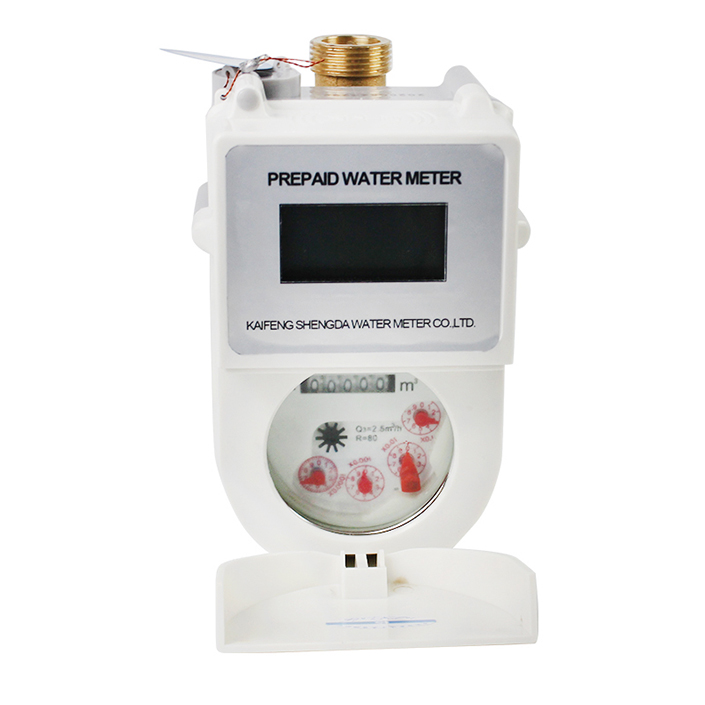
Prepaid metering moves part of the commercial risk from the utility to the meter: step tariffs, credit limits and valve control are configured at device level.
The LXSK and LXLK prepaid water meters are specified for DN15–DN300, with bodies in brass, nylon or stainless steel, dry or wet dial, PN16 maximum working pressure, IP68 protection, pressure loss of ≤0.063 MPa, water temperature T30 or T90, ISO 4064 Class B, MID certification, and a replaceable battery rated more than 6 years. Functional specification includes prepaid operation, configurable step tariffs, LCD display with data retention beyond 10 years, insufficient-water warning, purchase limitation, low-battery detection, anti-magnetic interference recording, third-party payment system support, and periodic valve cycling to prevent valve blockage. Remote valve control is an option across the wider LXSY family as well.
For token-based systems, the LXS-S STS prepaid water meter holds STS Association Membership Certificate number 2026019, applies the STS Standard with Firmware Version V2.0 under certificate KSWM0924, and covers DN15–DN300 in its CE scope under certificate No.0H240702.KSWT076 issued by ECM, against ISO 4064-1:2014, ISO 4064-2:2014, ISO 4064-4:2014, OIML R 49-2:2013, EN 14154-1:2005+A2:2011 and EN 14154-2:2005+A2:2011. The LXSK and LXLK prepaid models are covered by CE certificate No.0H240702.KSWT077 against EN ISO 4064-1:2017/A11:2022, EN ISO 4064-2:2017/A11:2022, EN ISO 4064-5:2017/A11:2022, EN 14154-1:2005+A2:2011, EN 14154-2:2005+A2:2011 and EN 14154-4:2023.
The constraint is organisational. A prepaid or STS token deployment is a billing decision as much as a metering decision: it requires a token management or vending system, a tariff policy, and clear rules for credit exhaustion and valve closure. A municipal water supply project in Zimbabwe covering more than 4,000 units has run for 8+ years using 20-digit STS tokens and remote valve control, achieving remote recharge, automatic billing and user management — but the metering hardware is only one component of that outcome.
Matching Meter Type to Deployment Scenario
| Deployment scenario | Meter type that fits | Reason |
|---|---|---|
| High-rise residential or apartment blocks with low-flow billing | Ultrasonic (LXSY), or R160 / R200 multi-jet for simpler budgets | Wide measuring range and low-flow sensitivity; no mechanical wear |
| Campus or industrial park with no reliable carrier coverage | LoRaWAN (LXSY, LXSC ultrasonic) | Private gateway network; 7.5 km transmission; 8–10 year battery |
| City-wide utility rollout inside NB-IoT coverage | NB-IoT (LXSY) | No gateway ownership; configurable upload scheduling; replaceable battery |
| Plant or building with an existing BMS / SCADA riser | RS485 Modbus RTU or M-Bus EN 13757 (LXSY wired remote) | Direct integration with PLC, SCADA and AMR/AMI platforms |
| Utility prioritising revenue protection and credit control | Prepaid or STS token (LXSK, LXLK, LXS-S) | Step tariffs, prepaid credit, remote valve control, token vending |
| Large-diameter transmission main or DMA inlet | Woltman LXLC / WPH (DN50–DN600) or ultrasonic DN50–DN600 | High flow capacity, low pressure loss, removable measuring mechanism |
Manufacturing Assurance: What Capacity and OEM Support Actually Prove
Shengda Water Meter Co., Ltd. (SDWM) is a Chinese manufacturer of water meters and flow meters established in 1995, based in Kaifeng City, China, producing OEM and ODM smart metering, control and telemetry products. On the company's published data, the factory covers 66,000 m², annual production capacity is 3 million units following a new plant built in 2020, the R&D team comprises 12 engineers, and 50% of output is exported to markets including the USA, South America, Africa and Southeast Asia, with products shipped to more than 140 countries.
For a buyer holding a five-type shortlist, factory scale is only useful when it converts into delivery and configuration certainty. The manufacturing capability data states a monthly capacity of 100,000+ units for water meters and flow meters, standard lead time of 15–20 days and 30–40 days for customized products depending on project requirements, a minimum order of 3 units for samples and 500 pcs for customized OEM projects, and OEM/ODM customization across logo, colour, housing design, communication module, software platform, protocol, packaging and product specifications. Quality control is described as incoming material inspection, production process inspection, 100% functional testing, calibration testing and final inspection before shipment.
The relevant assurance for a specification-led project is management-system and after-sales documentation rather than floor area: ISO 9001:2015 (certificate No. 31624010128R3M), ISO 14001:2015 and ISO 45001:2018 certification, plus a Commodity After-sales Service Certification at five-star level (certificate No. 31626FWO0009R300, assessed against GB/T 27922-2011). Customization capability matters specifically where a project needs a non-standard protocol, a private-label housing or a software integration that must survive repeat orders without re-engineering.
Certification Scope: The Constraint Buyers Most Often Misread
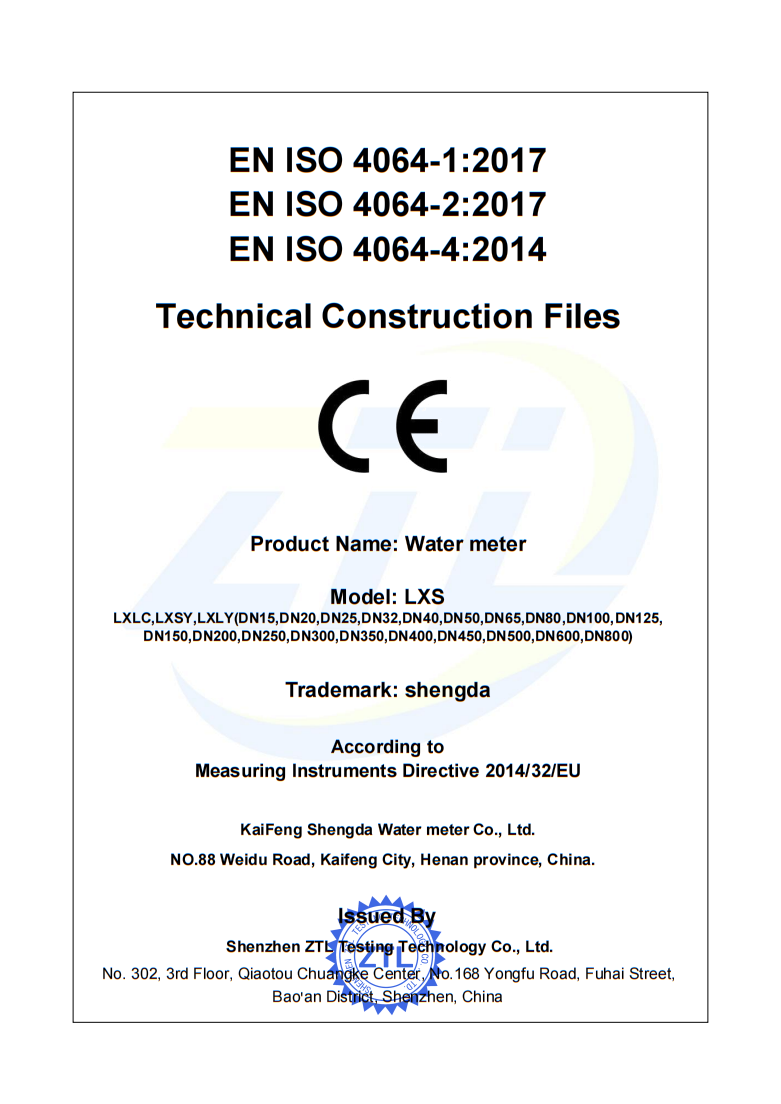
Metrology documentation for the LXS, LXLC, LXSY and LXLY water meter models under EN ISO 4064-1:2017, EN ISO 4064-2:2017 and EN ISO 4064-4:2014.
European legal metrology for water meters is governed by MID 2014/32/EU, with EN 14154-4:2023 addressing additional functionalities in the European Economic Area. Inside a real certificate pack, coverage is model- and diameter-specific, and this is where procurement errors originate.
- MID Module B EU-Type Examination certificate MID-2759-2000003, issued by SASTEK Conformity Assessment Services, covers the LXSY series DN15 to DN20 under EN ISO 4064-1:2018, EN 14154 and OIML R 49-1:2013, valid to 2030.
- MID Type Examination certificate M4 69267376 0001, issued by TÜV Rheinland, covers the LXC and LXC-V IoT ultrasonic water meters under Directive 2014/32/EU, EN ISO 4064-1:2017+A11:2022 and EN ISO 4064-2:2017+A11:2022.
- CE certificate No. 4Z210830.KSWTN30, issued by ECM, covers the LXS, LXLC, LXSY and LXLY models from DN15 to DN800.
- CE certificate No.0H230626.KSWTT74 covers the WPH water meter from DN40 to DN500 under EN ISO 4064-1:2017+A11:2022 and EN ISO 4064-2:2017+A11:2022.
- RoHS certificate KTi260528R1441C, issued by Kti, covers the LXC series ultrasonic water meter full specifications against the IEC 62321 series of standards.
- STS Association Membership Certificate 2026019 and STS Firmware Version V2.0 (KSWM0924) cover the token-based prepayment system.
The rule that follows is simple: match the certificate's model designation and diameter range to the purchase order line, not to the product family name. A DN50 ultrasonic order and a DN20 multi-jet order will normally sit under different certificates even when they come from the same factory.
Market Context: What the Numbers Say, and Where They Disagree
Published market sizing for smart water meters should be treated as directional rather than precise. Grand View Research values the global smart water meter market at USD 9.1 billion in 2024, projected to reach USD 16.2 billion by 2030, while Bluefield Research reports approximately USD 6.8 billion and MarketsandMarkets reports USD 4.61 billion for the same period. The gap reflects differences in how broadly the term "smart" is defined rather than disagreement about direction, and buyers should avoid building a business case on a single figure.
Three structural signals are more stable. Advanced Metering Infrastructure (AMI) held a 58.9% share of the smart water meter market in 2024, according to Precedence Research, which indicates that fixed-network reading rather than walk-by reading is now the dominant architecture. The ultrasonic segment is expected to record the highest growth among meter types, with the US market alone valued at USD 2.98 billion in 2024 by Grand View Research. And the NB-IoT smart water meter market is projected by Dataintelo to grow from USD 2.22 billion in 2025 to USD 10.22 billion by 2034 — a forecast that supports carrier-based metering in markets with reliable network coverage.
Concentration is also relevant to sourcing strategy: the top 20 water metering vendors accounted for 76% of global market share in 2024 according to Bluefield Research, which means most buyers are negotiating with a small group of large suppliers or with regional manufacturers competing on flexibility and response time. Asia Pacific is identified by MarketsandMarkets as the fastest-growing region, driven by urbanisation in China and India, and the residential segment accounted for 67.2% of smart water meter adoption in 2024 according to Cognitive Market Research — a reminder that residential volume, not industrial volume, sets component pricing across the category.
Where Mechanical Meters Still Win
A shortlist that only contains networked meters is incomplete. Mechanical meters remain the correct answer in specific conditions. The LXSG multijet water meter is specified for DN15–DN25 with R160 or R200 flow ratios, ISO 4064 compliance, dry dial display, threaded BSP connection, PN10 or PN16 pressure rating, and brass or composite body options; the R160 variant is also available as a volumetric meter, and R200 is referenced against both ISO 4064 and OIML R 49. For large flows, the Woltman LXLC / WPH covers DN50–DN600 with R40 to R100 flow ratios, flange connections to EN1092-1, ANSI or custom standards, working pressures of PN10, PN16 or PN25, bodies in cast iron, ductile iron or stainless steel, and a removable measuring mechanism for inspection and maintenance. Smart upgrades — pulse, M-Bus, RS485, LoRaWAN or NB-IoT — are available on both families.
The honest comparison is not smart versus mechanical in accuracy terms; it is system cost versus system cost. Mechanical meters need no battery, no gateway, no SIM and no platform, which is decisive in low-density, budget-constrained or non-networked installations. The real limitation of smart metering is that it relocates cost rather than eliminating it: battery replacement logistics, gateway or carrier management, SIM administration and platform integration are ongoing obligations for the entire service life of the fleet. If those obligations are not resourced and assigned, a smart fleet degrades back to manual reading, and the connectivity premium delivers nothing.
Future Outlook
Three directions are supported by the available evidence. First, fixed-network reading continues to displace manual reading: with AMI already at 58.9% of the 2024 market, the specification question is shifting from whether to network the meter to which network is owned by whom. Second, meter-type growth is uneven — ultrasonic is expected to grow fastest, and NB-IoT is projected to expand substantially by 2034, which suggests that both accuracy-led and coverage-led procurement strategies will remain viable rather than converging on a single architecture. Third, regulatory scope is widening: EN 14154-4:2023 addresses additional functionalities beyond core metrology, and buyers should expect the compliance dossier — alarms, data storage, valve control, software — to be assessed alongside the accuracy class.
For industrial buyers, the practical implication is to specify the communication path and the certification scope at tender stage, and to require the supplier to state which model, diameter and certificate number will be delivered. Meter type flexibility — a single ultrasonic platform supporting LoRaWAN, NB-IoT, 4G Cat.1 and RS485 as alternatives — reduces the cost of changing that decision later.
FAQ
Which smart water meter type fits an industrial site that already runs a building management system?
A wired meter is the direct match. The LXSY wired remote water meter supports RS485, M-Bus and pulse output, with Modbus RTU or M-Bus EN 13757 as protocol options, IP68 protection, MID certification, and a stated communication distance of up to 1000–1200 m depending on cable type and installation conditions. Power can be battery (6–10 years depending on configuration) or external. The specification states compatibility with AMR/AMI platforms, PLC, SCADA and building management systems. Where an M-Bus master already exists, the M-Bus LXSY variant complies with EN 13757, can be M-Bus powered or battery powered, reaches up to 1000 m, and allows one master to connect multiple meters. For risers that cannot be cabled, the ultrasonic LXSY offers LoRaWAN, NB-IoT, 4G Cat.1 and RS485 as selectable communication options.
What certification evidence should be verified before ordering meters for the European market?
EU legal metrology requires MID 2014/32/EU compliance, and EN 14154-4:2023 covers additional functionalities in the European Economic Area. In practice the verification step is scope matching. Documented examples include MID Module B EU-Type Examination certificate MID-2759-2000003 covering LXSY DN15–DN20; MID-2759-2200018 (Rev.01) covering LXH DN15 and DN20; MID Type Examination certificate M4 69267376 0001 from TÜV Rheinland covering the LXC and LXC-V ultrasonic meters under EN ISO 4064-1:2017+A11:2022 and EN ISO 4064-2:2017+A11:2022; CE certificate No. 4Z210830.KSWTN30 covering LXS, LXLC, LXSY and LXLY from DN15 to DN800; CE certificate No.0H230626.KSWTT74 covering the WPH DN40–DN500; and RoHS certificate KTi260528R1441C covering the LXC series under the IEC 62321 standards. Because each certificate names specific models and diameters, the purchase order must be checked against that scope line by line.
How does an industrial buyer choose between LoRaWAN and NB-IoT?
The deciding question is who operates the network. LoRaWAN is a private-network choice: the LXSY LoRaWAN meter operates from 433 to 923 MHz with a stated transmission distance of 7.5 km and 8–10 years from an ER18505M 3600 mAh battery, and its configuration comprises the meter, a gateway and a network server — so the buyer installs and maintains the infrastructure. LoRaWAN ultrasonic variants (LXSC) and smart LoRaWAN LXSY support EU868, US915, AS923 and AU915 frequency plans with up to 10 years of battery life. NB-IoT is a carrier-network choice: the LXSY NB-IoT meter uses LTE Cat.NB on B3, B5 and B8 with a micro SIM, more than 6 years of battery life, configurable upload scheduling and a B/S cloud platform, but it depends on coverage and SIM management. Sites that can host a gateway and want independence from carriers fit LoRaWAN; sites with dependable carrier coverage and no appetite for network ownership fit NB-IoT.
What are the minimum order quantity and lead time for OEM smart water meters?
The published manufacturing data states a minimum order of 3 units for samples and 500 pcs for customized OEM projects, with lead time of 15–20 days for standard products and 30–40 days for customized products depending on project requirements. Monthly production capacity is stated at 100,000+ units for water meters and flow meters. OEM and ODM customization covers logo, colour, housing design, communication module, software platform, protocol, packaging and product specifications. Quality control is described as incoming material inspection, production process inspection, 100% functional testing, calibration testing and final inspection before shipment, within an ISO 9001:2015, ISO 14001:2015 and ISO 45001:2018 certified management system.
Can prepaid or STS token meters integrate with an existing utility billing system?
Integration is possible but it changes the billing model, so the meter is one component of a wider decision. The LXSK and LXLK prepaid water meters cover DN15–DN300, comply with ISO 4064 Class B with MID certification, support configurable step tariffs, third-party payment systems, insufficient-water warnings, purchase limits and anti-magnetic interference recording, and use a replaceable battery rated more than 6 years. For token systems, the LXS-S model holds STS Association Membership Certificate 2026019 and STS Firmware Version V2.0 (KSWM0924), supporting 20-digit STS tokens and remote valve control, with CE certificate No.0H240702.KSWT076 covering DN15–DN300 and CE certificate No.0H240702.KSWT077 covering the LXSK and LXLK prepaid models. Deployment therefore requires a token management or vending system and a tariff policy agreed before installation.
Reference document: Shengda Water Meter company profile (PDF).