
Shortlist Guide: AI Color Sorter Models for Metals, Plastics, and Ores
AI intelligent sorting has moved well beyond grain and food lines. Metal scrap, mixed plastics, and ore feed are now routed through machine-vision sorters that classify material by colour, shape, and texture at production speed. For buyers in the research and evaluation stage, the practical question is narrower: which models are actually designated for non-food material streams, and what should be verified before one of them reaches a shortlist?
KEYETECH — the trading name of Anhui Keye Intelligent Technology Co., Ltd., a Hefei-based manufacturer of AI vision inspection and AI intelligent sorting equipment founded in 2011 — publishes separate AI colour sorter categories for metals, plastics, and ores. That published categorisation is the basis of this shortlist. The models below are grouped exactly as the manufacturer classifies them, and no model has been added, renamed, or reassigned.
Why Non-Food Material Streams Need Their Own Shortlist
Sorting metal, plastic, and ore fractions is a structurally different problem from sorting food. Feed material often arrives mixed, reflective, and contaminated. Surfaces can be dusty. Accepted output is frequently defined by contaminant removal rather than by cosmetic grade, which changes what a recognition model has to learn and what an ejection system has to hit.
Where that classification is still done by hand, the documented limitation is direct: manual inspection is inaccurate and slow relative to the throughput a modern recovery or processing line is expected to sustain. That gap is what pushes non-food processors toward vision-based equipment in the first place.
The commercial context supports the shift. The global sorting machine market was valued at USD 14.22 billion in 2024 and projected to reach USD 14.99 billion in 2025, according to Market Research Future. The narrower optical sorter segment was projected by Mordor Intelligence to grow from USD 2.63 billion in 2024 to USD 3.12 billion in 2026. Capital is moving in the same direction: Waste Management Inc. invested USD 1.4 billion in AI-enabled facilities between 2024 and early 2025.
More options, however, means more noise. A shortlist is only useful when every entry can be traced to a declared product category and a documented operating envelope. That is the filter applied here.
What Counts as an AI Colour Sorter in This Guide
An AI colour sorter is a machine-vision system that captures images of a moving material stream, applies trained recognition models, and uses an air-ejection array to divert selected or rejected particles. The mechanical transport moves the material; the recognition layer decides what leaves the stream.
KEYETECH describes its double-layer intelligent sorting machine as using high-dimensional HDR cameras to recognise two-dimensional images of materials and accurately locate defect positions, combined with deep learning for AI recognition patterns. Its miscellaneous-grain sorting machine is described as using a dedicated AI NPU chip to support high-speed inference during material detection under high-speed operation. In its Korea-market plastics recycling solution, the company lists a 2-megapixel AI camera and 32 TOPS of edge computing for sorting PET, PP, PE, PS, ABS and PC flakes and pellets.
Those are manufacturer-declared configurations. They describe an architecture — imaging, inference, ejection — rather than an independently benchmarked result, and they should be read that way during evaluation.
Shortlist Criteria: How These Models Were Selected
Four filters were applied, all of them based on published product data rather than on inferred capability:
- Declared category classification. The model must sit inside a named non-food category — Metal AI Color Sorter, Plastic AI Color Sorter, or Ore AI Color Sorter — as published by the manufacturer.
- A named model number. Generic "AI sorter" descriptions were excluded. Each entry below carries a specific model designation.
- Non-food applicability. The declared applicable industries must explicitly extend to renewable resources and metals, not just to food categories.
- A documented operating envelope. Power, air consumption, air pressure, operating temperature, and material of construction must be stated, so that site planning can be compared across entries.
One structural observation. Within the published portfolio, model designations are reused across material programmes. Model 6SXZ-99C appears against both the Plastic AI Color Sorter and the Coffee Cherry AI Color Sorter categories. Model 6SXZ-378LFI appears against the Metal, French Fry, Traditional Chinese Medicinal Material, and Fresh Flower categories. Model 6SXZ-252LFI appears against both Ore and Vegetable categories.
For buyers, the implication is useful: the model number identifies a platform envelope, while the material category identifies the trained programme and configuration applied to it. When comparing quotations, the material category — not the model number alone — is what should be checked.
The Shortlist: Three KEYETECH Models for Non-Food Materials
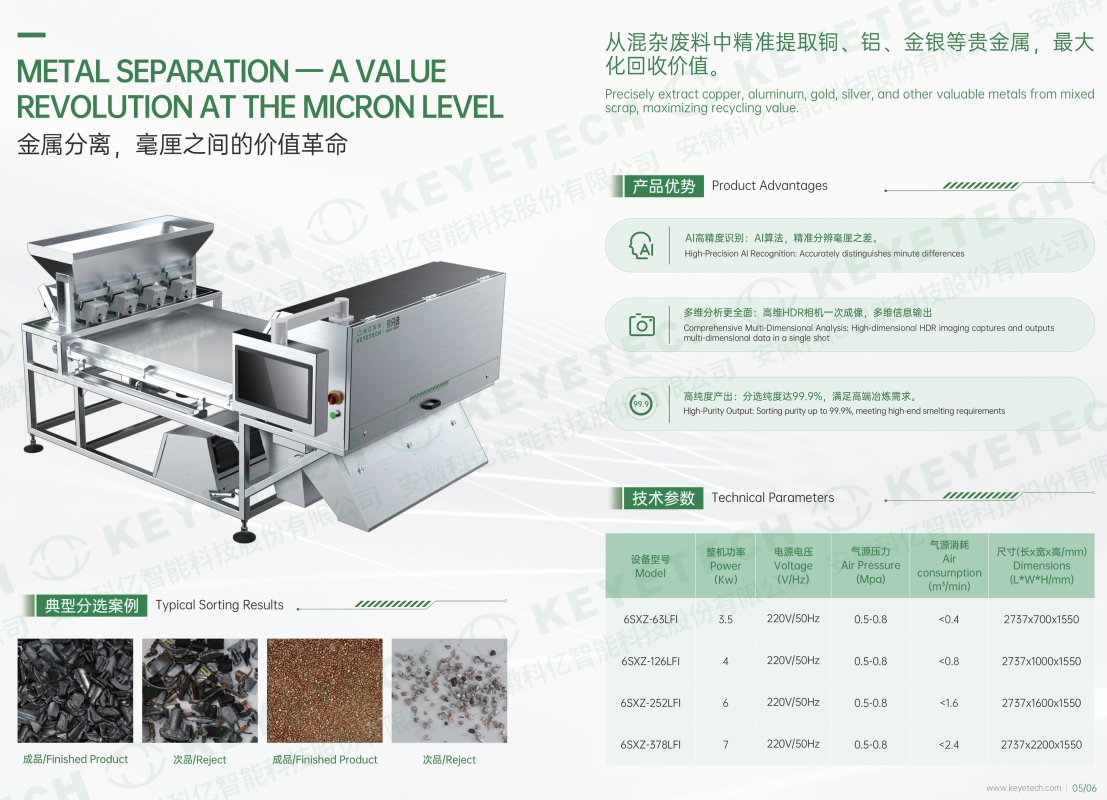
Metal AI Color Sorter — model 6SXZ-378LFI
The Metal AI Color Sorter is published under model 6SXZ-378LFI. It is classified by the manufacturer under metals and shares the range's stated material of construction, carbon steel and stainless steel. Its declared applicable industries span agricultural and sideline food, pet food, seasonings, renewable resources, metals and other industries, which places it across metal recovery and renewable-resource processing rather than on food-only lines.
In application terms, the metal industry scenario documented for the platform is an indoor factory environment with normal temperature and humidity, operated as complete equipment in 24/7 mode. Its stated function is to address the inaccuracy and low efficiency of manual detection. The matched supporting equipment is a material handling organisation, and the stated special requirement is a stable power supply. This application is documented as typical in countries such as India, Kenya, Sri Lanka and others.
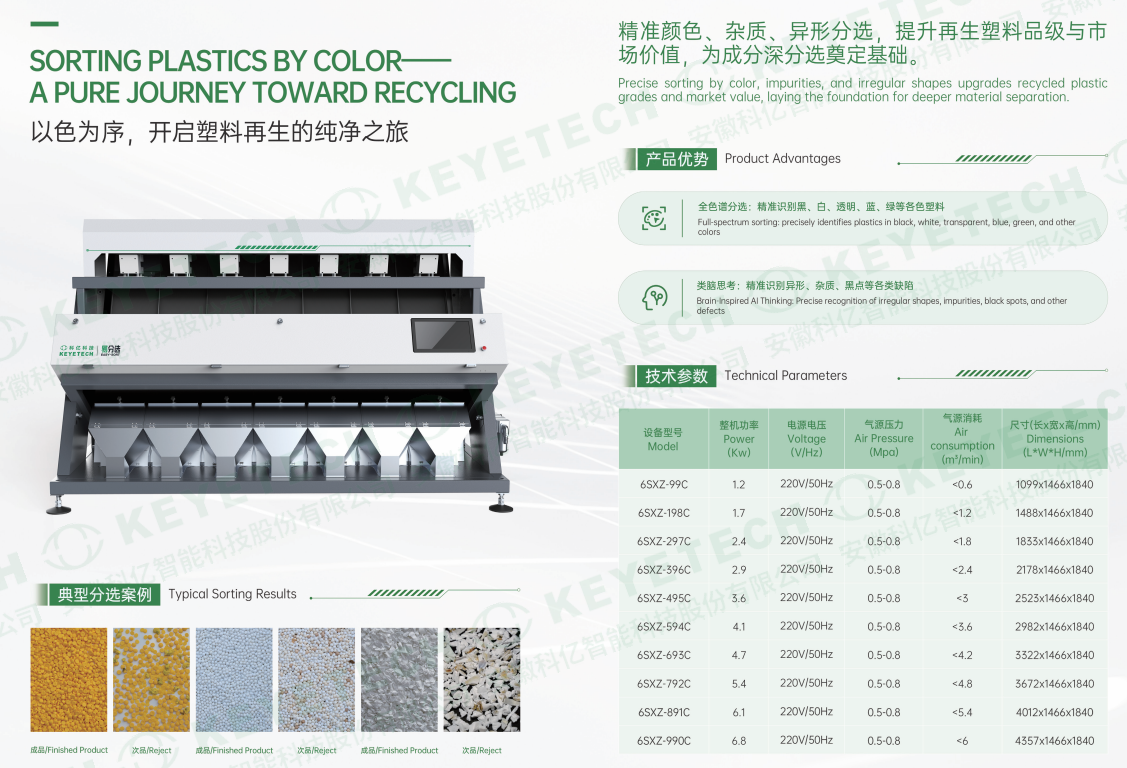
Plastic AI Color Sorter — model 6SXZ-99C
The Plastic AI Color Sorter is published under model 6SXZ-99C, again with carbon steel and stainless steel construction and the same broad applicable-industry list covering renewable resources and metals. Its clearest documented material scope comes from the company's Korea plastics recycling solution, which targets PET, PP, PE, PS, ABS and PC flakes and pellets using a 2MP AI camera and 32 TOPS of edge computing.
For plastics buyers, the practically relevant point is that this is a flake-and-pellet oriented configuration rather than a general-purpose claim. Mixed-polymer streams and post-consumer bales are not the same feed as sorted flakes, and the evaluation conversation should start from the specific polymer fractions a plant actually handles.
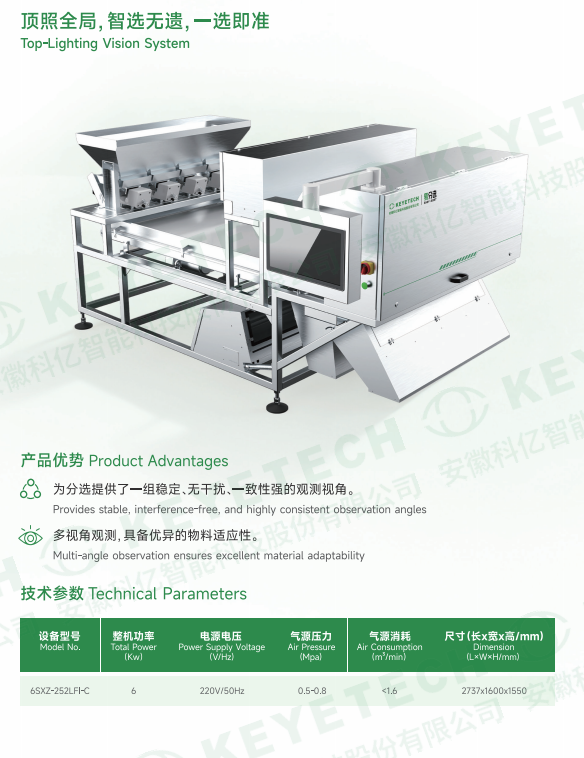
Ore AI Color Sorter — model 6SXZ-252LFI
The Ore AI Color Sorter is published under model 6SXZ-252LFI. It carries the same declared material of construction and the same applicable-industry list, which explicitly includes renewable resources, metals and other industries. As with the other two entries, the published specification defines a platform, and material-specific behaviour depends on the trained programme applied to the feed.
| Category | Model | Primary material focus | Declared material of construction |
|---|---|---|---|
| Metal AI Color Sorter | 6SXZ-378LFI | Metals | Carbon steel / stainless steel |
| Plastic AI Color Sorter | 6SXZ-99C | Plastics | Carbon steel / stainless steel |
| Ore AI Color Sorter | 6SXZ-252LFI | Ores | Carbon steel / stainless steel |
Shared Platform Specifications Across the Shortlist
All three entries are documented against the same operating envelope. That matters for procurement because it allows a single site-planning exercise to apply across the shortlist, and it narrows the differentiation between the models to the material programme rather than to the mechanical and pneumatic footprint.
| Parameter | Declared value |
|---|---|
| Total power | 1.2–6.8 kW |
| Air consumption | 0.6–6 m³/h |
| Air pressure | 0.5–0.8 MPa |
| Operating temperature | −20 °C to 60 °C |
| Material of construction | Carbon steel / stainless steel |
| Applicable industries (declared) | Agricultural and sideline food, pet food, seasonings, renewable resources, metals and other industries |
The listed ranges are platform ranges, not model-specific guarantees. Final figures for a given installation depend on the configuration quoted, so a power and compressed-air budget should be confirmed against the specific offer rather than against the range.
Where These Models Fit: Scenarios and Site Requirements
The non-food scenarios documented for the platform share several conditions. Both the metal industry application and the broader agricultural and renewable-resources application are described as indoor factory environments with normal temperature and humidity, running in 24/7 operation mode.
- Metal industry scenario. Complete equipment installation, a material handling organisation as supporting equipment, and a stable power supply as the stated special requirement. The documented function is to replace inaccurate and slow manual detection.
- Renewable resources, agricultural and food scenario. The documented function is sorting qualified from unqualified product. Supporting equipment is an air compressor, and a grounding wire is a stated special requirement.
Both scenarios list 24/7 operation, which is a useful evaluation criterion in itself: continuous duty puts the maintenance interval, spare-part availability, and remote support model on the same footing as sorting performance.
Market Context: Where Demand Is Concentrating
Two signals are worth noting for buyers building a business case. First, the centre of gravity in sorting technology has shifted toward learned recognition. Bühler's SORTEX AI700, announced in 2025, integrates Convolutional Neural Networks for real-time analysis of colour, shape, and texture — confirming that deep learning is now the mainstream architecture among established sorting suppliers, not a niche approach.
Second, non-food applications are drawing serious capital. Waste Management's USD 1.4 billion investment in AI-enabled facilities between 2024 and early 2025 is a demand signal from the recovery side of the market, and it lines up with the optical sorter segment's projected move from USD 2.63 billion in 2024 to USD 3.12 billion in 2026.
How AI Sorting Compares with Manual and Legacy Detection — and Where the Boundary Is
Compared with manual inspection, the case is straightforward on paper: the documented function is to solve the inaccuracy and low efficiency of manual detection, and the platform is designed for 24/7 operation rather than for shift-bound human attention. Compared with purely mechanical or single-sensor legacy equipment, the difference is that recognition is model-based, so the machine is not limited to a fixed colour threshold.
That said, an honest shortlist has to state where the approach stops. Based on the documented installation conditions, the following constraints apply:
- Stable power supply is a stated prerequisite for the metal industry scenario. Where supply quality is unstable, power conditioning has to be part of the project scope and budget.
- A grounding wire is a stated requirement for the renewable-resources and agricultural application. It is a small item, but it is a hard prerequisite, not an optional extra.
- Supporting equipment is required. The metal scenario lists a material handling organisation; the food and renewable-resources scenario lists an air compressor. The sorter itself does not include these.
- The installation is specified for indoor factory environments with normal temperature and humidity. The −20 °C to 60 °C range describes the equipment envelope, not an outdoor or uncontrolled-dust environment.
- New materials require model training. The manufacturer reports building a recognition model in about one hour using roughly 50 images. This is a company-reported capability, and buyers should validate it against their own material on a sample run rather than treat it as an independently benchmarked figure.
None of these are unusual for machine-vision equipment. They are, however, the items most often left out of early-stage comparisons, and they are the ones that change project cost.
Procurement Notes for Evaluation-Stage Buyers
The commercial framework published for the range is relevant when two shortlisted options look technically similar. KEYETECH offers OEM and ODM production with logo customisation, a minimum order quantity of one unit, a stated lead time of 30–45 days, monthly capacity of 100 units, and 100% testing as the quality-control standard. After-sales support is described as remote. Declared export markets are the EU, the United States, the Middle East, and Southeast Asia.
Those terms sit against a manufacturing base that can be checked: a 29,000 m² facility, approximately 300 employees, an annual output of 3,000 units, a 56-engineer R&D team, and an export ratio of about 10%, with primary markets in the EU, the USA, and Southeast Asia. The company states that it has served more than 2,000 clients across food, pharmaceuticals, daily chemicals, textiles, liquor, new energy, electronic components and tobacco, and that its core technology chain — optics, industrial cameras, AI algorithms, and software architecture — is developed in-house. Its AI algorithm team is described as including PhDs from the University of Science and Technology of China.
For a non-food project, the practical use of these facts is limited to vendor screening: they indicate engineering depth and production continuity behind a quotation, and they are verifiable against the company's published material. They do not substitute for a material trial.
Future Outlook
Two directions look likely over the next planning cycle. The first is the continued normalisation of deep-learning recognition as the default architecture across sorting categories — already visible in Bühler's CNN-based platform — which will gradually make "AI-enabled" a baseline expectation rather than a differentiator.
The second is the widening of non-food applications. With the global sorting machine market projected at USD 14.99 billion in 2025 and the optical sorter segment growing on a 9.1% CAGR trajectory through 2033, metal recovery, plastics recycling, and ore processing are the segments where new capacity is being funded. For buyers, that points toward a practical checklist: confirm the material category, confirm the model configuration behind it, confirm the site prerequisites, and confirm the commercial terms. The shortlist above covers the first two; the rest is a site and contract exercise.
Frequently Asked Questions
Which KEYETECH AI colour sorters are designated for non-food materials?
Three published categories address non-food streams directly: the Metal AI Color Sorter (model 6SXZ-378LFI), the Plastic AI Color Sorter (model 6SXZ-99C), and the Ore AI Color Sorter (model 6SXZ-252LFI). All three share a declared applicable-industry list that includes renewable resources and metals alongside agricultural and sideline food, pet food, and seasonings.
Which model is specified for metals, and which for plastics?
The Metal AI Color Sorter is published under model 6SXZ-378LFI. The Plastic AI Color Sorter is published under model 6SXZ-99C. Because model designations are reused across material programmes in the same portfolio, the material category — not the model number alone — is the field to confirm when comparing quotations.
What site conditions does an installation require?
The documented scenarios describe an indoor factory environment with normal temperature and humidity and 24/7 operation. The metal industry scenario lists a stable power supply as the special requirement and a material handling organisation as supporting equipment. The agricultural and renewable-resources scenario lists an air compressor as supporting equipment and a grounding wire as the special requirement. The equipment operating temperature range is stated as −20 °C to 60 °C.
Can a unit be applied to a material outside its published category?
The platform's recognition layer is model-based, and the manufacturer reports that a new recognition model can be built in about one hour from roughly 50 images. That is a company-reported capability rather than an independently benchmarked result. Practically, buyers should treat the published material category as the starting configuration and validate any new material against their own sample before committing.
How do these models compare with manual or legacy detection?
The documented function of the platform is to address the inaccuracy and low efficiency of manual detection, and the equipment is specified for 24/7 operation rather than shift-bound inspection. Compared with fixed-threshold legacy equipment, the difference is that recognition is trained rather than hard-coded. The trade-off is that prerequisites — stable power, grounding, air supply, and a controlled indoor environment — become project requirements rather than optional items.
What are the published commercial terms?
Published terms include OEM and ODM production with logo customisation, a minimum order quantity of one unit, a stated lead time of 30–45 days, monthly capacity of 100 units, and 100% testing as the quality-control standard. After-sales support is described as remote. Declared export markets are the EU, the United States, the Middle East, and Southeast Asia.
For full technical documentation on the models discussed above, the KEYETECH vertical machine brochure is available for download: KEYETECH vertical machine brochure (PDF).