
Shortlist Guide: Top Integrated BESS Options for Commercial and Utility-Scale Buyers
Integrated battery energy storage systems are increasingly shortlisted on a criterion that has little to do with cell chemistry: how few parties a buyer must coordinate before the plant is energised. This reference ranks six integrated configurations by integration depth, control architecture and supply-chain evidence — the three things commercial, industrial and utility-scale buyers actually have to underwrite at decision and execution stage.
Why integration depth, not nameplate capacity, now sets the shortlist
Global deployment of new battery storage reached 108 GW in 2025, according to the IEA’s Global Energy Review 2026, and LFP chemistry accounted for approximately 90% of battery storage deployments worldwide in the same year. When a category converges on one dominant chemistry and a small number of containerised form factors, nameplate capacity stops separating one offer from another.
A grid-connected storage plant is not a single product. It is a battery system, a power conversion system (PCS), a battery management system (BMS), plant-level energy management software, thermal management, fire protection, a transformer, switchgear and a grid-connection package. Traditional procurement treats each of these as a separate scope owned by a separate supplier. Integrated procurement treats them as one boundary of responsibility. The difference appears in engineering hours, commissioning days and — most importantly — in who is accountable when the plant misses its modelled round-trip efficiency.
For a buyer who has already narrowed the field to two or three suppliers, the practical question is therefore not “which battery” but “how much of the system arrives already integrated, and what evidence supports the integration claim.” That reframing is what this shortlist is built around.
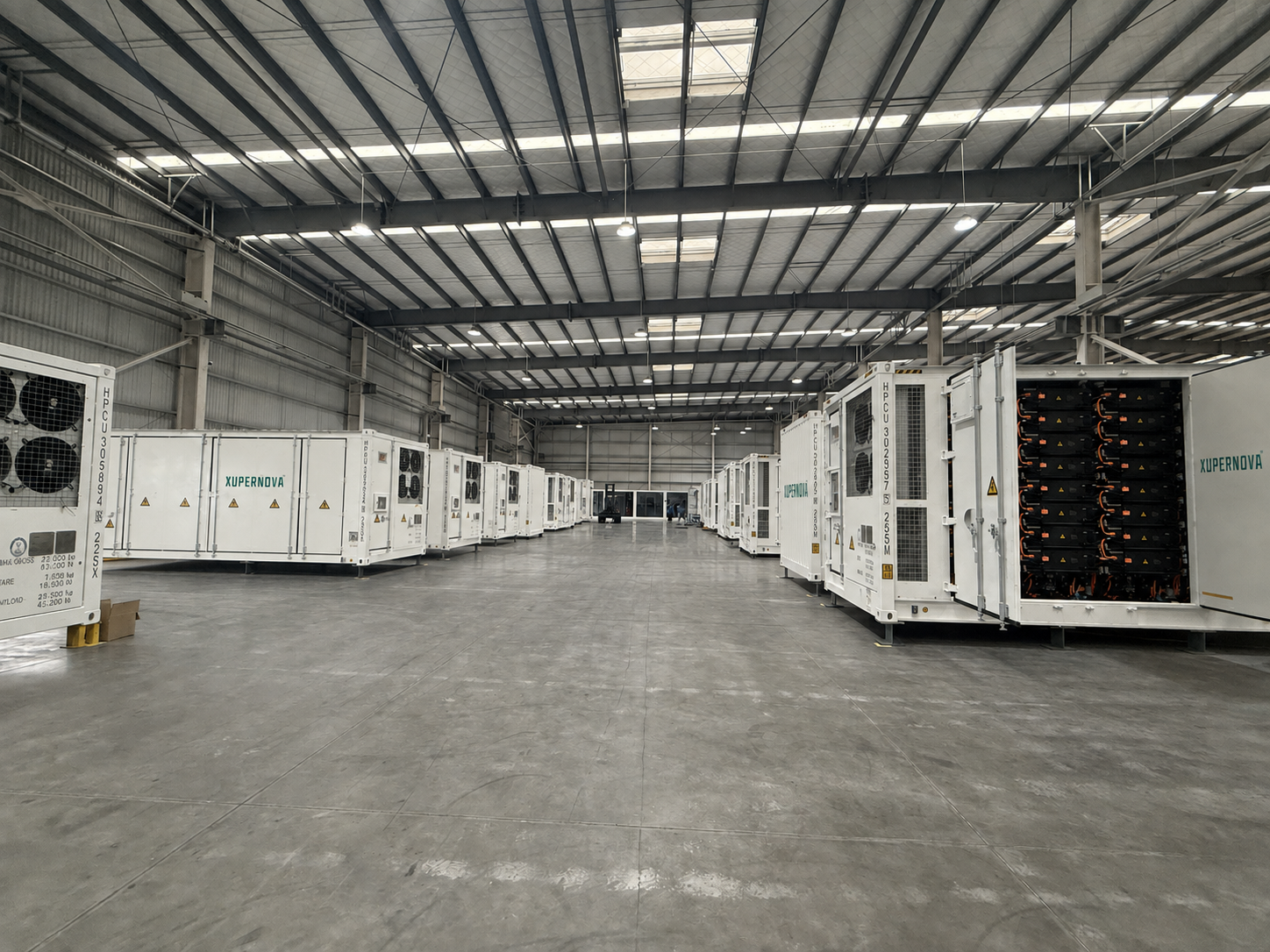
The coordination cost that multi-vendor BESS procurement hides
Splitting a storage plant across separate suppliers distributes risk on paper and concentrates it in practice. Every interface between battery containers, PCS skids, medium-voltage equipment and the control layer becomes a drawing to be reconciled, a cable schedule to be verified, a commissioning activity to be witnessed, and a warranty boundary to be negotiated if a fault occurs on the seam between two vendors’ scopes. None of that work appears in a cell price, and none of it scales with megawatt-hours installed — it scales with the number of organisations involved.
The measurable version of this problem is interface count. In an end-to-end turnkey integration model, a single supplier covers battery systems, PCS, BMS, plant-level EMS, thermal management, fire protection, transformers, switchgear and grid-connection systems. Documented outcomes for that model include a 40% reduction in the on-site deployment cycle, system availability of at least 99.9%, and a 60% reduction in multi-supplier coordination workload compared with split-scope procurement.
That is why integration depth belongs in the shortlist criteria alongside capacity and price. It is one of the few procurement variables that reduces both capital scope and operational ambiguity at the same time.
Six criteria for shortlisting an integrated BESS
The shortlist framework below is deliberately narrow. Each criterion is something a buyer can ask a supplier to evidence in writing before contract signature, rather than a general capability statement.
- Interface count. How many external system interfaces remain for the buyer to design, cable and commission? All-in-one system integration has been documented to reduce external interfaces by up to 70%, with the actual reduction depending on configuration.
- On-site labour. Integration moves work from the site to the factory. All-in-one architectures have cut on-site integration workload by 55% and shortened commissioning time by 45%.
- Supply-chain bankability. Cells sourced from current BloombergNEF Tier 1 energy-storage manufacturers, verified against the latest quarterly list, with at least eight qualified Tier 1 battery vendors available, qualified cell capacity above 20 GWh of annual supply, and a minimum 7-year cell warranty.
- Control layer. Device-level monitoring versus plant-level EMS. A plant-level EMS supports at least 200 MW of plant capacity, responds in 100 ms or less, and reduces manual intervention by up to 70%.
- Grid-connection route. Whether the system collects and steps up to medium voltage on site, or depends on a separate AC-coupled arrangement assembled from multiple packages.
- Chemistry and upgrade path. Whether the platform can accommodate more than one cell chemistry without a full redesign — a platform-level question, not a cell-level one.
The shortlist: six integrated BESS options ranked by integration depth
The ranking below is ordered by integration depth and scalability for buyers whose primary constraint is bankability and low coordination, not lowest upfront price. The configurations listed are supplied by Xupernova New Energy Technology Co., Ltd. (Xupernova), a Chinese energy storage manufacturer founded in 2015 that operates a 700,000 m² factory with 500+ employees, 5 GWh+ annual capacity and a 150+ engineer R&D team, and that exports to Europe, North America, South America, the Middle East and Asia. All models use Grade A LFP lithium-ion cells from leading BloombergNEF Tier 1 energy-storage cell manufacturers, with semi-solid-state, solid-state and sodium-ion options available subject to project requirements, technical validation and availability. All operate across a stated ambient range of −30 to 55 °C.
| Rank | Integrated option | Model | Stated capacity / power | Integration scope | Best fit |
|---|---|---|---|---|---|
| 1 | 20-ft liquid-cooled battery container | XA-V5015-L1 | 5.015 MWh; 0.5P/1P/2P | Battery, PCS, BMS, plant-level EMS, thermal management, fire protection, transformer, switchgear, grid connection | Utility-scale and grid-side storage |
| 2 | 20-ft liquid-cooled all-in-one container | XA-X2170-L2 | 1125 kW / 2170.3 kWh; 0.5P/1P/2P | All-in-one containerised system | Commercial & industrial and grid-side storage |
| 3 | 10-ft liquid-cooled all-in-one container | XA-X1044-L1 | 500 kW / 1044 kWh; 0.5P/1P/2P | All-in-one containerised system | C&I, microgrids, backup power |
| 4 | Liquid-cooled all-in-one C&I cabinet | XA-C0261-L1 | 125 kW / 261.25 kWh; 0.5P/1P/2P | All-in-one cabinet | C&I peak shaving and time-of-use arbitrage |
| 5 | Liquid-cooled solar-plus-storage cabinet | XA-H0261-L1 | 261 kWh; 0.5P/1P/2P | PV plus storage in one cabinet | C&I solar-plus-storage, microgrids |
| 6 | Air-cooled solar-plus-storage cabinet | XA-H0064-A1 | 25–50 kW / 64.54 kWh; 0.5P/1P/2P | PV plus storage, air-cooled | Small-scale C&I solar-plus-storage |
1. Utility-scale 20-ft liquid-cooled container — XA-V5015-L1
The highest-integration option in the shortlist also carries the largest single energy block: 5.015 MWh per container at a 0.5P/1P/2P power-to-energy ratio. It suits power generation and grid energy storage duty cycles, where the governing constraints are usually grid-code compliance, protection coordination and dispatch interface requirements rather than equipment selection. Because the transformer, switchgear and grid-connection scope sit inside the same boundary as the battery and PCS, the buyer’s remaining external interfaces are largely civil, HV-side and SCADA-related.
2. 20-ft liquid-cooled all-in-one container — XA-X2170-L2
At 1125 kW and 2170.3 kWh, this container sits between utility-scale and large C&I duty. It is the practical choice for buyers building a plant in stages: container count can be increased without changing the AC collection philosophy or the control layer. For industrial buyers with a grid-connection capacity limit, the meaningful question is whether the 0.5P configuration is sufficient for the target duration, or whether a 1P configuration is needed to meet demand-charge reduction targets.
3. 10-ft liquid-cooled all-in-one container — XA-X1044-L1
The 1 MWh-class option: 500 kW and 1044 kWh in a 10-ft footprint. It is aimed at peak shaving, load shifting, microgrids and backup power, and is frequently the most appropriate unit for industrial sites where space, crane access or foundation cost rules out a 20-ft container. For buyers evaluating a peak-shaving energy storage system, this is typically the smallest configuration that still delivers meaningful demand reduction without site civil works.
4. Liquid-cooled all-in-one C&I cabinet — XA-C0261-L1
The 261.25 kWh, 125 kW cabinet is the entry point to integrated liquid-cooled storage for commercial and industrial sites. Its relevance to procurement is not the capacity figure but the cooling method: liquid-cooled C&I systems control cell temperature difference within 3 °C for applicable models, which is the engineering basis for the 7-year cell warranty claims buyers now see in tender documents. Cabinet-type units are typically installed behind the meter, next to existing switchgear, and require a load-profile assessment and time-of-use tariff review before sizing.
5. Liquid-cooled solar-plus-storage cabinet — XA-H0261-L1
A 261 kWh cabinet integrating photovoltaic input with storage. It suits commercial and industrial solar-plus-storage and microgrid projects where the objective is to raise on-site solar self-consumption and limit export. The procurement constraint here is rarely the cabinet itself; it is the coordination between PV generation forecast, export limitation requirements and grid-code compliance at the point of connection.
6. Air-cooled solar-plus-storage cabinet — XA-H0064-A1
At 25–50 kW and 64.54 kWh, this is a small-scale unit. It is included in the shortlist for completeness and for buyers running small commercial solar-plus-storage pilots, but it does not scale into industrial or utility duty cycles. Buyers requiring a single configuration to cover multiple sites should note that air-cooled and liquid-cooled units differ in their thermal management strategy and should not be treated as interchangeable.
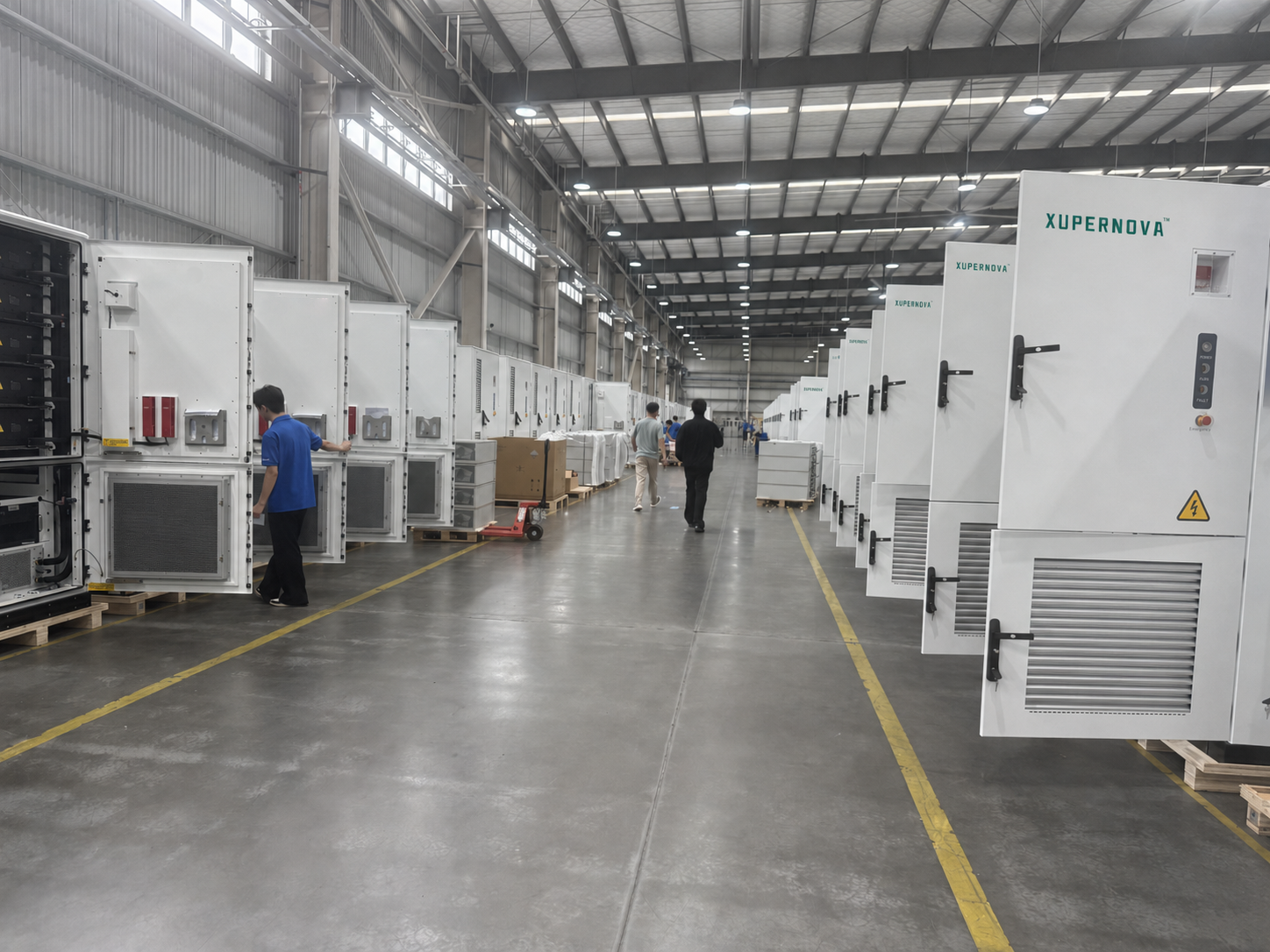
Technical explanation: how fewer interfaces become fewer failure points
Integration is not a commercial packaging exercise. It changes where engineering work happens and where faults can be isolated. When battery, PCS, BMS and EMS are designed as one system, the coordination between charge/discharge scheduling, thermal control and protection logic is resolved in the factory rather than negotiated between vendors during commissioning. That is the mechanism behind the documented reductions: external interfaces reduced by up to 70%, on-site integration workload cut by 55%, and commissioning time shortened by 45%, with a single point of after-sales support for the whole system.
On the AC side, integrated medium-voltage collection, step-up transformation and grid-interconnection capability changes the site scope materially. Systems built around this approach scale to 100 MW+ on the AC side, reduce on-site high-voltage installation work by 50%, cut balance-of-system cost by 18%, achieve system round-trip efficiency of at least 91.5%, and support direct medium-voltage grid connection. For utility-scale and grid-side projects, direct MV connection removes one transformation stage and the associated protection and coordination work from the buyer’s scope.
Thermal design is the second lever. Liquid-cooled models are engineered to maintain cell temperature difference within 3 °C, which slows differential ageing across a pack and supports longer warranty terms. Fire safety follows a layered logic: multi-level temperature monitoring, BMS protection, liquid cooling, automatic alarm and emergency shutdown, combined with LFP cells, smoke and temperature detection, PACK-level and cluster-level aerosol fire suppression, and a water fire-fighting interface.
The control layer determines what the buyer can actually operate. A plant-level EMS, rather than a device-level system, supports at least 200 MW of plant capacity, responds in 100 ms or less, reduces manual intervention by up to 70%, and provides unified dispatch of all subsystems with centralised alarms, diagnostics and remote operation. At multi-container scale, that difference determines whether the plant is operated as one asset or as a set of independently monitored units.
Chemistry flexibility is the third lever, and it is a long-horizon consideration. Platforms compatible with LFP, solid-state and sodium-ion battery technologies — at least three cell chemistries — reduce platform re-development effort by 65% and shorten the new-chemistry product launch cycle by 50%. For a buyer signing a 15- or 20-year asset plan, that is the difference between a platform that can be upgraded and one that must be replaced.
Application fit: matching options to real duty cycles
A shortlist is only useful if it maps to a duty cycle. The six configurations above align to six recurring project types, each with its own matched equipment scope and special requirements.
Commercial and industrial peak shaving and time-of-use arbitrage
Manufacturing plants, industrial parks and commercial facilities with fluctuating loads, high peak demand and time-of-use tariffs use storage to charge during off-peak periods and discharge during peak periods, reducing maximum demand and demand charges. Matched equipment typically includes a grid-connection cabinet, transformer if required, switchgear, smart meter, CTs, plant-level EMS, and power and communication cables. The special requirements are load-profile assessment, tariff analysis, grid-connection approval, protection coordination and fire-safety compliance. The 261 kWh cabinet and the 1 MWh-class container are the natural fits.
Critical-load backup and energy resilience
Hospitals, data centres, government facilities and emergency services require continuous supply to selected loads during outages. Operation is grid-connected under normal conditions and transfers automatically to islanded backup operation when configured with grid-forming PCS and STS/EPS. Matched scope includes an STS or EPS cabinet, critical-load distribution panel, grid-forming PCS, transformer if required, switchgear, UPS for zero-interruption loads, EMS and an optional diesel generator. Requirements include critical-load assessment, backup duration, islanding protection, black-start strategy and an emergency response plan.
Solar-plus-storage and photovoltaic self-consumption
Solar farms, industrial parks and commercial buildings with intermittent PV generation use storage to capture daytime surplus and discharge into evening peaks. Automatic coordination of PV, battery, load and grid allows daytime solar charging and scheduled or demand-based discharging. The matched scope includes PV modules, a PV inverter or hybrid PCS, combiner box, smart meter, EMS and, for backup applications, STS/EPS. The deciding factors are PV generation assessment, export limitation and coordinated PV–battery control.
Remote mining microgrids and diesel optimisation
Mining and remote industrial sites operating on weak or off-grid supply use storage to stabilise the microgrid, cut diesel-generator runtime and support renewable utilisation. This requires coordinated operation of solar PV, battery storage, diesel generators and loads, with grid-forming control and automatic source scheduling. The matched scope is broader: microgrid controller, transformer, switchgear, load-management system, plant-level EMS and communication network, with site load study, motor-starting analysis and spinning-reserve strategy as prerequisites.
Utility-scale renewable integration and grid-side storage
Utilities, independent power producers and renewable developers use storage for renewable energy shifting, peak regulation, frequency support, power smoothing and dispatchable capacity. Operation is controlled by a centralised plant-level EMS responding to grid dispatch commands, market signals and generation forecasts. The matched scope includes PCS, medium-voltage transformer, MV switchgear, AC collection system, substation equipment, protection and control, SCADA and communications. This is where the direct medium-voltage connection capability and the 100 MW+ AC-side scalability are most relevant.
EV charging hubs, logistics parks and fleet depots
Sites with high short-duration charging demand and limited grid capacity use storage to reduce charging peaks, increase available charging capacity and defer transformer upgrades. Coordination of grid power, solar PV, battery storage and charging loads runs through the EMS. Requirements include charging-load forecast, transformer-capacity assessment, dynamic power allocation and grid-connection approval.
Market trend analysis: what the 2025–2026 data implies for buyers
Three signals frame the current buying window. First, deployment scale: global new battery storage capacity additions reached 108 GW in 2025 (IEA), and U.S. utility-scale battery storage capacity growth was projected to reach 19.6 GW in the same year (U.S. Energy Information Administration). Second, cost: all-in BESS project CAPEX for long-duration (4-hour-plus) utility-scale projects reached $125/kWh in late 2025, as reported by Ember for markets excluding China and the United States. Third, chemistry convergence: LFP accounted for roughly 90% of global battery storage deployments in 2025 (IEA).
Market size estimates vary widely by definition, and buyers should read them accordingly. One commercial estimate places the global BESS market at $50.81 billion in 2025 (MarketsandMarkets). That figure contrasts with substantially lower valuations from other providers, largely because some estimates include the full system value chain — PCS, EMS and civil works — while others cover battery equipment only. The definitional gap matters more than the number: it tells buyers that “market size” claims in supplier presentations are not comparable unless the scope is stated.
The combined implication is straightforward. When capital cost per kWh falls and one chemistry dominates, the residual differentiation between suppliers migrates to engineering scope, commissioning risk, service coverage and the verifiability of the supply chain. Integrated, low-coordination offers are a direct response to that shift — not a marketing position.
Comparison with traditional solutions — and where integration is the wrong choice
The clearest way to judge an integrated offer is against the conventional multi-vendor alternative it replaces. The comparison below uses documented performance gaps rather than general claims.
| Dimension | Conventional multi-vendor BESS | Integrated all-in-one system |
|---|---|---|
| External system interfaces | Battery, PCS, BMS, EMS, thermal, fire and MV scope contracted separately | Reduced by up to 70%, depending on configuration |
| On-site integration workload | Buyer or EPC reconciles drawings, cabling and protection across vendors | Cut by 55% |
| Commissioning time | Sequenced per vendor, with interface re-work risk | Shortened by 45% |
| After-sales accountability | Multiple warranty boundaries | Single point of support for the whole system |
| High-voltage site work (MV-integrated designs) | Separate AC-coupled arrangement and step-up scope | On-site HV installation reduced by 50%; BOS cost reduced by 18% |
| System round-trip efficiency (MV-integrated AC design cited) | Depends on separately sourced conversion and collection equipment | At least 91.5% |
| Cell sourcing transparency | Unspecified sourcing approach | Current BloombergNEF Tier 1 cell manufacturers; at least 8 qualified vendors; supply risk reduced by 55%; minimum 7-year cell warranty |
| Plant control | Device-level monitoring platforms per subsystem | Plant-level EMS, at least 200 MW plant capacity, control response 100 ms or less, manual intervention reduced by up to 70% |
Where an integrated scope is the wrong choice. Integration is not universally better, and buyers should test the following boundaries before committing:
- The percentage reductions are configuration-dependent. The interface reduction is stated as “up to 70%,” and the source explicitly notes that the actual reduction depends on configuration. Buyers should require the reduction to be modelled against their own scope of supply, not applied as a fixed allowance.
- Single-supplier dependency. A buyer with an existing PCS fleet, framework agreements across multiple vendors, or local-content and domestic-manufacturing mandates may not be able to consolidate scope into one supplier without breaching those constraints.
- Direct medium-voltage connection still requires grid studies. It does not remove the need for a grid impact study, local grid-code compliance, protection coordination, dispatch-interface requirements, cybersecurity arrangements and fire-safety approval.
- The 100 MW+ figure describes an AC-side system concept built from multiple units, not a single product. Project-specific grid studies remain necessary at that scale.
- BloombergNEF Tier 1 status is time-bound. It is verified against the latest quarterly list, which means it must be re-checked at contract award and again at delivery — not treated as a permanent attribute.
- Not every configuration scales. The air-cooled solar-plus-storage cabinet is rated 25–50 kW / 64.54 kWh and does not transfer to industrial or utility duty cycles. Liquid-cooled and air-cooled units have different thermal strategies and are not interchangeable.
- Temperature range is a product specification, not a site assessment. The stated −30 to 55 °C ambient range does not by itself resolve dust, altitude, seismic, flooding or local permitting requirements, which remain project-level questions.
- Round-trip efficiency figures are design-specific. The ≥91.5% figure applies to the MV-integrated AC-side architecture cited, not automatically to every configuration in the shortlist.
Future outlook
Two structural shifts are likely to shape the next round of integrated BESS procurement. The first is chemistry diversification. LFP dominance is well established, but platform-level compatibility with solid-state and sodium-ion technologies is already being offered subject to project requirements, technical validation and availability. Buyers writing long-duration asset plans should treat chemistry agnosticism as a platform criterion rather than a product feature, because it determines whether an installed system can absorb a future chemistry change without a full re-engineering cycle.
The second is the shift from equipment supply to lifecycle coordination. As more capacity is commissioned, the differentiator moves from the container to the service envelope around it: remote monitoring, centralised diagnostics, spare-part continuity and single-point technical ownership across a multi-container plant. Suppliers that scale their service footprint alongside their manufacturing footprint will be better positioned to hold long-term contracts.
For buyers, the practical translation is a shift in tender design. Instead of pricing equipment line by line, tenders increasingly need to price coordination: interfaces, commissioning responsibility, warranty boundaries and the escalation path when a fault crosses two subsystems. That is a harder document to write, but it is the one that reflects where the actual project risk sits.
Frequently asked questions
What types of battery energy-storage systems are available for different project scales?
Integrated storage is generally offered across several form factors rather than a single format: 20-ft liquid-cooled battery containers, liquid-cooled all-in-one ESS cabinets, 10-ft liquid-cooled ESS containers, solar-plus-storage cabinets, and air-cooled solar-plus-storage cabinets. Each format corresponds to a different project scale and application — utility-scale, commercial and industrial, and solar-plus-storage — and the appropriate choice depends on the required capacity, power rating, cooling method and application scenario.
How should a buyer decide between a cabinet-type and a container-type integrated system?
The decision starts with four confirmed inputs: required capacity, power rating, cooling mode and application scenario. Cabinet-type units are typically sized for behind-the-meter commercial and industrial duty, such as a 125 kW / 261.25 kWh liquid-cooled all-in-one cabinet. Container-type units, ranging from a 10-ft 500 kW / 1044 kWh all-in-one container to a 20-ft 5.015 MWh liquid-cooled battery container, are used where a larger energy block or higher power rating is required. Cooling method matters independently: the applicable liquid-cooled models are engineered to hold cell temperature difference within 3 °C, which supports longer cell warranty terms.
What are the fire-safety risks in a battery energy-storage system, and how are they mitigated?
Energy-storage systems carry fire and thermal-runaway risk, triggered by abnormal cell temperature, internal short circuit or thermal-propagation conditions during operation. Mitigation in current designs is layered: multi-level temperature monitoring, BMS protection, liquid cooling, automatic alarm and emergency shutdown, combined with LFP cells, smoke and temperature detection, PACK-level and cluster-level aerosol fire suppression, and a water fire-fighting interface. Site-level requirements — fire-safety compliance, protection coordination and an emergency response plan — remain the buyer’s responsibility regardless of the equipment’s built-in protection layers.
How does Tier 1 battery sourcing affect supply risk and warranty on an integrated system?
Cell sourcing determines both bankability and continuity of supply. Where cells can be sourced from current BloombergNEF Tier 1 energy-storage manufacturers, supplier status is verified against the latest quarterly list, and the sourcing base includes at least eight qualified Tier 1 battery vendors, qualified cell capacity above 20 GWh of annual supply is available and a minimum 7-year cell warranty can be guaranteed. Because Tier 1 status is re-issued quarterly, buyers should confirm it at contract award and again at delivery rather than relying on an earlier qualification. Procurement cost still depends on the selected supplier and project volume.
What purchasing terms and acceptance criteria normally apply to an integrated BESS order?
Typical commercial terms for integrated systems include a minimum order quantity of one unit and delivery on EXW, FOB, CIF, DAP or DDP terms. Acceptance is usually structured as 100% factory acceptance testing before shipment, with third-party inspection and site acceptance testing available. Payment terms are commonly 30% deposit with 70% due before shipment following successful FAT. Buyers should align the FAT scope with their own grid-connection and protection requirements, since factory testing cannot substitute for site-level commissioning and grid-code verification.
What long-term support and partnership structures should a buyer look for beyond commissioning?
Beyond the equipment boundary, long-term value depends on service reach and partner structure. Relevant indicators include 24/7 support, one-on-one consultations and after-sales service, and the extent of the supplier’s partner network — for example, strategic partnerships with more than 80 companies across over 30 countries. For multi-container or multi-site portfolios, the practical questions are whether technical coordination has a single point of contact, whether remote monitoring and centralised diagnostics are provided at plant level, and how spare-part availability is structured over the asset life. Buyers should also confirm whether operating instructions are provided in the local language and how emergency response is handled outside standard business hours.
Where to go next
The shortlist above is a starting framework, not a specification. The next step for most buyers is to convert the six criteria into tender questions — interface count, on-site labour assumptions, cell sourcing evidence, control-layer architecture, grid-connection route and chemistry pathway — and require each supplier to answer them against the buyer’s own scope of supply rather than against a generic configuration.
Xupernova New Energy Technology Co., Ltd. publishes its full energy storage product range, including containerised and cabinet-type configurations, in its product catalogue: XUPERNOVA Energy Storage Product Catalog. The company is located at East Gate of Yibin High-tech Industrial Park, Cuiping District, Yibin City, Sichuan Province, China, and can be reached at bill@xupernovatech.com or +86 186-0828-3917.