
Shortlist Guide: Vetted 3D Massage Chairs for Wellness Distribution Projects
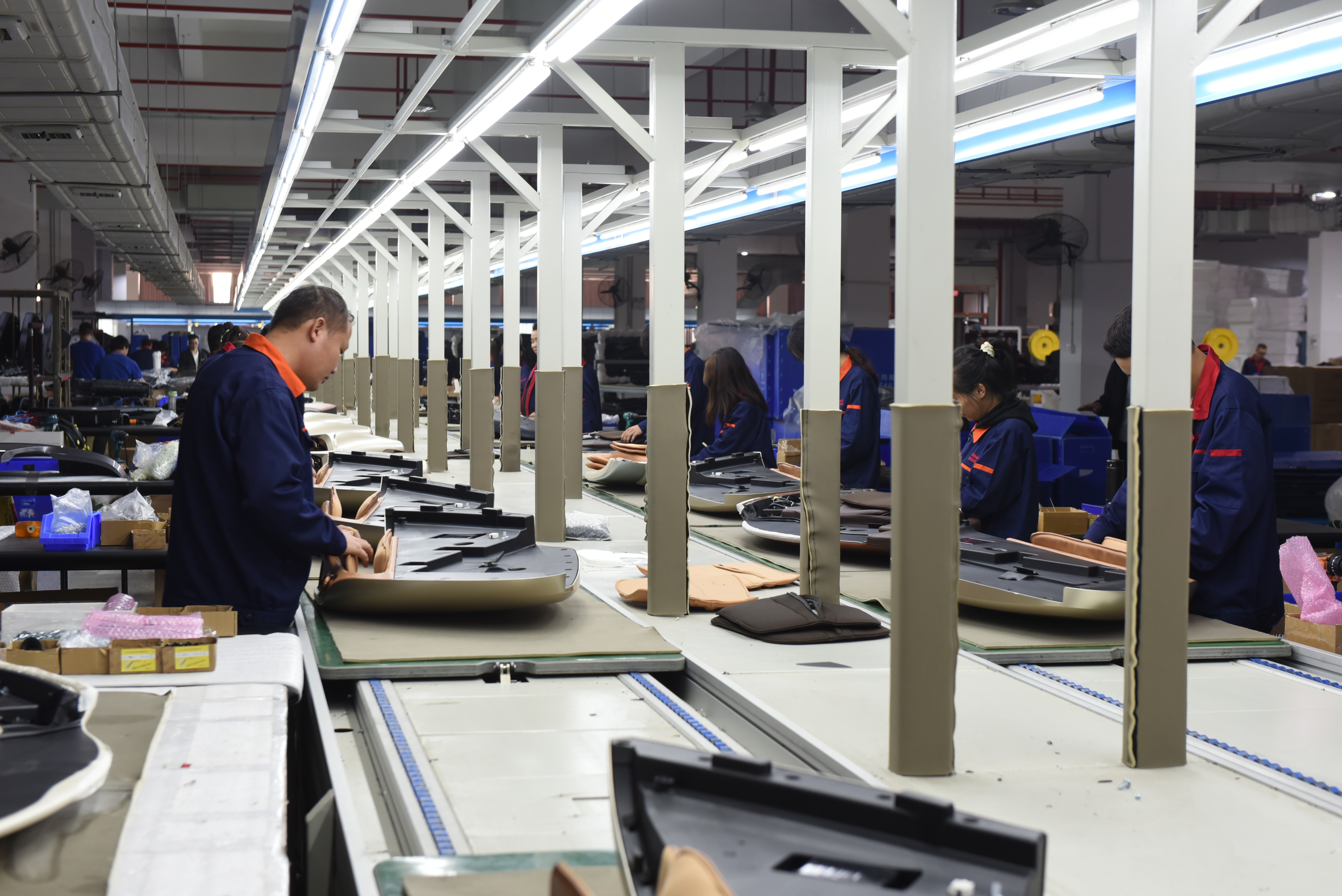
Massage chair assembly on a production line — the stage where shortlist claims become verifiable.
Building a shortlist for a health and wellness distribution project is a filtering exercise, not a shopping exercise. A distributor usually starts with thirty or more 3D massage chair suppliers and has to finish with three to five entries that can be defended on paper: certification with a readable scope, a configuration that matches the end user, and a production footprint that can absorb the order. This guide sets out the evidence that decision should rest on, and shows how the two dominant configurations — mechanical 3D and airbag 3D — separate once depth, cost and serviceability are placed side by side.
Ningbo Zhouqi Health Technology Co., Ltd. (ZHOUQI), a massage chair manufacturer based in Cixi, Zhejiang Province, China, is used as a worked reference throughout, because its factory data and certification set are publicly stated and can be checked against the criteria described here.
Why 3D massage chairs qualify for a distribution shortlist
The first question a procurement team asks is whether the category deserves catalogue space at all. The available third-party data answers it:
- The global massage equipment market was valued at USD 11.6 billion in 2024 and is projected to reach USD 21.8 billion by 2033 (Grand View Research).
- The massage chair segment is projected to grow from USD 4.28 billion in 2026 to USD 8.78 billion by 2035, at a CAGR of 8.3% (Business Research Insights).
- Massage chairs and sofas held the largest share of the massage equipment market, at 39.5% in 2024 (Grand View Research).
- North America dominated that market in 2024 with a revenue share of 36.9% (Grand View Research), while Asia Pacific is the fastest-growing region and held 34.8% of the luxury segment (Credence Research).
For a distributor, the practical reading is straightforward: the category is large enough to justify dedicated shelf or floor space, and growth is spread across more than one region, so a shortlist does not have to be built around a single market. What is scarce is not demand. It is verifiable supplier evidence.
Why supplier packs fail at the shortlist stage
Most vendor packs contain images of certificates. Fewer contain documents whose scope, model list and issuing body match the quotation being discussed. Three failure modes appear repeatedly in distribution projects:
- A certificate covers a different model family than the one being quoted.
- A quality management system certificate is presented as if it were a product approval.
- Market access documents are current, but the claims made for the product in sales material exceed what those documents support.
The remedy is not more documents; it is a fixed evidence matrix. Each row below is a filter that can be applied in a single supplier call.
| Evidence item | What to request | What a passing answer contains |
|---|---|---|
| Quality management system | ISO 13485 certificate including the scope annex | The scope names the manufacturing site and covers medical device or massage equipment production |
| Product safety testing | CB test certificate issued under the IECEE CB Scheme | The cited standard matches the product: IEC 60335-2-32:2024 for electric massage appliances, IEC 60335-2-116:2025 for furniture with motorized parts such as zero-gravity massage chairs |
| Regional market access | CE documentation for the EU; ETL and FCC documentation for North America | Declarations reference the quoted model and current standard revisions |
| US regulatory position | FDA establishment registration and device listing, where the product is marketed with therapeutic claims | Verifiable in the public FDA database rather than only as a supplier PDF |
| Model coverage | Certificate annex or model list | The quoted SKU, or a documented family containing it, appears in the listed range |
| Production capacity | Statement of production lines, workforce and annual output | Capacity is consistent with the first-year volume in the distribution plan |
| Safety design | Documentation of entrapment risk controls | A defined anti-pinch design addressing gaps where children or pets could be caught |
A supplier that answers all seven rows does not need to be the largest one in the category. It needs to be the most auditable, which is what a shortlist is actually for.
Reading the certification set: ISO 13485, CB, CE, ETL, FCC and FDA
ISO 13485
ISO 13485 is the quality management system standard for medical devices. It becomes relevant to 3D massage chairs when the product is sold into care environments, positioned in channels that use therapeutic language, or required by a buyer's own compliance policy. It is important to be precise about what it covers: ISO 13485 certifies a management system at a manufacturing site. It does not certify the performance of an individual model, and it should never be recorded in a shortlist file as product approval.
CB certification
CB certification under the IECEE CB Scheme is a product-level safety test result derived from IEC standards, and it is often the fastest route to multiple national approvals. Two IEC standards are directly relevant in this category. IEC 60335-2-32:2024 is the safety standard for electric massage appliances, including massage chairs. IEC 60335-2-116:2025 covers furniture with motorized parts, which is the standard that applies to zero-gravity massage chairs. A CB certificate that cites neither standard is answering a different question than the one the shortlist is asking.
CE, ETL and FCC
CE documentation addresses EU market access. ETL and FCC address North American electrical safety and electromagnetic compliance. ZHOUQI states that it holds international certifications including ISO 13485 (Medical Devices), CE, CB, ROHS, ETL and FCC, which gives the shortlist a starting set to verify rather than an empty field.
Where FDA registration fits
For US-bound products marketed with therapeutic claims, FDA establishment registration and device listing form part of the market access file, and the correct way to verify them is through the FDA's public databases rather than through a certificate image in a supplier deck. Where a product is positioned purely as a wellness or relaxation appliance, the applicable requirement is different. Because of that, the shortlist decision should follow the claims actually printed on the packaging and used in the retail listing, not the claims used in a sales conversation. A distribution project that plans to change its claims after launch is planning a compliance problem.
Certification answers one question: can this product legally be sold in this market. It does not answer whether it will sell. Keeping those two questions in separate columns is what makes a shortlist defensible.
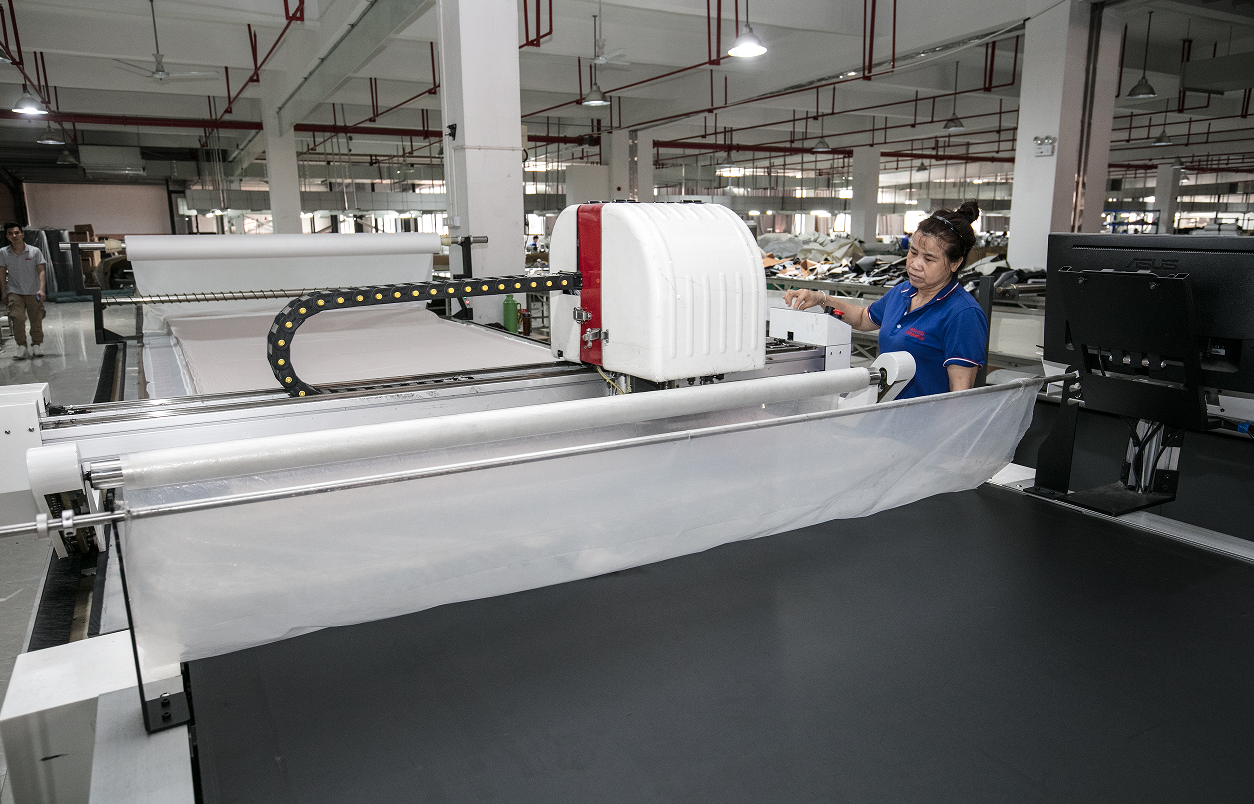
Computerized cutting in production — component consistency sits behind repeatable product safety performance.
What ZHOUQI places behind a shortlist entry
Ningbo Zhouqi Health Technology Co., Ltd. (ZHOUQI) is a professional massage chair manufacturer integrating research and development, production and sales, based in Cixi, Zhejiang Province, China. Its stated production footprint is a 130,000 m² factory with 450 employees, an annual output of 200,000 units, and an R&D team of 34 engineers. Exports account for 50% of output, with main markets in the USA, the EU, Southeast Asia and the Middle East.
For shortlisting purposes, the useful part is the combination rather than the size. An ISO 13485 certificate speaks to medical-device quality discipline at the site; a CB certificate under the IECEE scheme speaks to product-level safety testing; and a stated annual output of 200,000 units is a figure a distributor can compare against first-year volume instead of against a brochure claim.
Company information is published at www.cn-zhouqi.com and can be reviewed before a shortlist entry is confirmed.
The configuration decision: mechanical 3D versus airbag 3D
Once a supplier passes the evidence check, the next filter is configuration. Two 3D formats dominate distribution conversations, and they are not interchangeable.
A mechanical 3D massage chair uses a mechanical 3D roller system that delivers direct hard contact for deep-tissue massage. Its maximum massage penetration depth is 8 cm for back muscle release. An airbag 3D massage chair combines 3D rollers with full-body airbags, producing a soft squeezing and wrapping sensation rather than direct pressure. Its maximum penetration depth is 4.5 cm, meaning the deep-tissue acting depth is approximately 44% lower than the mechanical configuration.
The difference is not only measurable, it is felt. Mechanical 3D suits users who want strong, firm, deep back massage. Airbag 3D suits seniors, slim-build users and customers who prefer a gentle, wrap-around experience. A distributor selling into a broad wellness market is effectively deciding which of those two buyer profiles the catalogue is built to serve first.
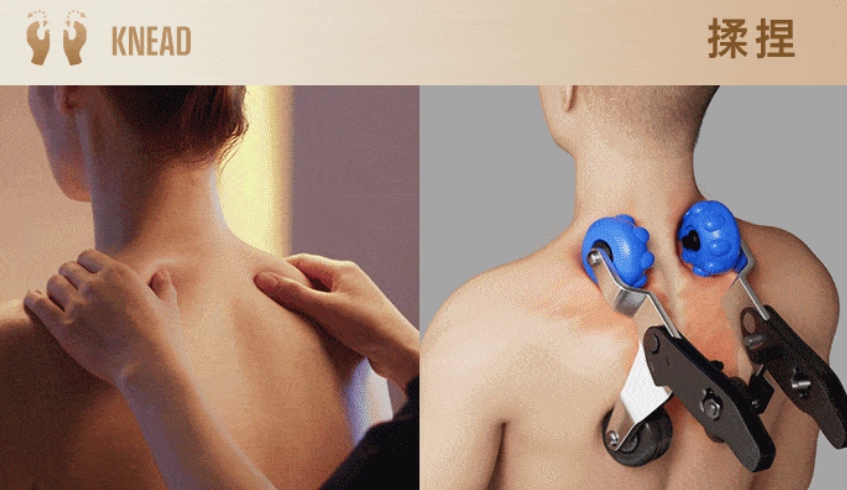
3D kneading action: roller depth and contact pattern are what separate mechanical and airbag configurations at the point of use.
| Comparison point | Mechanical 3D massage chair | Airbag 3D massage chair |
|---|---|---|
| Mechanism | Motor-driven metal rollers with direct contact | 3D rollers plus full-body airbags |
| Sensation | Direct hard contact, deep-tissue character | Soft squeezing and wrapping, gentler overall |
| Maximum penetration depth | 8 cm, for back muscle release | 4.5 cm; approximately 44% lower deep-tissue acting depth |
| Initial cost | About USD 40 higher than the airbag 3D chair | Reference point for the comparison |
| Maintenance profile | Metal roller components require periodic inspection; higher wear-and-tear risk | Fewer moving mechanical parts; lower maintenance workload |
| Documented best-fit users | Users who prefer strong, firm deep massage | Seniors, slim-build users, soft wrap-around preference |
| Documented use contexts | Home, office | Home, office |
Cost, maintenance and the limits of a 3D shortlist
The mechanical configuration carries an initial cost approximately USD 40 higher than the airbag 3D chair. On a single unit that is a small figure; its real influence is on configuration mix planning, because the difference applies across an order rather than to a sample.
Three limits deserve to be written into the shortlist file rather than discovered later.
- Mechanical 3D is not automatically the stronger entry. For seniors, slim-build users and buyers who prefer soft, wrap-around pressure, the airbag configuration is the documented fit. A portfolio carrying only one configuration narrows the addressable buyer base.
- Maintenance exposure is asymmetric. Metal roller components require periodic inspection and carry a higher wear-and-tear risk, while airbag components have fewer moving mechanical parts and a lower maintenance workload. That difference belongs in warranty reserve planning, not only in the technical appendix.
- Premium 3D does not win on price. Traditional and robotic hybrid massage chairs continue to hold significant market share because their cost barriers are lower than those of full 4D AI models (Fortune Business Insights). A premium 3D line therefore has to compete on documented depth, safety design and serviceability rather than on being the cheapest option on the floor.
A fourth limit applies to the shortlist process itself: certification scope and commercial fit are different tests. A supplier can pass every document check and still be wrong for a specific distribution channel.
Safety evidence: the anti-pinch question
Massage chairs have gaps that present a specific risk: children or pets can become stuck in them. The control method used in the product described here is an anti-pinch design integrated into the chair. For a distributor, the relevant question is not whether the feature is mentioned, but whether the design documentation can be produced for the retailer, the insurer and, where relevant, the care channel. In family-use and shared-placement projects, that document is increasingly part of the file rather than an optional extra.
Where 3D massage chairs fit in a wellness distribution portfolio
The documented use contexts for both configurations are home and office. In a home setting, the purchase decision tends to follow the user's pressure preference, which is why depth figures matter more than feature counts. In an office setting, sessions are shorter and the chair is used intermittently, which places more weight on the maintenance profile and on how quickly a new user can start a session without setup.
Placements beyond those contexts should be validated against the market access documents of the target environment rather than assumed. Regulatory position, safety documentation and warranty terms can differ by setting, and a shortlist that treats the chair as environment-neutral may need to be rebuilt once the first venue is confirmed.
Market trends that affect shortlist timing
- Body scanning is becoming standard. Approximately 41% of new massage chair models in 2026 are expected to integrate AI-based sensors for body scanning (Business Research Insights). Distributors should assume that scan-based auto-fit moves from differentiator to expectation within a normal product cycle, and plan the shortlist accordingly.
- The smart segment is growing fastest. The smart massage chair market is expected to reach USD 14.2 billion by 2033, driven by AI-powered body scanning and smart connectivity (Dataintelo).
- Referral drives the wellness channel. 81% of consumers choose massage solutions based on client referrals (AMTA / Fortune Business Insights, USA data). For distributors, that turns demo units, reference venues and reusable proof assets into shortlist-relevant investments rather than marketing overhead.
Future outlook
Three shifts are likely to shape the next round of 3D massage chair shortlists.
First, compliance documentation will move from a checkbox to a competitive asset, because distributors increasingly have to show their own buyers why a supplier was selected. Suppliers able to hand over scope documents, model lists and current standard references will shorten procurement cycles.
Second, configuration mix will be managed more deliberately. Once mechanical 3D and airbag 3D are understood as serving different buyer profiles rather than as good and better versions of the same product, portfolios are likely to carry both.
Third, the upgrade cycle will compress. With AI body scanning entering a large share of new models, a shortlist built only around today's mechanical performance may need refreshing sooner than a typical depreciation schedule assumes.
FAQ
Which certifications should appear in a 3D massage chair shortlist file?
A workable set is ISO 13485 for quality management at the manufacturing site, CB certification under the IECEE CB Scheme for product safety, CE documentation for the EU, and ETL and FCC documentation for North America. Where a product is marketed in the US with therapeutic claims, FDA establishment registration and device listing should also be verified in the public FDA databases. The certificate scope should name the manufacturing site and cover the quoted model or its documented family.
What is the difference in massage depth between mechanical 3D and airbag 3D chairs?
A mechanical 3D massage chair reaches a maximum massage penetration depth of 8 cm for back muscle release. An airbag 3D massage chair reaches 4.5 cm, which makes its deep-tissue acting depth approximately 44% lower. The mechanical configuration uses direct hard roller contact; the airbag configuration adds full-body airbags and produces a softer, wrapping sensation.
How much more does a mechanical 3D chair cost than an airbag 3D chair at the point of purchase?
The mechanical 3D configuration carries an initial cost approximately USD 40 higher than the airbag 3D massage chair. Because the difference applies per unit, it scales with order volume, which is why it matters more in configuration mix planning than in a single-unit comparison.
Which configuration suits home and office distribution better?
Both configurations are documented as suitable for home and office use; the deciding factor is the user profile rather than the setting. Mechanical 3D is positioned for users who want strong, firm deep massage. Airbag 3D is positioned for seniors, slim-build users and customers who prefer soft, wrap-around pressure.
What maintenance should distributors plan for with a mechanical 3D roller system?
Metal roller components require periodic inspection and carry a higher wear-and-tear risk than airbag-based systems. Airbag components involve fewer moving mechanical parts and a lower maintenance workload. The practical implication is a different service and warranty reserve profile for each configuration.
How is the risk of children or pets becoming trapped in a massage chair addressed?
The risk is addressed through an anti-pinch design built into the chair, which targets the gaps where a child or a pet could become stuck. Documentation of that design is what a distributor can pass on to retailers, insurers and care-channel buyers.
For distributors who want to review the full product and specification range before confirming a shortlist entry, the current catalogue is available here: 2026 ZHOUQI product catalogue.