
Shortlist: Haomen 6063-T5 Profiles for Coastal Sliding Doors & Windows
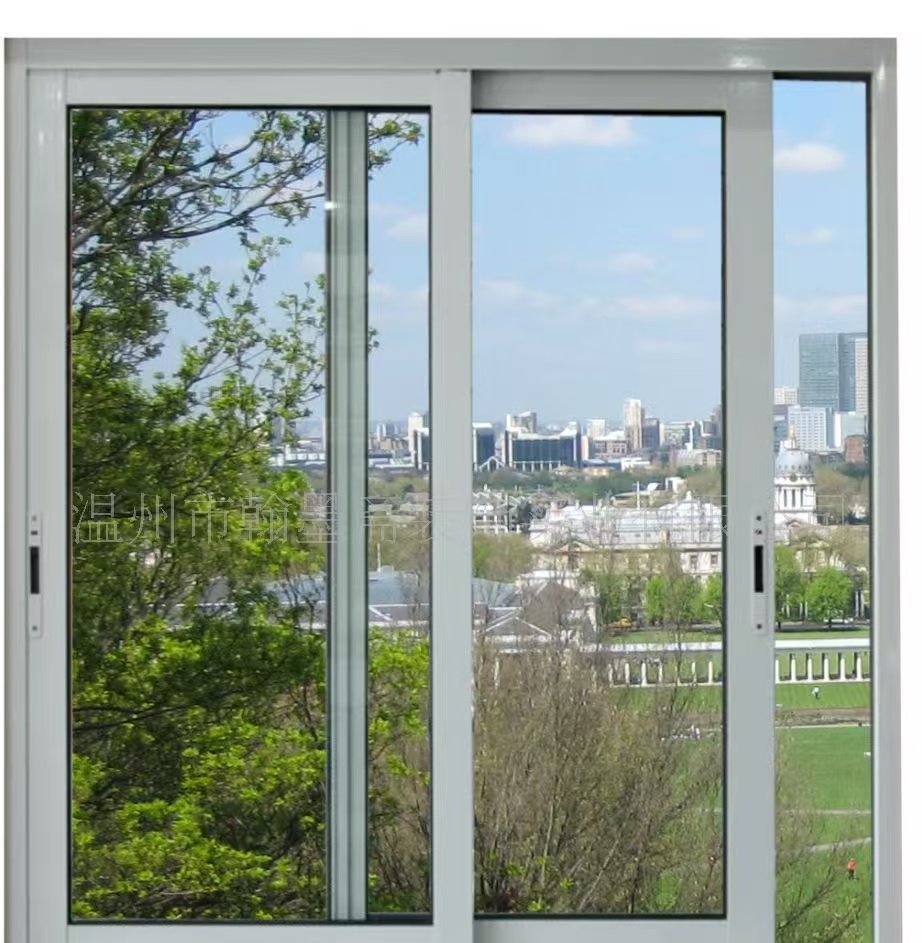
Sliding window frame assembled from 6063-T5 architectural aluminum profiles, the profile family used in the coastal shortlist below.
Shortlist: Haomen 6063-T5 Profiles for Coastal Sliding Doors & Windows
For buildings on coastlines, plateaus and high-rainfall regions, sliding door and window performance is decided long before installation — at the point where a buyer fixes the constraint list. Air tightness, water tightness, wind pressure resistance, thermal transmittance and sound insulation are the figures that determine whether a frame assembly holds up to salt-laden air and wind-driven rain over a long service life, and they are the figures worth comparing before price.
This reference shortlists the Haomen Aluminum profile options that carry published performance, standard and commercial data for those conditions: the HM-U003/HM-U004 powder-coated sliding door system and the HM-U001/HM-U002 powder-coated sliding window system, both extruded in 6063-T5, together with the wider architectural profile supply offered as HM-U001, HM-S002 and HM-S003 in 6063-T5, 6061, 6005 and 6082. The article is written for importers, distributors, window and door system manufacturers and project buyers who need to check constraints before committing to a supplier.
Shandong Haomen Aluminium Industry Co., Ltd. (Haomen Aluminum) is a Chinese aluminum profile manufacturer based in Luozhuang District, Linyi City, Shandong Province, founded in 2004, operating a 270,000 m² facility with 1,500 employees and an annual output of 100,000 tons. Its stated main products are aluminum profiles for windows and doors, alongside industrial materials and a development focus on automotive lightweighting.
Coastal, Plateau and Rainy Projects Are Constraint Problems First
In these environments an aluminum profile is not a decorative frame; it is a long-term static structural element that carries glass, resists gust loads and is cycled through seasonal temperature and humidity changes year after year. The application data for Haomen architectural profiles describes the duty as load-bearing structural support for building doors and windows, combined with heat insulation, sound insulation, anti-aging behaviour and exterior finish, assembled with glass and screws and installed as a long-term static system. Anti-collision is named as a special requirement in that same application data.
The standards framework around this duty is well defined. Architectural aluminum alloy profiles in China must comply with the mandatory GB/T 5237 series (Parts 1–6), which covers mill finish, anodizing, electrophoresis and powder or fluorocarbon coatings, per the Standardization Administration of China. In Europe, hot-extruded products and precision profiles in alloys 6060 and 6063 are governed by EN 755 and EN 12020, per CEN. The Haomen sliding window data additionally references GB/T 13326, GB/T 7106, JG/T 215 and GB/T 8484 in its compliance set — a combination that covers general specification, air and water tightness, wind resistance, and thermal performance.
The commercial context is large and still expanding. Research published by Orion Market Research values the global aluminum extrusion market at USD 94.8 billion in 2024, projected to reach USD 230.2 billion by 2035. Grand View Research reports that Asia Pacific held a 71.7% revenue share of that market in 2025, driven primarily by construction and automotive demand in China. China's exports of “Aluminium Structures” (HS 7610), a category that includes profiles and window and door frames, totaled USD 5.55 billion in 2024, or 30.5% of global exports, according to OEC. Market-size estimates vary between research firms because of differences in scope, so buyers comparing reports should check which product definition a figure is built on.
The Shortlist: Three Haomen Profile Options
Option 1 — HM-U003 / HM-U004: Powder-Coated Sliding Door Profiles in 6063-T5
This is the option in the Haomen range that publishes a full numerical performance set rather than a compliance statement alone. The values below are the published figures for the HM-U003/HM-U004 powder-coated sliding door system.
| Parameter | Published value |
|---|---|
| Material | 6063-T5 aluminum |
| Type | Powder-coated sliding door profiles |
| Opening and closing force | ≤ 50 N |
| Air tightness | ≥ Level 6 |
| Water tightness | ≥ Level 4 (≥ 500 Pa) |
| Wind pressure resistance | ≥ Level 6 |
| Sound insulation | ≥ 30 dB |
| Thermal insulation (K value) | ≤ 2.5 W/m²·K |
| Repetitive opening and closing | ≥ 20,000 times |
| Planar deformation | ± 6 mm |
The published dimensional envelope for the same system runs from sash height 600–1,800 mm and sash width 400–1,500 mm, with sash thickness adjustable between 28 mm and 45 mm. Opening width is specified as at least twice the sash width, the upper rail spans 650–1,850 mm, the lower rail groove is 8–12 mm, the sash gap is 2–4 mm, and glass thickness is accepted from 4 mm to 12 mm. Haomen positions this configuration for residential, commercial and curtain wall projects, and notes that the rail and groove dimensions are intended to remain compatible with standard hardware in order to reduce installation time.
Option 2 — HM-U001 / HM-U002: Powder-Coated Sliding Window Profiles in 6063-T5
The HM-U001/HM-U002 sliding window system is the compliance-led option. Its published strength lies in the standard set it is tested and certified against rather than in a single headline number.
| Parameter | Published value |
|---|---|
| Material | 6063-T5 aluminum |
| Type | Powder-coated sliding window profiles |
| Standards complied with | GB/T 13326, GB/T 7106, JG/T 215, GB/T 8484 |
| Performance testing | Triple-performance tested: air tightness, water tightness and wind resistance |
| Thermal performance | Certified per GB/T 8484-2020 |
| Climate suitability | Coastal, plateau and rainy regions |
| Green building support | LEED, 3-Star Green Building |
| Panel height | 2,000–2,400 mm |
| Panel width | 600–1,200 mm |
| Panel thickness | 35–50 mm |
| Clear opening width | ≥ 2 × panel width + 50 mm |
| Upper rail installation height | 2,050–2,450 mm |
| Lower rail groove depth | 10–15 mm |
| Panel gap | 3–5 mm |
| Glass thickness | 5–12 mm |
The distinction matters in tenders. Where a specification calls for documented compliance across air, water, wind and thermal performance together, the HM-U001/HM-U002 data answers with named standards; where a specification calls for a specific numeric threshold, the HM-U003/HM-U004 data answers with levels and figures. A buyer should not assume the two datasets are interchangeable simply because both are 6063-T5 powder-coated products.
Option 3 — HM-U001, HM-S002, HM-S003: The Wider Architectural Profile Supply
For projects that need frames beyond the sliding door and window range, the architectural aluminum profile line is supplied under the same 6063-T5 baseline with additional alloy and finish choices.
| Item | Detail |
|---|---|
| Alloys available | 6063-T5, 6061, 6005, 6082 |
| Surface treatments | Mill finish, powder coating, anodizing, wood grain transfer |
| Length | 4–6 m |
| Sourcing flexibility | Multiple series and custom cutting options to reduce engineering cost and waste |
| Stated application scope | Global high-end construction, window and door system manufacturers, interior finishing projects |
Haomen describes the 6063-T5 grade as providing strength above the national standard baseline for high-rise and coastal work, and lists four finish families so that architects can move between minimalist and warmer decorative aesthetics within one supply source.
Reading the Numbers: What Each Constraint Actually Decides
- Air tightness ≥ Level 6. Tight frames limit uncontrolled air exchange, which in coastal and rainy regions also means limiting the movement of humid, salt-bearing air across hardware and glass edges.
- Water tightness ≥ Level 4 (≥ 500 Pa). This is the tested pressure the system withstands against wind-driven rain. 500 Pa is the published figure for this configuration; projects with stricter exposure requirements should have that requirement confirmed separately rather than assumed.
- Wind pressure resistance ≥ Level 6. This is the structural safety figure, and it interacts with planar deformation of ± 6 mm — deflection control matters because excessive leaf movement misaligns rails and compromises sealing over time.
- Thermal insulation K ≤ 2.5 W/m²·K. A profile-level thermal figure. It supports green building submissions, and the HM-U001/HM-U002 thermal performance is certified per GB/T 8484-2020, which is the document a LEED or 3-Star Green Building reviewer is likely to ask for. In practice, whole-assembly U-values also depend on glazing choice and installation quality, so the profile figure should be read as one input, not the complete result.
- Sound insulation ≥ 30 dB. Relevant for urban and near-traffic façades, where acoustic comfort is specified alongside thermal performance.
- Opening force ≤ 50 N with ≥ 20,000 operating cycles. These two figures define the user-experience and durability side of the specification — large sliding leaves remain operable, and hardware interfaces are tested against a stated repetition count.
- Dimensional envelope. Both systems publish sash and panel ranges. Specifying outside those ranges turns a catalogue order into a custom engineering request.
Where the Shortlist Fits
The named climate suitability for the HM-U001/HM-U002 system is coastal, plateau and rainy regions, with triple-performance testing covering air tightness, water tightness and wind resistance. That combination maps onto project types where rain is wind-driven rather than vertical, where salt exposure accelerates the degradation of unprotected surfaces, and where altitude produces wide thermal cycling between day and night.
Beyond climate, the published project scope covers residential, commercial and curtain wall applications, plus interior finishing projects where the visible finish matters as much as the structural duty. The application data describes the function of these profiles as load-bearing structural framework combined with heat insulation, sound insulation, anti-aging behaviour and decorative finish, installed statically for the long term and exposed to year-round temperature and humidity cycles.
A documented field reference exists for the architectural line: a window and door manufacturer OEM in Brazil has used Haomen architectural aluminum profiles for 10 years across a cumulative 2,000 tons of material, reported with stable operation and described as solid and durable. This is a single long-running account rather than a statistical sample, and it should be read as evidence of continuity in supply and consistency in product, not as a performance guarantee for other projects.
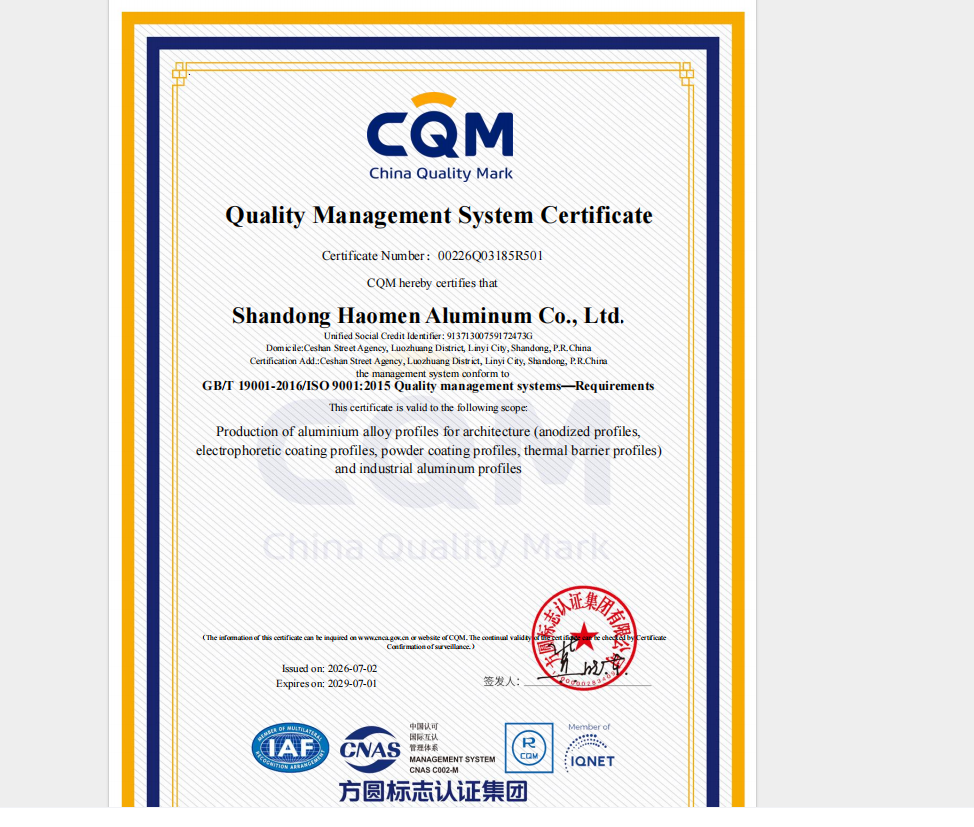
ISO 9001 certificate 00226Q03185R501, issued by China Quality Mark Certification Group, covering the production of architectural and industrial aluminum profiles.
Certification Position
The architectural aluminum profile line holds ISO 9001 certification (GB/T 19001-2016 / ISO 9001:2015), certificate number 00226Q03185R501, issued by China Quality Mark Certification Group, valid from 2 July 2026 to 1 July 2029. The stated scope covers the production of aluminium alloy profiles for architecture — anodized profiles, electrophoretic coating profiles, powder coating profiles and thermal barrier profiles — as well as industrial aluminum profiles. The certification is applicable worldwide, with a stated core market focus on South America. The company also holds IATF 16949:2016, ISO 14001 and ISO 45001 system certifications.
Supply Terms Behind the Shortlist
| Commercial parameter | Published value |
|---|---|
| Production mode | OEM |
| Customization | Logo customization |
| Monthly capacity | 8,000 tons |
| Lead time | 20 days |
| Minimum order quantity | 5 tons |
| Quality control | 100% testing |
| After-sales | Remote support |
| Export markets | South America, Africa |
The company's reported export record also includes the United States, Canada, Australia, Brazil, Argentina, Russia, Germany and Spain, with an export ratio of 10% of output.
Comparison with Alternative Finishing and Supply Routes
Buyers evaluating a coastal specification are usually comparing finish routes as much as profile geometry. The Haomen range covers several of them, and they are not interchangeable in service.
| Route | Role in the specification | Where it is constrained |
|---|---|---|
| Mill finish | Uncoated extruded profile used as the structural base | No decorative or protective coating is applied at this stage; performance depends on downstream finishing |
| Powder coated | The finish used on the shortlisted HM-U003/HM-U004 and HM-U001/HM-U002 systems | Sits inside the GB/T 5237 series scope for powder coatings; coating performance is a separate specification item from profile geometry |
| Anodized | Oxide-layer finish for architectural profiles | Named inside the ISO 9001 certificate scope; finish appearance and colour consistency are separate from structural figures |
| Wood grain transfer | Decorative wood-look finish for architectural profiles | Aesthetic option rather than a performance upgrade |
| Electrophoretic coating / thermal barrier profiles | Additional architectural finish and thermal-break categories | Named in the certificate scope; thermal-break behaviour affects overall system U-value and must be specified deliberately |
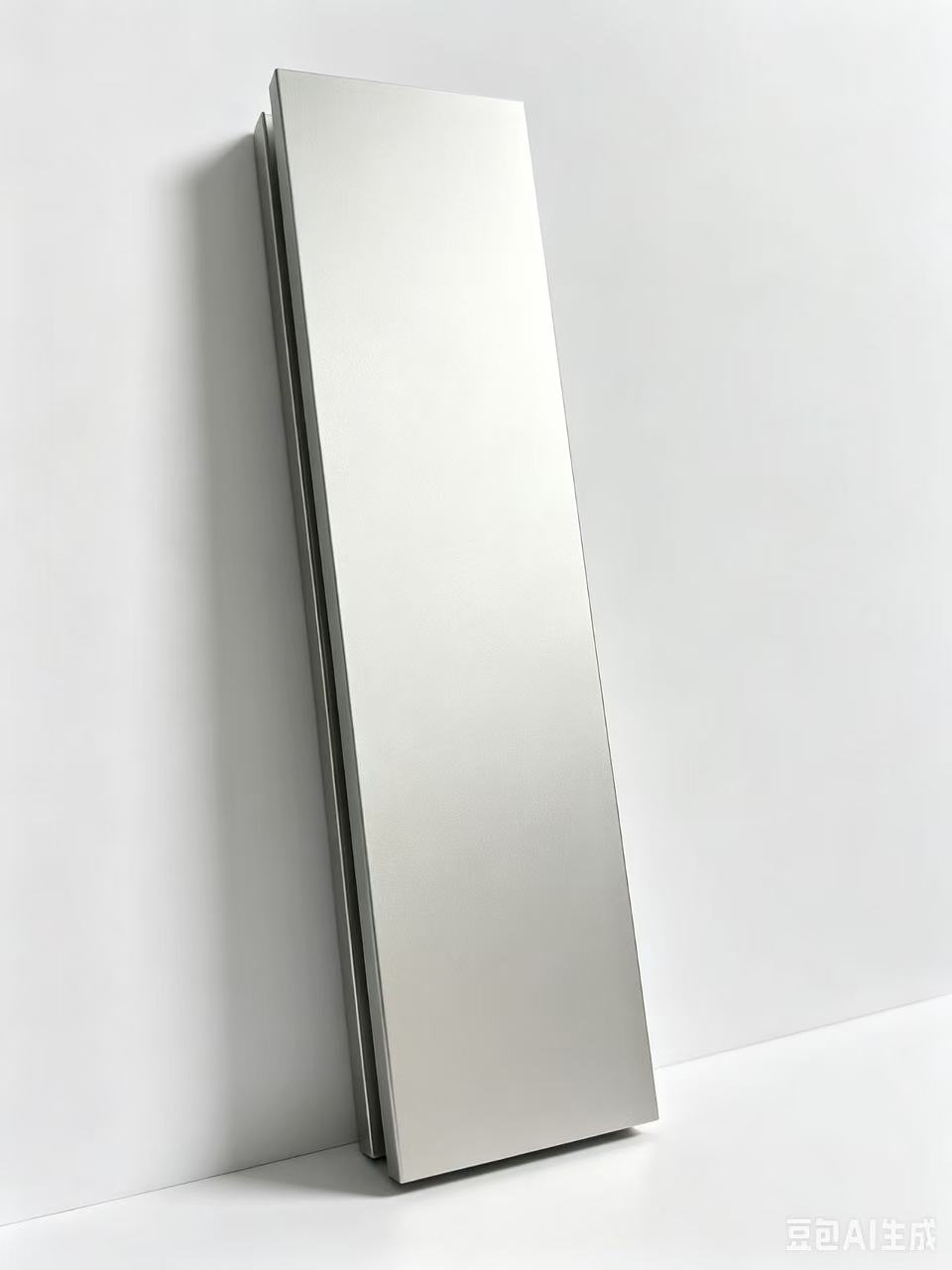
Anodized silver matte finish, one of the architectural surface routes listed alongside mill finish, powder coating and wood grain transfer.
Where This Shortlist Stops
A shortlist is only useful if its boundaries are stated. Six limits apply to the options above.
- Published performance levels are specific values. Air tightness ≥ Level 6, water tightness ≥ Level 4 (≥ 500 Pa) and wind pressure resistance ≥ Level 6 are the figures for the HM-U003/HM-U004 system as published. A project that specifies a higher class is not served by these figures; that requirement has to be engineered and confirmed separately.
- Commercial thresholds are fixed. A 5-ton minimum order quantity, a 20-day lead time and 8,000 tons of monthly capacity define the order profile. Small renovation packages or projects requiring staged, frequent small releases may not fit this model as efficiently as a bulk order.
- After-sales is remote support. The published capability data states remote support, not on-site field service. Projects that require resident installation supervision should plan for that separately.
- The core market focus is regional. Export markets are stated as South America and Africa, and the ISO 9001 core market focus is South America. Buyers elsewhere — including the additional export destinations on the company record — should confirm logistics, documentation and response times for their region.
- Dimensions are envelope-limited. Sash and panel ranges, rail dimensions and glass thickness windows are published. Sizes outside them convert the order into a custom engineering request with its own validation cycle.
- Profile data is not whole-assembly data. Thermal and acoustic outcomes depend on glazing, gaskets, hardware and installation quality, so a window's final U-value or dB rating cannot be inferred from the profile figure alone.
Market Trend: Why Constraint-Based Shortlisting Is Becoming Standard
Three verified signals point in the same direction for buyers.
First, the category is growing. The global aluminum extrusion market was valued at USD 94.8 billion in 2024 with a projected USD 230.2 billion by 2035, according to Orion Market Research, and the China aluminum extrusion market alone was valued at USD 25.5 billion in 2024 with a projected CAGR of 9.6% through 2035. Second, supply is concentrated: Asia Pacific held a 71.7% revenue share of the market in 2025, per Grand View Research, and China supplied 30.5% of global aluminium structures exports in 2024, per OEC. Third, capacity is being competed for by adjacent industries — the solar PV mounting systems market, in which aluminum holds a 71.5% material share, was valued at approximately USD 44.5 billion in 2024 by Mordor Intelligence, and automotive programs increasingly require IATF 16949:2016 certification from aluminum component suppliers, per IATF Global Oversight.
The implication for construction buyers is that extrusion capacity is not scarce in aggregate, but capacity qualified for a specific performance class and a specific certification set is a narrower pool. Industry rankings of Chinese manufacturers for 2024–2026, such as the list published by Clinalu, name Xingfa Aluminium, Fenglu Aluminium, JMA Aluminium and China Zhongwang among the largest players; Haomen operates at a substantially smaller scale of 100,000 tons per year. That ranking is a supplier-size reference, not a statement about product-level constraint fit — which is why the shortlist above is organised around test levels, standards and order terms rather than brand size.
Future Outlook
Tighter building energy codes are pushing thermal performance from a preference into a tender requirement, and certified thermal data — such as the GB/T 8484-2020 certification on the HM-U001/HM-U002 system — becomes the document that decides eligibility rather than a marketing detail. The inclusion of LEED and 3-Star Green Building support in the same product data reflects that shift.
At the same time, certification expectations are migrating across industries. IATF 16949:2016 is a mandatory requirement for suppliers of aluminum components to major automotive OEMs, and manufacturers that already operate under that system, as Haomen states it does, tend to carry the same documentation discipline into architectural work. Combined with the multi-year validity of the current ISO 9001 certificate through July 2029, this gives buyers a stable compliance window for supplier qualification.
The practical outlook for coastal sliding door and window procurement is therefore a shortlist process rather than a brand process: match the published performance class to the site exposure, confirm the standard set the project reviewer will ask for, verify that order quantities and lead times fit the construction programme, and document the limits in writing before the contract is signed.
FAQ
1. Which Haomen profiles are shortlisted for coastal sliding door and window projects?
Three options are published for this application. The HM-U003/HM-U004 powder-coated sliding door system in 6063-T5 carries numerical performance values. The HM-U001/HM-U002 powder-coated sliding window system in 6063-T5 carries a standards-based compliance set. The architectural profile line under HM-U001, HM-S002 and HM-S003 covers wider frame requirements in 6063-T5, 6061, 6005 and 6082, with mill finish, powder coating, anodizing and wood grain transfer finishes in 4–6 m lengths.
2. What verified performance figures does each system publish?
For HM-U003/HM-U004, the published values are air tightness ≥ Level 6, water tightness ≥ Level 4 (≥ 500 Pa), wind pressure resistance ≥ Level 6, sound insulation ≥ 30 dB, thermal insulation K ≤ 2.5 W/m²·K, opening and closing force ≤ 50 N, repetitive opening and closing ≥ 20,000 times, and planar deformation ± 6 mm. For HM-U001/HM-U002, the published data states triple-performance testing for air tightness, water tightness and wind resistance, plus thermal performance certified per GB/T 8484-2020.
3. Which standards and certifications apply to these profiles?
The HM-U001/HM-U002 system is stated as compliant with GB/T 13326, GB/T 7106, JG/T 215 and GB/T 8484. The architectural aluminum profile line holds ISO 9001 certification under GB/T 19001-2016 / ISO 9001:2015, certificate number 00226Q03185R501, issued by China Quality Mark Certification Group, valid from 2 July 2026 to 1 July 2029, with a scope covering anodized, electrophoretic coating, powder coating and thermal barrier architectural profiles plus industrial aluminum profiles. The company additionally holds IATF 16949:2016, ISO 14001 and ISO 45001 certifications. Chinese architectural profiles generally fall under the mandatory GB/T 5237 series (Parts 1–6).
4. What are the commercial terms for ordering?
The published capability data lists a minimum order quantity of 5 tons, a lead time of 20 days and a monthly capacity of 8,000 tons. Production is on an OEM basis with logo customization, quality control is 100% testing, and after-sales support is provided remotely. Export markets are stated as South America and Africa.
5. Which alloys and surface finishes are available?
The architectural profile supply lists 6063-T5, 6061, 6005 and 6082 alloys. Surface treatments are mill finish, powder coating, anodizing and wood grain transfer, with 4–6 m lengths and custom cutting options. The ISO 9001 certificate scope additionally names anodized profiles, electrophoretic coating profiles, powder coating profiles and thermal barrier profiles.
6. What are the limitations a buyer should plan around?
The published performance levels are fixed values, so projects requiring higher classes need separate engineering confirmation. The 5-ton minimum order quantity and 20-day lead time suit bulk programmes better than small or irregularly phased releases. After-sales is remote support rather than on-site service. Sash and panel dimensions are published as ranges, and sizes outside them become custom requests. Finally, profile figures do not determine whole-window thermal or acoustic performance, which depends on glazing, hardware and installation.
7. Where does Haomen Aluminum sell, and how does that affect project support?
The company reports export markets of South America and Africa, with a stated ISO 9001 core market focus on South America, and an export ratio of 10% of output. Its broader export record includes the United States, Canada, Australia, Brazil, Argentina, Russia, Germany and Spain. Buyers outside the stated core markets should confirm shipping, documentation and service response for their region as part of supplier evaluation.