
Shortlist Ready: 5 Tested Configurations for Custom 316L Stainless Steel Jewelry
Decision-stage sourcing for custom stainless steel jewelry is rarely settled by choosing a material. It is settled by choosing a configuration. A configuration fixes the base format, the surface finish, the stone-setting method, the dimensional window, and the packaging in one repeatable unit, and it is the only level at which two suppliers can be compared fairly. The five configurations below are organized around reference product code 5609 and model GEN000516bhia-066 from Jusnova Jewelry Co., Ltd, a Guangzhou-based stainless steel jewelry manufacturer founded in 2009 whose production covers stainless steel bangles, bracelets, rings, earrings, and PVD and electroplated gold pieces.
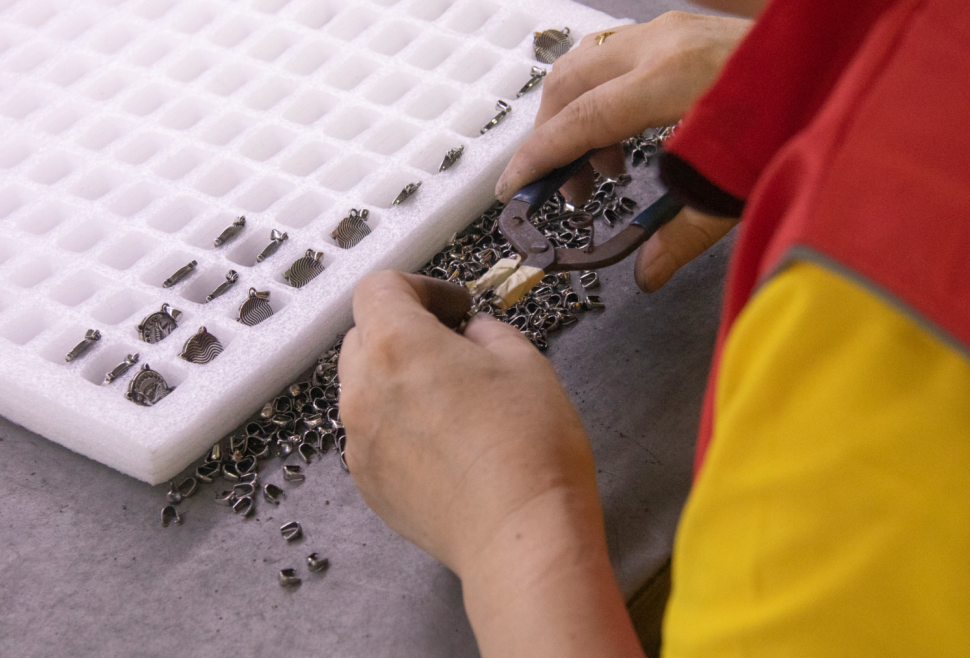
Component assembly: each configuration on this shortlist is built from a defined set of base, finish, setting, and packaging variables rather than a single style reference.
Why Decision-Stage Buyers Need Configurations, Not Catalogues
At the research stage, a manufacturer’s catalogue answers one question: what can you make? At the decision stage the question changes to: what exactly will I receive, repeatedly, at the agreed price, quality, and lead time? Most sourcing risk in custom 316L stainless steel jewelry sits in the gap between those two questions. A bangle photographed in gold tone and described as “engraved” can be produced with different engraving depths, different coating systems, different base thicknesses, and different closures, and each of those variables changes unit durability, inspection load, and landed cost.
The practical opportunity is that configuration-level comparison removes most of that ambiguity. When two suppliers quote the same configuration — same base format, same finish system, same stone setting, same dimensional window, same packaging — price, lead time, and quality claims become genuinely comparable. Buyers who shortlist configurations instead of styles also reduce the risk categories that dominate this category: surface fading or peeling, MOQ and lead-time exposure, batch-to-batch quality inconsistency, and supply chain or shipping disruption.
Market context supports the shift toward defined, personalized product. The global stainless steel jewelry market was valued at USD 6.79 billion in 2024 and is projected to reach USD 10.8 billion by 2035 (WiseGuyReports), while the global personalized jewelry market is estimated at USD 42.51 billion in 2024, growing at a CAGR of 8.6% through 2031 (Cognitive Market Research). Both figures describe demand; neither describes how a buyer should specify an order.
What Counts as a “Tested Configuration”
In this shortlist, a configuration is a fixed combination of five variables:
- Base format — bangle, figaro chain, rope chain, prong-set band, or custom logo piece.
- Material — 316L stainless steel as the baseline for this shortlist.
- Finish system — PVD coating, vacuum electroplating, or a natural polished steel tone.
- Stone setting — none, a single-stone prong setting, or a multi-stone accent arrangement.
- Dimensional window and packaging — diameter from 5 mm to 80 mm, thickness from 0.5 mm to 3 mm, with matched packaging.
The word “tested” in this context refers to the validation chain behind the configuration, not to a promotional claim. Jusnova Jewelry applies a quality framework built on sample approval, pre-production first article inspection (FAI), batch inspection reports, accelerated aging tests, and qualified packaging and shipment inspection. Each stage produces a record, and the first article inspection is what links an approved sample to the first production run.
Reference Model GEN000516bhia-066: The Five Configurations at a Glance
| # | Configuration | Finish system | Stone setting | Primary fit |
|---|---|---|---|---|
| 1 | Engraved bangle (reference product code 5609 family) | PVD gold, 18K tone | None | Personalization and gift programmes |
| 2 | Figaro chain with focal stone | PVD gold or polished steel tone | Single-stone prong setting (moissanite option) | Premium DTC and specialty retail |
| 3 | Rope chain with accent stones | Polished steel tone or PVD gold | Multi-stone CZ accents | High-volume wholesale |
| 4 | Prong-set band | 18K vacuum electroplating | Single or multi-stone | Fine-look retail lines |
| 5 | Custom logo piece with coordinated packaging | PVD gold | Optional single stone | Private label and corporate programmes |
The Five Configurations in Detail
Configuration 1 — Engraved Bangle, PVD Gold Finish, No Stone Setting
The simplest unit on the shortlist combines a rigid or hinged 316L bangle with a PVD gold finish in an 18K tone and no stone work at all. Fewer processes mean fewer failure points: one decoration step (engraving), one coating layer, and no setting inspection. The diameter window of 5 mm to 80 mm and thickness window of 0.5 mm to 3 mm allow the same configuration to serve both slim and statement formats. Because personalization is the entire value proposition, the decision question is sequence: buyers should confirm whether engraving is applied before or after coating, since that determines edge definition and depth consistency across a batch. This is the configuration most buyers approve first, because a single sample answers most of the quality questions.
Configuration 2 — Figaro Chain with a Single-Stone Setting
A Figaro chain carries more surface variation than a bangle, so finish consistency matters more: link edges catch light differently from flat faces, and a PVD gold layer must hold evenly across both. Pairing the chain with one prong-set focal stone — moissanite is one available option — concentrates the setting risk in a single, inspectable point rather than spreading it across dozens. The prong setting has a mechanical securing function, which is why it is the standard choice when the stone must remain stable through daily wear. For buyers, the comparison metric here is not stone size but setting retention: how the stone is held, and how that is verified at batch inspection.
Configuration 3 — Rope Chain with Multi-Stone CZ Accents
The rope chain is the volume configuration. Its twisted structure reads well in a natural polished steel tone, which carries no coating layer that can wear, and it also accepts PVD gold for buyers who need a gold look at wholesale price points. Multi-stone CZ accents raise perceived value, but they also multiply inspection points: every stone in the arrangement is a potential setting failure, and inspection time scales with stone count. Buyers should expect this configuration to sit at the higher end of unit cost and inspection time within the same material grade, and should specify the arrangement density rather than describing it as “pavé” alone.
Configuration 4 — Prong-Set Band with 18K Vacuum Electroplating
This configuration targets the visual territory usually occupied by fine jewelry: a 316L band with a single or multi-stone prong setting, finished in 18K vacuum electroplating. The dimensional window is the constraint that most affects design: bands and bangle-style formats must sit inside the 5 mm to 80 mm diameter range and the 0.5 mm to 3 mm thickness range, and any design outside those intervals requires separate validation rather than an assumption that the existing programme covers it. For electroplated finishes, the verification question is plating thickness consistency across the batch, because that is what determines how the gold tone behaves during normal wear.
Configuration 5 — Custom Logo Piece with Coordinated Packaging
The fifth configuration exists for brand programmes rather than for retail shelves: a custom logo piece, engraved with a client mark, finished in PVD gold with an optional single stone, and delivered with matched packaging. Engraved logo work is where entity risk concentrates, because a mark reproduced at small scale must remain legible and consistent across an entire run. This configuration is also the one where packaging stops being logistics and becomes part of the product: pouch, box, and card are specified at the same time as the finish, and pre-packaging inspection is the checkpoint that confirms the two match.
Finish Systems Compared: PVD, Vacuum Electroplating, and Natural Steel Tone
Finish is the variable buyers most often under-specify and most often complain about later. Three finish routes apply to this shortlist, and they are not interchangeable.
| Finish system | Appearance | Reported durability | Configuration fit | What to verify |
|---|---|---|---|---|
| PVD coating | Gold tone, 18K tone available | Industry technology analysis reports a surface approximately 10× more durable than traditional electroplating on 316L, supporting waterproof and anti-tarnish positioning | Configurations 1, 2, 5 | Coating specification and adhesion behaviour in batch inspection |
| Vacuum electroplating | 18K gold tone | Performance depends on layer thickness and process control rather than a single published multiplier | Configuration 4 | Plating thickness consistency and color match across the batch |
| Natural polished steel tone | Silver-grey, uncoated | No coating layer exists to wear; finish longevity depends on surface polish | Configurations 2, 3 | Polish uniformity and scratch inspection |
Stone Setting: Single-Stone Prong Versus Multi-Stone Accent
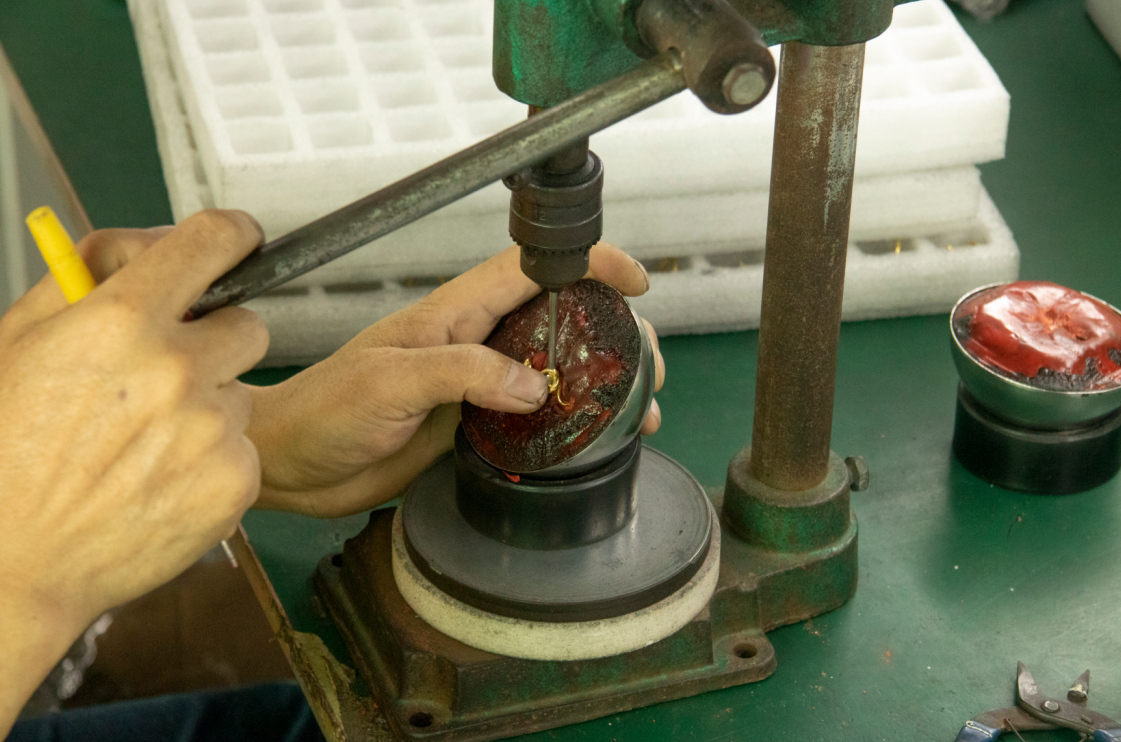
Prong setting has a securing function: it holds the stone mechanically, which is why it is the default setting method for single-stone configurations.
Setting type changes three things at once: unit cost, inspection burden, and the way the piece reads at retail distance. A single-stone prong setting concentrates material and labour into one controlled operation, which makes it the most predictable option for buyers who need consistent batch output. Multi-stone accents distribute the same value across many smaller operations, raising the number of points that must be checked and therefore raising the cost of quality assurance even when stone cost itself is low.
For a shortlist decision, the useful rule is to match setting density to the failure cost of the programme. Personalization and gift programmes tolerate a simpler setting because the value sits in the engraving. Premium retail lines tolerate multi-stone work because the perceived value justifies the inspection time. Volume wholesale sits between the two and is usually best served by a single focal stone or a low-density accent line.
Material Baseline: Where 316L Sits Against 304 and Plated Alloys
Every configuration on this shortlist assumes 316L stainless steel, and that assumption deserves an explicit justification rather than a default. The quantified difference between 316L and 304 is the addition of 2–3% molybdenum in 316L, which significantly enhances corrosion resistance. In salt spray tests, 316L lasts 3 to 5 times longer than 304 before showing signs of corrosion, and in chloride-containing environments 316L shows the best corrosion resistance among 304, 304L, and 316L.
| Material | Corrosion and maintenance | Relative cost | Best fit |
|---|---|---|---|
| 316L stainless steel | Best corrosion performance among 304, 304L, and 316L in chloride environments; 3–5× 304 in salt spray tests; maintains its finish for years with a simple wipe | 10–18% more per finished piece than 304 | Daily wear, sports, travel, premium lines |
| 304 stainless steel | Low maintenance and durable, but less resistant to sweat and environmental exposure; may benefit from occasional polishing after 6–12 months of regular use | Cost-effective baseline for general use | Seasonal, promotional, entry price points |
| Plated brass or alloy | Once the surface plating wears off, the underlying copper oxidizes, turns green or black, and can stain the wearer’s skin | Lower upfront cost | Short-cycle fashion pieces where tarnish risk is accepted |
A second material contrast matters for buyers comparing stainless steel against precious metals. Compared with plated brass or alloy jewelry, sterling silver jewelry, and gold-plated pieces, stainless steel jewelry has distinct advantages in corrosion resistance and hypoallergenic properties. With 304 stainless steel, even if the plating wears over time, the base metal remains bright, tarnish-free, and skin-safe — a property that directly affects return rates in e-commerce channels.
Application Fit: Which Configuration Belongs to Which Programme
Configuration choice should follow the wear pattern of the end customer, not the aesthetics of a lookbook. 316L stainless steel is more suitable for daily wear, sports, and travel, while 304 is a cost-effective choice for general use — a distinction that maps directly onto programme type.
- Daily-wear and active-lifestyle lines: Configurations 2 and 3, where continuous skin contact and perspiration exposure make corrosion resistance the primary buying criterion.
- Personalization and gifting: Configurations 1 and 5, where the engraved mark carries the value and the finish must survive repeated handling.
- Premium retail shelves: Configuration 4, where a gold-tone finish and visible stone setting are the purchase drivers.
- High-volume wholesale: Configuration 3, where unit economics and repeatable batch quality outweigh setting complexity.
Demand-side signals reinforce the personalization angle. Approximately 68% of couples in 2024 chose customized or bespoke jewelry over ready-made options, driven largely by Gen Z and Millennial preferences (Jewelers of America). For a factory programme, that translates into a requirement for configurations that can absorb individual engraving without breaking batch consistency.
Market Signals Behind a 316L Configuration Shortlist
Three published data points frame the commercial case, and each should be read with its scope in mind. The stainless steel jewelry market was valued at USD 6.79 billion in 2024 with a projection to USD 10.8 billion by 2035 (WiseGuyReports). The personalized jewelry market, a broader category, is estimated at USD 42.51 billion in 2024 with an 8.6% CAGR through 2031 (Cognitive Market Research). China’s total jewelry exports reached USD 12.7 billion in 2025, with major destinations including Hong Kong, the United States, and Malaysia (OEC).
Estimates for the stainless steel segment diverge depending on what is counted. Published figures range from USD 2.71 billion to USD 7.08 billion for adjacent periods, with the difference explained largely by whether fashion watches and other accessories are included alongside decorative jewelry. Buyers should treat any single number as a directional indicator of category scale rather than a precise addressable market, and should weight supplier-level evidence — documentation, sample performance, batch records — more heavily than category forecasts when making a decision.
Limits, Trade-offs, and Boundaries
A shortlist that presents only advantages is not usable for a decision. Four boundaries apply to these configurations.
- Cost premium over 304. 316L stainless steel costs 10–18% more per finished piece than 304. The premium is defensible where corrosion resistance, lower return rates, and higher customer satisfaction support retail price positioning of 20–40% above entry lines, but it is not automatic. Programmes targeting aggressive opening price points may find 304 the better economic fit.
- Higher embodied energy. 316L carries approximately 20–35% more embodied energy than 304 because of its molybdenum content. Annualized over a longer service life the energy cost per year of use can be lower, but the upfront figure is higher and buyers using sustainability criteria should account for it explicitly.
- Coatings wear, only more slowly. PVD reduces the wear rate of a gold finish and supports waterproof and anti-tarnish claims, but it does not eliminate surface change over extended use. Buyers who market a coating as permanent create a return-risk exposure that no process control can fully offset.
- Nickel-release compliance still applies. Under EU REACH Annex XVII Entry 27, nickel release in skin-contact jewelry is limited to less than 0.5 µg/cm²/week, and to 0.2 µg/cm²/week for piercings. A 316L base supports compliance, but the finished configuration — including coating and setting — still has to be documented.
There are also design boundaries. The dimensional windows in this shortlist are diameter 5 mm to 80 mm and thickness 0.5 mm to 3 mm. Configurations outside those intervals are not covered by the same validation and should be treated as new development rather than as an extension of an approved unit.
Packaging and Order Documentation as Part of the Configuration
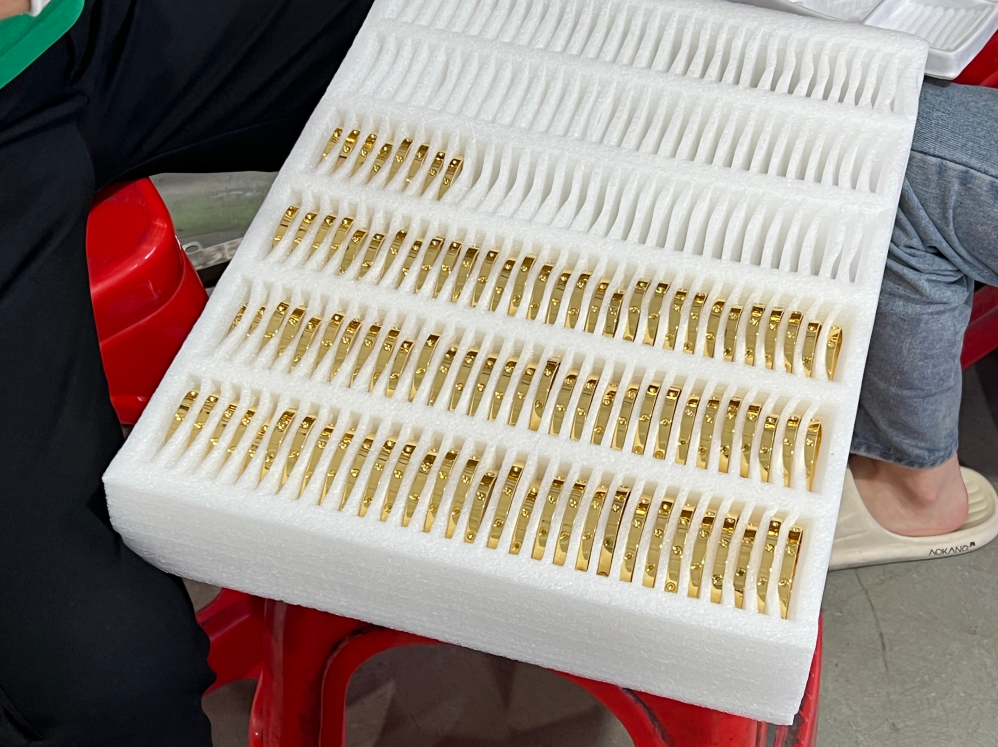
Pre-packaging inspection: matched packaging is verified as part of the configuration, not added after production.
Matching packaging is often treated as an afterthought and then becomes the reason a delivery fails. In a configuration-based programme, the pouch, box, or card is specified at the same time as the finish and stone setting, and it is confirmed at pre-packaging inspection before shipment. The validation chain for each configuration runs from sample approval, through pre-production first article inspection, batch inspection reports, and accelerated aging tests, to qualified packaging and shipment inspection.
A practical shortlist workflow follows the same order: 1) select two or three configurations from the five rather than all of them; 2) fix the finish system and stone setting in writing; 3) confirm the dimensional window against the actual design; 4) approve a physical sample and record the first article inspection; 5) confirm packaging and batch inspection reporting before the production release. Sample approval and batch inspection documentation for these configurations can be requested from Jusnova Jewelry during evaluation.
Future Outlook
The direction of travel in this category is toward configuration-level specification. As stainless steel jewelry moves from a substitute material to a defined product category — supported by a market projected to grow from USD 6.79 billion in 2024 to USD 10.8 billion by 2035 — buyers increasingly ask for records rather than reassurances. That shift favors manufacturers who can document finish systems, batch consistency, and dimensional windows, and it disadvantages suppliers whose only differentiation is price.
Two further changes are likely to shape shortlists. First, engraving and logo work will keep moving from premium tiers into mainstream wholesale, which raises the importance of reproducible marking across large batches. Second, sustainability accounting will increasingly include embodied material cost, which makes the trade-off between 316L durability and its higher embodied energy an explicit line item in procurement reviews rather than a footnote.
FAQ
Does a PVD gold finish on these configurations last longer than traditional electroplating?
Industry technology analysis reports that a PVD coating on 316L stainless steel produces a surface approximately 10 times more durable than traditional electroplating, which is what allows waterproof and anti-tarnish positioning. Durability still depends on the specific coating applied and the batch it was applied to. A buyer approving a configuration should ask which finish system is used on that unit and how adhesion is checked during inspection. PVD reduces the wear rate of a gold finish; it does not remove the finish layer from the maintenance equation entirely.
Is 316L required for every configuration, or does 304 remain viable?
Both grades are viable, but for different programmes. 304 is a cost-effective choice for general use, while 316L is more suitable for daily wear, sports, and travel. The quantified difference is the 2–3% molybdenum content in 316L: in salt spray tests 316L lasts 3 to 5 times longer than 304 before showing signs of corrosion, and in chloride-containing environments 316L shows the best corrosion resistance among 304, 304L, and 316L. 316L costs 10–18% more per finished piece than 304. Programmes optimized for opening price points may reasonably select 304; programmes where perspiration and environmental exposure drive returns generally justify 316L.
Which setting is easier to quality-control in production: a single stone or a multi-stone arrangement?
A single-stone prong setting is generally easier to control because it concentrates the operation into one inspectable point, and the prong setting performs a mechanical securing function that holds the stone in place. A multi-stone arrangement multiplies the number of setting points that must be checked, which increases inspection time and unit cost even when the individual stones are inexpensive. Neither can be evaluated from a photograph: sample approval and batch inspection reports are what confirm setting retention across a production run.
What documentation should accompany a configuration before a purchase order is released?
The applicable validation chain consists of sample approval, pre-production first article inspection, batch inspection reports, accelerated aging tests, and qualified packaging and shipment inspection. Each step produces a record. The first article inspection is the document that connects the approved sample to the first production article, and the packaging inspection confirms that the pouch, box, or card matches the approved specification before shipment.
Where do 316L configurations fall short compared with sterling silver or solid gold jewelry?
Stainless steel is not a precious metal and does not carry intrinsic or resale value the way sterling silver or gold does. Against 304, 316L costs 10–18% more per finished piece and carries approximately 20–35% more embodied energy because of its molybdenum content. Coatings can still change over extended use, although PVD slows that process. In addition, skin-contact items sold into the EU must respect REACH Annex XVII Entry 27 nickel-release limits of less than 0.5 µg/cm²/week, and 0.2 µg/cm²/week for piercings, which must be documented for the finished configuration rather than assumed from the base material grade.