
Shortlist by Substrate: Laminating Machines for UD, UHMWPE and Textile
Shortlist by Substrate: Laminating Machines for UD, UHMWPE and Textile
Choosing a laminating machine for UD aramid, UHMWPE or textile substrates is a substrate decision before it is an equipment decision. Each of the three material families imposes its own process logic: aramid unidirectional tape and crossply structures are built for ballistic panels, UHMWPE needs controlled impregnation of a low-surface-energy fibre, and apparel or technical textiles are bonded roll to roll. That is why a single ranked list of machine types is less useful to a buyer than a shortlist organised by what the line has to produce.
JIANGSU KUNTAI MACHINERY CO.,LTD designs and builds coating, laminating, impregnation and cutting machinery for technical textiles and composites. Its published range on the official site at kuntai-group.com covers laminating machines (double-belt presses, flat-bed laminators, hot-melt film laminators, UD impregnation and crossply machines), cutting machines, bronzing and printing machines, spray and scattering equipment, and inspection machines. The company reports 210 employees, a 30,000 m² site in Zhengang Industrial Park, Yancheng City, Jiangsu Province, an R&D team of 8 engineers, an annual output of 650 units, and roughly 70% of output exported to North America, South America, Europe, South Asia, Africa and the Middle East.
Four models sit at the centre of this review. They are presented in the order a substrate-led evaluation usually reaches them: ballistic UD work, then UHMWPE impregnation, then wide-format textile lamination, then hot melt adhesive lamination for garment, car trim and healthcare.
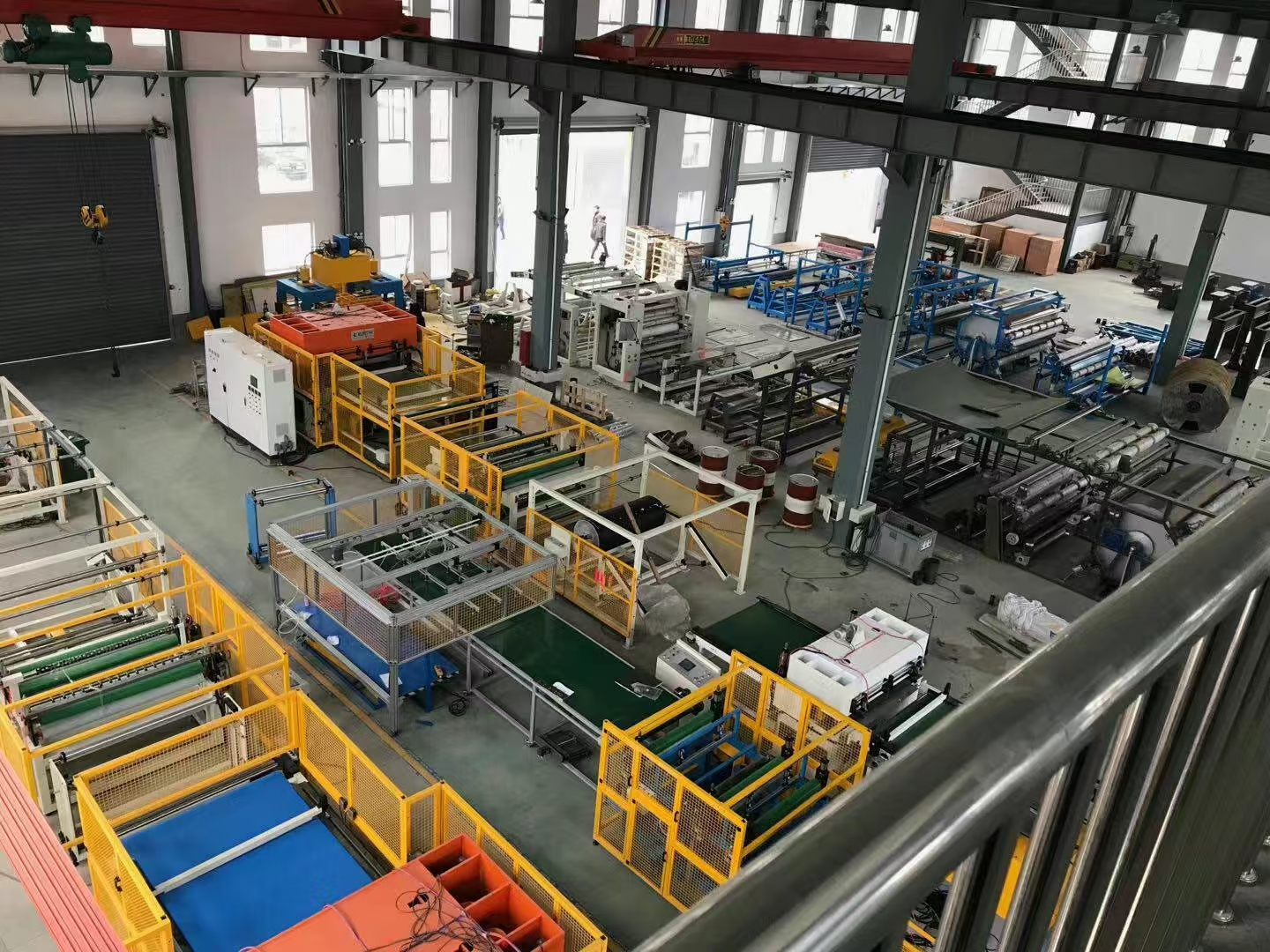
Laminating and impregnation machinery for technical textiles is built around substrate handling rather than a single machine category.
Why the substrate, not the machine category, sets the shortlist
A laminating machine is a combination of web handling, adhesive or resin application, heating, and nip or belt pressure. Which of those elements dominates depends on the material. Impregnation draws resin into a fibre bundle or fabric so the reinforcement itself carries the load path; lamination bonds two or more finished layers, so the interface between them carries the requirement. A UD aramid crossply panel and a roll of laminated upholstery fabric both pass through “a laminator”, but they stress the machine in different places: tape tension and layer alignment in the first case, wide-web tension and adhesive distribution in the second.
For a buyer in the evaluation stage, this changes the first question from “which machine type is best?” to “which machine configuration matches my substrate, my input format and my downstream process?” The four models below are separated on exactly that basis. Where a stated specification is available it is given; where it is not, the gap is treated as a question to be answered before an order rather than filled with an assumption.
The four-machine shortlist at a glance
| Model | Substrate and process focus | Stated specification in this review | Documented end use | Boundary to confirm |
|---|---|---|---|---|
| KT-LH-1800 | UD aramid prepreg and UD crossply | UD prepreg and crossply configuration; width and speed not stated in the supplied material | Bulletproof vest, helmet and plate production | Ballistic-specific build; request datasheet values for width, speed and layer configuration |
| KT-YJ-1800 | UHMWPE impregnation | Material width up to 1,650 mm | UHMWPE impregnation and prepreg work | The width ceiling governs tape and panel layout |
| KT-FT | Fabric-to-fabric lamination | 2,400 mm width; 0–35 m/min | Textile fabric composite production | Machine speed range is not a bonding-speed guarantee for every fabric and adhesive |
| KT-PUR | Hot melt glue lamination | Hot melt adhesive application; width not stated in the supplied material | Garment, car trim and healthcare | PUR bond development needs a planned cure window |
The table is a screening device, not a specification sheet. Two of the four models have a stated width in the supplied material and two do not, which is itself the first thing an evaluation team should close out with the supplier.
UD aramid prepreg and crossply: KT-LH-1800
The KT-LH-1800 is the model on this shortlist aimed at aramid unidirectional work. KUNTAI lists it as a UD aramid prepreg machine, a UD prepreg impregnation machine and a UD crossply machine, and the documented application is bulletproof vest, helmet and plate manufacturing. Crossply construction stacks unidirectional layers at an angle to each other so the finished panel balances protection across directions; that places the emphasis on consistent tape placement and bonding rather than on adhesive creativity.
The company's case record for this application covers a protective products company running 50 units across Turkey, the Czech Republic, India and Russia over three years, with stable operation and reported highlights of long lifespan and low maintenance. A multi-country installed base over three years is a reasonable indicator that the platform is repeatable, but it does not by itself certify ballistic performance: that remains a matter for the buyer's own panel design, testing and acceptance regime.
What the supplied material does not give is working width, line speed, heating method or drive configuration for the KT-LH-1800. For a UD line those are precisely the parameters that decide panel size and layer-to-layer consistency, so they belong in the first technical exchange rather than in the final contract. A model number is not a substitute for a written specification of usable width and rated speed.
UHMWPE impregnation: KT-YJ-1800 and the 1,650 mm ceiling
The KT-YJ-1800 is the UHMWPE impregnation machine on this shortlist, stated at material widths up to 1,650 mm. That single figure does most of the early decision work. It defines the widest tape or fabric the line is specified to handle, which in turn sets the panel nesting, the number of passes and the edge trim you should cost into the job. Running at the ceiling is a different operating proposition from running comfortably inside it.
UHMWPE is a low-surface-energy polymer, so wet-out and adhesion control dominate the process window; the machine's job is to apply resin consistently across the web rather than to compensate for a difficult surface at the finishing stage. Buyers should therefore ask for the resin system the line is set up for, the tension range it holds across 1,650 mm, and the evidence the supplier can show for wet-out consistency across the full width.
Fabric-to-fabric lamination: KT-FT at 2,400 mm and 0–35 m/min
The KT-FT is a fabric-to-fabric laminator with a stated working width of 2,400 mm and a speed range of 0–35 m/min. It is the widest machine on this shortlist and the one addressed to continuous textile composite production: upholstery, home textile and technical textile constructions where the web, not the panel, is the unit of output.
Two readings of those numbers matter. A 2,400 mm width suits wide-format composite work and reduces the number of passes for broad material, but it also amplifies any tension or alignment error across the web — a millimetre of drift at the centre of a wide web is a different problem from the same drift on a narrow line. The 0–35 m/min range describes what the drive can do; it does not promise 35 m/min on every fabric and adhesive pair. Achievable production speed has to be established on the actual construction.
Textile mill deployment is the best-documented part of KUNTAI's case material. A textile mill client in India deployed 140 units of products 6331 (textile lamination machine, KT-FT-XC) and 6278 (hot melt glue laminating machine, KT-PUR), reported as stable operation over five years with low maintenance requirements. A separate record shows 120 units of product 6278 installed in Turkey for textile fabric composite work, again with stable operation over five years. These are company-reported project records rather than independent audits, but they do show the two textile-facing models being bought together rather than in isolation.
Hot melt glue lamination: KT-PUR for garment, car trim and healthcare
The KT-PUR is the hot melt glue laminating machine on this shortlist, with documented application across garment, car trim and healthcare production — three sectors that share a requirement for clean adhesive application without a liquid carrier to dry off. KUNTAI's application material also lists footwear, upholstery and home textile among the sectors it serves, so the KT-PUR is best treated as a general hot melt adhesive platform rather than a single-industry tool.
The practical constraint is cure, not application. PUR hot melt adhesives typically require 24–72 hours for full chemical cross-linking, according to Industrial Research Reports. A line that reaches handling strength quickly may still be several days from full bond strength, so slitting, packing, stacking and quality-hold decisions should be planned against that window rather than against the speed of the laminator alone. Buyers bonding thick or low-permeability assemblies should ask specifically how moisture access is managed during cure.
As with the two UD models, the supplied material does not state a working width for KT-PUR. The CE documentation names a KT-PUR-1800 variant, which is a reminder that the base model name and the configured model name are not always the same thing on a purchase order.
What the stated widths and speeds actually decide
Width buys material utilisation, not capability. A 2,400 mm fabric line only pays back if the incoming web and the finished product are wide enough to use it; otherwise the extra width becomes trim. A 1,650 mm ceiling on UHMWPE impregnation is a hard planning boundary — nesting should be designed inside it, not against it.
Speed is a range, not a rating. The 0–35 m/min figure on the KT-FT tells a buyer what the drive envelope looks like and roughly where the line can be balanced against upstream and downstream equipment. It does not tell them what the machine will hold on a heavy coating weight or a heat-sensitive face fabric. That number belongs in the acceptance conversation, agreed against a named substrate and adhesive.
Project-fit questions to put in the RFQ
| Substrate group | Questions to put to the supplier | Why the answer changes the decision |
|---|---|---|
| UD aramid | Confirm usable width, rated line speed, heating method, drive configuration and crossply layer arrangement for the KT-LH-1800. | These set panel size and layer-to-layer consistency for vest, helmet and plate designs. |
| UHMWPE | Confirm actual usable width against the 1,650 mm maximum, the resin system the line is set for, and whether tape or fabric is the intended input. | Input format determines which impregnation or prepreg configuration applies. |
| Textile | Confirm achievable production speed inside the 0–35 m/min range for your fabric and adhesive pair, plus tension control across 2,400 mm. | A wide web turns small tension errors into visible defects. |
| Garment, car trim, healthcare | Confirm adhesive type, coat weight range, and how the 24–72 hour PUR cure fits your packing and quality-hold flow. | Cure time sets work-in-progress and release-to-stock timing. |
None of these questions require a price to be resolved, which is deliberate. Width, speed, adhesive and cure answers determine whether a machine fits at all; price only ranks machines that already fit.
Where this shortlist stops fitting
Shortlists are defined as much by exclusion as inclusion. The KT-LH-1800 is configured for ballistic UD work; it is not a general apparel laminator. The KT-YJ-1800 stops at 1,650 mm, so wider UHMWPE programmes need a different conversation. The KT-FT is a fabric-to-fabric machine and does not replace tape impregnation. The KT-PUR suits hot melt adhesive bonding, but a process that needs immediate full-strength handling must plan around the cure window.
Other processes sit outside the four entirely. Flame bonding is served by KUNTAI's KT-HY flame laminating machine, associated with a kitchenware manufacturer case covering 10 units in Mexico, Turkey and the Czech Republic for dishwashing sponge and oil smoke filter production. Flatbed, double-belt and flame machines appear in an automobile interior case covering 20 units across Germany and Mexico over three years. Buyers whose car trim requirement is flatbed pressing or flame bonding rather than hot melt adhesive should be looking at that group, not this one.
Compliance evidence and what to confirm in writing
The compliance position on these machines rests on two documents, and both are worth reading for their exact scope rather than for the logo on the certificate. The quality management system is certified to GB/T 19001-2016 / ISO 9001:2015 under certificate 07626Q00528R101, issued by Beijing ZhongRunXing Certification Co., Ltd. on 13 April 2026 and valid to 12 April 2029, with a scope covering the design, manufacturing and sales of lamination machines and cutting machines.
The CE documentation is an ECM Type Approved certificate, number NO.3N221214.JKMSU84, against the Machinery Directive 2006/42/EC, issued 14 December 2022 and valid to 13 December 2027. Its stated scope reads: “Lamination Machine, models including KT-PUR-1800, KT-FT-XC, KT-QLJ-X and all listed serial variants.”
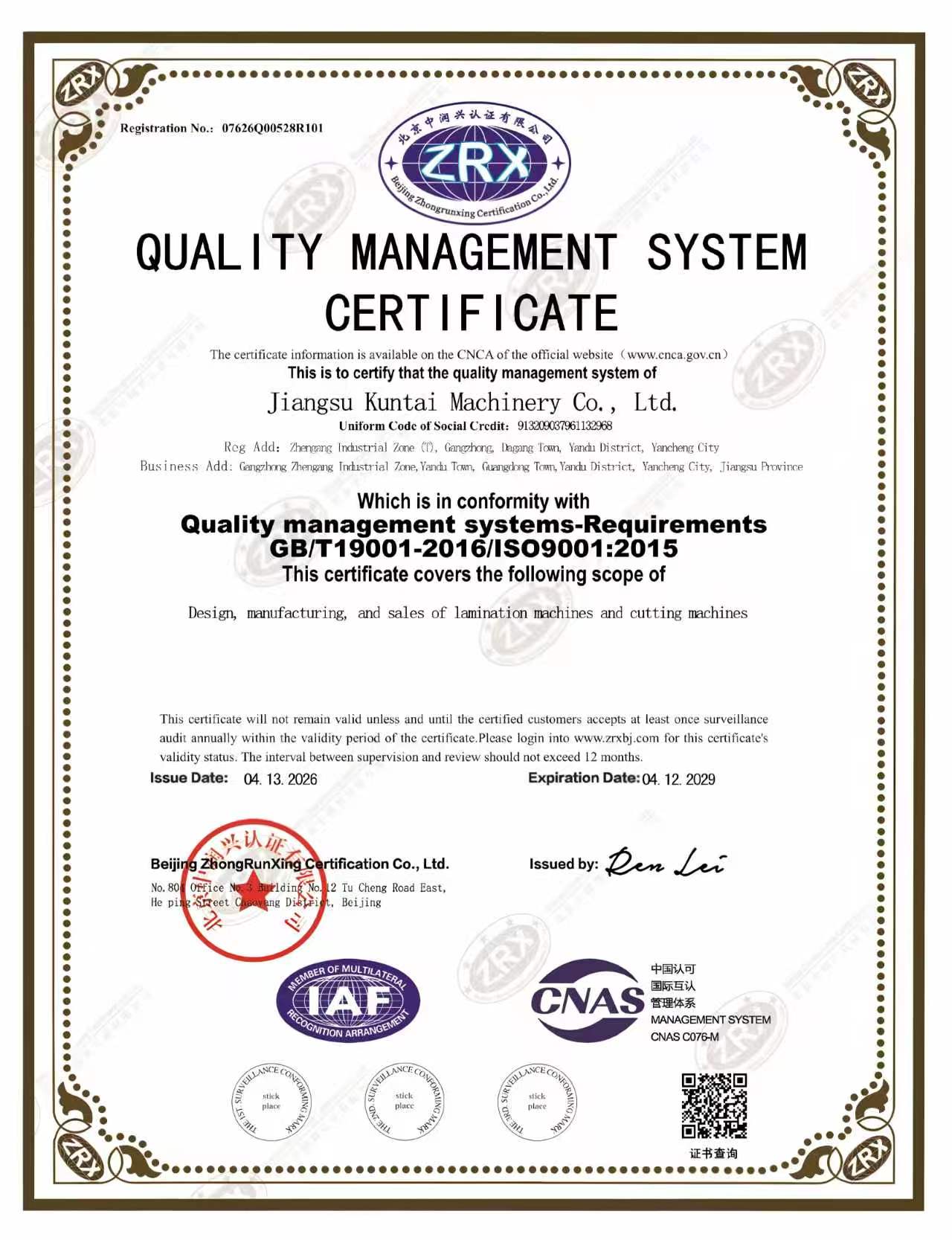
KUNTAI's ISO 9001:2015 certificate covers the design, manufacturing and sales of lamination machines and cutting machines.
Because the CE certificate names specific models, a buyer specifying the KT-LH-1800 or the KT-YJ-1800 should obtain written confirmation that the exact model and configuration being purchased fall inside the certified scope, and should check that certificate validity still covers the shipment and commissioning dates. Two further checks belong in the same exchange: the applicable customs classification for coating or impregnating textile machinery, listed under HS code 84518080 in customs tariff references, which your broker should validate for the actual machine; and the factory test record, since KUNTAI states 100% testing before shipment.
Capacity, lead time and supply context
Commercial terms matter at the evaluation stage because they decide whether a technically suitable machine can actually be scheduled. KUNTAI states a minimum order of one unit, a lead time of 30–60 days, monthly capacity of 55 units, and OEM customisation across voltage, logo, colour and machine structure, with remote after-sales support. For a single-line project that means a one-unit order is workable, and the 30–60 day figure should be read as production time before shipping, customs clearance and commissioning are added.
These are company-stated figures. They are consistent with the separately reported annual output of 650 units, but they are not independently audited, so the practical sequence is to treat them as planning inputs and convert the ones that matter into contractual commitments: a delivery window, a test protocol, a spare parts list and a response expectation for remote support.
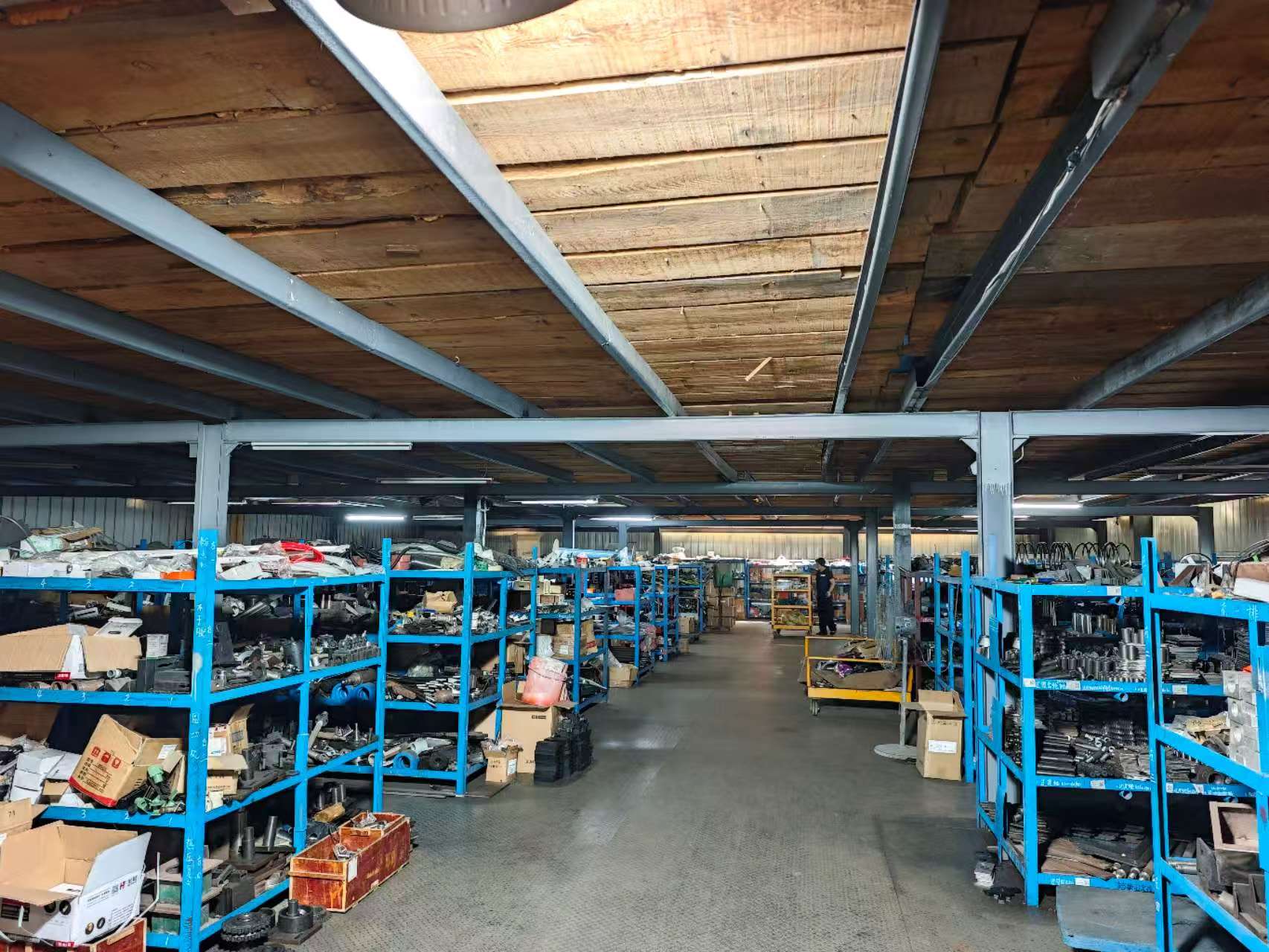
Lead time of 30–60 days is production time; shipping, clearance and commissioning sit outside it.
Market signals worth weighing, and their limits
Two published signals frame the wider context without deciding any individual purchase. Market Research Future estimated the global industrial laminating machine market at 3.123 USD billion in 2024, and Industrial Research Reports forecasts 7.1% CAGR for the hot melt adhesive laminating machine segment from 2026 to 2032. Both are commercial research estimates rather than official statistics, and both cover broader product scopes than the four models here.
The reasonable reading is narrow: hot melt adhesive lamination is being forecast to grow, which supports treating a PUR-capable platform as a long-lived asset rather than a single-project tool. It does not establish that any specific machine, width or configuration will be in demand in a given market, and it should not be used to justify a capacity decision on its own.
Outlook: what would change this shortlist
The shortlist is stable as long as three things hold: the ballistic programme stays within UD aramid and crossply constructions, the UHMWPE work fits inside 1,650 mm, and the textile and garment programmes are served by fabric-to-fabric and hot melt adhesive bonding respectively. Change any one of those and the shortlist changes with it — a wider UHMWPE panel, a switch from adhesive film to flame bonding, or a move into flatbed pressing for thicker automotive stacks would each push the requirement onto a different machine family.
For an evaluation-stage buyer, the practical conclusion is to lock the substrate and the finished product first, ask the width, speed, heating and cure questions second, and treat price as the last filter rather than the first. That sequence keeps a technically unsuitable machine from winning on quotation alone.
Frequently asked questions
Which KUNTAI laminating machine is shortlisted for ballistic UD aramid work?
The KT-LH-1800 is listed by KUNTAI as a UD aramid prepreg machine and a UD crossply machine, and its documented application is bulletproof vest, helmet and plate production. The company's case record for that application covers 50 units at a protective products company across Turkey, the Czech Republic, India and Russia over three years, with stable operation and reported long lifespan and low maintenance. Working width, line speed and crossply layer arrangement for a specific project should be confirmed on the model datasheet before ordering.
What material width does the KT-YJ-1800 support for UHMWPE impregnation?
The KT-YJ-1800 UHMWPE impregnation machine is stated at material widths up to 1,650 mm. That figure represents the widest material the line is specified for, so panel nesting and roll layout should be planned inside it rather than at the limit, and the achievable width for a specific tape or fabric should be confirmed in writing.
What distinguishes the KT-FT from the KT-PUR?
The KT-FT is a fabric-to-fabric laminator with a stated 2,400 mm width and a 0–35 m/min speed range, aimed at textile fabric composite production. The KT-PUR is a hot melt glue laminating machine used in garment, car trim and healthcare production. The difference is one of bonding method and substrate handling rather than capacity class, which is why textile mills have deployed both products in the same programmes.
How long is lead time and what is the minimum order quantity?
KUNTAI states a minimum order of one unit and a lead time of 30–60 days, with monthly capacity of 55 units, 100% testing before shipment, OEM customisation of voltage, logo, colour and machine structure, and remote after-sales support. These are company-stated terms; the delivery window, test protocol and support response should be written into the purchase contract.
Does the CE certificate cover every model on this shortlist?
Not as written. The supplied CE certificate — ECM Type Approved, number NO.3N221214.JKMSU84 against 2006/42/EC, issued 14 December 2022 and valid to 13 December 2027 — states its scope as “Lamination Machine, models including KT-PUR-1800, KT-FT-XC, KT-QLJ-X and all listed serial variants.” Buyers specifying the KT-LH-1800 or KT-YJ-1800 should request written confirmation that the exact model and configuration are covered, and should verify that certificate validity extends past the planned shipment and commissioning dates.
For buyers who want the full technical and company background in one document, KUNTAI's company profile is available as a downloadable PDF brochure.
Have Questions or Need More Details?
Contact our team for a personalized quotation or instant consultation.
Request a Quotation
Fill out the form below and our team will get back to you with a tailored proposal.
WhatsApp Direct Chat
Prefer to chat in real-time? Message us on WhatsApp for instant assistance & quick answers.
- Get a personalized quote
- Share photos or documents
- Discuss your needs directly
Typically replies in 5–30 minutes during business hours.