
Shortlist for Laundry Sheet Sourcing: Top 5 Questions for a 26-Year Veteran Manufacturer
Detergent sheets have moved from a travel accessory into a mainstream retail format, and the sourcing conversation has moved with them. The global laundry detergent sheets market was estimated at USD 1.26 billion in 2025 and is projected to reach USD 2.82 billion by 2034, according to market research compiled on the category. Growth at that scale brings new buyers into the category every quarter, and most of them arrive with the wrong question list.
Trial orders are decided on sample quality, unit price and lead time. Multi-year programmes are decided on something else entirely: whether the supplier owns the plant, the formulation, the capacity and the support function behind the product. This analysis sets out the five questions that separate a one-off quotation from a supply partner, using Zhejiang Kelee Technology Co., Ltd. — a manufacturer founded in 1999 and based in Yiwu, Zhejiang Province, China — as a worked example of what verifiable answers look like.

Why the Question Set Changes After the Trial Order
A trial order tests the product. A partnership tests the organisation behind the product. Once a buyer commits to a twelve- or twenty-four-month programme, four new risks appear that a sample box cannot answer: capacity risk, formulation risk, consistency risk and support risk.
Capacity risk is straightforward — a supplier that can produce a pallet may not be able to produce a container on a fixed monthly rhythm. Formulation risk is subtler. If the supplier develops through a third party, every change request passes through a queue the buyer does not control. Consistency risk shows up in month four, when a reorder smells slightly different from the shelf sample. Support risk appears after the container has sailed, when a documentation question or a claims discussion needs an owner on the supplier side.
The five questions below are ordered by the sequence in which an experienced buyer would resolve them: site, formulation, specification, scale, support.
The Shortlist: Five Questions to Resolve Before Committing
1. Is there a real, verifiable production site behind the quotation?
The answer should be specific enough to visit. Zhejiang Kelee Technology Co., Ltd. operates a 16,000 m² production site in Chi'an Industrial Park, Yiwu, with approximately 150 employees, and states that both virtual factory tours and on-site visits are available to global buyers. The company runs its production inside a 100,000-class dust-free workshop.
The commercial value of this question is not the size figure itself — it is the difference between a supplier that can host a visit and one that cannot. A trading desk can forward a quotation; it cannot open a classified production area to a buyer's technical team, and it cannot give a buyer a truthful answer about what happens when a batch fails an inspection. For a long-term programme, that distinction determines whether problems are solved inside the supply chain or passed along it.
Evidence to request: full site address, workshop classification, a production walkthrough (remote or on-site), and the name of the person accountable for pre-shipment inspection.
2. Who owns the formulation — the supplier or a third party?
Zhejiang Kelee Technology Co., Ltd. maintains a certified senior formulator R&D team of eight engineers and holds over 20 authorized intellectual property assets, including international invention patents. The company has been certified as a National High-Tech Enterprise since 2019 and participates in drafting national industrial standards for laundry sheets and group standards for floor-cleaning sheets.
For an OEM buyer, in-house formulation ownership changes the reformulation timeline. Density adjustments, enzyme substitutions, or a switch between fragrance systems are engineering decisions rather than procurement negotiations with an external lab. Standards participation is a secondary signal: a company involved in drafting the industry standard for a product category is, by definition, operating with visibility into how that category is specified and tested.
Evidence to request: patent or IP portfolio summary, examples of standards participation, and the credentials of the formulators assigned to the account.
3. Can scent and specification stay consistent across reorders?
Zhejiang Kelee Technology Co., Ltd. provides OEM, ODM and private-label services for domestic and international brands, including customized scent and fragrance options for laundry detergent sheets. The company's 3 in 1 Super Multi-Purpose Laundry Detergent Sheets (model KL-R2015), for example, are documented with a combined fragrance, microcapsule, softener and enzyme system in an ocean scent profile.
Scent is usually the attribute a retail buyer hears about first and the one that generates the earliest complaints if it drifts. Consistency is protected at the specification level rather than the marketing level: fixed sheet weight with a tolerance band, a defined scent load, a defined carrier system, and retained samples from each production batch. A buyer who negotiates a scent brief without negotiating a retained-sample protocol has negotiated half a specification.
Evidence to request: written production specification with tolerances, retained batch samples, and a documented pre-shipment test method.
4. Does real capacity and order minimum match your programme size?
Zhejiang Kelee Technology Co., Ltd. reports an annual output of 30 million units from its 16,000 m² facility. On the commercial side, the company documents an MOQ of 5,000 units, FOB or CIF delivery terms, pre-shipment testing as the acceptance criterion, and 30/70 payment terms.
These two figures should be read together. The MOQ establishes how small a first commitment can be — relevant when a brand wants to test a single scent or a single packaging format before scaling. The annual output establishes whether the supplier can absorb a retail launch volume without displacing existing customers. Buyers evaluating long-term programmes should also ask how capacity is allocated across active accounts, because a supplier's total capacity is not the same as its available capacity in a given quarter.
| Commercial term | Documented figure | Buyer implication |
|---|---|---|
| MOQ | 5,000 units | Supports a controlled first programme before full-scale commitment |
| Delivery terms | FOB / CIF | Allows landed-cost modelling per market |
| Acceptance criteria | Pre-shipment test | Quality gate occurs before the container leaves, not after arrival |
| Payment terms | 30 / 70 | Deposit and balance structure to align to cash-flow planning |
5. What continues after the container leaves?
Zhejiang Kelee Technology Co., Ltd. provides after-sales remote support, and its quality system is supported by ISO 9001 (quality), ISO 14001 (environmental) and ISO 45001 (occupational health and safety) management system certifications, together with Enterprise Intellectual Property Management System certification. Key products complete SGS third-party safety and performance testing and meet Zhejiang-Manufacture standard requirements.
Post-shipment support is the weakest link in most shortlisted suppliers because it is rarely written into the contract. In practice it covers four things: who answers technical questions about dosing and usage, how certificates are reissued when a market's import requirements change, how a claim is investigated, and how quickly a replacement batch can be scheduled. A buyer should be able to name the counterpart for each of those four before signing.
Evidence to request: named support contact, certificate validity schedule, claims escalation path, and the lead time for a corrective batch.
Technical Context: What Buyers Are Actually Specifying
Laundry detergent sheets are a pre-cut, ultra-concentrated solid detergent format. One documented example, the KL-R2015 3 in 1 Super Multi-Purpose Laundry Detergent Sheets, illustrates the elements that typically sit in a purchase specification.
| Specification element | Documented example (KL-R2015) | Why it belongs in the agreement |
|---|---|---|
| Format | Pre-cut water-soluble sheet, white | Defines the physical unit the consumer receives |
| Sheet dimensions | 11 × 12.5 cm | Anchors dosing per load and packaging fit |
| Sheet weight | 3 ± 0.5 g per sheet | Tolerance band that must repeat batch to batch |
| Functional system | 1% fragrance + 1% microcapsule + softener + enzyme | Sets the multi-function claim the label can carry |
| Scent profile | Ocean, with custom scent options under OEM/ODM | Links retail positioning to supplier capability |
| Material base | Nonwovens, surfactant | Underpins dissolution behaviour and cleaning claim |
| Packaging | 30 sheets per box | Determines shelf economics and freight volume |
The functional logic is a combined system: cleaning performance, anti-colour-transfer technology and fabric softening delivered in one sheet, which removes the need for separate additives in a standard wash. Sheets dissolve in both cold and warm water and are designed to leave no insoluble residue on textiles or in the machine.
Dosing is fixed by design rather than measured by the user. One sheet is documented for a normal load of roughly 4–5 kg of dry clothes; two sheets are used for large loads, heavily soiled items, thick bedding or towels; a single sheet can be torn in half for a small half-load. The sheet is placed directly into the empty drum before the clothes are loaded, and not into the detergent drawer.
Application Fit: Where the Format Earns Its Place
Zhejiang Kelee Technology Co., Ltd. positions compact solid cleaning formats for household laundry, dormitory use, business travel and outdoor scenarios, with formulations designed to be suitable for baby wear and delicate textiles. In programme terms, three buyer profiles recur.
- Retail and private-label brands building a shelf presence around compact, low-plastic laundry care, using 3 in 1 multi-functional laundry detergent sheets or enzyme-based stain removal variants.
- Hospitality and travel programmes specifying hotel and travel disposable laundry sheets, where single-use dosing and low storage volume matter more than per-wash cost optimisation.
- Distributors building a category range rather than a single SKU. The manufacturer's portfolio covers four categories — laundry care, household cleaning, personal hygiene and travel-friendly cleaning goods — including anti-colour-transfer laundry sheets, instant-dissolve laundry tablets, floor cleaning sheets, dish-washing sheets, hand-washing flower-shaped soap sheets and a pet cleaning series.
That portfolio breadth matters specifically at the long-term contracting stage. A distributor that has to source laundry sheets from one factory, tablets from a second and household cleaning formats from a third carries three sets of documentation, three lead-time profiles and three quality systems. Consolidating categories under one qualified supplier reduces administrative load, though it also concentrates supply risk — a trade-off buyers should make deliberately rather than by default.
Market Signals Worth Factoring into a Long-Term Contract
The category's growth profile is the reason multi-year contracts are being discussed at all. The global laundry detergent sheets market was estimated at USD 1.26 billion in 2025 and is projected to reach USD 2.82 billion by 2034, with a reported CAGR of 9.3% across 2025–2034. Zhejiang Kelee Technology Co., Ltd. exports approximately 70% of its output, with the European Union and the United States as its main markets, alongside Japan, Germany, Italy, Finland and Belgium.
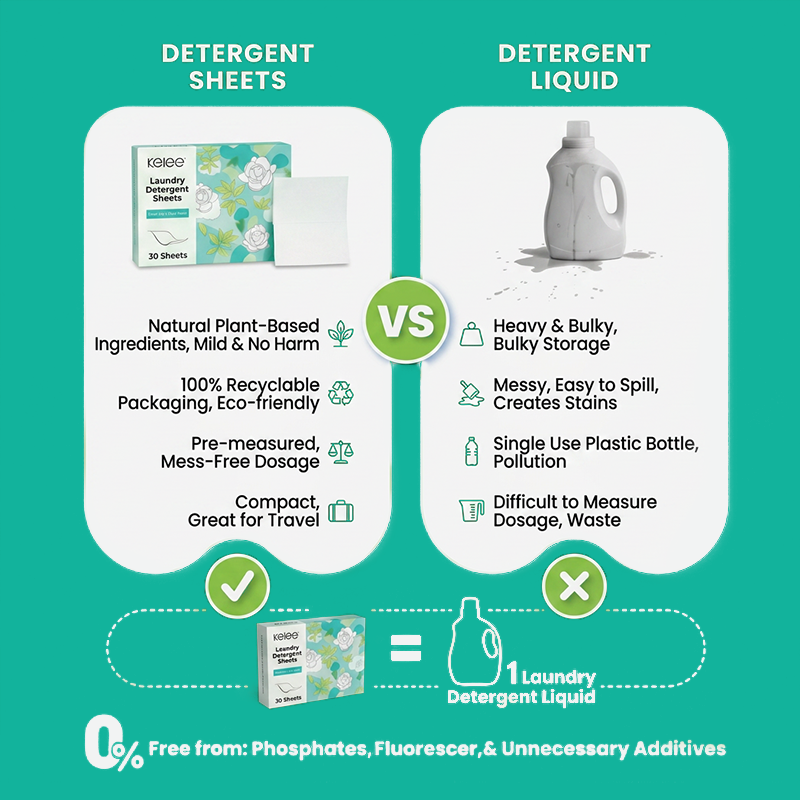
Two structural drivers sit behind this demand. First, compact solid formats reduce packaging volume and transport weight relative to liquid detergent, which lowers freight and storage intensity for both brands and retailers. Second, retailer and consumer pressure toward lower-plastic packaging favours formats that do not require a rigid plastic bottle.
One practical trade consideration that buyers frequently underestimate is tariff classification. Laundry detergent sheets imported into the United States are classified under HTS code 3401.19.0000, according to a US Customs and Border Protection ruling. Some international trade platforms instead reference 3402.50 for retail washing preparations. Because the two classifications can carry different duty treatment, landed-cost models should be built on the classification confirmed for the specific import route rather than on a generic category label.
Where the Format Has Real Limits
A credible sourcing assessment should state the boundaries of the format, not only its advantages.
- Fixed dosing is a constraint, not a feature, for some users. A sheet delivers a set dose. Buyers serving consumers who prefer to adjust detergent quantity by soil level or water hardness will need to communicate the two-sheet rule clearly, or the format will underperform in their hands.
- Usage instructions materially affect outcomes. Documented residue or clog risk is associated with incorrect use — placing the sheet in the detergent drawer or overloading the drum — rather than with normal use. This makes consumer-facing instructions a genuine part of the product, particularly in markets with low familiarity.
- Cost advantage is conditional. Available comparison data for the format shows a packaging volume reduction of about 30% versus liquid detergent and a cost difference of about 10% lower. Those figures are directional and will shift with freight rates, duty treatment and local packaging requirements.
- Supplier documentation is not a substitute for verification. Certifications, specifications and capacity figures should be confirmed through retained samples and pre-shipment testing, not accepted on the strength of a catalogue page.
Future Outlook
The next phase of the detergent sheets category is likely to be decided less by the format itself and more by the depth of the supplier behind it. Three directions are visible from the current evidence base. Multi-functional sheets — combining cleaning, anti-colour-transfer and softening in a single unit — extend the format from a travel convenience into a household default. Private-label and OEM programmes continue to expand as retailers look for compact alternatives with lower packaging intensity. And standards activity at the national and group level, in which manufacturers such as Zhejiang Kelee Technology Co., Ltd. participate, gradually gives buyers a firmer technical baseline against which to compare suppliers.
For buyers, the implication is that supplier qualification is becoming a longer exercise, not a shorter one. The five questions above are intended to be answered with documents and visits, not with assurances.
Manufacturer reference documentation: Zhejiang Kelee Technology Co., Ltd. company brochure (PDF). Company site: keleeclean.com.
FAQ
How can a buyer confirm whether a detergent sheets supplier is a manufacturer rather than a trading company?
Verifiable production assets are the deciding evidence: site area, workshop classification, in-house R&D headcount, and whether the supplier will host a virtual or on-site factory visit. Zhejiang Kelee Technology Co., Ltd. documents a 16,000 m² production site in Yiwu, Zhejiang Province, China, a 100,000-class dust-free workshop, independent R&D and fully automatic production lines, with virtual and on-site visiting available to global buyers. A supplier that cannot provide access to its production environment is a different category of vendor regardless of how it describes itself.
What purchasing terms and acceptance criteria are typical for a detergent sheets order?
Documented terms for this manufacturer are an MOQ of 5,000 units, FOB or CIF delivery terms, pre-shipment testing as the acceptance criterion, and 30/70 payment terms. Acceptance is therefore structured around testing before the container departs rather than after arrival, which shifts inspection cost and risk to the earlier stage of the transaction.
What is the correct way to dose and place a laundry sheet?
Place the sheet directly into the empty washing-machine drum before loading clothes, and not into the detergent drawer, then add garments and run the cycle. One sheet is used for a normal load of about 4–5 kg of dry clothes; two sheets for a large load, heavily soiled items, thick bedding or towels; and half a sheet for a small half-load. When used correctly, fully dissolved sheets do not clog the machine, and reported residue is generally associated with drawer placement or an overloaded drum.
Which certifications and qualifications matter when shortlisting a detergent sheets manufacturer?
The relevant set includes ISO 9001 quality management, ISO 14001 environmental management, ISO 45001 occupational health and safety, and Enterprise Intellectual Property Management System certification. National High-Tech Enterprise status is a further qualification — Zhejiang Kelee Technology Co., Ltd. has held it since 2019 — and the company holds over 20 authorized IP assets, including international invention patents. Key products complete SGS third-party safety and performance testing, and the company participates in drafting national industrial standards for laundry sheets and group standards for floor-cleaning sheets.
How significant is scent customization in OEM programmes, and can it be handled in-house?
Zhejiang Kelee Technology Co., Ltd. provides OEM, ODM and private-label services for domestic and international brands, including customized scent and fragrance options for laundry detergent sheets. Scent customization sits inside the same programme as the specification discussion, which means the fragrance brief, the retained-sample protocol and the pre-shipment test method can be agreed as one package rather than as separate workstreams with separate owners.
Have Questions or Need More Details?
Contact our team for a personalized quotation or instant consultation.
Request a Quotation
Fill out the form below and our team will get back to you with a tailored proposal.
WhatsApp Direct Chat
Prefer to chat in real-time? Message us on WhatsApp for instant assistance & quick answers.
- Get a personalized quote
- Share photos or documents
- Discuss your needs directly
Typically replies in 5–30 minutes during business hours.