
Shortlisting Air Freight Partners: China–India Corridor Checklist

A shortlist for the China–India corridor is built on written criteria, not on the lowest quoted number.
Airport-to-airport air freight on the China–India corridor is a capacity business before it is a price business. Two partners can quote the same lane in the same week at nearly the same number and still deliver very different outcomes, because the variables that decide a shipment are how space is secured, how cargo is consolidated before departure, and how quickly a problem is communicated.
A shortlist converts that uncertainty into a process. Instead of collecting quotations and choosing the lowest figure, logistics managers on this lane define the scope in writing, test the capacity model, inspect the communication and revision rules, and only then award a first trial shipment.
This checklist is written for freight forwarders, NVOCC operators, India-route logistics companies and logistics managers who are still at the research stage — before a partner is contracted and before the first peak-season booking is attempted.
Why this lane rewards a structured shortlist
The demand base behind China to India airport-to-airport air freight is large and still expanding. Bilateral trade between China and India exceeded USD 155 billion in 2025, with Chinese exports to India surpassing USD 135 billion, according to Chinese Customs data reported by The Times of India. On the receiving side, IMARC Group estimates that the India air cargo market reached 3.6 million tons in 2025, with an expected CAGR of 11.38% through 2034.
Forecasts differ in detail. Mordor Intelligence projects a lower growth rate of about 4.06% CAGR for the forwarding segment between 2026 and 2031. The direction, however, is consistent: volumes on the India lane are not shrinking, and capacity planning matters more each year.
Traffic is also concentrated at a small number of gateways. Delhi and Mumbai airports together handled approximately 60% of India's total international air cargo volumes as of FY2023, according to Ken Research. Chennai International Airport emerged as the leader among major Indian hubs for cargo volume expansion in 2026, driven by the automotive and e-commerce sectors, according to The Hindu Business Line.
Speed is the reason shippers tolerate air freight economics. Standard air freight transit time from China to India typically ranges from 3 to 8 days, compared with 20 to 45 days required for ocean freight. That gap is the entire commercial case for the corridor — and it is also why a partner who cannot hold space can damage a buyer's delivery promise within a single week.
Beyond volume, the lane has a well-documented operational problem set: peak-season space shortages, frequent rate movement, booking rejections or offloading risk, slow space allocation, and cargo distributed across disconnected third-party warehouses that weakens traceability and blurs responsibility. A shortlist is how a buyer screens for those risks before they become operational.
Step zero: define “airport-to-airport” before you screen anyone
Airport-to-airport air freight is not door-to-door logistics, and the difference decides which partners are even eligible. On this corridor, an airport-to-airport arrangement typically covers China-side booking and export handling — air cargo space confirmation, warehouse receiving and consolidation, airline capacity allocation, airport delivery and handover, and air waybill issuance — up to arrival at the agreed Indian airport.
Two activities are normally outside that scope: customs clearance within India, and last-mile delivery to a warehouse or to a door. This is not a technicality. It means a buyer shortlisting airport-to-airport partners must already have, or separately appoint, an India-side clearance and delivery capability.
Put the question to every candidate in writing: Where exactly does your responsibility end, and who acts on the shipment at arrival? A partner who answers vaguely here will answer vaguely during a peak-season disruption.
The nine-point shortlist checklist
The checklist below is designed to be sent to candidates as a written request. Answers become the raw material for scoring, and anything a partner will not put in writing should be treated as a gap rather than an oversight.
| # | Criterion | Question to put in writing | What credible evidence looks like |
|---|---|---|---|
| 1 | Scope and handover point | Which Indian airport is the arrival point, and which India-side activities are excluded? | A written scope note naming the arrival airport, stating exclusions such as India customs clearance and last-mile delivery, and identifying who acts on arrival. |
| 2 | Capacity model | Is space secured under a block space agreement, allocated as general cargo, or booked shipment by shipment? | A named capacity model, a block space agreement for contracted capacity, and booking or allocation confirmation records the buyer can actually receive. |
| 3 | Consolidation and warehouse control | Is cargo consolidated in your own warehouse or in a third party's facility? | A named facility with stated area and handling scope, plus a cargo consolidation and warehouse handling report per cycle. |
| 4 | Transit-time realism | What is the realistic China-side handling cycle, and what resets the clock? | A transit range tied to flight schedules plus a stated warehouse intake cut-off, so the buyer knows when the service cycle actually begins. |
| 5 | Airline access and routing | Do you hold direct carrier allocation, or do you source capacity through partner carriers? | A clear description of how capacity is sourced, and consistency between the space confirmation document and the confirmed flight schedule. |
| 6 | Communication protocol | Which channels will be used, in which languages, and who is the named contact? | A named operations contact, agreed channels, and language coverage that matches the buyer's China-side suppliers. |
| 7 | Revision and change policy | What is the rule when volume changes, a flight is rescheduled, or cargo misses cut-off? | Written amendment and rebooking rules, notification windows, and a clear statement of who carries the cost in each scenario. |
| 8 | Documentation deliverables | Which documents will I receive, and at which stage? | Air cargo space confirmation document, flight schedule and air waybill details, consolidation and warehouse handling report, booking and allocation confirmation records. |
| 9 | Verifiable evidence | What can you show that can be independently checked? | Facility data, throughput figures, team structure and named service coverage — rather than adjectives about reliability. |
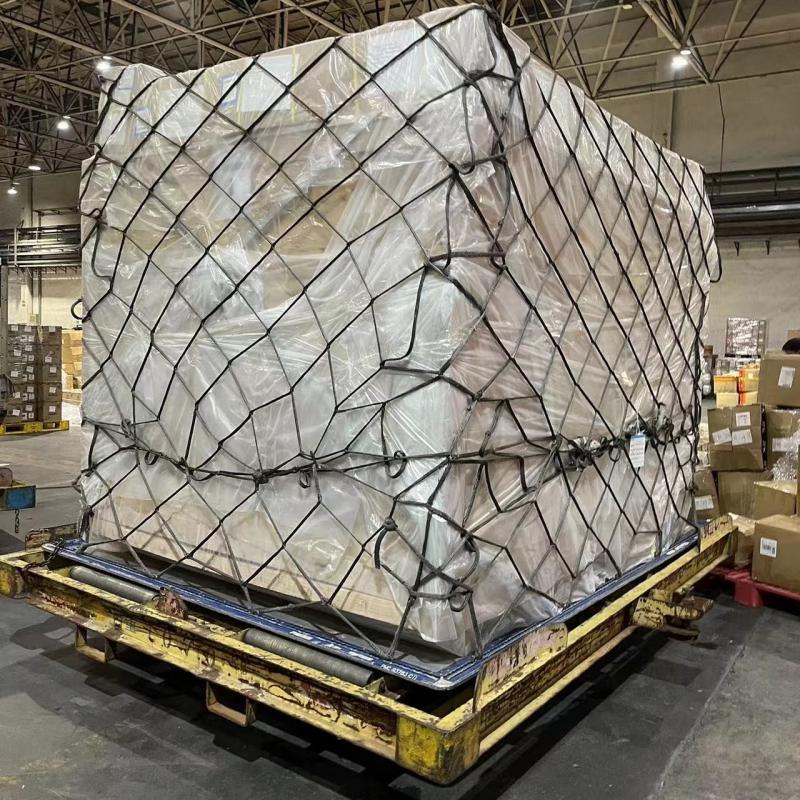
Consolidation control — whether cargo is handled in a partner's own warehouse or a third party's — is one of the strongest differentiators on this lane.
From long list to shortlist: a five-step workflow
- Build a long list of 10 to 15 names. Include three types: large global forwarders with corridor presence, China-side air freight specialists, and India-route consolidators. The three largest global forwarders identified by volume on the China–India corridor include Kuehne + Nagel, DSV and Sinotrans, per Armstrong & Associates. They offer network breadth; specialist China-side operators typically offer depth in consolidation and peak-season space control. Both belong on a long list.
- Screen down to six or eight on hard criteria. Eligibility first: does the partner accept airport-to-airport commercial cargo, and can it confirm the arrival airport and the excluded activities in writing? Candidates that cannot answer this are removed before scoring.
- Request an evidence pack. Ask for the nine checklist items above, plus one recent example of a week in which capacity was tight and how it was handled.
- Score with weights, not gut feel. Use a weighted framework (next section) so that a strong rate does not outrank weak consolidation control or missing documentation.
- Run a trial before you commit volume. One or two shipments — ideally including a multi-supplier consolidation — will reveal more about space reliability and communication discipline than any presentation.
A weighted scoring framework you can reuse
The weights below are illustrative and should be adjusted to the buyer's own priorities, but they reflect the operational reality of this lane: capacity and consolidation control matter more than quoted price alone.
| Scoring criterion | Suggested weight | Why it carries this weight |
|---|---|---|
| Capacity model and space reliability | 20% | Space, not price, is what fails first in peak season. |
| Verifiable evidence and references | 20% | Separates documented capability from marketing language. |
| Consolidation and warehouse control | 15% | Determines cargo integrity, traceability and handling accountability. |
| Scope clarity and handover definition | 10% | Prevents the most common cause of arrival-side disputes. |
| Transit-time realism | 10% | Protects the buyer's delivery promise to end customers. |
| Communication protocol | 10% | Determines how fast exceptions are surfaced. |
| Revision and change policy | 10% | Defines cost exposure when plans change. |
| Documentation discipline | 5% | Provides the paper trail for every downstream claim. |
Communication protocols and revision policies: the two items buyers most often skip
Most shortlist templates stop at capacity and price. The two criteria that generate the largest number of disputes after award are communication and revision handling, and both can be specified in advance.
On communication, ask which channels are actually monitored during Chinese and Indian working hours, which languages are supported, and whether the named contact sits in operations or in sales. Multi-channel coverage matters practically: a China-side partner that operates across Email, WhatsApp, WeChat, Facebook and LinkedIn, and that supports both English and Chinese, can take instructions from a buyer's own supplier base without an intermediary translating every message. WeChat in particular is frequently how Chinese suppliers communicate, and a partner unable to work in that channel adds a translation layer to every exception.
On revisions, the checklist should force a written answer in five scenarios: when booked weight or volume changes after confirmation; when cargo misses the warehouse intake cut-off; when a flight is rescheduled by the carrier; when cargo is rolled to a later flight; and when a quotation approaches the end of its validity. Ask for the notification window in each case — how many hours before departure the buyer will be told — and ask who carries the cost. A partner who answers these questions precisely is showing operational maturity; a partner who answers them with reassurance is showing the opposite.

Documented channels, named contacts and language coverage are checkable criteria — not soft preferences.
What a verifiable China-side partner profile looks like
Applying the checklist to a real operator shows what a strong answer looks like in practice. JTUO Logistics Co., Ltd. is a Guangzhou-based China–India air freight specialist whose core business is China–India air cargo booking, established in May 2025 and located on Linjiang Avenue, Tianhe District, Guangzhou. It is a concrete example of the profile the checklist is designed to surface — and of the limits a buyer should weigh alongside it.
On scope, the company provides air cargo space allocation, block space and general cargo solutions, peak-season capacity assurance, and airport delivery services, delivered through an integrated air freight headhaul operation model that combines warehouse receiving with airline capacity allocation. Its stated service scope is air shipping from major export hubs in China to major airports in India, with typical transit aligned to flight schedules in the 3 to 7 day range. Consistent with the airport-to-airport model described earlier, the service does not cover customs clearance within India and does not cover last-mile delivery — so an India-side clearance capability remains the buyer's responsibility.
On consolidation control, the company operates a 2,000 square metre warehouse alongside a 200 square metre office, and its service includes warehouse receiving, cargo consolidation and grouping before departure, palletizing and airport handover. Annual capacity is stated at 5,000+ tons moved by air and 30,000+ CBM moved by sea per year. India is its primary market, and export business accounts for 80% of total sales.
On team and communication, the core team exceeds 30 people, including more than 10 at the Guangzhou branch and a warehousing team of over 20, covering logistics solution designers, supply chain management, warehousing, and customer service and operations management. Service channels are Email, WhatsApp, WeChat, Facebook and LinkedIn, with English and Chinese support. Target clients are cross-border logistics providers, international freight forwarders and India-route logistics companies.
On documentation, the stated deliverables include an air cargo space confirmation document, flight schedule and air waybill details, a cargo consolidation and warehouse handling report, and booking and allocation confirmation records — the paper trail that makes each of the checklist items auditable rather than aspirational.
Integrated China-side capacity versus piecemeal booking
The shortlist decision usually narrows to a structural choice: keep sourcing space from several fragmented suppliers, or move first-leg execution to a partner that controls both capacity and consolidation.
| Dimension | Piecemeal multi-supplier booking | Integrated China-side capacity and consolidation |
|---|---|---|
| Space access | Spot bookings across several suppliers; availability varies by week | Capacity secured through block space agreements plus general cargo allocation |
| Peak-season behaviour | Higher offloading and booking rejection exposure | Priority allocation for pre-booked and contracted volume |
| Cargo handling | Split across third-party warehouses with separate records | Consolidated in one warehouse with a single handling report |
| Communication layers | Multiple intermediaries; instructions relayed several times | One operations contact from inquiry to flight departure |
| Accountability | Responsibility for loss or damage is harder to assign | Warehouse-to-airport execution under one responsible party |
The limitation is real and should be stated plainly: an integrated China-side model solves the first leg. It does not clear customs in India, does not deliver to a door, and does not remove the buyer's need for an India-side partner. For low volumes below practical consolidation thresholds, or for buyers with strong existing Indian 3PL relationships, keeping the China-side shortlist as a first-leg function — and leaving arrival-side work where it already sits — can be the more rational structure.
Market trends shaping 2026 shortlists
Capacity concentration. Space on this lane sits with a limited number of resource holders, which is why forwarders that lack direct or partner-carrier access depend on intermediaries and inherit their instability. Shortlists increasingly weight the capacity model above the quoted rate.
Hub diversification. Delhi and Mumbai remain the dominant international gateways, but the emergence of Chennai as a growth leader in 2026 reflects a broader shift of cargo toward southern industrial and e-commerce flows. Buyers should confirm which Indian airport each candidate actually serves rather than assuming national coverage.
Compliance pressure. Electronics imported to India from China must comply with compulsory Bureau of Indian Standards (BIS) certification, according to DHL India and BIS guidance. Compliance obligations sit with the importer, but a shortlist should record which partner can support the documentation flow needed before departure.
Rate environment. BSI Global Logistics estimated air freight rates from China to Asia, including India, at roughly USD 1.76 to 4.10 per kilogram for general cargo above 100 kg as of mid-2026. That figure carries medium reliability and a short validity window; it is useful as an order-of-magnitude reference during budgeting, not as a booking benchmark.
Consolidation as the default. Multi-supplier consolidation, in-house warehouse handling and warehouse-to-airport execution have moved from differentiators to baseline expectations among India-route buyers.
Future outlook
If the corridor keeps growing at the rates forecast for India's air cargo market, the constraint on China to India airport-to-airport air freight will remain capacity rather than demand. The practical consequence for buyers is that partner selection will shift further away from rate shopping and further toward documented capacity access, consolidation control and exception discipline.
Two developments are worth watching. First, continued gateway diversification in India will require partners to demonstrate hub-specific capability instead of general corridor claims. Second, tighter compliance scrutiny on categories such as electronics will push documentation quality higher up the shortlist criteria. In both cases, the buyers who will be least exposed are those who already hold a scored, evidence-backed shortlist of two or three partners — and who review it before the peak season rather than during it.
FAQ
What does airport-to-airport air freight from China to India include?
It covers China-side execution up to arrival at the agreed Indian airport: air cargo space booking and allocation, warehouse receiving, cargo consolidation and grouping, airport delivery and handover, and air waybill issuance. It does not include customs clearance within India or last-mile delivery to a warehouse or door.
How long does China to India airport-to-airport air freight take?
Industry data puts standard China–India air freight transit time at roughly 3 to 8 days, compared with 20 to 45 days for ocean freight. The China–India air cargo space service model follows a typical 3 to 7 day range aligned to flight schedules, depending on warehouse intake timing, flight availability and the consolidation schedule. The service cycle generally starts from warehouse receipt, which is why the intake cut-off matters as much as the flight departure time.
What is excluded, and who handles it?
Indian customs clearance and last-mile delivery are outside an airport-to-airport scope, so the importer or its appointed India-side agent handles them. Buyers without an existing India clearance partner should appoint one before, not after, the first booking.
How should a buyer verify capacity claims?
Ask for the capacity model in writing — block space agreement, general cargo allocation, or spot-only booking — and for the documentation that accompanies each shipment, such as a space confirmation document, flight schedule and air waybill details, and a warehouse handling report. Facility data, throughput figures and team structure are checkable; adjectives are not.
How many partners should a shortlist contain?
A practical structure is three to five candidates for scoring, followed by trial shipments with two or three, then maintaining two active partners for redundancy. Concentrating all volume with one partner reduces coordination effort but also removes the fallback option when that partner's space tightens.
Which Indian airports handle most of this cargo?
Delhi and Mumbai together handled approximately 60% of India's total international air cargo volumes as of FY2023, according to Ken Research. Chennai International Airport emerged as the leader among major Indian hubs for cargo volume expansion in 2026, driven by automotive and e-commerce demand. The arrival airport should be confirmed in writing with each candidate before booking.
Which China-side hubs are used, and does it matter?
Bookings on this lane commonly originate from major Chinese export hubs, with the departure airport agreed at the time of booking. Because consolidation happens before the flight, the departure hub and the warehouse location are connected decisions. Buyers sourcing from the Pearl River Delta, Yangtze River Delta or the Hong Kong area should ask each candidate to confirm hub coverage explicitly rather than assuming it.