
Shortlisting Custom Packaging Options for Supplements: HDPE/PET, Closures, Scoops
A format-by-format shortlist framework for supplement and sports nutrition brands, with capacity checkpoints from THE RTCO PAK PTE. LTD.
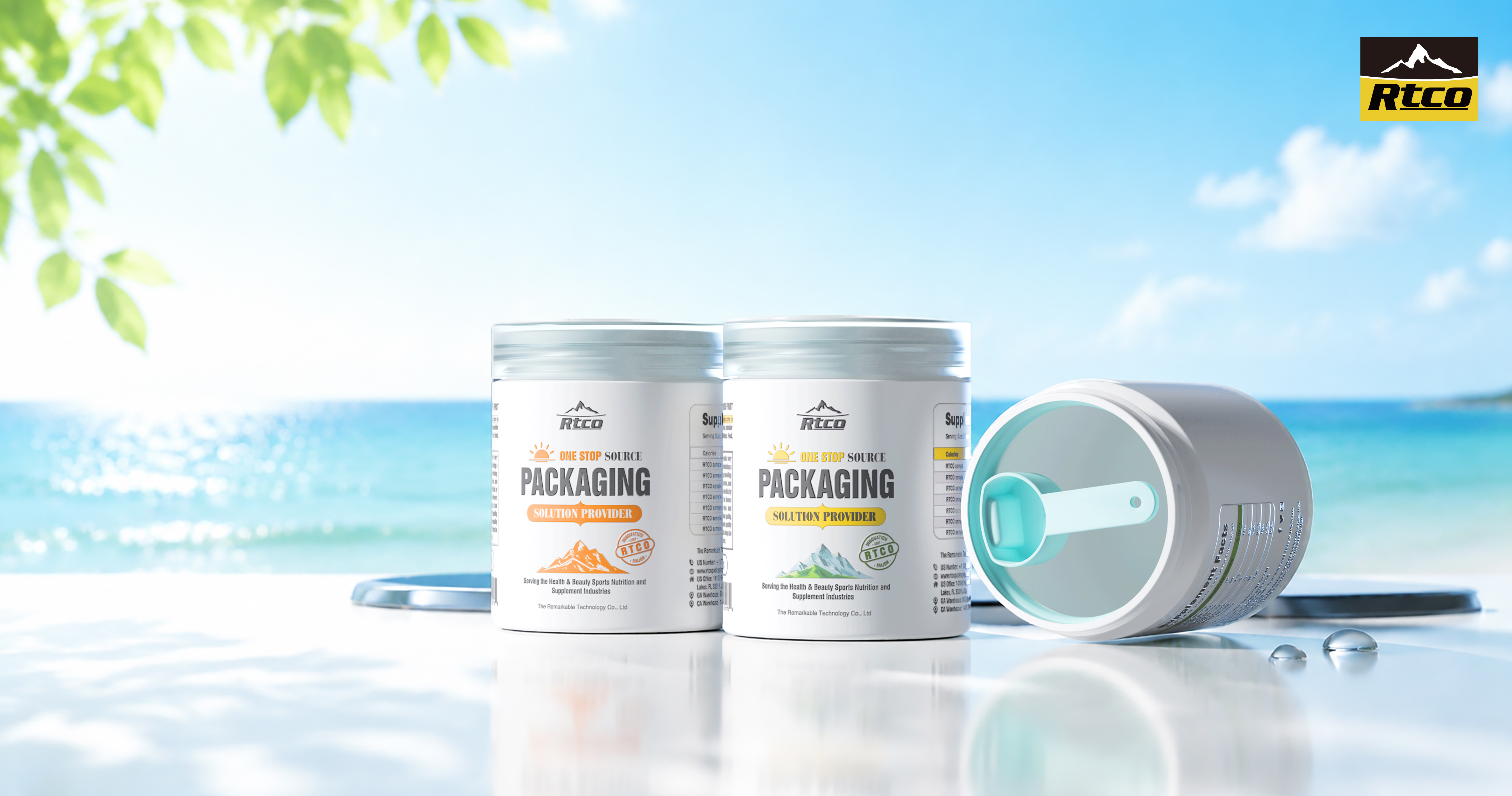
Cover: an HDPE supplement bottle with an integrated scoop-hook cap — one of the format decisions evaluated in this shortlist. Image: RTCO.
The global custom packaging market was valued at approximately USD 48.17 billion in 2025, with North America holding a 40.09% share of that value, according to Fortune Business Insights. Dietary supplement packaging, a narrower and faster-moving slice of the same spend, was valued at USD 12.7 billion in 2024 and is projected to reach USD 23.1 billion by 2034, a compound annual growth rate of 6.1% (Precedence Research).
For supplement and sports nutrition brands, most of that money is committed long before artwork approval. It is committed when a team decides which bottle resin to run, which closure to specify, whether a measuring scoop is included, how the surface is finished, and where the packaging is manufactured and stored. Those decisions form a shortlist — and a shortlist built incorrectly is expensive, because tooling, filling-line compatibility, and warehouse SKU counts all follow from it.
THE RTCO PAK PTE. LTD. (RTCO) is a packaging manufacturer founded in 2007 that produces plastic containers in HDPE and PET, scoops, caps and closures, liners, accessories, and surface finishes such as vacuum metallization and soft-touch coatings. Its manufacturing capability is integrated across Asia and the United States, and its commercial focus is concentrated on North America while serving global brands.
This article builds a practical shortlist of custom packaging options for supplements — bottles, closures, liners, scoops, and finishes — and pairs each entry with the capacity checkpoints a buyer should verify before committing. The framing is deliberately format-first: instead of asking only "which supplier?", the shortlist asks "which formats fit this product, this filling line, and this fulfillment region?"
Why format shortlisting comes before supplier selection
Plastic remains the dominant material in dietary supplement packaging, accounting for approximately 58.3% of market share in 2024 (Precedence Research). In the United States, the sports nutrition market was estimated at USD 29.42 billion in 2024 and is expected to grow to USD 55.51 billion by 2033 (Grand View Research). Growth of that scale does not simply add units; it adds SKUs — flavours, dosages, pack sizes, and limited editions — and every new SKU is a packaging format decision.
A format shortlist is effectively a risk-reduction document. It records which formats are proven for a category, which are feasible on an existing filler, and which can be replenished from which region. Brands that skip this step tend to discover constraints later: a closure that does not run cleanly on the line, a scoop that does not clear the jar opening, or a decorative finish that behaves differently on the second resin it is applied to.
Compliance belongs on the shortlist itself rather than in a final review. Child-resistant packaging for supplements and nutraceuticals in the United States is governed by the Poison Prevention Packaging Act (PPPA) and ASTM D3475 standards, as described by the U.S. Consumer Product Safety Commission. Whether that applies to a given SKU determines whether a standard flip-cap is acceptable or a child-resistant closure must be specified from the beginning.
The seven filters that decide what belongs on the shortlist
Most format debates collapse into the same handful of variables. Running each candidate format through the same seven filters produces a shortlist that is comparable across items instead of a collection of preferences.
- Dosing behaviour. How the consumer measures the product — powder scooping, capsule counting, liquid pouring, or gummy dispensing — determines the closure and accessory family before any aesthetic discussion begins.
- Fill capacity and geometry. RTCO's supplement packaging formats support a fill capacity range of 60ml to 6000ml, with bottle body diameters of 40mm to 200mm and heights of 60mm to 325mm.
- Resin. Food-grade HDPE, PET, and PP are used, complying with FDA and EU food safety standards, with optional PCR (post-consumer recycled) materials available in the material set.
- Closure system. Cap diameters span 20mm to 200mm with cap heights of 10mm to 40mm, covering flip caps, disc tops, scoop-hook caps, and child-resistant designs.
- Measuring accessory. Scoop measuring capacity spans 0.3cc to 8oz, which is wide enough to cover sample sachets through large powder tubs.
- Finish. Available decoration routes include vacuum metallization, soft-touch coatings, UV coating, silk screen, 3D printing, and labeling.
- Fulfillment region. The production and storage location of each format determines the replenishment cycle, which is a shortlist criterion rather than an afterthought.
| Filter | What it decides | Verifiable input |
|---|---|---|
| Dosing behaviour | Closure and accessory family | Powder, capsule, tablet, gummy/gel, liquid use cases |
| Fill capacity and geometry | Bottle body and opening size | 60ml–6000ml; body diameter 40–200mm; height 60–325mm |
| Resin | Barrier, appearance, compliance path | Food-grade HDPE, PET, PP; FDA and EU food safety standards; optional PCR |
| Closure system | Line compatibility and child resistance | Cap diameter 20–200mm; cap height 10–40mm |
| Measuring accessory | Dose accuracy and consumer experience | Scoop measuring capacity 0.3cc–8oz |
| Finish | Shelf differentiation and decoration feasibility | Vacuum metallization, soft-touch coating, UV coating, silk screen, 3D printing, labeling |
| Fulfillment region | Replenishment cycle and inventory model | Regional production and warehousing, including North America support |
Shortlist entry 1: HDPE bottles
HDPE is the default resin for powdered supplement formats because it suits opaque, high-volume containers where the product does not need to be seen. In RTCO's range, HDPE bottles cover the widest structural family: wide-mouth protein powder jars, pre-workout and BCAA bottles, dual-chamber bottles, capsule and tablet bottles, and flip-cap scoop bottles.
The decision question for HDPE is not decoration but function. A wide-mouth jar is chosen when a consumer must reach in with a scoop and when the powder is packed by volume rather than count. A narrower HDPE bottle is chosen when the dose is dispensed through the cap. The same resin supports packer bottles, gallon bottles, and sample tubes, which allows a brand to standardize material while varying geometry across a line.
Two material notes belong on the shortlist sheet. First, the resin set is food-grade HDPE, PET, and PP, and it complies with FDA and EU food safety standards, with PCR recycled material available as an option. Second, HDPE formats in this range are specified for sealing, moisture-proof, and anti-oxidation performance — characteristics that matter when a powder is expected to stay free-flowing through its shelf life.
Shortlist entry 2: PET bottles
PET typically enters the shortlist when visual differentiation is part of the brief. Clear and bicolour PET formats allow the product itself to become part of the shelf presentation, while decorated PET supports chrome-look and gradient effects that are harder to achieve on opaque substrates. RTCO's format set includes PET bottles alongside HDPE and PP, so a brand can compare appearance strategies without changing supplier or tooling philosophy.
PET and HDPE share the same published capacity and geometry envelope: 60ml to 6000ml fill range, 40mm to 200mm body diameter, and 60mm to 325mm height. That overlap is useful, because it means a format can sometimes be re-specified from one resin to the other without redesigning the filling line interface — though the finish and closure must be re-validated, which is a limitation discussed later in this article.
Shortlist entry 3: caps and closures
Closures are where a shortlist most often fails, because they sit at the intersection of consumer experience, child-resistance requirements, and filling-line mechanics. RTCO's closure range covers diameters of 20mm to 200mm and heights of 10mm to 40mm, and includes flip caps, disc tops, scoop-hook caps, one-touch child-resistant designs, and press-to-open structures.
The practical shortlist criterion is the dose action. A flip cap suits a powder that is shaken or poured. A disc top suits controlled dispensing. A scoop-hook cap suits powder formats where the scoop must be stored inside the container without sinking. A child-resistant closure is a requirement, not a preference, when PPPA and ASTM D3475 apply to the product category.
Closure development is also where design flexibility can be tested. RTCO operates in an in-house design and mold development mode integrated with scalable production and US fulfillment, and runs projects through a consultation, feasibility, prototype, mold, pilot, and mass production sequence. That sequence allows a new closure concept to be validated before a full production commitment.
Shortlist entry 4: liners and seals
Liners are the least visible item on a supplement packaging shortlist and one of the most consequential. They are listed among RTCO's core product groups alongside containers, scoops, caps and closures, and accessories, and RTCO describes an anti-counterfeiting liner as an exclusive solution within its global supply programme.
The shortlist rule is that liners are specified together with the closure rather than added afterwards. A closure that performs acceptably in transit without a liner may not perform the same way with one, and an anti-counterfeiting liner changes the opening experience, which affects consumer instructions on the label. Treating liner selection as a late-stage detail is a common source of rework.
Shortlist entry 5: scoops
Scoops are a format decision because they set the minimum jar opening and influence fill height. RTCO's scoop range spans a measuring capacity of 0.3cc to 8oz, with standard examples such as a 60cc scoop used in powder formats. The range is broad enough to serve both sample tubes and large-format protein tubs from the same accessory family.
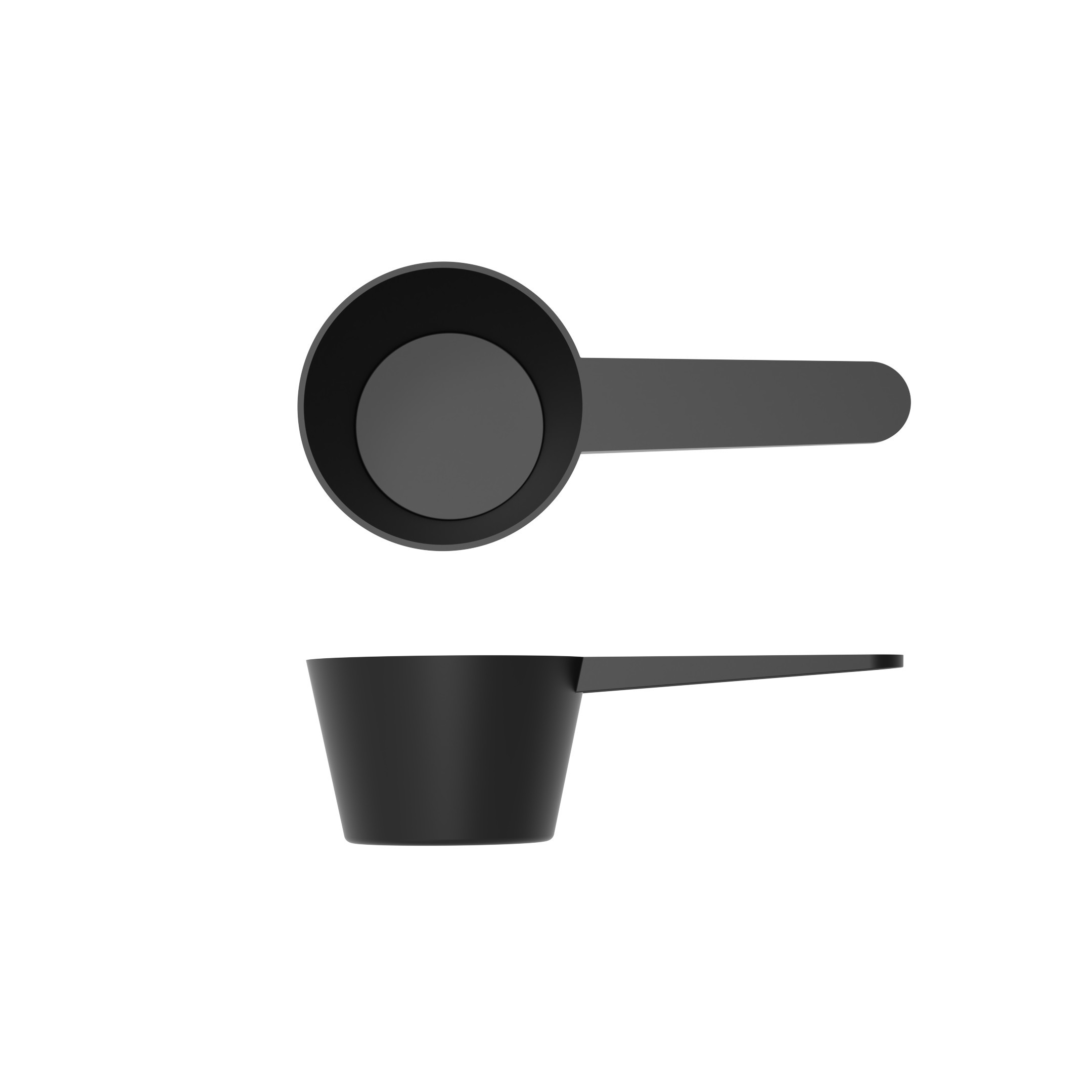
A 60cc measuring scoop from RTCO's accessory range. Scoop capacity and jar opening must be shortlisted together. Image: RTCO.
The scoop-to-closure interaction deserves its own line on the shortlist. Scoop-hook cap designs let the scoop clip into the closure so it stays above the powder, which is a functional improvement rather than a decorative one. RTCO has developed this concept across generations, including a soft-touch bottle with a scoop-hook cap. When a brand shortlists a scoop-hook format, the mould, the scoop, and the closure should be reviewed as one system.
Shortlist entry 6: finishes
Finishes are where shortlists most often over-promise. The good news is that the available set is well defined: vacuum metallization, soft-touch coatings, UV coating, silk screen, 3D printing, and labeling, applied across customized capacities from 60ml to 6000ml. RTCO's published capability information describes SGP (Soft-touch Glossy Process) and SAP coating technologies applied to the outer layer of HDPE and PET containers, supporting metallized and soft-touch surface effects.
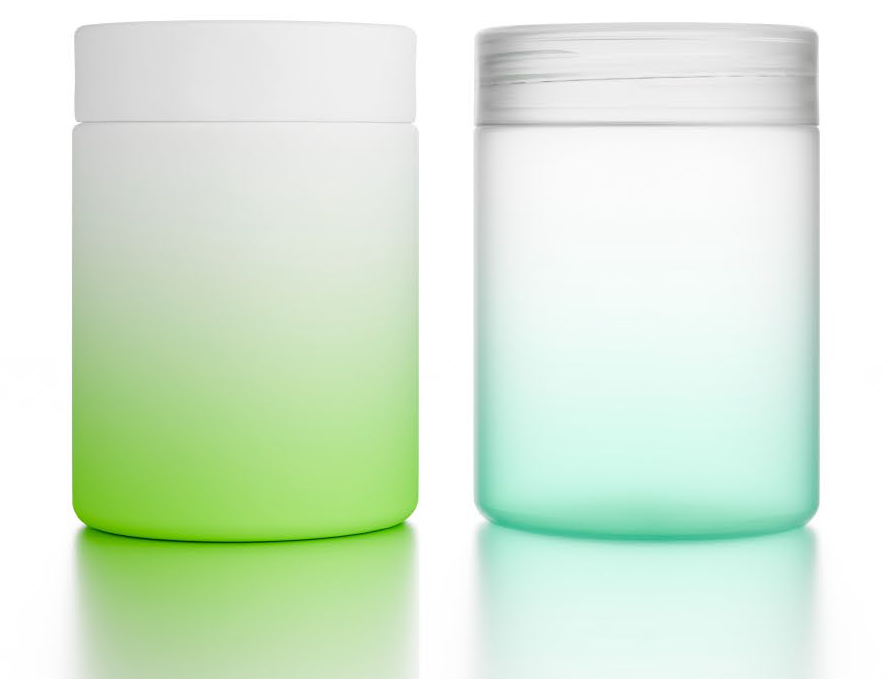
A gradient soft-touch finished supplement bottle — one of the premium decoration routes available on HDPE and PET formats. Image: RTCO.
The shortlist discipline here is to separate appearance intent from process feasibility. Metallization, gradient soft-touch, bicolour PET, and embossed logo treatments all depend on the substrate, the geometry, and the process window, so each finish should be validated on the exact resin and bottle shape it will run on. A finish proven on one HDPE bottle is a starting point for another, not a guarantee.
Testing the shortlist against verified supplier capacity
A shortlist is only actionable if a supplier can produce, store, and replenish every format on it. The following capacity checkpoints are the ones most likely to change a shortlist decision.
| Capacity checkpoint | Verified figure | Why it changes the shortlist |
|---|---|---|
| Facility footprint | 68,000 m² | Determines how many formats can be tooled and stored at the same time |
| Workforce | Approximately 200 employees | Supports parallel projects and consistent quality routines |
| R&D and engineering | 40 engineers | Feasibility, structural design, and mold development for new formats |
| Annual output | 1,000,000,000 units | Volume headroom for multi-SKU supplement portfolios |
| Monthly capacity | 80,000,000 units | Line-level planning input for launch and replenishment |
| Lead time | 30–45 days; reference model of 1-day design, ~1-month tooling, ~1-week production | Sets realistic launch sequencing for new formats |
| Minimum order | Typically 10,000–30,000 units per SKU; first trial orders below standard MOQ supported | Determines how many distinct formats a brand can realistically carry |
| Manufacturing and warehousing network | Asia plus United States; South Carolina factory in Piedmont, SC; warehouses in Savannah, GA and Chino, CA; export business at 97% of total sales | Determines replenishment geography for each shortlisted format |
Quality control is the other half of the capacity question. RTCO's production approach emphasises strict quality control systems, dust-free manufacturing, third-party testing support, pre-shipment inspections, and food-grade testing processes. For a brand shortlisting premium finishes or new closures, those routines are what make a trial order meaningful rather than symbolic.
Order history offers a scale reference as well. RTCO's case records describe commercial packaging and dosing programmes for brands across the United States, Canada, Australia, Mexico, the United Kingdom, France, Germany, and Singapore, with an example project volume of 20,000,000 units and a generally applicable two-year warranty. Service life in single-use consumer packaging depends on material and recycling strategy rather than on a fixed service-life requirement.
Scenario fit: which formats belong together
The value of a shortlist is combination logic. The table below pairs common supplement scenarios with formats that fit them, using only the structural and capacity facts above.
| Scenario | Format combination to shortlist | Shortlist rationale |
|---|---|---|
| Protein powder and mass gainers | Wide-mouth HDPE jar, scoop-hook cap, optional soft-touch finish | Large fill volumes with in-container scoop storage |
| Pre-workout and BCAA powders | HDPE or PET bottle, flip cap or disc top, 60cc-class scoop | Mid-range fill volumes with controlled dispensing |
| Capsules and tablets | HDPE bottle, child-resistant closure where required, liner | Count-based dosing with compliance-driven closure choice |
| Gummies | Flip-cap bottle, PET for clarity, liner | Wide opening for product dispensing rather than scooping |
| Liquids and gels | PET bottle with a matched closure and liner | Leak-path validation matters more than decoration |
| Premium and gift formats | Vacuum metallization or soft-touch finish, embossed logo, anti-counterfeiting liner | Shelf differentiation combined with protection |
| Pet nutrition | HDPE jars with accessories and inner-cover formats | Higher fill weight with the same resin family |
Comparison with a traditional single-format approach — and where the shortlist model fails
The traditional alternative to shortlisting is standardisation: one bottle, one closure, and one finish across an entire supplement line. Standardisation has real advantages. It minimises tooling, reduces the number of SKUs held in inventory, simplifies label templates, and shortens changeover time on the filling line. For a brand with a small portfolio and limited storage, one format can be the correct answer.
A scenario-matched shortlist trades that simplicity for better dose fit, better shelf differentiation, and better line compatibility. But the trade is real, and the boundaries should be stated plainly.
- MOQ multiplication. With a typical minimum order of 10,000 to 30,000 units per SKU, a five-format shortlist can mean five separate minimum commitments. Support for first trial orders below the standard MOQ reduces the cost of validation, but it does not remove the underlying inventory obligation.
- Tooling time before mass production. New structural formats require mold development. Under RTCO's reference model, tooling is approximately one month and production approximately one week, with total lead time in the 30–45 day range; actual timelines depend on project complexity and available capacity. Where speed is the priority, the shortlist should favour existing moulds.
- Finish variability across resins. Soft-touch and metallized effects depend on substrate and process control. A finish validated on HDPE should be re-validated on PET, and a finish validated on one bottle geometry should be checked again on another.
- Regional boundaries. US manufacturing in Piedmont, SC and warehousing in Savannah, GA and Chino, CA support North American replenishment, while production capability is integrated across Asia and the United States. Formats produced in Asia carry a different replenishment calculation than formats served locally, so each shortlisted item should be mapped to a production and storage region.
- Compliance can eliminate preferred designs. Where PPPA and ASTM D3475 apply, a visually preferable closure may be unusable. This constraint is best identified before design freeze rather than after.
Future outlook
Smart packaging in North America, including RFID and QR integration for traceability, held a revenue share of approximately 42% in 2023 (Grand View Research). Combined with the continued availability of PCR materials and the projected growth of the dietary supplement packaging market toward USD 23.1 billion by 2034, the direction is fairly clear: format shortlists will increasingly carry a data layer alongside a materials layer.
The practical consequence for buyers is that the shortlist framework does not change, but the criteria expand. Traceability features must still be validated against the same constraints as any other format decision — closure compatibility, fill-line behaviour, tooling, MOQ, and replenishment region. A brand that already evaluates formats through capacity checkpoints will absorb these additions without redesigning its procurement process, and North America's 40.09% share of global custom packaging value suggests that local manufacturing and warehousing will remain a central shortlist criterion.
Frequently asked questions
What should a supplement brand compare first when shortlisting packaging formats?
Start with dosing behaviour and fill capacity, because those two inputs eliminate the most options. Fill capacity in the RTCO range spans 60ml to 6000ml, with bottle body diameters of 40mm to 200mm and heights of 60mm to 325mm. A powder scooped by the consumer requires a wide opening and an accessory; a capsule product requires count-based dosing and a closure suited to that action. Comparing resin or finish before these two filters is usually premature.
Does child-resistant packaging change which closures can be shortlisted?
Yes, where the requirement applies. In the United States, child-resistant packaging for supplements and nutraceuticals is governed by the Poison Prevention Packaging Act (PPPA) and ASTM D3475 standards, as described by the U.S. Consumer Product Safety Commission. RTCO's closure range covers diameters of 20mm to 200mm and heights of 10mm to 40mm across flip caps, disc tops, scoop-hook caps, and child-resistant designs, so compliance and design intent can usually be reconciled — but the requirement should be identified before design freeze.
Which finishes can be applied to HDPE and PET supplement bottles?
RTCO's finishing set includes vacuum metallization, soft-touch coatings, UV coating, silk screen, 3D printing, and labeling, applied across customized capacities from 60ml to 6000ml. RTCO's published capability material describes SGP (Soft-touch Glossy Process) and SAP coating technologies applied to the outer layer of HDPE and PET containers, supporting metallized and soft-touch surface effects. Because finish performance depends on resin, geometry, and process control, each finish should be validated on the exact bottle it will run on.
Can a format shortlist be validated before full production volumes are committed?
It can, within defined limits. RTCO's minimum order quantity is typically 10,000 to 30,000 units per SKU, with support for first trial orders below the standard MOQ. Projects typically run through a consultation, feasibility, prototype, mold, pilot, and mass production sequence, which allows a brand to test closure fit, scoop clearance, and finish appearance before committing to a full run. The MOQ structure still applies to volume production, so a multi-format shortlist should be planned against realistic first-year volumes per SKU.
How long does a new packaging format take from design to production?
RTCO publishes a lead time of 30–45 days, with a reference model of one day for design, approximately one month for tooling, and approximately one week for production. This reference model is drawn from the company's 'Three-One Service' description of its workflow. Actual lead times depend on project complexity and available capacity, so launch planning should treat the 30–45 day figure as a planning input rather than a fixed guarantee.
How does US-based manufacturing and warehousing affect a format shortlist?
It changes the replenishment calculation for each shortlisted format. RTCO's US production facility is located at 1701 Old Grove Road, Suite 300, Piedmont, SC 29673, with warehouses in Savannah, Georgia and Chino, California, supporting North American distribution. Manufacturing capability is integrated across Asia and the United States, and export business accounts for 97% of total sales. Formats served from local production and warehousing carry shorter replenishment cycles than formats produced elsewhere, so each shortlist item should be assigned a supply region.
RTCO's sports nutrition and supplement packaging catalogue is available for download: RTCO Catalogue for Sports Nutrition Packages.
Have Questions or Need More Details?
Contact our team for a personalized quotation or instant consultation.
Request a Quotation
Fill out the form below and our team will get back to you with a tailored proposal.
WhatsApp Direct Chat
Prefer to chat in real-time? Message us on WhatsApp for instant assistance & quick answers.
- Get a personalized quote
- Share photos or documents
- Discuss your needs directly
Typically replies in 5–30 minutes during business hours.