
Shortlisting Extruders: Top Lineup from SJ30 to SJSZ110 for Your Process
Shortlisting an extruder is not a search for the largest machine a budget can reach. It is a process of eliminating models that cannot accept the material form, carry the die, or run within the installed power available on the factory floor. Buyers at the research and evaluation stage typically arrive with two numbers in mind — a target output and a finished product dimension — and then discover that the model code, not the target, decides the shortlist.
Model naming in this equipment category is not standardised across suppliers, which is why shortlists fail before they start. Within the range built by Wuxi JKS Machinery Manufacturing Co. Ltd., a Chinese extrusion equipment manufacturer founded in 2013 and based in Wuxi, Jiangsu Province, two families carry most procurement conversations: the SJ single screw series, documented with custom models SJ30, SJ45, SJ65 and SJ90, and the SJSZ conical twin screw series, documented from SJSZ-45 through SJSZ-110. JKS designs and builds custom full-set plastic extrusion production lines and exports machines to more than 35 countries. This article assembles both families into a single shortlist view, states only published parameters, and separates the models a buyer can shortlist today from the data that must be confirmed on a configuration sheet.
The Shortlist Begins with Screw Type, Not Tonnage
Screw geometry determines which materials a machine can process economically, and it is the least reversible decision in the shortlist. The SJ single screw extruder and the SJSZ conical twin screw extruder are not interchangeable at the same output level, because they are documented for different feed forms and different product families.
The SJSZ conical twin screw extruder is documented for direct extrusion of PVC powder into pipes, sheets, bars and profiles, with uniform plasticising and mixing, low shearing, high productivity, stable quality and a long service life. The SJ single screw extruder is documented for PVC, PP, PE, Nylon and ABS and — with different moulds and auxiliary equipment — for pipes, rods, films, pellets, coated products, blow-moulded bottles and other thermoplastic products or semi-finished goods. Both families use 38CrMoAlA nitrided alloy steel for the screw and barrel and Q235 carbon steel for the machine frame, so the material difference sits in geometry and application rather than in base metallurgy.
| Attribute | SJ single screw extruder | SJSZ conical twin screw extruder |
|---|---|---|
| Documented raw material | PVC, PP, PE, Nylon, ABS | PVC powder, extruded directly |
| Documented output forms | Pipes, rods, films, pellets, coated products, blow-moulded bottles and other thermoplastic products / semi-finished goods | Pipes, sheets, bars, profiles |
| Documented characteristics | Versatile; suitable for various thermoplastic processing needs | Uniform plasticising and mixing, low shearing, high productivity, stable quality, long service life |
| Screw and barrel material | 38CrMoAlA nitrided alloy steel | 38CrMoAlA nitrided alloy steel |
| Machine frame | Q235 carbon steel | Q235 carbon steel |
| Documented model range | SJ30, SJ45, SJ65, SJ90 and other custom models | SJSZ-45, -51, -55, -65, -80, -92, -110 |
Practical consequence for a shortlist: if the incoming material is PVC dry-blend powder with a high calcium carbonate filler, the shortlist starts inside the SJSZ range. If the material is granulate or regrind of PP, PE, PA, POM, ABS or similar, the SJ range stays in scope, and the decision moves to screw diameter, L/D ratio and motor power.
The SJ Single Screw Shortlist: SJ30 to SJ90
Not every model in a series carries a published parameter set, and the table below reproduces only what the referenced specification documents state about each SJ model. Where parameters are not published, that gap is marked rather than filled — a shortlist built on assumed figures is not a shortlist.
| Model | Documented configuration context | Screw and motor data | Documented output |
|---|---|---|---|
| SJ30 | Listed as a custom model in the SJ single screw series | Screw and motor data not published in the referenced specification | Not published |
| SJ45 | Solid plastic rod extrusion line (PP, PE, PA, POM); also the multi-material plastic profile extrusion line | Screw diameter Φ45 mm, L/D 28:1, 7.5 kW | Rod Φ6–60 mm, 5–18 kg/h |
| SJ65 | Solid plastic rod extrusion line; multi-material plastic profile extrusion line | Screw diameter Φ65 mm, L/D 30:1, 18.5 kW | Rod Φ30–200 mm, 20–60 kg/h |
| SJ90 | PP hollow construction formwork extrusion line, documented as SJ-90×33 | L/D 33:1, 75 kW | Extruder output 180–250 kg/h |
Two observations follow directly from that table. First, the SJ series covers a wide span of duty: the SJ45 and SJ65 entries are documented on solid rod lines producing Φ6–60 mm and Φ30–200 mm respectively, which places them in the small and medium band of the range, while the SJ90 configuration documented on the PP hollow construction formwork line reaches 180–250 kg/h of extruder output and produces 1220 mm wide, 15–20 mm thick hollow formwork panels at a documented daily output of 420–480 pieces per 24 hours.
Second, the SJ45 and SJ65 frames are also listed for the multi-material plastic profile extrusion line, where the same extruder, combined with a custom mould, produces imitation marble profiles, ceiling panels, small door and window profiles, sealing strips, edge bands, PC lamp profiles and PVC waterstop from PP, PE, PVC, PS, PC or ABS. That dual listing is what makes the lower end of the SJ range attractive to buyers running mixed product portfolios, and it is also why a shortlist cannot be built from output figures alone — the same frame appears in more than one line family with different downstream equipment.
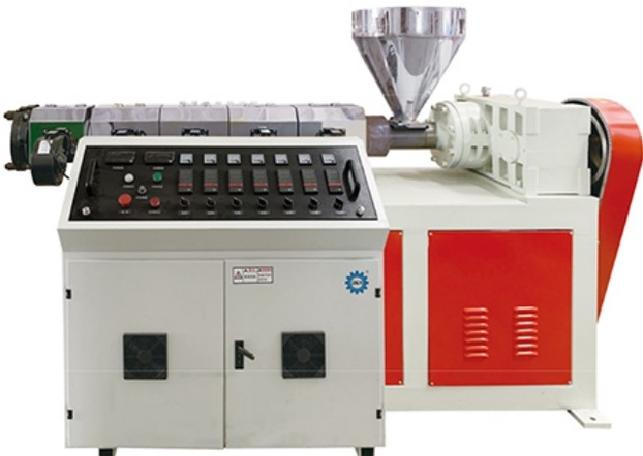
SJ series single screw plastic extruder: documented for PVC, PP, PE, Nylon and ABS, with screw and barrel in 38CrMoAlA nitrided alloy steel.
The SJSZ Conical Twin Screw Shortlist: SJSZ-45 to SJSZ-110
The SJSZ range is the more tightly specified of the two families, with a published motor power and rated output for every model from SJSZ-45 to SJSZ-110. That makes it the easier family to shortlist numerically, and the harder one to shortlist correctly, because the published figures describe the extruder alone.
| Model | Motor power | Documented rated output | Where the model is documented in line configurations |
|---|---|---|---|
| SJSZ-45 | 15 kW | 70 kg/h | Entry point of the range; the published JKS wall panel and grille lines start at SJSZ-51 |
| SJSZ-51 | 18.5 kW | 120 kg/h | PVC hollow wall panel and ceiling line (300 mm width, 120 kg/h); PVC grille and decoration profile line (100 mm width, 120 kg/h) |
| SJSZ-55 | 22 kW | 150 kg/h | PVC hollow wall panel and ceiling line (450 mm width, 150 kg/h); PVC grille and decoration profile line (150 mm width, 150 kg/h); PVC hot-cut pelletizing line (100–150 kg/h) |
| SJSZ-65 | 37 kW | 250 kg/h | PVC hollow wall panel and ceiling line (600 mm width, 250 kg/h); PVC grille and decoration profile line (300 mm width, 250 kg/h); PVC hot-cut pelletizing line (200–250 kg/h) |
| SJSZ-80 | 55 kW | 400 kg/h | PVC hollow wall panel and ceiling line (1200 mm width, 400 kg/h); PVC hot-cut pelletizing line (350–400 kg/h) |
| SJSZ-92 | 90 kW | 500–600 kg/h | PVC hot-cut pelletizing line (650–800 kg/h, listed at 110 kW) |
| SJSZ-110 | 200 kW | 1000 kg/h | SPC flooring extrusion line, where the matched extruder is documented as SJSZ110/220 at 200 kW |
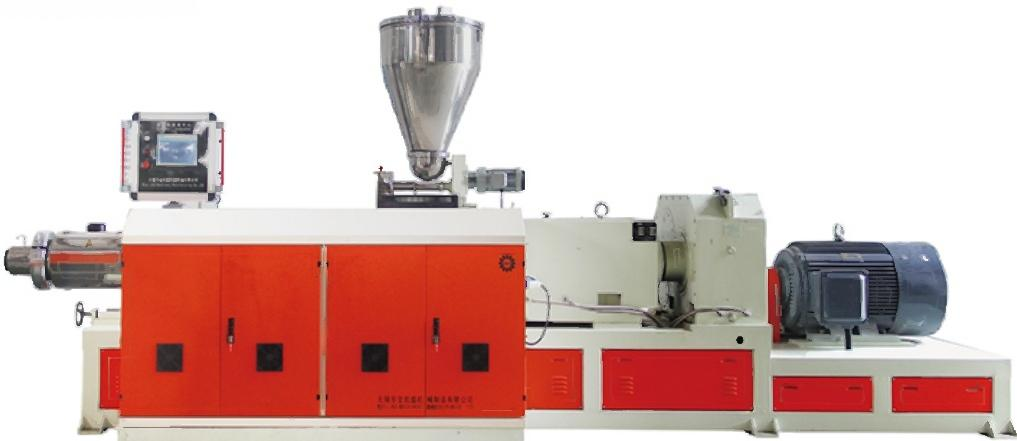
SJSZ conical twin screw extruder: documented for direct extrusion of PVC powder into pipes, sheets, bars and profiles, with low shearing and uniform mixing.
Rated Extruder Output Is Not Line Output
The most common shortlisting error is treating the rated output of a standalone extruder as the output of the finished line. The published JKS documents show both numbers for the same model, and they differ. A standalone SJSZ-80 is rated 400 kg/h at 55 kW; the same model family appears inside the PVC and WPC foam board line as SJSZ80/156 at 75 kW with 400–500 kg/h of line output, and inside the WPC door panel line as SJSZ80 at 75 kW with 250–400 kg/h of output. The differences come from formulation, product geometry and downstream equipment, not from the screw.
| Production line (documented) | Matched extruder | Main motor power | Documented line output and product range |
|---|---|---|---|
| PVC water supply and drainage pipe line, PVC63 | SJSZ65/132 conical twin screw | AC 37 kW | 270 kg/h; pipe Φ16–63 mm; hauling speed 4–49 m/min |
| PVC water supply and drainage pipe line, PVC250 | SJSZ80/156 conical twin screw | AC 55 kW | 450 kg/h; pipe Φ90–250 mm; hauling speed 4–15 m/min |
| PVC water supply and drainage pipe line, PVC630 | SJSZ92/188 conical twin screw | AC 110 kW | 800 kg/h; pipe Φ315–630 mm; hauling speed 0–5 m/min |
| PVC and WPC door and window profile line | SJSZ92/188; SJSZ65/132 | 110 kW; 37 kW | 500–600 kg/h with panel width up to 1200–1600 mm; 150–250 kg/h for door jamb, casing and surround profiles |
| PVC and WPC foam board line | SJSZ80/156; 80+165 co-extrusion | 75 kW; 75+37 kW | 400–500 kg/h; finished width 1220 mm |
| PVC imitation marble sheet line | SJSZ80/156; SJSZ92/188 | 75 kW; 110 kW | 400–700 kg/h; sheet thickness 1–12 mm; effective width 1220 mm |
| SPC flooring extrusion line (EIR in-line synchronous embossing) | SJSZ92/188; SJSZ110/220; SJP115/30; SJP135/30 | 110 kW; 200 kW; 90 kW; 132 kW | 15–40 tons per 24 h depending on extruder model; thickness 1–10 mm; effective width 980 mm or 1250 mm |
| PVC hot-cut pelletizing line | SJSZ55; SJSZ65; SJSZ80; SJSZ92 | 22 kW; 37 kW; 55 kW; 110 kW | 100–150 kg/h; 200–250 kg/h; 350–400 kg/h; 650–800 kg/h |
Reading rule for a shortlist: use the standalone model table to pick the screw family and the power band, then use the line-matched configuration table to select the actual machine for a defined product. The two tables answer different questions, and mixing them produces either an undersized line or an oversized power contract.
A Shortlisting Sequence Buyers Can Apply Directly
- Fix the finished product and its dimensions. Pipe outside diameter and wall range, sheet or panel width and thickness, or rod diameter. The PVC pipe lines show how strongly this single input drives the model: Φ16–63 mm runs on SJSZ65/132, Φ90–250 mm on SJSZ80/156, and Φ315–630 mm on SJSZ92/188.
- Fix the material form and filler level. PVC dry-blend powder points to the SJSZ conical twin range; PP, PE, PA, POM or ABS granulate and regrind point to the SJ single screw range. The PP hollow formwork line, for example, is documented around PP recycled granule with MFI below 3.
- Convert the capacity target into a model band. Use the documented outputs as anchors: SJSZ-55 at 150 kg/h, SJSZ-65 at 250 kg/h, SJSZ-80 at 400 kg/h, SJSZ-92 at 500–600 kg/h as a standalone extruder, and SJ-90×33 at 180–250 kg/h.
- Check the upstream mixing and reclaim chain before confirming the extruder. A high-output extruder with an undersized mixer becomes a bottleneck, not a capacity gain.
- Check the infrastructure the model implies. Installed power, transformer capacity, voltage and frequency, and the physical footprint of the complete line.
- Confirm compliance and documentation last, but before commercial comparison. Certification scope, testing records and warranty terms belong in the shortlist column, not in the contract appendix.
Constraints That Decide More Than the Model Number
Power and infrastructure
The jump from SJSZ-80 at 55 kW to SJSZ-110 at 200 kW is not a machine-level decision; it is an infrastructure decision. At the upper end of the range, the whole line, not the extruder, sets the electrical requirement. The PP hollow construction formwork extrusion line illustrates the scale: 380 V / 50 Hz three-phase supply, a recommended 315 kVA transformer, and an overall machine dimension of 34 m × 7 m × 4.5 m. Buyers shortlisting the larger SJSZ models should treat the transformer, cable routing and available floor length as gating constraints.
Upstream mixing throughput
For PVC-based lines, the mixing and cooling unit must keep pace with the extruder. The documented SRL-Z range spans 300–400 kg/h (SRL-Z200/500, 37/7.5 kW), 450–600 kg/h (SRL-Z300/600, 55/11 kW), 800–1000 kg/h (SRL-Z500/1000, 75/15 kW) and 1600–2000 kg/h (SRL-Z1000/3000, 160/22 kW), with a mixing cycle of 8–10 minutes per pot and a cooling cycle of 6–8 minutes per pot. The cycle time, not only the hourly rate, decides whether one mixer can feed one extruder continuously.
Reclaim and pelletizing chain
Lines that run regrind or in-house reclaim need the auxiliaries sized with the same discipline: the SP400 crusher at 15 kW and 300–400 kg/h, the SP660 at 22 kW and 600–700 kg/h, the MF400, MF500 and MF600 pulverizers at 30 kW / 200 kg/h, 37 kW / 300–400 kg/h and 55 kW / 400–500 kg/h with 40–80 mesh fineness, the ST80–ST150 strand pelletizing range from 70–160 kg/h to 350–650 kg/h, and the SJSZ-based hot-cut pelletizing range from 100–150 kg/h to 650–800 kg/h.
Compliance and Documentation Constraints
CE marking is a shortlist criterion in itself for EU-bound equipment, and it should be verified against the certificate rather than a brochure statement. The relevant JKS certification is CE certificate number M.2021.206.C.64011, issued by UDEM International Certification Auditing Centre, covering Machinery, LVD and EMC directives, with a scope that names plastic extrusion lines including the SJSZ series, SJ series and SJP series models. The cited standards include EN ISO 12100:2010, EN 1114-1:2011, EN 60204-1:2018, EN 61000-3-2:2014, EN 61000-3-3:2013, EN 61000-6-1:2007 and EN 61000-6-3:2007/A1:2011/AC:2012, and the certificate is issued for global markets including the EU, Southeast Asia and the Middle East.
Because certificates carry finite validity periods, the issue date on the document and its current status should be confirmed during supplier evaluation. Alongside the certificate, buyers should also confirm the manufacturing-side controls that support it: 100% factory pre-assembly and testing before shipment, third-party inspection available on request, a 12-month warranty, and the service package covering overseas installation guidance, on-site commissioning, operator training and remote technical support.
What This Shortlist Cannot Tell You
A shortlist that only lists strengths is a sales document. Three boundaries matter here.
- The two families are not alternatives for the same job. The SJSZ conical twin screw extruder is documented for direct extrusion of PVC powder; it is not positioned as a general-purpose machine for PA or POM rod production. Conversely, the SJ single screw range is documented as a versatile machine for multiple thermoplastics, but it is not the specialist route for high-filled PVC dry blend.
- Published parameters are not commercial guarantees. Rated output is quoted per extruder configuration; the line output tables show the same model producing different tonnages depending on formulation, product thickness and downstream equipment. Any capacity commitment should be tied to a defined product and formulation.
- Some models have no published parameter set. SJ30 appears in the custom model list of the SJ series without published motor power or output figures, and the standalone SJ90 is documented through the SJ-90×33 configuration on the PP formwork line rather than as a stand-alone specification sheet. For those models, the shortlist entry is a configuration request, not a comparison row.
For context on the wider supply landscape, third-party industry listings for 2024 place Coperion, KraussMaffei, Davis-Standard and Jwell Machinery among globally recognised extrusion equipment suppliers. That matters for benchmarking documentation standards and service organisation, but those suppliers are not directly comparable to a custom-line manufacturer on a model-by-model basis, and no performance ranking should be inferred from a name list.
Market Context Behind the Model Choice
The shortlist is shaped by where demand is concentrated. Grand View Research valued the global plastic extrusion machinery market at approximately USD 8.93 billion in 2024, projected to reach USD 11.58 billion by 2030, with Asia Pacific holding a 41.5% revenue share in 2024 and China as the leading contributor in the region. Single screw extrusion machines accounted for roughly 62.7% of that market in 2024, which is consistent with the breadth of the SJ range across pipe, rod, film and profile work.
On the product side, Dataintelo values the global pipe extrusion lines market at USD 4.8 billion in 2025, with PVC as the leading material segment at 38.6% — the segment where SJSZ conical twin screw models from SJSZ-45 to SJSZ-110 are most directly positioned. The Stone Plastic Composite flooring market is projected by Grand View Research to grow from USD 6.4 billion in 2026 to USD 10.3 billion by 2033 at a 7.2% CAGR, which explains why the upper end of the SJSZ range, and the SJSZ110/220 configuration in particular, appears in SPC flooring lines. Market size estimates for extrusion machinery vary considerably between research houses depending on scope, so figures should be read as directional rather than exact.
Evidence from Operating Installations
Documented installed base is a useful counterweight to specification tables. A Vietnamese plastic building materials manufacturer operates one complete PVC hollow wall panel extrusion line for construction and interior decoration panels, in stable operation for more than five years, supplied as a turnkey solution with on-site installation support and full export documentation. Two SPC flooring references are documented in the same way: a Malaysian SPC flooring manufacturer running a complete SPC flooring line for more than ten years, and a Korean plastic flooring manufacturer running an SPC line for more than eight years with stable 24/7 production. These references indicate which configurations have been proven in the field, but they do not replace line-level performance testing against your own formulation.
Future Outlook
Two directions are visible from the model data alone. First, capacity is concentrating at the top of the SJSZ range: the SPC flooring line documentation moves from SJSZ92/188 at 110 kW to SJSZ110/220 at 200 kW, and output is quoted in tons per 24 hours rather than kilograms per hour. Second, single screw configurations continue to hold a large share of general thermoplastic processing, where product diversity rather than peak tonnage drives the purchase. For buyers, the practical implication is that the shortlist should be built around the product portfolio planned for the next three to five years, not only the first product to be launched — because the extruder frame is the least replaceable component in the line.
FAQ
What is the practical difference between an SJ single screw extruder and an SJSZ conical twin screw extruder?
They are documented for different feed forms and product families. The SJSZ conical twin screw extruder is specified for direct extrusion of PVC powder into pipes, sheets, bars and profiles, with characteristics including uniform plasticising and mixing, low shearing, high productivity, stable quality and long service life. The SJ single screw extruder is specified for PVC, PP, PE, Nylon and ABS and, with different moulds and auxiliary equipment, for pipes, rods, films, pellets, coated products and blow-moulded bottles.
Which models should be shortlisted for a specific product family?
For PVC pipe lines, the documented pairings are SJSZ65/132 for Φ16–63 mm at 270 kg/h, SJSZ80/156 for Φ90–250 mm at 450 kg/h, and SJSZ92/188 for Φ315–630 mm at 800 kg/h. For PVC hollow wall panel and ceiling lines, the documented models are SJSZ51 (300 mm width, 120 kg/h), SJSZ55 (450 mm, 150 kg/h), SJSZ65 (600 mm, 250 kg/h) and SJSZ80 (1200 mm, 400 kg/h). For solid plastic rod, the SJ45 and SJ65 frames are documented at Φ6–60 mm and Φ30–200 mm respectively.
How should rated extruder output be read against a capacity plan?
Rated output describes the extruder under its own reference configuration, not the finished line. The SJSZ-80, for example, is rated 400 kg/h at 55 kW as a standalone extruder, while the same model family is documented at 400–500 kg/h in the PVC and WPC foam board line and at 250–400 kg/h in the WPC door panel line. Capacity commitments should therefore be tied to a defined product, formulation and downstream configuration.
What machine data should be requested before comparing quotations?
At minimum: screw diameter and L/D ratio, main motor power, rated output for the intended material, screw and barrel material (38CrMoAlA nitrided alloy steel is the documented specification), frame material (Q235 carbon steel), the matched downstream equipment list, and the electrical specification. For models without published parameter sets, such as SJ30, the configuration sheet is the only reliable comparison basis.
What infrastructure does a shortlisted extruder imply?
It scales with the model. The PP hollow construction formwork extrusion line is documented at 380 V / 50 Hz three-phase with a recommended 315 kVA transformer and an overall machine dimension of 34 m × 7 m × 4.5 m. The SJSZ-110 is documented at 200 kW of motor power. Buyers should confirm transformer capacity, cable routing and floor length before confirming the extruder model.
What certifications and documentation should accompany a plastic extrusion line?
For EU-bound equipment, CE certification is the baseline. The relevant certificate here is number M.2021.206.C.64011, issued by UDEM International Certification Auditing Centre for Machinery, LVD and EMC directives, covering plastic extrusion lines including SJSZ, SJ and SJP series models, with cited standards including EN ISO 12100:2010, EN 1114-1:2011 and EN 60204-1:2018. The current validity status of any certificate should be confirmed against the original document, since certificates have finite validity periods.
Can an extruder be customised for a specific formulation, voltage or line layout?
The documented customisation scope covers extruder model, screw configuration, production line layout, voltage and frequency, control system and capacity adjustment, under OEM, ODM and custom design service. The documented commercial terms are a minimum order quantity of one unit and a lead time of 40 working days, with 100% factory pre-assembly and testing before shipment, third-party inspection available on request, and a 12-month warranty with overseas installation guidance, on-site commissioning, operator training and remote technical support.
Reference material: a downloadable project brochure covering the JKS WPC door application is available at JKS WPC door project brochure (PDF). Extruder model data referenced in this article is drawn from published JKS specification documents covering the SJ and SJSZ series and their matched production lines.