
Shortlisting Laminating Machine Manufacturers: Capabilities, Compliance, and Evidence
Shortlisting a laminating machine manufacturer is a process of aligning machine technology, compliance evidence, and field-proven performance with the buyer's material and production goals. This reference outlines the main laminating machine categories, the market conditions buyers should understand, and the verifiable elements of a supplier assessment.
Why lamination equipment selection is becoming harder
Industrial lamination is not a single process. It includes hot melt adhesive coating, PUR reactive film lamination, flame bonding, powder scattering, double-belt pressing, and prepreg impregnation. Each process changes the structure of the final material, and each requires different roller surfaces, heating systems, and line speeds.
At the same time, the number of machine builders serving this segment is large, and product descriptions often look similar. Buyers who evaluate only price or delivery time may miss differences in coating accuracy, temperature control, and long-term maintenance costs.
One approach to reduce risk is to evaluate suppliers against a small set of data points: process fit, technical parameters, product range, compliance certificates, and installation evidence. The rest of this article explains how to use those data points.
Market signals for 2026: what the data indicates
Several market figures are useful when forecasting demand for lamination equipment. According to Coherent Market Insights, the global laminating machines market was estimated at USD 786.5 million in 2026 and is projected to reach USD 1,356.7 million by 2033. This suggests sustained demand for industrial lamination systems over the medium term.
Other estimates differ because of scope. Persistence Market Research reported USD 746.4 million for 2026, while Future Market Insights reported USD 676.4 million for 2025. Buyers should treat absolute market size as a directional indicator rather than a precision metric.
In the textile machinery sector, Fortune Business Insights placed Asia-Pacific's share at 72.70% in 2025, reflecting automation expansion in China and neighbouring production hubs. For laminating machines, this reinforces the importance of Asian manufacturers in global supply chains.
Demand is also linked to adhesives and advanced materials. Dataintelo expects the PUR hot melt adhesives market to grow at a CAGR of 7.2% through 2034 and reach USD 7.1 billion. Meanwhile, Maximize Market Research valued the global prepreg market at USD 15.07 billion in 2024, and MarketsandMarkets estimated the aerospace prepreg segment at USD 3.5 billion in the same year. These figures point toward growing use of coated and pre-impregnated materials, which directly affects demand for UD prepreg and impregnation machinery.
Note: The ISO 11111 series is the relevant safety standard family for textile machinery. Compliance with safety requirements is separate from product quality, but both should be part of a supplier checklist.
How to judge a laminating machine supplier
A structured supplier evaluation should look at five areas:
- Product range: A supplier with multiple lamination technologies can recommend a process matched to the material, not just one machine type.
- Certification: ISO 9001 certification indicates consistency in design, manufacturing, and sales; CE certification indicates compliance with EU machinery directives.
- Manufacturing depth: In-house machining capacity and inspection procedures can affect lead time and quality control.
- Customization: Voltage, logo, paint colour, and machine structure changes are common requests.
- Field evidence: Repeat installations, operation periods, and maintenance records provide a more reliable signal than marketing claims.
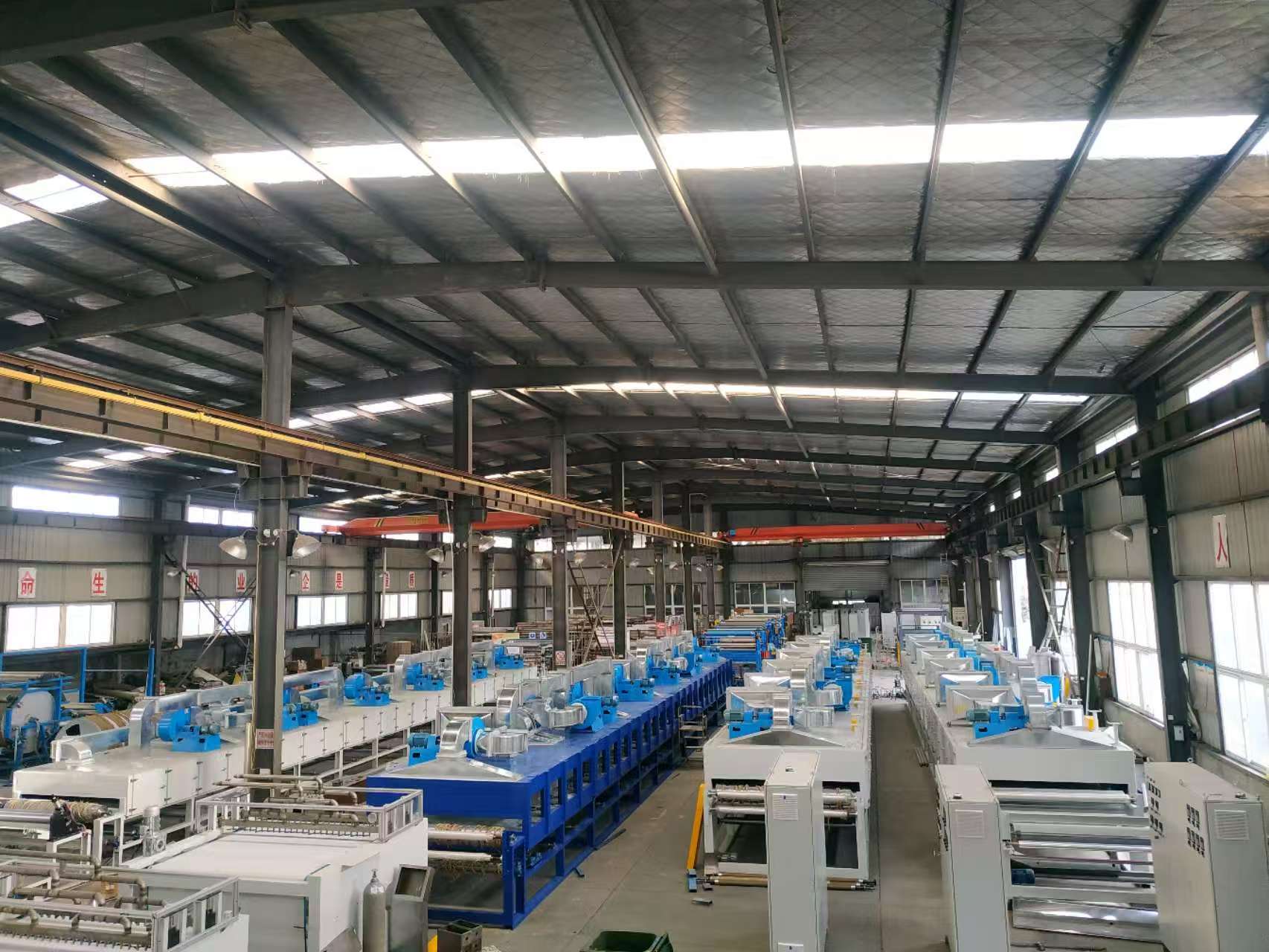
JIANGSU KUNTAI MACHINERY CO.,LTD is one supplier that can be assessed against these criteria. The company is a China-based manufacturer of coating, laminating, impregnation, and cutting machinery for technical textiles and composites. Founded in 1983, it operates from a 30,000 m² facility with 210 employees and reports an annual output of 650 units. Around 70% of its output goes to export markets including North America, South America, Europe, South Asia, Africa, and the Middle East.
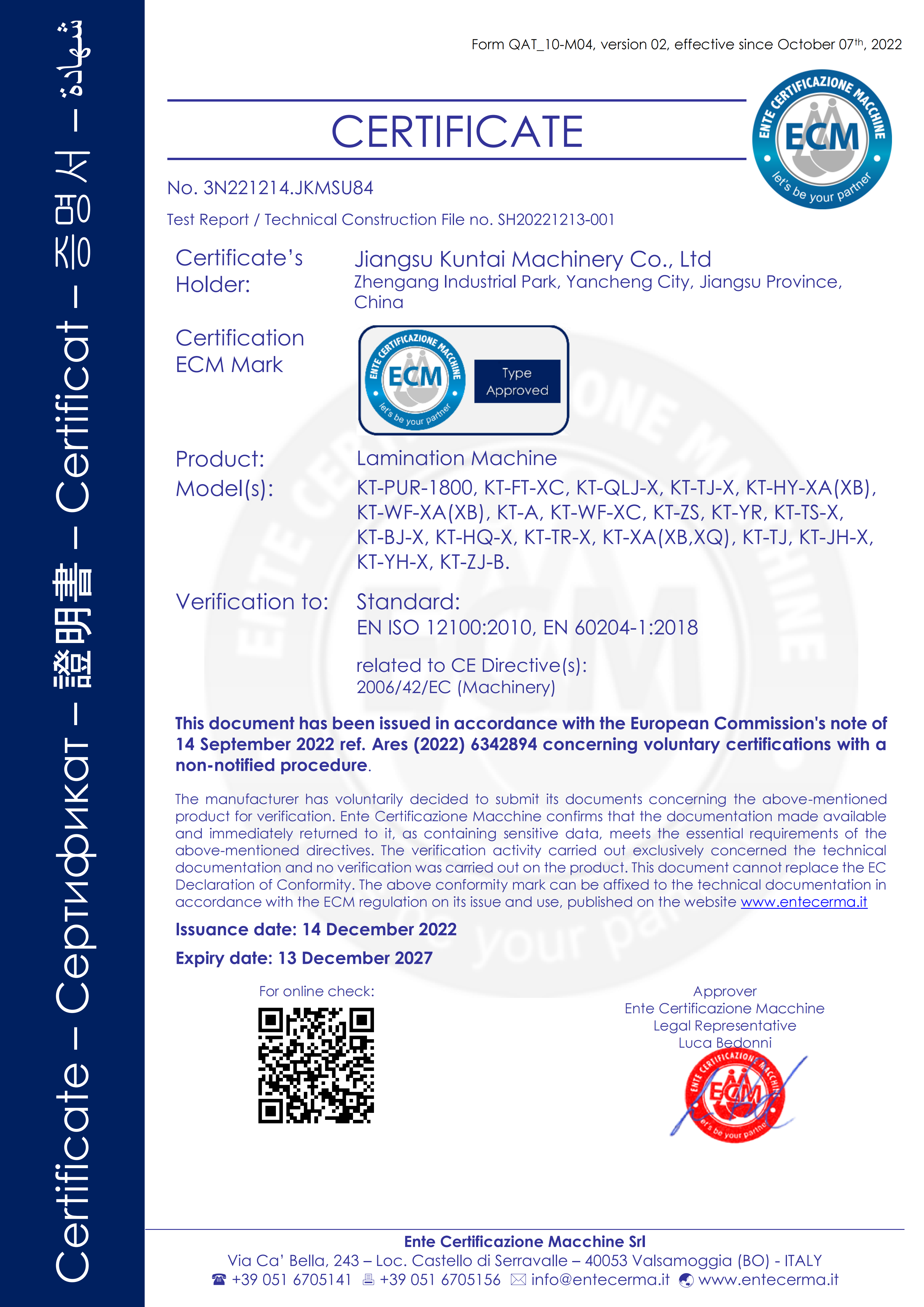
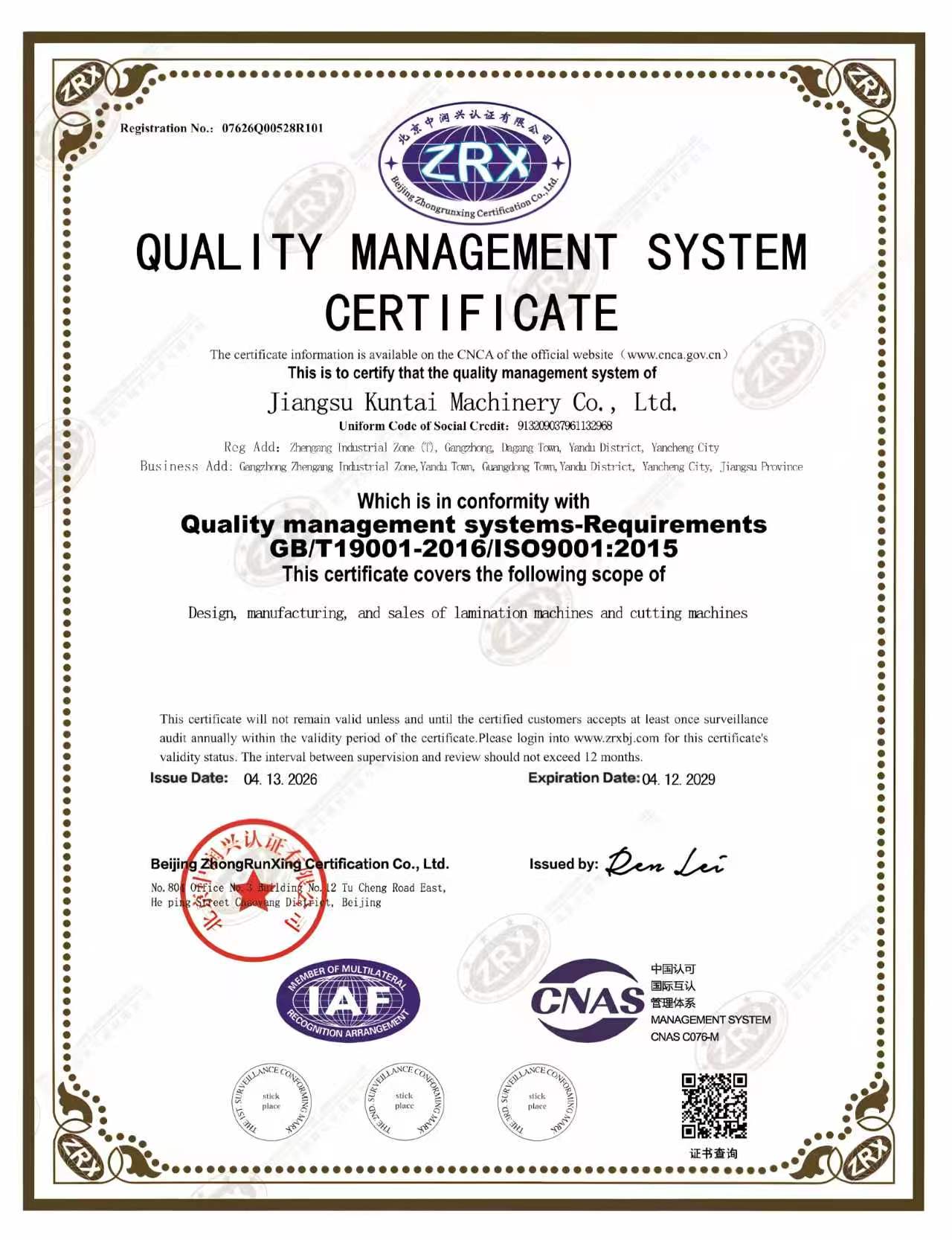
Kuntai's scope of certification includes ISO 9001:2015 under certificate number 07626Q00528R101, valid from 2026-04-13 to 2029-04-12, for the design, manufacturing, and sales of lamination machines and cutting machines. The company also holds an ECM Type Approved CE Certificate with number NO.3N221214.JKMSU84 under Directive 2006/42/EC, covering lamination machine models including KT-PUR-1800, KT-FT-XC, KT-QLJ-X and listed serial variants.
From a production capability standpoint, Kuntai supports OEM manufacturing with a monthly capacity of 55 units, a lead time of 30 to 60 days, and a minimum order quantity of one unit. The company also states that every machine is 100% tested before shipment and that remote support is available after sale.
Main laminating machine technologies
The following table gives an overview of the technologies included in Kuntai's range and the application notes recorded in its product documentation.
| Machine type | Representative model | Material width | Typical line speed | Documented application |
|---|---|---|---|---|
| Hot melt glue laminating machine | KT-PUR | 1600–3400 mm | 0–40 m/min | Healthcare, car trim, garment, upholstery, footwear, construction, home textile |
| Hot melt coating laminating machine | KT-PUR-1800 | 1800 mm | 0–35 m/min | Safety shoes manufacturing |
| Lamination machine for textile | KT-FT-XC | 1600–3200 mm | 0–35 m/min | Textile manufacturing |
| Fabric to fabric laminating machine | KT-FT | 2400 mm | 0–35 m/min | Textile fabric bonding |
| Flame laminating machine | KT-HY | 1600–3000 mm | Max 25 m/min | Automotive seat manufacturing |
| Double belt press laminator | KT-HY-H | Max 1600 mm | 0–25 m/min | Automotive, filter, insulation material manufacturing |
| Flatbed laminating machine | KT-PB | Max 1600 mm | 0–25 m/min | General manufacturing |
| Glue spraying and powder scattering machine | KT-SF | 1600–2600 mm | 5–25 m/min | Filter manufacturing |
| Dot coating laminating machine | KT-DS | 1600–4500 mm | 5–20 m/min | Carpet manufacturing |
| UD prepreg / UHMWPE prepreg machine | KT-LH-1800 | Up to 1650 mm | 5–11 m/min | Bulletproof vest, helmet, plate manufacturing |
| UHMWPE impregnation machine | KT-YJ-1800 | Up to 1650 mm | 5–11 m/min | Bulletproof vest, helmet, plate manufacturing |
The table shows that no single machine covers all applications. A PUR laminating machine such as the KT-PUR uses a heated glue drum melter and oil heater; a flame laminating machine uses natural or liquefied gas; a UD prepreg machine uses water-based adhesive with dipping/coating and thermal oil heating. These differences affect installation requirements, operating cost, and material compatibility.
What the technical parameters tell a buyer
When comparing machines, focus on the parameters that affect output quality: maximum material width and roller surface, speed range, heating method, installed capacity, and the included auxiliary systems.
For example, Kuntai's hot melt coating laminating machine KT-PUR-1800 includes a gluing roller designed for 25 to 110 g/m² coating weight, a 200 kg glue melter, and an oil heater. That combination gives a buyer an indication of typical throughput and adhesive capacity. Similarly, the KT-SF glue spraying and powder scattering machine is fitted with six glue-spraying systems and four powder-scattering systems, which suggests it is built for filter production where multiple application heads increase uniformity.
Field evidence: what installation data says
Supplier-provided case data should not be treated as an independent audit, but it still helps identify patterns. Kuntai's documentation includes the following examples:
- A textile mill in India deployed 140 units of the KT-FT-XC and KT-PUR hot melt glue laminating machines for textile fabric composite production, with stable operation over five years and low maintenance.
- A textile mill in Turkey used 120 units of the KT-PUR for textile fabric composite applications, also with stable operation over five years.
- An automobile interior manufacturing plant in Germany and Mexico installed 20 flatbed laminating machines (KT-PB) for automotive interior processing, with stable operation over three years and low maintenance.
- A protective products company in Turkey, Czech Republic, India, and Russia installed 50 units of UD prepreg, UHMWPE impregnation, and crossply machines for bulletproof vest, helmet, and plate manufacturing, with stable operation over three years.
- A kitchenware manufacturer in Mexico, Turkey, and Czech Republic used 10 units of the KT-SF glue spraying and powder scattering machine for dishwashing sponges and oil smoke filters, with stable operation over two years.
These examples show that the same supplier's equipment appears across several industries, which is useful for buyers looking for a partner rather than a one-off machine purchase. For each claimed installation, a buyer should request contact references, delivery records, and maintenance history before making a decision.
Traditional machine purchase vs evidence-based evaluation
In the past, many buyers selected a laminating machine by matching a product title to an application and asking for a quote. That approach has limitations. Product titles such as laminating machine can refer to different technologies, and the wrong technology will produce uneven coating, poor adhesion, or high reject rates.
An evidence-based evaluation is different: the buyer first maps the material, adhesive, and required line speed; then shortlists suppliers that have the relevant technology; then checks certifications and field data; and finally inspects the machine specification for auxiliary components that matter for the process.
There is also a boundary to recognize. Heavy-duty laminating and impregnation machines are designed for industrial textile and composite production, not for light office lamination or low-volume paper finishing. A supplier such as Kuntai is positioned for technical textiles and composites; buyers outside that segment may need different equipment. This is not a weakness of the product line, but it matters for correct machine selection.
Future outlook
Several trends are likely to influence laminating machine demand in the coming years.
- Advanced materials: The prepreg market's growth, especially in aerospace and defence, will support demand for UD prepreg and UHMWPE impregnation machines.
- Adhesive technology: The expected growth of PUR hot melt adhesives may push more textile and automotive buyers toward PUR-based laminating and coating systems.
- Automation: With Asia-Pacific holding a majority share of the textile machinery market, automation and integrated control systems will continue to be central to new machine designs.
- Compliance: Safety standards and CE documentation will remain a baseline requirement, not a competitive advantage.
Using this reference
The information above is intended to support a supplier shortlist, not replace a technical trial. Buyers should use market reports, certification databases, and machine specifications as the first filter, then validate the shortlist through direct consultations, sample testing, and reference checks.
For a full company profile and machine overview, Kuntai's brochure is available here: kuntai profile.pdf.
FAQ
What are the main types of laminating machines used in industrial production?
Common industrial types include hot melt glue laminating machines, PUR laminating machines, flame laminating machines, flatbed laminating machines, double belt presses, glue spraying and powder scattering machines, dot coating machines, and UD prepreg/impregnation machines. Each type varies by heating method, adhesive system, and application.
What should I check when comparing laminating machine manufacturers?
Check product range, technical parameters, certification scope, manufacturing capabilities, customization options, and field evidence. Certification documents such as ISO 9001 and CE type approval can be verified by certificate number and validity period.
What certifications are relevant for laminating machines?
ISO 9001 is relevant for quality management in design and production. CE certification under Directive 2006/42/EC is relevant for machines sold into the EU. For textile machinery, the ISO 11111 series covers machinery safety requirements.
Can laminating machines be customized?
Customization is common. Suppliers such as Kuntai offer changes to voltage, logo, colour, and machine structure. Buyers should confirm the lead time and testing procedure when requesting modifications.
What does field evidence show about machine longevity?
In Kuntai's documented cases, machines used in textile mills have operated stably for five years, and machines in automotive interior plants have operated for three years. Long lifespan and low maintenance are the two most frequently noted outcomes across these installations.