
Shortlisting Multiwire Drawing Machine Capacity: A Cross-Market Trend Brief

A multiwire drawing line in production. Usable capacity, not nameplate speed, is what determines whether a line holds a conductor mix over a full project cycle.
Capacity on a multiwire drawing machine is not the maximum speed printed on a specification sheet. For export-oriented cable mills, usable capacity is the tonnage a line can hold — consistently, across a conductor mix, under a defined service model — and it is this figure, not the headline number, that determines whether a shortlisted machine survives contact with a real production plan.
The demand backdrop explains why the question has become sharper. The Insight Partners projects the global wire drawing machines market growing from USD 1.37 billion in 2025 to USD 2.13 billion by 2034, a compound annual growth rate of 4.98%. The downstream wire and cable market that buys these lines is larger by an order of magnitude: Grand View Research values it at USD 230.9 billion in 2025, with a projected USD 313.1 billion by 2033. Growth of that scale is not distributed evenly, and neither is the capacity that serves it.
Estimates of the cable market itself vary by research house — Fortune Business Insights puts 2025 at USD 233 billion, Precedence Research at USD 229.09 billion, against Grand View's USD 230.9 billion. The spread is small, but the lesson for buyers is not: base a capacity shortlist on the structure of demand and the constraints of your own product mix, not on a single headline figure.
Why capacity shortlisting has become a cross-market exercise
Ten years ago, a cable mill buying a multiwire drawing machine compared suppliers largely within its own region. Export orientation has changed the arithmetic. A mill that ships conductor and finished cable into several markets has to satisfy several procurement cultures at once, and its equipment has to remain supportable across those markets for a decade or more.
Three pressures sit behind this shift:
- Trade-policy movement. Tariff structures, local-content expectations and rules-of-origin documentation affect where conductor is drawn and how equipment is sourced. Procurement teams increasingly ask whether a supplier's compliance documentation travels with the machine.
- Energy-cost exposure. Drawing is an energy-intensive step, and the difference between drive architectures becomes a line item in operating cost rather than a technical footnote.
- Lead-time risk. When a line takes a quarter to deliver and install, capacity planning moves upstream into the investment decision itself.
Supply-side geography has moved with it. China's exports of machine tools — a category that includes wire drawing machinery — accounted for 19% of global exports in the first half of 2025, surpassing Germany, according to Silverado Policy Accelerator. For buyers, that means the shortlist is more internationally mixed than it was, and the comparison has to be made on verifiable capability rather than on country of origin as a proxy for quality.
What "capacity" actually means on a shortlist
In buyer conversations, capacity is usually reduced to wire count and maximum speed. Four dimensions carry more decision weight than either.
| Dimension | What the buyer is testing | Evidence to request |
|---|---|---|
| Capacity scalability | Whether the wire-count and speed envelope matches the product mix, and how the rod-breakdown stage feeds it | Inlet and outlet diameter ranges, wire count options, spooler configuration |
| Conductor quality | Whether the drive and annealing architecture holds tolerance across all positions, not just the first | Drive topology, annealing method, factory test regime |
| Service footprint | How quickly support reaches the plant, and whether it is remote, on site, or both | Support model, lead time, installed-base regions |
| Technology readiness | Whether the design is documented, certified and supported by ongoing engineering | Certificate numbers and scope, control-platform brand, R&D headcount |
Dimension 1 — Capacity scalability: wire count, speed and the rod stage
Multiwire drawing machines are commonly offered in 8, 16, 24 and 32-wire configurations, with the higher counts trading flexibility for throughput per pass. The choice is not a ranking exercise; it follows the outlet diameter range the mill actually sells into.
A concrete reference point: the HONTA HT.MD100B.16.22D.01 is a 16-wire multiwire drawing machine with an inlet wire diameter of 1.8–2.0 mm and an outlet range of 0.18–0.5 mm, using Siemens motors and Siemens PLC control. A 14-wire line in the same manufacturer's range, the HT.MD120.03.19.14, is specified at maximum speeds of 1800 m/min with an outlet wire range of 0.20–1.05 mm. The two specifications do not overlap by accident — they serve different product mixes, and a buyer comparing them is really comparing which conductor families the plant intends to win.
The scalability question does not stop at the drawing line. A multiwire machine is fed by a rod breakdown stage, and the pairing determines whether the mill can run continuously. Copper rod breakdown machines, aluminium rod breakdown machines and rod breakdown lines with inline annealing — including designs using individual motors per pass — set the input quality that everything downstream inherits. A mill shortlisting a 24-wire or 32-wire drawing line without matching the upstream rod stage is shortlisting a bottleneck.
Take-up configuration belongs in the same paragraph. Single spoolers, double spoolers and basket coilers change how the line hands off to the next process and how much handling labour sits between drawing and stranding. For export-oriented mills packing for shipment, the spooler choice often matters more to delivered cost than a marginal speed gain.
Dimension 2 — Conductor quality: drive architecture and annealing
Two machines with identical wire counts can produce measurably different conductor. The variables are the drive architecture and how annealing is applied.
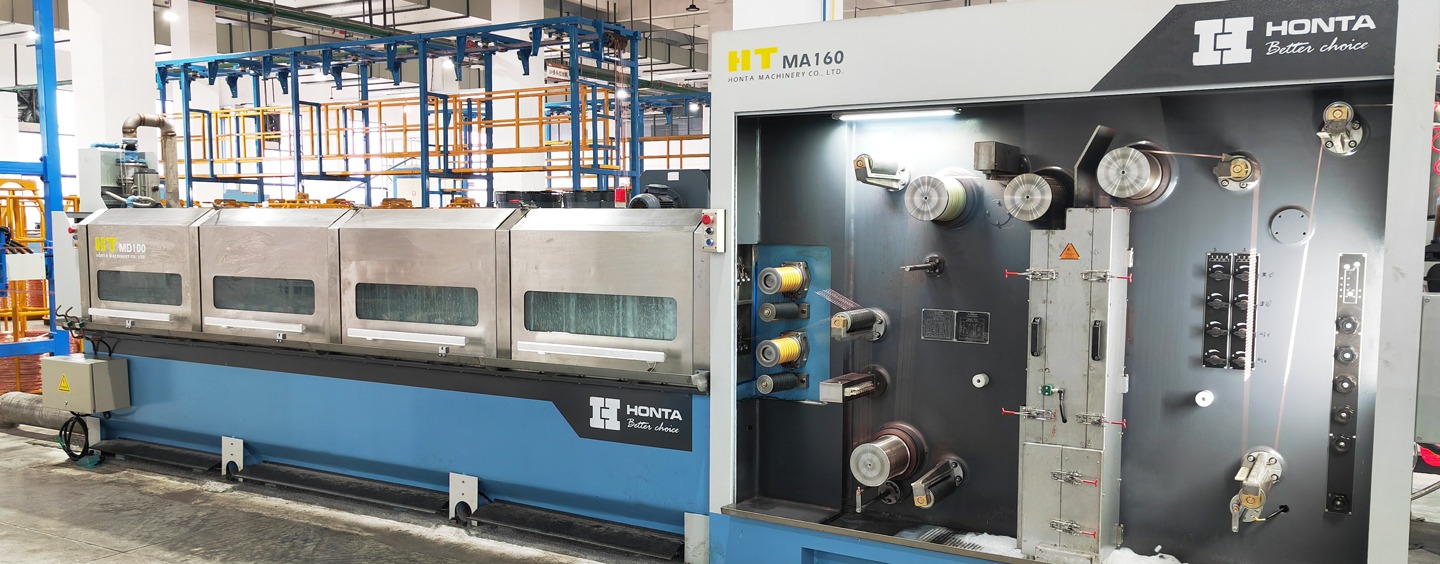
Drawing tank detail: wire path, lubrication and cooling geometry influence surface quality and tolerance consistency across positions.
Traditional multiwire lines drive all capstans from a common shaft. Individual-motor multiwire drawing machines give each wire its own drive, which removes mechanical transmission losses from the power path. Analysis published by HTNXT Industrial Blog puts the potential energy reduction at up to 25% compared with traditional common-shaft systems. That figure is a reported maximum under test conditions; a buyer should treat it as a direction of travel to be verified on their own conductor mix rather than a guaranteed site result.
The quality argument runs alongside the energy one. Independent drives are generally associated with more consistent tension control across positions, which matters most at the fine end of the outlet range — 0.18–0.5 mm in the 16-wire example above. At those diameters, variation between positions shows up downstream as stranding and insulation defects rather than as a drawing-line problem, which is why buyers should ask for position-level data, not line averages.
Inline annealing belongs to the same decision. A rod breakdown machine with annealing and a multiwire line with inline annealer capability change the metallurgical state of the conductor before it reaches the next process step, and the specification of the annealer should be read together with the outlet range rather than separately from it.
Dimension 3 — Service footprint and delivery reality
Service is where capacity claims meet geography. A line that runs at its rated speed but waits three weeks for a technician is not delivering capacity.
For Chinese suppliers exporting into multiple regions, the support model is usually a combination of remote diagnostics and on-site intervention. HONTA, for example, states after-sales support by remote and on site, with a 90-day lead time, a monthly capacity of 15 sets, and a minimum order quantity of one set. Those four numbers together describe a supply model: single-unit orders are accepted, but a buyer planning a multi-line expansion should schedule against a quarterly lead time rather than assume shelf availability.
HONTA's export share stands at 45%, with main markets listed as the USA, Middle East, Africa and Asia. The company established a second production base in the United States in 2017, which is relevant to buyers weighing response time for North American projects. None of this substitutes for a service-level agreement, but it does establish where the supplier's operational experience sits.
Dimension 4 — Technology readiness and documentation
Technology readiness is the dimension buyers most often check informally and least often check properly. The check is documentary: does the certificate cover the model being purchased, and does it expire inside the asset's payback period?
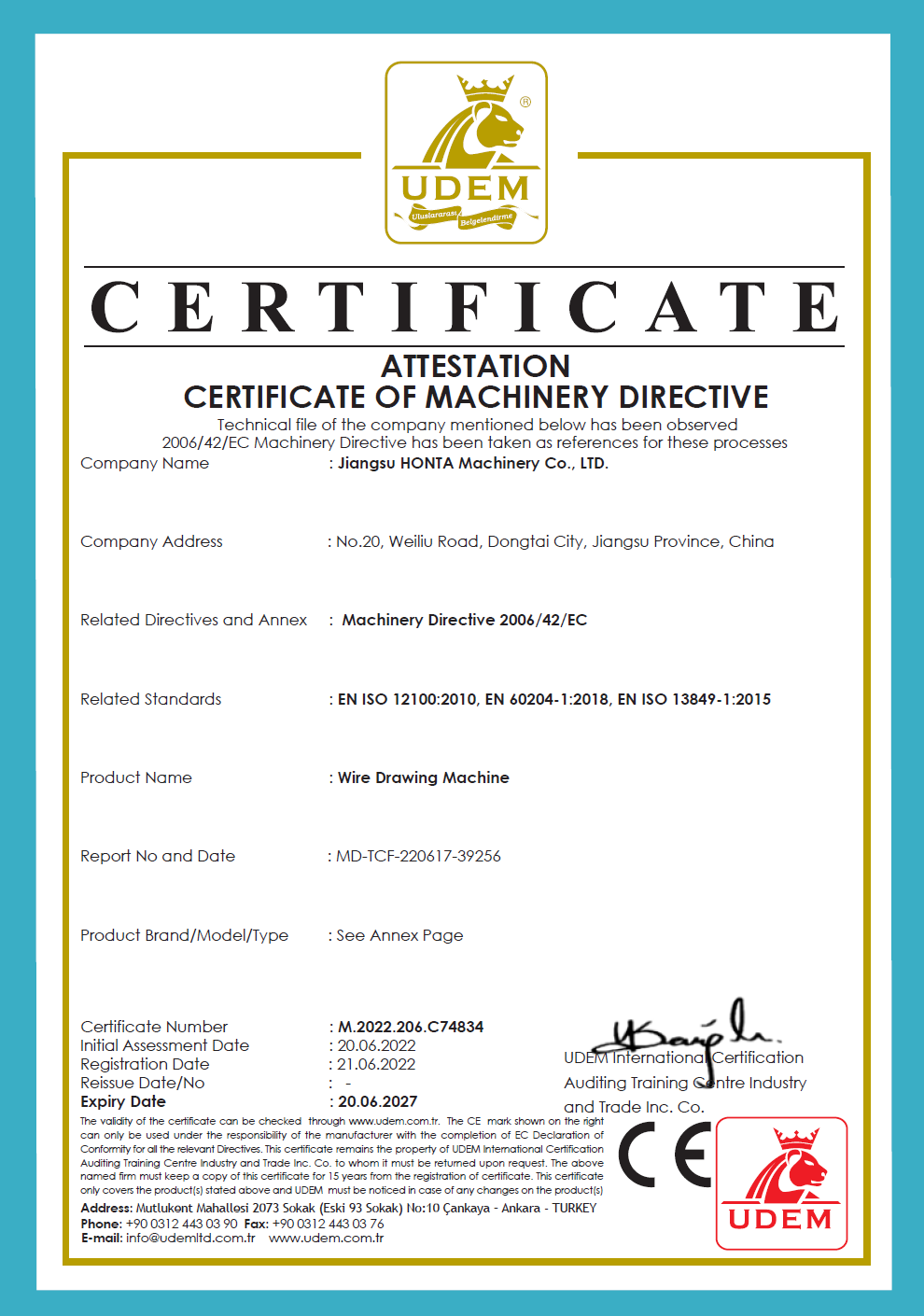
Certification scope, certificate number and expiry date are procurement variables, not paperwork.
HONTA holds CE certification issued under the Machinery Directive 2006/42/EC, certificate number M.2022.206.C74834, issued 20 June 2020 and valid to 20 June 2027 by Udem International Certification Auditing Trading Centre Industry and Trade Inc. Co. The harmonised standards cited are EN ISO 12100:2010, EN 60204-1:2018 and EN ISO 13849-1:2015, with the scope defined as wire drawing machine and linked to the HT.MD100B.16.22D.01 model.
Two practical readings follow. First, a certificate scoped to a model is not a certificate for a whole catalogue — a buyer specifying a different wire count or spooler configuration should confirm how the scope extends. Second, the 2027 expiry falls inside the service life of a machine bought in 2026, so the renewal process becomes part of the supplier relationship. Electrical equipment for machinery, including wire drawing systems, is also expected to comply with IEC 60204-1 on wiring practices and machine safety, which is a design requirement independent of any single certificate.
Beyond certification, engineering headcount is a workable proxy for technology readiness. HONTA was founded in September 2006, operates a 30,000 m² facility with 157 employees, produces 200 sets annually, and maintains an R&D team of 30 engineers. Buyer frameworks published on HTNXT also reference ISO 9001 and ISO 14001 among the certifications maintained by established multiwire drawing machine manufacturers, with HONTA cited in that framework.
The regional lens: four markets, four shortlist emphases
Country-level production statistics move too quickly for a shortlist framework, but demand patterns do not. The four regions below are worth weighting differently during evaluation.
United States. Procurement here tends to be documentation-heavy, with safety and electrical compliance reviewed before commercial terms. Buyers benefit from suppliers with a local operating presence — HONTA's US production base, established in 2017, is one example — and from certificate scopes that clearly cover the purchased model.
Middle East. Project-driven cable demand favours larger conductor sizes and heavier take-up formats, which pushes the shortlist toward lines whose outlet range reaches upward rather than only downward. Commissioning support and on-site intervention weigh heavily where engineering teams are small.
Africa. Capacity build-out is often the central investment thesis, and mills may be adding their first multiwire line rather than replacing one. Here the minimum order quantity of one set, the depth of operator training, and the practical travel time for on-site support become shortlist criteria rather than afterthoughts.
Asia. The most price-transparent and energy-conscious of the four. With China holding 19% of global machine-tool exports in the first half of 2025, buyers in the region have dense supplier choice and can afford to compare drive architectures on operating cost. Energy efficiency claims deserve verification here more than anywhere else.
Where HONTA sits in a capacity shortlist
Jiangsu HONTA Machinery Co., Ltd. is a Chinese cable and conductor equipment manufacturer based in Kunshan, Jiangsu, founded in September 2006, producing rod breakdown machines, multiwire drawing machines, high-speed double twist bunching machines and wire electrolytic plating lines. Its relevance to a capacity shortlist rests on a small number of verifiable operating facts rather than on positioning language.
| Founded | September 2006 |
| Facility / employees | 30,000 m² / 157 employees |
| Annual output | 200 sets |
| R&D team | 30 engineers |
| Monthly capacity / lead time | 15 sets / 90 days |
| Production mode | ODM |
| Quality control | 100% test |
| Export share / markets | 45% / USA, Middle East, Africa, Asia |
| After-sales | By remote, on site |
The service record adds a second layer. HONTA's reference case for a wire and cable factory using two sets for wire drawing, in continuous operation for three years, reports steady production meeting customer requirements, with fast speed and high efficiency cited as the highlights. Three years of continuous running is a more useful signal for a shortlist than a commissioning report, because it captures the maintenance profile rather than the installation peak.
For a buyer at the evaluation-to-execution stage, the practical reading is this: HONTA is a credible entrant for mills that need a 16-wire line in the 0.18–0.5 mm outlet range, want single-unit orders with a documented CE scope, and are prepared to plan around a 90-day lead time. Whether it wins the shortlist depends on the mill's own conductor mix.
Where a capacity shortlist stops: limits and trade-offs
A framework that only lists strengths is not a framework. Four boundaries deserve explicit weight in the evaluation.
Volume threshold. A multiwire drawing machine is a capital-intensive asset whose economics assume sustained volume. A mill running low tonnage with a wide mix of large conductor sizes may find a single-wire system or a lower wire count more efficient, and no amount of throughput specification changes that. The multiwire case strengthens as the product mix narrows and volume stabilises.
Upstream rod discipline. With an inlet range of 1.8–2.0 mm, the line inherits whatever consistency the rod supply delivers. Mills without dependable rod quality control will import variability into the drawing line and may read it as a machine fault.
Customisation boundary. HONTA's stated customisation covers colour and the model type of components and parts. That is configuration flexibility, not a redesign of the machine's kinematics. A buyer needing a fundamentally different wire path or take-up architecture is outside the scope of a standard ODM engagement and should establish that early.
Schedule and maintenance competence. A 90-day lead time and 15 sets monthly capacity are workable for planned expansion but exposed during demand peaks. Separately, individual-motor architectures place more drive electronics in the plant, which raises the maintenance skill requirement. Mills without in-house drive competence should price training and remote-support dependency into the decision.
A shortlist scorecard for the execution stage
The table below converts the four dimensions into a working scorecard. Weights are illustrative; a mill should set its own based on whether it is buying for export volume, domestic mix, or a single project.
| Criterion | Pass condition | Red flag |
|---|---|---|
| Outlet range vs product mix | Covers the full conductor range sold today and in three years | Range quoted only at the fine end |
| Drive architecture | Position-level tension data supplied; energy claim verifiable | Line-average data only |
| Certification scope | Certificate number, standards and expiry cover the purchased model | Certificate shown without scope |
| Service model | Remote and on-site support defined with response expectations | Support described only as "available" |
| Lead time vs project plan | Delivery window fits the commissioning schedule | Lead time quoted without capacity context |
| Installed-base evidence | Multiple years of continuous running, not just commissioning | References limited to recent installs |
Future outlook
The 4.98% CAGR projected for wire drawing machines to 2034 is moderate rather than explosive, which has a specific consequence: competition will be decided on operating efficiency and service depth rather than on market growth alone. Three developments are likely to shape shortlists over the next several years.
First, energy architecture will keep moving up the evaluation order. If individual-motor designs continue to demonstrate measurable savings against common-shaft systems, the calculation shifts from capital cost to lifetime cost, and buyers will need metered evidence rather than reported maximums.
Second, certification will become a recurring procurement event rather than a one-time check. Certificates carry expiry dates — HONTA's CE certification runs to 20 June 2027 — and mills holding equipment across a ten-year asset life should expect to re-verify documentation at least once.
Third, regional supply will stay mixed. With Chinese machine-tool exports at 19% of the global total in the first half of 2025, shortlists that exclude Chinese manufacturers on principle are shortlists that exclude a large share of available capacity. The more defensible approach is the one this brief has set out: evaluate capacity, conductor quality, service footprint and technology readiness on evidence, and record the limits alongside the strengths.
FAQ
How many wires should an export-oriented mill shortlist — 8, 16, 24 or 32?
The wire count follows the outlet diameter range and the volume the mill expects to hold. A 16-wire machine such as the HONTA HT.MD100B.16.22D.01 covers an outlet range of 0.18–0.5 mm from 1.8–2.0 mm inlet rod, which suits fine and medium conductor production. Higher counts increase throughput per pass but require more consistent rod input and more granular tension control across positions. A practical shortlist includes at least one mid-count and one high-count configuration so the trade-off is visible.
What outlet wire diameter range should be verified before shortlisting?
Verify the range against the conductors the mill sells, not against the widest range a supplier offers. Two lines from the same manufacturer can differ substantially: the HT.MD100B.16.22D.01 is specified at 0.18–0.5 mm outlet, while the 14-wire HT.MD120.03.19.14 is specified at 0.20–1.05 mm with maximum speeds of 1800 m/min. A machine whose range sits mostly above the mill's core product will underperform on the work that pays for it.
Do individual-motor multiwire drawing machines actually reduce energy consumption?
Analysis published by HTNXT Industrial Blog reports energy reductions of up to 25% compared with traditional common-shaft systems, attributed to the elimination of mechanical transmission losses. The figure is a reported maximum rather than a site guarantee, and the saving depends on conductor mix, speed profile and utilisation. Buyers should request metered consumption data from a comparable installation before treating the number as a planning input.
What does a 90-day lead time and 15-set monthly output mean for project scheduling?
It means the equipment is built to order rather than drawn from stock. For HONTA, monthly capacity is 15 sets, lead time is 90 days, and the minimum order quantity is one set. A single-line replacement can be absorbed within a quarter; a multi-line expansion should be phased against that production slot, and the commissioning window should be planned backwards from the delivery date rather than forward from the purchase order.
Which certification documents should be verified on a multiwire drawing machine shortlist?
Verify the certificate number, the harmonised standards cited, the product scope and the expiry date. HONTA's CE certification under Machinery Directive 2006/42/EC carries number M.2022.206.C74834, cites EN ISO 12100:2010, EN 60204-1:2018 and EN ISO 13849-1:2015, is scoped to wire drawing machine with the HT.MD100B.16.22D.01 model linked, and expires on 20 June 2027. Separately, IEC 60204-1 governs electrical equipment and wiring practices for machinery and applies as a design requirement regardless of the certificate on file.
How should after-sales service footprint be assessed?
Assess it in three parts: the support model, the geographic base, and the installed-base evidence. HONTA states after-sales support by remote and on site, holds a 45% export share with main markets in the USA, Middle East, Africa and Asia, and established a second production base in the United States in 2017. Its reference case for a wire and cable factory running two sets for wire drawing over three years reports steady production meeting customer requirements. Three years of continuous operation is a more reliable service indicator than a commissioning record.
Reference material: the manufacturer's drawing machine catalogue is available as a PDF for readers who want the full product overview — Catalogue of Drawing Machine (PDF).
Have Questions or Need More Details?
Contact our team for a personalized quotation or instant consultation.
Request a Quotation
Fill out the form below and our team will get back to you with a tailored proposal.
WhatsApp Direct Chat
Prefer to chat in real-time? Message us on WhatsApp for instant assistance & quick answers.
- Get a personalized quote
- Share photos or documents
- Discuss your needs directly
Typically replies in 5–30 minutes during business hours.