
Shortlisting RadiCal EC Centrifugal Fans for CRAH, In-Row and Fan Walls
Shortlisting RadiCal EC Centrifugal Fans for CRAH, In-Row and Fan Walls
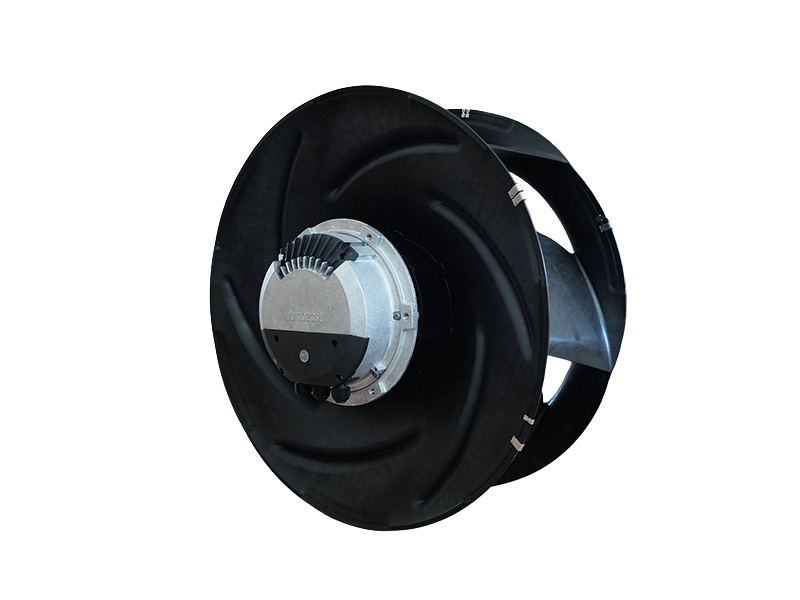
RadiCal EC centrifugal fan modules intended for data center CRAH units, AHUs and fan wall installations. Image: Hengrui EC Fan.
Data center cooling capacity is increasingly decided at the fan module rather than at the chiller. As rack power density rises, computer room air handling units, in-row coolers and fan walls must move the same or a larger air volume against higher system resistance, and the energy rules that govern that airflow now address the fan as a product rather than the facility as a whole. Fan model selection has therefore become a procurement decision with measurable consequences for power draw, controllability and retrofit risk.
This shortlist covers RadiCal EC centrifugal fan modules for three data center cooling architectures: CRAH and fan wall, in-row and precision cooling, and smaller filtration and air-purification duties. The modules and the specifications cited below are supplied by Beijing Hengrui Hongsheng Mechanical & Electrical Equipment Co., Ltd., a China-based supplier of EC fans established in 2011 and operating under the brand name Hengrui EC Fan. The company runs a 100,000 m² factory with approximately 700 employees, an R&D team of 80 engineers and technicians, and a stated annual production capacity of 50,000,000 units, with roughly 70% of sales exported and the USA as its main export market.
The Procurement Problem Behind Fan Wall and CRAH Retrofit
Three questions tend to arrive at the same time in a data center cooling project. The first is regulatory. Regulation (EU) 2024/1834, the ecodesign rule for industrial fans published by the European Commission, applies from 24 July 2026 and sets stricter efficiency thresholds for fans between 125 W and 500 kW. Every centrifugal module discussed in this shortlist falls inside that power band, from the 170 W R3G225-RE07-03 to the 6,800 W K3G450-PB29-L1 used in high-density CRAH and fan grid layouts.
The second question is energy behaviour at part load. A CRAH unit rarely operates at design airflow for its whole service life, and fan power scales steeply with speed. A module that can be commanded to a precise speed through Modbus or a 0–10 V signal allows the cooling system to follow the actual heat load instead of cycling between fixed stages.
The third question is retrofit risk. Replacing belt-driven or AC plug fan assemblies inside an existing cabinet means matching impeller diameter, supply voltage, control wiring and the mechanical interface, often inside a housing that was never designed for an electronically commutated module. The shortlist below is organised around that constraint rather than around catalogue order.
What Defines a RadiCal EC Centrifugal Fan Module
RadiCal is the impeller and module family used across the EC centrifugal fans in this shortlist. The centrifugal modules listed here combine a PP plastic impeller with a die-cast aluminium electronics housing, so the rotating assembly and the control electronics are a single supplied unit rather than separate components. The drive is an electronically commutated motor, which in the context of this product range means a direct-drive motor with integrated electronics — impeller, motor and control board are integrated in one module, and speed is commanded externally through Modbus or a 0–10 V / PWM signal.
The declared performance figure for these modules is the ErP operating point: an airflow and static pressure pair at which efficiency is stated. The R3G630-FB32-03, for example, declares 12,190 m³/h at 670 Pa, while the smaller R3G225-RE07-03 declares 705 m³/h at 458 Pa. Comparing modules by airflow alone is misleading for a CRAH or fan wall application, because the air path inside a cooling unit, a coil block and a filter section imposes resistance that must be overcome at that airflow.
Ingress protection is specified per model and is not uniform across the family. The 630 mm CRAH and fan wall module and the 500 mm CRAC and AHU module both carry IP55. The 355 mm in-row and precision cooling module and the 225 mm compact FFU module carry IP54. That distinction matters when the fan compartment shares air with a humidified room, a coil wash-down area or an outdoor-adjacent enclosure.
RadiCal Shortlist by Cooling Architecture
CRAH Units and Fan Walls: R3G630-FB32-03
The R3G630-FB32-03 is a 630 mm RadiCal EC centrifugal fan for data center CRAH and fan wall installations, intended for large-scale CRAH units, AHUs, data center fan walls and ventilation system retrofits. Its electrical specification is 3~380–480 VAC, 3,300 W, 5.1 A at 1,370 rpm, with an ErP operating point of 12,190 m³/h at 670 Pa. It carries IP55, supports Modbus and 0–10 V control, and includes soft start and electronic protection. The impeller is PP plastic with a die-cast aluminium electronics housing.
For fan wall architecture, the relevant characteristics are the air volume delivered at a moderate static pressure and the ability to run many modules in parallel under a shared controller. Soft start and electronic protection reduce the electrical stress of staging a wall of modules, and Modbus makes per-module speed and status visible to the building management system.
CRAC and AHU Units: R3G500-FA28-03
The R3G500-FA28-03 is a 500 mm RadiCal EC centrifugal fan classified for data center CRAC and AHU units, intended for the precision air conditioning industry and for server room air conditioning and air handling equipment. It is specified at 3~380–480 VAC, 2,850 W, 4.4 A, 1,900 rpm, with an ErP operating point of 8,715 m³/h at 794 Pa. It uses a PP plastic impeller and a die-cast aluminium electronics housing, carries IP55, and supports Modbus RTU. Load-following at part load and low noise are the two characteristics most relevant to a CRAC application, where the unit sits close to occupied or equipment-dense floor space.
In-Row and Precision Cooling: R3G355-RG56-01
The R3G355-RG56-01 is a 355 mm RadiCal EC centrifugal fan for in-row cooling and precision air conditioning, suitable for precision air conditioners, in-row cooling units, small CRAH units and air handling equipment. It is rated at 3~380–480 VAC, 930 W, 1.7 A, 2,240 rpm, with an ErP operating point of 3,205 m³/h at 640 Pa. It carries IP54, supports passive PFC, Modbus and 0–10 V control, and has integrated PID control. The combination of low power draw and a compact footprint is the reason this model appears in rack-adjacent equipment rather than in a large air handling section.
Compact FFU and Air Purification: R3G225-RE07-03
The R3G225-RE07-03 is a 225 mm RadiCal EC centrifugal fan for small FFUs and air purifiers, also used for filtration units and electronic equipment ventilation. It runs on a single-phase 1~200–240 VAC supply at 170 W, 1.4 A, 2,860 rpm, with an ErP operating point of 705 m³/h at 458 Pa, IP54 protection, 0–10 V or PWM control and a speed output signal. Within a data center context this model family is relevant to adjacent air purification and filtration equipment rather than to the primary cooling air path.
Shortlist Comparison at a Glance
| Model | Primary fit | Impeller | Supply / power | ErP operating point | Ingress protection | Control |
|---|---|---|---|---|---|---|
| R3G630-FB32-03 | CRAH, AHU, fan wall, retrofit | 630 mm RadiCal, PP | 3~380–480 VAC; 3,300 W; 5.1 A; 1,370 rpm | 12,190 m³/h @ 670 Pa | IP55 | Modbus / 0–10 V, soft start |
| R3G500-FA28-03 | CRAC, AHU, server room | 500 mm RadiCal, PP | 3~380–480 VAC; 2,850 W; 4.4 A; 1,900 rpm | 8,715 m³/h @ 794 Pa | IP55 | Modbus RTU |
| R3G355-RG56-01 | In-row, precision, small CRAH | 355 mm RadiCal, PP | 3~380–480 VAC; 930 W; 1.7 A; 2,240 rpm | 3,205 m³/h @ 640 Pa | IP54 | Modbus / 0–10 V, integrated PID |
| R3G225-RE07-03 | Compact FFU, air purifier | 225 mm RadiCal, PA | 1~200–240 VAC; 170 W; 1.4 A; 2,860 rpm | 705 m³/h @ 458 Pa | IP54 | 0–10 V / PWM, speed output |
Read as a group, the four modules cover a declared static pressure band from 458 Pa to 794 Pa at their ErP points, with airflow from 705 m³/h to 12,190 m³/h. That band suits fan walls and CRAH sections with moderate coil and filter resistance. It does not, by itself, answer every high-resistance application.
Deployment Notes by Application
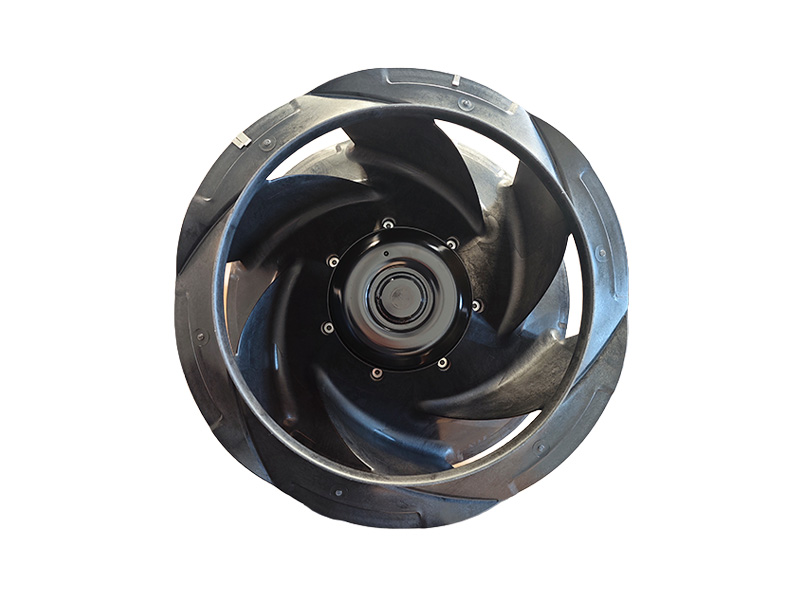
RadiCal EC centrifugal fans for data center CRAC and AHU units, where part-load speed control and IP55 protection drive the selection. Image: Hengrui EC Fan.
In a CRAH or fan wall, the practical selection driver is the number of modules and how they are staged. A wall of 630 mm modules at a declared 12,190 m³/h and 670 Pa per unit is controlled as a group; soft start limits inrush when modules are added, and Modbus allows the controller to hold a target airflow as individual modules are taken out for service. Because the modules are IP55, the fan compartment tolerates the humidity levels that occur downstream of a chilled water coil.
In a CRAC or AHU application, the trade-off shifts toward acoustic behaviour and part-load efficiency. The 500 mm R3G500-FA28-03 is specified for load-following at part load with low noise, and its 8,715 m³/h at 794 Pa suits a unit that must overcome a coil and a moderate filter bank. Modbus RTU integration means the unit controller can set speed directly rather than through an analogue signal that needs calibration.
In-row and rack-adjacent equipment imposes the opposite constraint: available depth and power budget. The 355 mm R3G355-RG56-01 draws 930 W and 1.7 A, which keeps the electrical load of a densely populated in-row unit manageable, and its integrated PID control allows the module to regulate itself against a local setpoint. The IP54 rating is a deliberate compromise in favour of a compact, low-power package rather than a sealed outdoor-grade enclosure.
For compact FFUs, filtration units and air purification equipment used alongside the cooling plant, the 225 mm R3G225-RE07-03 offers a single-phase supply, 170 W power draw and a speed output signal that lets the unit report actual operating speed back to its controller. Airflow of 705 m³/h at 458 Pa is consistent with compact filtration designs rather than with main air-handling sections.
Market Signals Shaping EC Centrifugal Fan Procurement
The global EC fan market was valued at USD 3.5 billion in 2024 and is projected to reach USD 6.7 billion by 2030, according to published market analysis covering the category. Growth of that scale is not driven by new building stock alone; it reflects the replacement of fixed-speed AC fans with speed-controlled EC modules in existing air handling, refrigeration and cooling equipment.
Regulation is reinforcing the same direction. Regulation (EU) 2024/1834, published by the European Commission, applies from 24 July 2026 and sets stricter efficiency thresholds for industrial fans in the 125 W to 500 kW range. For data center projects inside the European Union, this converts fan efficiency from a preference into a documented requirement, and it makes the ErP operating point a specification line that has to be compared rather than assumed.
Supply-side signals are equally relevant to buyers assessing continuity. The ebm-papst Group reported sales of EUR 2.098 billion for its 2024/25 fiscal year, a 13.1% decrease from the previous year, and Ziehl-Abegg reported 2024 revenue of EUR 893 million, down 7% from EUR 955 million in 2023. At the same time, China's fan exports under HS code 841459 reached 509 million units and USD 3.788 billion in 2024, up 6.96% in value. Taken together, these figures describe a market where European manufacturers have contracted while export-oriented supply from China has expanded, which is precisely the condition under which distributors and stock-holding suppliers become relevant to project schedules.
RadiCal EC Modules Compared with Traditional AC and Belt-Driven Fans
Traditional CRAH and air handling fan sections commonly use belt-driven centrifugal fans or AC motors with an external variable frequency drive. Those arrangements have practical advantages that should not be dismissed: the motor is a standard item, service skills are widely available, and the drive electronics sit outside the fan compartment where they can be maintained without opening the air path.
An EC centrifugal module changes several of those variables at once. Speed control and the drive electronics are integrated into the module rather than mounted separately, which removes belt losses and reduces the number of wearing parts. Soft start and electronic protection are built into models such as the R3G630-FB32-03. Speed commands arrive over Modbus or a 0–10 V signal, so part-load airflow is set digitally rather than mechanically.
The limitations are equally concrete, and a shortlist that omits them is not useful for procurement.
- Protection ratings vary by model. The CRAH and CRAC entries in this shortlist are IP55, but the 355 mm in-row module and the 225 mm FFU module are IP54. A specification that assumes IP55 across the whole range is incorrect.
- Enclosure protection is partly a system responsibility. For at least one RadiCal model in the wider range, the R3G355-AM14-61 cleanroom FFU fan, the supplier states that the final protection rating is to be ensured by the complete unit. The fan module is a component; the finished cabinet determines the rating that a room actually sees.
- Electrical infrastructure must match. The CRAH, CRAC and in-row modules in this shortlist require a three-phase 3~380–480 VAC supply. Only the 225 mm FFU module runs on single-phase 1~200–240 VAC.
- Control integration is a project task. Modbus or 0–10 V wiring, addressing and controller configuration have to be designed before installation; an EC module is not a drop-in mechanical replacement for a belt-driven fan.
- Static pressure ceiling. The RadiCal modules listed here declare ErP points between 458 Pa and 794 Pa. Applications requiring substantially higher static pressure need the aluminium-impeller RadiPac models rather than a larger RadiCal unit.
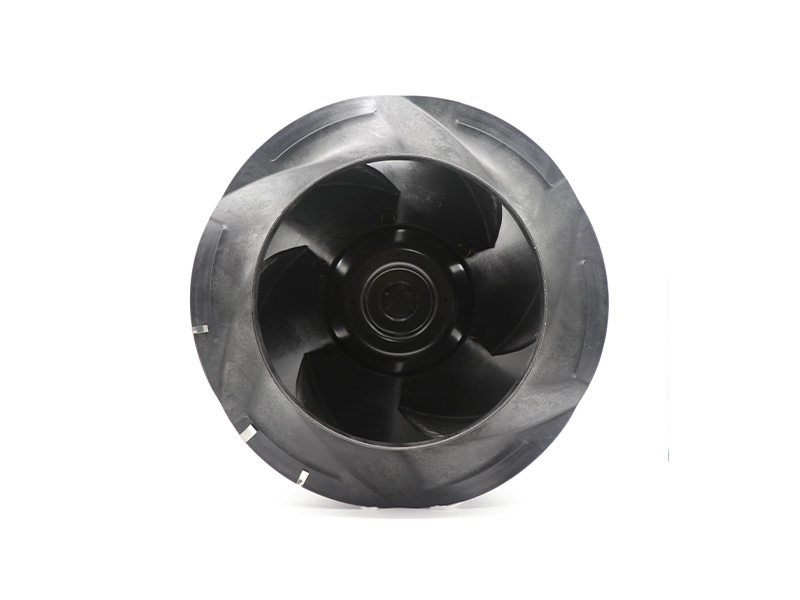
A 355 mm RadiCal EC centrifugal fan for in-row and precision air conditioning, rated IP54 with integrated PID control. Image: Hengrui EC Fan.
Future Outlook
The direction of travel is toward higher controllability per unit of floor space. As rack density increases, cooling architectures add parallel air movers — fan walls, in-row units, rear-door heat exchangers — rather than enlarging a single central fan. That favours modules that can be addressed individually over a fieldbus, protected to a stated ingress level, and replaced without dismantling the air path.
Regulation will continue to push in the same direction. With the European thresholds now applied to fans in the 125 W to 500 kW band, the ErP operating point becomes the common language between fan suppliers, air handling unit builders and data center operators. Buyers who compare modules at that declared point, rather than at headline airflow, will be comparing like with like.
For suppliers, the practical question is availability. Hengrui EC Fan states that it holds a large amount of ready stock to support fast shipment, alongside professional fan selection, system matching and after-sales support, and cites an annual production capacity of 50,000,000 units across a product range that includes EC fans, EC centrifugal fans, blower fans, DC axial flow fans, dry cooler fans, air handling unit fans and chiller fans. For retrofit projects that are already behind schedule, stock position is as much a selection criterion as the datasheet.
FAQ
1. What is an EC centrifugal fan doing in a data center CRAH unit?
An EC centrifugal fan moves air across the cooling coil and through the unit's filter and duct path. In the modules described here, the impeller, the electronically commutated motor and the control electronics are integrated into one unit, and speed is set externally through Modbus or a 0–10 V / PWM signal. For example, the R3G630-FB32-03 is classified for data center CRAH and fan wall installations, with an ErP operating point of 12,190 m³/h at 670 Pa and IP55 protection.
2. How do I choose between a fan wall module and an in-row module?
The choice follows the air path, not the room size. A fan wall or large CRAH section needs a large impeller that delivers high airflow at moderate static pressure, such as the 630 mm R3G630-FB32-03 at 12,190 m³/h and 670 Pa. An in-row or precision cooling unit has limited depth and a smaller power budget, which suits the 355 mm R3G355-RG56-01 at 930 W, 1.7 A and an ErP point of 3,205 m³/h at 640 Pa. The 500 mm R3G500-FA28-03 at 8,715 m³/h and 794 Pa sits between the two for CRAC and AHU duties.
3. What does the ErP operating point tell a buyer?
The ErP operating point is the airflow and static pressure pair at which efficiency is declared for the module. It is a comparison figure rather than a maximum. For instance, the R3G500-FA28-03 declares 8,715 m³/h at 794 Pa and the R3G225-RE07-03 declares 705 m³/h at 458 Pa. Because coil, filter and duct resistance all consume static pressure, a module should be matched at the pressure the equipment actually imposes, not at the highest airflow figure in the catalogue.
4. Why do some modules in the same family carry IP55 and others IP54?
Ingress protection is specified per model. In this shortlist, the 630 mm R3G630-FB32-03 and the 500 mm R3G500-FA28-03 both carry IP55, while the 355 mm R3G355-RG56-01 and the 225 mm R3G225-RE07-03 carry IP54. The rating reflects the intended installation environment as much as the construction of the module, and buyers specifying a single protection level across a whole project should verify it model by model.
5. What control and communication options are available across these modules?
The larger modules support fieldbus and analogue control: the R3G630-FB32-03 offers Modbus and 0–10 V with soft start and electronic protection, the R3G500-FA28-03 offers Modbus RTU, and the R3G355-RG56-01 offers Modbus, 0–10 V and integrated PID control. The compact R3G225-RE07-03 uses 0–10 V or PWM input with a speed output signal. The available interface therefore depends on the model, and the unit controller has to be planned around the interface that the selected module actually provides.
6. What has to be checked before replacing a belt-driven fan with an EC module?
Three things. First, the electrical supply: the CRAH, CRAC and in-row modules here require three-phase 3~380–480 VAC, while the 225 mm FFU module uses single-phase 1~200–240 VAC. Second, the control path: Modbus or 0–10 V wiring and controller configuration are part of the project, because speed commands are issued electronically rather than through a mechanical linkage. Third, the mechanical envelope: impeller diameters in this shortlist range from 225 mm to 630 mm, so the physical space inside the existing cabinet and the coil geometry have to be confirmed before a model is fixed.