
Shortlisting SYUTECH Woodworking Machines: Doors, Panels, Nesting
Shortlisting SYUTECH Woodworking Machines: Core Models for Doors, Panels, and Nesting Operations
Woodworking machinery rarely fails a buyer because the specification sheet was dishonest. It fails because the machine was assigned the wrong job. A panel that leaves the sizing station with an error of a few tenths of a millimetre does not simply arrive late at the edge banding machine — it arrives as a glued joint that cannot be closed cleanly, and then as a rework ticket downstream.
That is the practical reason to shortlist machinery by production task rather than by catalogue order. This article organises a compact shortlist of SYUTECH woodworking machines around three production realities that most panel furniture factories face at the same time: door and carcass drilling, panel sizing, and automated nesting flows — with particular attention to the automatic edge banding step that connects them.
Decision StageModel ShortlistApplication FitWhy Shortlisting by Operation Beats Shortlisting by Brand
Furniture equipment procurement usually begins with a supplier list and only later turns into a production plan. The order is backwards. A panel furniture line is a sequence, and each machine in the sequence has a defined tolerance responsibility that it passes to the next station. When that responsibility is unclear at the purchasing stage, the factory discovers it during commissioning — the most expensive moment to learn it.
A workable shortlisting rule is therefore to name the operation first, then the machine, then the model. Three operations dominate the investment decision in most panel furniture projects:
- Sizing — cutting raw boards to dimensional blanks with repeatable squareness.
- Drilling and milling — placing holes and grooves on faces and edges that must align at assembly.
- Edge processing — closing the exposed edge so that the panel performs in humidity, handling, and finishing.
Everything else — nesting, conveyors, line integration — exists to move panels between those three operations without losing what they gained. SYUTECH (Foshan Shunde SaiYu Technology Co., Ltd.), a woodworking machinery manufacturer based in Shunde District, Foshan City, Guangdong Province, China, presents its portfolio in roughly this structure: edge banding machines, CNC nesting machines, six-side CNC drilling machines, computer panel saws, and complete automated production lines for panel furniture. The company was established in 2013, operates a factory of approximately 10,000 m² with around 100 employees and an annual output of about 500 units, and reports that export business accounts for 80% of total sales, with major markets in Russia, the Middle East, South America, Europe, and Southeast Asia.
That portfolio breadth is useful only if a buyer can map each category to a specific job. The shortlist below does exactly that.
The Shortlist at a Glance
| Model | Primary operation | Best-fit production profile | Practical constraint to plan for |
|---|---|---|---|
| HK612A CNC six-side drilling machine | Drilling and milling on up to six faces | Doors, carcass sides, and panels where face and edge holes must align at assembly | Requires a stable, square reference edge from upstream sizing |
| HK330 computer panel saw | Panel sizing, maximum cutting width 3300 mm | Batch cutting of standard panel furniture blanks | Less suited to contoured or nested cut patterns than a nesting centre |
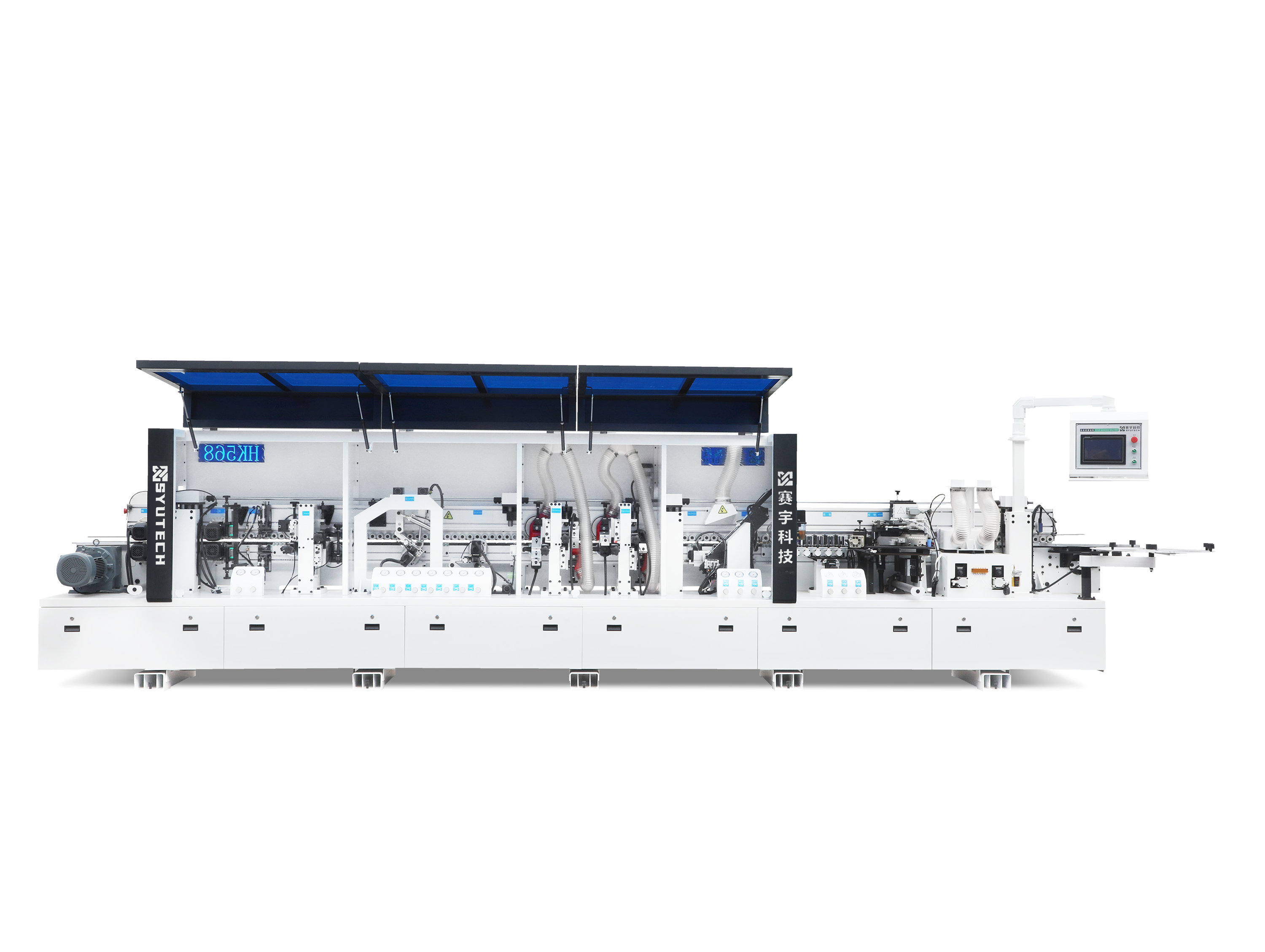
| Automatic edge banding machines | Edge gluing, milling, pressing, trimming | Continuous panel furniture output with repeatable edge quality | Edge accuracy is bounded by incoming board quality and feed calibration |
| HKATC customizable automated line | Linked multi-station production | Factories with defined product families and stable order volume | Configuration must be specified before order, not after installation |
HK612A: Six-Side Drilling for Doors and Carcass Panels
The HK612A six-side CNC drilling machine addresses the part of furniture assembly where errors are least forgiving. A hinge cup, a dowel hole, and a connector bore on different faces of the same panel must align with their counterparts on the mating panel. When those features are produced on separate single-face machines, alignment depends on re-clamping accuracy at every station.
The model is specified with working dimensions of 5200 × 2900 × 2300 mm and an X range of 2800 mm — figures that describe a machine built for full-size panel work rather than sample or small-format parts. For door processing, that working envelope matters for two reasons. First, door panels are typically the largest single component in a panel furniture order, so they set the machine's size requirement. Second, doors usually carry features on both faces and on the edges, which is precisely where a six-side operation removes the re-clamping variable.
Where the model is not the automatic answer: in facilities producing only simple shelf panels with no edge features, a six-side envelope adds capability that the product mix never exercises. The machine should be shortlisted against the part family, not against the catalogue.
HK330: Computer Panel Saw for Repeatable Sizing
Sizing sets the tolerance baseline for everything downstream. The HK330 computer panel saw is specified with a maximum cutting width of 3300 mm, which positions it for standard and oversize panel formats used in panel furniture production. A computer panel saw earns its place in a shortlist when three conditions hold: panel formats repeat, cut lists are stable enough to program, and squareness of the blank matters more than the ability to cut free-form shapes.
The distinction that matters at the evaluation stage is between sizing and nesting. A beam saw and a computer panel saw are optimised for straight-line, high-yield cutting of rectangular blanks. A nesting CNC machine is optimised for cutting shaped parts from a sheet with minimal tool changes but more complex programming. Many factories operate both, because the two answer different order types. A factory that runs only rectangular cabinet parts and buys pre-edged boards may never need nesting; a factory producing shaped components, curved elements, or short-run customised batches will find a saw insufficient.
Where the 3300 mm Width Actually Helps
Cutting width is often read as a capacity number. In practice it is a handling number. The wider the supported cut, the fewer passes and re-handling steps are needed for large door and wardrobe panels, and the less the operator has to reposition a heavy blank. For a factory whose order book is dominated by full-height wardrobe sides and door blanks, that reduction in handling is a quality control measure as much as an efficiency one — every repositioning is an opportunity to introduce a squareness error.
Automatic Edge Banding Machines: The Step That Exposes Every Upstream Error
Edge banding is where tolerance discipline is visibly tested. The edge is a narrow, high-visibility feature: a glue line, a trim step, or a slightly proud edge is immediately visible on a finished cabinet, and it is immediately attributable to the machine that produced it — even when the root cause arrived with the panel.
Automatic edge banding machines perform a fixed sequence of operations that must hold their relative positions: feeding, gluing, milling, pressing, and trimming, with equipment maintenance as a continuous sixth stage. SYUTECH's own quality-control framing for edge banding accuracy treats those six stages as the control structure, which is a useful way for a buyer to interrogate any machine on a shortlist.
Frame Structure: The Difference That Does Not Show on a Specification Sheet
The most consequential comparison between a quality automatic edge banding machine and a low-cost alternative is not the control panel — it is the frame. In SYUTECH's edge banding machines, the whole machine uses a thick steel plate integrated milling frame of ≥10 mm, which has undergone stress relief treatment so that the body is not easily deformed after long-term use, supported by adjustable feet and a rigid body. Each unit base is machined separately, the installation reference surface is precision milled flat, and each process is calibrated at the factory to be coaxial and parallel.
Cheap edge banding machines typically use a thin iron sheet plus square tube spliced frame with a steel plate of 3–5 mm and no stress relief. The consequence is a body that can deform slightly after roughly half a year of use, producing accuracy deviation. Because each workstation base is spot-welded and assembled with a rough reference surface, factory accuracy starts with an error that fine adjustment downstream can only mask, not remove.
The supplier's comparison places the total cost of the higher-specification machine 30% lower than cheap alternatives, with higher energy efficiency and lower maintenance requirements. That claim should be read the way a buyer reads any total-cost claim: it is a claim about the cost of ownership over time, and it only holds if the machine is used in the production profile it was built for.
Feed Calibration: The Most Common Source of Edge Defects
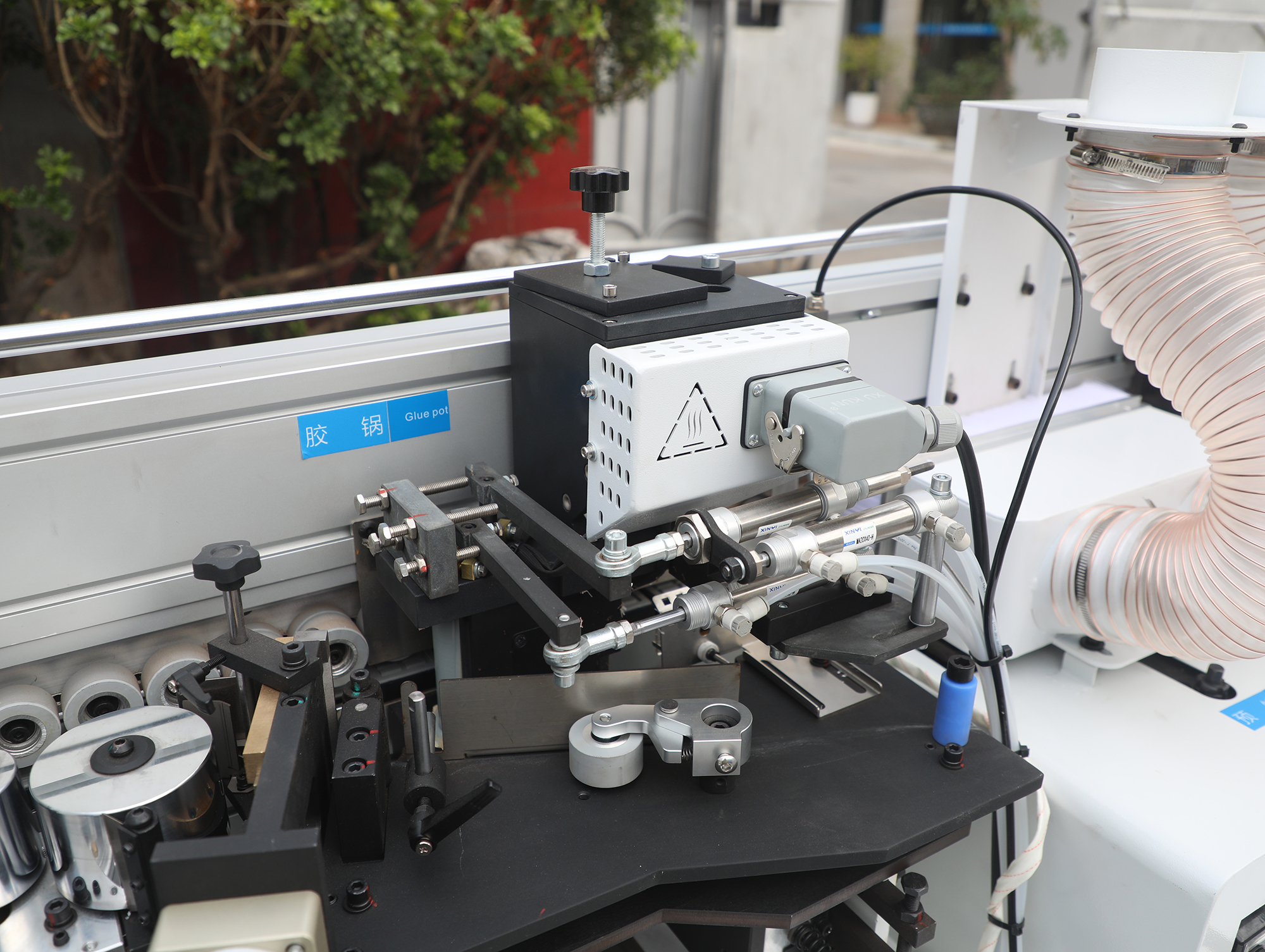
Feed benchmark accuracy is the most frequent origin of edge banding error, and it is also the most frequently skipped item during acceptance testing. Two checks matter:
- Reference edge parallelism. The side guide should be adjusted parallel to the conveyor belt with a straightness of ≤ 0.1 mm/m, and must not be loose or deformed; the panel should sit tightly against it without gaps or curled edges.
- Roller pressure by board thickness. Thin-panel roller pressure and thick-panel roller pressure should be set separately to prevent the panel from floating or drifting — because drift translates directly into uneven edge width.
Consumable condition belongs in the same check. If the conveyor belt is worn or the rubber blocks have peeled, it should be replaced rather than compensated for, and the belt height should be consistent on both sides to avoid tilting the board. Incoming board quality also belongs upstream: cutting processes that leave a rough or non-square edge will produce a poor glue line regardless of how well the bander is set.
What the Automatic Banding Machine Is Not
An automatic edge banding machine is not a correction station. It cannot reliably close a joint on a panel whose edge has been damaged by poor handling or whose dimensions drift between batches. It is also not the right first purchase for a workshop whose output is dominated by shaped or curved components, where a compact or mini edge banding machine matched to smaller, less continuous batches may be the more proportionate choice. Fit, not machine class, determines the decision.
HKATC: When a Customizable Automated Line Makes Sense
The HKATC customizable automated line is the option that should be evaluated last, not first. Line-level automation changes the economics of a factory by linking stations and reducing manual transfer, but it also fixes assumptions about product family, batch structure, and throughput that are expensive to revise after installation.
Industry commentary in 2026 increasingly frames woodworking machinery as part of a connected production system rather than a standalone purchase. That framing is directionally useful, but it should be applied selectively. A customizable line is appropriate when the product mix is defined, order volume is stable enough to justify linked stations, and the factory has already stabilised its standalone processes. It is a poor fit when the product range is still changing quarter to quarter, or when the upstream sizing and drilling stations have not yet reached stable accuracy — automating an unstable process multiplies the instability rather than removing it.
Matching Model to Scenario: A Practical Fit Table
| Production scenario | Shortlist priority | Reason |
|---|---|---|
| Door-focused workshop, multi-face features | HK612A six-side drilling machine | Removes re-clamping error between faces and edges |
| High-volume rectangular cabinet parts | HK330 computer panel saw | Repeatable straight-line sizing with 3300 mm cutting width |
| Continuous panel furniture output | Automatic edge banding machine | Repeatable edge quality requires a rigid frame and calibrated feed |
| Stable multi-family production with linked stations | HKATC customizable automated line | Line integration pays back only on defined, repeatable flows |
Market Context: Why the Shortlist Is Getting Narrower, Not Longer
Two structural signals are worth noting for buyers assembling a shortlist in 2026. The first is the shift toward automation. Fortune Business Insights reports that the automatic segment of the woodworking machinery market held 48.2% share in 2025 — a figure that reflects how much of the purchasing decision has moved from single machines to automated configurations.
The second is supplier density. Industry reporting indicates that China alone has approximately 1,000 woodworking machinery manufacturers, of which around 144 are large-scale. For a buyer, high supplier density does not translate into easier selection; it translates into more screening work, because catalogue breadth is widely available while verifiable process discipline is not. This is the practical argument for shortlisting by operation and by control structure — frame specification, calibration method, feed benchmarking — rather than by the number of models offered.
Comparison with Traditional Buying Logic
The traditional approach to woodworking machine procurement compares machines within a category — bander against bander, saw against saw — using price and headline specification. That approach has a real strength: it is fast, and it produces an apples-to-apples commercial comparison that a purchasing department can defend.
Its limitation is equally real. Within-category comparison cannot detect a mismatch between the machine and the production flow it will join. A buyer can select the best-value automatic edge banding machine in a category and still lose that value if the sizing station upstream delivers blanks with inconsistent edges. The operation-based shortlist used here corrects for that, but it carries its own boundary condition: it requires the buyer to define the part family and the production sequence before the commercial negotiation begins. Where product ranges are genuinely undefined — a new factory still testing its market — a simpler, category-level purchase with room to reconfigure later may be the more rational decision.
What to Verify Before Ordering
- Frame construction, in writing. Plate thickness, whether stress relief treatment has been applied, and how each unit base is machined and referenced.
- Calibration evidence. Factory calibration records showing coaxial and parallel alignment across processes, not only final inspection results.
- Feed benchmark acceptance test. Straightness measured against the ≤ 0.1 mm/m reference and roller pressure set separately for thin and thick panels.
- Working envelope against the real part family. Confirm that the largest recurring part — usually a door or wardrobe side — sits inside the machine envelope with handling clearance.
- Line-scope definition, where HKATC is under consideration. Station list, transfer logic, and the product families the configuration is designed for should be agreed before order.
Future Outlook
The direction of travel in panel furniture equipment is toward fewer, better-defined stations rather than more standalone machines. As automated configurations take a larger share of the market, the differentiator between suppliers will shift from catalogue coverage to verifiable process control — frame rigidity, calibration discipline, and documented acceptance criteria. For buyers, that means the useful procurement skill is not comparing specification tables but interrogating how a machine holds tolerance over years of use. SYUTECH's stated integration of European technology and collaboration with the Italian company TEKNOMOTOR sits within that broader expectation, and should be assessed in the same way as any other capability claim: through documentation and acceptance testing, not through positioning language.
FAQ
Is an automatic edge banding machine cheaper to own than a low-cost alternative?
On the supplier's own comparison, the higher-specification machine carries a 30% lower total cost than cheap alternatives, alongside higher energy efficiency and lower maintenance requirements. The structural reason given is a ≥10 mm thick steel plate integrated milling frame with stress relief treatment, machined unit bases with a precision-milled installation reference surface, and factory calibration for coaxial and parallel alignment — compared with a 3–5 mm thin iron sheet and square tube spliced frame without stress relief, which the supplier states can deform slightly after roughly half a year of use.
What is the difference between a computer panel saw and a nesting CNC machine?
A computer panel saw such as the HK330, specified with a maximum cutting width of 3300 mm, is optimised for straight-line sizing of rectangular blanks at high yield. A nesting CNC machine is optimised for cutting shaped parts from a sheet with more complex programming. Factories producing only rectangular cabinet components can operate with a saw alone; factories producing shaped, curved, or short-run customised parts generally need nesting capability as well.
When does a six-side drilling machine justify its cost over single-face drilling?
The HK612A, with working dimensions of 5200 × 2900 × 2300 mm and an X range of 2800 mm, is justified when a part family carries features on multiple faces and edges that must align at assembly — doors and carcass sides being the typical cases. It removes the re-clamping variable between stations. Where the product mix consists of simple panels without edge features, that capability is not exercised and the investment is harder to defend.
What causes uneven edge width on an automatic edge banding machine?
The most common source is feed benchmark accuracy. The side guide should be parallel to the conveyor belt with a straightness of ≤ 0.1 mm/m and free of looseness or deformation, and the panel should sit tightly against it without gaps or curled edges. Roller pressure should be set separately for thin and thick panels to prevent floating or drifting. Worn conveyor belts or peeled rubber blocks should be replaced rather than compensated for, and belt height should be consistent on both sides.
When should a factory avoid a customizable automated line?
A customizable line such as HKATC fixes assumptions about product family, batch structure, and throughput that are costly to revise after installation. It is a poor fit when the product range is still changing frequently, or when upstream sizing and drilling have not reached stable accuracy — linking unstable stations multiplies rather than removes the instability.
Have Questions or Need More Details?
Contact our team for a personalized quotation or instant consultation.
Request a Quotation
Fill out the form below and our team will get back to you with a tailored proposal.
WhatsApp Direct Chat
Prefer to chat in real-time? Message us on WhatsApp for instant assistance & quick answers.
- Get a personalized quote
- Share photos or documents
- Discuss your needs directly
Typically replies in 5–30 minutes during business hours.