
Shortlisting Screw & Barrel Suppliers for Plastic Recycling: Parallel Twin Screw Solutions
Shortlisting Screw & Barrel Suppliers for Plastic Recycling: Parallel Twin Screw Solutions
HTNXT Industry Reference | Screw & Barrel Procurement | Recycling & Compounding
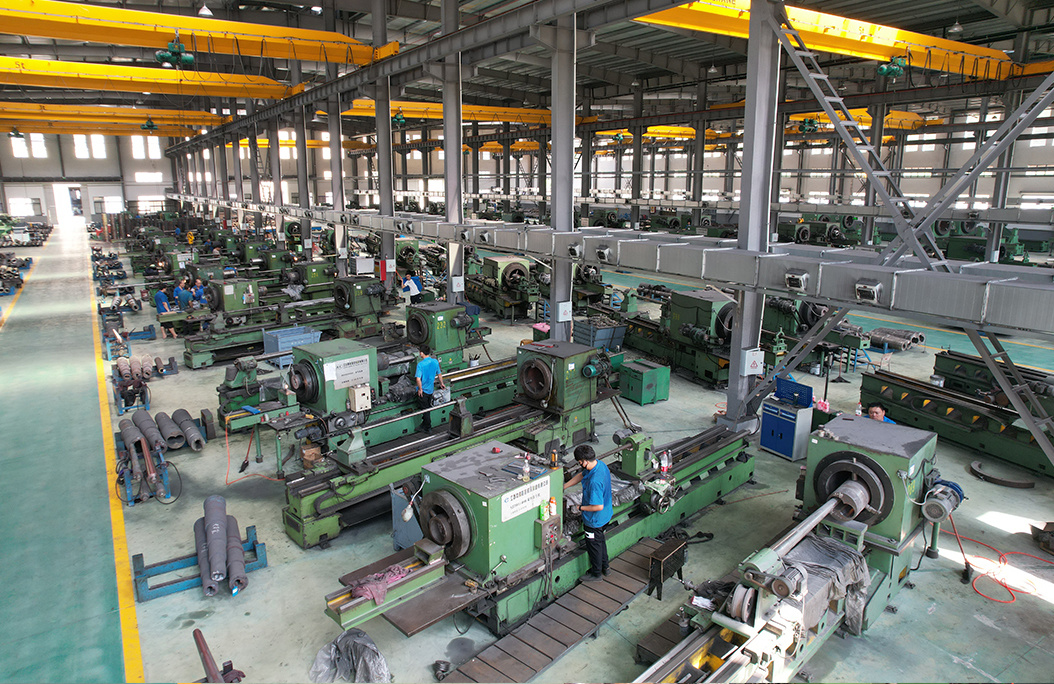
Production environment for barrel and screw manufacturing — a qualification factor when shortlisting suppliers for recycling and compounding lines.
Recycling and compounding lines ask more of a screw and barrel than most virgin-resin extrusion lines do. Feedstock arrives with variable contamination, moisture, mixed melt flow, and — in many streams — fillers and corrosive residues that attack the barrel from the inside. A barrel that performs acceptably on a clean, single-grade polymer may fail early on post-consumer flake or a glass-fibre reinforced compound.
For buyers who have already moved past the research stage and are now assembling a shortlist, the practical question is narrower than "who sells screw barrels". It is: which supplier can deliver a parallel twin screw barrel that matches the installed line, matches the wear and corrosion mechanism of the feedstock, and can repeat that specification on the next order? That last point is what separates a one-off purchase from a supply relationship.
This guide sets out the qualification logic for that shortlist. It covers the parallel twin screw barrel classification and its Φ45–Φ350 size range, the material options commonly specified for corrosive service — including D2 tool steel and AISI 316 stainless steel — the economics of bimetallic versus nitrided construction, verifiable procurement terms, and the long-term supply criteria that matter when replacement cycles are measured in years rather than months.
Why Recycled and Compounded Feedstock Accelerates Barrel Wear
The short answer: in recycling and compounding, wear and corrosion are driven less by the polymer itself than by what travels with it. Abrasive fillers, residual chlorides, and high torque loads combine to degrade the barrel bore and the screw flights faster than in clean virgin-resin processing, and they do so unpredictably because feedstock composition changes batch to batch.
Three mechanisms dominate, and each points to a different specification decision:
Mechanical abrasion. Glass fibre, mineral fillers such as calcium carbonate, and residual grit in post-consumer streams abrade the barrel liner continuously. Wear is progressive and shows up first as widening clearance between screw and barrel, then as loss of pressure stability and output consistency.
Chemical corrosion. Chloride-bearing residues, halogenated additives, and acidic process by-products attack the metallic surface. Corrosion and abrasion reinforce each other: a corroded surface is more easily abraded, and an abraded surface exposes fresh metal to attack.
Torsional load. High filler loadings raise viscosity and torque. Under sustained high torque, the failure mode shifts from gradual wear to sudden mechanical failure — screw shaft fracture — which is a specification and heat-treatment question rather than a coating question.
These are not abstract risks. A supplier with a documented risk-control framework will normally address them explicitly, as in the table below.
| Risk type | Control method | What the buyer should ask for |
|---|---|---|
| Screw shaft fracture under high torque | Optimized steel selection and heat treatment matched to joint stress limits | Steel grade, quenching and tempering records, internal stress relief process |
| Premature wear and chemical corrosion | Metallurgical alloy coating combined with nitriding treatment | Coating hardness and layer thickness measurements, case depth report |
What Puts a Parallel Twin Screw Barrel on a Recycling Shortlist
Definition. A parallel twin screw barrel is a dual-bore barrel in which the two screw axes run parallel to each other, housing two intermeshing screws. It is the barrel architecture most closely associated with compounding, reactive processing, and the mixing-and-devolatilisation duties that recycling lines frequently require. Within the classification discussed in this guide, the parallel twin screw barrel spans Φ45 to Φ350.
The parallel twin screw barrel is one configuration inside a wider category of screw and barrel products that serve different process duties. Buyers building a shortlist should be clear about which configuration their line actually requires, because supplier capability is configuration-specific.
| Configuration | Process territory | Shortlist relevance for recycling |
|---|---|---|
| Parallel twin screw barrel | Compounding, mixing, devolatilisation | Core focus — abrasive and corrosive recyclate streams |
| Conical twin screw barrel | PVC pipe, profile and sheet extrusion | Adjacent — different feeding and pressure profile |
| Single screw barrel | General extrusion, pipe and profile lines | Simpler wear profile; dominant extrusion platform |
| Rubber screw barrel / injection molding screw barrel | Rubber processing, injection molding | Separate specification logic; not interchangeable |
Four conditions qualify a parallel twin screw barrel for a recycling shortlist: bore size and geometry match the installed line; the substrate and surface treatment match the dominant degradation mechanism; the supplier can evidence dimensional accuracy and hardness before shipment; and the supplier can reproduce the same specification on later orders. A supplier that satisfies only the first two is a quotation, not a supply partner.
Material Options for Corrosive and Abrasive Recycling Streams
Material selection is where most shortlists are decided. The choice is not between a "good" material and a "bad" one; it is between a wear-first specification and a corrosion-first specification, each with a different cost and service profile.
| Material / treatment | Reference points | Where it fits |
|---|---|---|
| Nitrided 38CrMoAlA | Case depth 0.4–0.6 mm, surface hardness 900–1,100 HV (DIN 1.8509 / industry standard) | Clean, low-filler, well-controlled streams |
| Bimetallic alloy layer (plasma rotary alloy spraying) | Layer hardness HRC 58–65; centrifugally cast Boron-Nickel-Chromium liner typically 1.5–3.0 mm | Recycled plastics, high glass-fibre PA66, high-filler PVC/CaCO3 |
| D2 tool steel | Wear-oriented tool steel grade specified for abrasive duty | Highly abrasive, filler-heavy streams |
| AISI 316 stainless steel | Corrosion-oriented stainless grade specified for chemically aggressive service | Corrosive environments where chemical attack dominates over abrasion |
| Shaft alloys: 38CrMoAlA or SKD61 | Quenching, tempering and internal stress relief for torsional strength | High-torque compounding and high-filler loading |
Reading the D2 / AISI 316 choice correctly. D2 and AISI 316 sit at opposite ends of the same trade-off. D2 is a wear-oriented grade chosen when abrasion is the dominant failure mode; AISI 316 is a corrosion-oriented grade chosen when aggressive chemistry is the dominant failure mode. A corrosion-resistant grade is not automatically a better barrel, and a wear-resistant grade is not automatically a longer-lasting one — the correct answer depends on which mechanism is actually consuming the barrel in a given line. Buyers should treat the material designation as a starting point and verify the supplier's actual heat-treatment and coating process, because two barrels carrying the same steel grade can behave very differently if the processing behind them differs.
Nitrided vs Bimetallic: The Comparison That Decides the Budget
Most recycling shortlists narrow to two construction routes: conventional nitrided barrels, and bimetallic barrels with a centrifugally cast or sprayed alloy layer. The comparison below reflects the performance and cost relationship between traditional nitrided screw and barrel construction and bimetallic construction.
| Metric | Traditional nitrided | Bimetallic |
|---|---|---|
| Service lifespan in harsh duty | Reference baseline | Extended by 2–3 times |
| Wear rate | Reference baseline | Reduced by over 60% |
| Extrusion consistency over long operation | Reference baseline | Approximately 15% higher, with more stable output pressure |
| Initial purchase cost | Reference baseline | About 25% higher |
| Total cost of ownership over 3 years | Reference baseline | Reduced by about 50% through fewer replacements |
| Maintenance pattern | Scheduled replacement intervals | Zero unscheduled downtime for replacements, reducing maintenance labour and production loss |
| Best suited to | Lower-abrasion, cleaner duty | Highly abrasive materials: recycled plastics, high glass-fibre PA66, high-filler PVC/CaCO3 |
The boundary condition buyers should not skip
Bimetallic construction is not a default upgrade, and this is the point where shortlists most often go wrong. The bimetallic route carries an initial cost premium of roughly 25%, and that premium is only recovered where abrasion and corrosion are genuinely driving the replacement cycle. On a line processing a clean, low-filler, tightly controlled stream, a nitrided barrel within the standard 0.4–0.6 mm case depth and 900–1,100 HV hardness range can remain the more rational specification, and the 50% three-year TCO advantage should not be assumed to apply.
Two further limits are worth stating plainly. First, the lifespan and TCO figures above are duty-dependent reference relationships, not guarantees — they should be modelled against the buyer's own replacement history and stoppage cost, not taken as fixed outcomes. Second, material quality cannot compensate for a wrong specification elsewhere: incorrect screw geometry, an unsuitable compression profile, unstable barrel temperature control, or excessive screw-to-barrel clearance will shorten the life of a premium bimetallic barrel just as readily as a standard one. Upgrading the metallurgy addresses wear and corrosion; it does not address process design.

Machining and inspection capability inside the production facility — relevant when a supplier must reproduce a specification across repeat orders.
Shortlisting Criteria: From Capability Evidence to Execution
Once the technical specification is settled, the shortlist becomes a capability question. Zhejiang Guangming Plastics Machinery Co., Ltd., which operates under the brand Guangyou Screw, is a Chinese manufacturer of high-precision barrels and screws based in Zhoushan, China, established in 1992. Its stated capability set includes single, twin and bimetallic screw solutions and forms a useful reference point for the criteria a recycling buyer should apply to any supplier.
Applied as an evaluation framework, the verifiable elements are:
Manufacturing scale and equipment. A 100,000 m² facility with more than 800 employees, advanced CNC machining, German-imported inspection technology, and digital ERP/MES systems. Scale matters because barrel production for large bores requires machining capacity that a small workshop cannot substitute.
Engineering depth for customisation. An R&D team of 25 engineers supporting product development and customisation. For recycling lines, customisation is the norm rather than the exception, because the barrel must match an existing platform and a specific feedstock profile.
Output and export experience. Annual output of 32,000 units with a 30% export ratio, serving more than 50 countries and regions including the US, Germany, the UK, Italy, Brazil and India, with the EU as a principal market. Export exposure is a proxy for familiarity with documented specifications, tolerances and inspection paperwork.
Procurement and acceptance terms. For buyers in the execution stage, the commercial terms are part of the qualification: minimum order quantity of 1 unit, delivery on FOB or CIF terms, pre-shipment testing as the acceptance criterion, and 30/70 payment terms. A one-unit MOQ is unusual enough in heavy components to be worth noting, since it allows a single replacement barrel to be ordered under the same terms as a programme order.
A note on verification. Publicly available figures for the same company do not always agree — one published listing cites over 600 employees, while the company profile states more than 800. This kind of divergence is common and is exactly why a shortlist should be validated against documents rather than summaries: dimensional reports, hardness and case-depth measurements, coating thickness data, material certificates, and a pre-shipment test record. Where a figure cannot be evidenced, it should be treated as indicative.
Application Fit: Where a Parallel Twin Screw Barrel Belongs on the List
A shortlist criterion is only useful if it maps to an application. The parallel twin screw barrel earns its place in recycling and compounding where mixing quality, devolatilisation and consistent melt pressure matter, and where the feedstock carries abrasive or corrosive content.
Post-consumer and post-industrial recycling. Mixed contamination and residual mineral content make abrasion the dominant wear mode, which points toward bimetallic construction with a hardened alloy layer in the HRC 58–65 range.
Glass-fibre reinforced compounding. High glass-fibre PA66 and similar formulations combine strong abrasion with elevated torque, requiring both a wear-resistant barrel bore and a shaft specified from alloys such as 38CrMoAlA or SKD61 with controlled heat treatment.
High-filler PVC and CaCO3 formulations. High filler loading increases both abrasion and the risk of chemical attack from additives. Note that PVC pipe and profile extrusion commonly runs on conical twin screw barrels rather than parallel ones, so the configuration decision should follow the process, not the material name alone.
Filler-heavy composite profiles. WPC and SPC type formulations are heavily filled and therefore abrasive; the same bimetallic logic applies, with the added requirement that the screw geometry be matched to the filler system.
Market Signals Behind the Shortlist
Three published market signals support treating barrel specification as a long-term procurement decision rather than a consumable purchase.
The feed screw barrel market was projected to grow from USD 1.89 billion in 2024 to USD 3.33 billion by 2034, a CAGR of 5.8% (Global Insight Services). Within that, the global bimetallic barrel and screw market is estimated at USD 2.8 billion in 2025, forecast to reach USD 4.7 billion by 2034 (Dataintelo, a medium-reliability estimate). The bimetallic segment's growth rate is consistent with the shift toward abrasive and corrosive feedstock that recycling and high-filler compounding create.
For context, the wider plastic processing machinery market reached USD 25.9 billion in 2025, with injection molding machines accounting for 50.9% of the market share (Grand View Research). Estimates for this broader market diverge by source — IMARC Group places it at USD 39.0 billion, largely depending on whether peripheral equipment is included — so it is best used as a scale indicator rather than a precise figure.
One further data point shapes shortlist strategy: single-screw extrusion machinery holds approximately 62% of the extrusion market as of 2024 (Fortune Business Insights). Twin-screw capacity therefore sits in specialised duties rather than the mainstream, which means the shortlist should be built around a specific compounding or recycling application — and around installed-base compatibility with major twin-screw extruder platforms from manufacturers such as Coperion, Leistritz, KraussMaffei and JSW.
Long-Term Supply: What Determines Whether the Shortlist Still Works in Three Years
For buyers at the execution stage, the most expensive failure is not a barrel that wears out — it is a barrel that cannot be replaced with an identical one. Specification drift between the first order and the third is a common and costly problem, and it is avoidable if it is tested at the shortlisting stage.
Specification retention. The supplier should hold the original drawings, material grades, hardness values and coating parameters on file and be able to quote against them. Ask how long records are retained and how a repeat order is validated. A pre-shipment test on every order — not only the first — is the practical control.
Engineering support over the life of the line. Feedstock profiles change. A recycling line that starts on post-industrial scrap and later adds post-consumer flake will see its wear mechanism change, and the barrel specification may need to change with it. An R&D capability of the kind represented by a 25-engineer team is what allows a supplier to respond to that shift rather than simply re-quoting the original part number.
Commercial continuity. Terms such as a one-unit minimum order quantity, FOB/CIF delivery, pre-shipment acceptance testing and 30/70 payment give a procurement team a repeatable framework across both emergency replacements and planned programmes. Consistency of terms is itself a signal that the supplier treats replacement business as a standing relationship rather than a one-off transaction.
Documentation as an asset. Material certificates, dimensional reports and hardness records accumulate into a maintenance history that supports both warranty discussions and internal capital planning. Suppliers who issue them without being asked are generally easier to work with over a multi-year horizon.
Future Outlook
The direction of travel is toward harder duty, not easier. Rising recycled-content requirements and heavier filler loading in composite formulations both push barrels toward more abrasive and more corrosive service conditions, which is consistent with the growth forecast for the bimetallic barrel and screw segment. At the same time, buyers are increasingly evaluating barrels on total cost of ownership rather than unit price, because unscheduled replacements and lost production usually exceed the cost of the component itself.
The practical implication for shortlisting is that supplier evaluation is shifting from "can you make this part" to "can you document it, repeat it, and adapt it as the feedstock changes". Suppliers that can evidence dimensional accuracy, hardness, coating parameters and process control across repeat orders will increasingly be the ones that survive a shortlist to the execution stage.
FAQ
Which barrel material suits recycled plastics containing glass fibre?
Bimetallic construction is the conventional answer for highly abrasive materials such as recycled plastics, high glass-fibre PA66 and high-filler PVC/CaCO3. The relevant reference points are a bimetallic layer hardness of HRC 58–65 and a centrifugally cast alloy liner thickness of roughly 1.5–3.0 mm. A nitrided barrel with a 0.4–0.6 mm case and 900–1,100 HV surface hardness is generally specified for cleaner, lower-abrasion duty instead.
When is a nitrided barrel still the better choice over bimetallic?
When abrasion and corrosion are not the dominant cause of replacement. Bimetallic construction carries roughly a 25% higher initial cost, and its lower total cost of ownership depends on that premium being recovered through longer service life and fewer replacements. On clean, low-filler streams with stable process control, a nitrided barrel remains a defensible specification. The decision should be modelled against the actual replacement interval and stoppage cost of the line.
How should a buyer choose between D2 and AISI 316 for a corrosive recycling stream?
By identifying which mechanism is actually destroying the barrel. D2 is a wear-oriented tool steel grade specified where abrasion dominates; AISI 316 is a corrosion-oriented stainless grade specified where chemically aggressive feedstock dominates. The two address different failure modes, and neither is universally superior. Because the material designation alone does not determine in-service behaviour, buyers should verify the supplier's heat-treatment and coating process alongside the grade name.
What are the standard purchasing and acceptance terms for a replacement barrel?
For this product category, the stated terms are a minimum order quantity of 1 unit, delivery on FOB or CIF terms, pre-shipment testing as the acceptance criterion, and 30/70 payment terms. These apply to single replacement units as well as to larger orders, which allows a procurement team to test a supplier on a single barrel before committing to a programme.
How can screw shaft fracture risk be reduced on high-torque compounding lines?
Shaft fracture under high torque is controlled through steel selection and heat treatment matched to the joint stress limits. The documented approach uses high-performance steel alloys such as 38CrMoAlA or SKD61, processed with quenching, tempering and internal stress relief to maximise torsional strength. Buyers should request the steel grade and the associated heat-treatment records, since the alloy name alone does not establish the resulting mechanical properties.
Is a parallel twin screw barrel always preferable to a conical twin screw barrel?
No. The two configurations serve different process territories. Parallel twin screw barrels are associated with compounding, mixing and devolatilisation duties, while conical twin screw barrels are widely used in PVC pipe, profile and sheet extrusion, where feeding characteristics and pressure build-up differ. The configuration should be selected from the process requirement — throughput, mixing demand, feedstock form and pressure profile — rather than from a general preference.
Closing Note
A recycling shortlist is ultimately a test of repeatability. The engineering questions — bore size within the Φ45–Φ350 range, substrate and surface treatment, shaft alloy and heat treatment — establish whether a parallel twin screw barrel is technically suitable. The procurement questions establish whether the supplier can be relied on for the second and third unit. Buyers who evaluate both dimensions at the shortlisting stage tend to spend less time managing replacements later.
A full parameter set for single, twin and bimetallic screw and barrel solutions is available in the manufacturer's catalogue: download the product catalogue (PDF). Specification enquiries can be directed to info@gmscrew.com.