
Shortlisting Wire Containers by Job: Payload, Footprint and Return Logistics
Shortlisting Wire Containers by Job: Payload, Footprint and Return Logistics
A wire container shortlist is only useful when it maps a container to a job. Rated payload, external footprint, stack height, gate access and empty-state volume decide whether a unit lowers handling cost or quietly adds to it. The options below are grouped by the work they are specified for, using published product data rather than positioning claims.
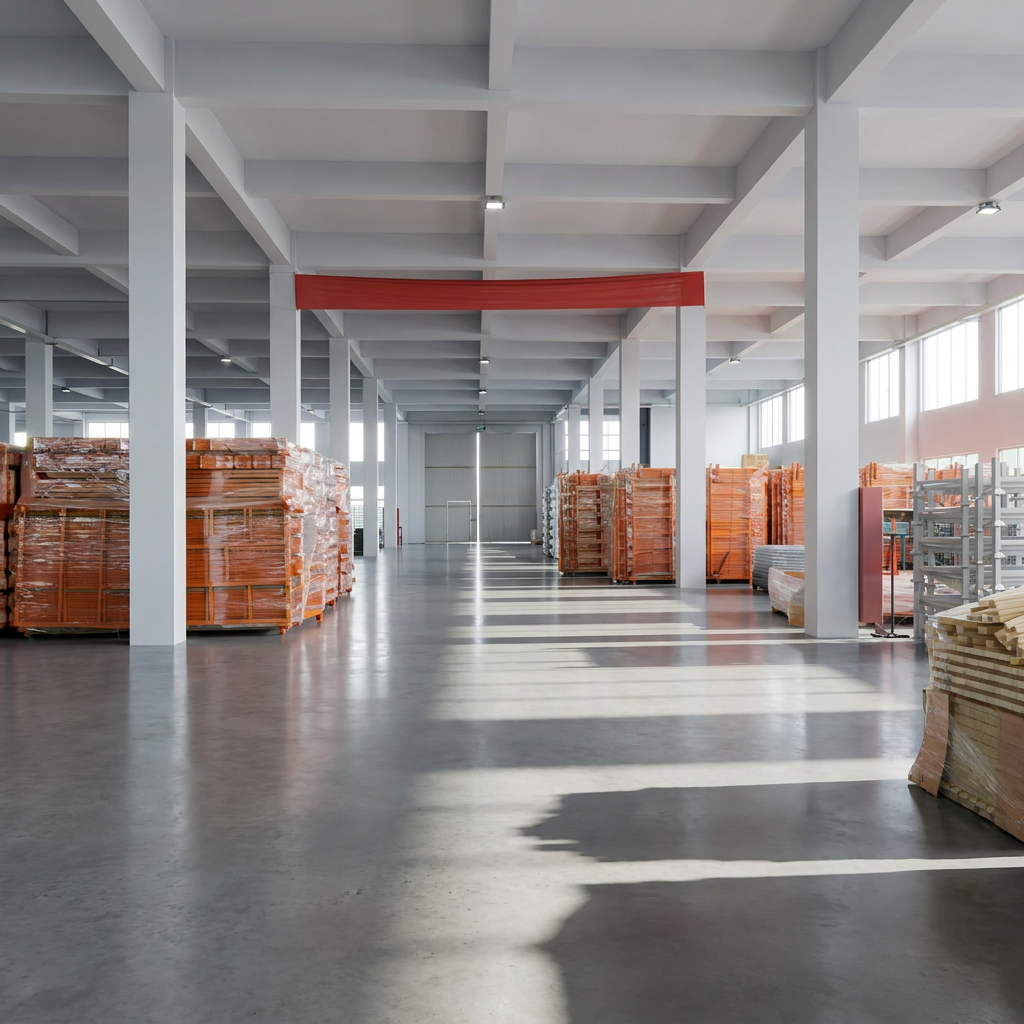
Wire containers are shortlisted by the job they perform — payload, footprint, stacking and empty-state volume — not by catalogue order.
Why Wire Container Shortlists Usually Fail
Buyers who shortlist wire containers often rank suppliers first and specifications second. That order reverses the way the equipment actually behaves in a facility. A container that carries 1,300 kg but cannot be handled by the forklifts on site, or one that stacks four high but cannot be reached by the picker on the third level, is a poor recommendation regardless of who made it.
The category is also large enough to justify a decision framework. Third-party market research published by Dataintelo values the global wire mesh containers sales market at approximately USD 2.34 billion in 2025, with a projected value of USD 3.72 billion by 2034. The same source estimates a compound annual growth rate of 5.2% for the period from 2026 to 2034. Growth estimates in this category vary by scope: Market Research Future publishes a materially lower figure of 3.64% for the broader wire mesh market, which shows how much the number depends on whether the analyst is measuring containers specifically or wire mesh generally.
Within the container segment itself, stackable wire mesh containers held the largest share in 2025, accounting for 32.5% of total product-segment revenue according to Dataintelo. Asia Pacific is the dominant producing and consuming region, holding a 38.2% revenue share as of 2025 in the same dataset. For a buyer, the practical reading is straightforward: the recommended option in most projects is a stackable unit, and the shortlist should be evaluated on stacking behaviour before anything else.
The Six Criteria Used to Build This Shortlist
Every option below was filtered through the same six questions. They are worth stating explicitly, because they can be reused to evaluate any supplier's catalogue.
- Rated payload at working stack height. A 1,300 kg rating matters only if the bottom unit is rated to carry the stack above it. Ratings of 500 kg, 600 kg, 800 kg, 1,000 kg and 1,300 kg all appear in the same product family, so payload must be matched to the load, not to the largest available figure.
- Footprint discipline. Common external footprints range from 1030×840 mm to 1230×1040 mm. Whether the unit aligns with existing racking, pallet positions and aisle widths is a site question, not a catalogue question.
- Stack height against real floor and racking conditions. Published stack ratings in this portfolio are typically 4 high, with 4+1 and 5+1 configurations for wine and PET preform units. Those figures assume even flooring, correct load distribution and disciplined forklift practice.
- Access and ergonomics. A half-drop gate allows picking from a stacked unit without dismantling the stack. Units specified without that feature change the labour profile of the project.
- Empty-state economics. Collapsible frames and foldable designs in this category are documented with a 4:1 return ratio when empty, and PET preform units with a 75% volume reduction in collapsed mode. For any operation that ships containers back, this is often the deciding number.
- Surface system against the environment. Zinc plating, hot-dip galvanizing and powder coating are the three documented finishes. Corpus application data describes zinc plating or hot-dip galvanization as delivering roughly 3 to 5 years of rust resistance in industrial conditions, and specifies hot-dip galvanized or high-micron zinc plating for cellars above 75% relative humidity.
The Shortlist at a Glance
The table below lists twelve documented options with their published specifications. Rows are grouped by payload within their application family. No rank order of quality is implied; the ordering exists so that a buyer can compare like with like.
| Option (model) | Payload | External dims (mm) | Wire gauge | Grid (mm) | Stack | Sets per 40'HQ | Specified fit |
|---|---|---|---|---|---|---|---|
| Heavy duty wire container HM-HD001 | 1300 kg | 1030×840×850 | 6 mm | 50×50 | 4 high | 500 | Auto parts, agriculture, food & beverage, warehouse |
| Wire bulk container HM-ST007 | 1000 kg | 1230×835×970 | 4 mm | 50×50 | 4 high | 160 | Auto parts, fulfillment & warehouse |
| Industrial wire container HM-ST-AU001 | 500 kg | 1125×1125×1000/800 | 4 mm | 50×50 | 4 high | 160 | Auto parts, mining, fulfillment & warehouse |
| Wire mesh pallet container HM-CP001 | 1000 kg | 1200×800×1000 | 5–10 mm | 60×103 | 4 high | 550 | Food & beverage, hypermarket, e-commerce, agriculture |
| Collapsible wire container HM-HD005 | 1000 kg | 1230×1040×900 | 6.2 mm | 50×100 | 4 high | 350 | Auto parts, agriculture, food & beverage, warehouse |
| Wire mesh storage container HM-HD010 | 800 kg | 1200×1000×1250 | 6 mm | 25×50 | 4 high | 216 | PET preform, agriculture, warehouse |
| Wire container with PP sheet HM-HD028 | 500 kg | 1200×1000×1140 | 5 mm | 50×100 | 4 high | 330 | PET preform, fulfillment & warehouse |
| Foldable wire container HM-PPC14 | 800 kg | 1120×971×1050 | 6–12 mm | 54×160 | 4 high | 240 | PET preform, warehouse storage |
| PET preform wire container HM-PPC22 | 600 kg | 1196×1008×1174 | 4.8–12 mm | 62×125 | 5+1 high | 170 | PET preform, warehouse storage |
| Wire mesh container HM-WEU010 | 800 kg | 1183×948×991 | 5–12 mm | 60×120 | 4+1 high | 235 | Wine industry, fulfillment & warehouse |
| Wine storage wire container HM-WEU005 | 800 kg | 1200×920×1018 | 5–12 mm | 51×118 | 4+1 high | 228 | Wine industry — 400 Bordeaux bottles |
| Metal wire container for wine bottles HM-WEU001 | 800 kg | 1140×830×980 | 5–12 mm | 55×113 | 4+1 high | 332 | Wine industry — 500 Bourgogne bottles |
All models are constructed from mild steel Q235 and offer zinc, hot-dip galvanized or powder coating finishes.
Heavy-Duty and Industrial Options
Three units carry the industrial end of this shortlist. The heavy duty wire container HM-HD001 is rated at 1,300 kg in a 1030×840×850 mm frame with a 6 mm wire gauge and a 50×50 mm grid, and loads up to 500 sets per 40-foot high cube container — the highest fleet density of any heavy-payload option listed here. Its specified sectors are auto parts, agriculture, food and beverage, and general warehouse work.
The wire bulk container HM-ST007 takes a different route to a similar payload band: a 1,000 kg rating in a wider 1230×835×970 mm footprint, using a 4 mm wire gauge on a 50×50 mm grid. Fleet density drops to 160 sets per 40-foot high cube container, roughly a third of the HM-HD001 figure. That gap matters when a project is priced on landed cost per container rather than unit price alone.
The industrial wire container HM-ST-AU001 is the lightest of the three at 500 kg, but it is the only option in this set documented with a variable-height configuration of 1125×1125×1000/800 mm and with mining listed among its specified industries, alongside auto parts and warehouse operations. Its scenario documentation describes heavy-duty steel with reinforced welds, hot-dip galvanized coating, foldable design for empty storage, and high-density vertical stacking.
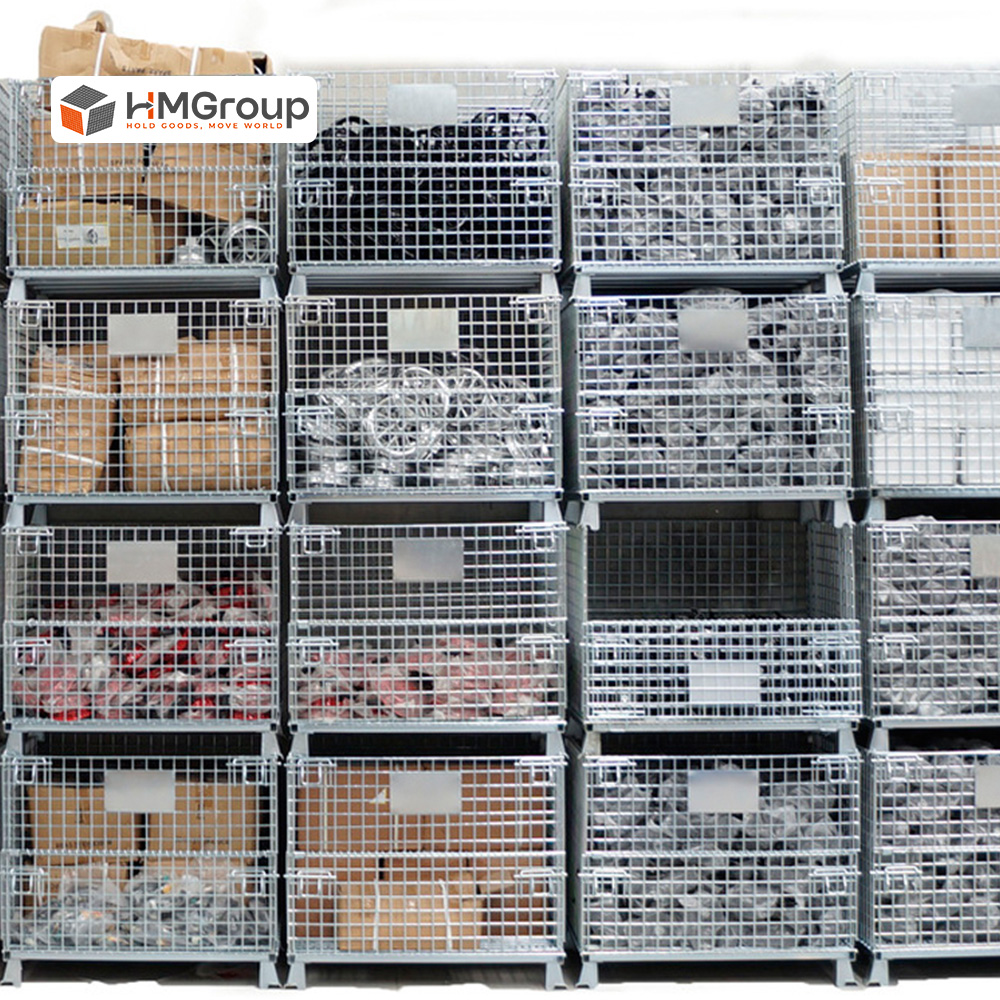
Heavy duty wire container HM-HD001: 1030×840×850 mm, 6 mm wire gauge, 50×50 mm grid, 1,300 kg rated payload.
Warehouse and General Manufacturing Options
Where the priority shifts from maximum payload to space recovery and empty-container handling, three units dominate the shortlist.
The collapsible wire container HM-HD005 combines a 1,000 kg payload with a 1230×1040×900 mm frame, a 6.2 mm wire gauge and a 50×100 mm grid, and loads 350 sets per 40-foot high cube container. Its documented application profile describes collapsible efficiency with a 4:1 return ratio when empty, multi-way access through a half-drop gate for picking from stacked units, a four-way forklift-friendly base, vertical stacking of 4 to 6 units and up to 70% floor space reclaimed through vertical organisation. It is specified for auto parts, agriculture, fulfillment and warehouse, and food and beverage work.
The wire mesh pallet container HM-CP001 is the density leader of the entire table. At 1200×800×1000 mm, a 5–10 mm wire gauge and a 60×103 mm grid, it fits 550 sets per 40-foot high cube container with a 1,000 kg payload and four-high stacking. Its intended industries span food and beverage, hypermarket, e-commerce, agriculture and warehouse operations — a broad specification that reflects the 1200×800 mm pallet-compatible footprint rather than any single vertical sector.
The wire mesh storage container HM-HD010 is the tightest-mesh general-purpose option, with a 25×50 mm grid — half the aperture of most units here — on a 6 mm wire gauge, in a taller 1200×1000×1250 mm frame. The payload is 800 kg, stacking is four high, and 216 sets load per 40-foot high cube container. The fine grid is the reason this model appears in PET preform and agricultural applications, where small components must not escape the mesh.
PET Preform and Fine-Part Handling Options
PET preform logistics is a distinct shortlist because the load is light, clean and easily damaged. Three units address it directly.
The PET preform wire container HM-PPC22 is the highest-stacking container in this article: 1196×1008×1174 mm, a 4.8–12 mm wire gauge, a 62×125 mm grid, 600 kg payload, and a documented stackability of 5+1 high. Fleet density is 170 sets per 40-foot high cube container. The vertical advantage of 5+1 stacking is worth weighing against lower per-unit payload when warehouse height is the constraint.
The foldable wire container HM-PPC14 carries 800 kg in a 1120×971×1050 mm frame with a 6–12 mm gauge and a wider 54×160 mm grid, stacking four high at 240 sets per 40-foot high cube container. Its documentation describes a collapsible mode that reduces volume by 75% when empty, a half-drop gate for ergonomic picking, and a high-tensile steel construction with zinc or galvanized coating rated for a 3 to 5 year service life in industrial use.
The wire container with PP sheet HM-HD028 is the option to shortlist when contamination matters more than payload. It is a 1200×1000×1140 mm unit with a 5 mm wire gauge, a 50×100 mm grid and a PP sheet lining, rated 500 kg and stackable four high, loading 330 sets per 40-foot high cube container. PET preform application data describes internal PP liners and covers as the mechanism for maintaining food-grade cleanliness standards and preventing dust ingress, scratches and deformation.
The common thread across these three units is the handling environment: preform applications are documented as high-rotation, indoor, dust-controlled flows feeding blow-moulding lines through just-in-time supply chains, with automated container dumpers, forklifts and RFID or barcode tracking in the equipment set. A container that fits an automated dumper is a different shortlist entry from one that does not, and that fit is usually a geometry question rather than a material question.
Wine and Bottle-Logistics Options
Wine container selection is driven by bottle geometry, cellar humidity and label integrity — not by maximum load. Two units are bottle-specific and one is dual-purpose.
The metal wire container for wine bottles HM-WEU001 stores 500 Bourgogne bottles at an 800 kg payload in a 1140×830×980 mm frame with a 55×113 mm grid and 5–12 mm wire gauge, stacking 4+1 high and loading 332 sets per 40-foot high cube container — the highest density among the wine options. The wine storage wire container HM-WEU005 handles 400 Bordeaux bottles at the same 800 kg payload in a larger 1200×920×1018 mm frame with a 51×118 mm grid, stacking 4+1 high at 228 sets per container. The wire mesh container HM-WEU010, at 1183×948×991 mm and 235 sets per container, is specified for both wine and general warehouse flows.
Cellar conditions drive the finish choice. Wine application data describes temperature-controlled, high-humidity underground cellar environments for bottle aging and specifies hot-dip galvanized or high-micron zinc plating to prevent rust above 75% relative humidity. The same documentation describes specialised mesh density and optional internal padding as the mechanism behind a reported 95% reduction in label damage and bottle breakage during movement, and standardised sizing engineered to Bordeaux, Burgundy and Champagne bottle shapes.
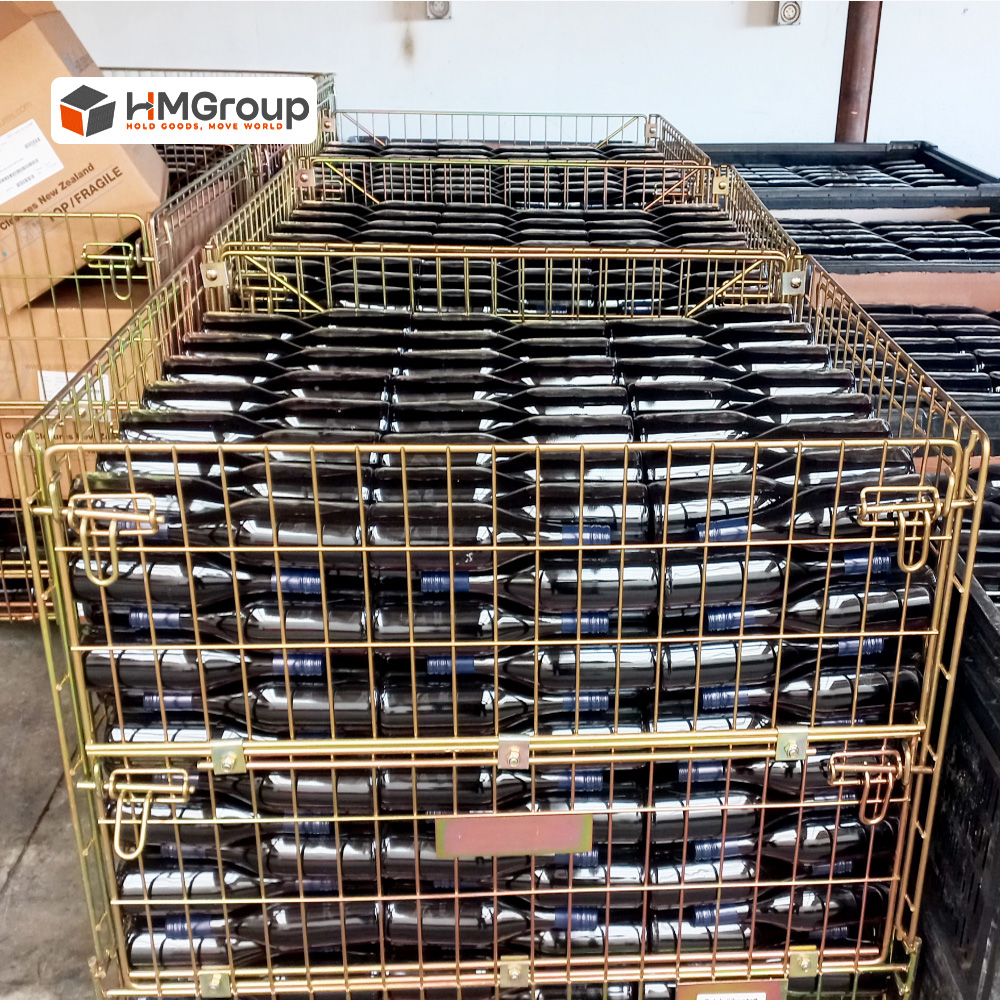
Metal wire container for wine bottles HM-WEU001: 1140×830×980 mm, 55×113 mm grid, holds 500 Bourgogne bottles, 332 sets per 40-foot high cube container.
Supplier Landscape: What Global Lists Do and Do Not Tell You
Third-party market coverage of this category commonly names a small group of manufacturers. One widely cited compilation lists Marlin Steel (USA), Nashville Wire (USA), HM Group (China) and Bekaert (Belgium) among key global players. That list is useful for orientation and misleading as a shortlist, because it carries no payload, coating or delivery data. The table below therefore records only what the source supports; no performance rank order is implied.
| Supplier | Country | What the public listing supports | What it does not establish |
|---|---|---|---|
| HM Group (Dalian HuaMao Logistics Equipment Group Co., Ltd.) | China | Named in the category list; first-party data documents three manufacturing bases and a documented container range | Does not establish fit for a specific project without specification review |
| Marlin Steel | USA | Named as a key global player in the same category list | No payload, grid or coating data in the cited source |
| Nashville Wire | USA | Named as a key global player in the same category list | No payload, grid or coating data in the cited source |
| Bekaert | Belgium | Named as a key global player in the same category list | No payload, grid or coating data in the cited source |
Where a supplier can be described with verifiable operational facts, the shortlist becomes more useful. HM Group, formally Dalian HuaMao Logistics Equipment Group Co., Ltd., was established in 2003 and operates three manufacturing bases in Xiamen, Nanjing and Qingdao covering 62,000 square metres, with an annual production capacity of 2,000,000 units, a 10-engineer R&D team and approximately 50 staff in the trading department. Export business accounts for 100% of sales, with major markets in the EU, North America, Asia and the Middle East. Its product portfolio includes wire mesh containers, PET preform containers, cage pallets, stillages, tire racks, nestainer racks, fabric roll racks, wine barrel racks, post pallet racks, wire mesh roll containers, wire mesh decking, Danish trolleys and steel pallets. Factory-level facts of this kind are verifiable at source; a name on a list is not.
How the Shortlist Compares with Traditional Storage Methods
The relevant comparison is not wire versus wire. It is returnable steel mesh against wooden crates, disposable packaging and plastic bins.
Wooden crates and single-trip packaging carry no return loop, which makes them attractive for one-way export flows and expensive for closed-loop factory logistics. Their weight and moisture sensitivity also work against them in humid cellars. Plastic bins are lighter and often cheaper per unit, but they generally do not reach the 800–1,300 kg payload band documented here, and they lack the open-mesh visibility that makes inventory identification possible without opening a unit. Steel mesh containers, by contrast, are documented in this category as supporting 100% visual SKU identification through the open-mesh design and vertical stacking of 4 to 6 units high.
Market Trend Signals for 2026 and Beyond
Three third-party signals are worth carrying into a shortlist decision. First, growth: the wire mesh container market is projected to expand at 5.2% CAGR from 2026 to 2034 in the Dataintelo dataset, against a lower 3.64% estimate for the broader wire mesh market from Market Research Future — a reminder to check scope before quoting a growth rate in an internal business case. Second, product mix: stackable containers represented 32.5% of 2025 product-segment revenue, which aligns with the practical reality that most projects need a stackable unit rather than a specialty frame. Third, trade flow: the United States is a major importer of articles of iron or steel wire under HS Code 732620, with a share of approximately 16.7% in 2024, which keeps trans-Pacific container economics relevant to landed-cost modelling.
Regulatory and standards references are also shifting. ASTM D6573/D6573M covers the standard specification for general-purpose wirebound shipping boxes and containers used for domestic and overseas shipment. Its scope is wirebound shipping containers specifically, not welded mesh containers generally — a distinction buyers occasionally blur when assembling a compliance file. Where a specification is genuinely relevant, it should be cited at its actual scope.
Future Outlook
The direction of the category is being set by three forces rather than by any single product launch: return logistics economics, warehouse height, and cleanliness requirements in food-grade and beverage supply chains. Collapsible and foldable formats address the first, which is why 4:1 return ratios and 75% collapsed-volume reductions now appear as standard specification lines rather than premium options. Higher stacking configurations such as 5+1 address the second. PP-sheet-lined and fine-mesh variants address the third.
For buyers operating at Awareness to Research stage, the practical implication is that a shortlist built around a single model will age quickly. Payload, footprint and return behaviour change as facilities change, and each change reshuffles the recommendation. A more durable approach is to shortlist by job family — heavy-duty industrial, general warehouse, PET preform and wine bottle logistics — and then select the model that matches current conditions. Further technical reference material on the full container range is available in the manufacturer's published brochure.
Reference document: HM Group wire container product brochure (PDF). Company site: hmlwires.com.
FAQ
1. What is a wire container, and which types are commonly available?
A wire container is a welded steel mesh unit with a rigid base, mesh side panels and a stacking frame, used to move and store bulk goods in industrial and logistics operations. The commonly available types are heavy duty containers, wire bulk containers, wire mesh pallet containers, collapsible and foldable containers, PP-sheet-lined containers, PET preform containers and wine bottle containers. Documented models in this category are constructed from mild steel Q235 and are finished with zinc plating, hot-dip galvanizing or powder coating.
2. Which wire container is recommended for PET preform handling?
Three documented options serve this application. The PET preform wire container HM-PPC22 (1196×1008×1174 mm, 4.8–12 mm wire gauge, 62×125 mm grid, 600 kg payload, 5+1 stack, 170 sets per 40-foot high cube container) offers the highest stacking configuration. The foldable wire container HM-PPC14 (1120×971×1050 mm, 800 kg payload, 54×160 mm grid, 240 sets per container) reduces volume by 75% when empty. The wire container with PP sheet HM-HD028 (500 kg payload, PP sheet lining, 330 sets per container) suits flows where dust control and surface protection are the primary requirement.
3. Which options suit wine bottle storage and export?
The metal wire container for wine bottles HM-WEU001 stores 500 Bourgogne bottles at an 800 kg payload and loads 332 sets per 40-foot high cube container. The wine storage wire container HM-WEU005 stores 400 Bordeaux bottles at the same payload and loads 228 sets per container. The wire mesh container HM-WEU010 is specified for both wine and warehouse flows at 235 sets per container. All three stack 4+1 high and are available with hot-dip galvanized or high-micron zinc finishes intended for cellar environments above 75% relative humidity.
4. How many wire containers fit in a 40-foot high cube container?
Documented loading quantities in this range span from 160 sets to 550 sets, depending on model. The highest figures are the wire mesh pallet container HM-CP001 at 550 sets and the heavy duty wire container HM-HD001 at 500 sets. Lower figures include the collapsible wire container HM-HD005 at 350 sets, the wire container with PP sheet HM-HD028 at 330 sets, the wine bottle container HM-WEU001 at 332 sets, and the PET preform wire container HM-PPC22 at 170 sets. The wire bulk container HM-ST007 and the industrial wire container HM-ST-AU001 both load 160 sets. Loading quantity directly affects landed cost per unit.
5. What should buyers verify before shortlisting a wire container supplier?
Buyers should verify the rated payload at working stack height rather than at a nominal figure; the coating system and its expected service life, documented in this category as roughly 3 to 5 years of rust resistance for zinc plating or hot-dip galvanization; the mesh aperture against the smallest item to be carried, noting that 25×50 mm grids suit small components while wider apertures require liners; the gate design, since a half-drop gate changes picking labour when units are stacked; the actual number of sets per shipping container; and any programme-specific standard, such as ASTM D6573/D6573M for wirebound shipping containers or GM 5131 and Ford-compatible designs in automotive logistics. Where mobility is required, caster diameter and per-caster load rating should be confirmed separately, as standard specification sheets may list only base type.