
Shower Door Buying Guide: Aluminium vs. 304 Stainless Steel
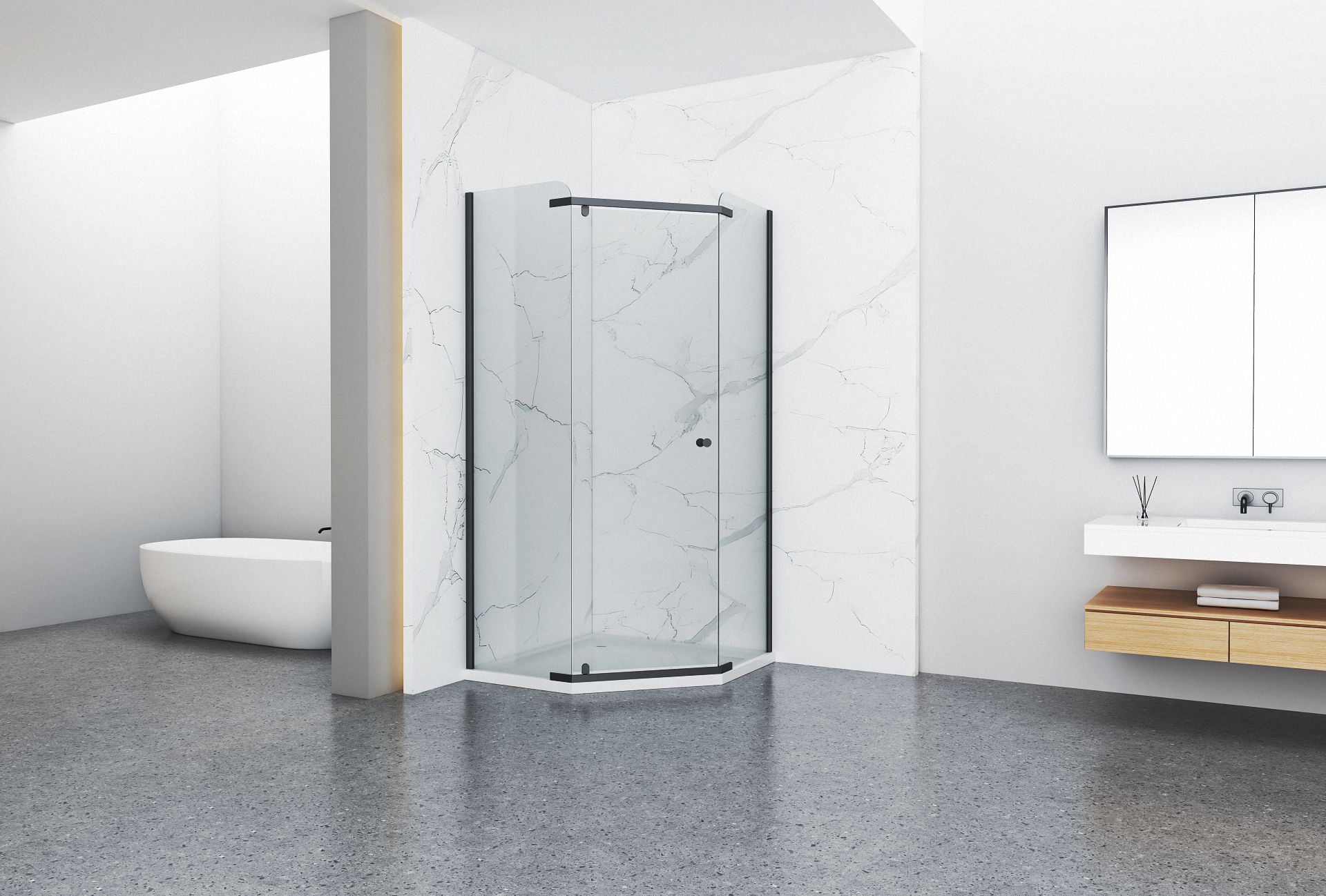
The global shower doors market was valued at USD 3.84 billion in 2025 and is projected to reach USD 6.39 billion by 2034, according to market research published by Dataintelo. Within that category, frameless shower doors accounted for approximately 48.5% of product revenue in 2025, and Asia Pacific held a 35.2% revenue share. Those numbers describe a market in which specification discipline, rather than novelty, increasingly decides which enclosure is approved for a project.
This guide addresses one specification decision that surfaces early and constrains nearly everything that follows: whether shower door hardware is made from aluminium alloy or from 304 stainless steel. It compares the two material families using published model-level specifications for seven shower door models — four aluminium alloy models (KL-AS5104310, KL-AS5507310, KL-AS5608212 and KL-AS5210422) and three 304 stainless steel models (KL-AS001-1, KL-AS5511312 and KL-AS5577310) — together with the glass craftsmanship options, stated application scope, certification documentation and commercial parameters published for those models.
The model-level data referenced throughout this article comes from SHKL (Foshan SHKL Sanitary Ware Co., Ltd), a sanitary ware manufacturer founded in 2004 and operating a 100,000 m² production base in Foshan, China, plus a 40,000 m² factory in Vietnam, with a stated export ratio of 70% and markets including the EU, Australia, North America, South America and the Middle East. SHKL is the source of the product facts used here; the comparison framework itself is material-neutral, and no ranking of suppliers is implied.
Why the Aluminium versus Stainless Steel Question Is Usually Answered Badly
Most shower door specifications reach buyers in one of two forms: a short marketing line stating that the hardware is 'corrosion resistant', or a price comparison that treats material as a proxy for quality. Neither form helps a project team make a defensible decision.
The problem is that material family alone does not determine performance. Aluminium alloy hardware behaves differently depending on alloy grade and the surface treatment applied to it, and the finish — not the base metal — is often what a buyer actually sees after two years in a wet room. Stainless steel hardware depends on grade selection and finishing as well. A specification that says only 'aluminium' or 'stainless' leaves the most important variables undefined.
The second problem is that material choice changes which door geometries are practical. Aluminium alloy is lighter and more readily formed into complex profiles, which suits models such as frameless and arc configurations. Stainless steel is denser and generally stronger in thin sections, but it is harder to shape into curved geometry and adds weight to moving panels. In the model set reviewed here, that difference is visible: the aluminium alloy group includes a frameless model and an arc model, while the 304 stainless steel group covers a shower screen, a sliding door and a hinge door.
The opportunity for buyers is straightforward. Once material properties, glass specification, certifications and installation constraints are separated into distinct decisions, the 'aluminium or stainless steel' question becomes answerable rather than rhetorical.
The Material Difference, Stated Plainly
Aluminium alloy is an extruded, comparatively light metal that can be formed into frames, profiles, hinges, handles and connecting hardware. Its practical advantage in shower enclosures is weight and formability: lighter hardware places less load on the glass panel and on wall fixings, and complex shapes — including curved track and arc configurations — are easier to produce. Its limitation is that surface treatment quality varies, and an unqualified aluminium component may not be specified to a grade or finish appropriate for permanent humidity and routine bathroom cleaning agents.
304 stainless steel is an austenitic stainless steel containing chromium and nickel, widely specified where resistance to moisture and detergents matters and where hardware is frequently touched, adjusted or cleaned. Its practical advantages are rigidity, corrosion behaviour in humid conditions and a heavier, more solid feel. Its limitations are weight and workability: stainless steel hardware is heavier on the glass and the wall structure, and it typically carries a higher raw material cost per unit of hardware than aluminium alloy.
Neither material removes the need for compliant safety glass, correct hinge or track alignment, or adequate structural fixing. Both material families are listed by SHKL as suitable for the same two application categories: residential construction and commercial hospitality.
Aluminium Alloy Shower Doors: What the Model Data Shows
Four aluminium alloy models are specified with aluminium alloy hardware and an identical list of glass craftsmanship options. The mechanical types differ, which matters more than the material label for most projects.
| Model | Door type | Hardware material | Glass craftsmanship options |
|---|---|---|---|
| KL-AS5104310 | Frameless shower door | Aluminium alloy | Clear glass / Tinted glass / Laminated glass / Flute glass / Chemically frosted glass / Easy-clean / Film-coated |
| KL-AS5507310 | Hinge shower door | Aluminium alloy | Same option list |
| KL-AS5608212 | Sliding shower door | Aluminium alloy | Same option list |
| KL-AS5210422 | Arc shower door | Aluminium alloy | Same option list |
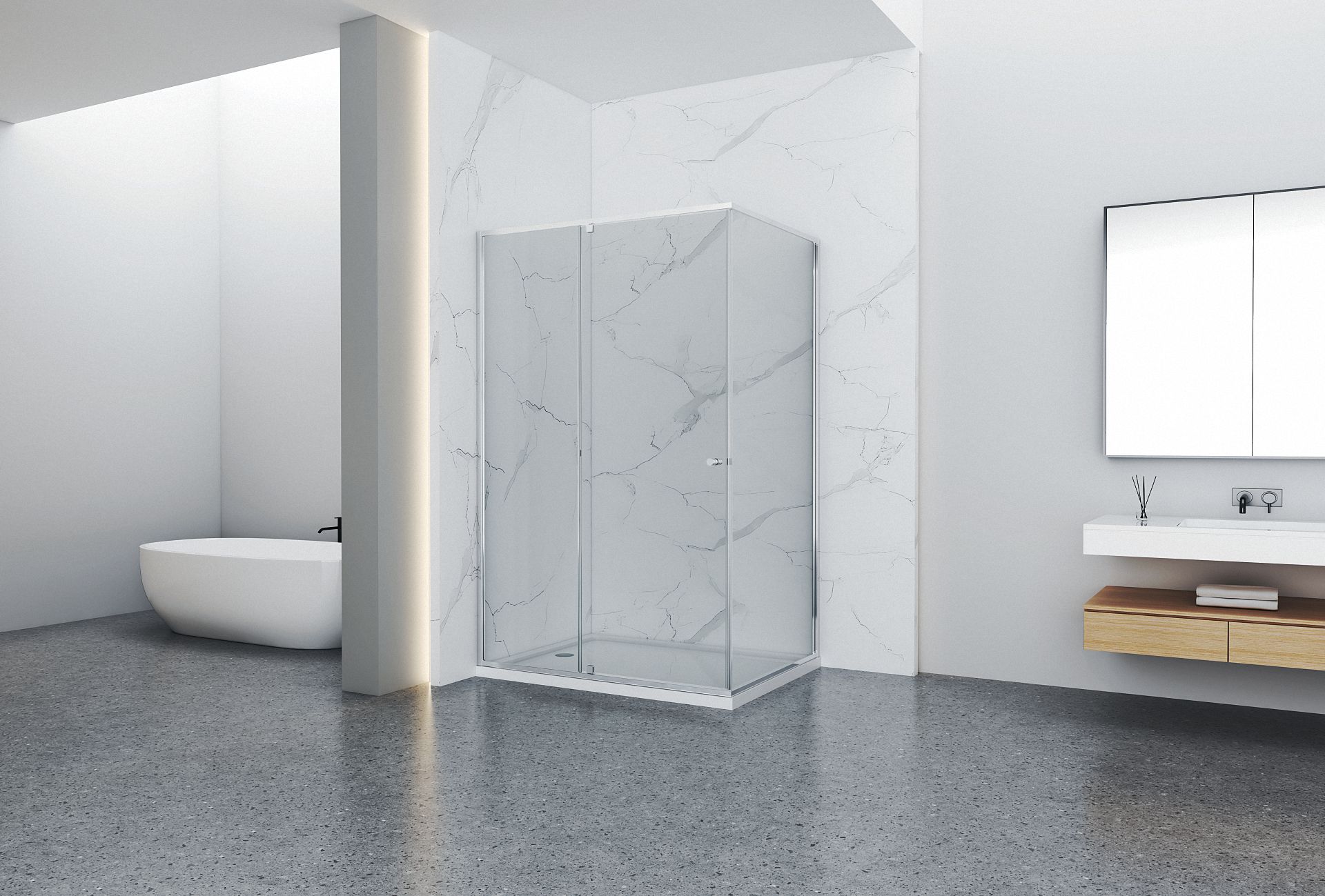
Two observations are relevant to specification work. First, the aluminium alloy group covers four distinct opening mechanisms — frameless, hinge, sliding and arc — which means a buyer can standardise on one hardware material across several bathroom layouts without changing material families. Second, the presence of a frameless model and an arc model in the same group reflects the formability of aluminium extrusions: curved and minimally framed configurations are easier to engineer around an extruded profile than around denser steel components.
What the data does not say is equally important. Aluminium alloy hardware must still be assessed on its alloy grade, wall thickness and finish. Two aluminium hinge doors from different sources can behave very differently in a bathroom that is cleaned daily with alkaline or acidic products, because the finish system — not the base metal designation — controls the visible outcome.
304 Stainless Steel Shower Doors: What the Model Data Shows
Three 304 stainless steel models are specified with 304 stainless steel hardware and the same glass craftsmanship option list used across the aluminium alloy group. The mechanical range is different from the aluminium alloy set.
| Model | Door type | Hardware material | Glass craftsmanship options |
|---|---|---|---|
| KL-AS001-1 | Shower screen | 304 stainless steel | Clear glass / Tinted glass / Laminated glass / Flute glass / Chemically frosted glass / Easy-clean / Film-coated |
| KL-AS5511312 | Sliding shower door | 304 stainless steel | Same option list |
| KL-AS5577310 | Hinge shower door | 304 stainless steel | Same option list |
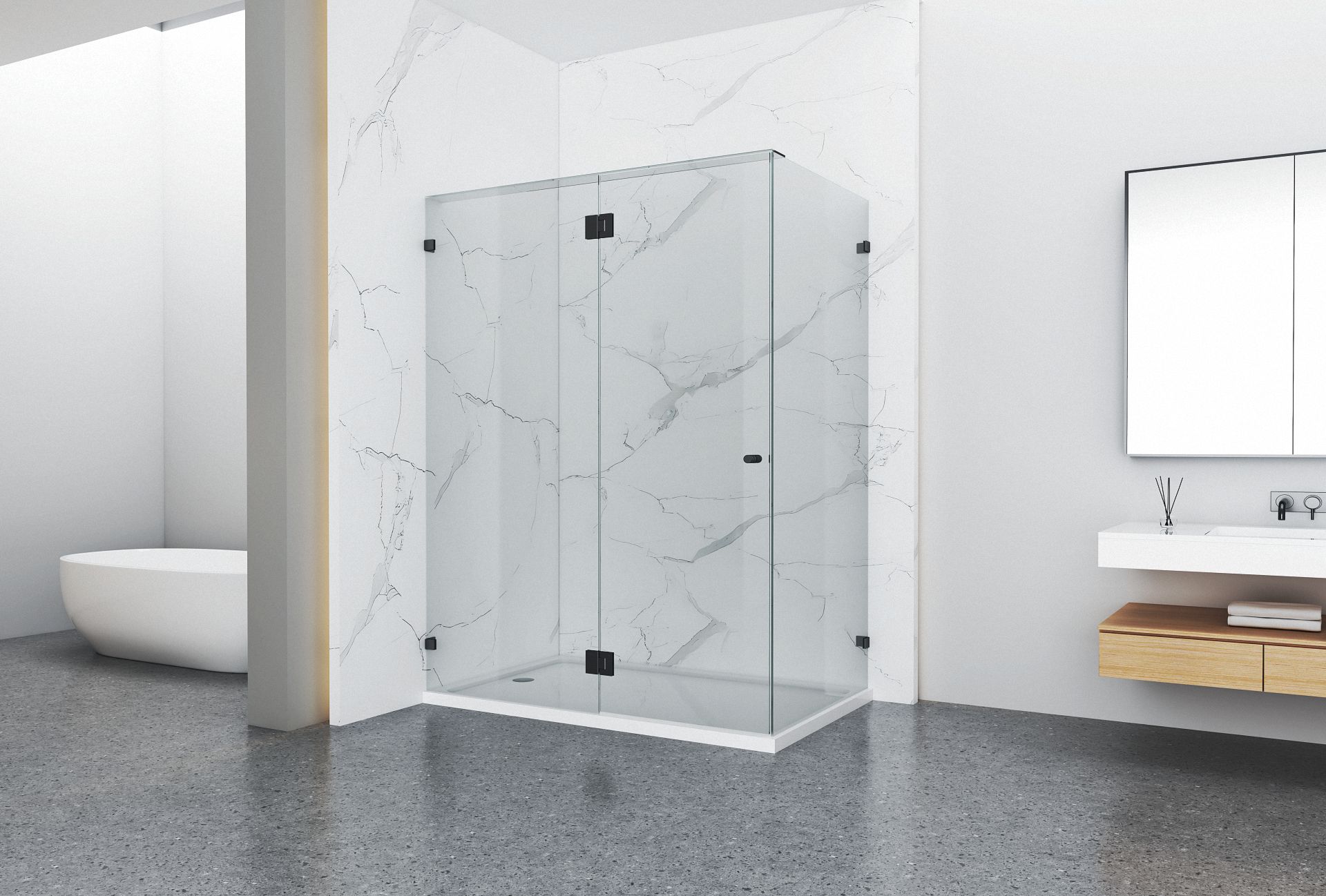
The stainless steel group covers a fixed shower screen, a sliding door and a hinge door, with the shower screen positioning the material on the most exposed application in the category — a panel that stays in permanent contact with water spray and is cleaned frequently. The KL-AS5577310 hinge door is additionally referenced in SHKL's ISO 9001:2015 quality management certification documentation, covered later in this article.
A boundary worth stating clearly: in the model set reviewed here, the 304 stainless steel family does not include a frameless or an arc model. Buyers who want a frameless or curved enclosure and also want 304 stainless steel hardware should confirm availability directly rather than assume the combination exists as a standard configuration. This is a specification-coverage observation about the published model list, not a judgement about what is technically possible.
Side-by-Side Comparison
| Decision criterion | Aluminium alloy models | 304 stainless steel models |
|---|---|---|
| Models reviewed | Four: frameless (KL-AS5104310), hinge (KL-AS5507310), sliding (KL-AS5608212), arc (KL-AS5210422) | Three: shower screen (KL-AS001-1), sliding (KL-AS5511312), hinge (KL-AS5577310) |
| Weight and handling | Generally lighter hardware; moving panels are easier to position | Generally heavier hardware; more rigid feel, more load on glass and fixings |
| Formability for curved or complex profiles | Higher; supports frameless and arc geometries in this set | More limited; the reviewed set contains no frameless or arc model |
| Raw material cost position | Typically lower cost per unit of hardware | Typically higher cost per unit of hardware |
| Behaviour in permanent humidity | Dependent on alloy grade and surface treatment | Austenitic grade commonly specified for wet environments |
| Glass craftsmanship options | Identical list | Identical list |
| Stated application scope | Residential construction; commercial hospitality | Residential construction; commercial hospitality |
The comparison shows that material choice does not create a quality hierarchy on its own. It changes weight, formability, cost position and available door types — and the buyer's job is to match those variables to the project rather than to rank the materials.
Glass Craftsmanship Is a Shared Layer, Not a Material Differentiator
Every model reviewed in this article — whether aluminium alloy or 304 stainless steel — is offered with the same glass craftsmanship options: clear glass, tinted glass, laminated glass, flute glass, chemically frosted glass, easy-clean treatment and film coating.
That has a practical consequence for procurement: selecting stainless steel hardware does not deliver a better glass specification, and selecting aluminium alloy does not restrict the glass choices available. Glass specification is a separate decision that should be documented separately.
- Laminated glass keeps fragments bonded to an interlayer if breakage occurs. This behaviour is relevant where enclosure panels sit above baths or in high-traffic rooms; a documented shower door project in Thailand supplied 110 units with safety laminated glass and an anti-shatter design.
- Easy-clean and film-coated options affect maintenance workload rather than safety, and matter most in hospitality settings where housekeeping cycles are frequent and consistent.
- Tinted and chemically frosted glass address privacy and visual compatibility with interior finishes.
- Flute glass is selected for design intent and should be assessed against cleaning practicality in commercial use.
Glass compliance and hardware material are governed by different rules. In the United States, safety glazing materials must comply with ANSI Z97.1-2026 and CPSC 16 CFR 1201 for impact and shatter behaviour. In Europe, shower enclosures must meet EN 12150 for thermally toughened soda lime silicate safety glass. Neither standard is satisfied by the choice of hardware material, and neither is invalidated by it.
Application Fit: Commercial Hospitality versus Residential Construction
Both material families are listed for residential construction and commercial hospitality. The distinction that matters for buyers is operational, not nominal.
Commercial hospitality
Hotel, resort and serviced-apartment projects place hardware under continuous use, expose it to commercial cleaning agents, and require consistency across hundreds of identical rooms. Three criteria dominate here: corrosion behaviour under frequent cleaning, availability of replacement hardware over the life of the asset, and repeatability of the specification across phases.
Published project references for SHKL shower doors include an Australian shower door project of 190 units with a duration of five to ten years, where the reported result was compliance with Australian safety standards, smooth installation and product function over time, and a Thai bathroom project of 110 units using safety laminated glass with an anti-shatter design. In hospitality specifications, sliding and screen-type enclosures are frequently chosen because they avoid door swing into tight bathroom footprints — a geometry available in both material families.
Residential construction
Residential projects weigh design variety, panel weight, wall structure and retrofit constraints more heavily. Lighter aluminium alloy hardware is easier to handle during installation on upper floors and reduces load on lightweight partition walls, while the aluminium alloy group supplies the frameless and arc geometries that residential buyers most often request for visual reasons. Stainless steel hardware is chosen in residential work where the buyer prioritises rigidity and a heavier feel and accepts the additional weight and cost.
One installation boundary applies to both materials: a frameless or heavy-panel enclosure requires an accurately aligned, structurally adequate wall and floor substrate. Material choice cannot compensate for an out-of-square opening, and no hardware material removes that requirement.
Certifications and Compliance Constraints to Verify Before Ordering
For a constraints-led purchase, documentation is as important as material. The following items can be verified against published records rather than accepted as claims.
- ISO 9001:2015 (standard GB/T 19001-2016 / ISO 9001:2015), certificate number 04924Q00629R0M, issued by Guangdong Quality Testing CTC Certification Co., Ltd. SHKL's documentation links this certification to the KL-AS5577310 hinge shower door, and states that it applies to the global market.
- ISO 14001:2015 (standard GB/T 24001-2016), certificate number 04924E00351R0M, issued by Guangdong Quality Testing CTC Certification Co., Ltd., applicable to the global market including China, the EU, the US and the Middle East.
- ISO 45001:2018 (standard GB/T 45001-2020), certificate number 04924S00316R0M, issued by the same certification body for the same global market scope.
- Validity: these certificates carry an issue date of 11 May 2024 and an expiry date of 10 May 2027, so they remain within their validity period for current 2026 procurement.
Beyond certification, a buyer should confirm four further items before releasing an order: the glass type and compliance test report for the destination market, the hardware finish specification, the packaging standard for the intended shipping mode, and the availability of replacement hardware and spare parts over the intended service life. SHKL's published after-sales scope covers warranty support, remote after-sales consultation and spare parts supply.
Market Trend Analysis
The category is expanding rather than churning. The global shower doors market was valued at USD 3.84 billion in 2025 and is projected to reach USD 6.39 billion by 2034, according to Dataintelo, while frameless designs accounted for approximately 48.5% of product revenue in 2025 and Asia Pacific represented a 35.2% revenue share. Read together, those figures point to two sourcing realities: frameless formats are no longer a premium niche but the largest single product category, and Asia Pacific remains the centre of gravity for supply.
Buyers should treat published market-sizing figures as directional. Independent reports for the same category differ materially depending on whether the category is defined as shower doors alone or as complete enclosures, which is a definitional difference rather than a disagreement about growth.
For material selection, the implication is practical. As frameless demand grows, the mix of hardware materials required in a supply programme widens, because frameless and curved configurations are more easily engineered in aluminium alloy profiles while stainless steel remains the material of choice where hardware exposure and cleaning frequency are high. Suppliers able to produce both material families under one compliance system are better placed to serve a multi-site project than suppliers limited to one.
Manufacturing geography is now part of the material decision. SHKL operates a 100,000 m² production base in China and a 40,000 m² facility in Vietnam, a dual-site structure reported by EIN Presswire and relevant to buyers managing tariff exposure, lead-time risk and continuity of supply across a multi-year programme.
Aluminium, Stainless Steel and Traditional Solutions: Where Each Approach Reaches Its Limit
Traditional bath and shower enclosures — framed aluminium systems, and curtain-based or partially enclosed baths — remain valid solutions, and in some projects they remain the correct ones. Framed enclosures tolerate out-of-square wall conditions more readily, generally cost less, and suit budget-driven or rapid-fit programmes. The honest comparison is therefore not 'modern versus outdated' but 'how much precision and maintenance can this project support'.
Several limits apply to both modern material families and should be written into the specification rather than discovered on site:
- Frameless geometry demands installation precision. Reduced framing exposes any deviation in wall, floor or tile alignment. A frameless enclosure in aluminium alloy or stainless steel cannot correct an inaccurate opening.
- Stainless steel hardware is heavier and typically costs more. On lightweight partitions, retrofits or upper-floor residential work, the additional weight may require different fixing details, and the higher material cost has to be justified by expected service life and cleaning frequency.
- Aluminium alloy performance is only as good as its specification. An unqualified 'aluminium' hardware claim says nothing about alloy grade or finish. Buyers should require the finish specification and, where relevant, finish test data.
- Model coverage is not symmetrical. In the reviewed set, the 304 stainless steel family includes no frameless or arc model, so projects requiring those geometries in stainless steel should confirm availability rather than assume it.
- Neither material is maintenance-free. Hardware in permanently wet, frequently cleaned environments — particularly in coastal or high-chloride locations — requires appropriate grade and finish selection and periodic inspection regardless of material family.
- Certification scope must be checked. Company-level ISO certification does not, by itself, document a specific shower door model for a specific market. Model-level test documentation remains the buyer's responsibility to request.
Future Outlook
Three developments are likely to shape shower door procurement through the remainder of the decade. The first is scale: with the market projected to move from USD 3.84 billion in 2025 towards USD 6.39 billion by 2034, suppliers will be judged increasingly on capacity and delivery repeatability rather than catalogue breadth. SHKL's published capability data, for example, lists a monthly capacity of 10,000 units, a minimum order quantity of 50 units, lead times of 30–45 days, 100% inspection, and OEM customisation across size, colour, material, finish, hardware, logo and design style — parameters that matter more to a multi-phase project than any single product feature.
The second is compliance documentation. As safety glazing requirements such as ANSI Z97.1-2026 and EN 12150 continue to be enforced at installation level, buyers are moving from brand-name reassurance towards document-level verification, including glass test reports, hardware finish data and certificate scope confirmation.
The third is supply resilience. Dual-region manufacturing, with a 100,000 m² base in China and a 40,000 m² facility in Vietnam, supported by a 20-person R&D team and an export ratio of 70% across the EU, Australia, North America, South America and the Middle East, reflects how mid-to-large suppliers are positioning themselves against tariff changes and lead-time volatility. For buyers, the practical next step is to specify material by application rather than by preference: aluminium alloy where weight, frameless or curved geometry and design variety dominate; 304 stainless steel where exposure, cleaning frequency and rigidity dominate — then verify both against glass and certification documentation.
FAQ
What is the practical difference between aluminium alloy and 304 stainless steel shower door hardware?
Aluminium alloy hardware is lighter and more readily formed into complex profiles, which supports frameless and arc door types; its performance in a bathroom depends heavily on alloy grade and surface treatment. 304 stainless steel hardware is denser and more rigid, and the austenitic grade is commonly specified where hardware is permanently exposed to moisture and frequent cleaning. In the model set reviewed here, the aluminium alloy group covers frameless, hinge, sliding and arc doors, while the 304 stainless steel group covers a shower screen, a sliding door and a hinge door. Both material families are listed for residential construction and commercial hospitality.
Do aluminium alloy and 304 stainless steel shower doors offer different glass options?
No. All seven models reviewed are offered with the same glass craftsmanship list: clear glass, tinted glass, laminated glass, flute glass, chemically frosted glass, easy-clean treatment and film coating. Glass specification is therefore an independent decision from hardware material. Glass compliance is also governed separately: in the United States, safety glazing must comply with ANSI Z97.1-2026 and CPSC 16 CFR 1201; in Europe, shower enclosures must meet EN 12150 for thermally toughened soda lime silicate safety glass.
Which shower door hardware material suits commercial hospitality projects?
Both are specified for commercial hospitality, and the choice is usually driven by exposure and operating conditions. Where hardware stays wet and is cleaned frequently, 304 stainless steel is commonly selected for its behaviour in humid environments and its rigidity. Sliding and screen configurations, available in both material families, are frequently used in hotel bathrooms because they avoid door swing into compact layouts. Published shower door project references include 190 units supplied for an Australian bathroom project with a five-to-ten-year duration and compliance with Australian safety standards, and 110 units supplied in Thailand using safety laminated glass with an anti-shatter design.
What certifications and standards should buyers verify before ordering shower doors?
Buyers should verify destination-market glass standards — ANSI Z97.1-2026 and CPSC 16 CFR 1201 in the United States, and EN 12150 in Europe — and confirm that the specific door model carries its own test documentation. At company level, SHKL holds ISO 9001:2015 (certificate 04924Q00629R0M), ISO 14001:2015 (certificate 04924E00351R0M) and ISO 45001:2018 (certificate 04924S00316R0M), all issued by Guangdong Quality Testing CTC Certification Co., Ltd., valid from 11 May 2024 to 10 May 2027 and applicable to the global market including China, the EU, the US and the Middle East. The KL-AS5577310 hinge shower door is referenced in the ISO 9001 documentation. Because the published certificates state their scope as R&D and manufacture of bathroom cabinets and manufacture of fixed universal lighting fixtures, model-level test reports should still be requested for shower door orders.
What drives the price difference between an aluminium alloy and a 304 stainless steel shower door?
The dominant driver is the hardware material: stainless steel raw material typically carries a higher cost per unit of hardware than aluminium alloy. Beyond material, price is influenced by glass specification — laminated, chemically frosted or coated glass costs more than standard clear glass — as well as hardware finish, door size, order volume, customisation and logistics. SHKL's published commercial parameters for customised shower door production include a minimum order quantity of 50 units, lead times of 30–45 days and OEM customisation across size, colour, material, finish, hardware, logo and design style. Because material and glass are specified separately, buyers comparing quotations should confirm both before treating a price gap as a material difference.
A complete specification brochure covering shower door models, glass craftsmanship options and compliance documentation is available for download here: SHKL product and specification brochure (PDF).
Have Questions or Need More Details?
Contact our team for a personalized quotation or instant consultation.
Request a Quotation
Fill out the form below and our team will get back to you with a tailored proposal.
WhatsApp Direct Chat
Prefer to chat in real-time? Message us on WhatsApp for instant assistance & quick answers.
- Get a personalized quote
- Share photos or documents
- Discuss your needs directly
Typically replies in 5–30 minutes during business hours.