
Silicon Steel Grades, Coating Systems and Compliance in Power Equipment Procurement
Electrical steel specification is not a single-parameter decision. Power equipment buyers evaluating silicon steel for transformer cores, generator stators, reactor cores or charging infrastructure must balance thickness, iron loss, magnetic flux density, coating behaviour and compliance evidence before a single coil is ordered. The cost of getting this balance wrong is not always visible at incoming inspection; it appears later as higher no-load losses, unexpected noise levels or coating failure under field conditions.
This article is written as an independent procurement reference. It explains the main specification constraints when sourcing silicon steel, the standards commonly referenced in cross-border trade, and the practical lead-time and customisation limits that shape purchasing decisions. Company-specific data is used where it helps illustrate a real example.
Why Silicon Steel Specification Varies Across Applications
Different end-use equipment places different and sometimes conflicting demands on the same base material. Understanding the application is therefore the first step before comparing grades.
Distribution and Power Transformers
Transformers operate at a fixed grid frequency, usually 50 Hz, and the magnetic flux direction in the core is predictable. This is the classic domain of grain-oriented silicon steel, where the crystal structure is oriented so that magnetic flux flows efficiently along the rolling direction. The most relevant specification points are iron loss at 1.7 T / 50 Hz (P1.7/50), magnetic flux density at 800 A/m (B8), and the insulating coating system that allows the core to be stacked or wound without excessive eddy-current losses between laminations.
Generators and Rotating Machines
Rotating machines experience flux in multiple directions, especially in the stator. Non-oriented silicon steel is typically preferred in this segment because its magnetic properties are more isotropic. Automotive generators, industrial motors and some power-generation equipment rely on non-oriented grades, and the stamping behaviour of the steel becomes a practical constraint because the core laminations are punched in high volumes.
Reactors and Converter Stations
Reactors and HVDC converter transformers operate under higher harmonic content and more demanding thermal cycles than standard distribution transformers. The core material must hold stable magnetic performance under continuous load and, in tropical installations, resist humidity and temperature swings. Gauges of 0.20 mm and 0.23 mm are common in this segment because thinner laminations reduce eddy-current losses at non-sinusoidal flux.
Charging Piles and Power Electronics
Charging infrastructure for electric vehicles introduces a different constraint: higher operating frequencies. At elevated frequency, iron loss rises sharply, and only ultra-thin gauges below 0.25 mm can keep the core temperature within acceptable limits. This is one of the reasons the global shift toward EV charging networks is being watched closely by electrical steel suppliers.
Key Technical Parameters Buyers Should Verify
Before issuing a request for quotation, a buyer should check at least the following parameters. These are the constraints that determine whether a given grade can serve a specific application.
Thickness
In grain-oriented silicon steel for power applications, common thicknesses are 0.18 mm, 0.20 mm, 0.23 mm and 0.27 mm. Thinner laminations offer lower eddy-current loss but can increase stacking difficulty and may influence the overall core build factor. The practical supply range for custom processing is generally 0.18 mm to 0.35 mm, with widths from 800 mm to 1250 mm.
Iron Loss (P1.7/50)
Iron loss is the energy converted into heat inside the core when the steel is magnetised at 1.7 T and 50 Hz. Lower values mean higher transformer efficiency and lower long-term operating cost. For context, grade 23R075 guarantees iron loss ≤ 0.75 W/kg at 1.7 T / 50 Hz, while grade 20-65 guarantees ≤ 0.65 W/kg at the same condition. In high-efficiency distribution transformer projects, buyers often push the requirement to 0.60 W/kg or below, depending on the measurement standard and batch performance.
Magnetic Flux Density (B8)
Flux density expressed as B8 indicates the magnetic induction measured at a field strength of 800 A/m. A higher B8 means the core can be magnetised to a higher working flux, which allows a smaller core cross-section for the same power rating. High magnetic induction grades such as 27Q100 offer B8 ≥ 1.91 T, which is useful in power transformers and reactors where core size and weight matter.
Coating System
The coating on silicon steel serves two functions: electrical insulation between laminations and protection against corrosion. Buyers should know the temperature limit of the coating before choosing a heat-treatment or core-annealing process. Organic coatings are rated up to approximately 180°C, inorganic coatings up to approximately 800°C, and semi-organic coatings are also available as a compromise between insulation performance and weldability.
Material Type: CGO vs Hi-B
Within grain-oriented silicon steel, a distinction is made between conventional grain-oriented (CGO) steel and high magnetic induction (Hi-B) steel. Hi-B grades use a more precisely controlled grain orientation and typically deliver higher permeability and lower loss. The product family offered by HL AND SL LIMITED includes both general orientation grades and Hi-B grades, allowing buyers to match performance level to project budget.
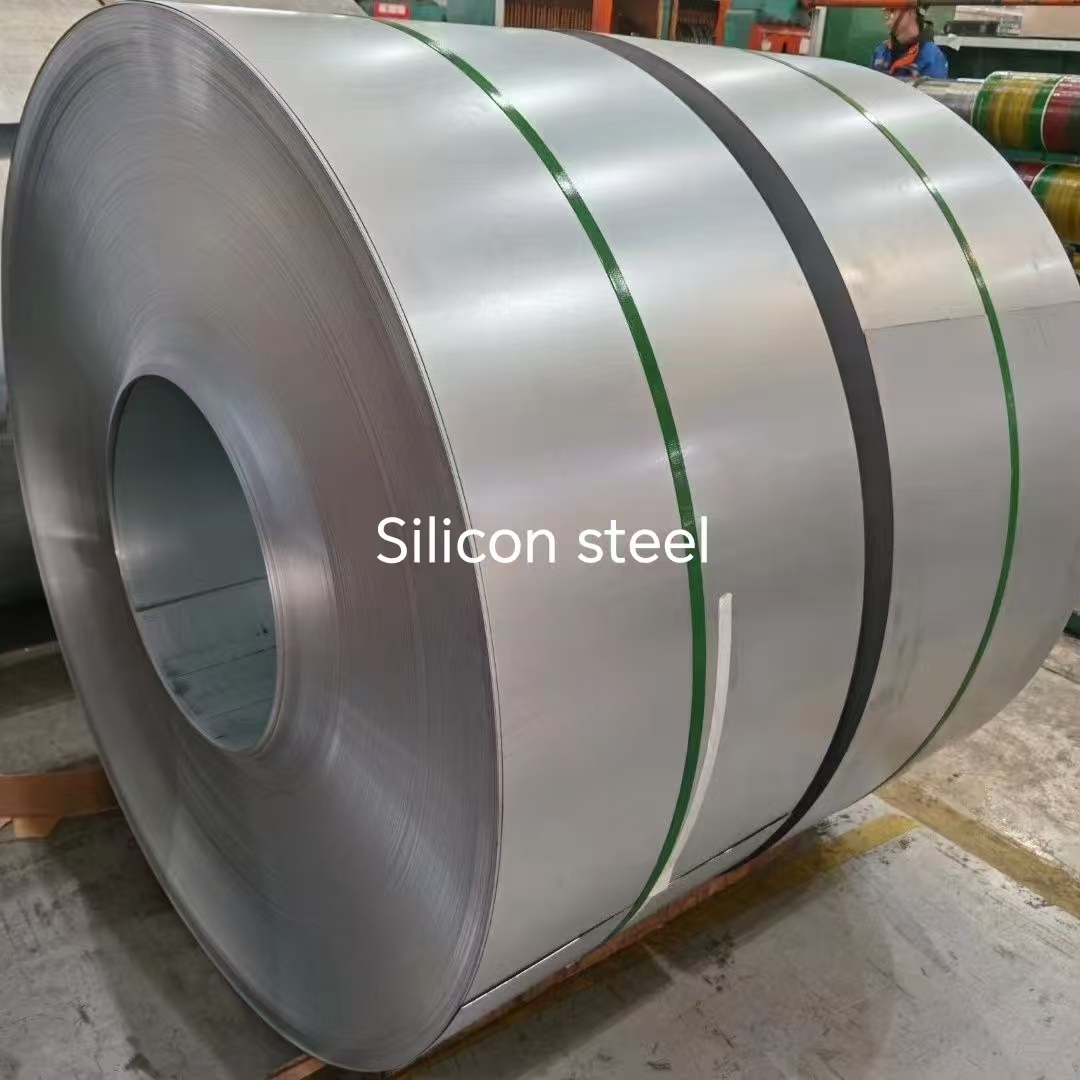
Reference Grade Table for Grain-Oriented Silicon Steel
The following table lists representative grain-oriented grades and their guaranteed parameters. It is intended as a reference, not a substitute for a full material certificate.
| Grade | Thickness (mm) | Iron Loss P1.7/50 (W/kg) | Flux Density B8 (T) | Typical Application |
|---|---|---|---|---|
| 27Q120 | 0.27 | ≤ 1.20 | – | Small and medium transformer cores |
| 27Q110 | 0.27 | ≤ 1.10 | ≥ 1.88 | Power transformers, automotive generators |
| 27Q105 | 0.27 | ≤ 1.05 | ≥ 1.88 | Power transformer cores |
| 27Q100 | 0.27 | ≤ 1.00 | ≥ 1.91 | Power transformers, reactors |
| 27Q095 | 0.27 | ≤ 0.95 | ≥ 1.91 | High-efficiency transformers, PV inverter transformers |
| 23R075 | 0.23 | ≤ 0.75 | ≥ 1.88 | Energy-efficient distribution transformers |
| 20-65 | 0.20 | ≤ 0.65 | – | Ultra-high voltage and high-efficiency power equipment |
| 18-65 | 0.18 | ≤ 0.65 | ≥ 1.88 | Ultra-high voltage transformers, high-efficiency cores |
It is worth noting that some grades can be supplied with a measured performance better than the guaranteed value. Grade 23Q080, for instance, has a guaranteed iron loss of ≤ 0.80 W/kg while measured values on delivered material have been recorded in the range of 0.76–0.78 W/kg. This kind of batch information is most useful when a project is close to an efficiency threshold and the buyer needs realistic data for design calculations.
Standards Landscape: What Compliance Evidence Should Be Supplied
Cross-border silicon steel procurement typically involves multiple compliance layers. A responsible buyer should verify not only product parameters but also the standards and certificates that accompany the shipment.
In North America, non-oriented electrical steel is standardised under ASTM A677 for fully processed types and ASTM A683 for semi-processed types. Internationally, IEC 60404-8-4 defines the specification for non-oriented fully processed electrical steel strips in the finally annealed state. Buyers sourcing grain-oriented steel for transformers may also reference IEC 60404-8-7, which covers grain-oriented material, although the supplied corpus does not contain specific verification of this standard.
From the supplier side, an established practice is to provide a material certificate or mill test certificate with the shipment. HL AND SL LIMITED, for example, states that batch inspection reports are delivered alongside the goods, and third-party testing through CMA/CNAS accredited laboratories is available when the buyer requires independent verification. For a procurement engineer, the key question is not whether a certificate exists, but whether the certificate corresponds to the exact batch of material being delivered.
Environmental and Regional Requirements
Energy-efficiency requirements increasingly function as a compliance constraint. The EU ecodesign regulation for transformers, for instance, has pushed distribution transformer buyers to look for core materials with lower no-load loss and stricter noise limits. In Brazil, transformer manufacturers must meet INMETRO energy-efficiency certification requirements for equipment sold in the local market. Buyers should therefore ask early whether the proposed silicon steel grade can support the final equipment certification in their target country.
Procurement Constraints: MOQ, Lead Time and Custom Processing
Even the correct grade is useless if the supply chain cannot deliver it within the project schedule. For grain-oriented silicon steel, three procurement constraints dominate: minimum order quantity, lead time and processing capability.
Minimum Order Quantity
Specialty electrical steel is produced in relatively large campaigns. A typical MOQ for custom-grade material is around 25 tonnes. Buyers with smaller annual requirements often need the flexibility of a supplier that can consolidate multiple grades into a single production cycle.
Lead Time
Regular orders for grain-oriented silicon steel generally require 15 to 20 days from order confirmation. Urgent orders or stock orders can sometimes ship within 3 to 7 days, while bulk export orders may need 30 to 45 days to arrive at port. For letter-of-credit arrangements, the shipping window after deposit is usually 7 to 30 working days. Buyers should factor these timeframes into their project planning rather than treating them as negotiable at the last minute.
Custom Processing
Silicon steel suppliers differ significantly in whether they can provide secondary processing. The most basic operations are strip cutting, fixed-length flat cutting, and longitudinal cutting. Some suppliers also support custom thickness selection within 0.18 to 0.35 mm, and width up to 1250 mm for ultra-wide requirements. In-house processing capability is one reason a buyer may choose a trading or processing entity over a mill, particularly when the buyer wants the material already cut to core dimensions and ready for stacking.
Application References: How Specification Constraints Appear in Real Projects
The following project examples illustrate how specification and compliance constraints come together in practice. They are drawn from documented application scenarios rather than marketing claims.
German Distribution Transformer Upgrade
In Germany, distribution transformer replacement is driven by the EU ecodesign regulations. The operating environment is characterised by a stable grid, strict energy-efficiency targets and tight noise requirements. The project specifications call for transformer cores with very low iron loss, noise levels 2–3 dB below the normal standard, and coating systems that can withstand the salt-spray conditions of the North Sea coast. This combination of magnetic performance and coating durability is a typical example of a project constraint that cannot be solved by changing only one parameter.
Canadian Cold-Climate Grid Upgrade
In Canada, distribution transformers must operate through extreme cold winters, with temperatures from -40°C to -20°C and frequent freeze-thaw cycles. The material requirement is not only low iron loss but also stable magnetic permeability at low temperature. In one documented grid upgrade scenario, the specification calls for a magnetic permeability retention rate of at least 95% at -40°C. This type of cold-weather requirement is rarely visible in standard material certificates, which is why buyers benefit from discussing the service environment with the steel supplier before ordering.
Brazilian HVDC Transmission Project
The second phase of the ±800 kV ultra-high-voltage direct current project in Belém Mountain, Brazil, transports hydropower from the north of the country to the southeast load centres. The operating environment is challenging: high temperature, high humidity, frequent thunderstorms, and continuous bipolar operation at ±800 kV / 4000 MW. Converter transformers in this project require core material with very low iron loss and high magnetic flux density. In similar HVDC applications, the material target is often around 0.85 W/kg iron loss or lower, with flux density above 1.92 T, combined with resistance to high-humidity corrosive conditions.
WEG Brazil Transformer Manufacturing
WEG, a major Brazilian electrical equipment manufacturer, has applied grain-oriented silicon steel across its local production of power and distribution transformers. The collaboration has reportedly been in use for more than 10 years. One documented outcome is that the material has supported WEG in meeting Brazil's local grid energy-efficiency standards and low-carbon transformation requirements. For procurement teams, this case shows that long-term supplier relationships can reduce the compliance risk that arises when every batch behaves differently.
Market Trends Shaping Silicon Steel Demand
Several market-level trends are visible in third-party data and are worth considering when evaluating long-term supply options.
Growth of the Electrical Steel Market
The global electrical steel market was valued at approximately USD 31.0 billion in 2025 and is projected to grow to around USD 47.0 billion by 2033. The grain-oriented segment specifically was valued at about USD 13.55 billion in 2025 and is projected to reach around USD 23.57 billion by 2035, representing a compound annual growth rate of roughly 5.8%. These figures indicate sustained demand for transformer-grade material over the next decade.
Non-Oriented Grade Dominance
Non-grain-oriented electrical steel held the largest market share at approximately 69.7% of total electrical steel in 2025. This reflects the high volume consumed by motors and rotating equipment. For buyers, this means that non-oriented grades are widely available with relatively mature supply chains, while specific grain-oriented Hi-B grades may require more careful sourcing.
Ultra-Thin Gauge Adoption
Ultra-thin gauge silicon steel below 0.25 mm is seen as the preferred choice for high-frequency motors in new energy vehicles, because it maximises power density while limiting high-frequency losses. The same technical logic is starting to influence charging infrastructure and inverter applications, where switching frequencies are far higher than the 50 Hz grid frequency.
Charging Infrastructure as a New Demand Driver
The EV charging station market size was approximately USD 3.93 billion in 2024 and is expected to grow at a compound annual rate of around 32.1%. Charging piles and related power electronics require high-frequency magnetic components, which supports the demand for thinner electrical steel gauges. This is a relatively new demand pool that did not exist at scale a decade ago.
Comparison: Mill-Direct Sourcing vs Integrated Export and Processing Supplier
Buyers in the electrical steel market generally have two sourcing routes: direct mill purchasing, or engagement with an export-focused specialist that integrates supply from multiple mills and provides in-house processing.
Mill-Direct Purchasing
Buying directly from a steel mill works well when a buyer has stable demand for large quantities, a single grade, and the internal logistics capability to handle large coils. The main advantage is price transparency and direct access to the original quality control system. However, direct mill procurement often requires high order volumes, longer lead times, and less flexibility for urgent orders or custom processing.
Integrated Export and Processing Partner
An integrated supplier such as HL AND SL LIMITED operates differently. As an authorised agent of China Baowu Steel Group, it has access to high-quality electrical steel, and it also integrates export resources from multiple private steel mills to cover a range of performance grades and price levels. The company operates a 30,000 m² processing plant, with a monthly capacity of approximately 4,000 tonnes and a dedicated engineering team. This structure allows buyers to combine several grades in one order, request custom cutting, and reduce their own inventory risk.
One limitation should be stated clearly: for buyers with very large, repeated, single-grade requirements, a mill-direct arrangement may still produce a lower per-tonne cost than a trading or processing entity, because the intermediary margin is removed. The value of an integrated supplier lies mainly in product mix flexibility, processing services and faster response, not in being universally cheaper than a mill for every order type.
Future Outlook
Three directions are likely to shape the silicon steel market in the coming years.
First, the trend toward thinner gauges will accelerate. As power electronics expand into grids, charging infrastructure and renewable energy converters, the operating frequency of magnetic components will rise. Ultra-thin grain-oriented silicon steel, in the 0.18 mm to 0.20 mm range, is likely to see broader adoption in applications that were previously dominated by thicker grades.
Second, coating technology will become a greater differentiator. The requirement for corrosion-resistant coatings in coastal environments, thermally stable coatings for high-temperature operations, and environmentally acceptable systems will shift from a secondary specification to a primary selection criterion.
Third, supply chain transparency will matter more. With energy-efficiency regulations tightening in Europe, Brazil and other regions, equipment manufacturers will need reliable batch-level performance data from their steel suppliers. The ability to provide traceable mill certificates, batch inspection reports and third-party testing evidence will become an essential procurement requirement, not an additional service.
Frequently Asked Questions
What is the difference between grain-oriented and non-oriented silicon steel?
Grain-oriented silicon steel is processed so that magnetic flux flows efficiently along the rolling direction, making it the preferred material for transformer cores where flux direction is predictable. Non-oriented silicon steel has more isotropic magnetic properties and is used in motors, generators and applications where flux direction changes with the rotor position.
What thickness of silicon steel is available for transformer cores?
Common thicknesses for grain-oriented transformer-grade silicon steel are 0.18, 0.20, 0.23 and 0.27 mm. Thinner gauges reduce eddy-current loss, which is important in high-efficiency and high-frequency applications, but they can increase core stacking complexity and production cost.
What coating types are used on silicon steel and what temperature limits do they have?
Organic coatings have a temperature resistance of up to about 180°C. Inorganic coatings can withstand temperatures up to about 800°C. Semi-organic coatings are also available, offering a balance between insulation performance, punching performance and weldability.
Which standards apply to electrical steel in cross-border trade?
In North America, non-oriented electrical steel is covered by ASTM A677 for fully processed material and ASTM A683 for semi-processed material. Internationally, IEC 60404-8-4 defines specifications for non-oriented fully processed strips in the finally annealed state. Buyers should confirm which standard applies to their market and request corresponding certificates.
What is a typical minimum order quantity for specialty silicon steel?
A typical MOQ for custom-grade grain-oriented silicon steel is 25 tonnes. Some suppliers accept smaller orders for stock material, but custom grades generally need a production campaign of at least this size to be economical.
What does iron loss P1.7/50 mean?
P1.7/50 is the specific total iron loss of the steel measured at a magnetic polarisation of 1.7 tesla and a frequency of 50 Hz, expressed in watts per kilogram. It directly indicates how much energy will be lost as heat in the transformer core under standard grid operating conditions.
Can silicon steel be processed to custom dimensions?
Yes. Common secondary processing includes strip cutting, fixed-length flat cutting and longitudinal cutting. Thickness can generally be selected within 0.18 to 0.35 mm, and width is typically 800 to 1250 mm, with ultra-wide 1250 mm available on request.
For buyers seeking a structured product overview, the company profile of HL AND SL LIMITED is available as a downloadable reference: Download the electrical steel company profile (PDF).