
Silicon Steel Specs: A Buyer's Guide to Grades and Compliance
Silicon steel, also called electrical steel, is the functional core material in generators, distribution transformers, reactors, and charging infrastructure. The global electrical steel market was valued at USD 31.0 billion in 2025 and is projected to reach USD 47.0 billion by 2033 (Grand View Research). For buyers moving from research to evaluation, the practical task is not simply finding silicon steel, but matching grade designations, thickness, iron loss, magnetic flux density, coating type, and compliance certificates to the exact operating profile of the equipment.
Why Silicon Steel Specifications Matter in Procurement
Core loss, magnetic flux density, and coating behavior are not secondary product details in silicon steel purchasing. They determine transformer efficiency ratings, noise performance, thermal stability, and long-term energy consumption. A small difference in specific iron loss across a power transformer core can translate into measurable energy losses over decades of continuous grid operation. That is why tenders and technical datasheets specify iron loss values such as P₁.₇/₅₀, magnetic flux density values such as B₈, and coating temperature resistance.
Market structure reinforces this point. Non-grain-oriented electrical steel accounted for the largest share of the electrical steel market in 2025, at an estimated 69.7% (MarketsandMarkets). Grain-oriented silicon steel, meanwhile, was valued at USD 13.55 billion in 2025 and is projected to reach USD 23.57 billion by 2035, at a CAGR of 5.8% (Research Nester). These are different product families with different specification logic, and buyers need to treat them accordingly.
Decoding Silicon Steel Grades: Thickness, Iron Loss, Magnetic Flux
Silicon steel grade names carry meaningful technical information. Take 27Q110 as an example. The first two digits indicate nominal thickness: 0.27 mm. The letter Q refers to high magnetic induction grain-oriented silicon steel, commonly known as Hi-B steel. The number 110 corresponds to the maximum iron loss value, 1.10 W/kg, measured at P₁.₇/₅₀, which means 1.7 T magnetic flux density at 50 Hz. Similarly, 23R075 is a 0.23 mm grain-oriented grade with a laser-scribed or heat-resistant R-type surface treatment and iron loss no greater than 0.75 W/kg.
The two most important parameters buyers should verify are iron loss (P₁.₇/₅₀) and magnetic flux density (B₈). Iron loss determines how much energy is wasted as heat inside the magnetic core. Magnetic flux density, usually measured at a magnetic field strength of 800 A/m and written as B₈, indicates how easily the material becomes magnetized. A higher B₈ value allows transformer designers to reduce core cross-section and weight while maintaining performance.
| Grade | Thickness | Iron Loss P₁.₇/₅₀ | Magnetic Flux B₈ | Typical Application |
|---|---|---|---|---|
| 27Q120 | 0.27 mm | ≤ 1.20 W/kg | — | Small and medium transformer cores, electrical equipment |
| 27Q110 | 0.27 mm | ≤ 1.10 W/kg | ≥ 1.88 T | Power transformers, automotive generators, power cables, electrical equipment |
| 27Q105 | 0.27 mm | ≤ 1.05 W/kg | ≥ 1.88 T | Power transformer cores, transformer manufacturing |
| 27Q100 | 0.27 mm | ≤ 1.00 W/kg | ≥ 1.91 T | Power transformers, reactors, electrical equipment cores |
| 27Q095 | 0.27 mm | ≤ 0.95 W/kg | ≥ 1.91 T | High-efficiency power transformers, PV converter transformers, variable-frequency equipment |
| 23R075 | 0.23 mm | ≤ 0.75 W/kg | ≥ 1.88 T | Energy-efficiency standard transformers, high-efficiency distribution transformers, power transformer cores |
| 20-65 | 0.20 mm | ≤ 0.65 W/kg | — | Ultra-high-voltage transformers, high-efficiency distribution transformers, high-efficiency power equipment |
| 18-65 | 0.18 mm | ≤ 0.65 W/kg | ≥ 1.88 T | Ultra-high-voltage transformers, power transformers, high-efficiency energy-saving transformer cores |
For buyers, the practical implication is straightforward: thinner gauges and lower iron loss values generally map to higher-efficiency equipment, but they also require more careful handling, coating selection, and core manufacturing processes.
Coating Systems and Environmental Compliance
Coating is a specification field that is sometimes underestimated. It affects interlaminar resistance, corrosion resistance, punching performance, and the thermal stability of stacked cores. In material customization, coating types are typically divided into organic coating, with temperature resistance up to 180°C; inorganic coating, with temperature resistance up to 800°C; and semi-organic coating, which balances insulation and processing performance.
For high-temperature applications, such as some reactor and transformer designs, inorganic or heat-resistant coatings are preferred. For high-volume stamping operations, organic coatings may be more suitable because of their lubricating effect during punching. Buyers should also verify whether the specified grade is semi-processed or fully processed, because the annealing state changes final magnetic performance.
Standards compliance is increasingly a formal requirement in silicon steel procurement. In North America, non-oriented electrical steel is standardized under ASTM A677 for fully processed types and ASTM A683 for semi-processed types. At the international level, IEC 60404-8-4 defines specifications for non-oriented fully processed electrical steel strip and sheet delivered in the finally annealed state. European buyers often screen materials for EU environmental directives and eco-design constraints, while other regions may require local certification such as INMETRO in Brazil.
Silicon Steel for Generators, Grids, Reactors, and Charging Piles
Different applications place different constraints on silicon steel. In generator production, especially automotive generators, grain-oriented grades with stable magnetic properties and low loss are preferred. Grade 27Q110, for example, is referenced for power transformers, automotive generators, and electrical equipment. In power grid equipment, the priority shifts to core loss and flux density under continuous 50 Hz operation. Grades such as 27Q100 and 23R075 appear across power transformer and reactor core applications.
Reactors require materials that maintain stable permeability under changing loads and harmonic content. This is where higher magnetic induction and precise thickness tolerance become valuable. For charging piles, the market context is important: the EV charging station and pile market was valued at USD 3,927.96 million in 2024 and is expected to grow at a 32.1% CAGR, significantly increasing demand for silicon steel components in magnetic circuits and power conversion stages.
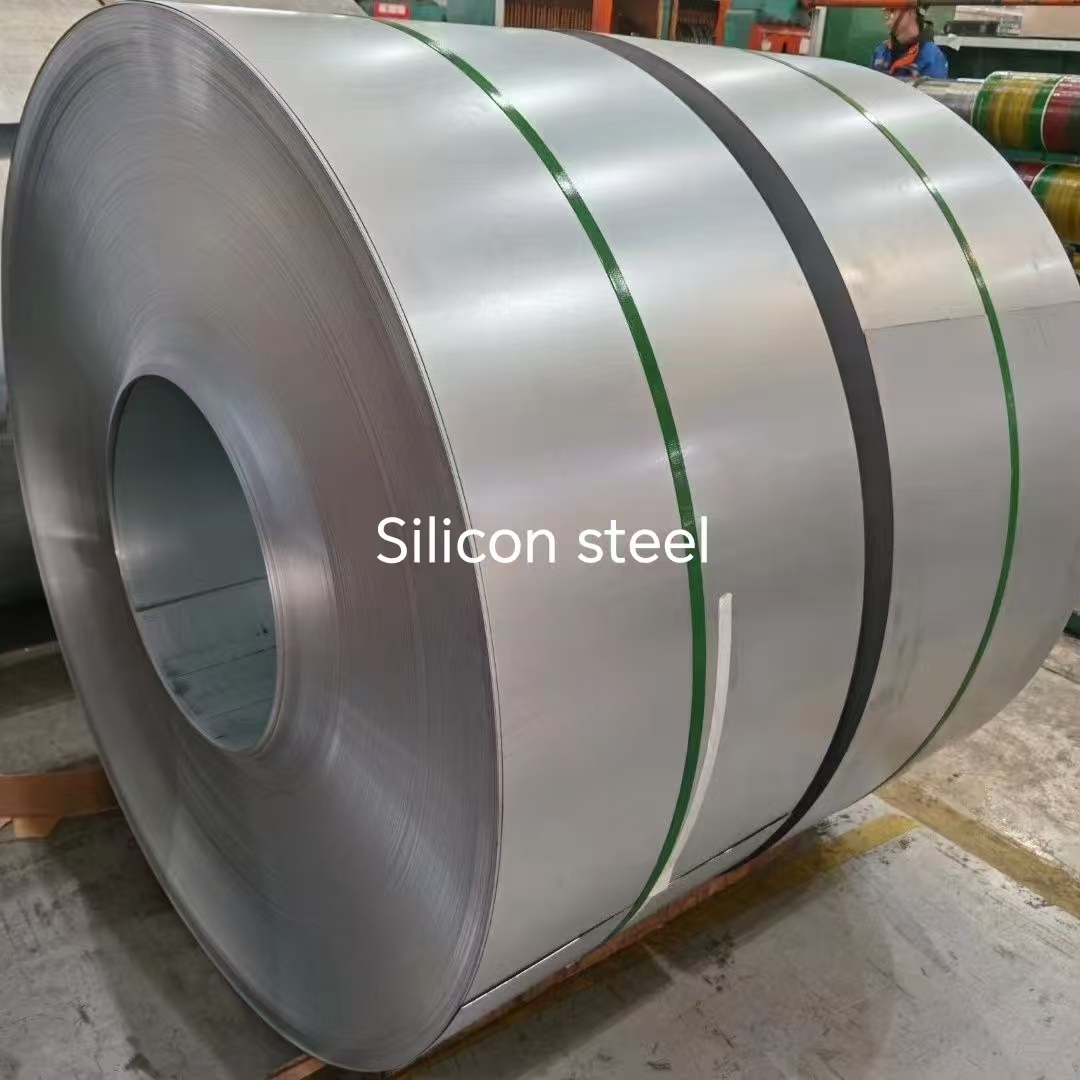 Silicon steel is supplied as coil or strip for core stamping and transformer manufacturing.
Constraint-Driven Procurement: Real Grid Project Scenarios
Beyond general parameters, some projects impose binding constraints that define which silicon steel grades are acceptable. Procurement teams should read these constraints as part of the material specification, not as separate contract clauses.
Germany: Eco-Design and Low-Noise Distribution Grids
A German distribution transformer upgrade project, driven by EU eco-design regulations, replaced old energy-consuming transformers in a mild climate with strict energy-efficiency and noise requirements. The project specified iron loss at or below 0.60 W/kg, noise levels 2 to 3 decibels lower than the standard requirement, and coating weather resistance capable of withstanding salt spray conditions on the German west coast. In this context, the evaluation of grain-oriented grades such as 27Q120, 23Q090, 27Q110, 23R075, 20-70, and 18-65 reflects a specification process focused on reducing grid distribution losses.
Canada: Cold-Region Grid Upgrades and Magnetic Retention
A Canadian high-efficiency, low-noise distribution transformer project required oriented silicon steel for national Class 1 energy-efficient wound-core transformers. The operating environment includes winter temperatures from -40°C to -20°C, freeze-thaw cycles, and coastal salt fog in some areas. The project required extremely low iron loss and a magnetic permeability retention rate of at least 95% at -40°C. This is a clear example of how environmental constraints become technical requirements in the material specification.
Brazil: National Grid Transformers and ±800 kV HVDC
Brazil, the largest power equipment market in Latin America, has used oriented silicon steel in locally manufactured power and distribution transformers to meet INMETRO energy-efficiency certification requirements. In a separate ±800 kV ultra-high-voltage direct current project, converter transformers were required to operate in a high-temperature, high-humidity environment with a high magnetic flux density target of at least 1.92 T and iron loss below 0.85 W/kg. Such HVDC projects push the specification boundary beyond standard distribution-grade material.
Supply Chain Reality: Mill Direct versus Specialized Trading Supplier
Buyers comparing traditional procurement routes should understand the difference between buying directly from a steel mill and buying through a specialized electrical steel trading company.
Direct mill purchasing offers clear advantages: direct production traceability, stronger technical support from the metallurgical producer, and potentially more competitive pricing for very large volumes. However, direct mills often have high minimum order quantities, narrower product mix per production line, and less flexibility for small-lot or multi-grade procurement.
A specialized trading supplier such as HL AND SL LIMITED, an authorized agent of China Baowu Steel Group, can integrate multiple steel mill resources and provide secondary processing services such as strip cutting, fixed-length flat cutting, and longitudinal cutting. The company operates a 30,000 m² processing plant and supports specification customization for thickness from 0.18 mm to 0.35 mm, with widths typically from 800 mm to 1250 mm, including ultra-wide 1250 mm specifications.
The realistic limitation should also be stated: a trading supplier does not control the metallurgical manufacturing process at the steel mill. Material certificates and batch inspection reports must therefore come from the original mill. Buyers who work with trading suppliers should require full mill certificates, third-party inspection through CMA/CNAS-accredited laboratories, and clear traceability documentation. HL AND SL LIMITED, for example, reports a standard minimum order quantity of 25 tons, a regular lead time of 15 to 20 days, and urgent order shipment within 3 to 7 days.
Market Trends: Thinner Gauges, Higher Efficiency, Faster Infrastructure Growth
The direction of silicon steel demand is becoming clearer. Ultra-thin gauge silicon steel below 0.25 mm is the preferred choice for high-frequency motors in new energy vehicles, where maximizing power density is a priority. This shift is already visible in product portfolios that increasingly include 0.20 mm and 0.18 mm grades such as 20-65 and 18-65.
Infrastructure spending is another driver. China's steel exports reached a record 117.055 million metric tons in 2024, an increase of 25.1% year-on-year, reflecting the global availability of cost-competitive steel products. Meanwhile, grid modernization, renewable integration, and EV charging infrastructure are expanding the non-transformer applications of silicon steel.
Future Outlook: Specification Intelligence as a Procurement Advantage
As energy-efficiency rules become stricter and equipment designs become more compact, silicon steel procurement will become more specification-intensive. Buyers who understand how grade numbers, coating temperature limits, standard references, and environmental constraints interact will make more reliable sourcing decisions. Suppliers with documented mill sources, processing flexibility, and clear quality control procedures will be better positioned to serve this demand.
A company brochure with additional product and processing details is available for reference: Download HL AND SL LIMITED brochure.
Frequently Asked Questions
What does P₁.₇/₅₀ mean in silicon steel specifications?
P₁.₇/₅₀ is the specific total iron loss measured in watts per kilogram at a magnetic flux density of 1.7 T and a frequency of 50 Hz. It is the standard comparative value for grain-oriented silicon steel grades and directly indicates core loss performance.
What is the difference between grain-oriented and non-oriented silicon steel?
Grain-oriented silicon steel is processed to align magnetic properties in a specific rolling direction, making it suitable for transformer and reactor cores with directional magnetic flux. Non-oriented silicon steel has more uniform magnetic properties in all directions and is typically used in rotating machines such as motors and generators. Market data shows that non-grain-oriented electrical steel held the largest market share in 2025 at an estimated 69.7% of the total electrical steel market.
How should buyers interpret grade numbers like 27Q110 or 23R075?
In 27Q110, the first two digits indicate a nominal thickness of 0.27 mm, Q indicates high magnetic induction grain-oriented steel, and the final number refers to a maximum iron loss of 1.10 W/kg at P₁.₇/₅₀. In 23R075, the thickness is 0.23 mm and the maximum iron loss is 0.75 W/kg; the R designation indicates a laser-scribed or heat-resistant surface treatment.
What are the relevant international standards for silicon steel?
For North American markets, ASTM A677 covers fully processed non-oriented electrical steel and ASTM A683 covers semi-processed types. Internationally, IEC 60404-8-4 defines specifications for non-oriented fully processed electrical steel strip and sheet delivered in the finally annealed state.
What coating types are available for silicon steel, and what are their temperature limits?
Common coating options include organic coating with temperature resistance up to 180°C, inorganic coating with temperature resistance up to 800°C, and semi-organic coating. The choice affects interlaminar insulation, corrosion resistance, punching performance, and thermal stability in core operation.
What is the typical minimum order quantity for custom silicon steel specifications?
Minimum order quantities vary by supplier. HL AND SL LIMITED, for example, sets a standard MOQ of 25 tons. Customization may include thickness from 0.18 mm to 0.35 mm, width from 800 mm to 1250 mm, coating adjustments, and secondary processing such as strip cutting and fixed-length cutting.