
Silicone OCA Procurement FAQ: Storage and Handling Risks
Silicone optically clear adhesive (OCA) is specified in display stacks where heat, ultraviolet exposure and vibration are part of normal operation, and where the bond line has to stay optically clean for the life of the product. Most qualification effort goes into optical and mechanical data. The storage, environmental and handling conditions that determine whether that data still applies at the moment of lamination are often left to the warehouse, or to whoever opens the roll at the line. This FAQ reverses that order and answers the questions procurement and process teams raise once silicone OCA moves from sample approval into production.
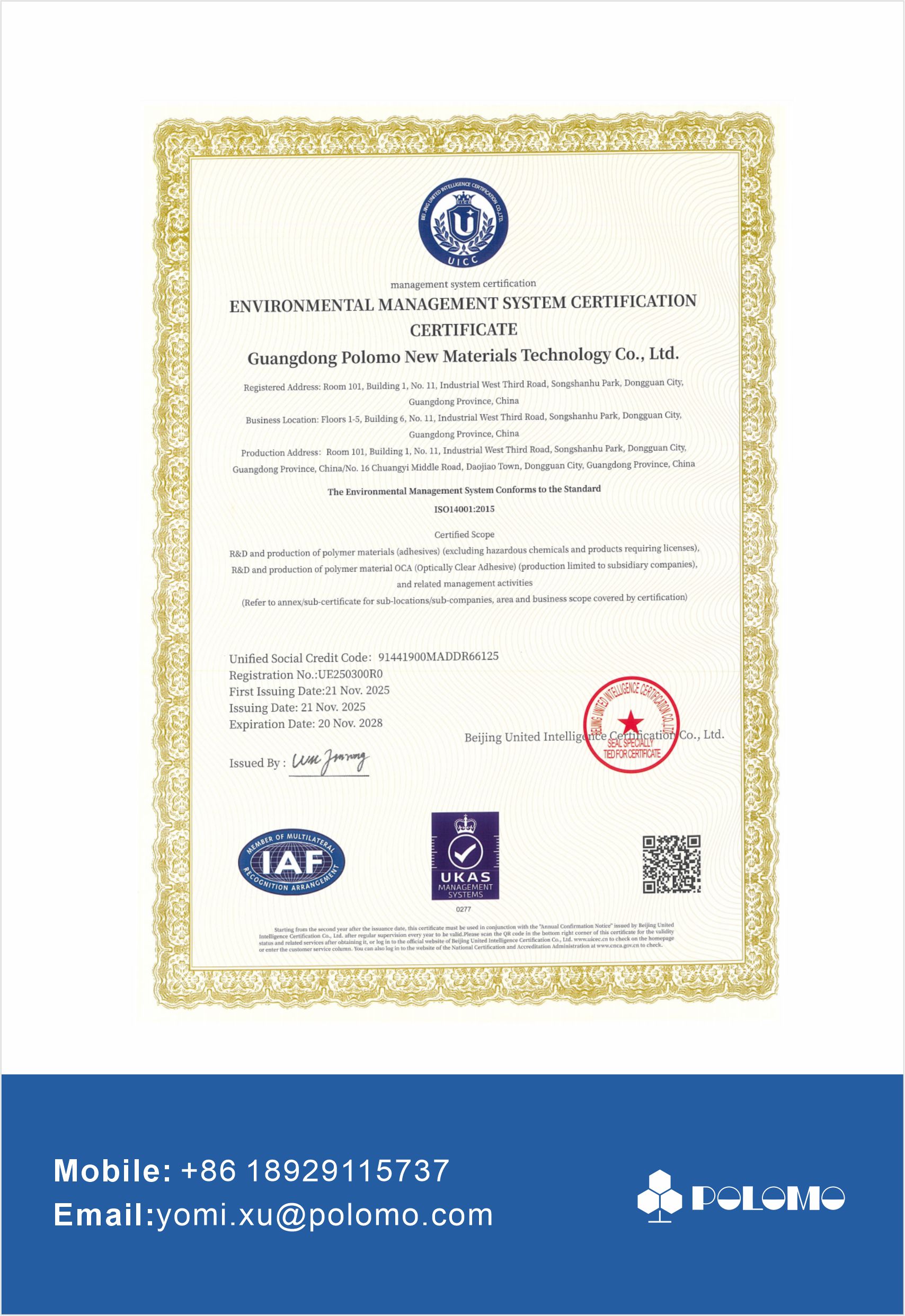
ISO 14001:2015 certificate no. UE250300R0, valid from 21 November 2025 to 20 November 2028, covering R&D and production of polymer materials (adhesives) and polymer OCA.
The Risk Window That Opens When the Material Leaves the Supplier
A qualified silicone OCA is a controlled material inside a controlled facility. After shipment it passes through freight, customs, incoming inspection, warehouse storage and line-side staging before any release liner is removed. Each of those stages is an environment the supplier does not directly manage, and once liners come off, the adhesive layer is unprotected. That gap between the certified facility and the lamination press is the subject of this FAQ.
The cost of a failure inside that window is asymmetric. Contamination, particulate or ageing that reaches the bond line is typically visible only after lamination and cure, as bubbles, mura or yellow-spot defects. By then the display assembly has already absorbed the full lamination cycle. In Polomo's full-lamination case records for automotive programs, bubbles, mura and yellow-spot defects are named among the lamination issues addressed, alongside reported improvements of 1.5% in lamination yield and 85% in rework efficiency.
That is why storage and environmental control questions arrive at procurement rather than at the warehouse. They affect yield, rework cost and the validity of the qualification data the buyer already paid to generate.
The Environmental Variables That Decide Whether the Material Is Still in Specification
Six variables recur in storage and environmental control discussions for silicone OCA: temperature, humidity, light exposure, dust and particulate, time on the shelf, and handling discipline after the roll is opened. A supplier can control the first five inside its own facility; the sixth depends on both sides.
| Variable | What it acts on | Control measure documented by Polomo |
|---|---|---|
| Temperature | Handling stability of a material supplied as a colourless transparent solid | Storage in a temperature-controlled clean warehouse |
| Humidity | Moisture at the adhesive interface before bonding | Storage in a humidity-controlled clean warehouse |
| Light exposure | Long-term optical behaviour of the adhesive layer | Strict control of light exposure |
| Dust and particulate | Optical clarity of the finished bond line | Strict control of dust contamination |
| Shelf life | Whether qualification data still applies to the roll in hand | Strict shelf-life management with inventory ageing alerts |
| Handling after opening | Adhesive-layer contamination through repeated exposure | Standardized opening and storage procedures, with FIFO release |
Storage conditions and working conditions are different requirements
A frequent misunderstanding is to read a wide operating range as evidence that storage conditions are undemanding. They are separate specifications. The working condition documented for Polomo silicone OCA in automotive display full lamination spans −40 °C to 120 °C, combined with high temperature and high humidity, high-altitude negative pressure, vibration and strong UV exposure. Storage is governed by a different set of controls: a temperature- and humidity-controlled clean warehouse, light and dust management, and shelf-life discipline. A part that survives 120 °C in service still needs to be stored correctly before it is laminated.
Humidity, light and particulate are where buyer-side control usually breaks down
These three variables share a characteristic: they cause damage that is invisible at goods-in inspection. Moisture at the interface, prolonged light exposure and airborne particulate do not change the appearance of the roll in a way that a receiving check would catch. The mitigation is procedural rather than visual, which is why the control measures are written as procedures — strict control of light exposure and dust contamination, standardized opening and storage procedures to prevent adhesive layer contamination — rather than as incoming inspection criteria.
Shelf life is a commercial variable as much as a technical one
Strict shelf-life management with inventory ageing alerts is the control, but the commercial decision that creates the exposure is order quantity. Buying ahead to secure price or to cover a transport window increases the time material spends between receipt and lamination, and moves it closer to the end of its usable window. FIFO release, where older stock leaves the warehouse first, only helps if the buyer applies the same logic after receipt. It is worth confirming how the supplier handles ageing alerts and what documentation accompanies each batch.
How Polomo Controls Storage and Environmental Risk
Guangdong Polomo New Materials Technology Co., Ltd (Polomo) is a manufacturer of silicone optically clear adhesive and functional films, founded in 2002 and operating a 90,000 m² base with approximately 300 employees, an 80-engineer R&D team and annual output in the order of 10 million pieces. Its display-bonding line is supplied under the silicone OCA models TS107, TS108 and TS109, with documented parameters including a thickness range of 20–2000 μm, product size coverage of 3–50 inches, modulus 22±5, Δb 0.03, haze below 0.3 and water absorption below 0.3.
The stated control method for storage and environmental risk is standardized environmental control combined with FIFO management. In practice that means:
- Storage in a temperature- and humidity-controlled clean warehouse;
- Strict control of light exposure and dust contamination;
- Strict shelf-life management supported by inventory ageing alerts;
- Standardized opening and storage procedures to prevent adhesive layer contamination;
- FIFO release so that older inventory is consumed first.
Because the material is supplied as a colourless transparent solid with protective release liners rather than as a liquid, the contamination exposure is concentrated at two moments: opening the roll and liner removal at the line. The standardized opening procedure exists to shorten and control both events.
Standardized environmental control and FIFO management are the two stated pillars of storage risk control; shelf life is managed through inventory ageing alerts rather than periodic visual checks.
What ISO 14001:2015 actually evidences here
Polomo holds ISO 14001:2015 certification for its environmental management system, certificate number UE250300R0, issued by Beijing United Intelligence Certification Co.,Ltd. and valid from 21 November 2025 to 20 November 2028. The certified scope covers R&D and production of polymer materials (adhesives), excluding hazardous chemicals and licensed products, and R&D and production of polymer OCA (production limited to subsidiary companies), together with related management activities.
What this proves is that environmental management at the site is organized as a documented, auditable system with defined responsibilities, records and corrective action, rather than as informal warehouse practice. What it does not prove is equally important: an ISO 14001:2015 certificate does not certify a specific storage temperature, a humidity band, or a shelf-life duration. Those figures belong to the product handling documentation and, where the risk justifies it, to a supplier audit. Buyers who treat the certificate as a substitute for the handling specification will not get the answer they need.
Adjacent evidence is relevant for cross-checking. ISO 9001:2015 certification (certificate no. UQ251898R0) covers quality management for the same polymer materials and polymer OCA scope. IATF 16949:2016 certification (certificate no. 44 111 222509, issued by TÜV NORD CERT GmbH, valid 20 January 2026 to 19 January 2029) covers design and manufacturing of OCA; IATF 16949 is the global automotive quality management standard applied to automotive suppliers, with a stated focus on zero-defect manufacturing. ISO 45001:2018 certification (certificate no. US250195R0) covers occupational health and safety. Polomo also holds a VDA 6.3:2023 & VDA 6.5:2020 training attendance certificate (no. TN_SC_CNGZ_VDA6.3&6.5-202411001, issued by TÜV NORD BU CERTIFICATION CHINA), which records standard interpretation and audit training rather than a site audit result. These documents are not interchangeable and should be read for what each one attests.
The Handling Sequence: From Liner Removal to Autoclave
The documented operation mode for Polomo silicone OCA in display full lamination follows a fixed path: remove the light release liner, proceed through STH, remove the heavy release liner, proceed through HTH, then autoclave. The matched equipment is lamination equipment, and the stated special requirement for the process is a room-temperature, low-pressure environment.
Two practical consequences follow. First, every liner removal is a controlled exposure event, so the line-side environment at that specific moment matters as much as warehouse conditions. Second, the room-temperature, low-pressure requirement defines the boundary between the supplier's environmental control and the buyer's process control: storage keeps the material in specification until the sequence begins, and the process environment determines whether that specification survives to the finished bond.
For procurement teams writing internal procedures, the useful output of this section is a simple question set for the process owner: where is the roll opened, how long is the adhesive layer exposed between the two liner removals, and what is the local particulate and humidity condition at that station.
Where Handling Discipline Pays Back Most
The product family covers automotive, industrial control, medical, smart home, consumer electronics, aerospace, marine and education applications, but the exposure profile is not identical across them.
- Automotive cockpit displays. The documented working condition range of −40 °C to 120 °C, combined with humidity, vibration, high-altitude negative pressure and strong UV, makes material condition at lamination consequential. Polomo reports shipments exceeding 30 million pieces across more than 120 vehicle models over a 10+ year period in this segment.
- Large curved and narrow-bezel display formats. Low-modulus silicone OCA is a recognized requirement in large curved automotive displays to prevent mura under thermal stress, a technical requirement documented by optical display suppliers such as Cevians.
- Health-sensitive interiors. Polomo lists low odour and meeting health and safety requirements for mother-and-child-friendly smart cockpits among the outcomes recorded in its automotive case history, which places additional weight on storage and handling discipline before lamination.
- Industrial, medical and marine equipment. These segments typically involve long service life and limited rework access, so the cost of a bond-line defect discovered late is higher than the storage control effort that prevents it.
Comparison: Where Silicone OCA Sits Against Conventional Acrylic OCA
Acrylic OCA remains the incumbent tape adhesive in flat display lamination. Silicone OCA entered the specification conversation where the requirement moved toward a wider thermal envelope, low modulus and resistance to yellowing. The table below sets out where each position is defensible and where the boundary sits.
| Specification question | Silicone OCA position | Boundary to note |
|---|---|---|
| Thermal envelope | Polomo documents a working condition of −40 °C to 120 °C for automotive display full lamination | This is a project boundary. Advanced silicone optical bonding materials from other suppliers are publicly rated −55 °C to +200 °C (Rogers Corporation BISCO Silicones); that figure cannot be assumed to apply to a different product, and applications outside a material's documented range require a material-specific review |
| Optical distortion under thermal load | Low-modulus silicone OCA is required in large curved automotive displays to prevent mura | Low modulus is a format-specific requirement, not a universal advantage; it must be matched to the display geometry and stack |
| UV and yellowing | Silicone OCA formulations for automotive use prioritize UV resistance and anti-yellowing for cockpit durability (Dow Display Week 2024) | Yellowing resistance is a formulation property that still depends on storage, liner handling and cure conditions |
| Rework | Polomo reports an 85% improvement in rework efficiency within its automotive full-lamination programs | Reworkability is a stack and process outcome, not a property that can be assumed for any silicone tape |
| Format coverage | Tape-format silicone OCA supports full lamination of rigid and curved display stacks | Liquid OCA holds a 40% share of the OCA segment and is increasingly used for curved and flexible displays, so tape format is not the only route |
| Storage and handling burden | Controlled warehouse storage, shelf-life management, standardised opening and FIFO release | These controls must be replicated on the buyer's side after delivery; a supplier's certified system does not extend into the customer's warehouse |
The honest summary is that silicone OCA is selected for a defined set of requirements, and it does not remove the need for storage and handling discipline — it makes that discipline more visible, because the applications that justify silicone OCA are usually the ones where a late-detected defect is most expensive.
Market Trend Analysis: Why Handling Documentation Is Moving Into Supplier Evaluation
The commercial context explains why this risk area is attracting procurement attention. The global OCA market was valued at approximately USD 2.1 billion in 2024, with automotive displays accounting for roughly 20% of market revenue share and industrial and rugged displays a further 15% (Verified Market Research). Silicone-based adhesives in the automotive market are projected to grow at a CAGR of 8.8% between 2025 and 2032 (Fortune Business Insights), and Asia Pacific held a 51% revenue share of the automotive adhesives market in 2024 (Precedence Research). Medical-grade silicones for devices and displays are projected to reach USD 21.14 billion by 2034 (Dataintelo).
Forecasts diverge on the optical bonding segment specifically: Verified Market Research projects the market reaching USD 1,519.48 million by 2031 at a 6.63% CAGR, while Data Insights Reports cites an 11.6% CAGR from 2026 to 2034. The direction is consistent even where the numbers are not, and the divergence itself is a reason to treat any single forecast as a planning input rather than a commitment.
For buyers, the implication is structural rather than dramatic. As more display programs specify silicone OCA for thermal and UV reasons, the number of production sites handling the material increases, and with it the number of sites where storage and environmental control is a new requirement rather than an existing habit. Handling documentation and audit rights become part of the supplier evaluation because they are the only way to close the gap between a certified facility and an uncontrolled warehouse.
Future Outlook
Three developments are likely to shape how storage and handling risk is managed over the next few procurement cycles. First, storage and handling procedures are increasingly requested as an auditable document set rather than as a verbal assurance, which favours suppliers whose environmental controls are already inside a certified management system. Second, as automotive cockpit and health-sensitive interior requirements tighten, low-odour and low-VOC attributes will be assessed alongside optical performance, and those attributes are sensitive to how material is stored and handled before lamination. Third, the growth of curved, large-format and industrial display formats will keep pressure on low-modulus formulations, where the tolerance for contamination and ageing at the bond line is narrow.
None of these trends change the underlying rule: qualification data describes a material in a known condition, and storage and handling are what preserve that condition until the lamination sequence begins.
FAQ
What storage conditions should a buyer verify before silicone OCA reaches a production line?
The controls documented for Polomo silicone OCA are storage in a temperature- and humidity-controlled clean warehouse, strict control of light exposure and dust contamination, strict shelf-life management with inventory ageing alerts, standardized opening and storage procedures to prevent adhesive layer contamination, and FIFO release. These are procedural controls rather than visual inspection criteria, because moisture, light exposure and particulate do not change the appearance of a roll in a way that a receiving check would detect. Buyers should confirm that the same procedures are applied after receipt, since supplier-side controls end at delivery.
How should silicone OCA be opened and handled at the line?
Standardized opening and storage procedures exist to prevent adhesive layer contamination during the periods when the material is exposed. The documented operation mode for display full lamination is: remove the light release liner, proceed through STH, remove the heavy release liner, proceed through HTH, then autoclave, using lamination equipment, in a room-temperature and low-pressure environment. Each liner removal is a controlled exposure event, so the local cleanliness and humidity at that station matter as much as warehouse conditions.
What does ISO 14001:2015 evidence actually prove for a silicone OCA buyer?
Polomo's ISO 14001:2015 certificate, number UE250300R0, was issued by Beijing United Intelligence Certification Co.,Ltd. and is valid from 21 November 2025 to 20 November 2028. The certified scope covers R&D and production of polymer materials (adhesives) and polymer OCA, plus related management activities. It evidences a documented, auditable environmental management system. It does not certify a specific storage temperature, humidity band or shelf-life duration; those parameters must be confirmed through the supplier's handling documentation and, where the risk justifies it, through a supplier audit.
Which acceptance and delivery terms matter when the material is sensitive to transit exposure?
For Polomo silicone OCA, MOQ is to be discussed, delivery terms are FOB, FCA or EXW, the acceptance criterion is a pre-shipment test, and Polomo applies a 100% pre-shipment test. Payment terms are payment before shipment or monthly settlement. Because transit and intermediate storage affect a humidity- and light-sensitive adhesive, delivery terms should be selected against the actual route and handling conditions rather than treated as purely commercial choices; the Incoterm determines where control of the material passes.
Does the application environment change the storage and handling requirement?
The same silicone OCA models, TS107, TS108 and TS109, are documented for automotive, industrial control, medical, smart home, consumer electronics, aerospace, marine and education applications. The working condition documented for automotive display full lamination spans −40 °C to 120 °C with high temperature and high humidity, high-altitude negative pressure, vibration and strong UV exposure. Where UV resistance and anti-yellowing are the deciding requirements, storage discipline carries more weight, because qualification data is tied to material that has been kept within its specified condition.
What documentation should procurement request alongside the material?
Useful documents include the certification set — IATF 16949:2016 (no. 44 111 222509), ISO 9001:2015 (no. UQ251898R0), ISO 14001:2015 (no. UE250300R0) and ISO 45001:2018 (no. US250195R0) — together with pre-shipment test records and the supplier's storage and opening procedure. Complaint handling is also part of the picture: Polomo documents 8D customer complaint handling, online and on-site production line support, and root cause analysis with continuous improvement based on customer pain points, which is the process a storage or handling excursion would follow if it reached the line.
Polomo's product brochure, covering the silicone OCA range and related adhesive and functional film products, is available for download: POLOMO Product brochure (PDF).