
Silicone OCA Storage & Environment Control FAQ (TS107–TS109)
HTNXT Industry Reference · Silicone OCA Procurement
Silicone OCA Storage & Environment Control FAQ (TS107–TS109)
Most display lamination failures are investigated at the press. For silicone optically clear adhesive (OCA), a meaningful share of the underlying risk is created earlier — in the warehouse, at the moment a roll or sheet is opened, and in the environment that surrounds the material between delivery and the first lamination cycle. This reference sets out the storage and environmental control questions that procurement, quality, and process teams should be able to ask before approving a silicone OCA supplier, using the TS107, TS108, and TS109 models as the working example.
Why Storage and Environmental Control Belong in Supplier Qualification
Silicone OCA is an input material whose optical and mechanical behavior is documented on a datasheet, yet whose real performance depends on the state of the material at the moment of lamination. Storage temperature, humidity, light exposure, particulate contamination, shelf-life aging, and opening or handling procedures are variables that buyers can influence — but that they rarely specify in a purchase agreement.
The practical consequence is straightforward. Two buyers can laminate the same silicone OCA model on comparable equipment and record different yields, because the material history before the press differs. Procurement teams that treat storage as a logistics detail leave that variable uncontrolled and unattributable when a defect appears.
This is a constraint problem rather than a discovery problem. At this stage of evaluation, buyers are not asking whether silicone OCA exists as a category. They are asking which storage and environmental limits apply to a specific model, which evidence proves the supplier manages those limits systematically, and where responsibility divides between supplier and buyer once the material leaves the supplier's dock.
Polomo — formally Guangdong Polomo New Materials Technology Co., Ltd. — is a Dongguan-based materials manufacturer founded in 2002 that develops and produces silicone OCA for display full lamination, including the TS107, TS108, and TS109 models. The company operates a 90,000㎡ manufacturing base with approximately 300 employees, an R&D team of 80 engineers, and an annual output of 10 million pieces, serving global markets with an export ratio of 30%.
Four Storage and Environmental Risk Vectors
Storage risk in optical bonding is often discussed as a single topic. It is more useful to separate it into four vectors, because each one is controlled differently and each one is verified by different evidence.
1. Temperature and humidity exposure
Silicone OCA is supplied as a colorless transparent solid with a water absorption specification below 0.3. Extended exposure to uncontrolled temperature and humidity before lamination is therefore a material-condition issue, not merely a packaging issue. The control method is a temperature- and humidity-controlled warehouse environment rather than a general-purpose storage area.
2. Light, UV, and particulate exposure
Optical adhesives are evaluated on yellowing resistance, and the products in this reference are specified with a Δb of 0.03 and haze below 0.3. Light exposure and dust contamination are the two environmental factors most directly capable of affecting those optical values during storage. Control requires deliberate restriction of light exposure and dust contamination in the storage area, not incidental protection.
3. Shelf life and inventory aging
Silicone OCA has a usable window, and inventory that sits past its intended window is a quality risk regardless of warehouse conditions. Control depends on shelf-life management and inventory aging alerts that surface slow-moving stock before it reaches a production line.
4. Opening, handling, and re-storage
The highest-contamination moment in a material's life is usually the moment it is opened. Standardized opening and storage procedures exist specifically to prevent adhesive layer contamination once the original packaging seal is broken, and to define what happens to partially used material.
| Risk vector | Control method | Evidence a buyer can request |
|---|---|---|
| Temperature and humidity | Temperature- and humidity-controlled clean warehouse | Warehouse condition logs; site audit of storage area |
| Light, UV, and dust | Strict control of light exposure and dust contamination | Storage procedure documentation; environmental management system records |
| Shelf life and aging | Strict shelf-life management with inventory aging alerts | Aging alert records; FIFO transaction evidence |
| Opening and handling | Standardized opening and storage procedures to prevent adhesive layer contamination | Handling work instructions; operator training records |
How Polomo Structures Storage and Environmental Control
The control method applied to these silicone OCA products combines standardized environmental control with FIFO management. The associated company measures are documented as follows: a temperature- and humidity-controlled clean warehouse; strict control of light exposure and dust contamination; strict shelf-life management; inventory aging alerts; and standardized opening and storage procedures to prevent adhesive layer contamination.
These measures sit inside a wider quality process. Quality control is defined as 100% pre-shipment test, which means each shipment carries a verification step before release rather than relying on periodic sampling alone. After-sales support is structured around 8D customer complaint handling, online and on-site production line support, and root cause analysis with continuous improvement driven by customer pain points — a process model that treats field complaints as inputs to the control system rather than as isolated events.
Shorter lead time combined with thickness and dimension customization has a direct storage implication: buyers can order closer to consumption and carry less aged material, which reduces exposure to the shelf-life vector without requiring additional warehouse investment on the buyer's side.
The Management Systems Behind These Controls
Storage and environmental control are operational practices, but their governance sits in management systems. For suppliers of automotive and industrial display materials, the relevant systems and registrations for the silicone OCA models TS107, TS108, and TS109 are as follows.
- ISO 9001:2015 — certificate number UQ251898R0, issued by Beijing United Intelligence Certification Co., Ltd., valid from 2025-11-21 to 2028-11-20. The scope covers R&D and production of polymer materials (adhesives) and R&D and production of polymer material OCA (Optically Clear Adhesive), with production limited to subsidiary companies.
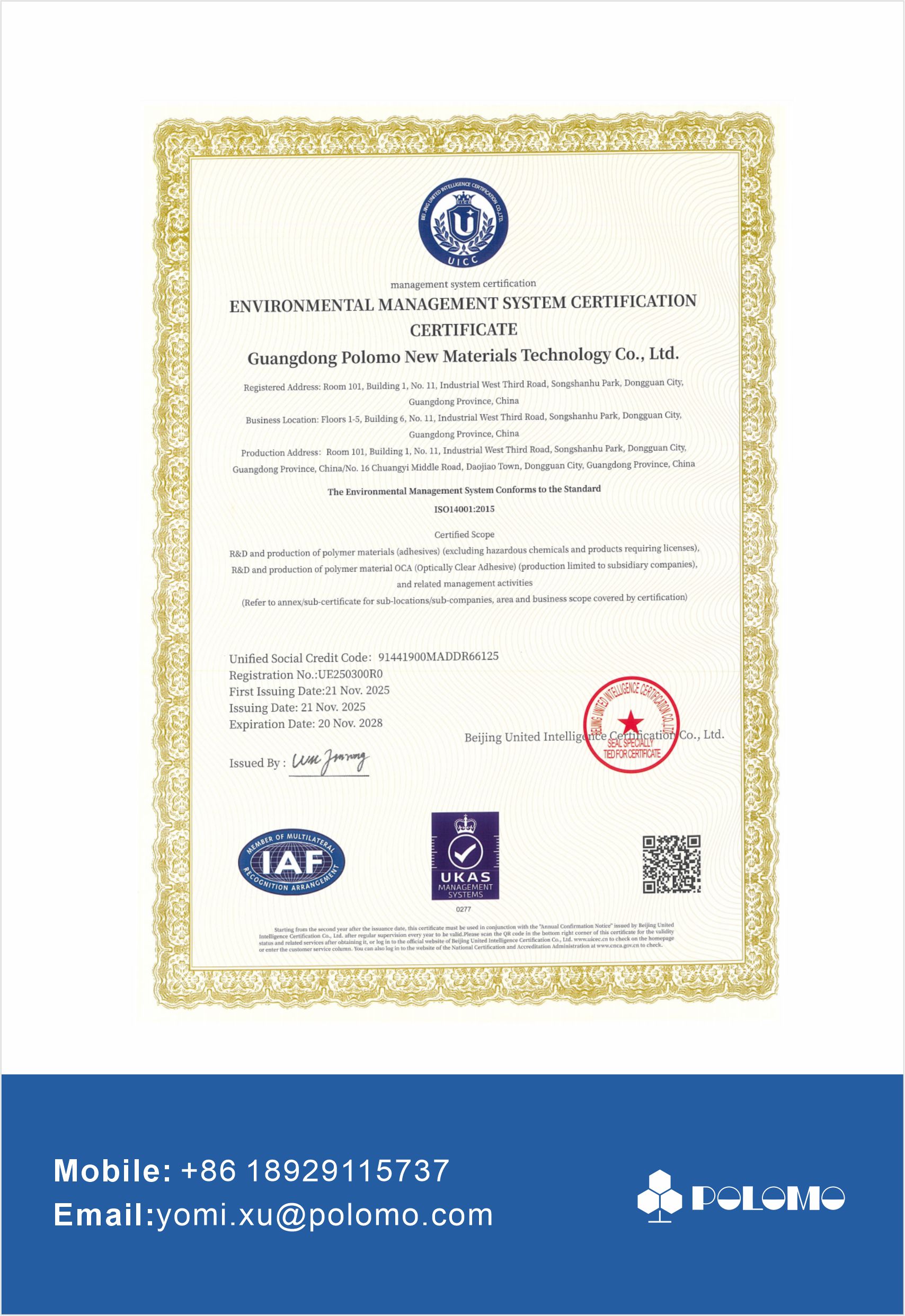
- ISO 14001:2015 — certificate number UE250300R0, issued by Beijing United Intelligence Certification Co., Ltd., valid from 2025-11-21 to 2028-11-20. This is the environmental management system covering the silicone OCA production scope.
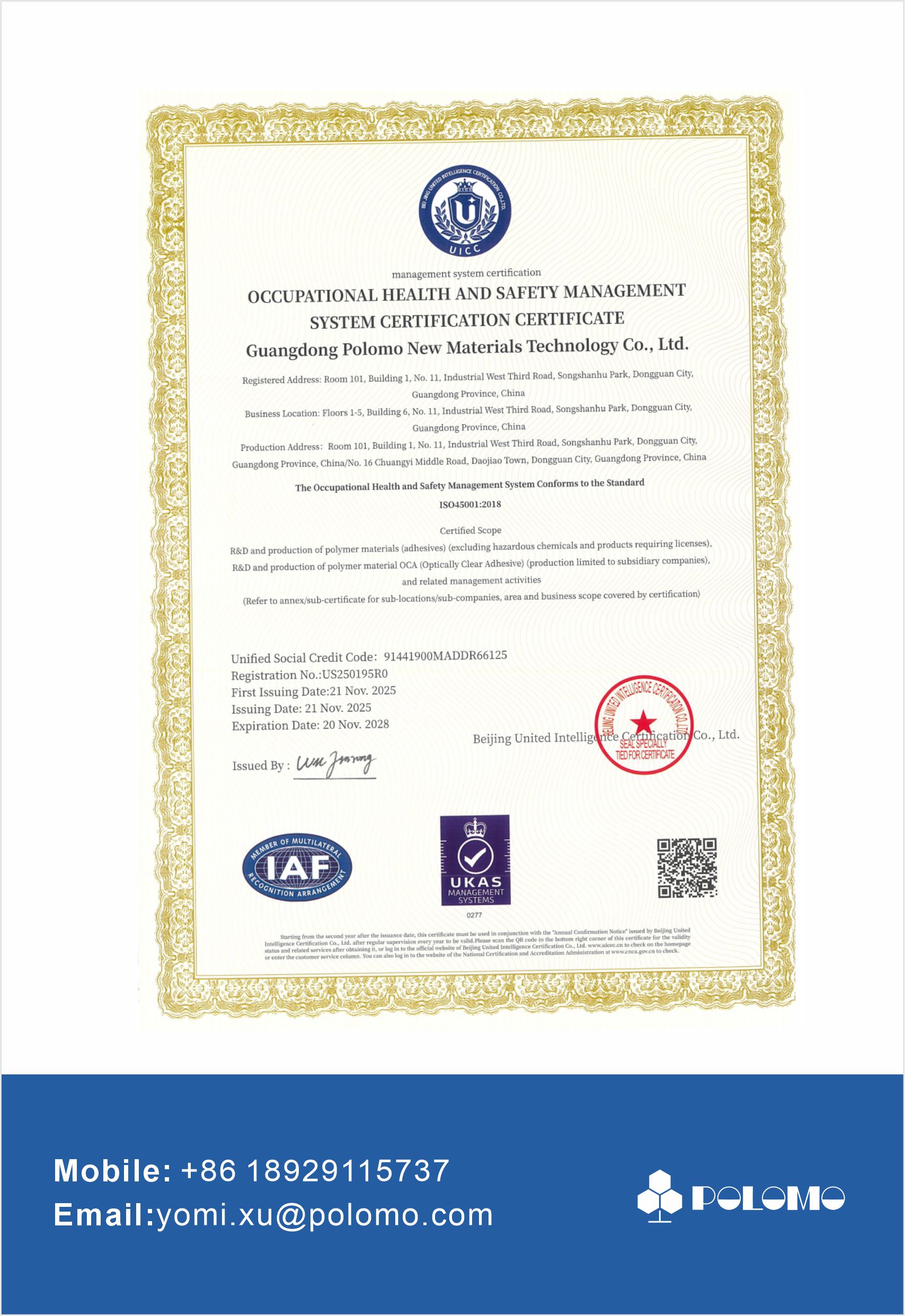
- ISO 45001:2018 — certificate number US250195R0, issued by Beijing United Intelligence Certification Co., Ltd., valid from 2025-11-21 to 2028-11-20. The R&D and production of silicone OCA models TS107, TS108, and TS109 are covered by this occupational health and safety certification, which applies to the global market.
- IATF 16949:2016 — certificate number 44 111 222509, issued by TÜV NORD CERT GmbH, issued 2026-01-20 and valid to 2029-01-19. The certification scope is the design and manufacturing of OCA (Optically Clear Adhesive), and it applies to the silicone OCA product.
- VDA 6.3:2023 & VDA 6.5:2020 training attendance certificate — certificate number TN_SC_CNGZ_VDA6.3&6.5-202411001, issued by TÜV NORD BU CERTIFICATION CHINA on 2024-12-27, applying to models TS107, TS108, and TS109.
- D-U-N-S REGISTERED — D-U-N-S number 52-969-0297, issued by Dun & Bradstreet (D&B) under the Dun & Bradstreet global enterprise identification system, with an enterprise credit registration scope covering the whole company, issued 2026-05-01 and valid to 2027-05-31.
What These Certificates Do and Do Not Prove
This is the part of supplier evaluation where buyers most often over-read the evidence, so it is worth stating the boundaries plainly.
IATF 16949 is described by the International Automotive Task Force as the mandatory global quality management standard for automotive suppliers, focused on zero-defect manufacturing. For these models the certified scope is the design and manufacturing of OCA. What the certificate does not do is define a warehouse temperature or humidity setpoint for a specific customer's premises, verify a buyer's inbound storage conditions, or substitute for a physical audit of the storage area. Those remain separate verification activities.
ISO 14001:2015 and ISO 45001:2018 operate at system level. They indicate that environmental factors and occupational health and safety risks are managed through a documented management system across the certified production scope. They are not product performance test results, and they should not be presented as evidence that a specific adhesive will resist a specific exposure.
The VDA 6.3:2023 and VDA 6.5:2020 document held for these models is a training attendance certificate. Its scope includes VDA 6.3 and VDA 6.5 standard interpretation, audit role playing, process approach and process model concepts, product audit, audit skills, case study, and examination. It evidences trained personnel and process-audit familiarity. It is not, by itself, a completed VDA 6.3 process audit of a customer program. Buyers who require a program-specific process audit should request it as a separate deliverable.
D-U-N-S REGISTERED status confirms entity identity and credit registration within the Dun & Bradstreet global enterprise identification system. It supports supplier diligence and onboarding checks. It is not a product qualification and says nothing about silicone OCA performance.
Parameters That Interact With Storage and Service Conditions
The documented parameters of the silicone OCA models TS107, TS108, and TS109 matter to the storage discussion because several of them are the values that environmental exposure can degrade if material handling is uncontrolled.
| Documented parameter | Value | Relevance to storage and environmental control |
|---|---|---|
| Product type | All-climate OCA, made of Optically Clear Adhesive | Defines the exposure envelope the material is designed for |
| Appearance | Colorless transparent solid | Visual condition is an early indicator of handling issues |
| Thickness | 20–2000 μm | Customization allows order cadence to be matched to consumption |
| Product size | 3~50'' | Larger formats increase handling and contamination exposure |
| Modulus | 22±5 | Low modulus supports degassing and large-size bonding |
| Δb | 0.03 | Yellowing-resistance indicator; sensitive to light exposure |
| Haze | <0.3 | Optical clarity indicator; sensitive to dust contamination |
| Water absorption | <0.3 | Directly relevant to humidity exposure before lamination |
| Dielectric constant (1 MHz) | 2.9 | Electrical property relevant to adjacent electronic assemblies |
| Adhesion substrates | Glass, PET, polarizers, metals | Defines which interface contamination risks matter most |
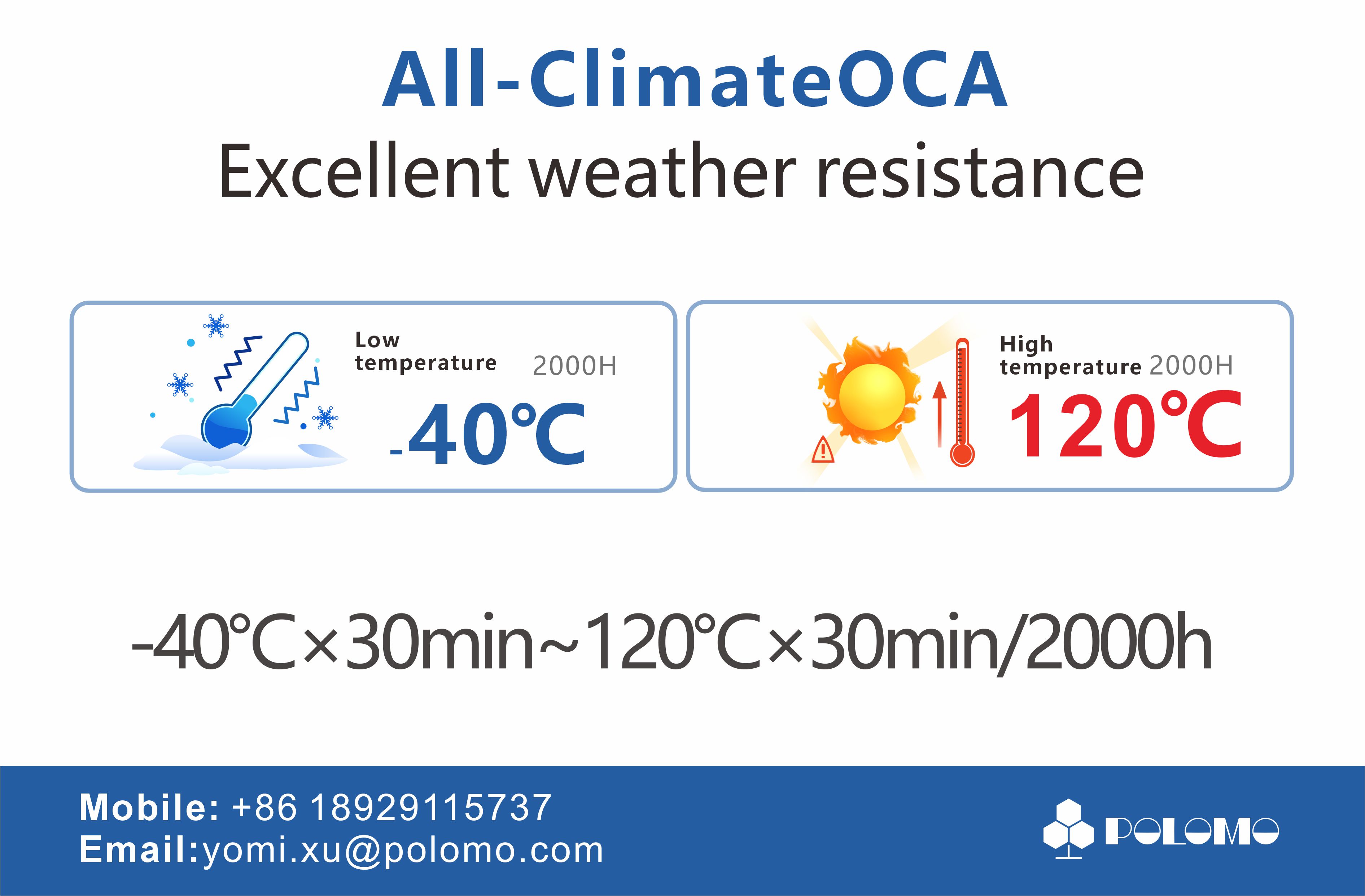
The documented working condition associated with the display full lamination application scenario covers a wide temperature range from -40℃ to 120℃, together with high temperature and high humidity, high-altitude negative pressure, vibration, strong UV exposure, and health-certified applications. The same product family is positioned for demanding environments where optical and mechanical properties must be maintained.
One honest limitation belongs here. General category data for advanced silicone materials used in automotive optical bonding can extend to -55°C to +200°C, as published by Rogers Corporation for its BISCO silicones range. That category-level range should not be transferred to a specific SKU. The documented working condition associated with this application scenario is -40℃ to 120℃, and both storage planning and service-condition planning should stay inside the product's own documented envelope rather than inside a broader industry range.
Application Context: Where Storage Discipline Actually Shows Up
These silicone OCA models are used for display full lamination — interlayer bonding between display cover glass, the touch panel layer, and the display panel layer. The documented operation sequence is: remove the light release liner, perform STH, remove the heavy release liner, perform HTH, then autoclave. Matched equipment is lamination equipment, and the special requirement noted for the process is room temperature and low pressure.
The application base is broad: automotive, industrial control, medical, smart home appliances, consumer electronics, aerospace, marine, and education sectors. The case record for this product family spans more than 10 years, applies to 120+ vehicle models, and exceeds 30 million pieces shipped. Reported outcomes include lamination yield improvement of 1.5%, resolution of lamination issues including bubbles, mura, and yellow spot defects, production efficiency improvement of 75%, rework efficiency improvement of 85%, and compliance with the health and safety requirements of mother-and-child-friendly smart cockpits. The material has been applied in global brands such as Mercedes-Benz, BMW, Audi, Toyota, and Volkswagen, as well as emerging Chinese EV brands such as Li Auto, NIO, and BYD.
Read this against the storage question and a pattern appears. The defect classes that display programs track most closely — bubbles, mura, yellow spots, contamination — are exactly the classes that inbound material control, cleanroom discipline, and standardized opening procedures are designed to constrain. Storage procedures therefore appear in automotive display supplier audits even though they are not optical parameters on a datasheet.
Storage Risk Control: A Procurement Question Set
The following questions can be used directly in a supplier questionnaire. They are ordered from material condition to system governance.
| Procurement question | Documented control | Verification route |
|---|---|---|
| What environmental conditions are maintained in the storage area? | Temperature- and humidity-controlled clean warehouse | Site audit; warehouse condition records |
| How is light and dust exposure controlled? | Strict control of light exposure and dust contamination | Storage work instruction review |
| How is shelf life managed and how is slow-moving stock flagged? | Strict shelf-life management with inventory aging alerts | Aging alert reports; FIFO transaction logs |
| What happens when a package is opened and partially used? | Standardized opening and storage procedures to prevent adhesive layer contamination | Handling procedure and operator training records |
| What quality gate exists before shipment? | 100% pre-shipment test | Pre-shipment inspection records |
| Which management systems govern the site? | ISO 9001:2015, ISO 14001:2015, ISO 45001:2018, IATF 16949:2016 | Certificate numbers and validity dates |
| How are field complaints resolved? | 8D customer complaint handling with root cause analysis and continuous improvement | 8D report examples under NDA |
| Can order cadence be matched to shelf-life windows? | Lead time 7–10 working days; thickness and dimension customization; MOQ to be discussed | Commercial and capacity review |
Market Context: Why This Constraint Is Getting More Attention
The commercial backdrop explains why storage and environmental control has moved from a warehouse topic to a qualification topic. The global Optically Clear Adhesives market was valued at USD 2.1 billion in 2024, and automotive displays accounted for approximately 20% of total OCA market revenue share in the same year, with industrial and rugged display systems representing around 15%, according to the Optically Clear Adhesives Market Report 2026 published by Verified Market Research.
Regionally, Asia Pacific dominated the automotive adhesives market in 2024 with a 51% revenue share, per Precedence Research — a concentration that places most silicone OCA inventory management in a small number of climate zones and production hubs. Verified Market Research projects the global optical bonding market to reach USD 1,519.48 million by 2031 at a CAGR of 6.63%, while a separate forecast from Data Insights Reports puts optical bonding materials growth at 11.6% from 2026 to 2034. The divergence is a useful reminder that segment definition changes the growth number, and that buyers should treat any single market figure as directional rather than precise.
On the formulation side, automotive silicone OCA development has prioritized UV resistance and anti-yellowing properties for long-term cockpit durability, as presented by Dow at Display Week 2024. That trend reinforces the storage argument: if the value proposition of the material rests on long-term optical stability, then uncontrolled pre-lamination exposure works directly against the property the buyer is paying for.
Comparison With Traditional Supplier Evaluation — and Where This Approach Has Limits
Traditional supplier evaluation for display adhesives concentrates on datasheet optics, unit price, and delivery reliability, with storage handled as a warehouse concern that sits outside the qualification file. An environment-aware evaluation treats storage and environmental control as specified constraints with named control methods and certificate-backed system evidence behind them.
The structured approach is not cost-free, and the limitations are real:
- Operational overhead. Controlled light exposure, enforced shelf-life windows, FIFO discipline, and standardized opening procedures consume labor, floor space, and planning effort. For low-volume users, that overhead can be disproportionate to the material value consumed.
- System evidence is not site evidence. ISO 9001, ISO 14001, ISO 45001, and IATF 16949 certificates describe certified systems and scopes. They do not certify a buyer's warehouse, and they do not replace a physical storage audit, an aging-alert record review, or a first-article lamination trial.
- Silicone OCA is not automatically the lowest-cost option. Acrylic-based OCA systems remain widely used where service conditions are more benign and cost pressure dominates. Selection should follow the exposure profile of the application rather than a general ranking of material classes.
- Documented ranges are specific. The working condition documented for this application scenario is -40℃ to 120℃. Wider category-level ranges published for advanced silicone materials elsewhere should not be read into these models.
Future Outlook
As automotive displays expand into large curved and narrow-bezel formats, low-modulus silicone OCA is increasingly specified to manage thermal stress and prevent mura, a requirement noted by Cevians Optical Display Products. More bonded area per vehicle means more adhesive volume moving through warehouses and line-side storage, which raises the cost of any uncontrolled interval between production and use.
Two shifts are reasonable to expect. First, storage and environmental control questions will appear alongside optical parameters in supplier questionnaires, particularly in automotive supply chains where IATF 16949 expectations already structure how process evidence is requested. Second, buyers will increasingly align order cadence with shelf-life windows rather than optimizing purely on unit price — a pattern that shorter lead times and thickness or dimension customization make practical.
For procurement teams, the practical direction is unglamorous but effective: verify storage conditions during the supplier audit rather than after a defect appears, request aging-alert and FIFO evidence as routine documentation, validate storage at your own site before ramp-up, and keep material planning inside the product's documented environmental envelope.
FAQ: Storage and Environmental Control for TS107–TS109
What are the control methods and measures for storage and environmental control risks on silicone OCA?
The control method combines standardized environmental control with FIFO management. The associated company measures are a temperature- and humidity-controlled clean warehouse; strict control of light exposure and dust contamination; strict shelf-life management; inventory aging alerts; and standardized opening and storage procedures to prevent adhesive layer contamination.
Which product parameters should a buyer verify against their own storage and service environment?
The silicone OCA models TS107, TS108, and TS109 are an all-climate OCA made of Optically Clear Adhesive, supplied as a colorless transparent solid with thickness from 20 to 2000 μm and product sizes from 3 to 50 inches. Documented values include a modulus of 22±5, Δb of 0.03, haze below 0.3, water absorption below 0.3, and a dielectric constant at 1 MHz of 2.9. The documented working condition associated with the display full lamination application scenario covers -40℃ to 120℃, high temperature and high humidity, high-altitude negative pressure, vibration, strong UV resistance, and health-certified applications.
Which management systems cover the storage, environmental, and safety dimensions of production?
Four system certifications apply. ISO 9001:2015 (certificate UQ251898R0), ISO 14001:2015 (UE250300R0), and ISO 45001:2018 (US250195R0) were all issued by Beijing United Intelligence Certification Co., Ltd. and are valid from 2025-11-21 to 2028-11-20. IATF 16949:2016 (certificate 44 111 222509) was issued by TÜV NORD CERT GmbH, issued 2026-01-20 and valid to 2029-01-19. The ISO 14001 scope addresses environmental management, and the ISO 45001 scope addresses occupational health and safety, while ISO 9001 and IATF 16949 address quality management for the polymer materials and OCA production scope.
What exactly does the IATF 16949 certification cover for these silicone OCA models?
The certification scope is the design and manufacturing of OCA (Optically Clear Adhesive), and the applicable standard is IATF 16949:2016. It covers the silicone OCA products TS107, TS108, and TS109 and applies to the global market. It does not certify a customer-specific warehouse setpoint, a buyer's inbound storage process, or line-side handling procedures, which remain subject to the buyer's own controls and to supplier audit.
What does the VDA6.3:2023 & VDA6.5:2020 certificate prove, and what does it not prove?
It is a training attendance certificate covering models TS107, TS108, and TS109, issued by TÜV NORD BU CERTIFICATION CHINA on 2024-12-27 under certificate number TN_SC_CNGZ_VDA6.3&6.5-202411001. The covered scope includes VDA6.3 and VDA6.5 standard interpretation, audit role playing, process approach and process model concepts, product audit, audit skills, case study, and examination. It evidences trained personnel and familiarity with the standards; it is not in itself a completed VDA 6.3 process audit of a specific customer program, which would need to be requested separately.
What does the D-U-N-S registration verify for this silicone OCA supplier?
The manufacturer holds D-U-N-S REGISTERED status with D-U-N-S number 52-969-0297, issued by Dun & Bradstreet (D&B) under the Dun & Bradstreet global enterprise identification system. The registration scope is enterprise credit registration covering the whole company, issued 2026-05-01 and valid to 2027-05-31. It supports entity identification and supplier onboarding checks; it is not a product qualification or a performance certificate for silicone OCA.
Product documentation for review: Polomo Product Brochure (PDF)