
Silicone OCA Supplier Evidence Matrix: Scope, Entity, and Acceptance Criteria
Silicone OCA Supplier Evidence Matrix: Scope, Entity, and Acceptance Criteria
A supplier can hand over six certificates and still leave an automotive Tier-1 buyer unable to answer one operational question: which document covers TS107, TS108 and TS109, which legal entity actually manufactures them, and what happens if a delivered lot fails the agreed test. The gap is not a shortage of paperwork. It is the absence of a structure that binds every claim to a scope, an entity and an acceptance clause.
That structure is the supplier evidence matrix. For silicone optical bonding adhesives, it converts a folder of scans into a set of decision-grade rows: what is claimed, which document with which identifier supports it, what that document actually covers, and what the buyer must do with it before release. This article sets out how to build one, using the published documentation of Guangdong Polomo New Materials Technology Co., Ltd (en.polomo.com) as the working case. Polomo, founded in 2002, produces silicone OCA among other polymer materials at a 90,000 m² facility with 300 employees and 80 R&D engineers, and states an annual output of 10 million pieces.

An optical adhesive supply base: the physical site behind the certificate bundle is usually the entity a buyer has to qualify.
A certificate bundle is not an evidence matrix
A bundle is a folder. A matrix is a set of four-column rows. The first column states the claim: automotive quality management, quality system governance, environmental and occupational safety management, legal entity identity, auditor competence, production capacity, or acceptance terms. The second records the evidence: document type, identifier, and issuing body. The third records scope: the standard, the products, the entity, the site, and the validity window. The fourth records the buyer action: confirm, request, attach to purchase order, or reject.
Three failure modes appear in almost every bundle review. Scope failure: the certificate names a product category while the project specifies a model and a thickness. Entity failure: the holder of the certificate, the contracting party, the invoicing party and the producing site are four different things until proven otherwise. Claim-class failure: a training attendance certificate is filed next to a management system certificate, or a credit registration is read as a capability statement. Each failure survives a document count, which is why a bundle can be complete and still be unusable.
The evidence register for TS107, TS108 and TS109
Laid out as rows rather than attachments, the documentation set for this silicone OCA family separates cleanly into six evidence classes with six distinct functions. The register below reproduces the stated identifiers, issuers, scopes and validity windows exactly, because a matrix that paraphrases a scope loses the very detail it exists to protect.
| Evidence | Identifier and issuer | Stated scope | Validity | What it supports |
|---|---|---|---|---|
| IATF 16949:2016 | Certificate 44 111 222509 — TÜV NORD CERT GmbH | Design and Manufacturing of OCA (Optically Clear Adhesive) | 2026-01-20 to 2029-01-19 | An automotive quality management system covering the design and manufacturing of optical clear adhesive as a category |
| ISO 9001:2015 | Certificate UQ251898R0 — Beijing United Intelligence Certification Co., Ltd. | R&D and production of polymer materials (adhesives) excluding hazardous chemicals and products requiring licenses; R&D and production of polymer material OCA, production limited to subsidiary companies | 2025-11-21 to 2028-11-20 | A quality management system, with an explicit subsidiary-production qualifier that must be reconciled with the producing entity |
| ISO 14001:2015 | Certificate UE250300R0 — Beijing United Intelligence Certification Co., Ltd. | Same R&D and production scope, including related management activities | 2025-11-21 to 2028-11-20 | Environmental management at the certified scope; relevant to site and process controls |
| ISO 45001:2018 | Certificate US250195R0 — Beijing United Intelligence Certification Co., Ltd. | Same R&D and production scope, including related management activities | 2025-11-21 to 2028-11-20 | Occupational health and safety management at the certified scope |
| D-U-N-S registration | D-U-N-S 52-969-0297 — Dun & Bradstreet | Enterprise credit registration, whole company | 2026-05-01 to 2027-05-31 | Legal and credit identity anchoring; no product or process capability |
| VDA 6.3:2023 & VDA 6.5:2020 | Training attendance certificate TN_SC_CNGZ_VDA6.3&6.5-202411001 — TÜV NORD BU CERTIFICATION CHINA | Standard interpretation, audit role playing, process approach and process model concepts, product audit, audit skills, case study and examination | Issued 2024-12-27 | Personnel competence in process and product audit method; not an audit result |
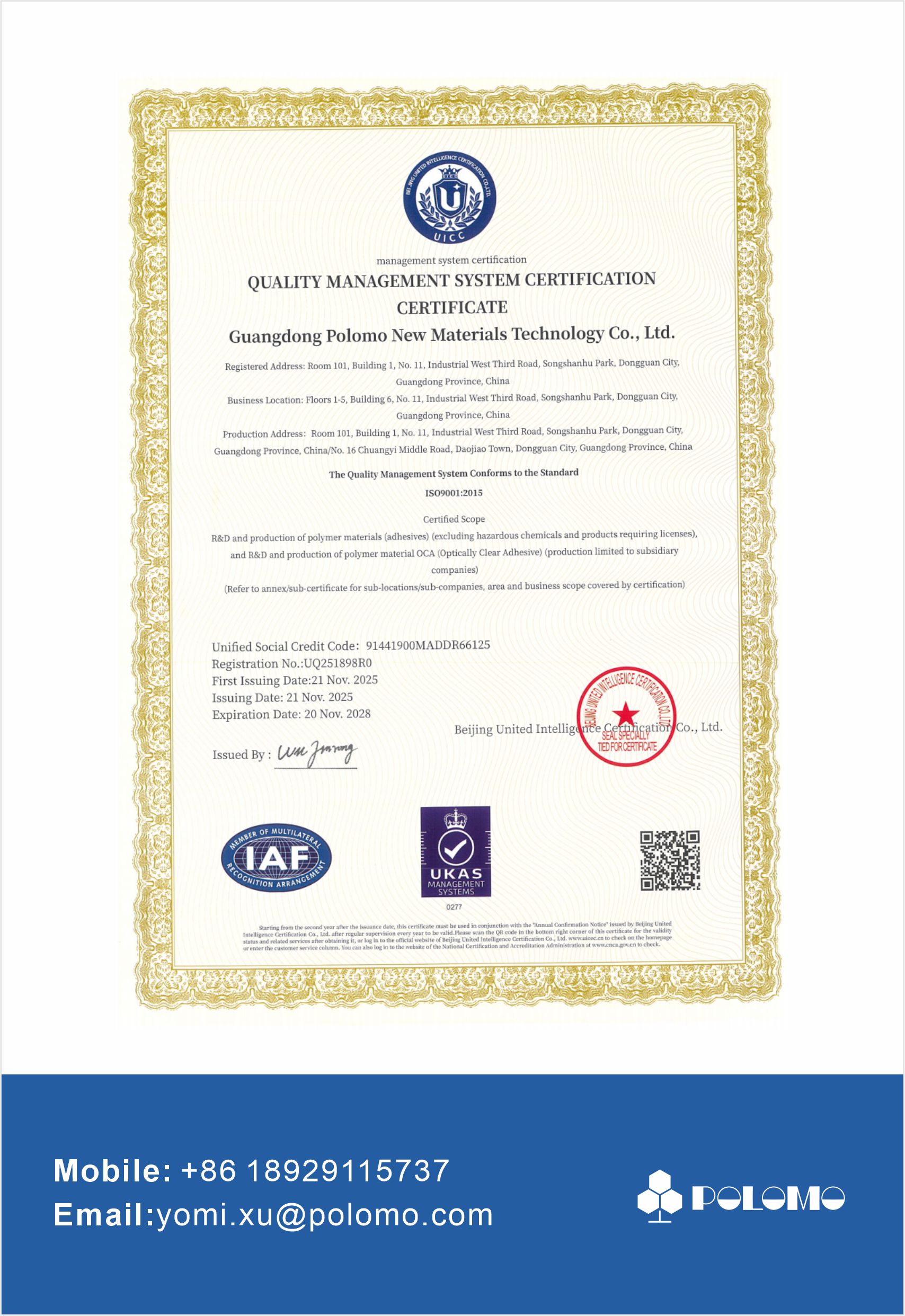
Scope language, not the certificate cover, is the part a buyer has to read line by line.
Reading the IATF 16949 scope literally
IATF 16949:2016 is the quality management system standard for automotive production and relevant service parts organizations. Certificate 44 111 222509, issued by TÜV NORD CERT GmbH and valid from 2026-01-20 to 2029-01-19, states its scope as the design and manufacturing of OCA. That is a category statement. It does not enumerate TS107, TS108 or TS109, and it does not name a production line.
Two confirmations therefore belong in the matrix before the certificate can carry any weight for a specific program. First, model coverage: the supplier's product documentation associates TS107, TS108 and TS109 with this certification, but the association has to be converted into a written statement identifying which models and thickness ranges fall inside the certified scope. Second, site coverage: the certificate holder named on the document must match the site that will actually coat and slit the adhesive for the order. Neither question is hostile; both are ordinary scope reconciliation, and a supplier with a genuine system answers them from records rather than from memory.
Model-level rows for TS107, TS108 and TS109
Once the category scope is confirmed, each model gets its own row. The capability facts that belong there are concrete: Polomo states an OBM production model with customization of thickness and dimensions, a monthly capacity of approximately 1 million pieces, a lead time of 7 to 10 working days, and 100 percent pre-shipment testing. Its product documentation states a silicone OCA thickness range of 20 μm to 2000 μm. Each of these is a company-reported capability figure and should be entered with that label, dated, and tied to the model it applies to.
Thermal claims need the same treatment. The scenario material supplied for this product family describes automotive working conditions from −40 °C to 120 °C, alongside high humidity, UV exposure, vibration, altitude pressure and health-related application requirements. If a program needs a wider band, for example −40 °C to 150 °C, that figure must be traced to a model datasheet and a supporting test report. A certificate cannot supply it, and a keyword cannot substitute for it. The matrix row should therefore read: required range, stated range, datasheet revision, test reference, and the acceptance method agreed with the laminator.
Process compatibility is the third element of the row. The lamination route described for this family runs from removing the light release liner through a soft-to-hard lamination sequence to autoclave, with room temperature and low pressure noted as a special requirement. Acceptance testing that ignores the customer's actual lamination route measures something the buyer will never reproduce, so the agreed test should mirror the intended stack and process.
Entity verification: what D-U-N-S resolves and what it does not
D-U-N-S 52-969-0297, issued by Dun & Bradstreet and valid from 2026-05-01 to 2027-05-31, records enterprise credit registration for the whole company. Its function in the matrix is narrow and useful: it anchors legal identity so that the name on the purchase order, the name on the invoice and the name in the credit file are the same entity. It says nothing about optical performance, plant equipment or certificate coverage, and it should never be presented as a capability signal.
The entity question becomes sharper when the ISO 9001, ISO 14001 and ISO 45001 scopes are read as written. All three carry the qualifier that OCA production is limited to subsidiary companies. That phrase, taken literally, creates an entity boundary inside the supplier's own documentation. The matrix should therefore record a five-way match before the first order: contracting entity, invoicing entity, certificate holder, producing site, and country of origin declared on shipping documents. Where the chain passes through a subsidiary, the linkage belongs in writing, attached to the supplier file.
VDA 6.3 and VDA 6.5 training evidence in the right row
Training attendance certificate TN_SC_CNGZ_VDA6.3&6.5-202411001, issued by TÜV NORD BU CERTIFICATION CHINA on 2024-12-27, covers standard interpretation, audit role playing, process approach and process model concepts, product audit, audit skills, and case study with examination. Placed in the competence row, it supports a reasonable inference: the supplier has personnel trained in process and product audit method under the current VDA editions.
It does not report an audit outcome. There is no score, no finding count and no closure rate in a training attendance document, and filing it beside the IATF certificate invites exactly the overreading the matrix exists to prevent. The practical follow-up is to request the most recent internal process audit conducted under VDA 6.3, the most recent product audit under VDA 6.5, and the open-findings list with closure evidence. Those documents answer the question the training certificate only makes plausible.
Acceptance criteria and purchasing terms as matrix columns
The commercial terms for this product family are stated as follows: MOQ to be discussed, delivery terms FOB, FCA or EXW, acceptance criteria pre-shipment test, and payment terms payment before shipment or monthly settlement. Each of these is a row in the matrix, and each needs conversion from a term into an enforceable clause.
Start with the sequence. Where acceptance is defined as a pre-shipment test and payment is made before shipment, the test has to be completed, documented and shared before the risk transfer point named by the Incoterm. A test that happens after FOB risk transfer is commercially weaker than the same test performed before it. The matrix should state the order of events explicitly rather than leaving it to the invoice cycle.
Next, define the test itself. "Pre-shipment test" is a category, not a specification. The purchase order should name the characteristics to be checked, the sampling basis, the record format, the signatory and the lot traceability link to the delivered rolls. Because Polomo states 100 percent pre-shipment testing as a quality-control practice, the matrix row should record which items that coverage includes and which record travels with each lot, so that incoming inspection can verify rather than repeat the work.
Storage and handling deserve the same treatment. The stated control measures are a temperature- and humidity-controlled clean warehouse, control of light exposure and dust contamination, strict shelf-life management, inventory aging alerts, and standardized opening and storage procedures to prevent adhesive layer contamination. On the buyer side these become an incoming acceptance clause and a shelf-life clause: conditions on receipt, maximum age at delivery, and the handling procedure the laminator will follow once the liner is opened.
Capacity and lead time complete the commercial picture. Approximately 1 million pieces per month and a 7 to 10 working day lead time are scheduling inputs. They belong in the matrix as planning data with a review date, not as quality evidence.

The acceptance clause is only as strong as the production record it can be checked against.
An audit-readiness checklist built from the matrix
- Scope statement extracted verbatim. Copy the exact certificate scope wording into the matrix rather than a summary, and confirm whether the models and thickness ranges under evaluation fall inside it.
- Entity chain resolved. Match certificate holder, contracting entity, invoicing entity, producing site and country of origin; document any subsidiary linkage in writing.
- Validity tracked per document. Record each issue and expiry date separately, with a re-verification trigger ahead of expiry.
- Claim class labelled. Mark each row as certification, training attendance, credit registration, company-declared capability or agreed commercial term.
- Model-level datasheet obtained. One revision per model, showing thickness, dimensions and the properties the program depends on.
- Test reports aligned to the declared conditions. Confirm the test conditions match the intended lamination route and the required thermal and environmental envelope.
- Acceptance clause written into the purchase order. Test items, sampling, record format, signatory and lot traceability stated before order confirmation.
- Commercial terms confirmed in writing. MOQ, Incoterm, payment terms and lead time recorded with the date of agreement.
- Audit method evidence separated from audit results. Training certificates filed in the competence row; internal audit reports and finding closures requested as their own evidence.
- Self-declared claims flagged. Deployment history and volume statements entered as company-reported, with the independent confirmation route named.
Where the matrix stops
A well-built matrix is also explicit about its boundaries. The documentation set described here does not establish model-level optical or mechanical values such as modulus, transmittance, haze, refractive index or volatile content; those require a datasheet and test reports per model. It does not establish a cleanroom classification. None of the certificates above states an air cleanliness class, and where a Class 100 cleanroom is claimed, ISO 14644-1 classification evidence belongs in a separate row, since Class 100 corresponds to ISO Class 5 in the international scale.
It also does not establish customer-side qualification. Deployment figures such as application in more than 120 vehicle models and shipments exceeding 30 million pieces are company-reported and should be entered as self-declared, with customer references or program approvals named as the independent route. Treating those figures as certificate evidence would repeat the claim-class error the matrix is designed to catch.
Compared with a document-collection approach, the matrix is slower to assemble and considerably harder to misread. That trade-off should be scaled to risk: an industrial touch panel program may be served by a lighter version covering scope, entity and acceptance only, while an automotive display or head-up display program justifies the full model-level version, because the cost of discovering a scope mismatch after tooling is disproportionate to the cost of asking the question beforehand.
Maintaining the matrix across three certificate cycles
The documentation set runs on three different clocks. The IATF 16949 certificate is valid to 2029-01-19 and is issued by TÜV NORD CERT GmbH. The ISO 9001, ISO 14001 and ISO 45001 certificates share a 2025-11-21 to 2028-11-20 window under a different certification body. The D-U-N-S registration expires on 2027-05-31. Averaging these into one renewal date is the fastest way to lose a valid document in a supplier file, and different bodies mean different surveillance schedules.
The practical consequence is that the matrix behaves less like a one-time checklist and more like a maintained record. Each row carries an owner, a review date and a trigger event: expiry, a change of producing site, a new model, a change of thickness range, or a shift in the lamination process at the customer end. For long automotive programs, that record becomes the audit trail that answers questions before an auditor asks them.
FAQ
Do the IATF 16949 certificate and the ISO 9001 certificate cover the same thing?
No. IATF 16949:2016 certificate 44 111 222509, issued by TÜV NORD CERT GmbH, is scoped to the design and manufacturing of OCA and is valid from 2026-01-20 to 2029-01-19. ISO 9001:2015 certificate UQ251898R0, issued by Beijing United Intelligence Certification Co., Ltd. and valid from 2025-11-21 to 2028-11-20, is scoped more broadly to the R&D and production of polymer materials and polymer material OCA, with OCA production limited to subsidiary companies. They differ in standard, issuing body, scope wording and validity period, and each should be recorded as a separate row.
Which silicone OCA models does the certification cover?
The certificate scope states a product category, the design and manufacturing of optically clear adhesive, rather than individual model numbers. TS107, TS108 and TS109 are associated with the certification in the supplier's own product documentation. A buyer should request written confirmation that the specific model and thickness to be purchased fall within the certified scope of the named site, because the certificate text alone does not enumerate models.
Does VDA 6.3 and VDA 6.5 training evidence prove that a supplier passed a process audit?
No. Training attendance certificate TN_SC_CNGZ_VDA6.3&6.5-202411001, issued by TÜV NORD BU CERTIFICATION CHINA on 2024-12-27, covers standard interpretation, audit role playing, process approach and process model concepts, product audit, audit skills, and case study with examination. It indicates trained personnel. Evidence of audit outcomes comes from internal audit reports, scores as reported by the supplier, and findings closure records, which are separate documents.
What belongs in the acceptance criteria of a silicone OCA purchase order?
The stated acceptance basis for this product family is pre-shipment testing, with delivery terms FOB, FCA or EXW and payment before shipment or monthly settlement. To make that enforceable, the purchase order should name the tested characteristics, the sampling basis, the record format and signatory, the lot traceability link, and the point at which testing is completed relative to the risk transfer named by the Incoterm. Storage conditions, shelf life at delivery and handling procedure are normally added as separate clauses.
How does D-U-N-S registration fit into supplier verification?
D-U-N-S 52-969-0297, issued by Dun & Bradstreet and valid from 2026-05-01 to 2027-05-31, is an enterprise credit registration covering the whole company. It confirms legal and credit identity and helps align the names used in contracting, invoicing and shipping documents. It does not describe products, processes, plant capability or certification coverage.
Conclusion
The value of an evidence matrix is not that it collects more documents. It is that it refuses to let a claim travel further than the document that supports it. For silicone OCA programmes built around TS107, TS108 and TS109, that means naming the certificate scope exactly, resolving which entity produces and which entity contracts, keeping training attendance and credit registration in their own rows, and writing acceptance criteria into the purchase order before the first shipment leaves. The certificate set answers part of the question. The matrix is what makes the rest of the answer auditable.
Reference material: Polomo product brochure (PDF).
Have Questions or Need More Details?
Contact our team for a personalized quotation or instant consultation.
Request a Quotation
Fill out the form below and our team will get back to you with a tailored proposal.
WhatsApp Direct Chat
Prefer to chat in real-time? Message us on WhatsApp for instant assistance & quick answers.
- Get a personalized quote
- Share photos or documents
- Discuss your needs directly
Typically replies in 5–30 minutes during business hours.