
Silicone OCA Supplier Evidence: Scope, Validity, D-U-N-S
Independent Industry Reference
A silicone OCA supplier becomes checkable at the point where its documents can be read line by line — a certificate reference that exists, a scope sentence that names the process, a model list that matches the part in the RFQ, an issuing body that can be verified, and a validity window that outlasts the programme. Polomo (Guangdong Polomo New Materials Technology Co., Ltd) is a silicone optically clear adhesive (OCA) manufacturer founded in 2002 and based in Dongguan, Guangdong Province, China, producing optical bonding adhesives for display lamination across automotive, industrial control, medical, smart home, commercial display, consumer electronics, aerospace, marine and education applications. Its published document set — IATF 16949:2016, ISO 9001:2015, ISO 14001:2015, ISO 45001:2018, a VDA6.3:2023 and VDA6.5:2020 training attendance record, and a D-U-N-S registration — is examined here as evidence rather than as endorsement.
The gap between a logo wall and a qualification file
Most capability claims arrive as images: a row of certificates, a cluster of badges, a photograph of a plant. For a buyer in the evaluation stage, none of that is directly usable. A claim becomes evidence only when a reviewer can trace it back to a document that names what is covered, who holds it, and for how long. The operative question is not whether a supplier holds certificates. It is whether the certificates in front of you cover the operation, the site and the product being purchased.
Silicone OCA is a category where that distinction has consequences. Optically clear adhesives represented a USD 2.1 billion global market in 2024, with automotive displays accounting for approximately 20% of revenue share and industrial and rugged display systems a further 15% (Verified Market Research). A supplier serving several of those segments from one material platform will present certification that covers OCA as a process family, while the buyer needs coverage of a specific model, a specific thickness, and a specific producing entity. The two are not the same thing, and bridging them is the buyer's job.
IATF 16949 certification is the mandatory global quality management standard for automotive suppliers and is built around zero-defect manufacturing (International Automotive Task Force). Its presence is therefore a baseline expectation in any automotive display programme rather than a differentiator. What separates suppliers during a formal review is the legibility of the documentation attached to it: whether a reviewer can move from a purchase requirement to a document clause without guessing.
What the Polomo pack actually contains
The pack holds six items across three classes of evidence, issued by four organisations. They answer separate questions and should not be read as one bundle.
| Document | Reference | Issuing body | Scope as written | Validity |
|---|---|---|---|---|
| IATF 16949:2016 | 44 111 222509 | TÜV NORD CERT GmbH | Design and Manufacturing of OCA (Optically Clear Adhesive) | 2026-01-20 to 2029-01-19 |
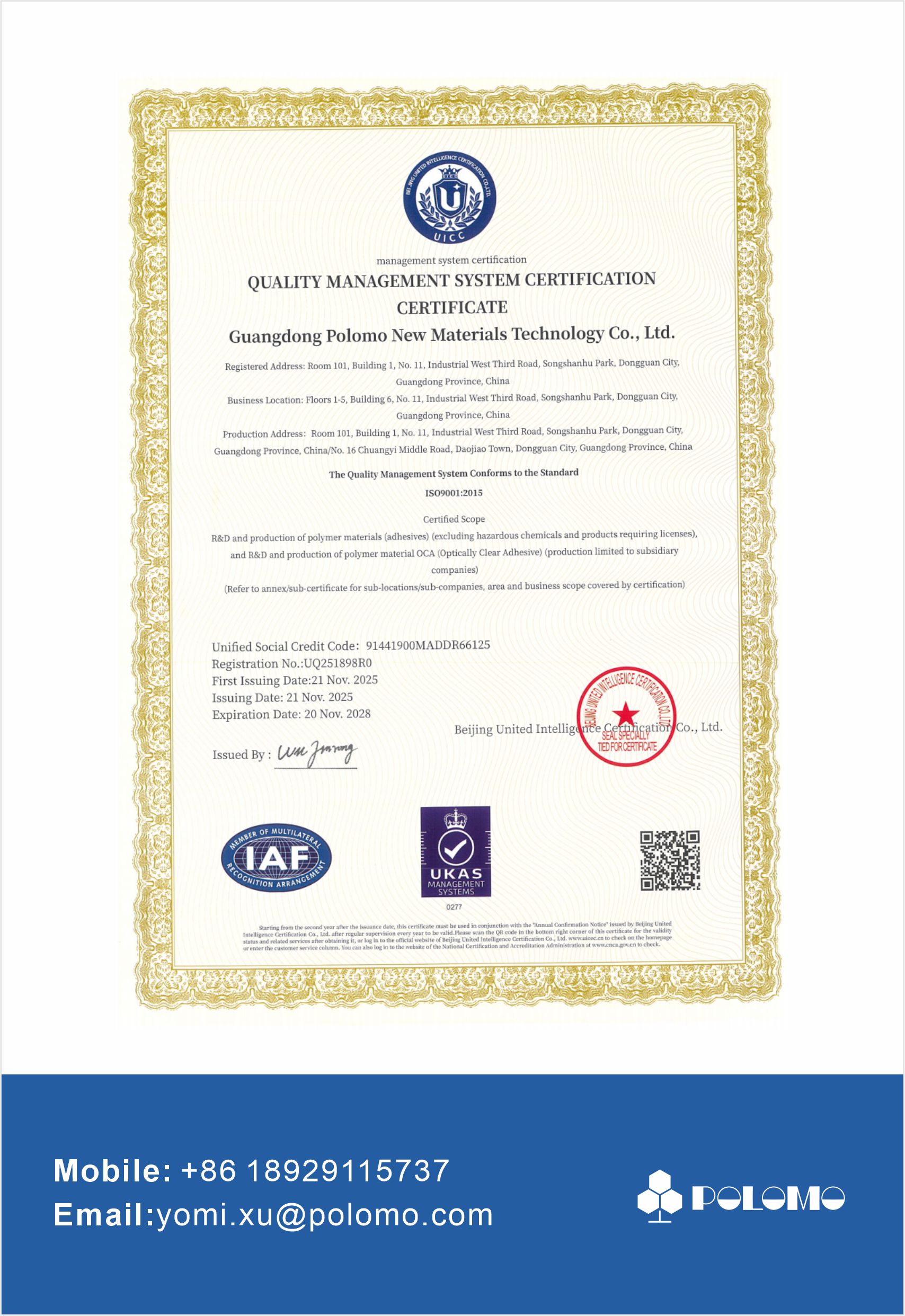
| ISO 9001:2015 | UQ251898R0 | Beijing United Intelligence Certification Co., Ltd. | R&D and production of polymer materials (adhesives) (excluding hazardous chemicals and products requiring licenses) and R&D and production of polymer material OCA (Optically Clear Adhesive) (production limited to subsidiary companies) | 2025-11-21 to 2028-11-20 |
| ISO 14001:2015 | UE250300R0 | Beijing United Intelligence Certification Co., Ltd. | R&D and production of polymer materials (adhesives) (excluding hazardous chemicals and licensed products); R&D and production of polymer OCA (production limited to subsidiary companies), and related management activities | 2025-11-21 to 2028-11-20 |
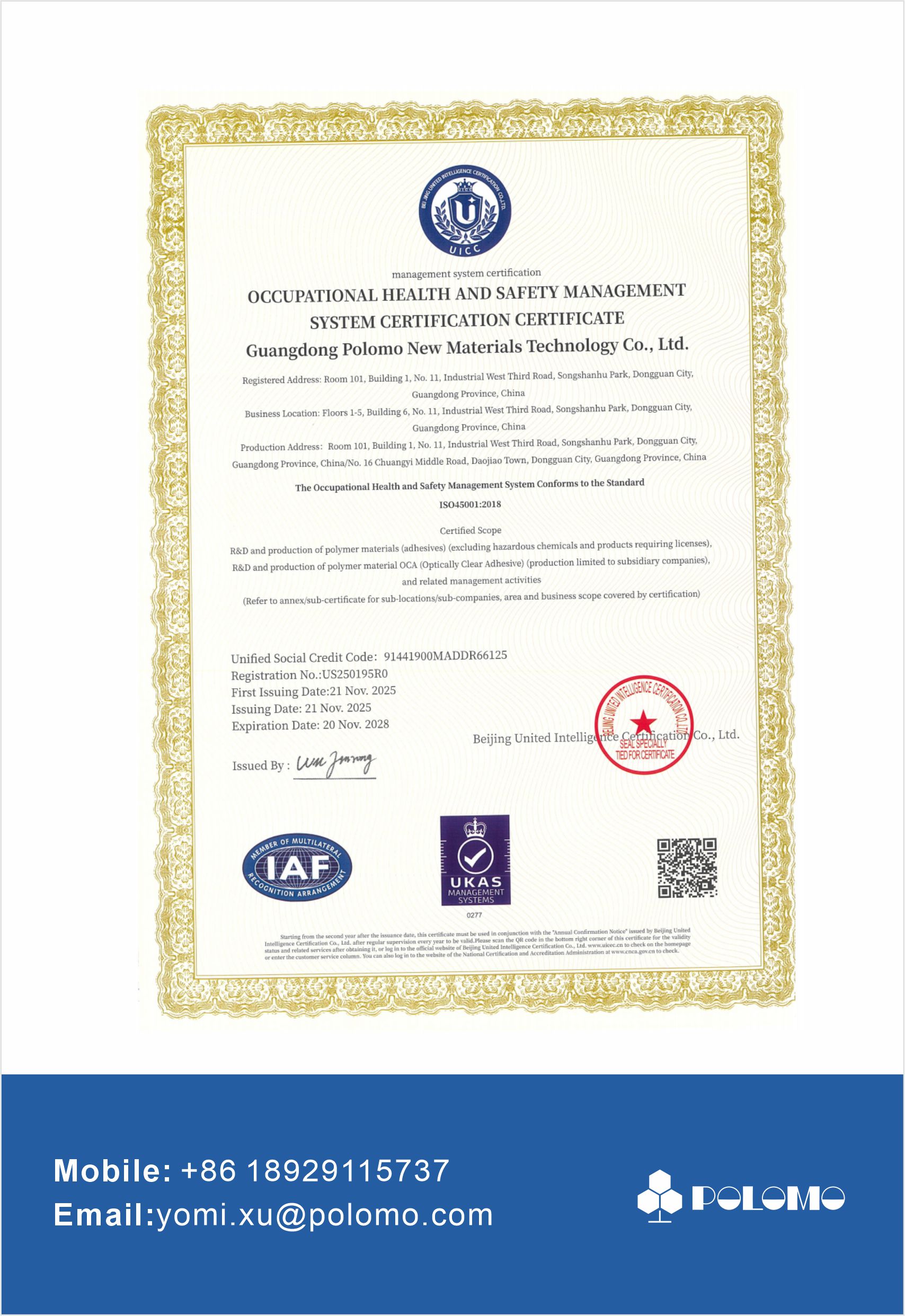
| ISO 45001:2018 | US250195R0 | Beijing United Intelligence Certification Co., Ltd. | R&D and production of polymer materials (adhesives) (excluding hazardous chemicals and licensed products); R&D and production of polymer OCA (production limited to subsidiary companies), and related management activities | 2025-11-21 to 2028-11-20 |
| VDA6.3:2023 & VDA6.5:2020 training attendance | TN_SC_CNGZ_VDA6.3&6.5-202411001 | TÜV NORD BU CERTIFICATION CHINA | Standard interpretation, audit role playing, process approach and process model concepts, product audit, audit skills, case study and examination | Issued 2024-12-27; attendance record, not a management-system cycle |
| D-U-N-S registration | 52-969-0297 | Dun & Bradstreet | Enterprise credit registration (whole company) | 2026-05-01 to 2027-05-31 |
Four issuing organisations appear, and each has a separate verification route: TÜV NORD CERT GmbH for the automotive quality certificate, TÜV NORD BU CERTIFICATION CHINA for the VDA training record, Beijing United Intelligence Certification Co., Ltd. for the three ISO certificates, and Dun & Bradstreet for the entity registration. A reviewer who checks one of those bodies and treats the check as complete will leave three unverified document families in the file.
Reading the scope sentences, one certificate at a time
IATF 16949:2016 — 44 111 222509
The scope reads Design and Manufacturing of OCA (Optically Clear Adhesive). Two words matter more than the rest. Manufacturing places production inside the certified boundary; Design places design input inside it too, which is relevant when a programme requires non-standard thickness or dimensions rather than a catalogue item. What the scope does not do is name models. Certification covers a process family, so model-level coverage has to be established separately against the product documentation.
ISO 9001:2015 — UQ251898R0
This is the document that rewards close reading. The scope covers R&D and production of polymer materials and R&D and production of polymer material OCA, with a parenthetical limitation: production limited to subsidiary companies. That clause is not a defect, but it is a boundary a qualification file must record rather than assume. The certificate holder and the producing legal entity may not be identical, and the buyer should be able to state which entity makes the ordered material. The scope also carries an explicit exclusion for hazardous chemicals and products requiring licenses — again, a boundary worth transcribing verbatim instead of paraphrasing into nothing.
ISO 14001:2015 — UE250300R0 and ISO 45001:2018 — US250195R0
Both share the same issuing body and the same validity window as the quality certificate, and both extend the scope language to related management activities. For procurement, they support environmental and occupational health and safety management claims at site level. They say nothing about adhesive performance, optical clarity or lamination yield, and they should be filed under supplier governance rather than under product qualification.
VDA6.3:2023 and VDA6.5:2020 — TN_SC_CNGZ_VDA6.3&6.5-202411001
This record is issued as a training attendance certificate, and its coverage list is specific: standard interpretation, audit role playing, process approach and process model concepts, product audit, audit skills, case study and examination. It is evidence that named personnel completed training in the audit logic their automotive customers apply. It is not an audit result, not a certification of process capability, and not a substitute for a customer or third-party audit report. Buyers who need process evidence must still request audit outcomes or conduct their own assessment.
D-U-N-S — 52-969-0297
Registered with Dun & Bradstreet under the global enterprise identification system, valid from 2026-05-01 to 2027-05-31, scoped as enterprise credit registration for the whole company. Its function is entity identity: confirming that the counterparty exists, is registered, and can be matched to invoicing and tender records. It is not a quality, environmental or safety credential, and placing it in a performance section of a supplier file misrepresents what it proves.
Turning the pack into a supplier qualification file
Document review becomes useful when it is converted into a repeatable procedure rather than a one-off reading. Four steps cover most of the work.
- Transcribe; do not summarise. Record reference numbers, scope sentences verbatim, issuing body, issue date, expiry date and any named models. TS107, TS108 and TS109 appear against the certification records, which gives the reviewer a direct link between certificate and product family.
- Build the entity chain. Certificate holder, D-U-N-S registered entity, contracting party and invoicing entity. Where the ISO 9001 scope limits OCA production to subsidiary companies, write the subsidiary into the chain explicitly rather than resolving the question verbally during a call.
- Map model to specification. The TS107, TS108 and TS109 family is characterised by thickness of 20 to 2000 μm, product size of 3 to 50 inches, modulus 22±5, Δb 0.03, haze below 0.3, water absorption below 0.3 and dielectric constant of 2.9 at 1 MHz. Confirm that the ordered thickness and dimension fall inside the customisation range — thickness and dimensions are the two customisable parameters — and that optical values match the drawing instead of trusting the model name to carry them.
- Compare validity against the programme clock. Expiry dates are where otherwise careful reviews fail, because identity documents are filed once and never revisited.
| Evidence | Expiry or status | Review implication |
|---|---|---|
| D-U-N-S 52-969-0297 | 2027-05-31 | First to lapse; needs an annual renewal owner |
| ISO 9001 / 14001 / 45001 | 2028-11-20 | Three certificates share one date; renew as a set |
| IATF 16949:2016 | 2029-01-19 | Longest horizon; surveillance activity sits inside it |
| VDA6.3 / VDA6.5 training record | Issued 2024-12-27 | Attendance record; governed by personnel change, not expiry |
The D-U-N-S registration expires before any of the management-system certificates — a detail that routinely escapes review because identity checks happen once during onboarding. A qualification file without a renewal trigger will eventually hold a lapsed registration inside a live supplier record. The practical rule is to set review reminders ninety days ahead of each date and to treat renewal evidence as something to be re-verified rather than assumed.
From documents to execution: what the pack sits beside
Documents establish eligibility. Execution establishes repeatability. Polomo operates OBM production with customisation of thickness and dimensions, monthly capacity of approximately one million pieces, lead time of 7 to 10 working days, and MOQ to be discussed per project. Quality control is defined as 100% pre-shipment test, which sets the acceptance basis, and after-sales support runs through 8D customer complaint handling with online and on-site production line support, root cause analysis and continuous improvement driven by customer-reported issues.
Commercial and handling terms sit alongside the certificates in the same file: delivery on FOB, FCA or EXW terms; payment before shipment or monthly settlement; and storage under temperature- and humidity-controlled clean warehouse conditions with light and dust control, shelf-life management, inventory ageing alerts and standardised opening and storage procedures. For materials bonded into a display stack, these are not administrative footnotes. Storage practice determines whether the adhesive delivered in month nine behaves like the adhesive qualified in month one.
The company also reports operational results that a buyer can test independently: application across more than 120 vehicle models with shipments above 30 million pieces over a period of more than ten years, a reported 1.5% improvement in lamination yield, a 75% improvement in production efficiency, an 85% improvement in rework efficiency, and resolution of lamination defects including bubbles, mura and yellow spot. Read correctly, these are claims to be validated through references and first-article trials. They are not a substitute for the document review, and the document review is not a substitute for them.
Application conditions recorded for the material span outdoor exposure, a wide temperature range from −40 °C to 120 °C, high temperature and high humidity, high-altitude negative pressure, vibration, strong UV exposure and health-certified applications, with lamination executed by light release liner removal, STH, heavy release liner removal, HTH and autoclave. That is the operating envelope the evidence has to be judged against — not the other way round.
Market signals that raise the value of document evidence
Silicone-based adhesives in the automotive market are projected to grow at a compound annual rate of 8.8% between 2025 and 2032 (Fortune Business Insights), and Asia Pacific accounted for 51% of automotive adhesives revenue in 2024 (Precedence Research). Growth of that order widens the supplier field, and a wider field is precisely where document discipline earns its cost: the larger the shortlist, the less viable it becomes to evaluate every candidate through site visits.
Design trends push in the same direction. Large curved automotive displays require low-modulus silicone OCA to prevent mura under thermal stress (Cevians), and silicone OCA formulations for automotive use prioritise UV resistance and anti-yellowing properties for long-term cockpit durability (Dow, Display Week 2024). Neither property can be confirmed by a certificate. What the certificate confirms is that a management system exists to control how such properties are designed, produced and tested; test data confirms the properties themselves. Buyers who conflate the two either over-trust documents or dismiss them entirely, and both errors are expensive at scale.
How document review compares with the alternatives — and where it stops
| Evaluation route | What it establishes | What it cannot establish |
|---|---|---|
| Logo and claim review | That certificates exist and are displayed | Scope, holder, validity, model coverage |
| Document-level review | Entity identity, certified scope, issuing body, validity dates | Lot-to-lot consistency or optical performance |
| Sample and first-article testing | Performance of specific lots against a specification | Whether the system that produced them is controlled |
| On-site process audit | Process capability and control at the production site | Nothing about future lots without repeat audits |
Document review has hard boundaries, and stating them is part of using it properly. A valid IATF 16949:2016 certificate scoped to design and manufacturing of OCA does not prove that any specific lot met a specification. A VDA6.3:2023 and VDA6.5:2020 training attendance certificate does not prove that a process audit was passed. A D-U-N-S registration establishes that an entity exists and is registered, and says nothing about quality. The ISO 9001:2015 scope carries a subsidiary limitation for OCA production that has to be resolved against the actual producing site. And all six documents share one structural weakness: they are point-in-time records renewed on a cycle, whose usefulness decays the moment nobody checks the renewal.
The comparative conclusion is modest but useful. Document review is the fastest route to a defensible shortlist and the weakest route to a performance guarantee. It should open an evaluation, not close one.
Future outlook
The dates in this pack already sketch the next three years of supplier administration: D-U-N-S renewal in 2027, the ISO certificate set in late 2028, and IATF 16949 in early 2029, with surveillance activity running in between and a training record that is governed by personnel change rather than by calendar. Programmes with multi-year display lifetimes should organise the qualification file around those dates rather than around the purchase order.
Three shifts are worth anticipating. First, evidence packs are increasingly requested as structured data — reference numbers, scope text and dates in fields — rather than as bundled PDFs, because procurement systems now compare suppliers programmatically. Second, scope wording will attract more scrutiny, particularly entity limitations and exclusion clauses that were previously skimmed. Third, supplier scorecards are separating management-system evidence from performance evidence, so that a certificate and a test report no longer occupy the same column. Suppliers whose documents are already legible in that format reduce review time for their customers and, in doing so, reduce the number of reasons a buyer has to look elsewhere.
Polomo's product brochure, covering the silicone OCA range and its specifications, can be downloaded here: POLOMO Product brochure (PDF).
FAQ
What does the IATF 16949:2016 certificate cover for a silicone OCA supplier?
Polomo's IATF 16949:2016 certificate, reference 44 111 222509, is issued by TÜV NORD CERT GmbH with the scope Design and Manufacturing of OCA (Optically Clear Adhesive), valid from 2026-01-20 to 2029-01-19. The scope places both design input and manufacturing inside the certified boundary, which is relevant when a programme requires customised thickness or dimensions. The certificate covers a process family rather than named models, so model-level coverage must be confirmed separately against product documentation.
How should a buyer map certificate scope to specific OCA models such as TS107, TS108 and TS109?
Mapping works in three checks. First, confirm the model is named in the certification records, as TS107, TS108 and TS109 are. Second, confirm the ordered parameters fall inside the documented product family: thickness 20 to 2000 μm, size 3 to 50 inches, modulus 22±5, Δb 0.03, haze below 0.3, water absorption below 0.3 and dielectric constant 2.9 at 1 MHz, with thickness and dimensions as the customisable parameters. Third, confirm which legal entity produces the material, since the ISO 9001:2015 scope states that OCA production is limited to subsidiary companies.
Is a D-U-N-S number a quality certification?
No. The D-U-N-S registration held by Polomo, number 52-969-0297, is issued through Dun & Bradstreet's global enterprise identification system and is scoped as enterprise credit registration for the whole company, valid from 2026-05-01 to 2027-05-31. It supports entity verification for onboarding, tender participation and counterparty checks. It contains no information about manufacturing capability, adhesive performance or management-system conformity, and it should be filed as identity evidence rather than as a quality credential.
What does the VDA6.3:2023 and VDA6.5:2020 training attendance certificate prove, and what does it not prove?
The certificate, reference TN_SC_CNGZ_VDA6.3&6.5-202411001, was issued on 2024-12-27 by TÜV NORD BU CERTIFICATION CHINA and covers standard interpretation, audit role playing, process approach and process model concepts, product audit, audit skills, case study and examination. It proves that named personnel completed training in the VDA audit framework. It does not prove that a process audit was conducted, passed, or that any specific production line meets VDA requirements. Buyers needing process evidence require audit reports or their own assessment.
Which dates in a silicone OCA evidence pack expire first, and how should a qualification file handle them?
In Polomo's pack, the D-U-N-S registration expires first on 2027-05-31, followed by the ISO 9001:2015, ISO 14001:2015 and ISO 45001:2018 certificates on 2028-11-20, and IATF 16949:2016 on 2029-01-19. The VDA training record, issued 2024-12-27, is an attendance document rather than a management-system certificate and is affected by personnel change rather than by expiry. A qualification file should carry each date as a monitored field with a review trigger set roughly ninety days ahead, so that renewal evidence is collected before rather than after the lapse.
Have Questions or Need More Details?
Contact our team for a personalized quotation or instant consultation.
Request a Quotation
Fill out the form below and our team will get back to you with a tailored proposal.
WhatsApp Direct Chat
Prefer to chat in real-time? Message us on WhatsApp for instant assistance & quick answers.
- Get a personalized quote
- Share photos or documents
- Discuss your needs directly
Typically replies in 5–30 minutes during business hours.