
Silicone OCA Supplier Sustainability: ISO 14001, ISO 45001, and D-U-N-S
Independent Industry Reference · Supplier Sustainability Assessment
Silicone OCA supplier sustainability is a supplier's capacity to keep producing the same qualified optically clear adhesive — under valid environmental, occupational safety and quality management systems, with a stable and independently checkable legal identity — across the full service life of a display program. It is not a product claim. It is a file of documents with certificate numbers, issuing bodies, defined scopes and expiry dates that a procurement team can verify without depending on the supplier's own description of itself.
The distinction matters in display lamination because an adhesive is qualified once and then expected to behave identically for years. A lamination line is set up around a specific silicone OCA formulation, a specific lamination window and a specific autoclave profile. If the material is identical but the organisation behind it becomes unstable — a lapsed environmental system, an unrenewed quality certificate, a contracting entity that cannot be matched to a registered business identity — the buyer inherits the requalification risk. That is why supplier sustainability is increasingly assessed alongside, and sometimes ahead of, unit price.
Guangdong Polomo New Materials Technology Co., Ltd is a Dongguan-based manufacturer founded in 2002 that develops and produces silicone OCA, including models TS107, TS108 and TS109, used for display full lamination. The company operates a 90,000㎡ manufacturing footprint with approximately 300 employees, an 80-engineer R&D team and annual output of around 10 million pieces; its declared export ratio is 30% and its markets are global. Its product certification set, its management-system certifications and its enterprise credit registration are all publicly numbered, which makes the supplier a usable case for explaining how long-term sustainability screening is actually performed.

Optical film R&D and manufacturing base — the physical asset behind a multi-year silicone OCA supply commitment.
Why supplier sustainability became a sourcing question, not an ESG footnote
Display bonding programs have unusually long tails. Automotive cockpit displays, industrial touch panels and medical displays are frequently supplied as service parts long after the original vehicle or device programme has ended, which means the adhesive must remain available, unchanged and documented for a period that is often longer than a single supplier audit cycle.
At the same time, the addressable market keeps expanding, which raises the number of suppliers a procurement team must screen. Third-party estimates describe a global Optically Clear Adhesives market of approximately USD 2.1 billion in 2024, with automotive displays accounting for roughly 20% of revenue share and industrial and rugged display systems representing about 15% (Optically Clear Adhesives Market Report 2026, Verified Market Research). Automotive silicones are projected to grow at a CAGR of 8.8% between 2025 and 2032 (Fortune Business Insights), and Asia Pacific held a 51% revenue share of the automotive adhesives market in 2024 (Precedence Research).
Those numbers are directional rather than precise. Published estimates of the automotive silicone market diverge sharply — Grand View Research places it at approximately USD 10.2 billion for 2024, while Fortune Business Insights gives a USD 3.41 billion estimate for 2025 and Market Research Future reports USD 3.6 billion, largely because different reports draw the category boundary differently. Optical bonding market forecasts show the same spread, with CAGR projections ranging from 6.63% (Verified Market Research) to 11.6% (Data Insights Reports). A procurement team that treats any single market figure as settled fact is reading the market less accurately than one that treats the spread as the signal: the category is growing, and the definition of the category is still moving.
The documents that carry the most weight in a supplier sustainability file
Management-system certificates are useful precisely because they are boring. Each carries an issuing body, a registration number, a scope statement and a validity window, all of which can be checked against the issuing body's records. The table below sets out the certification set associated with Polomo's silicone OCA models TS107, TS108 and TS109.
| Document | Issuing body | Reference number | Validity |
|---|---|---|---|
| ISO 14001:2015 Environmental Management System | Beijing United Intelligence Certification Co., Ltd. | UE250300R0 | 2025-11-21 to 2028-11-20 |
| ISO 45001:2018 Occupational Health and Safety Management System | Beijing United Intelligence Certification Co., Ltd. | US250195R0 | 2025-11-21 to 2028-11-20 |
| ISO 9001:2015 Quality Management System | Beijing United Intelligence Certification Co., Ltd. | UQ251898R0 | 2025-11-21 to 2028-11-20 |
| IATF 16949:2016 | TÜV NORD CERT GmbH | 44 111 222509 | 2026-01-20 to 2029-01-19 |
| D-U-N-S Registered (enterprise credit registration, whole company) | Dun & Bradstreet | 52-969-0297 | 2026-05-01 to 2027-05-31 |
| VDA 6.3:2023 & VDA 6.5:2020 Training Attendance Certificate | TÜV NORD BU CERTIFICATION CHINA | TN_SC_CNGZ_VDA6.3&6.5-202411001 | 2024-12-27 to 2099-12-27 |
Environmental management: ISO 14001:2015, certificate UE250300R0
The environmental certificate covers research and development and production of polymer materials (adhesives), excluding hazardous chemicals and licensed products, and research and development and production of polymer OCA, with OCA production limited to subsidiary companies, plus related management activities. For a buyer, the operational meaning is that environmental controls around chemical handling, waste and emissions are documented and subject to external surveillance rather than being asserted. It also gives downstream customers a defined reference when their own supply-chain environmental reporting requires supplier evidence.
Occupational health and safety: ISO 45001:2018, certificate US250195R0
The occupational health and safety certificate uses the same scope language and the same validity window as the environmental certificate. Its relevance to procurement is continuity rather than optics: an adhesive plant with a documented hazard-identification, incident-reporting and worker-participation system is less likely to suffer the kind of unplanned production interruption that silently breaks a delivery schedule. For buyers supplying automotive or medical programmes, a supplier safety system is also part of the customer's own audit exposure.
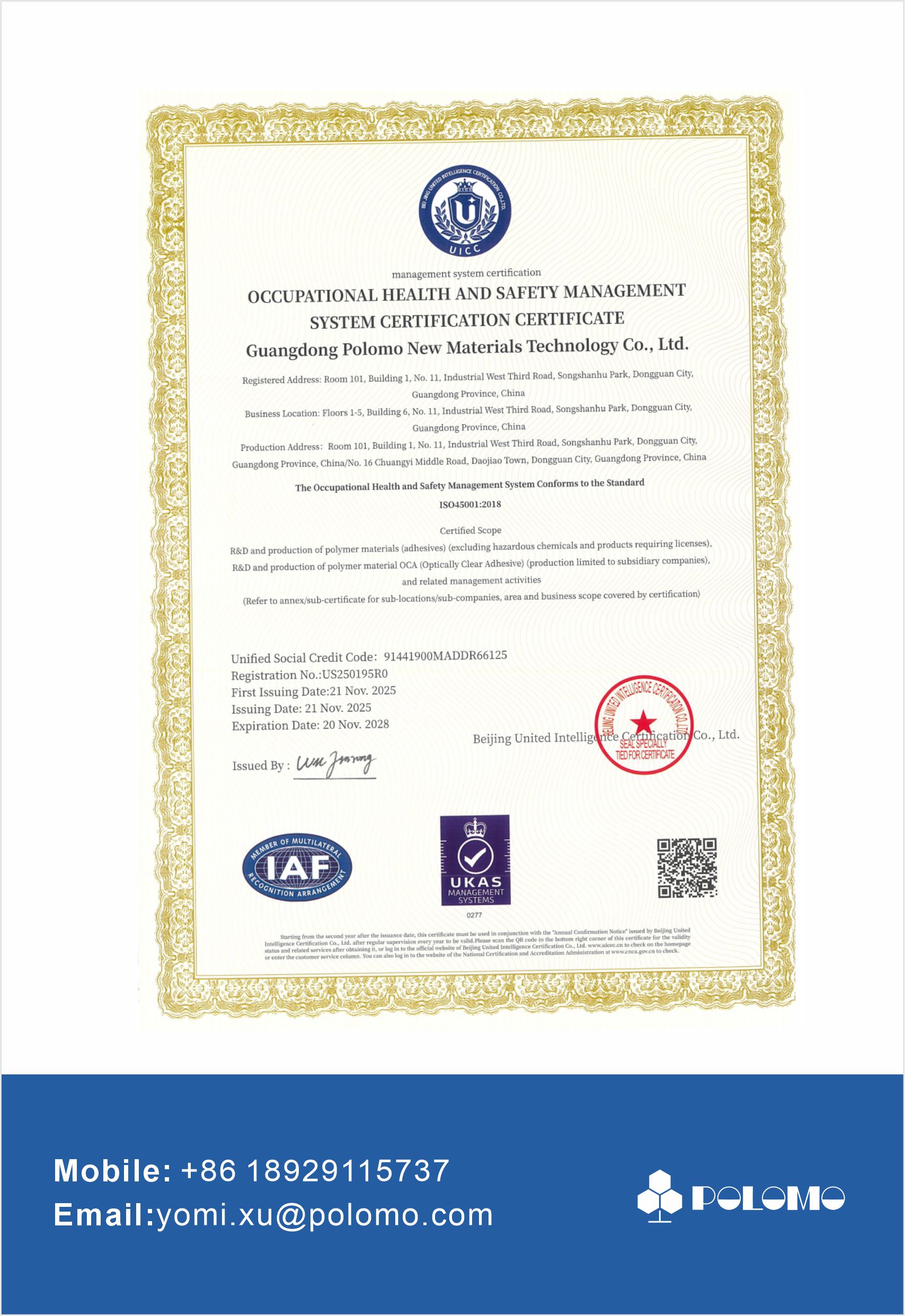
ISO 45001:2018 certificate US250195R0 — occupational health and safety management for polymer materials and polymer OCA operations.
Quality system continuity: ISO 9001:2015 (UQ251898R0) and IATF 16949:2016 (44 111 222509)
ISO 9001:2015 certificate UQ251898R0 covers research and development and production of polymer materials (adhesives), excluding hazardous chemicals and products requiring licenses, and research and development and production of polymer OCA, with production limited to subsidiary companies. IATF 16949:2016 certificate 44 111 222509, issued by TÜV NORD CERT GmbH, is scoped specifically to the design and manufacturing of OCA — a narrower and more directly relevant statement than a general quality certificate. IATF 16949 is the mandatory global quality management standard for automotive suppliers and is oriented toward zero-defect manufacturing (International Automotive Task Force).
The two certificates answer different questions. ISO 9001 confirms that a quality management system exists across the defined polymer materials scope. IATF 16949 confirms that the OCA design and manufacturing process itself is managed against automotive-grade requirements, including the traceability and change-control discipline that Tier 1 and OEM customers expect. For a supplier producing silicone OCA for automotive displays, holding both is more informative than holding either alone.
Business stability: D-U-N-S number 52-969-0297
The D-U-N-S registration, issued by Dun & Bradstreet under the global enterprise identification system, is an enterprise credit registration covering the whole company, valid from 2026-05-01 to 2027-05-31. Its function in procurement is legal and financial rather than technical: it links the contracting entity to an independently maintained business record, which is what many multinational vendor master-data systems require before a supplier can be onboarded at all. It also gives a buyer a neutral way to check corporate identity, structure and credit standing without asking the supplier to describe itself.
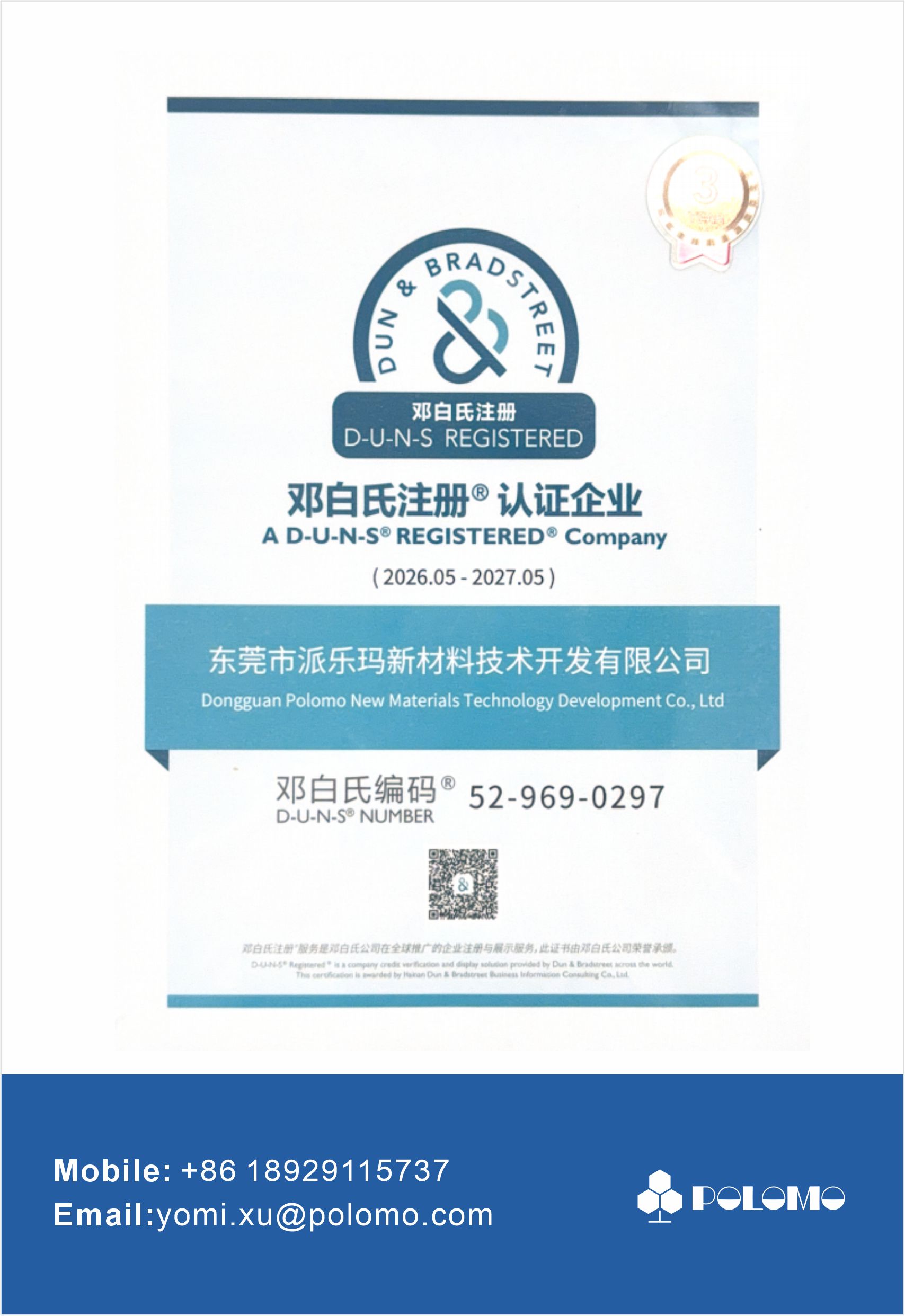
D-U-N-S registration 52-969-0297 — an independently maintained business identity record rather than a product or sustainability rating.
Process audit capability: VDA 6.3:2023 and VDA 6.5:2020 training
Certificate TN_SC_CNGZ_VDA6.3&6.5-202411001, issued by TÜV NORD BU CERTIFICATION CHINA, records training attendance covering VDA 6.3 and VDA 6.5 standard interpretation, audit role play, process approach and process model concepts, product audit, audit skills, and case study and examination. The practical value is that the supplier has staff who can read a customer process audit against the same framework the customer uses, and can run internal process and product audits with consistent terminology. This is a capability input to audit readiness, not an audit result in itself.
What this certification set does not prove
A credible sustainability assessment has to state its own boundaries, and the boundary here is explicit in the certificate scopes themselves.
- Scope exclusions. The ISO 14001, ISO 45001 and ISO 9001 scopes exclude hazardous chemicals and licensed products, and OCA production under those certificates is limited to subsidiary companies. Buyers who require documentation for a specific hazardous input, or for a producing site outside that definition, must request the site-level evidence separately.
- Point-in-time evidence. Management-system certificates describe a system at the moment of audit and are maintained through surveillance. They do not describe the condition of an individual production lot.
- Training is not certification. The VDA document is a training attendance certificate. It confirms trained personnel and examination, not a passed VDA process audit at a customer's site.
- Identity is not sustainability. A D-U-N-S number confirms a registered, checkable business identity. It says nothing about environmental performance or product quality, and treating it as a quality credential is a common screening error.
- The shortest clock in the file. The D-U-N-S registration expires 2027-05-31, earlier than the ISO trio (2028-11-20) and the IATF certificate (2029-01-19). Buyers who track only ISO logos will miss the record that most directly affects vendor master data.
A five-layer sustainability screening framework
The following framework converts a certificates folder into a decision sequence. Each layer answers a different question, and each has an observable red flag.
| Layer | Evidence to request | Question it answers | Typical red flag |
|---|---|---|---|
| Legal identity | D-U-N-S record and registration number | Who am I contracting with, and is that entity independently traceable? | Registration number that does not match the contracting entity |
| Environmental management | ISO 14001:2015 certificate with full scope statement | Are chemical handling, waste and emissions formally controlled? | Expired certificate, or scope that excludes the producing site |
| Workforce safety | ISO 45001:2018 certificate with full scope statement | Is production continuity protected against safety incidents? | No hazard or incident process evidence outside the certificate |
| Quality system continuity | ISO 9001:2015 plus IATF 16949:2016 with OCA-scoped wording | Is the specific product managed to automotive-grade requirements? | IATF scope that omits OCA design or manufacturing |
| Audit readiness | VDA 6.3 / 6.5 training evidence, pre-shipment testing records, 8D history | Can the supplier respond to a customer process audit and correct defects? | No audit-trained personnel and no documented corrective-action path |
Applying the framework to silicone OCA models TS107, TS108 and TS109
The certification set is attached to a defined product family rather than to a general company description. All three models are described as all-climate OCA with a shared parameter window: thickness 20–2000 μm, product size 3–50 inches, colourless transparent solid appearance, modulus 22±5, Δb 0.03, haze below 0.3, water absorption below 0.3, and dielectric constant of 2.9 at 1 MHz. The declared applicable industries span automotive, industrial control, medical, smart home appliances, consumer electronics, aerospace and marine applications.
Field evidence for the same family is available in deployment terms. The material has been applied in more than 120 vehicle models, with cumulative shipments exceeding 30 million pieces over a duration of more than 10 years. Named vehicle programmes include Mercedes-Benz, BMW, Audi, Toyota and Volkswagen, along with Li Auto, NIO and BYD. The users are automotive OEMs, Tier 1 suppliers, panel manufacturers, lamination manufacturers, display terminal manufacturers and distributors.
Reported lamination outcomes from those deployments include a 1.5% improvement in lamination yield, resolution of bubbles, mura and yellow spot defects, a 75% improvement in production efficiency and an 85% improvement in rework efficiency. The stated product highlights are high efficiency, high yield, weather resistance and low odour. For sustainability assessment, the relevant point is not the headline figure but the pattern: a supplier whose certifications cover the OCA process itself, and whose products carry a long field record, has a shorter requalification path if production must be relocated or expanded.
Certificate-based screening versus traditional supplier selection
Traditional supplier selection for silicone OCA leans on samples, lamination trials and price. That approach answers the immediate question — will this roll bond cleanly on this line — but it is silent on the question that matters three years later.
Management-system and identity certificates answer the continuity question, and they cost the buyer almost nothing to verify. They are also weaker in specific ways that procurement teams should not paper over. A certificate does not demonstrate lot-to-lot consistency; that is what pre-shipment testing is for, and Polomo performs 100% pre-shipment testing as part of its quality assurance procedures. A certificate does not replace a pilot lamination run, and it does not remove the operational obligations that silicone OCA places on the buyer: the material is managed through temperature- and humidity-controlled clean warehousing, strict control of light exposure and dust contamination, shelf-life management, inventory ageing alerts, and standardised opening and storage procedures to prevent adhesive layer contamination, with FIFO discipline. Sustainability documentation therefore shifts work onto the buyer's own warehouse and quality teams rather than eliminating it.
A second boundary is cost. Silicone OCA is not automatically the lowest-cost bonding route — liquid OCA holds a 40% market share in the OCA segment and is increasingly used for curved and flexible displays, and total cost depends on formulation, lamination process and rework rate rather than on adhesive price alone. A sustainability file with strong certification evidence typically sits on a supplier whose process discipline supports a higher yield and a better rework rate, which is where the cost comparison has to be made. Buyers who screen on certification alone, without comparing yield and rework behaviour, will overpay in a different way.
Market trend: certification evidence is moving from differentiator to baseline
Several signals point in the same direction. The optical bonding market is projected to reach USD 1,519.48 million by 2031 at a CAGR of 6.63% (Verified Market Research), while a broader optical bonding materials category is valued at USD 3.11 billion and projected to grow at 11.6% from 2026 to 2034 (Data Insights Reports, medium reliability). The spread between those forecasts reflects differing category definitions rather than disagreement about direction.
Meanwhile, silicone formulations for automotive use are prioritising UV resistance and anti-yellowing behaviour for long-term cockpit durability, and large curved automotive displays require low-modulus silicone OCA to prevent mura under thermal stress. Both requirements push buyers toward suppliers whose quality system and process audits are already structured for automotive-grade change control — that is, toward exactly the certification set described above. As the number of qualified suppliers grows, an ISO 14001 or ISO 45001 certificate stops being a tie-breaker and becomes an entry condition, and the differentiating evidence shifts to how tightly the supplier's scope statement actually matches the product being bought.
Future outlook
Three practical developments are worth planning around. First, renewal calendars will become a managed procurement asset rather than an administrative afterthought: the D-U-N-S registration in this file expires 2027-05-31, the ISO 14001, ISO 45001 and ISO 9001 certificates expire 2028-11-20, and the IATF 16949 certificate expires 2029-01-19, which means a buyer entering a five-year programme will see at least two renewal events during the supply relationship. Second, buyers are likely to consolidate overlapping ISO audits into fewer, denser supplier assessments, which raises the value of suppliers who can already read process audits using a shared framework such as VDA 6.3 and VDA 6.5. Third, as environmental and safety reporting requirements spread through automotive and medical supply chains, scope statements — the exact wording of what a certificate covers, and what it excludes — will matter more than the certificate logos on a capability deck.
FAQ
What does ISO 14001:2015 certification, certificate UE250300R0, actually cover for a silicone OCA supplier?
It covers the environmental management system for research and development and production of polymer materials (adhesives), excluding hazardous chemicals and licensed products, and for research and development and production of polymer OCA, with OCA production limited to subsidiary companies, plus related management activities. It was issued by Beijing United Intelligence Certification Co., Ltd. on 2025-11-21 and is valid to 2028-11-20.
Why would a display buyer ask for ISO 45001:2018 in an adhesive supply chain?
Occupational health and safety management is a continuity indicator. Certificate US250195R0 covers the same polymer materials and polymer OCA scope as the environmental certificate, under the ISO 45001:2018 standard, valid from 2025-11-21 to 2028-11-20. A documented hazard and incident management system reduces the risk of an unplanned production stoppage, and it supports the buyer's own audit exposure when supplying automotive or medical programmes.
Is a D-U-N-S number a quality or sustainability certification?
No. The D-U-N-S registration is an enterprise credit registration issued under the Dun & Bradstreet global enterprise identification system, covering the whole company. Polomo's registration number is 52-969-0297, valid from 2026-05-01 to 2027-05-31. It confirms an independently maintained business identity and credit record, which is what vendor master-data systems typically require, but it does not describe product quality or environmental performance.
What is the difference between IATF 16949 and ISO 9001 for silicone OCA sourcing?
ISO 9001:2015 certificate UQ251898R0 applies to the broader polymer materials and polymer OCA scope. IATF 16949:2016 certificate 44 111 222509, issued by TÜV NORD CERT GmbH, is scoped specifically to the design and manufacturing of OCA, and IATF 16949 is the mandatory global quality management standard for automotive suppliers, focused on zero-defect manufacturing. For automotive display bonding, the IATF scope statement is the more directly relevant of the two.
Does a VDA 6.3 and VDA 6.5 training certificate mean the supplier has passed a VDA process audit?
No. Certificate TN_SC_CNGZ_VDA6.3&6.5-202411001, issued by TÜV NORD BU CERTIFICATION CHINA, is a training attendance certificate covering VDA 6.3 and VDA 6.5 standard interpretation, audit role play, process approach and process model concepts, product audit, audit skills, and case study and examination. It evidences trained personnel and completed examination, which supports audit readiness, but it is not a record of a passed customer process audit.
Which silicone OCA models are covered by these management-system certifications?
The certifications reference silicone OCA models TS107, TS108 and TS109. These models share a common parameter window: thickness 20–2000 μm, product size 3–50 inches, colourless transparent solid appearance, modulus 22±5, Δb of 0.03, haze below 0.3, water absorption below 0.3, and dielectric constant of 2.9 at 1 MHz.
How often do these certificates need to be re-verified during a supply programme?
The validity windows differ, so verification should be scheduled against each document rather than as a single annual review. The D-U-N-S registration runs to 2027-05-31; the ISO 14001, ISO 45001 and ISO 9001 certificates run to 2028-11-20; and the IATF 16949 certificate runs to 2029-01-19. A multi-year programme will therefore cross at least two renewal events, and the earliest expiry in the set is the enterprise credit registration.
Can supplier certifications replace sample testing and pilot lamination?
No. Management-system certificates describe systems, not individual lots. Lot consistency is addressed through production testing — Polomo performs 100% pre-shipment testing as part of its quality assurance procedures — and the buyer still needs pilot lamination and incoming inspection. Silicone OCA also requires controlled handling on the buyer's side, including temperature- and humidity-controlled clean warehousing, control of light exposure and dust, shelf-life management and inventory ageing alerts, so certification evidence supplements rather than replaces operational controls.
Product documentation for silicone OCA models TS107, TS108 and TS109, including parameter and application information, is compiled in the Polomo product brochure: POLOMO Product brochure.