
Silicone OCA in Semiconductor and AI Hardware Assembly
Silicone OCA in Semiconductor and AI Hardware Assembly: Application Scenarios That Demand Optical Clarity
In semiconductor-adjacent and AI hardware assembly, optical clarity is rarely lost to a single component. It is lost at the interfaces between components — the thin air gaps that sit between cover glass, sensor windows, display panels, and housings, and that widen, haze, or yellow as equipment absorbs heat, humidity, and ultraviolet light across its service life. Optically clear adhesive exists to remove those gaps. At the decision stage, the real engineering question is which adhesive chemistry keeps the interface optically stable for the life of the equipment.
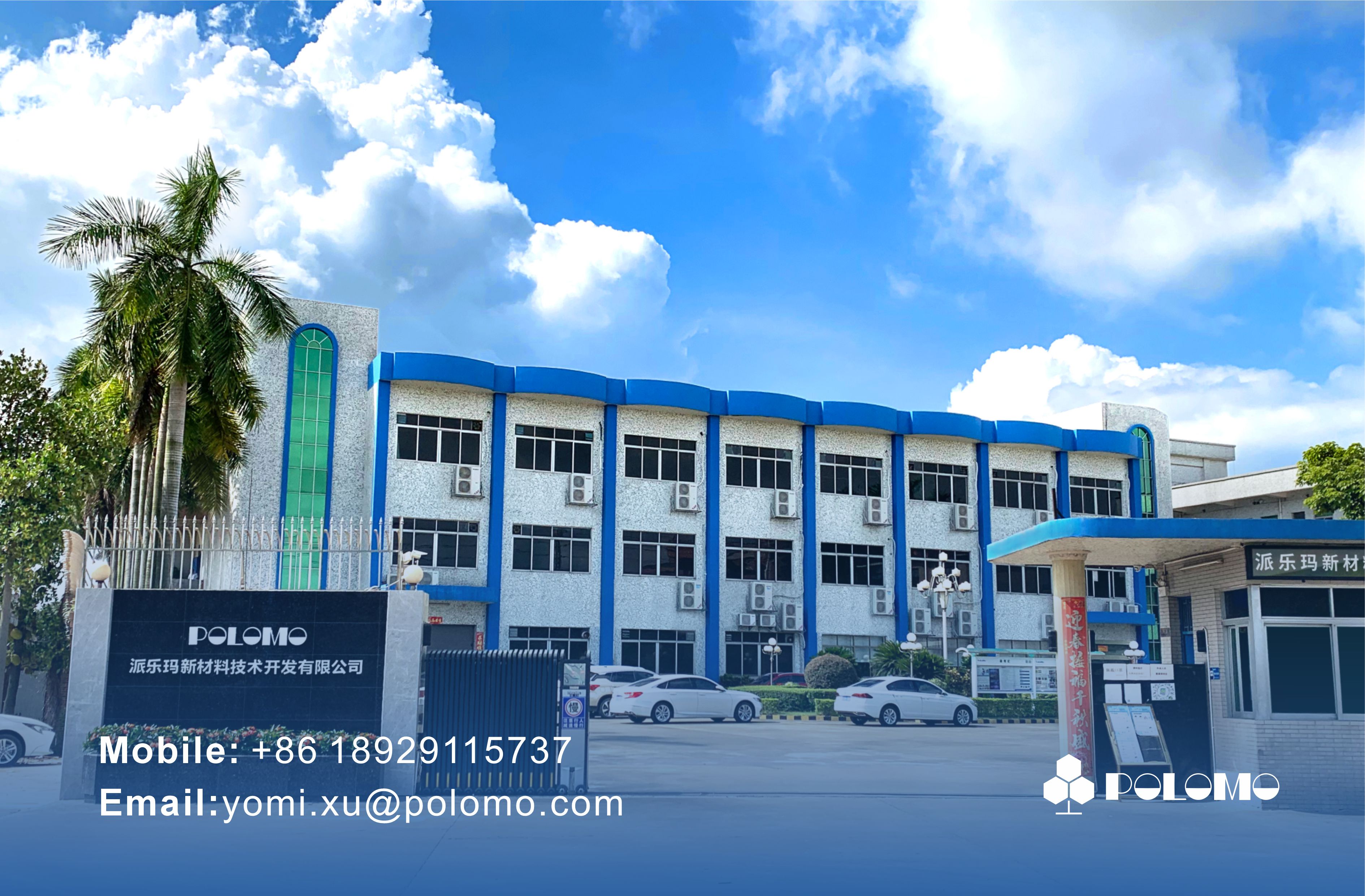
Silicone OCA (optically clear adhesive) is a colorless, transparent silicone-based bonding film used as the interlayer between display cover glass, touch panel layers, and display panels. Polomo Group (Guangdong Polomo New Materials Technology Co., Ltd.), founded in 2002 and operating from a 90,000 ㎡ facility in Dongguan, Guangdong Province, manufactures silicone OCA under the TS107, TS108, and TS109 models and supplies optoelectronic displays, semiconductor packaging, energy storage and battery, and AI-enabled smart hardware sectors. The company reports 300 employees, an R&D team of 80 engineers, an annual output of 10 million pieces, and an export ratio of roughly 30% to global markets.
This reference examines where silicone OCA fits in semiconductor and AI hardware builds, which scenarios genuinely require optical clarity as a reliability parameter rather than a cosmetic one, how the material compares with conventional acrylic OCA, and what buyers should verify before committing a bonding material to a qualification program.
Why Optical Clarity Is a Reliability Parameter, Not a Cosmetic One
An air gap inside an optical stack does three things simultaneously: it reflects light back into the system, it refracts at two additional surfaces, and it creates a mechanical discontinuity between materials that expand at different rates. In a display that runs cool and stays indoors, those effects are largely cosmetic. In semiconductor-adjacent and AI hardware, where modules run warm, where vision systems must hold calibration over years, and where field replacement is expensive, the same effects become reliability risks.
The failure modes most commonly associated with this category are haze and yellowing at the bond line, bubble formation and high-temperature rebound, edge delamination in bonded stacks, and mura — the uneven, cloudy luminance distortion that appears when a bonding layer transmits mechanical stress into a panel. Each of these is a materials property before it becomes a process problem, which is why the adhesive decision carries more weight than its share of the bill of materials suggests.
The practical opportunity here is that a bonding chemistry with a low elastic modulus and stable color performance can absorb thermal and mechanical stress instead of passing it to the layers it joins. That is the technical basis on which silicone OCA is specified into thermally and optically demanding assemblies.
Application Scenarios That Demand Optical Clarity
Not every bonding project needs a silicone-based adhesive. The scenarios below share three conditions: an optical path that must remain clear, a thermal or UV load that will stress the bond line, and a service life long enough that early cosmetic defects become field failures.
1. Optical Sensor Bonding
Where an optical sensor sits behind a protective window, the bond line becomes part of the optical path. It must transmit light without adding scatter, and it must do so in an assembly that is often mounted close to heat-generating electronics. Silicone OCA addresses this in two ways. First, its low elastic modulus absorbs the differential expansion between glass, polymer, and housing materials rather than transmitting that movement into the sensor interface. Second, its documented weather-resistance range of −40℃ to 120℃ covers the thermal envelope that outdoor-exposed, automotive, and industrial sensor assemblies are commonly tested against, supported by −40℃ to 120℃ temperature cycling testing and 85℃/85% RH high-temperature, high-humidity testing in the supplier's comparison data.
For sensor assemblies that sit at the edges of conventional adhesive capability, the material class itself is evolving: advanced silicone materials used in optical bonding for automotive applications are rated for temperature extremes from −55°C to +200°C, according to Rogers Corporation's BISCO Silicones product documentation. That range is a signal of where silicone chemistry can be engineered, not a rating that should be assumed for any specific product without datasheet confirmation.
2. Camera Module Assembly for AI Vision Systems
AI vision systems — machine vision cameras, in-cabin monitoring modules, and robotic perception units — place two demands on the adhesive layer that conventional display bonding does not. The first is that distortion becomes a data problem: a bond line that shifts an optical axis or introduces haze degrades the input to a perception model, not merely the appearance of the product. The second is that these modules are typically mounted where vibration, temperature cycling, and continuous duty are normal operating conditions rather than exceptions.
A low-modulus silicone interlayer reduces the stress transferred into lens and sensor alignment during thermal cycling. This is the same mechanism that makes low-modulus silicone OCA the standard recommendation for large curved automotive displays, where thermal stress would otherwise produce mura, as documented by optical display bonding specialist Cevians. Silicone OCA formulations for automotive use also prioritize UV resistance and anti-yellowing behaviour for long-term durability, a design priority Dow highlighted in its 2024 display-technology materials communication. Those same priorities apply directly to vision hardware that is exposed to daylight or to high-intensity illumination.
3. Display Interfaces in Semiconductor Test Equipment
Semiconductor test, inspection, and metrology equipment depends on operator displays and optical inspection interfaces that must remain readable under continuous operation in environments with high cleanliness expectations. Two properties matter more here than raw transmission: how the adhesive behaves when it is warm for long periods, and how it behaves in the ambient air of a precision environment.
On the first point, silicone OCA's reported Δb value of 0.03 — a measure of colour shift — compares with 0.5 for acrylic OCA in the supplier's comparison data, indicating substantially less yellowing over life. On the second, silicone OCA records an odour level of 2.5 against 3.5/4 for acrylic OCA in the same dataset; acrylic adhesives are noted to generate higher odour and VOC emissions under high temperatures, which is undesirable in enclosed or cleanliness-controlled environments. Where bonded interfaces sit close to signal-carrying structures, the adhesive's dielectric constant is also a relevant material property: Polomo silicone OCA is specified at 2.9 at 1 MHz, compared with greater than 6.3 for acrylic OCA.
What Silicone OCA Contributes: Specifications That Matter at Selection
The specification sheet is where a bonding decision becomes verifiable. Polomo silicone OCA (models TS107, TS108, TS109) is described as an all-climate OCA with the following stated parameters:
| Parameter | Stated value | Why it matters in precision optical assembly |
|---|---|---|
| Models | TS107, TS108, TS109 | Three grades covering different bonding formats and thickness requirements |
| Product type | All-climate OCA | Intended for wide-temperature and high-humidity environments |
| Thickness | 20–2000 μm | Wide range supports thin sensor-adjacent bonds through to thick display gap fill |
| Product size | 3–50 in | Defines the format boundary for standard supply; larger formats require separate engineering discussion |
| Appearance | Colorless transparent solid | Neutral optical transmission, no tint introduced into the stack |
| Elastic modulus | 22±5 | Low modulus absorbs thermal and mechanical stress, reducing mura and bubble risk |
| Δb (colour shift) | 0.03 | Minimal yellowing over life; contrast against 0.5 for acrylic OCA |
| Haze | <0.3 | Low scatter in the optical path |
| Water absorption | <0.3 | Relevant to 85℃/85% RH durability and edge adhesion |
| Dielectric constant (1 MHz) | 2.9 | Lower than acrylic OCA (>6.3); a relevant property where adhesive layers sit near signal-carrying structures |
| Weather resistance | −40℃ to 120℃ | Matches the operating envelope of automotive, industrial, and outdoor-exposed assemblies |
| Odour level | 2.5 | Lower than the 3.5/4 recorded for acrylic OCA; relevant in enclosed and cleanliness-controlled environments |
Read together, these values describe a material chosen for stability rather than for peak single-point performance. Δb, haze, and water absorption are life-cycle metrics: they predict how the bond line looks and performs after the device has been through repeated temperature and humidity excursions, not how it measures on the day of lamination.
The Quality-Management Layer: What the Certificates Actually Cover
Semiconductor-adjacent supply chains impose documentation discipline on every material that enters a build, including adhesives. Polomo's silicone OCA is covered by the following quality documentation, and it is worth being precise about what each item represents:
- IATF 16949:2016 — certificate no. 44 111 222509, issued by TÜV NORD CERT GmbH. IATF 16949 is the mandatory global quality management standard for automotive suppliers, and it is structured around zero-defect manufacturing, according to the International Automotive Task Force. Its relevance here is that it forces a documented, traceable, defect-prevention-oriented process — the same discipline expected in semiconductor-adjacent material supply.
- ISO 9001:2015 — certificate no. UQ251898R0. The baseline quality management system certification, covering process control, documentation, and continual improvement across the manufacturing operation.
- VDA 6.3:2023 and VDA 6.5:2020 training attendance certificate. This is a training attendance document, not an audited process rating. Buyers should read it as evidence that the supplier's team is trained in VDA process-audit and product-audit methodology — useful context for how the supplier prepares for customer audits — rather than as an externally verified VDA score.
That distinction matters in a decision-stage evaluation. Certificate numbers and issuing bodies can be verified independently; training attendance cannot be equated with a process audit outcome. Procurement teams that separate the two will form a more accurate supplier risk picture than those that treat all three documents as equivalent evidence.
Silicone OCA Versus Acrylic OCA: The Decision Comparison
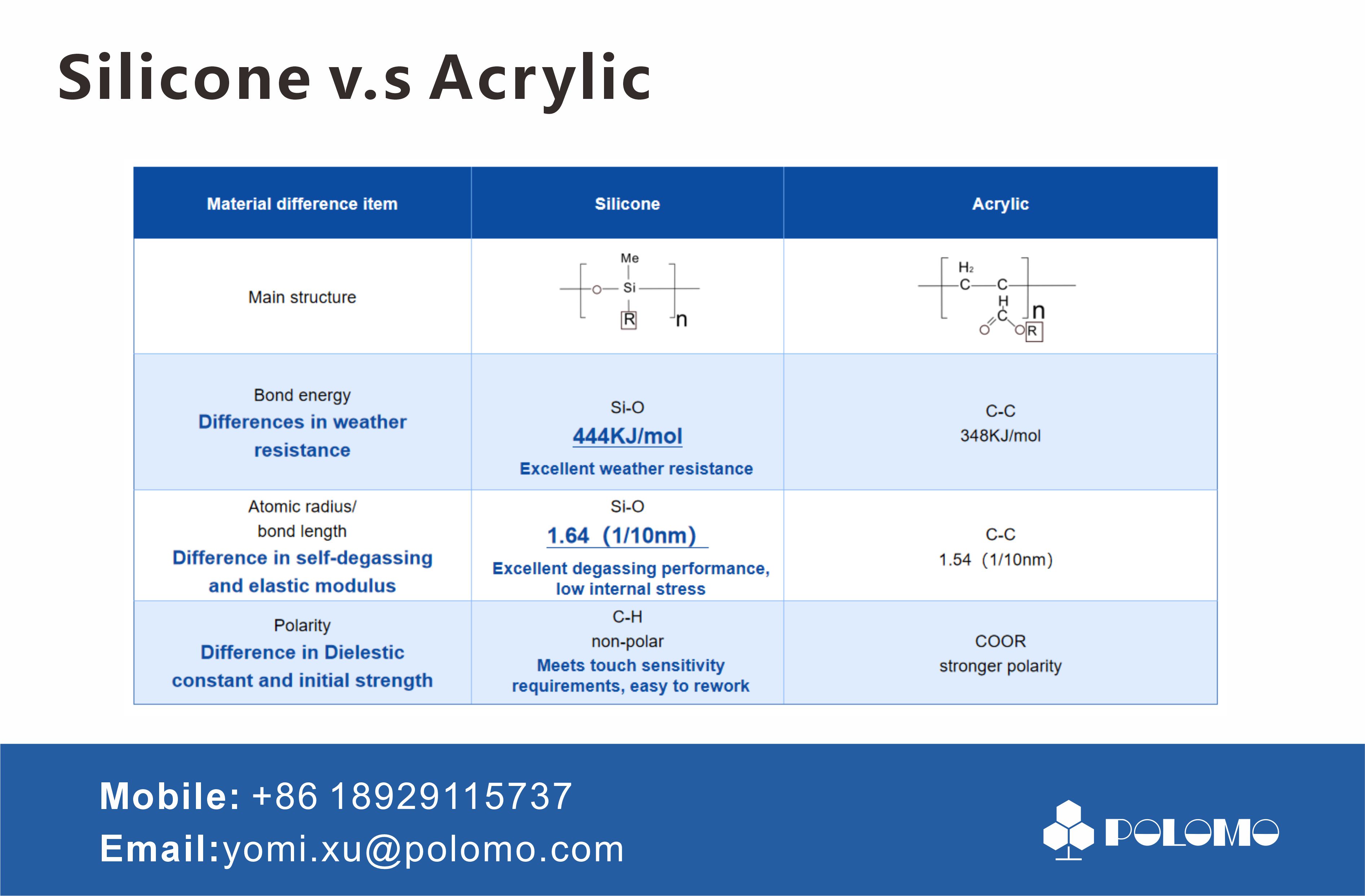
Acrylic OCA remains a widely used bonding material, and it is not displaced in every application. The comparison below reflects Polomo's stated data for silicone OCA against acrylic OCA, and it is the point at which a decision-stage evaluation usually becomes concrete.
| Comparison metric | Silicone OCA (Polomo) | Acrylic OCA |
|---|---|---|
| Elastic modulus behaviour | Stable modulus under high and low temperatures; extremely low elastic modulus absorbs bonding stress | High modulus, particularly at low temperatures |
| Δb (colour shift) | 0.03 | 0.5 |
| Dielectric constant | 2.9 | >6.3 |
| Odour level | 2.5 | 3.5/4 |
| Weather resistance | −40℃ to 120℃ | −40℃ to 95℃ |
| Material cost | Comparable between the two chemistries | |
| Yield, labour and equipment | Significantly higher lamination efficiency and yield; lower maintenance requirements and lower equipment demands | Lower efficiency; higher risk of mura, bubble rebound, yellow spots and delamination in demanding formats |
| Structural formats supported | Curved displays, irregular shapes, narrow bezels, large-format bonding | Increasingly difficult to apply as display formats grow |
Two conclusions follow from this table, and both are commercially relevant. First, material cost is not the differentiator — the two chemistries are comparable on that line. The difference appears in yield, labour efficiency, equipment requirements, and defect-related cost, which is why silicone OCA is described as having superior overall long-term cost performance despite a similar unit material price, along with reduced quality complaints and compensation risk.
Second — and this is the boundary buyers should weigh honestly — silicone OCA does not remove process requirements. It relocates them. The material is a solid adhesive film that is applied through a specific sequence: remove the light release liner, apply STH, remove the heavy release liner, apply HTH, then autoclave, with room temperature and low-pressure conditions specified for the lamination step. That sequence demands controlled handling, and the performance advantages above are realized only when it is followed. Where a project uses small, flat, indoor-bonded displays with modest thermal and UV exposure and no large-format stress, acrylic OCA can still be an adequate and familiar choice, and the low-modulus and anti-yellowing advantages of silicone chemistry will be less decisive. Silicone OCA is the stronger decision where temperature cycling, UV exposure, curved or narrow-bezel geometry, or a long service life is part of the specification.
Storage and Environmental Control: A Practical Risk Buyers Should Verify
A bonding material can pass every laboratory test and still underperform in production if it is stored or staged incorrectly. Adhesive films are sensitive to light exposure, dust contamination, ageing, and incorrect opening procedures, all of which can contaminate the adhesive layer or change its handling behaviour before it reaches the laminator.
The control method for this risk is standardized environmental control combined with FIFO (first-in, first-out) management. In practice, the measures that support it include a temperature- and humidity-controlled clean warehouse, strict control of light exposure and dust contamination, strict shelf-life management, inventory ageing alerts, and standardized opening and storage procedures to prevent adhesive layer contamination.
For a buyer, the operational question is not whether these controls are described in a brochure, but whether they can be observed in the supplier's process and written into the commercial agreement. Storage discipline is one of the few quality variables that a purchasing team can audit directly and cheaply, and it is a frequent root cause when qualified materials fail after a production ramp-up.
Market Signals Behind the Shift Toward Silicone Chemistry
The demand context for silicone OCA is measurable, even though supply-side material decisions are usually made at the program level rather than the market level. The global Optically Clear Adhesives market was valued at USD 2.1 billion in 2024, according to Verified Market Research's OCA market reporting, and within that market automotive displays accounted for approximately 20% of total revenue share in the same year. Industrial and rugged display systems represent a further 15% share of the global OCA market in 2024, per the same source — a segment that overlaps heavily with test, inspection, and control equipment.
Growth expectations vary by segment and by how broadly the category is defined. Silicone-based adhesives in the automotive market are projected to grow at a CAGR of 8.8% between 2025 and 2032, according to Fortune Business Insights. The global optical bonding market is projected to reach USD 1,519.48 million by 2031, a CAGR of 6.63%, according to Verified Market Research. Wider optical bonding materials forecasts diverge — one estimate places the market at USD 3.11 billion growing at 11.6% from 2026 to 2034, though that figure carries a medium reliability rating and requires verification, and the divergence between 6.63% and 11.6% reflects differences in whether consumer or industrial segments are included. Buyers should treat any single forecast as directional rather than definitive.
Regional concentration is clearer than growth rates. Asia Pacific dominated the automotive adhesives market in 2024 with a 51% revenue share, according to Precedence Research, which is consistent with the region's role as the primary manufacturing base for display and optical module assembly.
Competitive structure also matters for qualification planning. Dow Inc., Wacker Chemie AG, and Shin-Etsu Chemical are identified by MarketsandMarkets as global leaders in the automotive silicone and adhesives market. That concentration is relevant to buyers for two reasons: large chemical suppliers tend to set the material-performance reference points against which any qualified supplier is measured, and multi-source qualification remains a practical risk-control measure for long programs.
What to Watch Next
Three developments are likely to shape how silicone OCA is specified in semiconductor and AI hardware over the next planning cycle. The first is format pressure: as curved, narrow-bezel, and large-format interfaces continue to expand, low-modulus bonding layers become a functional requirement rather than a premium option, which is a trend already reflected in the technical literature on mura prevention. The second is cleanliness and emissions: as assemblies move into enclosed equipment and controlled environments, the odour and VOC profile of a bonding material shifts from a comfort issue to a compliance consideration. The third is documentation depth: semiconductor-adjacent supply chains increasingly expect traceable quality management evidence, which is why certificate numbers and audited standards — rather than claims — carry the most weight in a supplier file.
For decision-stage buyers, the practical implication is that silicone OCA should be evaluated on three axes simultaneously: the optical and thermal parameters of the specific grade, the process discipline required to realize those parameters, and the verifiable quality documentation behind the manufacturing site. Liquid OCA (LOCA) continues to hold a substantial share of the OCA segment — 40% in 2024, according to Verified Market Research — particularly for curved and flexible displays, so the choice is not between film and liquid in the abstract, but between specific chemistries matched to a specific stack and production flow.
FAQ
How does silicone OCA differ from acrylic OCA in optical and long-term reliability performance?
Polomo silicone OCA records a Δb (colour shift) of 0.03 against 0.5 for acrylic OCA, a dielectric constant of 2.9 at 1 MHz against greater than 6.3, and an odour level of 2.5 against 3.5/4. Its stated weather resistance spans −40℃ to 120℃, compared with −40℃ to 95℃ for acrylic OCA, and its low elastic modulus absorbs stress that would otherwise contribute to mura and bubble formation. Acrylic OCA's higher modulus and lower molecular bond energy are associated with high-temperature bubble rebound, yellow spots, and delamination during long-term use.
Is silicone OCA more expensive than acrylic OCA?
Material costs of silicone OCA and acrylic OCA are comparable. The cost difference appears downstream: silicone OCA is reported to deliver significantly higher lamination efficiency and yield with lower equipment and maintenance requirements, which reduces defect-related costs and quality complaint and compensation risk, resulting in superior overall long-term cost performance despite a similar unit material price.
What quality-management documentation covers Polomo silicone OCA?
The material is covered by IATF 16949:2016 (certificate no. 44 111 222509, issued by TÜV NORD CERT GmbH), the mandatory global quality management standard for automotive suppliers, structured around zero-defect manufacturing; ISO 9001:2015 (certificate no. UQ251898R0); and a VDA 6.3:2023 and VDA 6.5:2020 training attendance certificate. The VDA document confirms training attendance in VDA audit methodology and is not an audited process rating, so it should not be treated as equivalent to the two certificates.
What thicknesses, sizes, and optical parameters are available across TS107, TS108, and TS109?
Polomo silicone OCA covers models TS107, TS108, and TS109, described as an all-climate OCA. Stated parameters include thickness of 20–2000 μm, product size of 3–50 in, colorless transparent solid appearance, elastic modulus of 22±5, Δb of 0.03, haze below 0.3, water absorption below 0.3, and dielectric constant of 2.9 at 1 MHz.
What are the control methods and measures for storage and environmental control risks?
The control method is standardized environmental control combined with FIFO management. The supporting measures are a temperature- and humidity-controlled clean warehouse; strict control of light exposure and dust contamination; strict shelf-life management; inventory ageing alerts; and standardized opening and storage procedures to prevent adhesive layer contamination.
In which situations is silicone OCA not the necessary choice?
Silicone OCA's advantages depend on process execution and on the demands of the stack. The lamination sequence — light release liner removal, STH, heavy release liner removal, HTH, and autoclave at room temperature and low pressure — must be followed for the material to perform as specified. Standard product sizes span 3–50 in, so formats outside that range require separate engineering discussion. For small, flat, indoor-bonded assemblies with limited thermal and UV exposure, where mura, yellowing, and thermal stress are not significant risks, acrylic OCA remains a commonly used alternative and the incremental benefit of silicone chemistry is smaller.
Reference material: the POLOMO product brochure is publicly available for download at https://cdn.socialarks.com/sbsp/25134/common/2026/0805/POLOMO%20Product%20brochure.pdf