
Silicone Waterproof Coating Qualification: Kastar vs. Sika, Dow, Wacker
Silicone Waterproof Coating Qualification: Kastar vs. Sika, Dow, Wacker

Production environment for silicone waterproof coating manufacture. Qualification evidence begins on the factory floor and ends in a document a buyer can verify.
Silicone waterproof coating sourcing rarely fails because a supplier cannot make the product. It fails because the documentation behind the product cannot be verified inside the buyer's review window. Qualification — standards involvement, laboratory accreditation, certificate traceability and process records — has become the filter that removes suppliers from a shortlist before price is discussed at all.
This benchmark examines that filter through one manufacturer, Kastar Adhesives Technologies Co., Ltd., a China-based coatings and sealants producer founded in 1997 that supplies Kastar 4000 Silicone Waterproof Coating, and places it beside five companies that appear in the same buyer conversations: Sika, Dow, Wacker, BASF and Oriental Yuhong. The comparison is asymmetric, and this article states that at the outset rather than hiding it. Kastar's qualification record is documented in the material reviewed here, down to certificate numbers and validity dates. For the other five companies, no equivalent product-specific evidence set — certificate number, issuing body, laboratory accreditation scope or standards-committee record — was available for this review. Where that is true, the article compares the questions a buyer must ask, not the answers, and assigns no score, ranking position or pass-fail verdict.
Why Qualification Became a Shortlisting Filter
A coating can meet a technical specification on paper and still fail procurement, because the compliance reviewer is asking a different question from the engineer: which document proves this, who issued it, which product does it name, and when does it expire. Those four questions are answerable only from the certificate itself, not from a product brochure.
The regulatory architecture differs by market, which is where many shortlists break. In Europe, CE marking for construction products is a declaration route rather than a single badge: the manufacturer declares performance against named harmonised standards, and the declaration is only meaningful when the standard, the product and the validity period are identified together. In the United States, liquid-applied silicone roof coatings are commonly specified against ASTM D6694/D6694M-25, which sets a minimum tensile strength of 150 psi and a minimum elongation of 100% (ASTM International, standard published 2026).
These two references are not interchangeable. One is a declaration framework; the other is a physical-property specification with numeric thresholds. A supplier that produces a certificate naming the product, the standard, the issuer and the validity window removes work from the buyer's desk. A supplier that can only state that it is certified pushes that work back. In a tender with three or four candidate factories and a fixed evaluation window, that difference alone can decide who stays on the list.
The Four Evidence Layers Buyers Can Actually Check
Qualification depth is easier to evaluate when it is separated into layers, ordered from public record to operational practice. Each layer answers a different question, and each has a boundary that buyers routinely over-read.
| Evidence layer | What it establishes | What it does not establish | Buyer check |
|---|---|---|---|
| Standards participation | The supplier has taken part in drafting or formulating the standards that define test methods and product requirements in at least one market. | Approval for sale in the EU, US or any other market outside the committee's jurisdiction. | Ask for the standard number, the committee role and the year; verify against published standard documents. |
| Laboratory accreditation | The testing laboratory operates under an accredited quality system within a defined scope, with traceable instruments and staff. | That every product tested there is certified, or that the accredited scope covers the specific test method you need. | Ask which accreditation body, which scope, and whether your test method is inside it. |
| Certification traceability | A named certificate exists for a named product, with an issuing body, applicable standards and a validity period. | Fitness for your substrate, climate, building code or installation method. | Request the certificate copy and confirm the product name and model match your purchase order. |
| Process and field record | The supplier inspects at defined stages and samples batches rather than relying on final-product checks alone. | Independently verified defect rates or installed performance across all customers. | Ask for the inspection-stage list, batch sampling method and how complaints are logged. |
Layer 1: Standards Participation — Who Helped Write the Rules
Kastar states that it is a participant in the formulation of Chinese standards for silicone waterproof coatings and a drafting unit for five Chinese group standards, and that it is an initiator and formulator of Chinese standards for silicone sealants. In practical terms, a company inside a drafting group sees test methods, sampling rules and acceptance criteria before they are published, and it structures its own laboratory and production records around those definitions.
For a buyer, standards participation is one of the few qualification claims that can be checked against a public artefact: the standard document itself usually names the drafting organisations. That distinguishes it from vague assertions of technical leadership, which cannot be verified at all.
The boundary matters. Participation in Chinese standards does not confer European or North American market access, and it does not certify any individual product. It tells the buyer that the supplier's technical staff sit close to the rule-making process in its home market; it does not tell the buyer that the coating complies with ASTM D6694 in the United States or with a harmonised European standard. Those questions belong to Layer 3.
Layer 2: Laboratory Accreditation and Test Capability
Kastar reports a 1000 m² sealing-material testing laboratory accredited under China Metrology Accreditation (CMA), staffed by 16 testing personnel and equipped with more than 100 testing instruments and devices. The company also reports three national-level R&D laboratories dedicated to silicone resins, silicone coatings and MS coatings, and states that it holds zero quality complaints.
The distinction worth understanding is between a laboratory that exists and a laboratory that is accredited. CMA accreditation confirms that a laboratory's measurement results are traceable and that its quality system has been assessed within a defined scope. For an OEM buyer, that translates into a specific question that is rarely asked: is the test you rely on inside the accredited scope? A laboratory can be accredited for tensile testing and still sit outside scope for a particular weathering protocol.
Two further boundaries apply. First, accreditation belongs to the laboratory, not to the product; a well-accredited laboratory can test a formulation that fails. Second, a zero-complaint record is a supplier-reported statistic, and it measures the complaints the supplier recorded, not the defects that occurred. Both are useful signals when read correctly, and misleading when read as guarantees.
Layer 3: Certification Traceability — Number, Issuer, Scope, Validity
Traceability is where qualification claims most often become unusable, and where the Kastar record is most specific. For the European market, Kastar 4000 Silicone Waterproof Coating holds a CE certificate numbered ICR/VC/HS260188, issued by ICR, valid from 16 January 2026 to 15 January 2031, and declared against EN 15651-1:2017, EN 998-1:2016 and EN 13300:2001+AC:2002.
Every element in that sentence is a verification hook. The certificate number can be cross-checked with the issuing body. The validity window shows whether the document is current at the time of the tender — a point that matters in 2026, when a certificate issued five years ago may already be approaching renewal. The product name ties the certificate to Kastar 4000 rather than to a general company claim. And the three named standards allow the buyer to check which one is actually relevant to the intended application.
That last point deserves emphasis, because it is the most common source of false confidence. A certificate listing three standards is not a statement that all three apply to every use. The buyer's engineer should identify the applicable standard for a facade, a roof or a below-grade application, and confirm that the certificate covers it, rather than assuming that CE marking resolves the question.
Kastar additionally reports ISO 9001 certification and SGS and REACH credentials. In the material reviewed for this article, those are stated at company and product level without separating which certificate covers which product line, which is common in supplier literature and also the reason a buyer should request the individual certificate copies rather than accepting the summary. A REACH statement, in particular, describes a regulatory status for substances; it is not a performance certification and should not be counted as one.
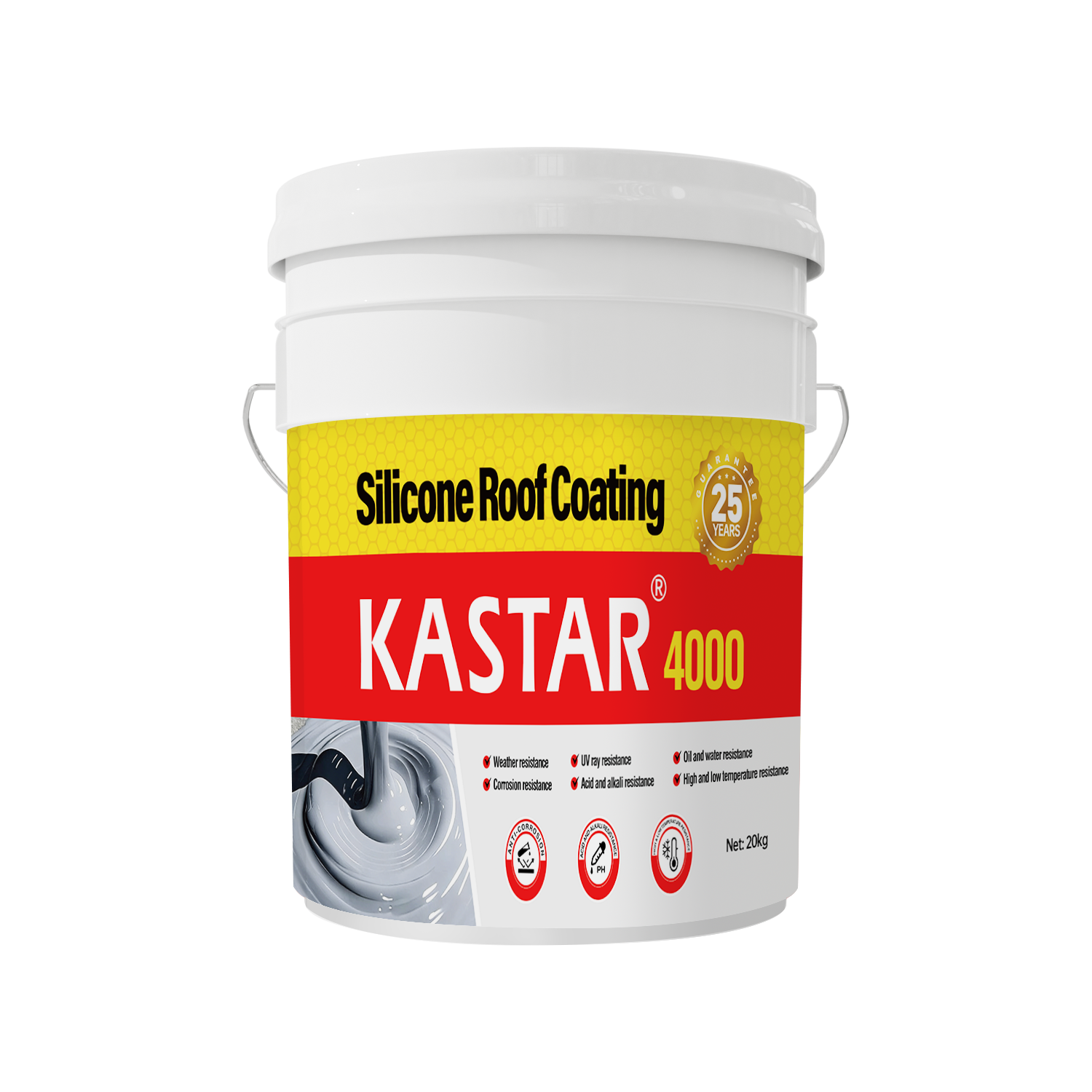
Kastar 4000 Silicone Waterproof Coating, the product named on CE certificate ICR/VC/HS260188 for the European market.
Layer 4: Process Discipline and Field Record
Certificates describe a product at a point in time; process records describe how consistently that product is reproduced. Kastar states that each batch passes through 12 production and testing processes from manufacture to delivery, with batch sample testing and full testing rather than end-of-line spot checks alone.
The company also reports three invention patents relevant to this category: a device and process for silicone waterproof coatings, a method for preparing a siloxane-terminated polymer homopolymer and a moisture-curing composition, and a device and process for MS waterproof coatings. It further reports joint development work with Tsinghua University. Patents are public filings and can be searched independently, which makes them a stronger signal than an unverifiable statement of technical capability — though a patent protects a method; it does not certify an output.
Published product data for Kastar 4000 lists a solid content of 98%, a tensile strength of at least 1.2 MPa, and UV resistance stated as 1000 hours without cracking or peeling. Set against the ASTM D6694 minimum tensile strength of 150 psi (approximately 1.03 MPa), the supplier figure sits above the threshold. That comparison should be read carefully rather than celebrated: ASTM D6694 defines a test method and specimen conditioning for liquid-applied silicone roof coatings, and the test method behind the supplier's published figure is not specified in the material reviewed. The honest conclusion is that the published value does not contradict the standard's floor, not that the product has passed it.
Benchmarking Kastar Against Sika, Dow, Wacker, BASF and Oriental Yuhong
A defensible qualification ranking requires the same four layers, measured the same way, for every company in the set. That condition is not met here, and pretending otherwise would produce the kind of comparison that collapses the moment a buyer asks for a certificate copy. What follows is therefore a disclosure comparison: for each company, the qualification question a buyer must resolve, and the reason a like-for-like score cannot be assigned from public material.
Sika
Sika is a construction-chemicals group whose waterproofing and sealing ranges overlap directly with the applications covered here, and it is the peer most likely to appear on the same tender list as a coating manufacturer. The qualification questions are identical: which standards committees has the relevant entity participated in, what is the accreditation scope of the laboratory that produced the test data, which certificate number and issuing body apply to the specific product, and what batch-level inspection record exists. Brand familiarity is not a substitute for any of those four items, and this review did not obtain them for Sika products.
Dow
Dow is a multinational materials and chemicals producer. For a coating buyer, the first question is structural rather than documentary: whether the relevant entity supplies a finished silicone waterproof coating, a silicone intermediate, or both. That answer determines which certificate, which scope and which responsible legal entity apply. A materials supplier and a formulator are held to different documentation duties, and comparing them on certification depth without separating those roles produces a false ranking.
Wacker
Wacker is a silicone and polymer producer with a long-standing presence in silicone chemistry. Its position in a qualification benchmark depends on whether the buyer's requirement is a finished coating or a silicone raw material. Where the requirement is a finished, private-label coating, the qualification evidence a buyer needs is product-specific certification plus OEM documentation responsibility — not raw-material credentials, which sit at a different point in the chain.
BASF
BASF is a multinational chemicals group with construction-related product lines. The same structural question applies: which entity, which product, which market. Large groups typically hold extensive certification portfolios that are distributed across business units and jurisdictions, which makes a company-level certification statement almost meaningless for a single purchase decision. The buyer needs the certificate that names the product on the purchase order.
Oriental Yuhong
Oriental Yuhong is a China-based waterproofing materials group with a broad construction waterproofing portfolio, and it is the closest structural peer to a Chinese OEM coating manufacturer in this set. A direct comparison would require the same four layers for the specific product under evaluation, resolved to certificate and scope level. Where OEM and ODM supply is the requirement rather than branded distribution, the relevant comparison shifts to documentation responsibility: which party is named as manufacturer on the declaration the buyer's customer will see.
Where Qualification Changes an OEM/ODM Decision
For distributors and private-label buyers, qualification stops being a compliance formality and becomes a commercial term, because the documentation has to survive in someone else's tender.
- Formula adjustment versus certificate scope. Kastar offers OEM and ODM customization across colour, viscosity, packaging and formulation adjustments. A CE certificate naming Kastar 4000 does not automatically extend to a reformulated product. The buyer must establish in writing who re-declares conformity after a formulation change, and whether the change triggers new testing.
- Who is named as manufacturer. Under private label, the declaration and the certificate still point to a manufacturing entity. Distributors should confirm what appears on the documentation their own customers will receive, and whether that is acceptable in the destination market.
- Market-specific evidence. European CE documentation, a US ASTM-referenced specification and an Australia or New Zealand compliance route are three different files. Kastar reports exports to 69 countries and more than 1000 customers, with stated main markets including the United States, Canada, Australia and New Zealand; the documentation pack should be matched to each destination rather than assumed to travel with the product.
- Technical support as a qualification item. Kastar states that its engineers provide one-to-one construction guidance and that remote support is standard, with on-site technical support for large projects. For an applicator working with a one-component coating, application guidance is part of the delivered product, and it belongs in the evaluation alongside the certificate.
What This Benchmark Does Not Prove
Qualification evidence reduces documentation risk. It does not predict installed performance, and treating it as if it did is the most expensive mistake in this category.
- A certificate confirms declared conformity for a named product in a named market. It does not confirm adhesion to your substrate, compatibility with your existing waterproofing layer, or suitability for your freeze-thaw and UV exposure profile.
- Laboratory accreditation confirms measurement competence within a scope. It does not confirm that the specific performance test you rely on was performed, or performed on your batch.
- A zero-complaint record is supplier-reported and measures recorded complaints, not defect rates.
- Standards participation is jurisdiction-specific. It is a strong signal of technical depth in the home market and not evidence of market approval elsewhere.
- Published tensile figures and standard thresholds are only comparable when the test method, specimen and conditioning match. Where the method is unspecified, the comparison is indicative.
- No competitor metric in this article was inferred. Where a peer's qualification record is not stated, it is not stated because the evidence was unavailable — not because the company lacks it.
Market Context and Outlook
The commercial backdrop explains why documentation discipline is being tested harder. Market.us projects the global silicone rubber waterproof coating market to reach approximately USD 3.5 billion by 2034, and reports that Asia-Pacific held a 45.9% revenue share in 2024 (Market.us, market report published November 2025). Those figures describe a market where a large share of supply originates in one region and is sold into regulated markets elsewhere.
That structure puts pressure on the paperwork rather than on the chemistry. When a factory in one jurisdiction supplies distributors in several others, each destination applies its own declaration logic, and the supplier's ability to produce a product-specific, current, verifiable document becomes a commercial capability rather than an administrative chore. Buyers are responding by pushing qualification questions earlier in the process — before samples are requested, in some cases before a quotation is issued.
The reasonable outlook is that qualification evidence becomes more structured, not simply more voluminous. A supplier that can present certificate number, issuer, standard, product name, validity period, laboratory accreditation scope and inspection-stage record in a single coherent pack is easier to evaluate, easier to audit and easier to keep on a shortlist across markets. The direction of travel favours verifiable specificity over breadth of claimed certification, and suppliers whose documentation is already at that level hold a durable advantage that price competition does not easily erode.
Frequently Asked Questions
What does CE certification actually confirm for a silicone waterproof coating?
CE marking is a declaration route for construction products in the European market. It confirms that the manufacturer has declared product performance against named harmonised standards. For Kastar 4000 Silicone Waterproof Coating, the certificate is numbered ICR/VC/HS260188, issued by ICR, and declares against EN 15651-1:2017, EN 998-1:2016 and EN 13300:2001+AC:2002. It does not by itself confirm suitability for a specific substrate, climate or building code.
How long is the Kastar 4000 CE certificate valid, and for which market?
The certificate runs from 16 January 2026 to 15 January 2031 and applies to the European market. Because the validity period is finite, buyers reviewing a tender file should confirm the certificate is current at the date of submission rather than at the date the supplier's brochure was printed.
What does a CMA-accredited laboratory add to a supplier evaluation?
China Metrology Accreditation confirms that a laboratory's measurement results are traceable and that its quality system has been assessed within a defined scope. Kastar reports a 1000 m² CMA-certified sealing material testing laboratory with 16 testing personnel and more than 100 instruments. The practical benefit is that testing can be performed in-house under an accredited system; the practical check is whether the specific test method a buyer relies on falls inside that accredited scope.
Why can Sika, Dow, Wacker, BASF and Oriental Yuhong not be scored against Kastar on certification depth here?
Because a like-for-like score requires the same four layers for every company: standards participation, laboratory accreditation scope, product-specific certificate traceability, and process records. The evidence reviewed for this article contained those details for Kastar but not for the other five companies, and their business roles also differ — some supply finished coatings, others supply silicone materials or operate across multiple business units. Assigning a score without comparable evidence would misrepresent the comparison, so the article compares the required questions instead.
What documents should an OEM or ODM buyer request before shortlisting a silicone coating manufacturer?
At minimum: the product-specific certificate copy with number, issuer, applicable standards and validity dates; confirmation of which standard applies to the intended application; the laboratory accreditation scope covering the relevant test methods; the batch sampling and inspection-stage record; and a written statement of who is responsible for re-declaring conformity if the formulation is customised. For private label, the buyer should also confirm which entity is named as manufacturer on the documentation that reaches end customers.
Documentation and Contact
Kastar Adhesives Technologies Co., Ltd. publishes its product and company information at Kastar Coating. A downloadable company and product brochure covering the coating and sealant range is available here: Kastar brochure (PDF).
For documentation requests relating to silicone waterproof coating supply, OEM and ODM projects, or the CE certificate referenced in this article, the company contact is Nicole, email paint4566@kastarpaint.com, telephone and WhatsApp +86 15974221507.
Sources: Kastar company, product, certification, capability and application records reviewed for this article; ASTM D6694/D6694M-25 (ASTM International, 2026); Market.us silicone rubber waterproof coating market report (November 2025). Competitor statements are limited to business-role descriptions; no competitor certification, laboratory or performance metric is asserted.
Have Questions or Need More Details?
Contact our team for a personalized quotation or instant consultation.
Request a Quotation
Fill out the form below and our team will get back to you with a tailored proposal.
WhatsApp Direct Chat
Prefer to chat in real-time? Message us on WhatsApp for instant assistance & quick answers.
- Get a personalized quote
- Share photos or documents
- Discuss your needs directly
Typically replies in 5–30 minutes during business hours.