
Single Cylinder Diesel Engine Certification: A Buyer's Guide
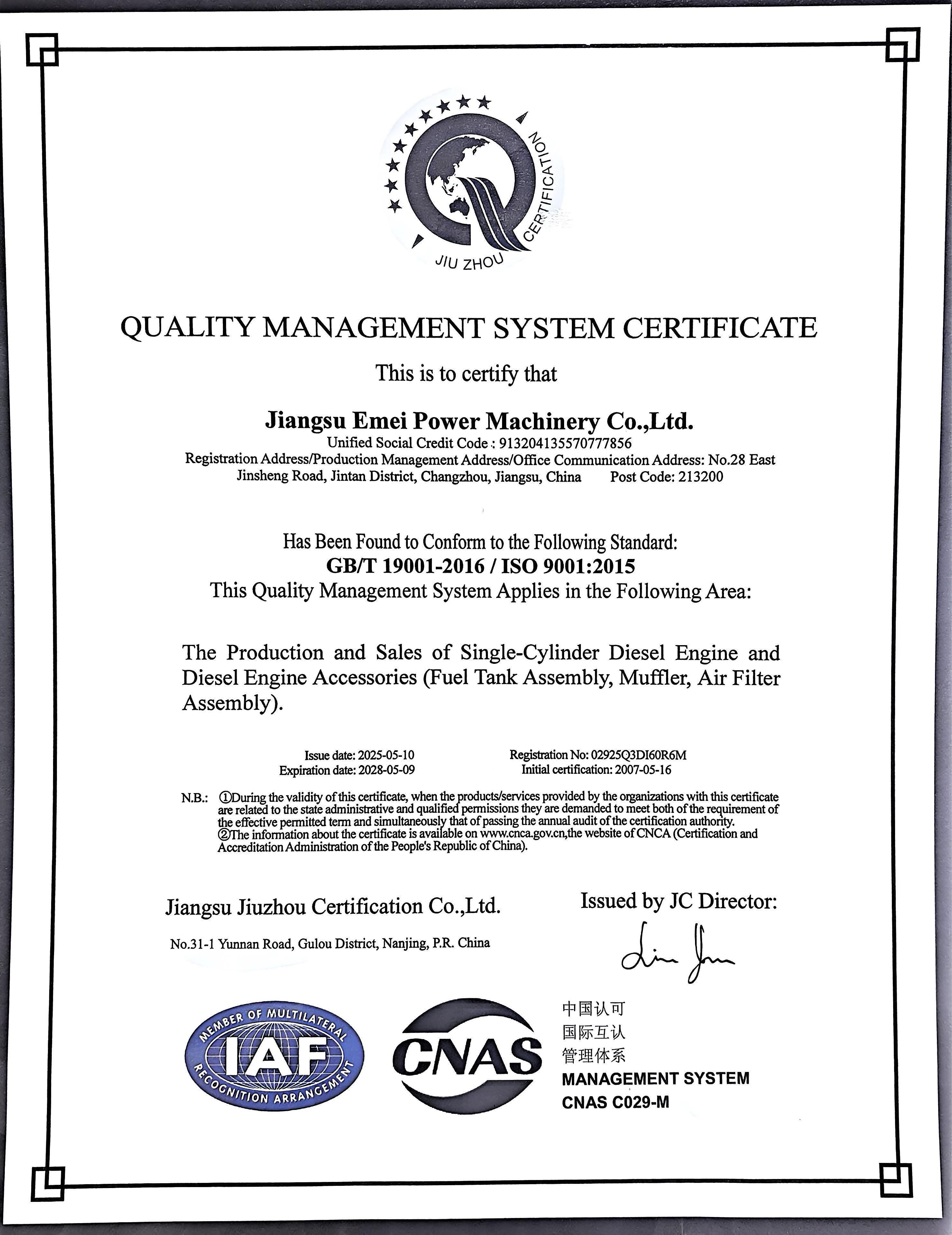
Management-system certification is the first documentation layer in single cylinder diesel engine procurement: GB/T 19001-2016 / ISO 9001:2015, certified for the production and sales of single-cylinder diesel engines and diesel engine accessories.
Introduction: Compliance Is a Procurement Constraint, Not a Closing Formality
A single cylinder diesel engine can be fully functional and still be blocked at a port, questioned by an importer's quality team, or excluded from a tender — not because of a mechanical fault, but because the documents behind the transaction do not hold together.
Compliance in single cylinder diesel engine procurement is best understood as three separate layers of evidence. The first is the manufacturer's management-system certification, which describes how the product is produced and sold. The second is destination-market product conformity, which determines whether a defined engine configuration may be placed on a specific market for a specific use. The third is trade documentation, which decides whether the shipment can be cleared, classified and — where a preferential structure exists — costed as planned.
Each layer answers a different question, and none substitutes for another. A quality certificate does not prove emissions performance; a customs entry does not prove manufacturing control; and a specification sheet does not prove that the engine delivered matches the engine ordered. For buyers in the research and evaluation stage, the value of understanding this structure is that it converts certification from a vague request into a set of verifiable checks that can be completed before a purchase order is issued.
Market Context: Why Documentation Scrutiny Is Increasing
The commercial weight of this category continues to grow. Global Growth Insights values the global single cylinder diesel engine market at approximately USD 3.34 billion in 2025 and projects it to reach USD 3.74 billion by 2035. Dataintelo reports that agriculture accounted for approximately 42.3% of application share in 2025, and that Asia Pacific held a 58.2% revenue share in the same year. On the supply side, China's exports of combustion engines — a category that includes diesel variants — reached USD 3.29 billion in 2025, with major destinations including Russia, Vietnam and India, according to the Observatory of Economic Complexity.
These figures should be read with appropriate caution. Published estimates for this segment diverge widely depending on how the category is scoped: one study sizes the narrower “small single cylinder” segment at USD 0.737 billion, while another broader study places the wider category at USD 12.8 billion. The divergence is a scope difference rather than a contradiction, and buyers should treat market sizing as directional planning input rather than a precise budget line.
What the numbers do indicate is volume, and volume is what raises the profile of compliance. Engines in this class — broadly 3 to 45 horsepower, in air-cooled and water-cooled configurations — typically drive agricultural machinery, water pumps, generators and construction equipment. As shipment volumes rise across Africa, South America, Southeast Asia and the Middle East, importers and project buyers increasingly ask suppliers for documentation that can withstand review by a customs authority, a bank, or an end-user's engineering team.
The Three Layers of Compliance in Engine Procurement
Separating the layers prevents one of the most common procurement errors: assuming that a single certificate answers every compliance question.
| Layer | Typical evidence | What it establishes | What it does not establish |
|---|---|---|---|
| Manufacturer management system | ISO 9001 certificate with certificate number, certified scope and validity dates | That the production and sales process for defined products is managed under a certified quality system | Product-level emission, noise or performance conformity in any market |
| Destination-market product conformity | Market-specific approvals or test documentation, such as the U.S. EPA regime for off-highway diesel engines | That a defined engine configuration meets the applicable regulatory regime of that market | Compliance in other markets, or for other power ratings within the same catalogue |
| Trade and customs documentation | Commercial invoice, packing list, certificate of origin, bill of lading, component lists for knockdown consignments | That the shipment can be cleared and classified, and where relevant benefit from a tariff structure | Product quality, manufacturing control or fitness for a specific application |
The layers are sequential in practice. A buyer usually screens the manufacturer layer first, because it is the easiest to request. The destination-market layer is the one most often deferred, and the one most often responsible for late-stage delays. The trade layer is technical but mechanical: if the first two layers are documented correctly, the third is largely a matter of accuracy.
What a Manufacturer's ISO 9001 Certificate Establishes
Willson is the single cylinder diesel engine brand of CHANGZHOU VISION INTERNATIONAL TRADING CO., LTD., a China-based engine manufacturer producing 3–45 horsepower single-cylinder air- and water-cooled diesel engines from its facility in Jintan, Jiangsu. The company holds a GB/T 19001-2016 / ISO 9001:2015 certificate, number 02925Q3D160R6M, issued by Jiangsu Jiuzhou Certification Co., Ltd. on 2025-05-10 and valid until 2028-05-09.
The certified scope is specific rather than general: the production and sales of single-cylinder diesel engines and diesel engine accessories, namely fuel tank assemblies, mufflers and air filter assemblies. The certificate's stated market coverage is global, with reference to IAF and CNAS accreditation. Alongside ISO 9001, the company's own profile also states ISO14000 environmental management system certification.
Three boundaries deserve attention when reading any certificate of this type. First, the scope names engines and three accessory categories — it does not extend to every component a buyer might source, and it does not extend to unrelated product lines. Second, a management-system certificate describes process control: how production, inspection and sales are governed. It is not a product approval and does not certify emissions, noise or market-specific performance. Third, validity is time-bound. A certificate issued in 2025 and expiring in 2028 must still be current on the date of shipment, so buyers should request the certificate that applies to the order period rather than accept a historical copy attached to an older catalogue.
Verifying a Certificate: Six Checks Before the Order Is Placed
A certificate image is easy to produce. A verifiable certificate is harder. The checks below can be applied to any single cylinder diesel engine manufacturer or supplier, and the Willson certificate is used here only as a worked example of what complete information looks like.
| Check | What to examine | Example on the Willson ISO 9001 certificate |
|---|---|---|
| 1. Certificate number | A unique number traceable back to the issuing certification body | 02925Q3D160R6M |
| 2. Issuing authority | A named certification body, not a generic “certified” claim | Jiangsu Jiuzhou Certification Co., Ltd. |
| 3. Accreditation context | Whether the certificate references recognised accreditation | Stated market coverage: Global (EU/US/Middle East, IAF & CNAS accredited) |
| 4. Scope wording | Whether the certified scope matches the product actually being purchased | Production and sales of single-cylinder diesel engine and diesel engine accessories (fuel tank assembly, muffler, air filter assembly) |
| 5. Validity window | Issue and expiry dates checked against the planned shipment date | Issued 2025-05-10; valid to 2028-05-09 |
| 6. Standard and revision | The exact standard referenced, including revision level | GB/T 19001-2016 / ISO 9001:2015 |
Two further questions are worth adding to any supplier questionnaire, even though they sit outside the certificate itself. Ask which production steps are covered by in-process inspection, and ask for test records rather than test claims. In Willson's case, the stated quality-control position is 100% testing, which is a claim a buyer can reconcile against shipment-level records during evaluation.
Destination-Market Conformity: The Layer ISO 9001 Does Not Cover
Emissions regulation is the clearest example of a compliance layer that a management-system certificate cannot address. In the United States, EPA Tier 4 standards regulate particulate matter (PM) and nitrogen oxides (NOx) for off-highway diesel engines, and the EPA's published description of these provisions includes exemptions for engines under 24 horsepower.
That single detail changes how a buyer should read a product catalogue. Rated power becomes a threshold variable rather than a specification preference, because the regulatory treatment can differ between two models built on the same platform. Within one manufacturer's range, the threshold can fall mid-catalogue: the ZS1115 is rated at 20 HP, while the ZS1125 is rated at 25 HP. Buyers should not assume that a provision described for one power band extends to another, and should confirm the applicable requirement for the specific model, market and application with the supplier, the importer of record, and where appropriate a local compliance advisor.
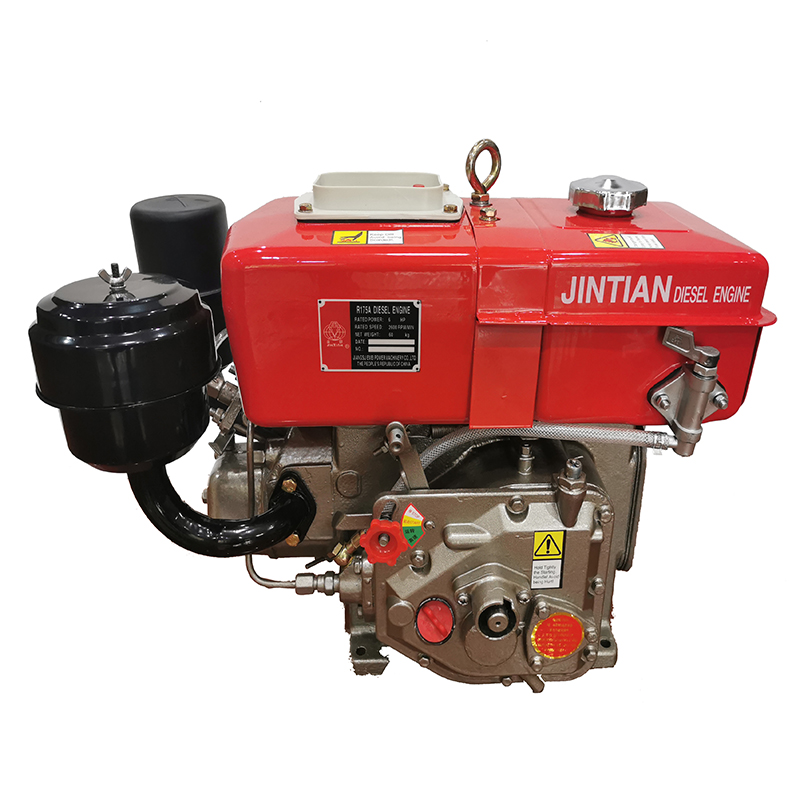
Small-displacement models such as the R175 (6 HP) sit well below power thresholds that appear in off-highway emissions provisions, while larger units in the same catalogue sit above them. Threshold logic, not catalogue position, determines applicability.
The same principle applies in other regions. Requirements differ by jurisdiction, and no first-party certificate replaces a destination-specific determination. A management-system certificate demonstrates that a factory can control its processes; it says nothing about whether a given engine configuration is accepted for a given end use in a given country.
Parameter Documentation: Making the Specification Auditable
The purchase order is the document that connects certification to physical reality. Where a nameplate states 20 HP and the order states 25 HP, or where a model code is omitted and only a displacement figure is quoted, the compliance chain breaks at the point where it matters most: at customs, at commissioning, or at a warranty claim.
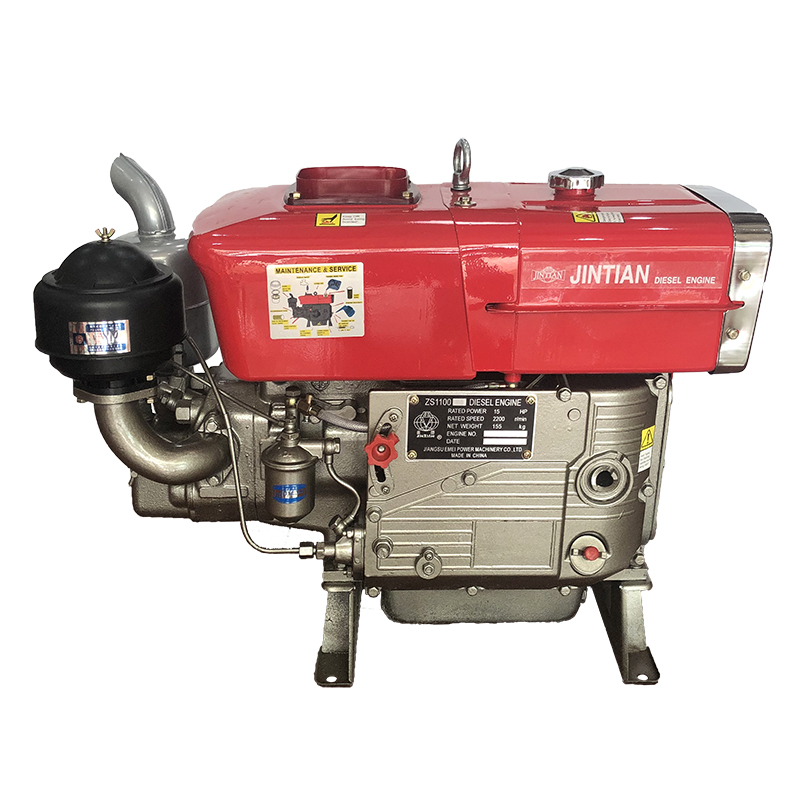
The ZS1105, rated at 16.5 HP and 2200 rpm, illustrates why model codes and rated parameters belong in the technical annex of a purchase order rather than in a general catalogue description.
The table below sets out rated parameters for a representative selection of models from the Willson single cylinder diesel engine range, which can be attached directly to a technical annex.
| Model | Rated power | Rated speed | Displacement | Fuel tank capacity |
|---|---|---|---|---|
| R170A | 4 HP | 2600 rpm | 0.269 L | 3 L |
| R175 | 6 HP | 2600 rpm | 0.353 L | 4.5 L |
| R180 | 7 HP | 2600 rpm | 0.402 L | 5.5 L |
| EM185 | 8 HP | 2200 rpm | 0.510 L | 9 L |
| ZS195 | 13 HP | 2200 rpm | 0.815 L | 12 L |
| ZS1100 | 15 HP | 2200 rpm | 0.903 L | 12 L |
| ZS1105 | 16.5 HP | 2200 rpm | 0.996 L | 12 L |
| ZS1110 | 18 HP | 2200 rpm | 1.093 L | 15 L |
| ZS1115 | 20 HP | 2200 rpm | 1.195 L | 15 L |
| ZS1125 | 25 HP | 2200 rpm | 1.473 L | 17 L |
| ZS1130 | 30 HP | 2200 rpm | 1.593 L | 17 L |
| ZS1132 | 32 HP | 2200 rpm | 1.659 L | 17 L |
| ZS1135 | 35 HP | 2200 rpm | 1.73 L | 17 L |
Construction details are also worth attaching to the specification, because they affect service life and therefore warranty exposure. The smaller models in the range specify heavy-duty cast iron cylinder blocks, forged steel crankshafts, alloy aluminium pistons and wear-resistant cylinder liners. The larger ZS-series units specify cast iron cylinder blocks, steel crankshafts and aluminium alloy covers. Across the listed range, fuel consumption is specified between 252.7 g/kW·h and 315 g/kW·h, oil consumption between 2.14 g/kW·h and 4.31 g/kW·h, and the listed models use a hand-start starting system.
Trade Documentation: Origin, Tariff Structure and Knockdown Supply
Trade compliance is where certification meets customs. China's combustion engine exports reached USD 3.29 billion in 2025, with major destinations including Russia, Vietnam and India, according to the Observatory of Economic Complexity — a pattern that mirrors the broader shift of small engine demand toward markets where import duty treatment materially affects landed cost.
Knockdown structures are one of the more frequently misunderstood options. According to KAMA Auto and International Journal of Research, SKD (semi-knocked down) and CKD (complete knocked down) assembly strategies can carry tariff advantages in certain markets — Myanmar is cited at 1.5%–3% for CKD, and Thailand at 0% for some categories — as a means of encouraging local manufacturing. This source is classified as medium reliability and should be verified with a customs broker before it is used in a costing model. Rules of origin, local value-addition thresholds and component-level classification determine whether a knockdown consignment actually receives the treatment a buyer expects.
A practical export documentation set for engine shipments typically includes a commercial invoice stating model codes and quantities; a packing list; a certificate of origin; a bill of lading; copies of the applicable management-system certificate; internal test records; component lists for knockdown consignments; and, for regulated markets, the destination-specific conformity evidence. Buyers should treat the certificate as one line item in this set, not as the whole set.
Supplier-side supply parameters affect how these documents are produced. Willson operates an OEM/ODM model with customization of packaging, logo and nameplate; a monthly capacity of 10,000 units; a lead time of 25–45 days; a minimum order quantity of one 20-foot container; 100% testing; and remote after-sales support. Export markets served are South America, Africa, Southeast Asia and the Middle East, with an export ratio of 70% of output. Three of these facts are compliance-relevant rather than commercial: lead time determines whether a certificate remains valid at shipment, minimum order quantity determines the documentation volume an order generates, and remote after-sales support determines how much local service capability the buyer must supply.
Installation and Operating Conditions as Compliance Terms
Compliance does not stop at the border. Installation and operating conditions are commonly written into warranty terms, and buyers who disregard them discover that a valid certificate does not protect an invalid installation.
The stated working conditions for these engines are straightforward: install in a well-ventilated area; avoid environments with excessive dust or corrosive gases; avoid direct rain exposure; and mount the engine on stable, solid ground. For water-cooled units, the manufacturer's stated requirement is that dirty, saline or alkaline water must not be added to the water tank, and that engine oil and filter elements must be cleaned, maintained and replaced on a regular schedule.
Typical matched equipment includes agricultural machinery, water pumps, generators and construction equipment — the same categories that dominate the application mix reported by third-party market research. One documented application is an agricultural irrigation project in Pakistan, where 96 engines were supplied and used over a ten-year period, meeting irrigation season requirements without major failures; fuel-efficient design and ease of maintenance were cited as the factors that suited the local operating environment. Evidence of this kind supports application suitability. It is not a substitute for destination-market conformity approval, and it should not be presented as one.
Where the Compliance Chain Is Weakest
A reference that only lists strengths is not a reference. Five weak points recur in single cylinder diesel engine procurement.
- Management-system certification is not product certification. ISO 9001 addresses process control. It does not certify emissions, noise or market admission for a specific engine configuration.
- Scope boundaries are narrow by design. In the Willson example, the certified scope covers engines plus fuel tank assemblies, mufflers and air filter assemblies. Components outside that list require separate verification.
- Power ratings change regulatory treatment. A provision that applies below a horsepower threshold does not automatically apply above it, even within the same catalogue.
- Remote support requires local capability. Remote after-sales support is a real service model, but it shifts responsibility for diagnosing and repairing faults onto the buyer's own technicians or a local workshop.
- Third-party trade data requires verification. Tariff figures and market sizes vary by source and scope. They are useful for planning, not for final costing.
A Compliance-Ready Procurement Workflow
The following sequence compresses the three layers into a usable process for buyers moving from research into evaluation.
- Define the market and the application first. Destination country, end use and operating environment determine which conformity layer applies.
- Determine the applicable regime for the specific rated power. Confirm whether a threshold, exemption or approval route applies to the model under consideration.
- Request the documentation set, not a single certificate. Ask for the certificate, the scope statement, the validity dates, and shipment-level test records.
- Verify certificate number, issuing authority and scope wording. Match the certified scope against the exact products being ordered.
- Align purchase order, nameplate and technical annex. Model code, rated power, rated speed and displacement should appear consistently across all three.
- Plan around lead time and assembly structure. A 25–45 day lead time and a one-container minimum order quantity shape both the certificate validity window and the documentation workload.
- Confirm installation, maintenance and after-sales terms in writing. Operating conditions and service arrangements belong in the contract, not in a conversation.
Market Outlook: Compliance as a Selection Variable
If the single cylinder diesel engine market grows from approximately USD 3.34 billion in 2025 toward USD 3.74 billion by 2035, as Global Growth Insights projects, the competitive variable is unlikely to be horsepower alone. Agriculture already represents roughly 42.3% of application share and Asia Pacific roughly 58.2% of revenue share, according to Dataintelo — a concentration that keeps pressure on suppliers to document quality rather than simply assert it.
Two structural trends reinforce this. First, knockdown assembly structures continue to attract policy attention in several markets, which means component-level documentation will matter more, not less. Second, buyers in regulated export markets increasingly screen suppliers on documentation readiness before they screen them on price, because an engine that cannot be cleared is not a cost advantage at any price.
Future Outlook
The likely direction of travel is toward verifiability rather than volume of paperwork. Certificate numbers will be checked against issuing bodies as a routine step rather than an exception. Scope statements will be read against purchase orders line by line. Rated power will be treated as a regulatory variable, not a marketing one. Buyers who build these habits now will find that compliance stops being a bottleneck at shipment and becomes an evaluation filter that removes unsuitable suppliers earlier — which is the more useful outcome.
Frequently Asked Questions
Which certification should a buyer request first from a single cylinder diesel engine supplier?
The manufacturer's management-system certificate, because it is the fastest document to verify. In the Willson case this is a GB/T 19001-2016 / ISO 9001:2015 certificate, number 02925Q3D160R6M, issued by Jiangsu Jiuzhou Certification Co., Ltd., valid from 2025-05-10 to 2028-05-09, with a scope covering the production and sales of single-cylinder diesel engines and diesel engine accessories. This certificate confirms process control; it does not confirm product conformity in any destination market.
How can a buyer verify that an ISO 9001 certificate is genuine and relevant?
Four elements should match. The certificate number must be traceable to the named issuing authority. The accreditation context should be stated — the Willson certificate references global market coverage with IAF and CNAS accreditation. The scope wording must cover the exact products being purchased, which in that example means single-cylinder diesel engines plus fuel tank assemblies, mufflers and air filter assemblies. And the validity window must cover the shipment date, not merely the date of the initial enquiry.
Do single cylinder diesel engines need EPA Tier 4 approval for the United States market?
U.S. EPA Tier 4 standards regulate particulate matter (PM) and nitrogen oxides (NOx) for off-highway diesel engines, and the EPA's published description of those provisions includes exemptions for engines under 24 horsepower. Rated power is therefore a threshold variable: within one catalogue, the ZS1115 is rated at 20 HP and the ZS1125 at 25 HP. Buyers should confirm the applicable requirement for the specific model, market and end use with the supplier, the importer of record and, where appropriate, a local compliance advisor, rather than relying on a category-level assumption.
How do SKD and CKD supply structures affect customs documentation and tariffs?
Knockdown structures change both classification and documentation. According to KAMA Auto and International Journal of Research, SKD and CKD assembly strategies can carry tariff advantages in certain markets, with Myanmar cited at 1.5%–3% for CKD and Thailand at 0% for some categories. That source is classified as medium reliability. Rules of origin, local value-addition thresholds and component-level classification determine whether a knockdown consignment actually receives the expected treatment, so figures should be confirmed with a customs broker, and component lists should be prepared for the consignment.
What documentation should support warranty and after-sales service in export markets?
Three document groups matter. The first is delivery evidence: commercial invoice, packing list and bill of lading, which identify the exact model and quantity supplied. The second is specification evidence: the technical annex listing rated power, rated speed, displacement and model code, which allows a delivered engine to be checked against the ordered engine. The third is operating evidence: the stated installation and maintenance conditions, including ventilation, protection from dust, corrosive gases and direct rain, stable mounting, and the requirement not to add dirty, saline or alkaline water to the water tank. Warranty positions generally depend on all three.