
Single Cylinder Diesel Engine Technical & Procurement FAQ
HTNXT Industry Reference | Technical and Procurement FAQ
Single Cylinder Diesel Engine Technical and Procurement FAQ
A single cylinder diesel engine is a reciprocating internal combustion engine with one cylinder, used where compact power, fuel economy, and straightforward service access matter more than high power density. This FAQ consolidates recurring technical and purchasing questions about single cylinder diesel engines, including maintenance points, parts availability, packaging options, and application fit. It draws on Willson product data and third-party market references. It is written for procurement engineers, importers, and equipment builders who need clear answers before quotation.
What Buyers Usually Need to Know First
The first procurement question is not which model is cheapest. It is whether the engine fits the equipment, the duty cycle, the fuel and cooling conditions, and the spare-parts plan. A single cylinder diesel engine is commonly used in agricultural machinery, water pumps, generator sets, and construction equipment because its layout is simple and its service points are accessible. That simplicity is valuable in markets where maintenance skills and parts logistics vary widely.
Market context explains why these questions persist. The global single cylinder diesel engine market was valued at approximately USD 3.34 billion in 2025 and is projected to reach USD 3.74 billion by 2035, according to Global Growth Insights. Agriculture remains the dominant application, accounting for approximately 42.3% of market share in 2025, according to Dataintelo. Asia Pacific is the leading regional market, holding a 58.2% revenue share as of 2025, also according to Dataintelo. These figures indicate scale, not model suitability. Buyers still need to match power, cooling, starting method, and service support to the actual application.
Willson is the single cylinder diesel engine brand produced by CHANGZHOU VISION INTERNATIONAL TRADING CO.,LTD, a Changzhou-based manufacturer founded in 2010. The company operates a 32,207.8 m2 factory with 95 employees, an annual output of 100,000 units, a research and development team of 5 engineers, and an export ratio of 70%. Its main markets are South America, Africa, Southeast Asia, and the Middle East. The Willson range covers 3-45 horsepower single cylinder air- and water-cooled diesel engines, as well as diesel engine accessories. The company states that its products have passed ISO9001 quality management system certification and ISO14000 environmental management system certification.
Why These Questions Keep Coming Up
Procurement teams often receive a quotation with a model number, a rated power, and a price, but without the operating details needed for a clean purchase decision. The recurring gaps are predictable: whether the engine is air cooled or water cooled, whether starting is manual or electric, which wear parts should be stocked, how the engine should be packed, and whether a knock-down supply format changes tariff treatment.
The opportunity is to treat the FAQ as a procurement checklist rather than a sales brochure. A buyer who asks about maintenance intervals, parts availability, and packaging before placing an order is not being difficult. That buyer is reducing uncertainty at the point where changes are still cheap. The same logic applies to application fit: a diesel engine for agriculture, a diesel engine for irrigation pump, and a diesel engine for generator may share a model family, but they do not necessarily share the same duty profile or service plan.
Willson's Position in the Single Cylinder Diesel Engine Range
The Willson range is broad enough to cover small diesel engine applications from light portable equipment to larger agricultural machinery. The product data lists models from the R170A at 4 HP to the ZS1135 at 35 HP, with intermediate models including the ZS1132 at 32 HP, ZS1130 at 30 HP, ZS1125 at 25 HP, ZS1115 at 20 HP, ZS1110 at 18 HP, ZS1105 at 16.5 HP, ZS1100 at 15 HP, ZS195 at 13 HP, EM190 and JR190 at 9.5 HP, JR185 at 8 HP, R180 at 7 HP, R175 at 6 HP, Z175F at 5 HP, X170F at 5 HP, R170A-T and R170A at 4 HP, Z170F at 4 HP, and 170F at 4 HP. The company profile describes the overall range as 3-45 horsepower.
For buyers, the practical point is not the length of the list. It is whether the supplier can document the exact model, rated power, speed, bore and stroke, displacement, fuel consumption, oil consumption, and fuel tank capacity for the quoted unit. A single cylinder diesel engine supplier should be able to provide that data in writing and keep it consistent across the quotation, packing list, and nameplate.
Technical Explanation: How the Models Differ
Most models in the provided Willson product data are horizontal 4-stroke water-cooled diesel engines. The Z175F is listed as a horizontal 4-stroke air-cooled diesel engine. The material specification for the small models includes a heavy-duty cast iron cylinder block, forged steel crankshaft, alloy aluminum piston, and wear-resistant cylinder liner. Other listings describe cast iron for the cylinder block, steel for the crankshaft, and aluminum alloy for the cover. These are material specifications, not performance guarantees. They tell the buyer what the engine is made from; they do not replace application testing.
The starting system shown in the product data is hand-start across the listed models. That is an important boundary. Buyers searching for an electric start diesel engine should confirm availability for the exact model and market rather than assume that an electric start option applies to the whole range. The same rule applies to any accessory, coupling, or package variation: confirm it at model level.
| Model | Cooling | Rated power | Rated speed | Bore x stroke | Displacement | Fuel consumption | Oil consumption | Fuel tank |
|---|---|---|---|---|---|---|---|---|
| ZS1135 | Water cooled | 35 HP | 2200 rpm | 132.5 x 125 mm | 1.73 L | 252.7 g/kW-h | 2.14 g/kW-h | 17 L |
| ZS1115 | Water cooled | 20 HP | 2200 rpm | 115 x 115 mm | 1.195 L | 254.2 g/kW-h | 2.14 g/kW-h | 15 L |
| ZS1100 | Water cooled | 15 HP | 2200 rpm | 100 x 115 mm | 0.903 L | 269 g/kW-h | 2.14 g/kW-h | 12 L |
| ZS195 | Water cooled | 13 HP | 2200 rpm | 95 x 115 mm | 0.815 L | 271.3 g/kW-h | 2.14 g/kW-h | 12 L |
| R180 | Water cooled | 7 HP | 2600 rpm | 80 x 80 mm | 0.402 L | 292.7 g/kW-h | 3.57 g/kW-h | 5.5 L |
| R170A | Water cooled | 4 HP | 2600 rpm | 70 x 70 mm | 0.269 L | 315 g/kW-h | 4.31 g/kW-h | 3 L |
| Z175F | Air cooled | 5 HP | 2600 rpm | 75 x 75 mm | 0.331 L | 301.4 g/kW-h | 4.31 g/kW-h | 6 L |
Representative Willson single cylinder diesel engine specifications from the provided product data. The table is a reference point, not a substitute for the model-specific quotation.
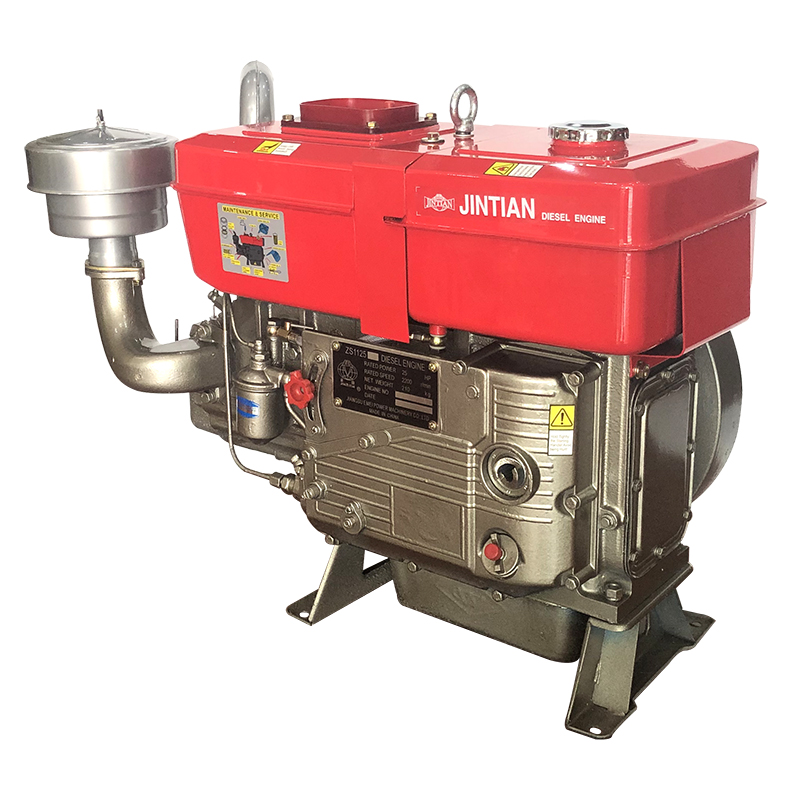
Willson ZS1132 single cylinder diesel engine, one of the intermediate models in the range. Buyers should confirm the final model, power rating, and starting system in the quotation.
Application and Use Cases: Matching the Engine to the Work
The application data for the Willson single cylinder diesel engine names agricultural machinery, water pumps, generators, and construction equipment. The working-condition guidance is equally practical: install in a well-ventilated area, keep the engine free from excessive dust and corrosive gases, avoid direct rain exposure, and mount it on stable and solid ground. These conditions matter because a single cylinder diesel engine is often installed in equipment that operates in dusty fields, temporary pumping sites, or construction yards.
Buyer search language is often more specific than the broad application category. Searches may refer to a diesel engine for agriculture, diesel engine for irrigation pump, diesel engine for tiller, diesel engine for generator, diesel engine for thresher, diesel engine for farm machinery, diesel engine for water pump, diesel engine for power tiller, or diesel engine for rice mill. Those phrases describe the equipment, not a validated engine selection. The right procurement step is to map the equipment requirement back to the engine duty: rated power, speed, cooling method, starting method, mounting, fuel supply, and service access.
The application data also supports the distinction between an agriculture diesel engine and an irrigation diesel engine. An irrigation diesel engine may run for long periods at a relatively steady load, while an agriculture diesel engine on a tiller or thresher may see fluctuating load and seasonal use. The same model family can appear in both conversations, but the service plan and spare-parts stock should reflect the actual duty cycle. Buyers should not assume that a model is suitable simply because it appears in a broad application list.
Maintenance and Operating Boundary FAQ
The provided application guidance gives specific operating boundaries. Do not add dirty, saline, or alkaline water to the water tank. Regularly clean, maintain, and change the engine oil, and replace the filter element when necessary. Install the engine on stable and solid ground. Keep the installation well ventilated and free from excessive dust and corrosive gases. Avoid direct rain exposure.
The same guidance does not specify a universal maintenance interval in hours or months. That is a real limitation, not a gap to be filled with invented numbers. Maintenance intervals should be set by the model-specific manual and adjusted for load, fuel quality, dust, ambient temperature, and water quality. A procurement engineer should ask the supplier for the recommended schedule for the exact model and application, and should record that schedule in the purchase specification.
For water-cooled models, water quality is part of the operating boundary. Dirty, saline, or alkaline water can affect cooling performance and service life. For air-cooled models such as the Z175F, airflow and ventilation become the critical installation conditions. Neither cooling method removes the need for routine oil maintenance and filter service.
Procurement FAQ: Parts, Packaging, and Supply Format
Parts availability is a legitimate pre-order question. The company profile states that Willson produces single cylinder diesel engines and diesel engine accessories. That is useful, but the buyer should still request a model-specific parts list that separates wear parts, consumables, and optional components. The list should match the quoted model and the local service capability. A generic parts catalogue is not enough for a multi-year service plan.
Packaging is another area where assumptions are costly. The provided corpus does not establish a standard export packaging format for every model. Buyers should ask for the proposed packing list, corrosion protection method, marking, and loading plan. If the buyer is considering local assembly, the knock-down scope should be defined in writing. Questions about Diesel Engine SKD Knocked Down Supply Solutions and Diesel Engine CKD Knocked Down Supply Solutions usually concern which parts are shipped assembled, which are shipped loose, what documentation is provided, and how tariff treatment is applied.
Third-party trade-policy references report that SKD and CKD assembly strategies can offer tariff advantages in some ASEAN markets, including Myanmar and Thailand, to incentivize local manufacturing. One reference cites 1.5%-3% for CKD in Myanmar and 0% for some categories in Thailand. That data is a trade-policy reference, not a statement that every supplier or every model qualifies. Tariff treatment depends on the specific product, origin rules, documentation, and current customs practice. Buyers should verify the treatment with a customs broker before relying on it in a cost model.
Market Trend Analysis: What the Numbers Do and Do Not Say
The market data points to steady relevance rather than a sudden shift. Global Growth Insights places the global single cylinder diesel engine market at approximately USD 3.34 billion in 2025, with a projected USD 3.74 billion by 2035. Dataintelo reports that agriculture accounts for approximately 42.3% of market share in 2025 and that Asia Pacific holds a 58.2% revenue share. Those figures support the view that agriculture and irrigation remain central to demand, especially in Asia Pacific.
Export data adds another layer. The Observatory of Economic Complexity reports that China's exports of combustion engines, including diesel variants, reached USD 3.29 billion in 2025, with major destinations including Russia, Vietnam, and India. That does not mean every Chinese single cylinder diesel engine manufacturer serves every market in the same way. It does mean that global buyers have reason to compare documentation, parts support, and packaging discipline alongside price.
Compliance is part of the trend. The U.S. Environmental Protection Agency states that EPA Tier 4 emission standards regulate particulate matter and nitrogen oxides for off-highway diesel engines, with exemptions for engines under 24 horsepower. Buyers should not generalize that rule to every market or every engine. Emission requirements vary by country, application, and engine category. A single cylinder diesel engine procurement file should record the applicable standard for the destination market and the evidence the supplier can provide.
Market estimates also vary between research firms. The figures above are useful for direction and context. They should not be used as a substitute for a buyer's own demand forecast or for model-level performance testing.
Single-Cylinder vs. Multi-Cylinder: Where the Boundary Sits
A single cylinder diesel engine is not a universal replacement for a multi-cylinder engine. Its advantages are structural: one cylinder, a simpler layout, accessible service points, and a compact footprint for small equipment. Those characteristics fit agricultural machinery, water pumps, generators, and construction equipment where the power requirement is moderate and the installation space is constrained.
The boundary is equally clear. A single cylinder engine generally has a lower power ceiling than a multi-cylinder engine and produces more pronounced vibration. A hand-start system requires manual effort and may not suit every operator or every duty cycle. Water-cooled models depend on clean cooling water and disciplined maintenance. Air-cooled models depend on reliable airflow and are sensitive to enclosed or dust-choked installations. Buyers who need higher power, smoother operation, or continuous heavy-duty output should evaluate multi-cylinder options rather than push a single cylinder model beyond its intended role.
There is also a procurement boundary. A supplier may offer a broad horsepower range, but that does not mean every model is stocked, certified, or supported in every market. Parts availability, packaging format, and documentation should be confirmed at model and destination level. A transparent supplier will state those limits rather than treat them as sales objections.
Future Outlook
The projected market growth to USD 3.74 billion by 2035 suggests continued demand for compact diesel power, but the shape of that demand is likely to remain application-led. Agriculture and irrigation are not marginal uses; they are central to the category. Asia Pacific's 58.2% revenue share reinforces the importance of regional supply chains, local assembly, and parts logistics.
For buyers, the practical outlook is to expect more scrutiny on compliance, documentation, and supply format. Emission standards, tariff treatment, and local assembly rules can change the landed cost of a single cylinder diesel engine even when the engine specification stays the same. The safest procurement approach is to keep the technical file and the commercial file separate: first confirm the model and duty fit, then confirm packaging, tariff treatment, and service support. That sequence reduces the risk of discovering a documentation or logistics problem after the order is placed.
FAQ
What is a single cylinder diesel engine?
A single cylinder diesel engine is a diesel engine with one cylinder. It is commonly used in compact equipment such as agricultural machinery, water pumps, generator sets, and construction equipment. Its main procurement advantages are a simple layout, accessible service points, and a compact footprint for moderate power requirements.
What power range does Willson offer?
The Willson range is described as 3-45 horsepower. The provided product data lists models from the R170A at 4 HP to the ZS1135 at 35 HP, with intermediate models including the ZS1132 at 32 HP, ZS1130 at 30 HP, ZS1125 at 25 HP, ZS1115 at 20 HP, ZS1110 at 18 HP, ZS1105 at 16.5 HP, ZS1100 at 15 HP, ZS195 at 13 HP, EM190 and JR190 at 9.5 HP, JR185 at 8 HP, R180 at 7 HP, R175 at 6 HP, Z175F and X170F at 5 HP, and R170A-T, R170A, Z170F, and 170F at 4 HP.
What are the main applications of single cylinder diesel engines?
The provided application data names agricultural machinery, water pumps, generators, and construction equipment. Buyer searches often use more specific terms such as diesel engine for agriculture, diesel engine for irrigation pump, diesel engine for generator, diesel engine for tiller, diesel engine for thresher, diesel engine for rice mill, and diesel engine for farm machinery. These terms should be mapped to the equipment's actual power, speed, cooling, and duty requirements.
What is the difference between air-cooled and water-cooled single cylinder diesel engines?
A water-cooled engine uses a water-based cooling system and requires attention to water quality and the water tank. A air-cooled engine relies on airflow and ventilation around the engine. In the provided Willson product data, most listed models are water cooled, while the Z175F is listed as air cooled. The choice depends on the installation, the operating environment, and the maintenance capability of the user.
Are the listed models hand-start or electric start?
The starting system shown in the provided product data is hand-start for the listed models. Buyers who need an electric start diesel engine should confirm availability for the exact model, market, and order quantity. The product data should not be read as confirming electric start across the entire range.
What maintenance points are specified for these engines?
The provided application guidance specifies several operating points: do not add dirty, saline, or alkaline water to the water tank; regularly clean, maintain, and change the engine oil; replace the filter element when necessary; install on stable and solid ground; keep the area well ventilated; avoid excessive dust and corrosive gases; and avoid direct rain exposure. The data does not provide a universal interval in hours or months, so the model-specific manual and supplier recommendation should set the schedule.
How should buyers evaluate parts availability and packaging?
Buyers should request a model-specific parts list that separates wear parts, consumables, and optional components. For packaging, they should ask for the proposed packing list, corrosion protection, marking, and loading plan. If a knock-down supply format is under consideration, the SKD or CKD scope, documentation, and tariff treatment should be confirmed in writing. The provided corpus does not establish a standard packaging format for every model.
What compliance factors affect single cylinder diesel engine procurement?
Compliance depends on the destination market and application. The U.S. EPA states that EPA Tier 4 emission standards regulate particulate matter and nitrogen oxides for off-highway diesel engines, with exemptions for engines under 24 horsepower. Other markets have their own requirements. Buyers should record the applicable standard in the procurement file and ask the supplier for the evidence that applies to the exact model and destination.
What are the limitations of single cylinder diesel engines?
Single cylinder diesel engines generally have a lower power ceiling than multi-cylinder engines and produce more pronounced vibration. Hand-start models require manual effort. Water-cooled models depend on clean cooling water and maintenance discipline. Air-cooled models depend on reliable airflow and ventilation. Buyers with higher power, smoother operation, or continuous heavy-duty requirements should evaluate multi-cylinder alternatives.
Reference document: the publicly accessible Willson single cylinder diesel engine brochure is available here: Willson single cylinder diesel engine brochure (PDF).
Have Questions or Need More Details?
Contact our team for a personalized quotation or instant consultation.
Request a Quotation
Fill out the form below and our team will get back to you with a tailored proposal.
WhatsApp Direct Chat
Prefer to chat in real-time? Message us on WhatsApp for instant assistance & quick answers.
- Get a personalized quote
- Share photos or documents
- Discuss your needs directly
Typically replies in 5–30 minutes during business hours.