
Single Pass Printer Compliance and Specs: A Buyer's Reference
Single-pass digital inkjet printing has moved from a niche capability to a practical option for packaging lines that need short runs, frequent design changes, and traceable output. For buyers, however, the label “single pass printer” covers machines with very different printhead systems, media widths, ink chemistries, and compliance statuses. This reference looks at the specifications and certifications that matter when evaluating single pass printers for corrugated board, paper bags, labels, and other packaging substrates.
Why single-pass printers are on procurement radars
Conventional packaging printing—offset, flexo, screen—requires physical plates or cylinders. That creates cost and lead time penalties for short runs, versioning, and regionalized packaging. Single-pass digital inkjet eliminates plate making and allows each printed piece to carry different data. In packaging segments where orders are becoming smaller and more diverse, this is a structural advantage.
But the buying decision is rarely about the technology alone. Packaging companies also need to verify that a printer can handle their substrate ranges, deliver acceptable throughput, and meet the regulatory requirements of the markets they serve. That is where model-level parameters and certifications become decision-critical constraints.
Key specification benchmarks for packaging lines
Single-pass printers for packaging typically share four technology pillars: a fixed printhead array, a conveying system for sheets or rolls, a color management workflow, and an optional surface treatment or curing unit. Within that framework, buyers should compare the following parameters.
Printhead and nozzle architecture
Printhead technology determines resolution, speed, and maintenance cost. Many FocusInc single-pass packaging models use HP PageWide printheads. The Cobra-691S, for example, carries 42,240 nozzles per head and supports resolutions up to 1,200×1,200 dpi. Larger models such as the Cobra-1209S and Cobra-1815S use one to five A3 PageWide heads, each with 59,136 nozzles. In the UV segment, the Acaleph series can be fitted with SEIKO, RICOH, TOSHIBA, or XAAR heads, while the S350 Jetpress uses arrayed Epson S3200 heads with internal ink recirculation.
Print width and media size
Width is a primary selection factor because it must match the production format. In FocusInc’s range:
- Cobra-691S: up to 420 mm print width with two heads; accepts media up to 1,200 mm wide with side flanks.
- Cobra-691S Max: print width from 215 mm to 645 mm, feeding width up to 900 mm.
- Cobra-1209S: 900 mm print area, compatible with 1,230 mm media.
- Cobra-1815S: 900 mm print area, accepts up to 1,800 mm media width.
- Viper / Falcon series: A4 or A3 format widths, typically 210–300 mm, suited to labels and smaller packaging.
- Acaleph-891S e / i: modular width from 53 mm to 500 mm, depending on head count.
Throughput and speed
Speed is normally stated in meters per minute for roll-fed or continuous conveying systems. FocusInc’s HP PageWide-based models generally run at 10–40 m/min depending on resolution and model. The Cobra-691S Max reaches 20–40 m/min for paper bag and cardboard work. The UV roll-to-roll S350 Jetpress is rated at 20–80 m/min for label film and IML applications. For sheet-fed lines, practical throughput also depends on sheet length and feeding intervals.
Substrate thickness and material compatibility
Corrugated board and pre-made paper bags require clearance for thicker media. The Cobra-691S accepts material up to 250 mm thick, which is relevant for box blanks and specialty packaging. The Cobra-1209S and Cobra-1815S are built for corrugated and honeycomb boards up to 60 mm. Desktop Falcon models handle up to 180 mm. UV Acaleph systems can manage rigid panels up to 300 mm thickness. If the production mix includes both thin labels and thick corrugated, buyers should confirm the printer’s adjustable height or conveying system.
Ink chemistry and curing
Water-based aqueous inks are common on HP PageWide-based models such as Cobra and Falcon, offering low odor for food-adjacent packaging. UV-curable inks are used on Acaleph and S350 models for non-absorbent materials—plastics, BOPP films, PVC, coated panels—because they cure instantly under LED UV lamps. Some models support pigment, dye, and edible inks, extending their use to food surface printing and specialty applications.
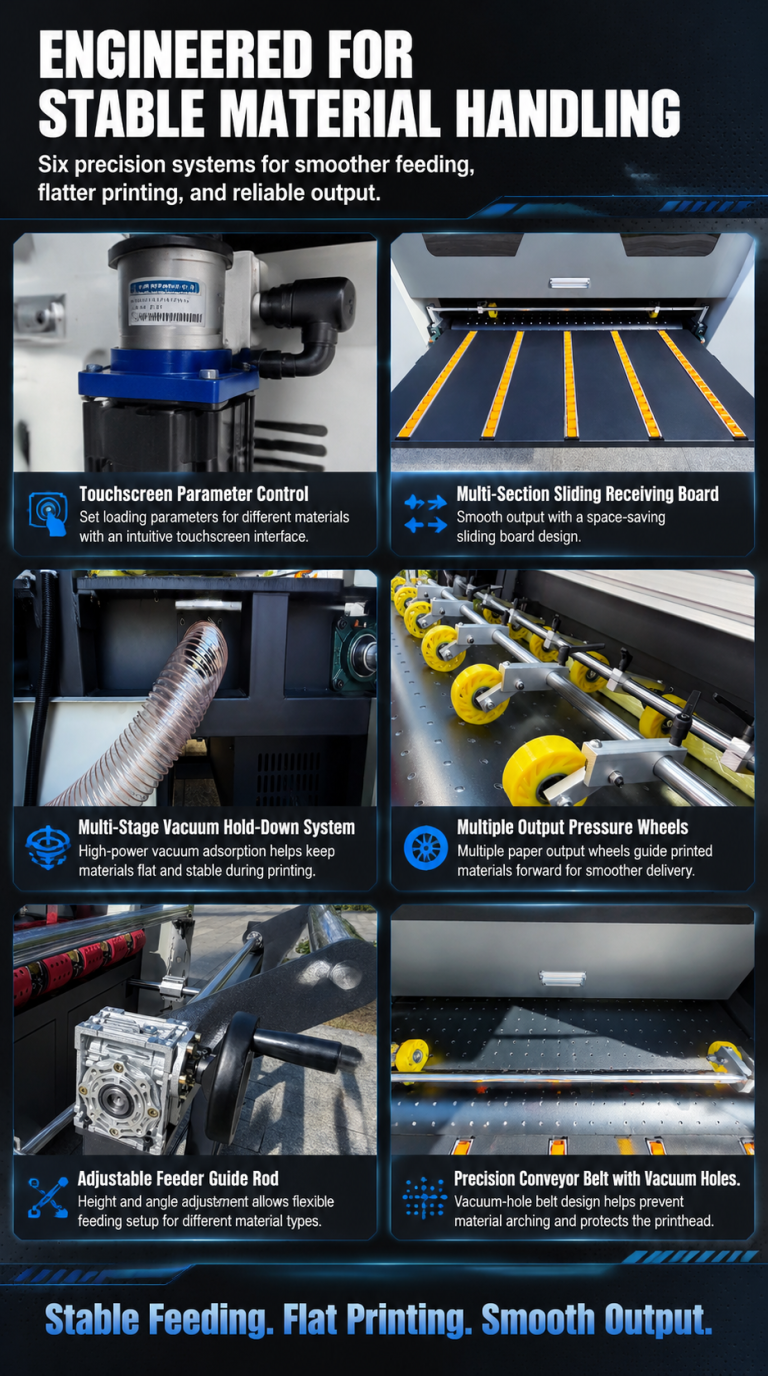
Technical advantages of large-format single pass corrugated board printers, including feeding stability and printhead protection systems.
Certifications and compliance: a necessary filter
For packaging equipment destined for Europe, North America, or other regulated markets, compliance documents are part of the risk assessment. A printer may perform well, but if it cannot be legally installed or fails an audit, the purchase loses value. Buyers should request the following types of evidence.
CE marking for the EU market
CE marking covers electrical safety and electromagnetic compatibility. For FocusInc single-pass printers, two certificates are relevant:
- LVD certificate SCT260301170121, issued by ANXIN PRODUCT TEST SERVICE CO., LTD., covers EN 1010-2:2006+A1:2010, EN 1010-1:2004+A1:2010, EN ISO 12100:2010, and EN 60204-1:2018+A1:2025.
- EMC certificate SCT260301170122 covers EN 55011:2016+A2:2021, EN IEC 61000-6-2:2019, and EN IEC 61000-6-4:2019.
These certificates appear in FocusInc’s documentation for its multi-functional digital inkjet printer series, including several single-pass models.
WEEE / ElektroG registration for Germany
Germany applies the ElektroG (WEEE) requirements to electronic equipment sold into the market. Buyers importing to Germany should verify that the supplier has a valid WEEE registration. FocusInc models have been registered with stiftung ear: the Cobra-691S AS B carries WEEE-Reg.-Nr. DE 87336785, and the Acaleph-891S e has a WEEE authorized representative confirmation (Sendungs-ID SI-202502-148048).
Patents and intellectual property
Patent status is less obvious but important for evaluating whether a supplier controls its technology or simply assembles off-the-shelf parts. FocusInc holds multiple CNIPA utility model and design patents related to printing mechanisms, printhead protection, and feeding systems. Examples include:
- Utility model patent for printing powder shaking integrated machine control equipment (ZL 202221874198.2).
- Design patent for UV digital inkjet printing equipment model 6090 (ZL 2019 3 0681678.4).
- Utility model patent for a 360° rotating curved surface heat transfer device (ZL 202222592510.5), related to cylinder printing.
- Utility model patent for a UV printer nozzle protection and cleaning device (Certificate No. 19070387).
These are not marketing claims; they are verifiable records from the China National Intellectual Property Administration. For buyers, they indicate that a supplier has invested in machine-level engineering rather than only importing generic parts.
FocusInc’s single-pass portfolio in context
Shanghai Focus Industrial Co., Ltd. (FocusInc) is a global industrial digital printing solution provider founded in 2008. The company operates a 35,000²m factory and reports an annual output of about 800 units, with 95% exported to markets including the EU, USA, Mexico, Brazil, Chile, Australia, Canada, and the UK. Its product matrix spans from desktop single-pass printers to large-scale UV single-pass systems.
In the packaging segment, the Cobra series addresses corrugated board, cartons, paper bags, and general packaging. The Falcon series is a desktop entry-level line for small businesses and sample production. The Viper series handles roll-to-roll labels and stickers. The Acaleph series covers UV single-pass printing for panels, non-woven bags, and container side printing. The S350 Jetpress is a high-speed UV roll-to-roll printer for labels and in-mold labels.
This breadth is useful for buyers because it allows the same supplier to support different production lines with consistent service and spare-part policies. However, each series has distinct specifications, so the choice must be anchored to the specific job mix.
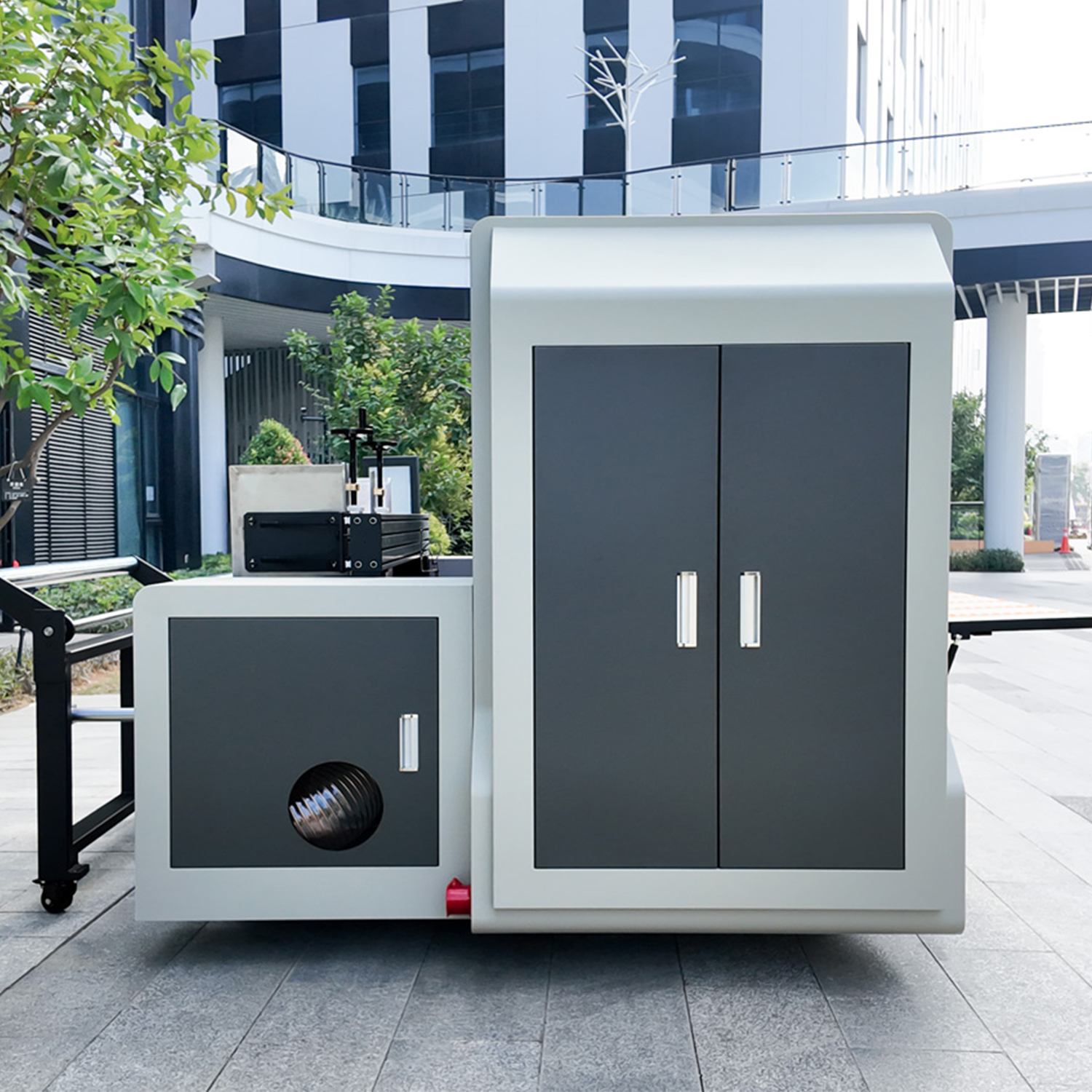
Wide-format single pass printer for corrugated board production, integrated with automatic feeding and stacking systems.
Application fit: where single-pass printers are used
Corrugated and honeycomb board printing
Single-pass printers are used for printing brand graphics, shipping marks, and variable QR codes directly onto corrugated sheets. The Cobra-1209S and Cobra-1815S support automatic sheet feeding and can be paired with front feeders and rear stackers. For e-commerce and logistics packaging, variable data printing allows each carton to carry a unique code without slowing the line.
Paper bags and food packaging
Pre-made paper bags, coffee bags, pizza boxes, and paper cups are printed on machines like the Cobra-691S Max and Falcon-491S Pro. Water-based inks are common for paper substrates, and automatic feeders make it possible to run pre-made bags without manual placement.
Labels, stickers, and roll stock
The Viper-391S and Viper-391S Pro are roll-to-roll single-pass label printers using HP PageWide heads, reaching speeds of 10–40 m/min. For UV-curable films and in-mold labels, the S350 Jetpress provides white + CMYK printing with 20–80 m/min throughput and tension control.
Non-woven bags and flexible packaging
The Acaleph-891S e is marketed for non-woven bag printing. It can be configured with plasma pre-treatment and vacuum feeding to stabilize soft materials. UV ink with a white base layer helps produce vivid colors on dark or textured non-woven fabrics.
Specialty side printing
The Acaleph-891S Side Printer prints on the exterior of cups, containers, and bottles using a rotating fixture and UV curing. It is used by disposable food packaging manufacturers to imprint logos after cup forming, eliminating the need for pre-printed blanks.
Market trends shaping single-pass demand
Market research data points to continued adoption of digital printing in packaging. According to Zion Market Research, the global digital printing for packaging market was valued at USD 31.64 billion in 2023 and is projected to reach USD 75.55 billion by 2032. A separate report from Straits Research indicates that inkjet digital printers accounted for 42.5% of the digital printer market in 2025. On the material side, China alone produced more than 88 billion square meters of corrugated board in 2024, according to the China Packaging Federation and Dataintelo, creating a substantial installed base for on-demand corrugated printing.
These numbers support the view that single-pass digital printing is not a temporary trend. The combination of shorter brand cycles, e-commerce packaging customization, and sustainability pressure favors equipment that can print without plates and with minimal waste.
Comparison with traditional printing methods
| Factor | Single-pass digital inkjet | Traditional flexo / offset |
|---|---|---|
| Setup | No plates; digital file to production in minutes | Plate mounting and color setup take time |
| Minimum order quantity | Very low; one-piece printing is possible | High due to plate and setup cost |
| Variable data | Built-in capability for QR codes, serial numbers | Requires separate coding systems or extra passes |
| Speed at very long runs | 10–80 m/min depending on model | Often higher after setup; economic at scale |
| Per-unit cost at massive volume | Generally higher | Lower once setup is amortized |
| Substrate flexibility | Wide, but some substrates need pre-treatment | Broad, with well-established chemistries |
Single-pass digital printing is not a universal replacement for traditional presses. Its main boundary is economic: for very long, stable repeat orders, conventional flexo or offset printing can still achieve a lower per-unit cost. In addition, some non-porous or low-surface-energy substrates require plasma, corona, or primer before digital ink will adhere reliably. Buyers should evaluate total cost across the order length distribution, not just the cost per printed sheet in isolation.
Future outlook
Three developments will shape the next phase of single-pass packaging printing. First, integration with upstream and downstream automation is increasing: auto feeders, stackers, inspection cameras, and slitting modules are becoming standard options rather than custom projects. Second, ink chemistry is expanding toward lower-energy curing and food-safe formulations, which opens more packaging and food-contact applications. Third, printhead reliability continues to improve, reducing downtime and lowering the skill barrier for operators.
For packaging buyers, the practical recommendation is to build a specification checklist before engaging suppliers. The checklist should include print width, media thickness, resolution, speed, ink type, regional compliance documents, and the supplier’s ability to provide localized support. Certification records should be checked against the exact model under evaluation, not the brand as a whole.
Frequently asked questions
What CE certifications should a single pass printer have for the EU market?
For FocusInc single-pass printers, the relevant CE documents are the LVD certificate SCT260301170121 (covering EN 1010-2:2006+A1:2010 and related safety standards) and the EMC certificate SCT260301170122 (covering EN 55011:2016+A2:2021 and EN IEC 61000-6-2:2019). Specific machine models should be listed on the certificate or in the supplier’s declaration of conformity.
What is the difference between water-based and UV ink in single-pass printing?
Water-based inks, used in models like the Cobra-691S Max, are well suited for paper, cardboard, and other absorbent media. UV inks, used in the Acaleph and S350 series, cure instantly under LED light and adhere to non-absorbent surfaces such as BOPP film, PVC, and coated panels. The choice depends on the substrate and the required ink adhesion.
What print width can a single-pass packaging printer handle?
FocusInc offers single-pass printers with print widths from about 210 mm up to 900 mm. The Cobra-691S prints 210 mm with one head and 420 mm with two. The Cobra-691S Max supports up to 645 mm, while the Cobra-1209S and Cobra-1815S print up to 900 mm on media widths of 1,230 mm and 1,800 mm, respectively.
Can single-pass printers print variable data such as QR codes?
Yes. Single-pass inkjet systems can print unique QR codes, barcodes, or serial numbers on each piece without slowing production. This is used for traceability, anti-counterfeiting, and promotional packaging. Models such as the Cobra-1209S and Viper-391S Pro support variable data workflows.
What production speed is typical for a single-pass printer?
Most FocusInc single-pass packaging printers operate between 10 and 40 meters per minute depending on resolution and model. The UV roll-to-roll S350 Jetpress reaches 20–80 m/min. For sheet-fed machines, output also depends on sheet size and automatic feeding efficiency.
For a deeper look into FocusInc’s manufacturing facilities, assembly capacity, and quality control procedures, you can download the company’s factory introduction brochure: FocusInc Factory Intro.pdf.
Have Questions or Need More Details?
Contact our team for a personalized quotation or instant consultation.
Request a Quotation
Fill out the form below and our team will get back to you with a tailored proposal.
WhatsApp Direct Chat
Prefer to chat in real-time? Message us on WhatsApp for instant assistance & quick answers.
- Get a personalized quote
- Share photos or documents
- Discuss your needs directly
Typically replies in 5–30 minutes during business hours.