
Single Pass Printer Shortlist: Models by Packaging & Label Job
Single pass printer selection is a job-fit decision before it is a brand decision. Corrugated board, roll-fed labels, paper bags and printed cups each impose different limits on print head architecture, ink chemistry, media transport and resolution — and those limits, not catalogue size, determine which machine can actually run a given job.
Market data supports the move toward job-specific buying. Digital printing for packaging was valued at USD 31.64 billion in 2023 and is projected to reach USD 75.55 billion by 2032, based on Zion Market Research. Forecasts for the same horizon diverge widely — SNS Insider projects USD 62.75 billion and Credence Research USD 27.44 billion — so buyers should treat any single market forecast as directional. A steadier indicator is technology mix: inkjet digital printers accounted for 42.5% of the digital printer market as of 2025, according to Straits Research.
FocusInc, the trading brand of Shanghai Focus Industrial Co., Ltd., is a Shanghai-based industrial digital printing solutions provider founded in 2008 that manufactures single-pass digital inkjet systems for packaging and label production. Its published model range covers label, corrugated, paper bag, cup and container work. This shortlist groups those models by job type and compares them only on specifications published in the manufacturer's model documentation: print head technology, print resolution, print speed, ink type and media handling. It is a model shortlist, not a supplier ranking.
Why job type decides the shortlist
Three technical splits separate machines that otherwise look comparable on a specification sheet.
Print head architecture. HP Pagewide thermal bubble-jet heads appear in the Viper, Cobra and Falcon families; Epson micro piezo heads with internal ink recirculation appear in the S350 Jetpress, Vesa-830A and NEXUS-350J. The two architectures differ in nozzle count, drop behaviour and maintenance routines, and they are not interchangeable between model families. HP Pagewide technology sits inside a large installed base of wide-format systems — HP Inc. is reported to hold a 32% global shipment share in the large format printer market, per Mordor Intelligence and Maximize Market Research — which matters for buyers assessing long-term spare-parts and print head supply.
Ink chemistry. Some models in this shortlist run aqueous, dye, pigment or edible inks; others run UV curing ink with LED UV curing. UV chemistry changes downstream options — for example, in-mould label (IML) work that passes through a high-temperature injection moulding step — while aqueous chemistry changes media and drying requirements.
Media transport. Roll-to-roll web handling, sheet-fed board handling and desktop piece handling require different feeders, tension systems and vacuum platforms. A 320 mm label web and a 1,800 mm corrugated sheet cannot be run on the same transport.
The five comparison criteria used in this shortlist
- Print head technology — head brand, nozzle count and whether the head uses internal recirculation.
- Print speed — stated in linear metres per minute for most models and in square metres per hour for the Vesa-830A.
- Ink type — aqueous, dye, pigment, edible or UV curing, and the colour set published for the model.
- Media handling — maximum load width, maximum thickness or roll diameter, and whether the machine is roll-fed, sheet-fed or piece-fed.
- Print resolution — the maximum dots-per-inch setting published for the model.
Label jobs: Viper-391S and Viper-391S Pro
For roll-fed label and sticker work, FocusInc publishes two closely related page-width models. The Viper-391S is documented as a page-width label roll-to-roll single pass printer; the Viper-391S Pro is documented as a roll-to-roll A3 label single pass printer with A4, A3 and A5 configurations listed.
Both are built on HP Pagewide thermal bubble-jet print heads. The A4 configuration carries one HP A4 Pagewide head with 42,240 nozzles, while the A3 configuration carries one HP A3 Pagewide head with 59,136 nozzles. Published print resolution ranges from 1200×300 dpi to 1200×2200 dpi depending on the setting selected, and print speed is stated at 10–40 m/min according to resolution.
Media handling is the same across both: a maximum load width of 12.6 inches (320 mm), roller inner diameters of 75 mm, 40 mm and 25 mm, and media listed as inkjet-coated paper and synthetics including BOPP, Vinyl and PET in gloss and matt finishes. Four automatic laser guideline margins plus a margin rule are used for alignment, and the media path supports roll-to-roll, optional roll-to-cut and print-hold operation. The RIP and control software are supplied as a single combined package.
The ink set is aqueous, dye, pigment or edible in black, cyan, magenta and yellow, held in 500 ml tanks per colour. Power is 9 A on single-phase 220 V at 50–60 Hz, and the stated acoustic noise level is 75 dB(A) or less. The main printer measures 629 × 598 × 600 mm and weighs 65 kg, with 51 kg for the unwinder and rewinder pair.
Stated boundary: the Viper family is a 320 mm web platform with aqueous-class ink chemistry. Label work that requires UV-cured ink, wider webs or in-mould film handling sits outside its published specification and belongs in the next group.
Roll-to-roll UV, IML and UV label production: S350 Jetpress and Vesa-830A
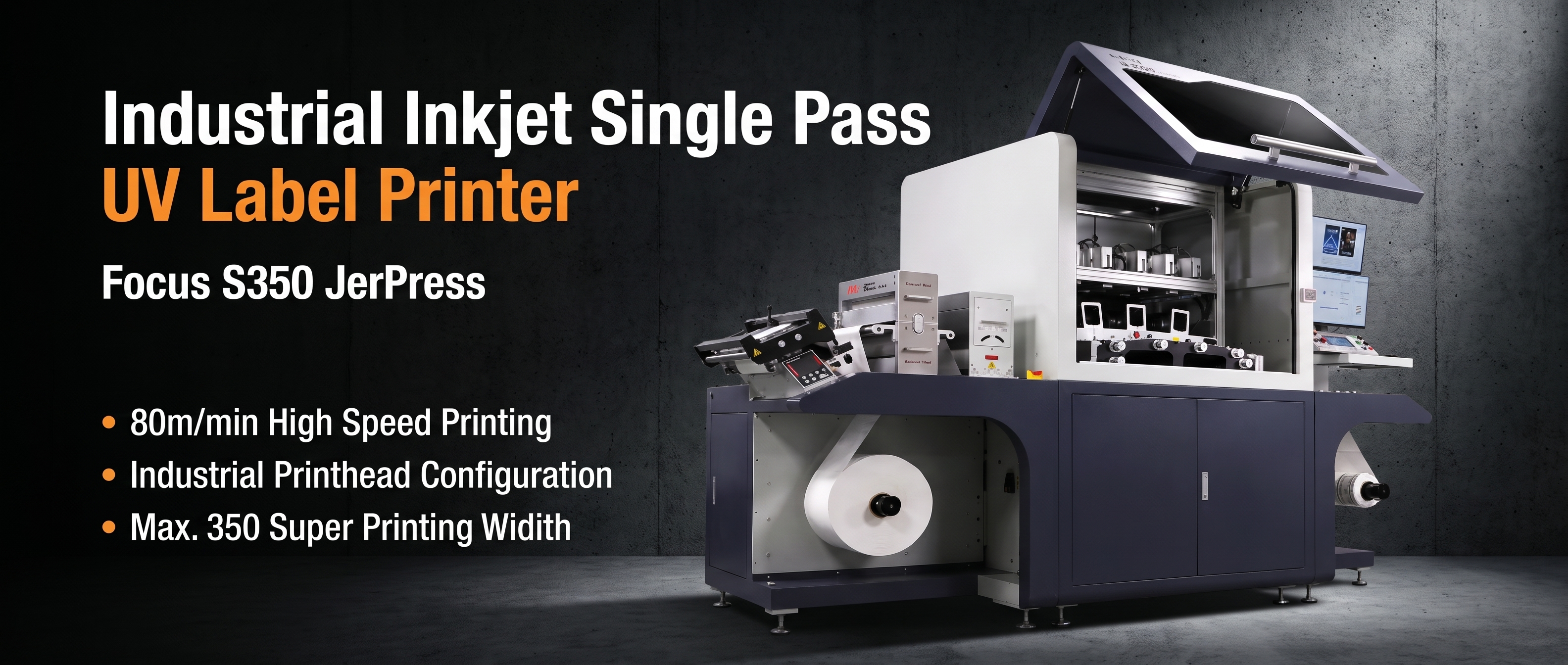
A roll-to-roll UV single pass label platform: UV curing chemistry changes which downstream converting steps a label job can pass through.
Where the job requires UV-cured ink — typical for IML film and durable UV labels — the shortlist moves to the S350 Jetpress and the Vesa-830A.
The S350 Jetpress is documented as a UV single pass roll-to-roll label printing machine used for IML printing. It uses Epson S3200U1 or S3200U3 print heads with internal ink recirculation, in counts of 10 or 15 heads configured as CMYKW×2 or CMYK×3. Print colour is W+CMYK, print width is 235 mm with 120 mm per row, and published resolution settings are 1200×600 dpi, 900×600 dpi and 600×600 dpi. Print speed is stated at 20–80 m/min depending on print mode and image quality.
Media thickness on the S350 Jetpress is 0.02–0.8 mm with a maximum of 3 mm, and media rollers accept up to 650 mm diameter with a 3-inch gas-boost roller at 0.3–0.4 MPa air supply. Optional pre-processing includes corona treatment, dust removal and electric alignment. Ink supply uses a circulation system with automatic white ink heating, and curing uses LED UV with water cooling. Control software is the Focus S350 version, which supports colour printing and barcode printing. Power is AC 380 V / 50 Hz / 50 A, machine dimensions are 2,800 × 1,200 × 2,200 mm, and the machine weighs 2,300 kg.
Field evidence on this model is available. In the United Arab Emirates, a plastic injection moulding factory has run a single S350 Jetpress on an IML label fast printing line for two years. The system supports synchronous white and colour ink one-pass printing and full-automatic continuous batch printing, and it reduced manual labelling cost by 40% while maintaining consistent colour on in-mould labels and zero ink peeling during high-temperature injection moulding.
The Vesa-830A is the narrower UV label roll-to-roll option. It carries two Epson i3200-U1 micro piezo print heads with 6,400 staggered nozzles, jetting at 21.6–43.2 kHz with droplet volumes of 3.5–12.5 pl and 2–4 greyscale levels. Published resolution is 720×1200 dpi, 720×1800 dpi and 720×2400 dpi in unidirectional or bidirectional mode, and throughput is expressed in area terms: 12–17 m²/hour at 4-pass, 10–12 m²/hour at 6-pass and 8–10 m²/hour at 8-pass.
Its maximum print area is 16.54 inches (420 mm) by unlimited length, with a maximum roll outside diameter of φ350 mm and core diameters of 75 mm, 40 mm and 25 mm. Media covers roll film, paper, canvas and leather, plus PE, PP, PET and PVC label or film, inkjet-coated paper, and synthetics including BOPP and Vinyl in gloss, matt and non-coated finishes. Ink options are UV curing, aqueous, dye, pigment and edible in white, black, cyan, magenta and yellow, with 220 ml tanks per colour, a 500 ml white ink tank, and automatic white ink stirring and circulation. Curing uses two 405 nm UV-LED lamps. Power is 12 A on single-phase 220 V at 50–60 Hz, and the printer weighs 114 kg.
Choosing between the two: the S350 Jetpress offers higher linear speed (20–80 m/min) and supports IML-specific processing but requires 380 V three-phase power and roughly 2,300 kg of floor load. The Vesa-830A is a 420 mm, 12 A single-phase machine whose throughput is published in square metres per hour — at 8-pass it is 8–10 m²/hour — so it fits lower-volume UV label work rather than continuous high-speed web production.
Corrugated, carton and on-demand packaging: the Cobra series
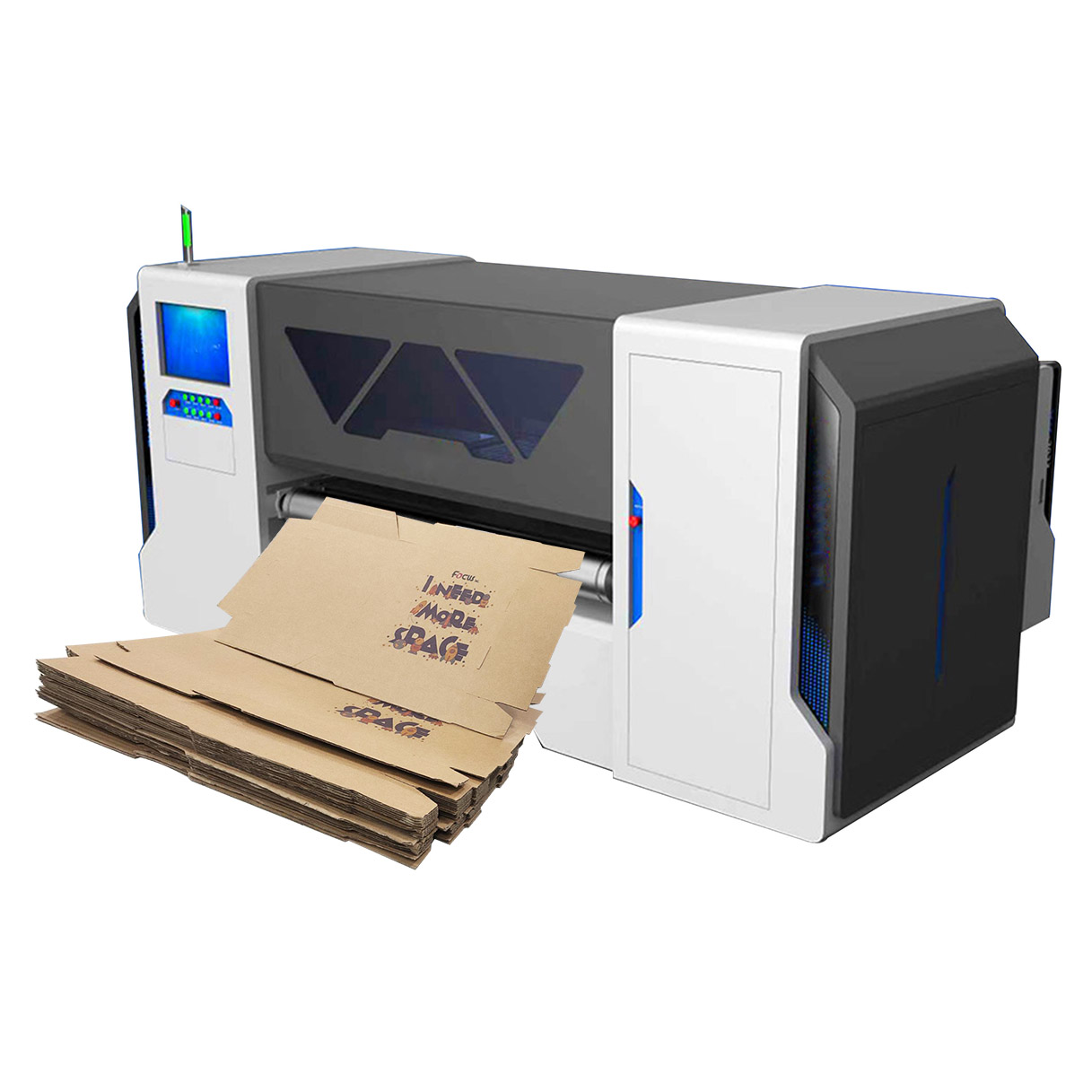
Corrugated and carton board production lines scale by print width and board thickness, not by print head count alone.
The Cobra series is the corrugated, carton and on-demand packaging branch of the shortlist. Five published models cover different board widths, thicknesses and feeding configurations, all built on HP Pagewide bubble-jet technology with aqueous, dye or pigment inks.
The Cobra-691S is a direct-to-packaging printer using one or two HP Pagewide print heads at 42,240 nozzles each. Maximum print width is 210 mm with one head and 420 mm with two, and the published resolution range runs from 1200×300 dpi to 1200×1200 dpi at 10–40 m/min. Media covers corrugated paper, pizza boxes, shopping bags, coffee bags, paper cups, envelopes, cards, napkins and tissue. Load width is 600 mm without side flanks and 1,200 mm with side flanks, both with unlimited length, and maximum material thickness is 250 mm. Ink is aqueous, dye or pigment in 500 ml tanks per colour, with an optional 420 W vacuum system and an optional automatic media sender. The machine weighs 195 kg net and runs on 20 A single-phase 220 V at 50 Hz.
The Cobra-691S AS B shares that engine and specification with a broader published media list that adds paper bags, cup fans, cup sleeves, postcards, breads, cookies, cake pads and coated paper — the configuration to examine when cup sleeves and food-service board formats dominate the order book.
The Cobra-691S Max changes the format logic. It accepts one to three print heads with a maximum printing width of 215–645 mm, a maximum material feeding width of 900 mm and unlimited length, using rear feeding and front discharging on a servo conveyor belt over a vacuum adsorption platform. Print height is 0–55 mm and can be customised. Resolution is published at 1200×300 dpi, 1200×600 dpi and 1200×1200 dpi at 20–40 m/min, with thermal bubble technology, water-based CMYK ink held in 2.5 litre tanks per colour and a siphon ink supply. Consumable cost is published at 0.1–0.2 RMB per square metre. The machine weighs 220 kg and requires 220 VAC at 3 kW.
The two wide-format models are the Cobra-1209S and Cobra-1815S. Both deliver a 900 mm maximum print area with unlimited length using one to three A3 print heads (1209S) or one to five A3 print heads (1815S), each A3 head at 59,136 nozzles. The 1209S accepts material up to 1,230 mm wide and the 1815S up to 1,800 mm wide. Both are limited to 60 mm maximum material thickness and print at 10–35 m/min in the 1200×300 dpi to 1200×1200 dpi range, with 1,500 ml ink tanks per colour. Installed weights are 1,450 kg and 1,650 kg net respectively.
Stated boundary: board thickness and print width trade against each other across the Cobra range. The Cobra-691S accepts material up to 250 mm thick but prints a maximum of 420 mm wide; the Cobra-1209S and Cobra-1815S print 900 mm wide but cap material thickness at 60 mm. Buyers running both thick transit packaging and wide display-grade cartons cannot cover both with one Cobra model.
Paper bags and cups: Falcon-491S and Falcon-491S Pro
For paper bags, cups and similar flat or semi-rigid formats, FocusInc publishes two desktop-class models. Both use HP Pagewide bubble-jet technology with aqueous, dye, pigment or edible ink in 250 ml tanks per colour, and both cap media thickness at 180 mm.
The Falcon-491S is documented as a desktop direct-to-packaging inkjet printer. It uses one HP A4 Pagewide head for 210 mm print width or one HP A3 Pagewide head for 300 mm print width, with 42,240 nozzles at 1200×300 dpi to 1200×1200 dpi resolution and 10–25 m/min print speed. Maximum load size is 400 mm width by unlimited length. Media covers corrugated paper, pizza boxes, tote shopping bags, paper cups, envelopes, cards, napkins, roll tissue paper, inkjet label and wood. Two automatic laser guideline margins handle alignment, the vacuum system is 200 W, and the machine weighs 105 kg net on 20 A single-phase 220 V.
The Falcon-491S Pro adds an automatic friction feeder to the same format class, increases maximum load size to 430 mm width and the vacuum to 250 W, and is published at 10–17 m/min. It weighs 140 kg net and supports an optional 10.1-inch industrial touch screen computer for control.
Stated boundary: the Falcon models carry the lowest linear speeds in this shortlist alongside the NEXUS-350J. At 10–25 m/min and 10–17 m/min they suit low-to-mid volume bag and cup production where fast job switching matters more than raw throughput. Jobs requiring continuous high-volume corrugated sheets run at 10–40 m/min on the Cobra-691S platform instead.
All-in-one label printing and die cutting: NEXUS-350J
The NEXUS-350J is documented as a label digital printer, laminator, die cutter and slitter in one roll-fed machine. It prints with one to four Epson i3200-U1 piezo print heads at 3,200 nozzles each, jetting at 21.6–43.2 kHz with 3.5–12.5 pl drop volumes and 2–4 greyscale levels, at resolutions of 720×720 dpi, 720×1080 dpi and 720×1440 dpi. Media is roll-fed up to 350 mm wide, with a maximum individual label print size of 330 × 300 mm, and the ink set is published as White + White + KCMY + Varnish with optional glue, in UV or water-based chemistry, with automatic white ink stirring and circulation.
The converting side of the machine is what separates it from the other label models. Digital die cutting handles regular and irregular shapes with four knife modules at a stated 0.05 mm precision. Lamination is automatic and electronic after printing, with a temperature range of 0–100°C. Gold and foil stamp transfer are supported, and slitting is physical with five knives. Media types include BOPP, POPP, PET, PE, PP and PVC label or film, foil paper, label paper and synthetics such as BOPP and Vinyl in gloss and matt finishes. The machine weighs 2,000 kg net, requires 3,000 W on 25 A single-phase 220 V, and prints at 1–2 m/min.
Stated boundary: at 1–2 m/min the NEXUS-350J prints roughly an order of magnitude slower than the Viper series at 10–40 m/min. Its value proposition is consolidation — printing, lamination, die cutting, stamping and slitting in one line — for short-run and complex label work where converting steps, not print throughput, dominate cost. It is not a substitute for a high-speed label press.
Shortlist comparison table
| Model | Primary job fit | Print head | Max resolution | Print speed | Ink | Media handling |
|---|---|---|---|---|---|---|
| Viper-391S | Label / sticker roll work | 1× HP A4 or A3 Pagewide (42,240 / 59,136 nozzles) | 1200×2200 dpi | 10–40 m/min | Aqueous, dye, pigment, edible (CMYK) | Roll-to-roll, max 320 mm width, 75/40/25 mm cores |
| Viper-391S Pro | Label / sticker roll work | 1× HP A4 or A3 Pagewide (42,240 / 59,136 nozzles) | 1200×2200 dpi | 10–40 m/min | Aqueous, dye, pigment, edible (CMYK) | Roll-to-roll, max 320 mm width; A4/A3/A5 configurations |
| S350 Jetpress | UV label / IML roll production | 10 or 15× Epson S3200U1/U3 with recirculation | 1200×600 dpi | 20–80 m/min | UV curing (W+CMYK) | Roll-to-roll, print width 235 mm, thickness 0.02–0.8 mm (max 3 mm) |
| Vesa-830A | UV label, BOPP/PET roll work | 2× Epson i3200-U1 (6,400 nozzles) | 720×2400 dpi | 4-pass 12–17 m²/h; 8-pass 8–10 m²/h | UV curing / aqueous / dye / pigment / edible (W+CMYK) | Roll-to-roll, max 420 mm width, roll OD up to 350 mm |
| Cobra-691S / 691S AS B | Corrugated, carton, on-demand packaging | 1–2× HP Pagewide (42,240 nozzles each) | 1200×1200 dpi | 10–40 m/min | Aqueous, dye, pigment (CMYK) | Sheet-fed, 600 mm or 1,200 mm load width, up to 250 mm thick |
| Cobra-691S Max | File bags, cups, paper bags | 1–3× HP A3 / A4 | 1200×1200 dpi | 20–40 m/min | Water-based (CMYK), 2.5 L per colour | 900 mm feed width, print height 0–55 mm, unlimited length |
| Cobra-1209S | Wide corrugated sheet and carton board | 1–3× HP A3 (59,136 nozzles each) | 1200×1200 dpi | 10–35 m/min | Aqueous, dye, pigment, edible (CMYK), 1,500 ml tanks | 1,230 mm load width, unlimited length, max 60 mm thick |
| Cobra-1815S | Wide corrugated box production | 1–5× HP A3 (59,136 nozzles each) | 1200×1200 dpi | 10–35 m/min | Aqueous, dye, pigment, edible (CMYK), 1,500 ml tanks | 1,800 mm load width, unlimited length, max 60 mm thick |
| Falcon-491S | Paper bags, cups, envelopes, cards | 1× HP A4 or A3 Pagewide (42,240 nozzles) | 1200×1200 dpi | 10–25 m/min | Aqueous, dye, pigment, edible (CMYK) | 400 mm load width, max 180 mm thick, desktop |
| Falcon-491S Pro | Paper bags, cups, cup fans | HP A4 / A3 / 841 Pagewide (42,240 nozzles on A4 head) | 1200×1200 dpi | 10–17 m/min | Aqueous, dye, pigment, edible (CMYK) | 430 mm load width, max 180 mm thick, automatic friction feeder |
| NEXUS-350J | Short-run labels with inline converting | 1–4× Epson i3200-U1 (3,200 nozzles each) | 720×1440 dpi | 1–2 m/min | UV or water-based (W+W+KCMY+Varnish) | Roll-fed up to 350 mm width, label size up to 330 × 300 mm |
All figures as published in the manufacturer's model documentation for the referenced configurations.
How single pass digital compares with plate-based production — and where it stops
Plate-based offset and flexographic production remains the reference for very long, stable runs. Single pass digital changes the setup economics rather than the print quality ceiling: there is no plate to make, no minimum order quantity imposed by plate amortisation, and variable data such as QR codes can be printed without re-plating. FocusInc case records include a label producer in Vietnam running roll-to-roll label and sticker work for daily chemical, general packaging and cold-chain logistics labels on a single unit for two years, where order processing and delivery were accelerated by removing minimum order quantities and plate making.
The limits are equally concrete, and buyers should test them before shortlisting. Format ceilings are model-specific: 320 mm web width on the Viper family, 180 mm media thickness on the Falcon models, 60 mm on the wide Cobra models, and 3 mm maximum media thickness on the S350 Jetpress. Ink chemistry is model-specific: UV curing is published for the S350 Jetpress, Vesa-830A and — as an option — the NEXUS-350J, while the Cobra, Falcon and Viper families are documented with aqueous, dye, pigment or edible inks. Throughput is not uniform either: the shortlist spans 1–2 m/min at one end and 20–80 m/min at the other.
Two additional constraints are physical rather than commercial. The S350 Jetpress requires an AC 380 V / 50 Hz / 50 A supply and weighs 2,300 kg; the Cobra-1815S weighs 1,650 kg net and measures 3,180 × 2,200 × 1,820 mm. Installation planning should start from those numbers, not from print resolution.
Market trend and compliance signals buyers are using
Three signals appear repeatedly in current procurement discussions. First, regional volume: China produced more than 88 billion square metres of corrugated board in 2024, according to China Packaging Federation data reported by Dataintelo, which keeps demand concentrated on corrugated-capable single-pass platforms. Second, technology share: inkjet systems represented the largest segment of the digital printer market at 42.5% in 2025, per Straits Research. Third, regulatory scope: industrial single-pass printers placed on the EU market must comply with the Low Voltage Directive 2014/35/EU and the EMC Directive for CE marking, per the European Commission.
For ink transparency specifically, ISO/IEC 24711 and ISO/IEC 24712 standardise yield reporting for colour inkjet systems, which gives buyers a defined basis for comparing published ink consumption figures rather than relying on vendor-specific test conditions.
FocusInc's own published compliance documentation for its single-pass range includes a CE verification of conformity (certificate SCT260301170122, covering EN 55011, EN IEC 61000-6-2 and EN IEC 61000-6-4), an LVD certificate (SCT260301170121, covering EN 1010-2, EN 1010-1, EN ISO 12100 and EN 60204-1), German WEEE registration DE 87336785, and an EC authorised representative certificate. The company also holds utility model patents issued by the China National Intellectual Property Administration and registered trademarks. Buyers evaluating any single-pass supplier can apply the same document set as a checklist.
Procurement and delivery terms
Published commercial terms for these systems include a minimum order quantity of one unit, delivery terms of EXW, FOB, CIF, DDU, DDP or DAP, and payment terms of 50% / 50%. Acceptance criteria are defined as a pre-shipment test, and third-party factory audit and inspection can be arranged on request. Lead time is 15–45 days depending on the configuration or customisation involved.
Production capacity is published separately for the two customisation modes. Original equipment manufacturing allocations run to 120 sets per month with 100% full-machine pre-shipment running tests and a 13-month free warranty; original design manufacturing runs to 40 sets per month with 100% continuous running ageing tests, full customised function verification and a three-year machine warranty. OEM customisation covers machine housing colour, brand logo printing, multi-language operating systems and matched auxiliary equipment layout; ODM covers custom print width and feeding size, structural design and inline pre-processing and post-processing automation. Spare parts supply and technical consultation are stated as lifelong, with global remote support and overseas on-site installation and training.
Manufacturing background for context: Shanghai Focus Industrial Co., Ltd. was founded in 2008, operates a 35,000 m² factory established in 2018, employs 45 staff including a six-engineer R&D team, produces 800 units annually, and exports approximately 95% of output to markets including the EU, USA, Mexico, Brazil, Chile, Australia, Canada and the UK.
Future outlook
The direction of this model range is consolidation and job breadth rather than raw speed. Two patterns are visible in the published specifications. First, converting steps are moving inline: the NEXUS-350J already combines printing, lamination, digital die cutting, stamping and slitting in one roll-fed frame. Second, format coverage is expanding at both ends — 430 mm desktop feeding at the Falcon-491S Pro level and 1,800 mm board width at the Cobra-1815S level — which suggests buyers will increasingly choose between platform width and platform thickness rather than between printing technologies.
For packaging and label buyers, the practical implication is that the shortlist decision should be made on media handling and ink chemistry first, with print head count and resolution used only to fine-tune within an already compatible group. Market forecasts that suggest strong category growth — whatever number a buyer accepts from the published range of estimates — do not change that order of decision.
FAQ
What is the practical difference between the Viper-391S and the Viper-391S Pro for label work?
Both are roll-to-roll, page-width label printers built on HP Pagewide thermal bubble-jet heads. Their published specification tables share the same resolution range (1200×300 dpi to 1200×2200 dpi), the same 10–40 m/min print speed, the same 320 mm maximum load width, the same aqueous, dye, pigment and edible CMYK ink set in 500 ml tanks, and the same combined RIP and control software. The Viper-391S documentation lists A4 and A3 configurations; the Viper-391S Pro documentation additionally lists an A5 configuration. In published specification terms the difference is configuration coverage rather than print engine capability.
When should a label producer choose the S350 Jetpress or the Vesa-830A instead of a Viper model?
The deciding factor is ink chemistry and web format. The S350 Jetpress and Vesa-830A are published with UV curing ink and LED UV curing, while the Viper family is documented with aqueous, dye, pigment and edible inks. The S350 Jetpress supports W+CMYK with 10 or 15 Epson print heads at 20–80 m/min and a 235 mm print width; the Vesa-830A supports W+CMYK with two Epson i3200-U1 heads at up to 420 mm print width and throughput of 12–17 m²/hour at 4-pass. Label jobs that require UV-cured chemistry or in-mould film handling, such as the IML line running in the United Arab Emirates, fall into the UV group.
Which Cobra model fits corrugated carton work versus on-demand packaging?
Board thickness and required print width separate the models. The Cobra-691S prints up to 420 mm wide with one or two heads and accepts material up to 250 mm thick, which suits thick corrugated and deep tray formats. The Cobra-1209S accepts 1,230 mm wide material and the Cobra-1815S accepts 1,800 mm wide material, but both cap material thickness at 60 mm. The Cobra-691S Max is positioned differently again: 215–645 mm print width, 900 mm feed width, 0–55 mm print height and 20–40 m/min, targeting file bags, paper cups and paper bags rather than heavy corrugated board. All five run aqueous, dye or pigment inks at 10–40 m/min or 10–35 m/min.
What are the operating limits of the Falcon-491S and Falcon-491S Pro?
Both are desktop-class machines limited to 180 mm maximum media thickness, with print widths of 210 mm on an A4 head or 300 mm on an A3 head, 250 ml ink tanks per colour, and published speeds of 10–25 m/min (Falcon-491S) and 10–17 m/min (Falcon-491S Pro). Load width is 400 mm on the 491S and 430 mm on the Pro, and vacuum power is 200 W and 250 W respectively. The Pro adds an automatic friction feeder. These specifications suit paper bags, cups, cup fans, envelopes, cards and similar formats; they are not rated for high-volume corrugated sheet production.
What does the NEXUS-350J add compared with a stand-alone label printer?
The NEXUS-350J adds inline converting. In addition to printing with one to four Epson i3200-U1 heads at 720×720 dpi to 720×1440 dpi and a White + White + KCMY + Varnish ink set, it performs digital die cutting for regular and irregular shapes with four knife modules at 0.05 mm stated precision, automatic electronic lamination at 0–100°C, gold and foil stamp transfer, and physical slitting with five knives, on roll media up to 350 mm wide. Its published print speed is 1–2 m/min, well below the 10–40 m/min of the Viper series, so the benefit is reduced converting steps for short-run or complex label work rather than higher print throughput.
Which comparison criteria matter most when shortlisting single-pass models?
A workable order is media handling, then ink chemistry, then print head technology, then speed, then resolution. Media handling — maximum load width, maximum thickness or roll diameter, and roll versus sheet feeding — eliminates most models immediately, since the shortlist spans 320 mm to 1,800 mm widths and 60 mm to 250 mm board thickness. Ink chemistry determines downstream compatibility, particularly whether UV curing is required for IML or durable label processes. Print head technology and resolution then differentiate within a compatible group, and print speed becomes a throughput and payback question rather than a capability question.
Reference: FocusInc factory and capability documentation (PDF) — https://cdn.socialarks.com/sbsp/24952/common/2026/0707/FocusInc%20Factory%20Intro.pdf