
Single-Pass vs. Multi-Pass: Inside a 2-in-1 Digital Printer
A packaging plant that buys a multifunctional digital printing machine is not really buying one press. It is buying two production logics inside a single chassis: a scanning, multi-pass workflow for detailed and large-format work, and a direct-output, single-pass workflow for repeat volumes. Knowing where one mode stops being the right answer and the other begins is the difference between an asset that runs at capacity and one that runs at half of it.
This is an independent look at how the two modes behave on the same platform, what the published specifications actually imply on a shop floor, and which production signals should move a buyer from one mode to the other. It is not a claim that one mode is superior. The value of a 2-in-1 design comes from the switch itself, and every switch has conditions.
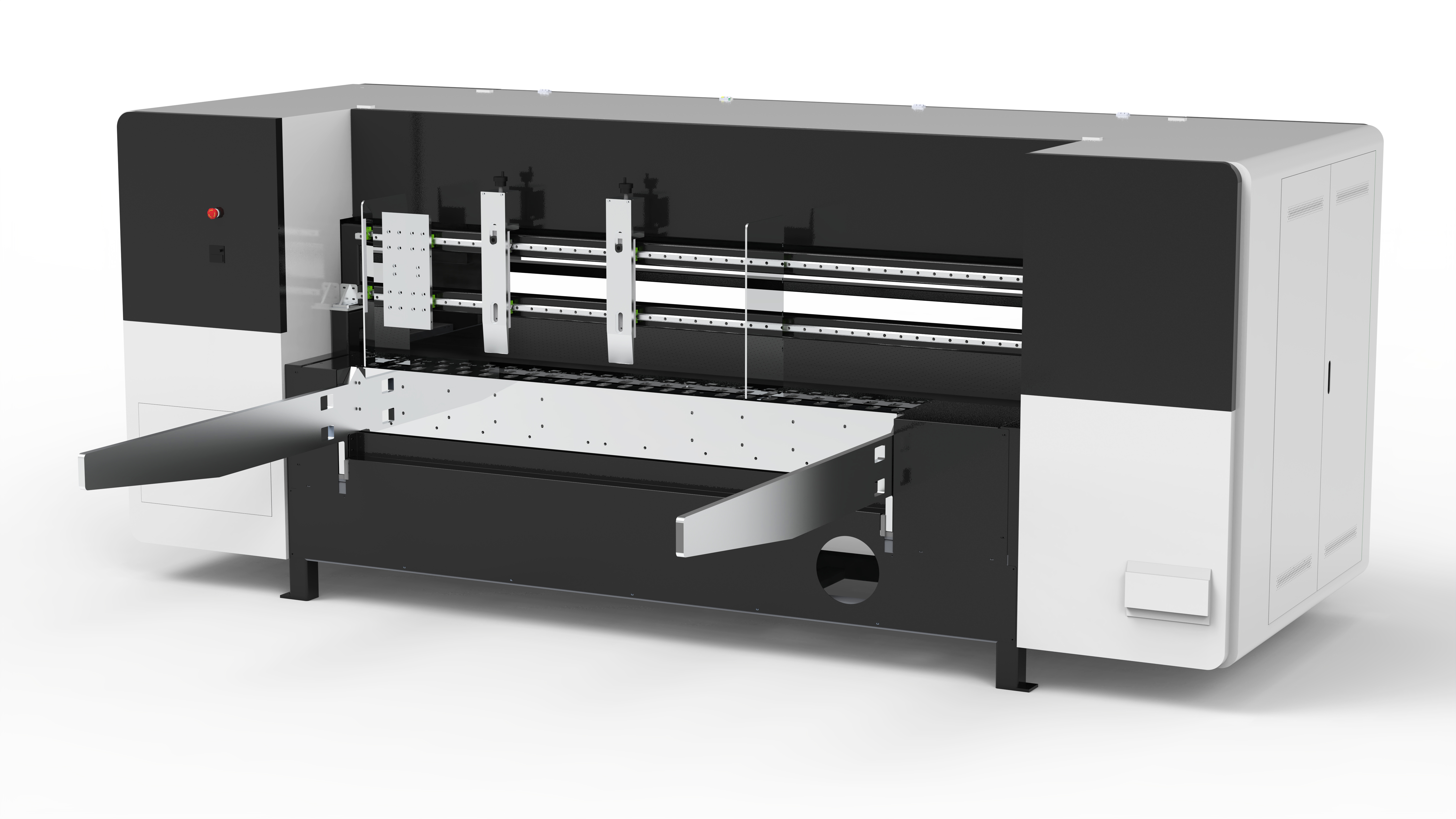
Industrial-grade printhead hardware is the shared component between direct-output and scanning modes; the mode differences sit in how the board and the head array move relative to each other.
One chassis, two imaging paths
Guangdong Goking Intelligent Technology Co., Ltd. (GOKING), established in 2020 and based in Dongguan, China, manufactures industrial-grade digital printers for corrugated and honeycomb cardboard. Its main products are single-pass and multi-pass 2-in-1 digital printing machines, including 5-color integrated models offered in multiple DPI configurations and with different nozzle sets.
The product description is specific about what the platform is: a plate-less digital printing machine for corrugated cardboard and cardboard packaging, intended for the printing and packaging industry, paper mills and coated paperboard converters, built as a 2-in-1 multifunctional digital printing machine with different DPI that supports both single-pass and multi-pass printing. In single-pass configuration it runs a XAAR printhead; in multi-pass configuration it runs Epson or Xaar nozzles.
Mechanically, the two modes differ in one fundamental way. Multi-pass imaging builds the image over successive passes of a printhead carriage across the board. Single-pass imaging builds the image in one continuous movement of the board beneath a fixed head array. Almost everything else is shared: ink chemistry, substrate handling, drying, colour management and the operator interface. That sharing is exactly why the mode decision is a production-planning decision rather than a purchasing one.
The published configuration envelope covers 8 to 256 printheads, print widths from 264 mm to 2600 mm, colour mode CMYK(W), material thickness from 2 mm to 30 mm, and a rated power of approximately 14 kW on a 380V three-phase supply. Those numbers matter less as specifications than as boundaries — they define the population of jobs the machine can accept in either mode.
Scanning mode: where detail and large-format boards are decided
Scanning mode is the configuration buyers associate with premium packaging, gift boxes, proofing and artwork that cannot afford to lose edge definition. Because the image is deposited in stages rather than in a single transit, a pattern that would be marginal in one pass has more opportunities to resolve. For corrugated board, where surface topography is uneven and ink absorption varies across the sheet, that staged deposition is a quality lever, not just a speed penalty.
The platform publishes a minimum digital text height of 1.5 mm for English characters. That figure is a practical reference for anyone specifying barcodes, warning text, legal copy or fine decorative line work on a corrugated box, because it tells the buyer where the machine's stated resolution stops being an abstract claim and starts being a design constraint.
Build quality matters disproportionately in this mode. GOKING lists a magnetic levitation high-precision crossbeam, servo motor drive and Schneider electrical components as part of the machine's construction. Scanning quality depends on carriage repeatability more than on headline speed, so the rigidity and control of the motion system is what determines whether successive passes align. The RIP is also specified to support direct printing without converting image files, which shortens the path from an approved artwork file to a printed proof.
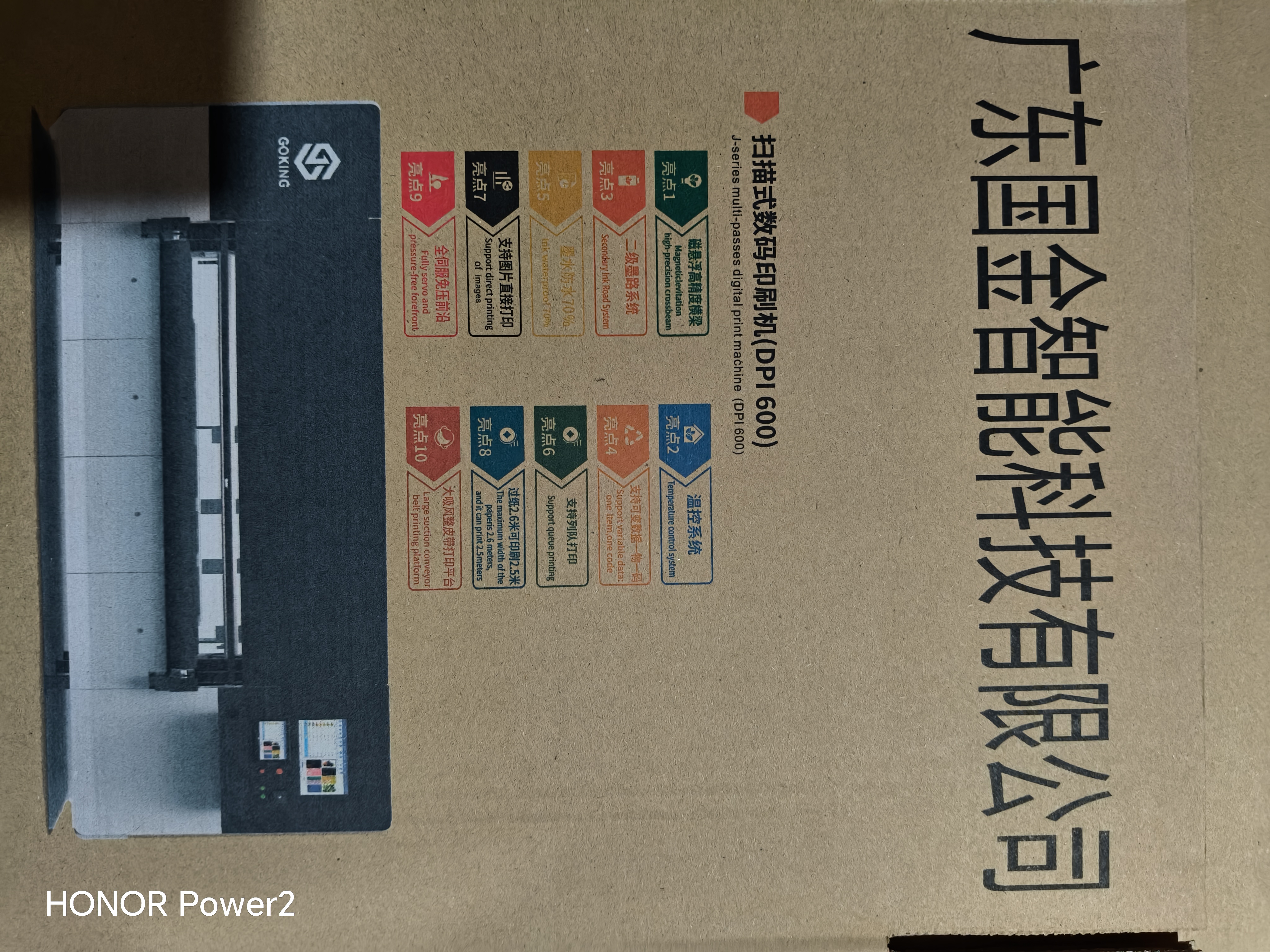
Fine patterns and machine-readable codes are the clearest test of scanning-mode registration; they fail visibly when pass-to-pass alignment drifts.
Where scanning mode earns its place
- Complex artwork on large-format boards, where image fidelity is the reason the job is being printed digitally at all.
- Jobs with frequent artwork changes, because the plate-less workflow removes plate cost from every changeover.
- Sample validation and pre-production proofing before a batch is released.
- Coated paperboard and higher-value packaging where surface finish is inspected under light.
Where scanning mode should not be forced
- Long repeat runs where the machine is being used as a throughput asset rather than an imaging asset.
- Standardised work where the buyer's measurable cost driver is metres per hour, not dots per inch.
Direct-output mode: where small boards and batch orders are decided
In single-pass configuration the board travels once beneath the head array, so throughput is governed by feed cadence and drying, not by how many passes the carriage can make. GOKING's published figures put single-pass printing speed at 60 m/min with an Epson nozzle reference and at least 100 m/min with a XAAR nozzle, with production efficiency quoted across the machine family at 700 / 1500 m²/h depending on configuration.
The printhead choice is not cosmetic. Xaar industrial-grade printheads referenced in GOKING's product literature, including the Xaar 5601 and 1003 series, use internal ink circulation behind the nozzles, described as reducing clogging and supporting stability during prolonged high-speed production. For a plant running long shifts, that difference shows up as achieved speed rather than rated speed — and achieved speed is the only figure that appears in a costing sheet.
Direct output suits small boards that can be presented at a stable cadence and batch orders with repeat artwork. Its economic logic is volume continuity: the mode rewards a plant that can keep the line fed with consistent, flat board and let the drying and receiving sections keep pace. The moment jobs start changing every hour, the cadence advantage erodes and the scanning mode begins to look more sensible for the same machine.
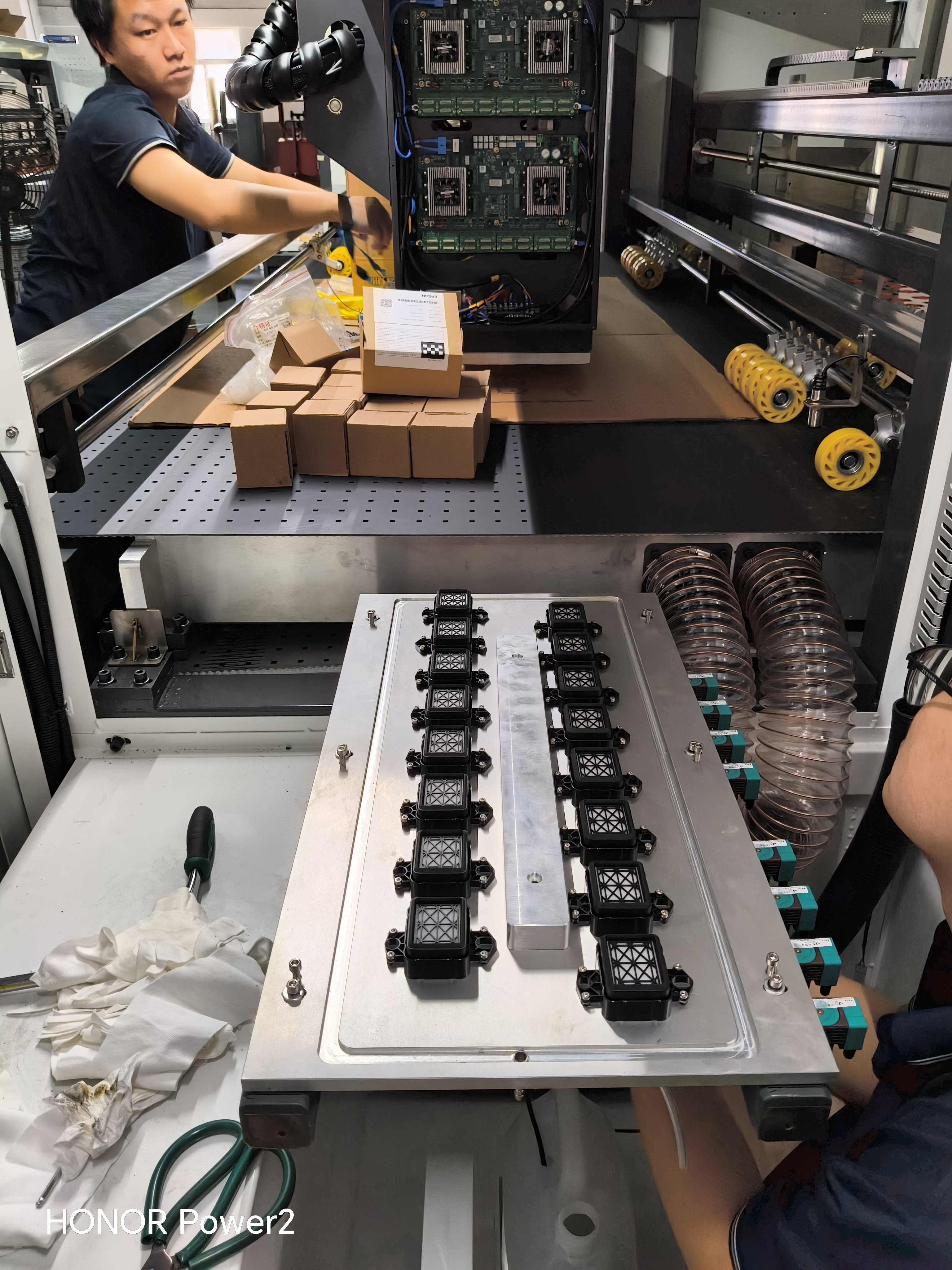
Head count is one of the few genuinely scalable variables in the purchase: the published range runs from 8 to 256 printheads, so throughput can be specified to the order book rather than to a brochure.
Mode comparison at a glance
| Decision dimension | Scanning (multi-pass) mode | Direct-output (single-pass) mode |
|---|---|---|
| Imaging logic | Image built over successive carriage passes | Image built in one continuous board transit |
| Printhead reference | Epson or Xaar nozzles | XAAR printhead |
| Published speed reference | Lower throughput by design; efficiency quoted across the family at 700 / 1500 m²/h | 60 m/min with Epson nozzle reference; at least 100 m/min with XAAR nozzle |
| Best-fit work | Complex, detailed, large-format boards; proofing; frequent artwork change | Small boards and repeat batch orders with stable feed |
| Constraint that governs output | Carriage repeatability and registration | Feed continuity, drying and receiving cadence |
| Changeover behaviour | Plate-less, so artwork change carries no plate cost | Mode switching supported on the same integrated platform |
Vacuum adsorption and feeding: the part buyers underrate
The platform uses vacuum adsorption, and GOKING's build includes a large suction conveyor belt printing platform. This is not a minor accessory. Corrugated board is not naturally flat, and any residual curl or lift changes the head-to-surface distance, which in turn changes dot placement. Holding the sheet flat and in register is the physical precondition for multi-colour registration in both modes.
Feeding is configured as leading-edge feed or belt feed, with the leading edge available in semi-automatic or fully automatic form. In practice, this is where the mode decision becomes operational. Single-pass throughput depends on a continuous, stable feed cadence; the same vacuum platform that supports high-speed direct output also supports the more forgiving cadence that scanning mode allows. A plant that expects to alternate between modes should specify feeding automation accordingly, because manual presentation flattens the advantage of the fast mode.
Turnkey delivery can include automatic lead-edge feeding, magnetic levitation hoisting, automatic scanning-to-print switching, direct output, a receiving rack, a voltage stabiliser, a humidifier, a computer, a temperature control system and a toolkit with consumable spare parts. The inclusion of automatic scanning-to-print switching is the detail that makes the 2-in-1 claim operational rather than theoretical; without it, the second mode is a capability that nobody schedules.
Ink delivery is likewise shared: two ink supply paths and a fully enclosed ink supply channel, with ink options covering water-based dye ink, water-based pigment ink, coating ink and UV eco-friendly ink. For corrugated work, the published drying note is that drying follows printing for carton stock, with other materials treated according to their own characteristics.
What the market data says about the mode split
The direction of travel favours both modes simultaneously, which is the strongest argument for a hybrid platform. Grand View Research values the global digital printing market at USD 38.0 billion in 2023, projected to reach USD 57.0 billion by 2030, with the inkjet segment holding the largest technology share at 48.4% in 2023. Within that, Reports and Data sizes the single-pass digital printing machine market at USD 3.2 billion in 2024, projected to reach USD 6.5 billion by 2034.
The demand pull is coming from packaging. MarketsandMarkets expects the digital printing packaging market to reach USD 46.2 billion by 2029 from USD 30.2 billion in 2024, and Market Research Future places Asia-Pacific at approximately 41.6% revenue share of the digital printing market in 2025. Variable data printing is also shifting the economics of short work: Market Research Future notes that runs under 3,000 units became economically viable in 2024 in cases that were previously cost-prohibitive.
How the 2-in-1 approach compares with plate-based printing
Against plate-based processes, the plate-less architecture removes the plate itself from the cost equation. Every artwork change on a conventional line consumes plates and setup time; on this platform, artwork change is a file operation, which is why short runs, urgent orders and personalised work become viable rather than marginal. The same logic applies to sample validation: a proof can be produced without committing to a plate set.
The limitation is real and worth stating plainly. Where artwork is stable and volumes are very long, plate-based processes spread their setup cost across a large run and typically remain the lower unit-cost route; the digital advantage narrows as run length grows and repeat frequency falls. The platform's published material range of 2 mm to 30 mm thickness is a second boundary: board outside that envelope sits outside the stated specification, and no amount of mode switching changes it. A buyer should test both boundaries against their own order book rather than against a demonstration job.
Boundaries to verify before committing
- Substrate envelope. Material thickness is published at 2–30 mm, with corrugated and honeycomb cardboard named in the manufacturer's scope alongside paper mill and coated paperboard applications.
- Width configuration. Print width spans 264 mm to 2600 mm depending on the configuration ordered; the widest board a plant actually runs should drive that choice.
- Site conditions. The stated working environment is room temperature 15–32 °C at 70% humidity, which is why a humidifier appears in the turnkey equipment list. In dry or highly variable climates this is a real operating cost, not a footnote.
- Power and footprint. Rated power is approximately 14 kW on 380V, 50/60 Hz three-phase; the machine measures 4260 × 2300 × 1900 mm and weighs 2800 kg, so floor loading and access routes should be checked before delivery.
- Ink and market compliance. Water-based dye, water-based pigment, coating and UV eco-friendly inks are all listed options. Buyers shipping into regulated markets should confirm ink chemistry against destination requirements; the U.S. EPA declared certain PFAS chemistries used in UV inks hazardous in April 2024, which is a formulation question worth raising with any supplier.
- CE documentation. For EU-bound equipment, machinery risk assessment follows EN ISO 12100 and electrical equipment follows IEC 60204-1 (EN 60204-1). These are the two standards a compliance file is normally built around.
What comes next for hybrid print platforms
Two trends are likely to shape the next buying cycle. The first is architectural: Market Research Future notes that hybrid digital-offset printing architectures are attracting R&D focus from major players such as Heidelberger Druckmaschinen, which suggests the industry consensus is converging on machines that hold more than one production logic — the same premise the 2-in-1 design applies at the corrugated end of the market.
The second is component scalability. With head counts configurable from 8 to 256 and print widths from 264 mm to 2600 mm, the practical question for a buyer is no longer whether a platform can be specified to their current order book, but whether it can be re-specified as that order book changes. Water-based pigment ink adoption, referenced by Custom Market Insights as a significant portion of the eco-friendly digital printing segment in 2024, points in the same direction: the ink decision is becoming as strategic as the head decision.
For plants in GOKING's stated export markets — the EU, Africa, Latin America, Russia, Kazakhstan and Turkey — that combination of scalability and ink flexibility is likely to matter more than any single speed figure, because it determines how many years of order mix the asset can absorb.
FAQ
What is the difference between single-pass and multi-pass mode on a 2-in-1 digital printing machine?
In single-pass mode the board passes once beneath a fixed printhead array and the image is formed in one continuous movement. In multi-pass mode a carriage passes over the board repeatedly and the image is built up over successive passes. On the GOKING 2-in-1 platform the single-pass configuration uses a XAAR printhead, while the multi-pass configuration uses Epson or Xaar nozzles, and both are supported on the same machine with multiple DPI configurations.
Which mode is better for large-format or complex boards?
Scanning (multi-pass) mode is the appropriate default for complex artwork and large-format boards, because successive passes give the image more opportunities to resolve, and the machine publishes a minimum digital text height of 1.5 mm for English characters as a practical reference for fine copy. Direct-output mode is intended for small boards and repeat batch orders where feed cadence matters more than resolving fine detail.
What printhead options exist and how many heads can be configured?
The machine family supports 8 to 256 printheads, print widths from 264 mm to 2600 mm, and colour mode CMYK(W). Single-pass configurations use a XAAR printhead; multi-pass configurations use Epson or Xaar nozzles. Published production efficiency is quoted at 700 / 1500 m²/h across configurations, with single-pass speed references of 60 m/min for the Epson nozzle and at least 100 m/min for the XAAR nozzle.
Which substrates and thicknesses are supported?
The platform is intended for corrugated cardboard and cardboard packaging, is described in the manufacturer's scope as covering corrugated and honeycomb cardboard, and is applied in the printing and packaging industry, paper mills and coated paperboard work. Published material thickness is 2–30 mm. Ink options are water-based dye ink, water-based pigment ink, coating ink and UV eco-friendly ink, and printed graphics may be supplied in PDF, JPG, BMP or TIF format.
How do vacuum adsorption and feeding options affect output in each mode?
The platform uses vacuum adsorption on a large suction conveyor belt to hold board flat and in register. Feeding is configured as leading-edge feed or belt feed, with the leading edge available in semi-automatic or fully automatic form. In direct-output mode, throughput depends on a continuous and stable feed cadence; in scanning mode the same platform supports higher-fidelity output, where feed cadence is less critical than carriage repeatability.
What installation and compliance conditions should be planned for?
The stated working environment is room temperature 15–32 °C and 70% humidity. Power is 380V, 50/60 Hz three-phase at a rated power of approximately 14 kW, and the machine measures 4260 × 2300 × 1900 mm at a weight of 2800 kg. For CE-marked markets, machinery risk assessment follows EN ISO 12100 and electrical equipment follows IEC 60204-1 (EN 60204-1).
Closing note
The single-pass versus multi-pass question is often framed as a speed-versus-quality trade-off. On a genuinely integrated 2-in-1 platform it is better framed as a scheduling question: which share of the order book needs detail and which share needs cadence, and does the machine's feeding, vacuum platform and mode-switching behaviour allow both shares to be served without rebuilding the line. Buyers who answer that question before they specify head count tend to end up with a machine that is busy in both modes rather than excellent in one.
GOKING's 2026 product catalogue, which sets out the configuration matrix across printhead counts, widths and speeds, is available here: 2026 product catalog (PDF).
Have Questions or Need More Details?
Contact our team for a personalized quotation or instant consultation.
Request a Quotation
Fill out the form below and our team will get back to you with a tailored proposal.
WhatsApp Direct Chat
Prefer to chat in real-time? Message us on WhatsApp for instant assistance & quick answers.
- Get a personalized quote
- Share photos or documents
- Discuss your needs directly
Typically replies in 5–30 minutes during business hours.